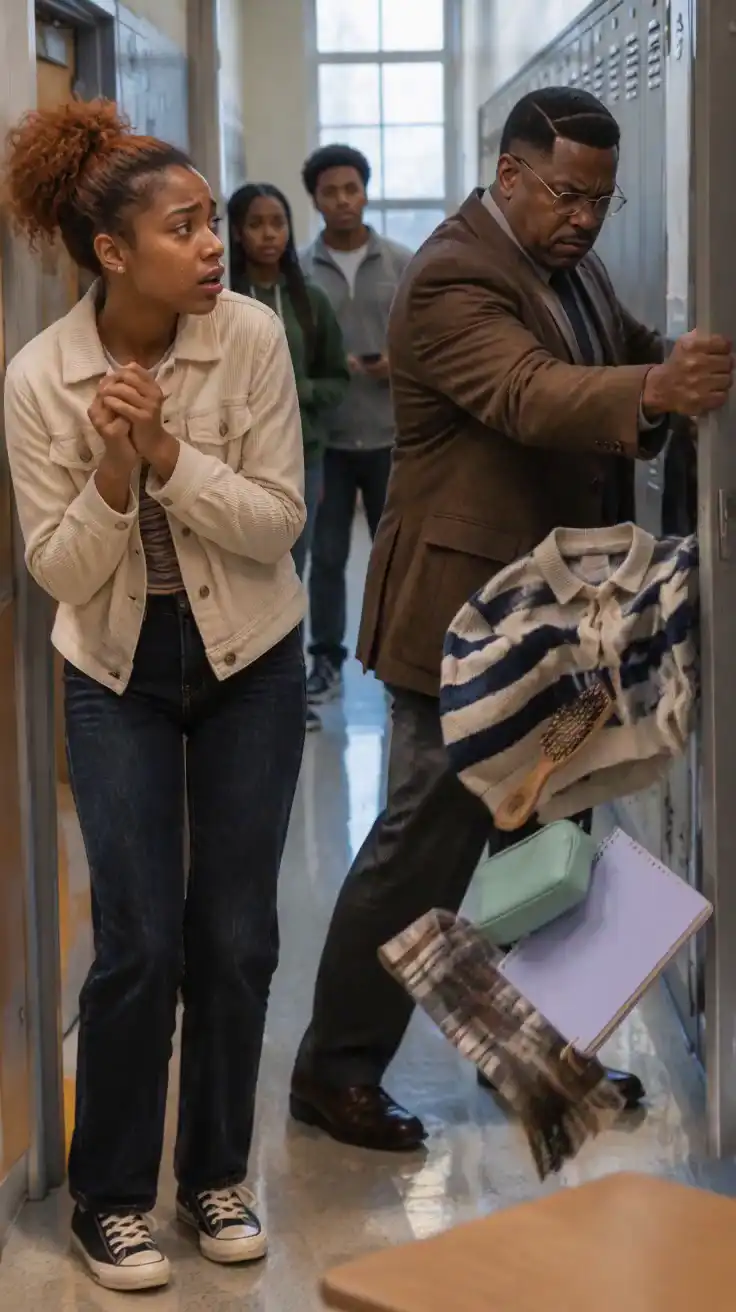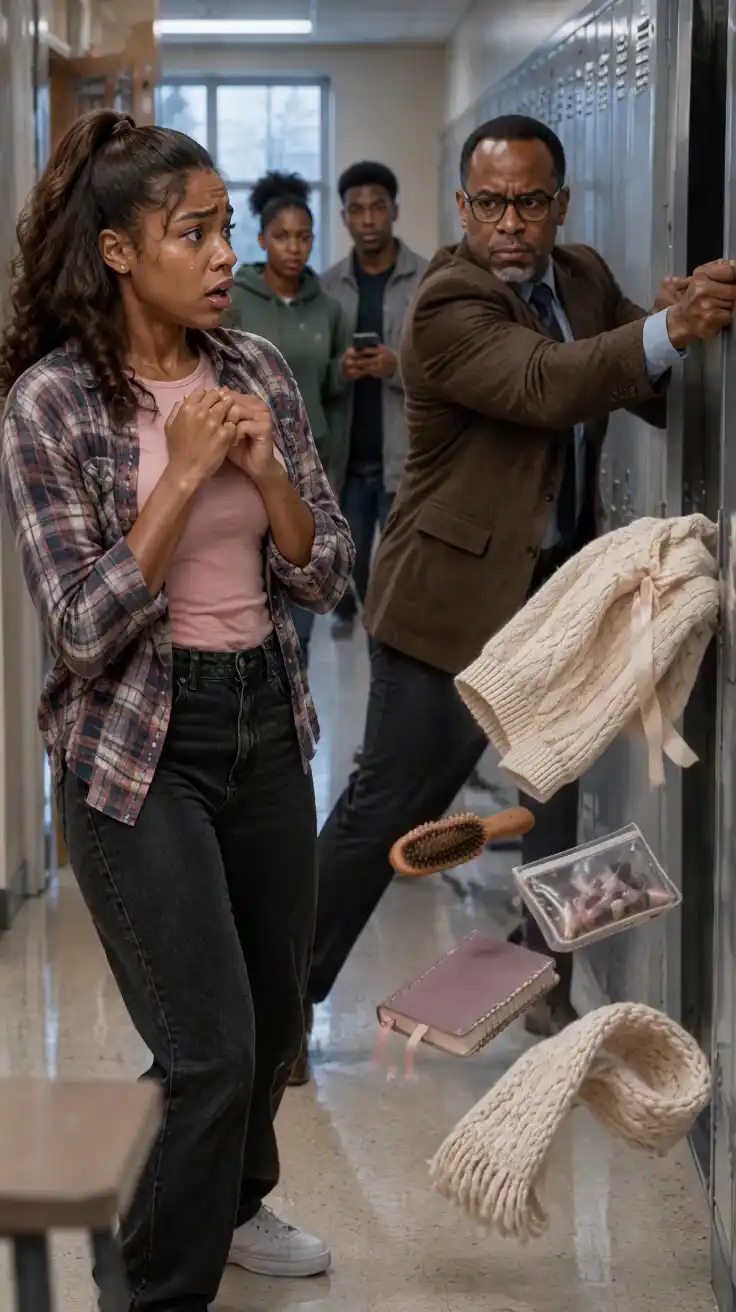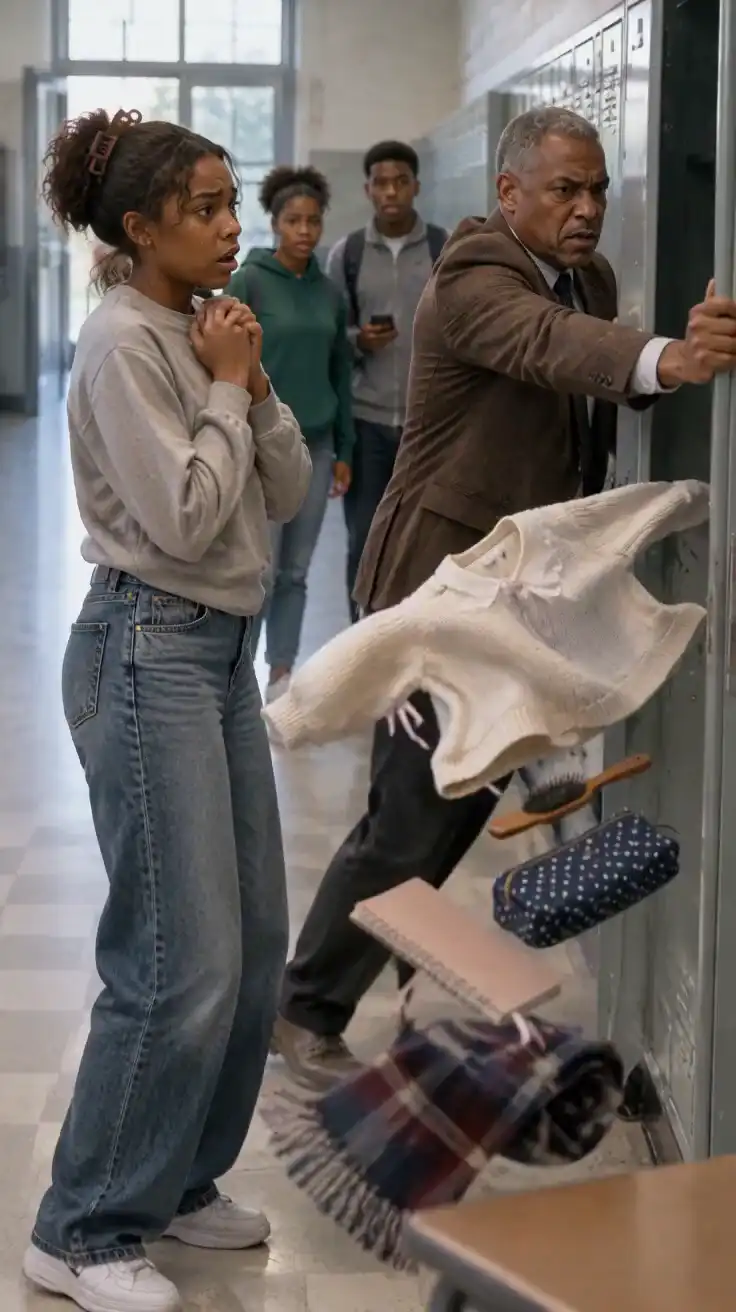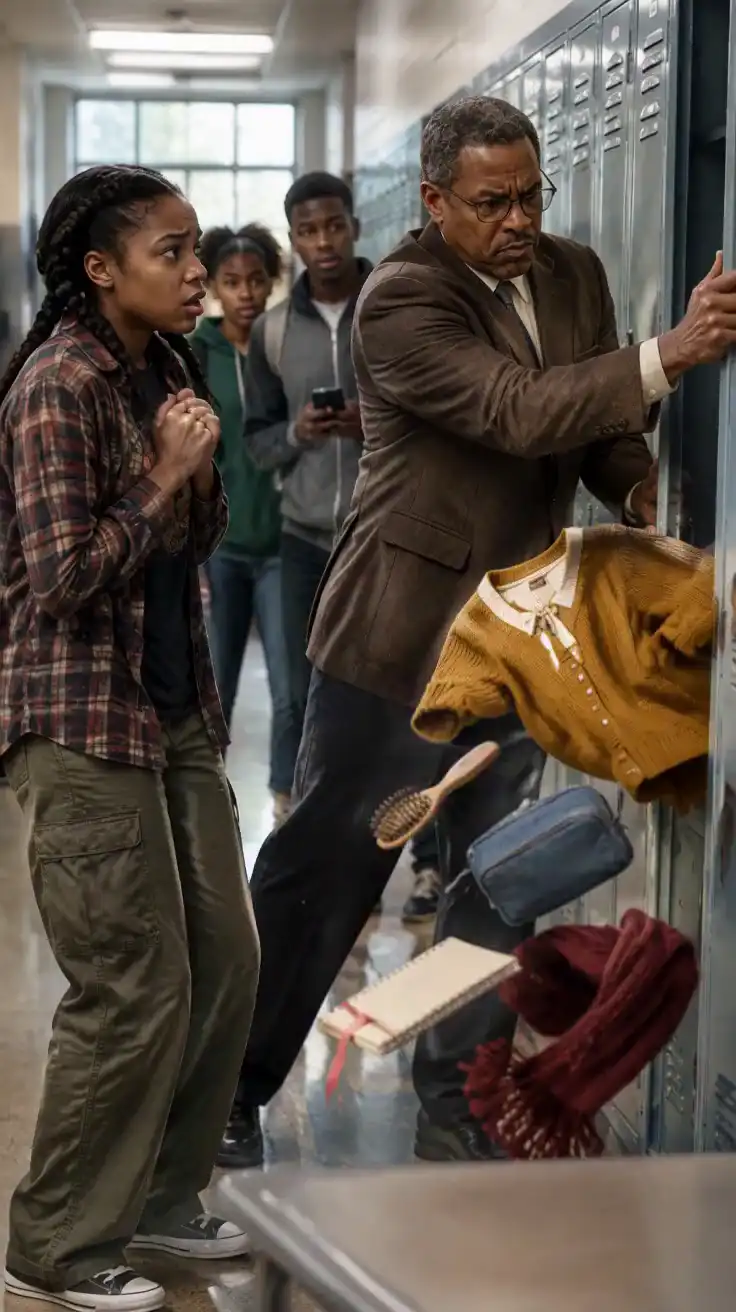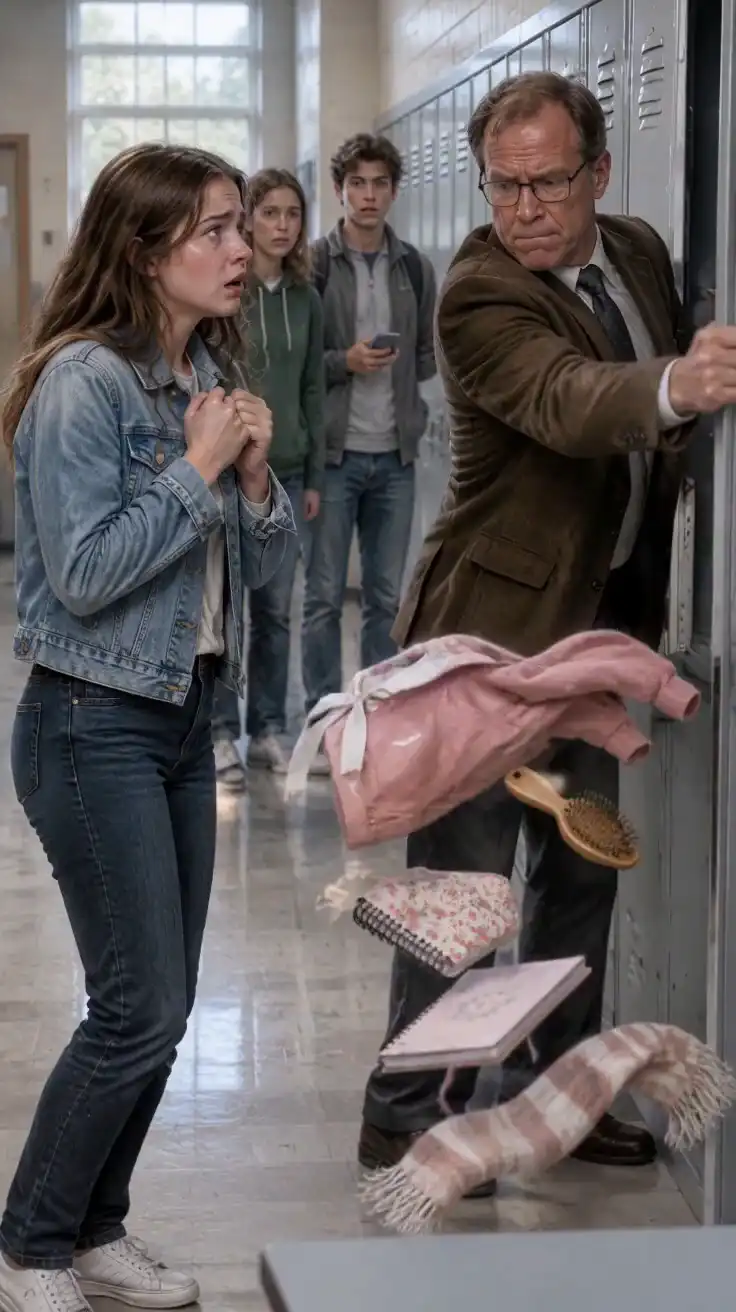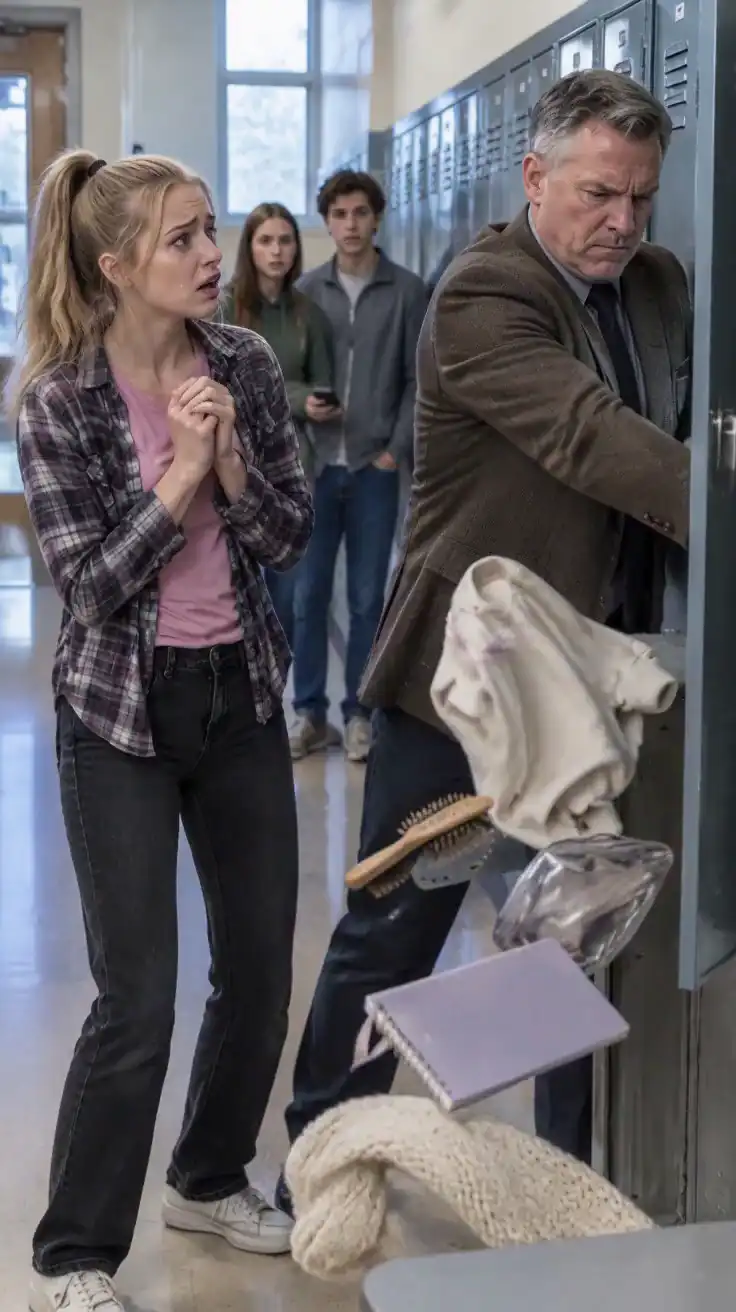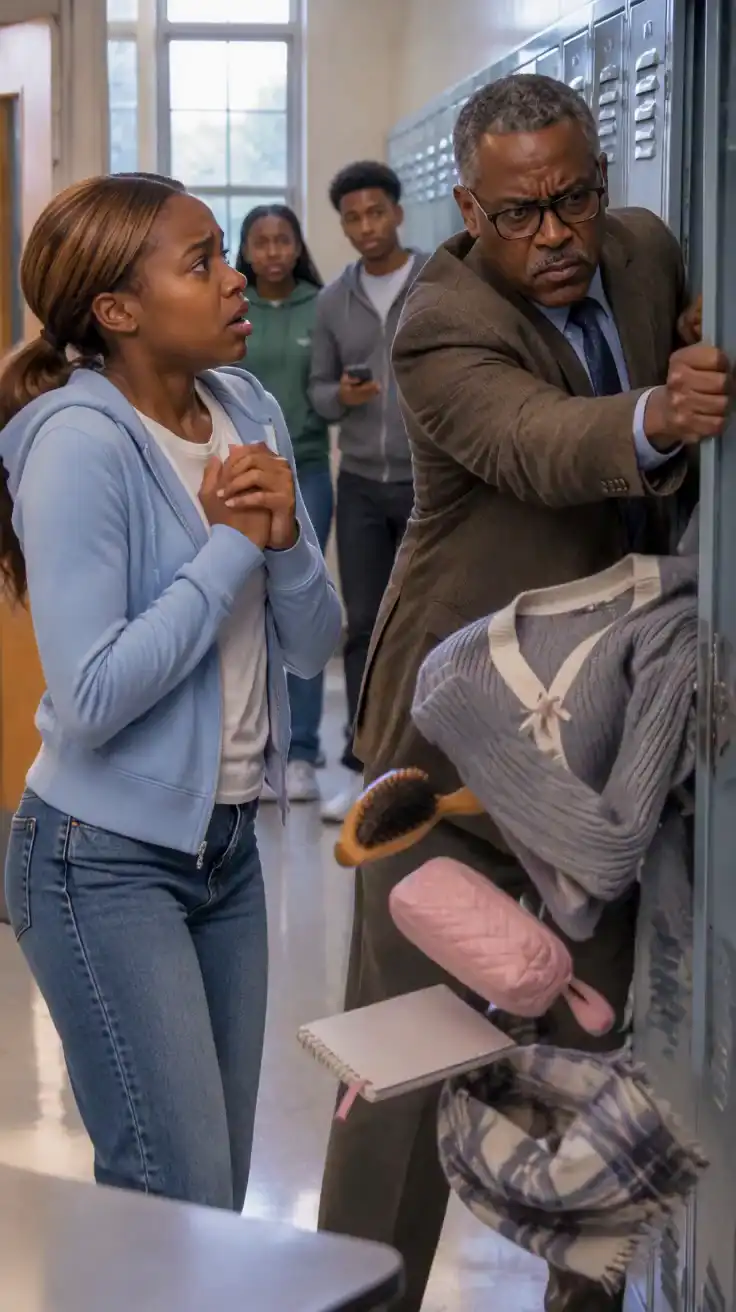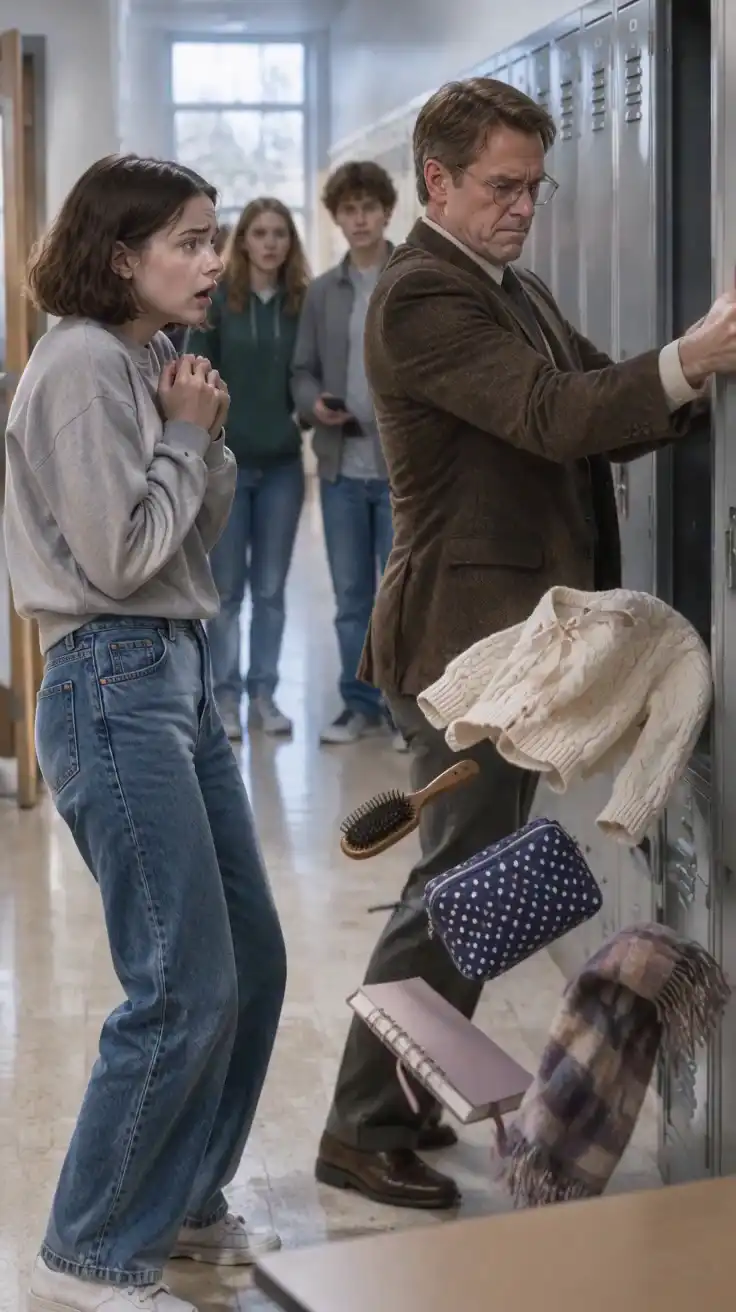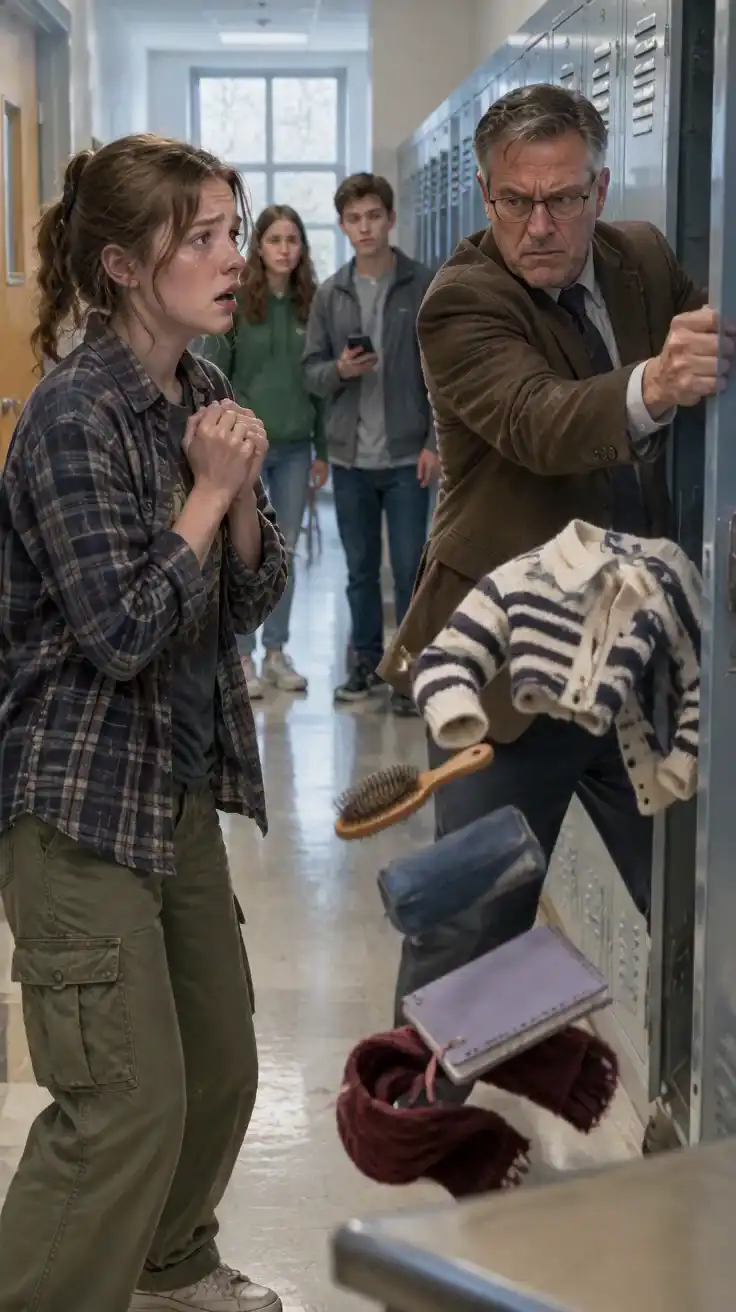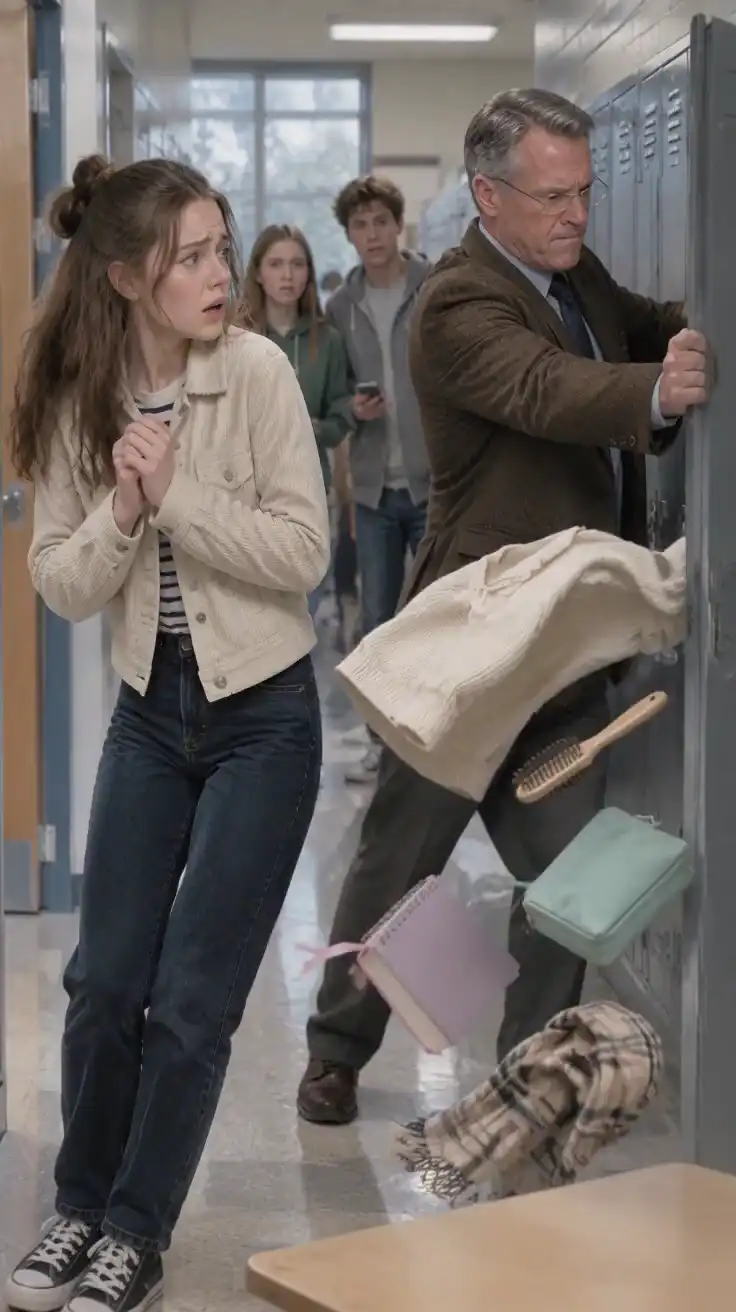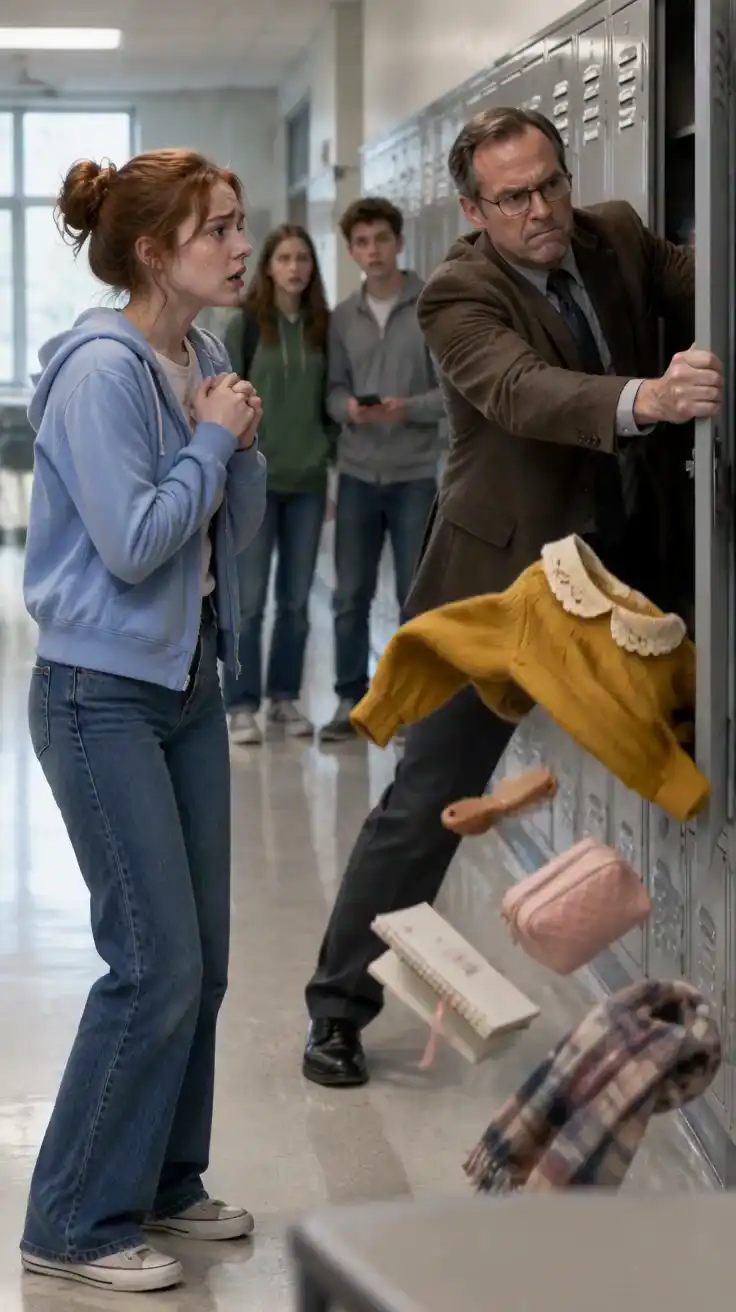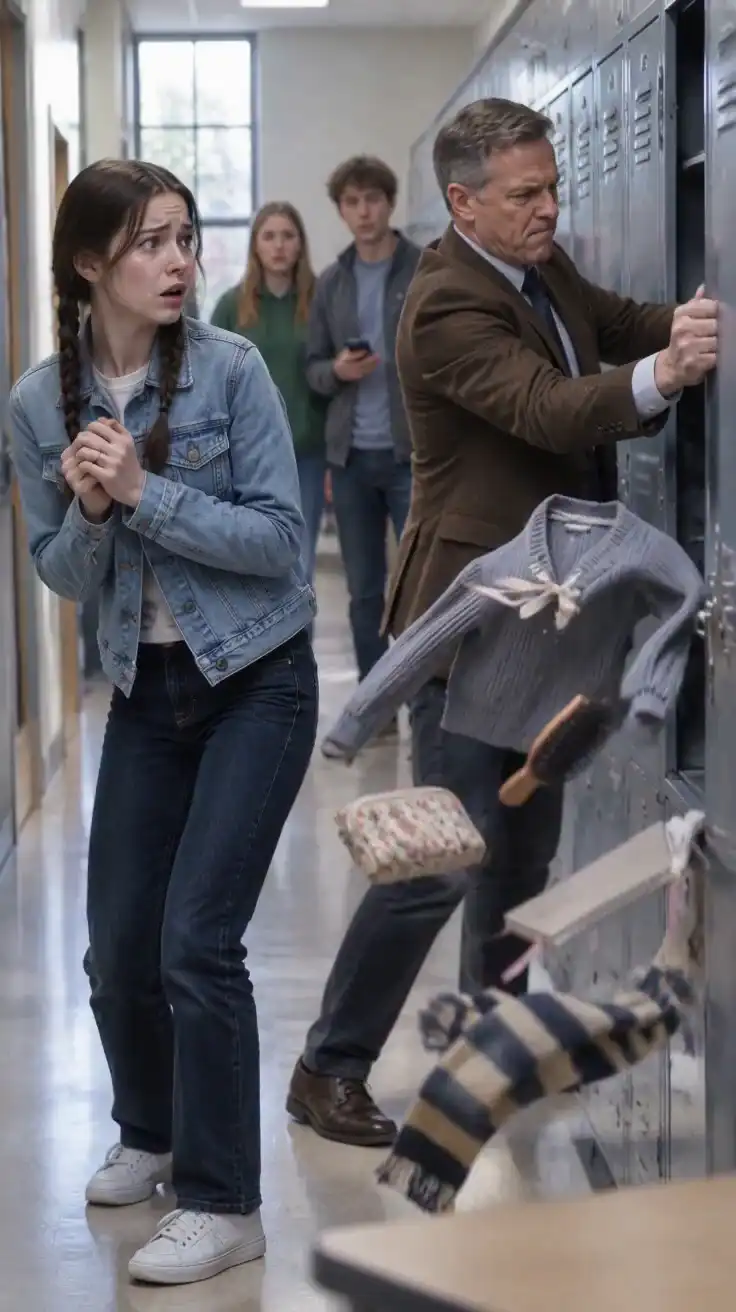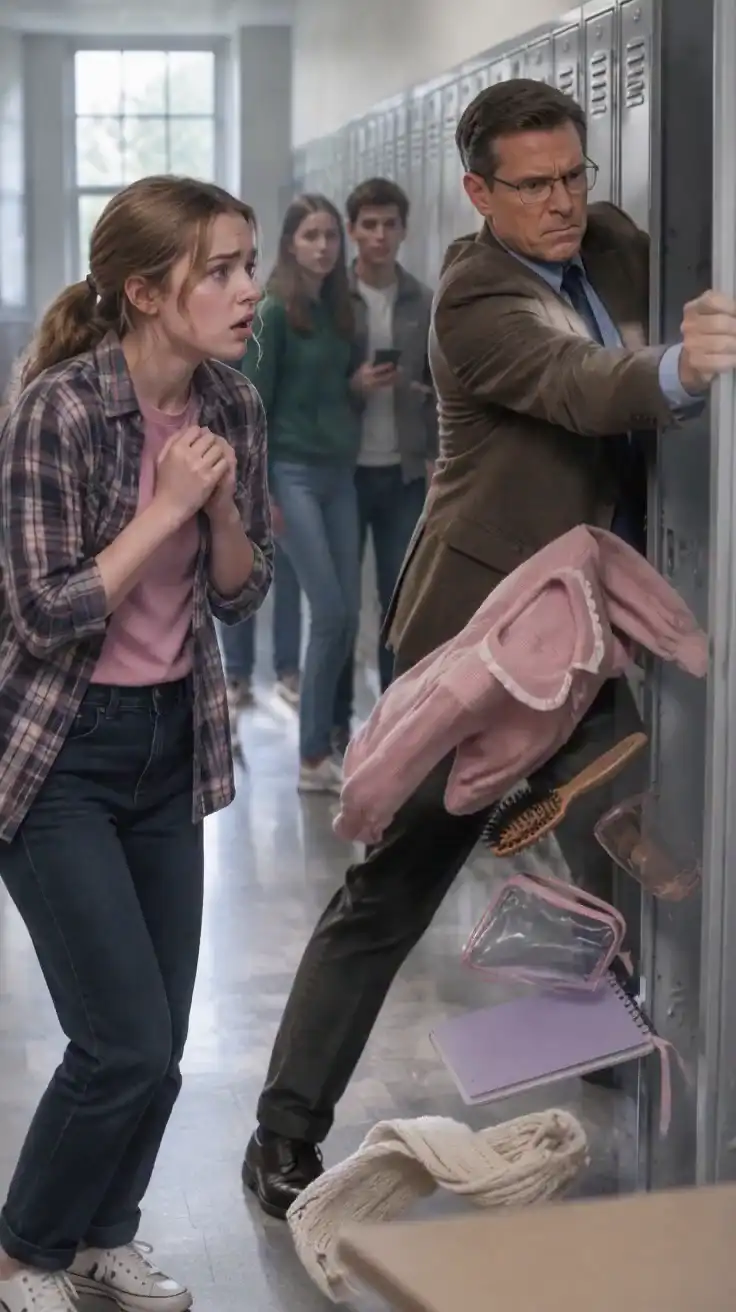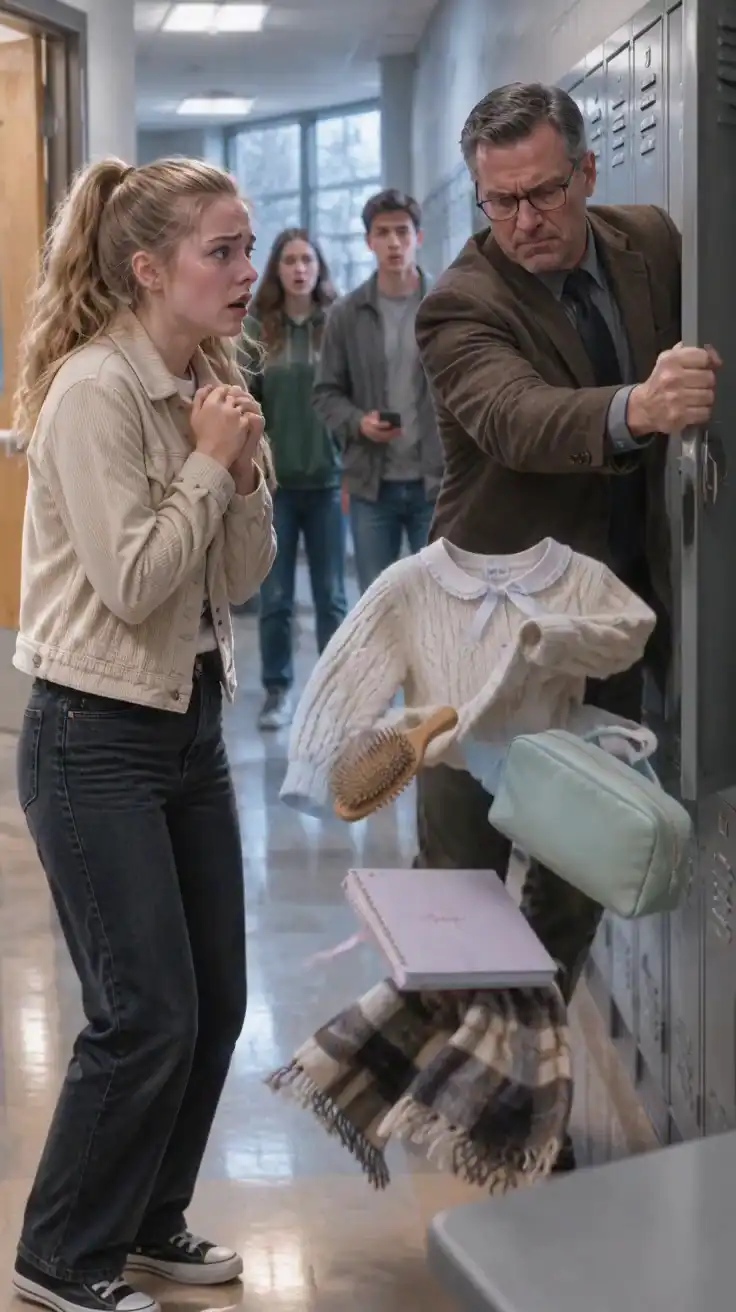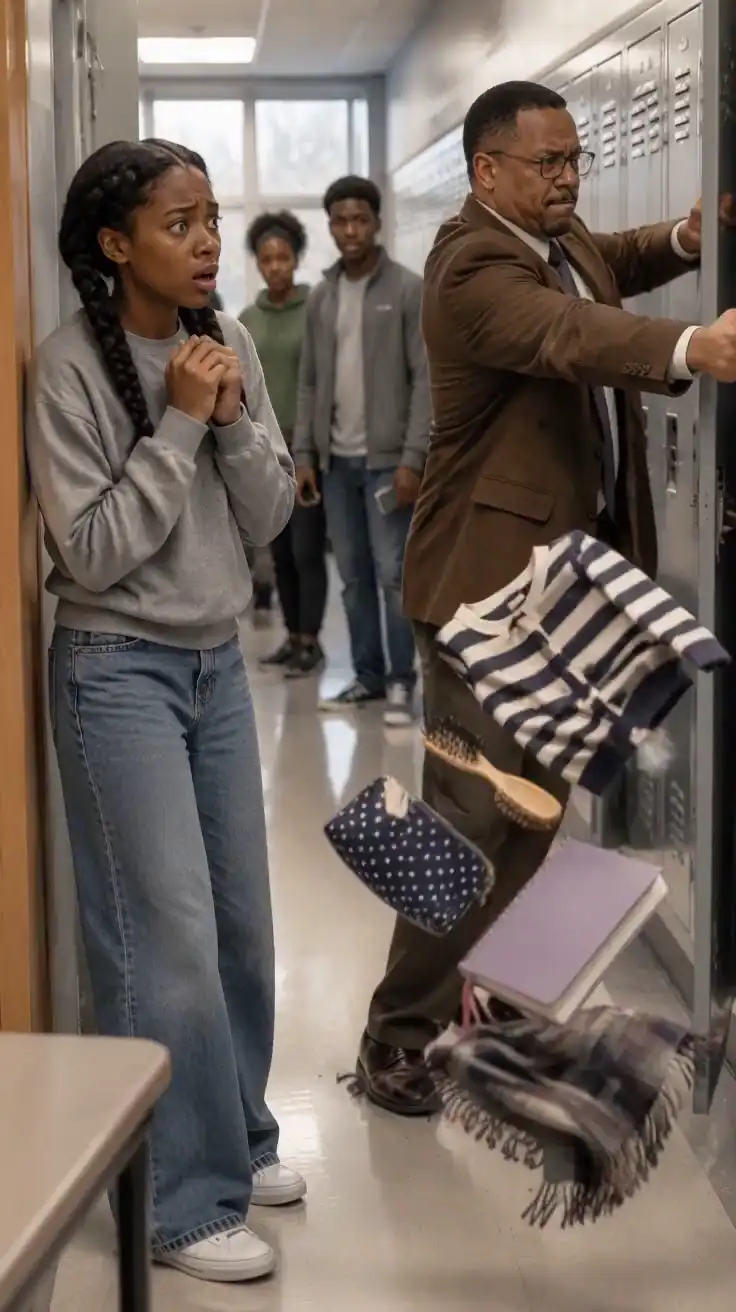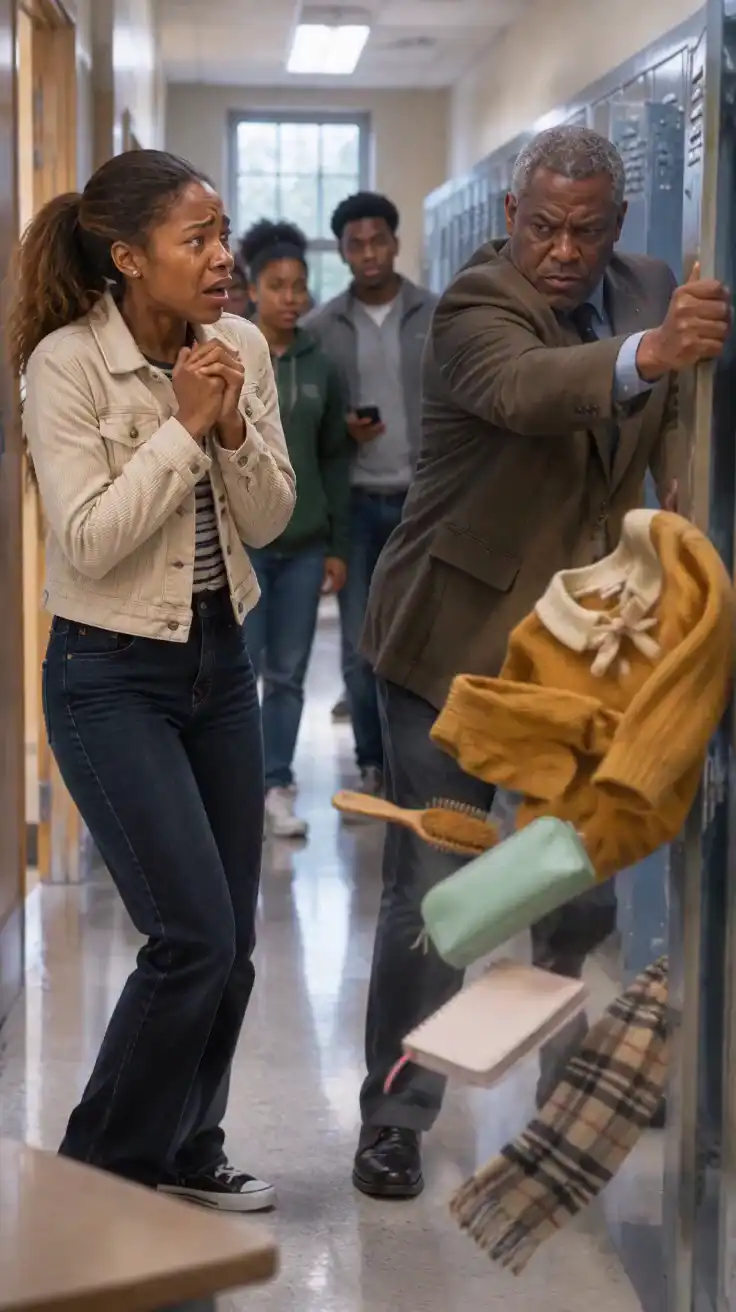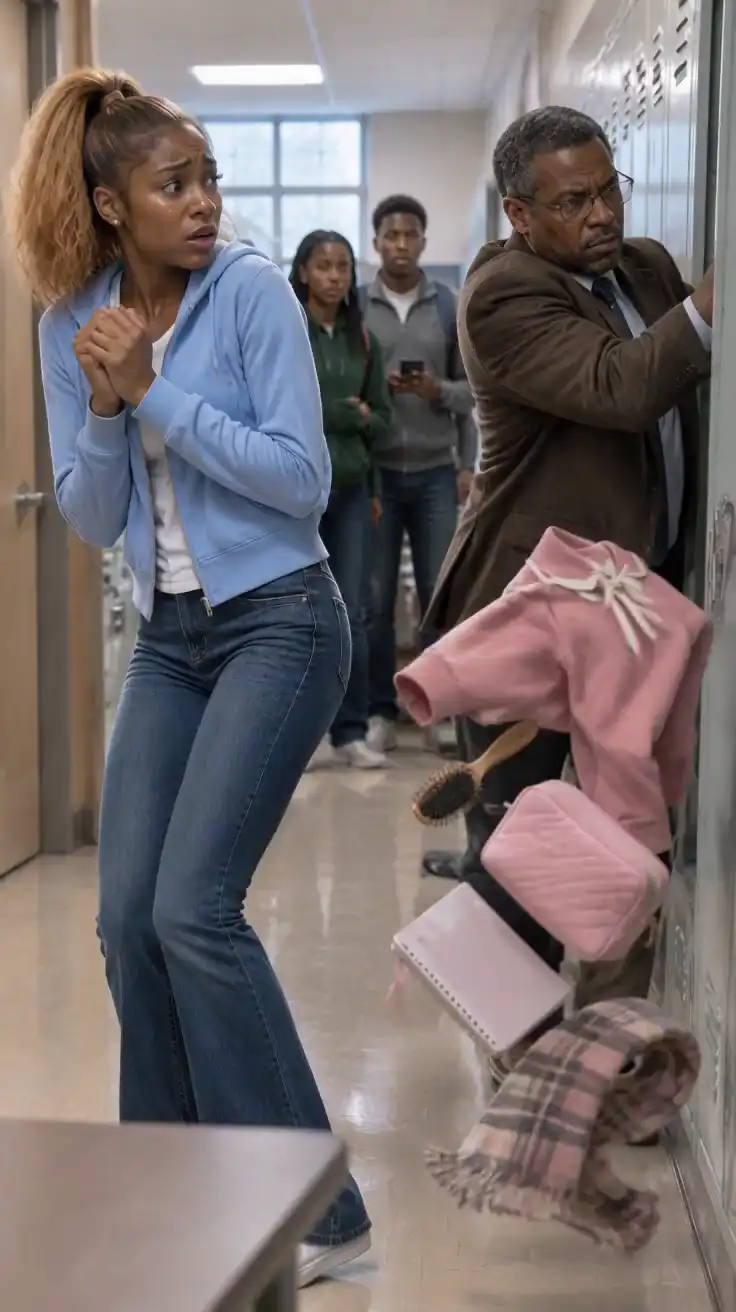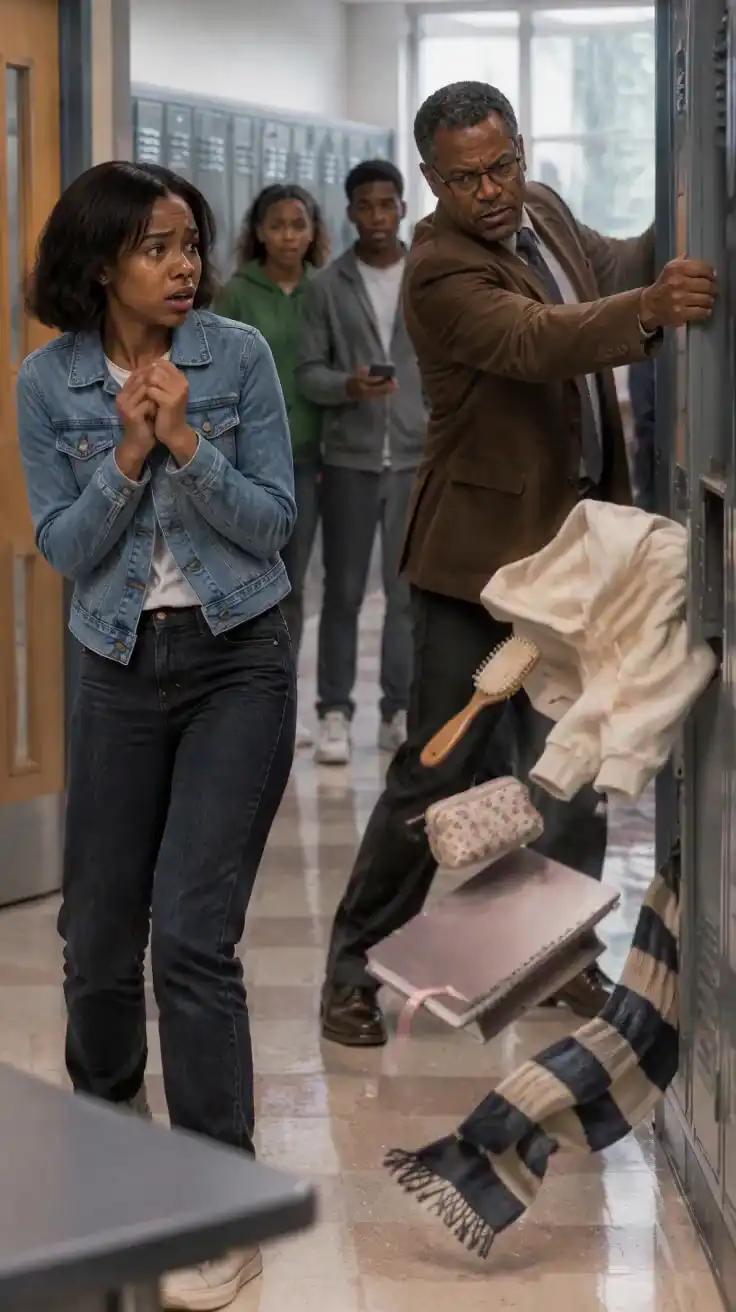
The dean turns his eyes toward the accuser, and the gold bracelet strikes the tile.
For one second, nobody moves.
Then the girl grabs at her sleeve.
“Don’t,” the dean says.
His voice is not loud, but it stops her. She freezes with her hand halfway to the bracelet. My niece is still on her knees. One of her notebooks has opened beside her, and a page of chemistry equations is bent under the heel of somebody’s shoe.
The girl who accused her is named Madeline Price. Everyone calls her Maddie. I learned that later, though I had heard the name before. She and my niece, Nia, had been lab partners all semester. They had worked together twice a week at the long black tables in the science room, where the stools had metal legs and the sinks always smelled faintly of bleach.
That afternoon, when the bracelet came out of Maddie’s sleeve, I knew only that her name was the one being shouted in the video.
I was standing in my sister Camille’s kitchen when I watched it. The video had been sent to me by a number I didn’t recognize. There was no message with it, only the file.
I had been cutting green beans at the counter. Camille was in the living room on the phone with the school, though at that point she thought the call was about Nia being accused of stealing. She had called me because she was driving home from work and didn’t want to be alone when she spoke to the dean. She had asked me to come over and sit with her.
The video was thirty-eight seconds long.
I watched it once without understanding what I was seeing. The second time, I noticed Nia’s face. The third time, I noticed the bracelet.
Then I called my sister.
She answered on the fourth ring.
“What happened?” she asked.
“You need to come back in the kitchen.”
“I’m already in the kitchen.”
She came around the doorway holding her phone. She was still wearing the navy blouse and black pants from the insurance office where she worked. Her hair had come loose from its clip on one side. She looked at me, then at the phone in my hand.
“What happened?”
I turned the video toward her.
She watched without speaking. When it ended, she held out her hand.
“Again.”
I played it again.
This time she covered her mouth before the bracelet appeared. When it struck the tile, she lowered her hand.
“That’s not hers,” she said.
“I know.”
“That’s Maddie’s bracelet?”
“I don’t know.”
“It’s not Nia’s.”
“I know that too.”
Camille looked toward the living room, where her purse sat on the coffee table. A stack of unopened mail leaned against it. She had left work early because the dean had called and told her Nia had been involved in “a serious theft allegation.” That was the phrase he used, according to her. Serious theft allegation.
She had been told to come to the school immediately.
By the time she got there, the school had already called her again and told her the situation had “changed.”
Changed was the word they used instead of explaining that an adult had emptied a fourteen-year-old girl’s locker onto the floor in front of a crowd.
Camille sat down at the kitchen table.
“What exactly did they say?” I asked.
She stared at the phone.
“They said Nia took a bracelet from Maddie. They said Maddie reported it during lunch. The dean asked Nia about it, and she denied it. Then he searched her locker.”
“She didn’t take it.”
“I know.”
“I mean, did she tell you that?”
Camille’s eyes moved to me.
“She said she didn’t take the bracelet.”
“That’s not what I asked.”
My sister leaned back in the chair. Her face changed, not because she doubted Nia, but because she remembered something.
“What?”
“I asked her this morning if she had taken money from my purse.”
The kitchen went quiet.
“What did she say?”
“She said no.”
Camille rubbed both hands over her face. “There was cash missing last week. Forty dollars. Then another twenty. I thought I had miscounted. I asked her this morning because I found a receipt in her backpack.”
“What kind of receipt?”
“From the drugstore. Makeup and a gift card.”
“And?”
“She said she didn’t know how it got there.”
I knew Nia well enough to know what that meant. It meant she had lied and hated herself for lying. Nia was not a child who could carry a lie comfortably. She became quiet around it. She stopped making eye contact. She would wash a dish that was already clean or fold a blanket nobody had asked her to touch.
Camille knew it too.
“She admitted it?” I asked.
“Not then.”
“But later?”
“Not yet.”
I watched the video again. Nia was on the floor, reaching toward the books that had fallen from her locker. Maddie was standing two feet away with one hand lifted, her finger aimed at Nia’s chest. The hallway behind them was crowded with students. Somebody was laughing. Somebody else was saying, “She stole it.”
“Why would Nia steal a bracelet?” Camille asked.
“She wouldn’t.”
“She took the money.”
“That doesn’t mean she took this.”
“I know what it means.”
“No, Camille. It means she did something wrong at home. It doesn’t turn her into the person everybody gets to accuse of everything else.”
My sister looked at me. She had tears in her eyes, but she refused to let them fall.
“I know,” she said again.
The school had sent the video to Camille because another student had recorded it. The student’s mother had gotten involved after seeing the clip on a group chat. She didn’t know us. She didn’t know Nia. She said she was sending it because “somebody ought to see what happened.”
The video was not the whole story, but it was enough to show that the bracelet had not come from Nia’s locker.
It came from Maddie’s sleeve.
The dean, Richard Halpern, had been searching the inside pocket of Nia’s backpack when Maddie started shouting that Nia had hidden the bracelet somewhere else. Nia told him to look in the locker. He did. Then he pulled out the shelves, opened her pencil pouch, unzipped the side pocket of her backpack, and turned everything onto the floor.
Maddie kept pointing.
When the bracelet slid out of her cuff, Halpern had looked down at it as if it were an answer to a question he hadn’t known how to ask.
He bent to pick it up.
“Is this the bracelet?” he asked Maddie.
She didn’t answer.
“Madeline, is this the bracelet you reported missing?”
Her mouth opened, but nothing came out.
Nia had looked from the bracelet to Maddie. She was still kneeling.
“It was in your sleeve,” Nia said.
Maddie’s eyes filled with tears.
“It got there when you grabbed me.”
“You didn’t grab me,” Nia said.
“You did.”
“I didn’t touch you.”
The dean stood up with the bracelet in his hand.
He had already decided who was guilty. That was clear from the way he had searched Nia’s locker. But now he was holding the evidence against the girl who had made the accusation.
“Where did you get this?” he asked.
Maddie shook her head.
“I don’t know.”
“Where did you get it?”
“I told you. She took it.”
“Then why was it in your sleeve?”
“I don’t know.”
The crowd in the hallway had gone almost silent. The students who had been watching Nia now watched Maddie. That shift was visible even through the shaky phone camera. Heads turned. A few students stepped back.
Halpern looked at Nia.
“Stand up.”
Nia did not move immediately. Her knees were red from the tile. Her hands were shaking. She looked at the mess around her, as if she had to remember which part of it belonged to her before she could leave.
“Stand up, Nia,” he said, softer this time.
She stood.
He looked at Maddie again.
“Come with me.”
“Where?”
“My office.”
“I didn’t do anything.”
“You reported a theft.”
“She stole it.”
“And it was found on you.”
“I didn’t put it there.”
“Then you can explain that in my office.”
Maddie began to cry.
That was when the dean suspended her.
Not after an investigation. Not the next morning. Not after calling her parents and gathering statements. He told her she was suspended from school pending an investigation into a false report and the attempted framing of another student.
The words were caught on the video because the student holding the phone followed them toward the office.
“Effective immediately,” Halpern said. “You are not permitted to return to campus until your parents have met with me.”
Maddie’s crying became louder.
“You can’t suspend me,” she said.
“I can, and I am.”
“My mom is going to kill me.”
“Your mother will be contacted.”
“I didn’t steal anything.”
“Then you should have reported that to begin with.”
Nia was standing beside the ruined contents of her locker, holding her chemistry notebook against her chest. She had not said anything else.
Halpern turned to her.
“Nia, you are not suspended. You may gather your things.”
He said it as though he were offering a kindness.
But the video showed what had already happened. It showed her kneeling in front of a crowd. It showed her being ordered to empty her belongings. It showed the accusation before it showed the truth.
A sentence does not erase the moment before it.
When Camille and I arrived at the school, Nia was sitting in a small conference room with the counselor, Mrs. Alvarez. The room had a round table, four chairs, and a poster about making healthy choices taped crookedly to the wall. Nia was wearing the same gray sweatshirt she had worn in the video. Her hair was pulled into a puff, but several curls had come loose around her face.
She stood when we entered.
My sister crossed the room in three steps and wrapped her arms around her.
Nia held herself stiffly at first. Then she folded into Camille’s shoulder.
“I’m sorry,” she said.
Camille pressed her face into Nia’s hair.
“Are you hurt?”
“My knees hurt.”
“Anything else?”
“No.”
“Did he touch you?”
“No.”
“Did anybody touch you?”
“Maddie grabbed my arm before the video started.”
The counselor looked at me.
“Her arm is red,” she said. “We documented it.”
I looked at Nia’s left forearm. There were four faint marks near her elbow. Finger marks. They were already fading.
“Why did you apologize?” I asked.
Nia did not look at me.
“Because I should have told Mom about the money.”
Camille pulled back.
“What?”
Nia’s eyes filled.
“I took it,” she said. “I took the money.”
My sister closed her eyes.
“How much?”
“I don’t know.”
“How much, Nia?”
“Sixty dollars. Maybe more.”
“Maybe?”
“I took forty first. Then twenty. I thought it was forty, but there was another ten in the envelope.”
Camille sat down hard in one of the chairs.
The counselor moved toward the door and shut it. Outside, we could hear students passing through the hallway.
“Why?” Camille asked.
Nia’s voice was barely audible.
“Maddie said I needed to help pay for something.”
“What something?”
Nia twisted the sleeve of her sweatshirt.
“Maddie had taken her mom’s bracelet.”
The room seemed to narrow.
I looked at Nia.
“What do you mean, taken?”
“She stole it.”
“From her mother?”
Nia nodded.
“Tell us what happened,” Camille said.
Nia sat beside her. I sat on the other side. Mrs. Alvarez remained near the door, giving us space but not leaving.
Nia took a breath.
“It started last week. Maddie said her mom had a gold bracelet in a jewelry box. She said it was worth a lot, but her mom never wore it because it was from her grandmother and the clasp was broken.”
“Why was she talking to you about that?” I asked.
“We were doing our lab report. She was upset because her mom had found out she was failing algebra.”
Nia explained that Maddie had been staying after school several days a week to make up assignments. She had told Nia that her mother was going to take away her phone and stop her from going to a friend’s birthday party. Maddie said she needed money for a ticket and food, and that she was going to sell the bracelet.
Nia had told her not to.
“I said she should put it back,” Nia said. “She said it wasn’t really stealing because it belonged to her family.”
“It belonged to her mother,” Camille said.
“I know.”
“Did she ask you for money?”
Nia nodded.
“She said if I gave her some, she wouldn’t have to sell it. She said she just needed enough to get through the weekend, and her dad would give her money on Monday.”
“Did you give her money?”
“I gave her ten dollars.”
Camille looked at her.
“From where?”
“My allowance.”
“That was yours.”
“I know.”
“What happened to the bracelet?”
“Maddie kept it. She said her mom hadn’t noticed it was gone.”
“And then?”
“She asked me for more money on Monday. I didn’t have any. She asked if I could take it from home.”
Nia began to cry.
“I told her no. Then she said if I didn’t help her, she would tell everybody I was the one who took it. She said she knew I had been in her house before and that her mom would believe her.”
“Had you been in her house?” I asked.
“Once. For a group project.”
“Did you touch the bracelet?”
“No.”
“Did you know where she kept it?”
“She told me.”
Camille’s hands were clenched on the table.
“What did she say yesterday?”
Nia wiped her cheeks.
“She said her mother had noticed it was gone.”
That was the reason for the accusation.
Maddie had taken the bracelet from her mother’s jewelry box, intending to sell it or trade it for cash. She had kept it hidden in the cuff of her school uniform sweater because her mother was searching the house. When Nia refused to keep giving her money, Maddie decided the safest way to explain the missing bracelet was to say Nia had stolen it.
She had not planned for the bracelet to fall out during the search.
At least, that was what she said later.
Nia had taken money from Camille’s purse because Maddie had frightened her. She had also been ashamed to tell the truth because she knew she had done wrong. She had spent some of it on a gift card and makeup for Maddie, who had promised to pay her back. The rest was still in the bottom of Nia’s desk drawer at home, inside a sock.
I asked Nia why she had never told us.
She looked at Camille.
“I thought you’d think I was a thief.”
My sister’s face broke then.
“Oh, baby.”
“I am one,” Nia said. “I took the money.”
“You took money,” Camille said. “That is something you did. It is not all of who you are.”
Nia stared at the table.
“I lied.”
“Yes.”
“I could have told you.”
“Yes.”
“I was scared.”
“I know.”
Camille reached for her hand.
“But you should have told me.”
“I know.”
The counselor quietly placed a box of tissues on the table.
The dean entered a few minutes later. He had a folder under one arm and Maddie’s bracelet in a clear plastic evidence bag. He looked tired now. Before the bracelet appeared, he had looked certain. Afterward, he had the strained expression of a man trying to calculate how much damage had happened while he was in charge of the room.
“I want to apologize,” he said.
Camille did not invite him to sit.
“For what?” she asked.
“For the way the search was conducted.”
“The way my daughter was treated.”
“Yes.”
“She was made to kneel on the floor.”
“I understand.”
“No, you don’t understand. You watched a child get accused, and you emptied her things out in front of other children. You told her to pick them up while the girl accusing her stood over her.”
“I was responding to a report of theft.”
“You were responding to a report made by one student. You had no proof. You didn’t call me before searching her locker.”
“I did call you.”
“After you started.”
He looked down at the folder.
“I called as soon as the allegation was made.”
“Your call log says otherwise,” I said.
He looked at me.
I had asked the front office secretary for the timeline while we waited. She printed it without hesitation. The school had called Camille at 1:47. The search began at 1:42. Maddie had reported the bracelet missing at 1:31. Nia had been pulled from class at 1:36.
Five minutes before the school called Camille, Halpern had started emptying Nia’s locker.
He looked at the printout in my hand.
“I was trying to resolve the situation quickly.”
“You resolved nothing quickly,” Camille said. “You humiliated her quickly.”
He had no answer for that.
His apology did not satisfy us, but it mattered that he gave one in front of Nia. Not because apologies repair everything. They do not. But an adult who had exercised authority over a child needed to acknowledge what he had done, in the same room where he had done it.
Halpern told us Nia’s academic standing would not be affected. He said the school would remove the incident from her disciplinary record and notify the honors program that she had been cleared. He also said the administration would send a letter to the families of every student who had witnessed the search, explaining that Nia had not stolen the bracelet.
Camille asked whether the school would send the same letter to the students who had seen the video.
“Yes,” he said.
“Will you say she was falsely accused?”
He hesitated.
“You will say exactly that,” Camille told him.
The next morning, the letter went out.
It was not enough.
There were already screenshots. The video had been shared through three student group chats and posted briefly to a social media account before someone’s parent made the student take it down. By then, other students had saved it. The caption had originally said, “Honors girl caught stealing.”
That caption stayed online longer than the video.
Nia stopped checking her phone. She turned off notifications and left it facedown on the kitchen table. She had been proud of the honors program because it was proof to her that all the evenings she spent studying had led somewhere. She had applied in seventh grade and been placed on a waiting list. The following year, she worked hard enough to earn a spot.
The program gave her advanced classes, a research project, and a chance to apply for a summer science institute. It also gave her a reputation she had not asked for. Some students believed honors students thought they were better than everyone else. Others believed they were supposed to be perfect.
Nia had spent one afternoon on the floor with her belongings scattered around her, and suddenly perfection was being demanded from her by people who had never offered her protection.
She asked Camille if she could leave the honors program.
“No,” Camille said.
“I don’t want to be there.”
“That is your decision, but don’t make it because somebody lied about you.”
“I don’t want people looking at me.”
“People will look at you wherever you go.”
“That’s not helpful.”
“I know.”
My sister sat beside her on the couch.
“You earned your place,” she said. “Maddie’s lie doesn’t get to take it.”
Nia leaned against her.
“What if they still think I did it?”
“Then they are wrong.”
“That doesn’t make it stop.”
“No,” Camille said. “It doesn’t.”
The school held a meeting three days later with the families. It was supposed to include Nia’s family, Maddie’s family, the dean, the principal, the counselor, and the science teacher. My sister asked me to attend because she wanted another person there who had seen the video and could keep track of what was said.
Maddie’s mother arrived first. Her name was Laura Price. She looked younger than I expected, with blond hair cut just below her chin and a face that seemed permanently startled. She held a black purse in both hands. Her husband, Eric, came in behind her. He was tall and red-faced, and he did not look at us.
Maddie was not at the meeting. She had been suspended on the spot, as the dean had told her, and her parents had been instructed to keep her home.
Laura saw the bracelet in the evidence bag on the table.
She stopped walking.
“That’s mine,” she said.
Halpern nodded.
“We’ll return it to you after the meeting.”
“Where was it?”
“In the hallway.”
“I know where it was found. Where was it?”
He glanced at us.
“In Maddie’s sleeve.”
Laura closed her eyes.
Eric said, “She didn’t steal it.”
Nobody spoke for a moment.
The principal, Dr. Benton, folded her hands.
“Mr. Price, the evidence indicates that Maddie removed the bracelet from your home and then made a false allegation against Nia.”
“That’s not what happened,” Eric said.
“It is what happened,” Laura said.
Her voice was quiet.
Eric turned toward her.
“Laura.”
“I found the jewelry box open,” she said. “I asked her about it last night. She told me she didn’t know where the bracelet was.”
“You said you weren’t sure it was missing.”
“I knew it was missing.”
“Why didn’t you tell me?”
“Because I was trying to find it.”
She looked at my sister.
“I’m sorry,” she said.
Camille’s expression did not change.
“Your daughter accused mine of stealing.”
“I know.”
“She had my sister’s child kneeling on the floor while people watched.”
“I know.”
“And your daughter kept pointing at her even after she knew where the bracelet was.”
Laura’s face crumpled.
“I know.”
Eric moved his chair back.
“This is a school matter,” he said. “We should be discussing what the school did.”
“It is both,” Dr. Benton said.
He looked at her.
“What does that mean?”
“It means the school is responsible for how the search was handled, and Maddie is responsible for making a false accusation.”
“She’s a child.”
“So is Nia.”
Eric looked at Nia then. She was sitting beside Camille with her hands folded in her lap. He looked away quickly.
The science teacher, Mr. Kline, spoke next. He said Nia and Maddie had been assigned as lab partners in September. He explained that they had worked together on every experiment since then. Their current project involved testing water samples from different locations around the county. Nia had completed most of the data analysis, while Maddie had handled the lab sketches and written observations.
“They were together constantly,” he said. “They worked well together.”
Nia looked down.
“Did Maddie ever ask you for money in class?” Mr. Kline asked.
“No.”
“Did she ever threaten you?”
“Not in class.”
“Where did she threaten you?”
“In the stairwell. And once behind the gym.”
“Can you explain what she said?”
Nia took a breath.
“She said if I told anyone about the bracelet, she would say I stole it. She said her mother would believe her because I was at their house for the project.”
Laura covered her mouth.
Eric leaned forward.
“Why didn’t you tell a teacher?”
Nia looked at him.
“Because I had taken money from my mom.”
He sat back.
“That doesn’t make any sense.”
“It did to me,” Nia said.
Her voice was steadier than it had been in the counselor’s office.
“I thought if I told anyone, they would ask where the money came from. Then my mom would find out. I knew I was wrong. I just didn’t know how to fix it.”
Camille reached over and held her hand.
The meeting lasted almost two hours. The school agreed to several things, some of which were required and some of which we had to fight for.
Nia’s disciplinary file would be corrected. The honors director would meet with her and confirm in writing that she remained in good standing. The school would provide counseling for both girls. The dean would receive a formal review of his conduct, including the decision to search Nia’s belongings publicly and the failure to contact her parent before beginning. The school would also create a protocol requiring an administrator and another adult witness to be present during student searches, with parents notified before the search whenever there was no immediate safety threat.
I asked whether the protocol would have existed if the video had not surfaced.
Dr. Benton said she could not answer that.
I told her she could answer whether it should have existed already.
She said yes.
Maddie’s suspension was initially set for five school days. It was extended after the school reviewed additional messages and spoke to students who had heard her threaten Nia. She was not expelled. Her family objected to the length of the suspension, then stopped objecting when the principal showed them the messages.
Maddie had texted Nia the night before the accusation.
You better say you don’t know anything about the bracelet.
Then, a few minutes later:
If you tell, I’ll say you stole it.
Nia had not answered either message.
Maddie had also searched online for places that bought gold jewelry. The browser history showed that she had looked up the value of a fourteen-karat bracelet and pawn shops near the school.
The bracelet had belonged to Laura’s mother. It had been given to her when she graduated from college. Laura had kept it in a velvet-lined box in the top drawer of her bedroom dresser. Maddie had seen her wear it once at a family dinner and had asked whether she could borrow it.
Laura had said no.
That answer had stayed with Maddie.
According to the statement she eventually gave, she took the bracelet two weeks later after an argument with her mother. She wanted to sell it, but the pawn shop clerk asked for identification and a parent’s signature. She left without selling it. She kept it in her sleeve because she was afraid to take it back home and afraid to leave it in her locker.
When she told Nia, she expected Nia to help her find another way to get money. Nia gave her ten dollars from her own allowance. When that was not enough, Maddie pushed harder.
The money Nia took from Camille’s purse went toward a gift card and cosmetics Maddie wanted. Nia had bought them because Maddie told her she would return the money after selling the bracelet. Nia still had the receipt, the unused portion of the gift card, and the makeup in a paper bag under her bed.
It was a childish scheme, but the fear inside it was not childish. Both girls had made choices they knew were wrong, and both had believed the consequences would be worse than the wrong itself.
That did not make their actions equal.
Maddie had stolen from her mother and threatened Nia. Then she had accused Nia publicly, knowing Nia’s reputation would make the accusation believable to some people.
Nia had stolen money from her mother and hidden the truth because she was afraid.
The difference mattered.
It also mattered that Nia was Black and Maddie was not. We did not pretend that the adults at school had acted without seeing those differences, even if none of them wanted to admit it. Halpern had later said he was responding only to the report. But responding only to the report had meant accepting Maddie’s version quickly, searching Nia’s belongings in the hallway, and treating Nia as though she had to prove her innocence.
The dean had not asked Maddie to empty her backpack first.
He had not searched her.
He had searched Nia.
When I said that during the meeting, the principal did not argue.
She said, “We need to examine that.”
I said, “You need to stop calling it an examination when a child has already paid the price.”
After the meeting, Laura approached us in the parking lot. She carried the bracelet in a small white envelope. She had asked the school to return it to her instead of putting it in the lost-and-found office.
“I know you don’t owe us a conversation,” she said.
Camille opened the car door for Nia but did not get in.
“What do you want?” she asked.
Laura looked at Nia.
“I want to apologize to you.”
Nia stood beside the car.
“For what?”
“For not seeing what my daughter was doing. For not teaching her better. For the things people said about you because of her.”
“You didn’t say them.”
“But she learned to say them somewhere.”
Eric stood several feet away. He did not come closer.
Laura held out the envelope.
“This is hers,” she said. “I know that doesn’t fix what happened.”
Nia looked at the envelope but did not take it.
“Why did she put it in her sleeve?”
Laura swallowed.
“She said she wanted to hide it until she could figure out what to do. She thought if she accused you, people would stop asking where it was.”
“She could have just told you.”
“Yes.”
“Why didn’t she?”
Laura glanced toward her husband.
“She was scared.”
Nia nodded slowly.
“So was I.”
Laura began to cry.
“I know.”
Nia did not hug her. She did not tell her it was okay. She stood there and let the apology exist without making it easier for the person giving it.
That was one of the first times I saw Nia understand that forgiveness was not something she owed just because someone was sorry.
At home, Camille dealt with the money.
She made Nia return every dollar. The gift card went back to the store, and the makeup was returned unopened. Nia had to write out exactly what she had taken, when she had taken it, and why. She had to sit with Camille while they looked at the bank statements together.
There was no shouting.
That made it harder.
Camille told Nia she was grounded for six weeks. Her phone would remain with Camille after dinner. She would not go to friends’ houses without asking. She would also begin meeting with a counselor, not because she was a bad child, but because fear had made her isolate herself and accept pressure she should not have carried alone.
Nia apologized several times.
Camille listened each time.
Then she said, “I believe you are sorry. Now I need you to learn from it.”
The school counselor helped Nia make a plan for what to do if another student threatened her. The plan sounded simple when written down: save the messages, tell an adult, tell a parent, do not meet the student alone, do not agree to keep secrets about stolen property.
Nia said the plan would have been easier if she had not already done something wrong.
Mrs. Alvarez told her, “Doing one wrong thing does not remove your right to ask for help when someone is doing another wrong thing to you.”
Nia wrote that sentence in the back of her chemistry notebook.
Maddie’s family had a more difficult time after the suspension. Laura told us later that Maddie had to tell her grandmother the truth about the bracelet. She had to write a letter to Nia and read it aloud to both families. She also had to attend counseling and complete a restorative justice meeting through the school.
Nia did not want to meet with her at first.
“I already heard her lie,” she said. “I don’t want to sit there while she cries.”
Nobody forced her.
For two weeks, Nia refused. Then she asked whether she could write down questions without attending. The counselor said yes. Nia wrote five.
Why did you choose me?
Why did you keep pointing at me after the bracelet fell?
Did you think I would be believed?
Did you ever plan to tell the truth?
What did you tell your mother about me?
Maddie answered them in writing before Nia agreed to see her.
Her answers were not satisfying.
She said she chose Nia because Nia knew about the bracelet and had been in her house. She said she kept pointing because she was panicking and thought the adults would ignore her if she stopped. She said she believed people would believe her because she had never been in trouble at school and Nia was already “acting weird” because of the money she had taken. She said she did not plan to tell the truth until the bracelet fell out. And she had told Laura that Nia had been asking questions about jewelry and had probably taken it during the group project.
That last part hurt Nia the most.
Not because it was believed. Because Maddie had used a private visit to her home as part of the lie.
When the girls finally met, the school placed them in a counseling room with Mrs. Alvarez and the principal. Camille and I waited in the hallway. Laura and Eric waited at the other end.
The meeting lasted twenty-six minutes.
Nia told us about it in the car afterward.
Maddie apologized. She said she had been afraid of her mother finding out about the bracelet. She said she knew Nia had taken the money and thought that made her easier to blame.
Nia asked, “Did you think I deserved it because I stole from my mom?”
Maddie said no.
Nia asked, “Then why did you use it?”
Maddie said she didn’t know.
Nia told her that was not good enough.
“I needed you to know why it was wrong,” Nia said. “Not just that you got caught.”
Maddie cried and said she was sorry.
Nia said, “I believe you’re sorry. I don’t trust you.”
Maddie nodded.
“I understand.”
“You don’t get to tell people I stole it.”
“I won’t.”
“You already did.”
“I know.”
“You have to correct it.”
“I will.”
She did. Maddie posted a statement to the group chat where the original accusation had spread. It said that Nia had not stolen the bracelet, that Maddie had removed it from her mother’s jewelry box, and that she had falsely blamed Nia when she was afraid of being caught.
The school shared its own statement with families.
The post did not erase the original caption. Some students apologized. Some did not. A few stopped Nia in the hall to say they had never believed it. She learned quickly that people who had believed it rarely approached her.
The honors director, Dr. Shah, met with Nia and told her the incident would have no effect on her standing in the program. He asked whether she still wanted to attend the summer science institute.
Nia said yes.
Then she asked whether people at the institute would know what happened.
Dr. Shah said no one would be told unless she chose to tell them.
She looked relieved.
Her first day back at school was harder than she expected. Camille drove her, though Nia usually took the bus. I went with them. We parked in the visitor’s lot, and Nia sat in the back seat without opening the door.
“I can’t do this,” she said.
Camille turned around.
“You can.”
“What if they stare?”
“They may.”
“What if somebody says something?”
“Then you tell a teacher.”
“What if a teacher says something?”
“Then you tell me.”
“What if everyone thinks I’m lying?”
I turned in my seat.
“Then you keep living in the truth. People’s opinions are not a court verdict.”
Nia looked at me.
“That sounds like something from a poster.”
“It may be. Posters occasionally get one thing right.”
She laughed, just once.
Then she opened the door.
The hallway looked exactly as it had in the video, which was part of the problem. The same blue lockers. The same yellow line painted along the floor. The same bulletin board advertising the fall musical. Nia stopped when she saw the spot where she had knelt.
I did not tell her to keep moving.
Camille took her hand.
After a moment, Nia stepped forward.
Several students looked at her. One boy whispered something to another. A girl from her history class approached and said, “I’m sorry I shared the video.”
Nia said, “You should be.”
The girl nodded and walked away.
That afternoon, Nia came home exhausted. She ate half a grilled cheese sandwich and went upstairs. At seven, she came back down with her chemistry notebook.
“I finished the water analysis,” she said.
Camille looked up from the table.
“Already?”
“Mr. Kline gave me extra time, but I don’t want it.”
“Why?”
“Because I did the work.”
That was the first sign that the incident had not taken everything from her. It had changed her, but not in the way people sometimes mean when they say a child has become stronger. Nia did not become fearless. She became more careful about who she trusted. She learned that adults could be wrong and that apologies could come after harm instead of before it.
She also learned that shame was not the same as accountability.
She returned the money. She told the truth. She accepted consequences. She did not use her own mistake as a reason to accept somebody else’s blame.
The dean’s review took nearly two months. He was not fired. He was removed from student searches and required to complete training on bias, de-escalation, and student privacy. The school district sent us a letter saying his conduct had not met expectations.
Camille thought the consequence was too small.
“So he gets training,” she said. “Nia gets a memory she’ll carry for years.”
I did not argue.
The district also offered to reimburse Nia for the counseling sessions. Camille declined the first time because she thought accepting it meant letting them off too easily. Then the counselor reminded her that reimbursement was not forgiveness.
She accepted.
Nia continued counseling through the spring. Some sessions were about the accusation. Some were about the money. Some were about being afraid that one mistake could erase every good thing people knew about her.
One evening, she asked me whether I thought she was a thief.
We were sitting on Camille’s front steps. The sun was going down, and the neighbor’s sprinkler was ticking across the sidewalk.
“I think you stole money,” I said.
She looked at me.
“That’s not the same answer.”
“It’s the honest answer.”
She picked at a loose thread on her jeans.
“Do you think I’m a bad person?”
“No.”
“How do you know?”
“Because bad people don’t become good by never doing anything wrong. They become good by facing what they did and changing what they do next.”
She was quiet for a while.
“Do you think Maddie is a bad person?”
“I think Maddie made a serious choice that hurt you. I think she needs to understand that choice. I also think she is more than the worst thing she has done.”
“Does that mean I have to forgive her?”
“No.”
“What if I never do?”
“Then you never do.”
She nodded.
“Mom says forgiveness is for me.”
“Sometimes it is. Sometimes people use that saying to pressure the hurt person into making everybody else comfortable.”
Nia smiled faintly.
“You and Mom say different things.”
“We do.”
“But you both agree about the important part.”
“What’s that?”
“That I’m still going to summer science institute.”
I laughed.
“Yes. That part is not negotiable.”
She went.
She spent three weeks at the institute learning about environmental testing and building a small filtration system with three students she had never met. She did not tell them about the bracelet until the last day, when one of the girls asked why Nia always kept her phone turned off during group work.
Nia said, “Something happened at school.”
The girl asked whether she wanted to talk about it.
Nia said no.
The girl said, “Okay.”
That simple acceptance mattered to Nia more than she expected.
When she came home, she brought a model filtration system in a cardboard box. She placed it on the kitchen table beside the fruit bowl and explained how the layers of charcoal and sand removed impurities from the water.
Camille listened with tears in her eyes.
“What?” Nia asked.
“Nothing.”
“You’re crying.”
“I’m proud of you.”
“You were already proud of me.”
“I know.”
“Then why are you crying now?”
“Because you kept going.”
Nia looked at the little machine.
“I almost didn’t.”
“But you did.”
“Yes.”
The Price family changed too, though not in ways we could see all at once. Laura called Camille once a month for several months. She did not ask to speak to Nia. She only gave updates about Maddie’s counseling and schoolwork. She said Maddie had apologized to the students who had heard the accusation in person. She said Maddie had stopped spending time with the group of girls who had encouraged her to sell the bracelet.
Eric resisted everything at first. He said the school had made Maddie a scapegoat. He said Nia’s family was exaggerating the racial element. He said children made mistakes.
Then Laura found messages on Maddie’s phone from the night before the accusation. One of the girls had written, Don’t worry, they’ll believe you. She’s already the one everyone thinks is sneaky.
Eric read the message.
After that, he stopped saying it was only a mistake.
Laura eventually told Camille that Maddie had heard adults in the family talk about “those kids” and “what people like that do.” She did not repeat the exact words. She said she had not realized Maddie was listening.
That information did not make us responsible for fixing their household. It did explain why an accusation against Nia had come so easily to Maddie and why the dean had accepted it without slowing down.
Prejudice does not always arrive as a speech. Sometimes it arrives as an assumption made in five seconds.
The bracelet itself stayed with Laura. She had the clasp repaired and put it in a safe-deposit box for a while. When her mother asked why, Laura told her the truth. The grandmother wanted to know whether the girl who stole it had been punished.
Laura said yes.
Then the grandmother asked whether the girl who had been accused had been protected.
Laura said, “Not at first.”
That answer stayed with me.
Not at first.
It was the most accurate summary of the whole situation. Not at first had Nia been protected by the school. Not at first had she protected herself by telling the truth about the money. Not at first had the adults understood how one girl’s fear had been turned into another girl’s humiliation.
Protection came later, after the bracelet fell, after the video spread, after parents called, after statements were collected, after people could no longer pretend they did not know what had happened.
I wish it had come before.
I wish Halpern had asked Maddie where she last saw the bracelet before pulling Nia from class. I wish he had called Camille before searching the locker. I wish someone had noticed that Nia was frightened rather than assuming fear meant guilt. I wish Nia had told us about the money the day she took it.
But wishing does not change the hallway.
The tile remains in the video. The scattered books remain. The bracelet still strikes the floor.
What changed was what happened afterward.
Nia stayed in the honors program. She completed her research project and earned the highest grade in her environmental science class. Mr. Kline recommended her for a leadership position the following year. She accepted, though she said she would never again agree to work alone with someone who threatened her.
Maddie returned to school after her suspension. She was moved to a different lab section. She finished the semester and remained in the school, though she no longer had the same group of friends. Laura said that losing them had been painful for Maddie, but necessary.
The two girls do not speak now.
They are not enemies. They do not sit together. They do not exchange birthday messages or pass notes in class. When they meet in the hallway, Nia keeps walking.
That is enough.
Camille still keeps every report card in a folder. She added the school’s written apology to it, not because it was a report card, but because it documented a moment when Nia had been cleared after being blamed.
Nia asked why she kept it.
“So you remember that they admitted it,” Camille said.
“I remember.”
“I know.”
“Then why keep it?”
“Because sometimes remembering is not enough. Sometimes you need the paper.”
I understood what she meant.
The video still exists too. Camille saved it to a drive, along with the call logs, the school letters, the messages, the counselor’s notes, and the statement from the student who recorded it. She does not watch it. Neither do I.
But I have watched it enough to know what it cannot show.
It cannot show Nia sitting at the kitchen table late at night, trying to decide whether telling the truth would make things worse.
It cannot show Maddie taking the bracelet from her mother’s jewelry box, closing the drawer, and walking away with her heart racing.
It cannot show two girls in a science classroom, passing a graduated cylinder between them and arguing over whether the water sample had been contaminated.
It cannot show how easily trust can become leverage when one person is desperate and the other is afraid.
It cannot show the day after, when Nia stood in the school hallway and walked past the place where she had been made to kneel.
It cannot show her returning the money.
It cannot show Maddie sitting across from her parents and admitting that the bracelet had been in her sleeve because she had stolen it from her mother.
It cannot show Laura learning that her daughter had used a Black classmate as cover because she believed the accusation would be accepted.
It cannot show the dean standing in front of our family and saying, “I should not have handled it that way.”
And it cannot show Nia answering him.
“You should have known better.”
She said it quietly. She did not raise her voice. She did not need to.
The bracelet had fallen out of Maddie’s sleeve, but the truth had been there before that. Nia had known it. Maddie had known it. The school could have known it if anyone had slowed down long enough to ask the right questions.
Instead, it took a piece of gold striking a tile floor to make everyone look in the right direction.
Even then, looking was not the same as understanding.
Understanding came later, in difficult conversations, in written apologies, in counseling offices, in the return of sixty dollars, in a mother learning that her daughter was capable of stealing and still worthy of guidance, and in another mother learning that being sorry did not give her family the right to demand forgiveness.
Nia is seventeen now. She still studies at the kitchen table, though she has outgrown the little chair she used to sit in. She keeps her chemistry notebook in a blue binder. The sentence Mrs. Alvarez gave her is still written in the back.
Doing one wrong thing does not remove your right to ask for help when someone is doing another wrong thing to you.
I think about that sentence often.
The first time I saw the video, I thought the bracelet was the whole story because it was the moment everything changed. I thought if it had not fallen out, Nia might have been suspended, removed from the honors program, and branded a thief for something she had not done.
That was true.
But the bracelet was also a distraction. It made the truth visible in one clean instant, while the rest of the harm was spread across days and decisions. It concealed Maddie’s theft from her mother, but it also exposed the assumptions adults made about Nia. It showed who had been believed first and who had been required to prove she was innocent.
The gold was easy to see.
The fear was not.
Neither was the shame.
Neither was the work required afterward to put two families back together with what they had learned.
Nia did not come out of the experience untouched. I don’t think anyone would. She is more cautious now. She does not keep secrets for people who call them loyalty. She asks for help sooner. She has learned to say, “I made a mistake, but that is not what you are accusing me of.”
She said that once during a meeting with the district, when an administrator referred to the money she had taken as part of “a pattern of dishonesty.”
Nia sat up straight.
“That’s not fair,” she said.
The administrator looked surprised.
“You admitted to taking money.”
“Yes. I did. And I accepted the consequence. But you don’t get to use that to make the bracelet accusation sound reasonable.”
The room went still.
She continued.
“I did something wrong at home. Maddie did something wrong to me. The dean did something wrong in the hallway. Those are three different things.”
Nobody corrected her.
They wrote it down.
That is what I remember most now. Not the bracelet hitting the floor, though I will never forget the sound. I remember Nia learning to separate guilt from blame. I remember Camille doing the same. I remember Laura realizing that protecting her daughter did not mean defending her choices. I remember the school being forced to admit that clearing a student after humiliating her was not the same as treating her fairly.
And I remember that for all the damage the accusation caused, Nia still went back to the lab.
She still measured the water.
She still wrote down the results.
She still took her place at the table.
The next time I visited her classroom, she was working with a new partner. They were wearing goggles and arguing over a graph. Nia looked up when she saw me through the window and smiled.
There was no bracelet in sight.
There was no crowd gathered around her locker.
There was only my niece, bent over her work, earning the place she had already earned.