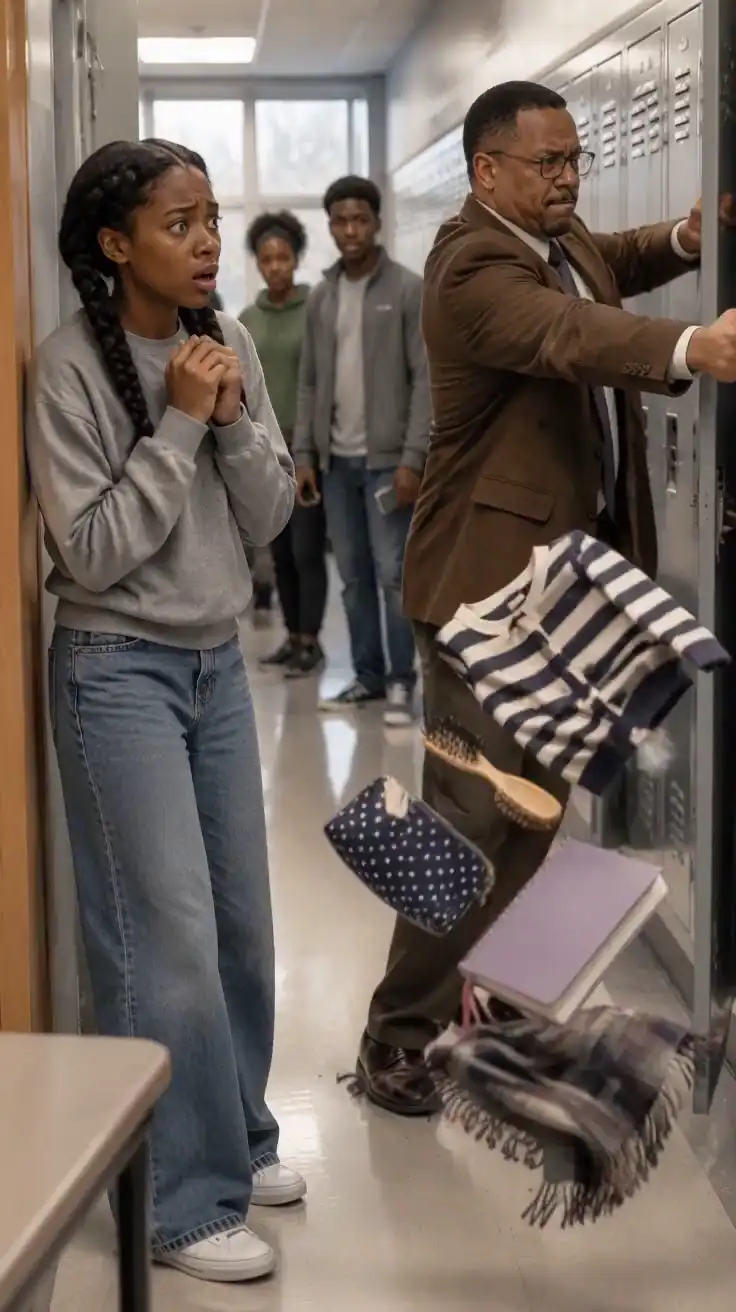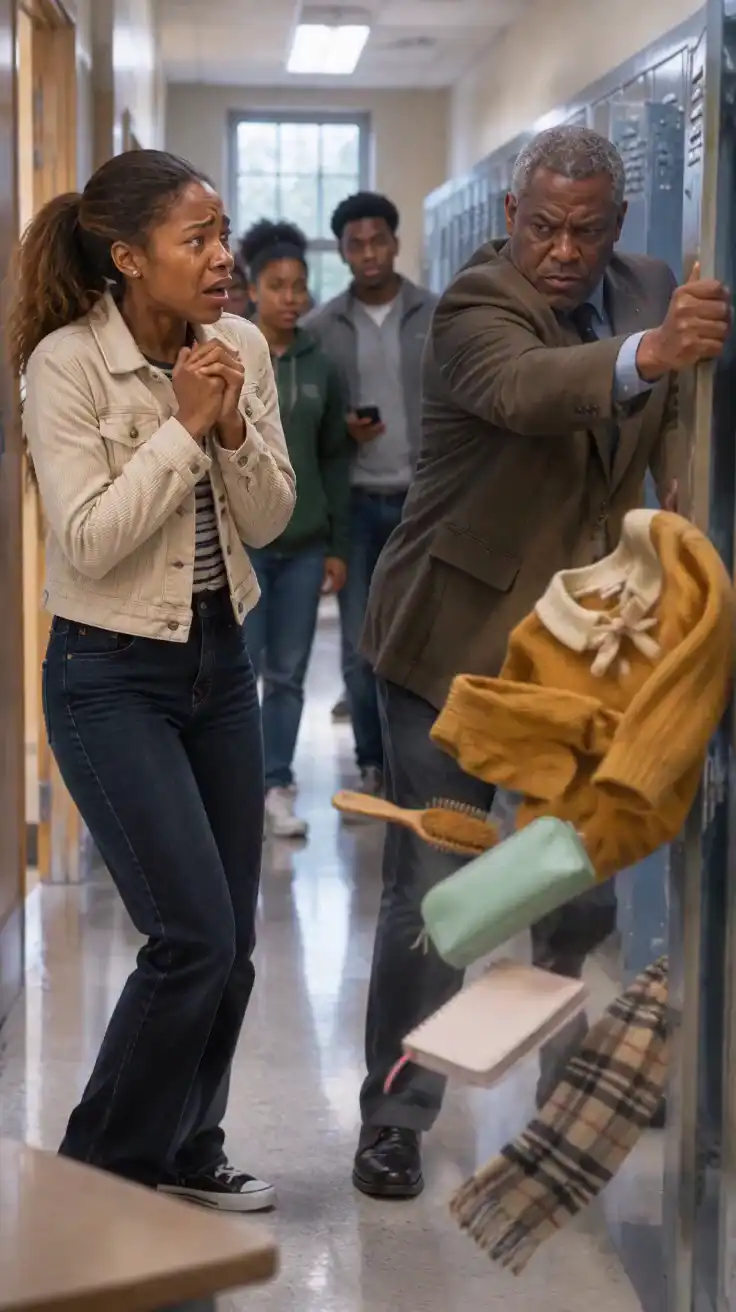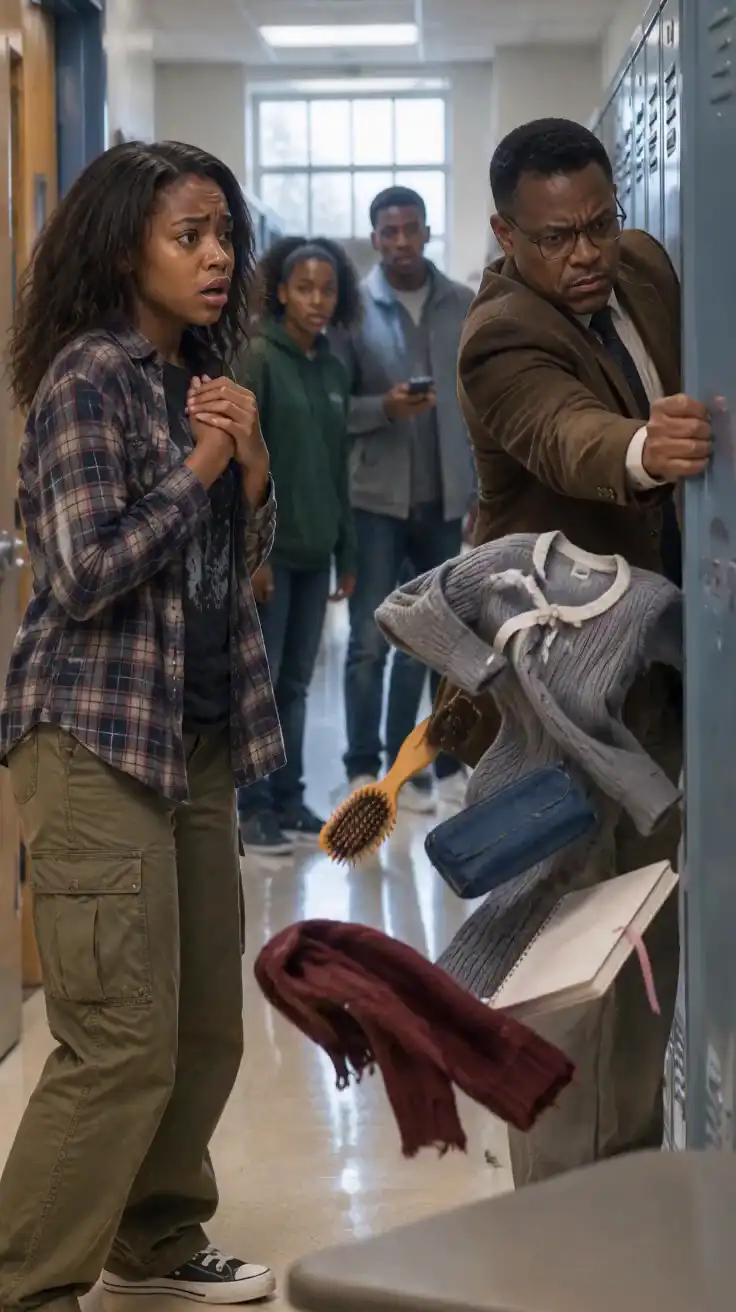
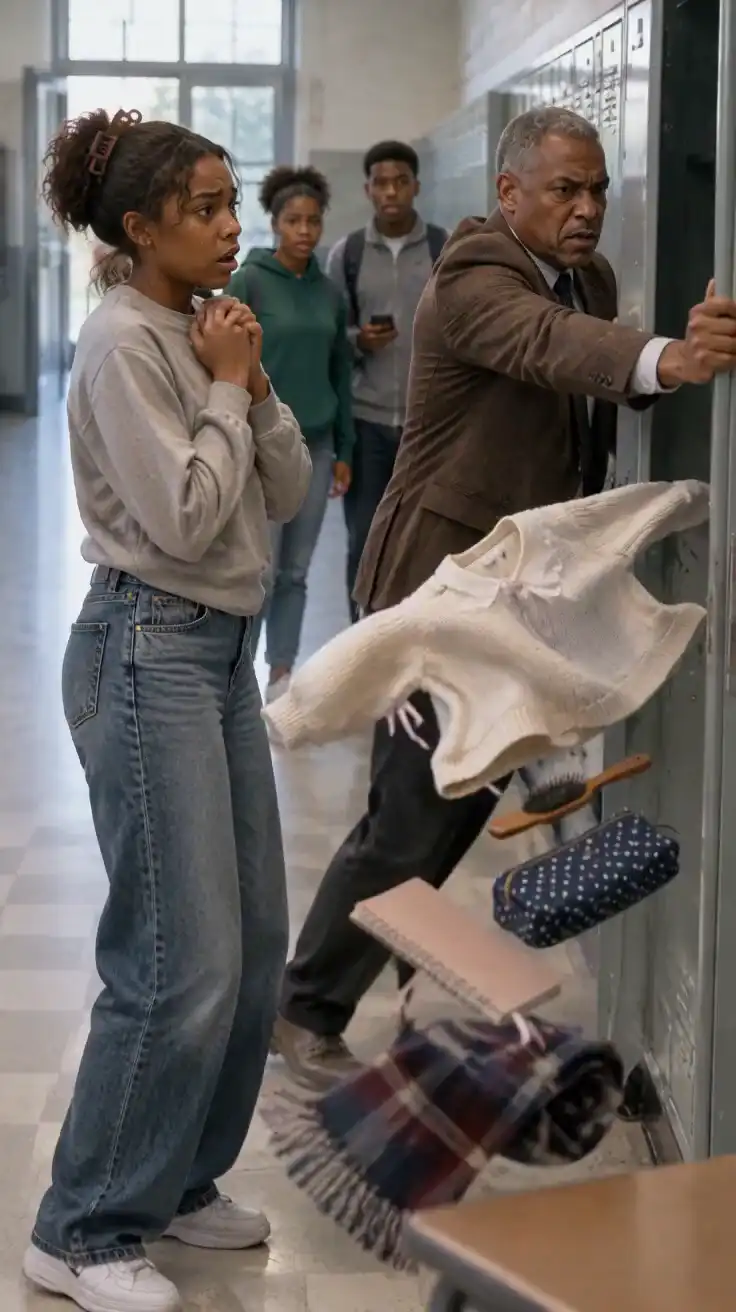
The gold bracelet hit the tile.
For one second, nobody moved.
It made a small sound, almost delicate. Not the dramatic clatter people expect from a piece of evidence. Just a bright little click against the floor, followed by the scrape of the girl’s sneaker as she stepped backward.
My daughter looked at the bracelet first. Then she looked at the girl who had pointed at her.
The dean looked at both of them.
“What is that?” he asked.
The girl’s name was Brielle Lawson. She had been my daughter’s best friend for almost three years.
Brielle’s mouth opened, but nothing came out.
The dean bent down and picked up the bracelet by its clasp. He held it between two fingers. The gold chain swung once in the fluorescent light.
“You told me she had it,” he said.
Brielle stared at my daughter. “I didn’t—”
“You told me she stole it.”
“I thought she—”
“You pointed at her,” he said. “You said she had it.”
Students along the wall started whispering. The noise moved through the hallway like wind through dry grass.
My daughter was still on her knees.
“Get up,” the dean told her.
She did not move.
“Amaya, stand up.”
Her name sounded strange in his mouth. He had called her “young lady” all morning, according to the students who sent me the video. Now he knew her name.
Amaya pressed her palms against the tile and stood. Her knees had gone red through her uniform skirt. She reached for the folder about Jordan, but one of the papers had slid underneath a boy’s shoe. He lifted his foot without being asked. Amaya pulled the page free and folded it in half.
The dean turned to Brielle.
“Office. Now.”
Brielle’s face changed.
Until that moment, she had been crying and angry and certain the adults would follow her where she led them. She had believed the story was already finished: bracelet missing, Black girl accused, search conducted, guilt confirmed. The bracelet falling from her own sleeve did not simply change the story. It removed the part she had been depending on herself to play.
“But I didn’t steal it,” she said.
The dean’s expression hardened. “I did not ask you whether you stole it.”
“She put it there.”
Amaya looked at her.
I had watched that look on the video before I ever stood in the building. It was not disbelief. It was exhaustion. My daughter had been explaining herself to Brielle for months, and Brielle had been acting as though every explanation was another piece of evidence.
“I didn’t touch your sleeve,” Amaya said.
“I saw you near my bag.”
“You asked me to hold your jacket.”
“You could have put it in there then.”
“You gave me your jacket after lunch.”
The hallway went quiet again.
The dean looked between them. “Office. Both of you.”
A teacher stepped forward. “Mr. Bell, should I clear the hall?”
“Yes. Nobody leaves until I say so.”
The teacher turned to the students. “Classrooms. Move.”
Phones disappeared into pockets, though not quickly enough. Some students kept filming through the fabric of their sweatshirts. That was how I saw the second angle later, from a girl standing near the water fountain. That video caught Brielle’s expression when the bracelet fell. It caught the way she looked at her own sleeve as if the gold chain had betrayed her personally.
My phone had been vibrating on the kitchen counter when the first message came through.
Mrs. Carter, come to school immediately.
Then:
There has been an incident involving Amaya.
Then:
Please do not call while driving.
I was already in my car before I finished reading. My hands were shaking so badly that I had to put the phone in the cup holder and use voice commands to call the school.
The front office secretary answered.
“Eastbrook High.”
“This is Renee Carter. I’m Amaya Carter’s mother. I got a message saying there was an incident.”
There was a pause. Not a normal pause. A pause where someone looks across a desk at another person and decides how much to say.
“Mrs. Carter, the dean is handling it.”
“I’m asking what happened to my daughter.”
“I’m not at liberty to discuss student matters over the phone.”
“You contacted me.”
“We asked you to come in.”
“I’m coming in. Is she safe?”
Another pause.
“She is in the dean’s office.”
“That wasn’t my question.”
“She is not injured.”
I gripped the steering wheel.
“Did someone put their hands on her?”
“No.”
“Was she searched?”
The secretary stopped breathing for half a second.
“Mrs. Carter—”
“Was my daughter searched?”
“I really think you should speak with Dean Bell.”
“I asked you a yes-or-no question.”
“I’m sorry, but I need to end this call.”
The line went dead.
I drove the rest of the way with the school’s message open on the dashboard and my husband, Marcus, calling every few minutes. I didn’t answer because I knew if I heard his voice I would start crying, and I needed both hands on the wheel.
Jordan was at school too. He was nine years old and in a specialized classroom three miles away. His caseworker, Ms. Dorsey, had been coming to our house twice a week to help us prepare for the placement review. We were trying to get him into a therapeutic residential program that could manage his seizures, his nighttime wandering, and the aggressive episodes that came when he could not explain pain.
The folder in Amaya’s locker held every piece of paper we had been collecting for almost six months.
Medical records.
Behavioral assessments.
Letters from his neurologist.
A statement from Ms. Dorsey about our family’s inability to keep him safe without round-the-clock support.
A copy of the placement application with my signature at the bottom.
There was also a letter from Amaya. She had written it for the review board because Jordan listened to her better than he listened to anyone else. She had written that he was funny when he was calm. That he sang the same four notes whenever he was nervous. That he hated socks and loved orange popsicles. That our family loved him, but love did not make our house safe enough for what he needed.
That was the paper I saw in the hallway video, folded underneath a pencil case.
The folder was not supposed to be in Amaya’s locker. She had taken it from home that morning because Ms. Dorsey was meeting us at the school at three. Amaya had planned to walk with me to the county office after dismissal.
She had asked me before leaving, “Do you want me to bring the letter?”
I had said, “Only if you’re sure.”
“I want them to hear me.”
So she put the folder in her backpack.
When I pulled into Eastbrook High, there were already three police cars parked along the curb.
I stopped in the visitor’s space so abruptly that the security guard came out of the booth.
“Ma’am, you can’t park there.”
“My daughter is inside.”
“Go to the front entrance.”
“I’m going to the front entrance.”
He stepped aside, but I could feel his eyes on me as I crossed the pavement. I had left the house wearing jeans, a sweater, and one earring. The other was still on the bathroom counter. My hair was tied up with the elastic I kept around my wrist for grocery bags.
The secretary looked up when I came through the doors.
“Mrs. Carter?”
“Yes.”
“Dean Bell is expecting you.”
“Where is my daughter?”
“He’ll explain everything.”
“I asked where my daughter is.”
“She’s in the conference room.”
“Is she alone?”
The secretary looked down at her computer. “Dean Bell is with her.”
“Take me there.”
“Mrs. Carter, you need to sign in.”
I stared at her.
She slid the clipboard toward me.
I wrote my name so hard the pen tore the paper.
The conference room door was shut. I could hear voices through it.
Amaya was speaking.
“I told you I didn’t take it.”
Dean Bell said, “Lower your voice.”
“I’m not yelling.”
“You are being disrespectful.”
I opened the door.
Amaya turned toward me. Her eyes were dry, but her face had gone pale. One side of her hair had come loose from its braid. She was holding the folder against her chest.
“Mom.”
I crossed the room and put my hand on the back of her neck. She leaned into me for one second. Then she straightened because she had spent the whole morning being told to stand up straight.
Dean Bell sat at the end of the table. He was a large man with silver hair and a school tie that looked too tight around his throat. Brielle sat across from him. Her mother was beside her.
I knew Brielle’s mother. Her name was Denise Lawson. She had been in our house many times. She had dropped Brielle off for sleepovers, picked her up after soccer, and once brought me a casserole when Jordan had been hospitalized.
She stood when I entered.
“Renee,” she said.
I did not answer her.
I looked at the dean. “Why was my daughter searched?”
Dean Bell folded his hands. “There was a report of a stolen item.”
“That doesn’t answer my question.”
“Amaya was identified as a possible suspect.”
“By whom?”
“Brielle reported seeing her near the location where the bracelet was last seen.”
I turned to Brielle.
“You told them she stole it?”
Her mother touched her arm. “Renee, everyone is upset.”
“I’m asking Brielle.”
Brielle’s eyes filled again. “I didn’t know it would become this.”
“Become what?”
“I didn’t know they would search her.”
“You named her.”
“I just told them what I saw.”
“What did you see?”
Brielle looked at Amaya. “You were by my bag.”
Amaya said, “You asked me to get your lip gloss.”
“I didn’t ask you to go through my things.”
“Your lip gloss was in the front pocket.”
“You could have put the bracelet in there.”
I looked at the dean. “Where was the bracelet found?”
Nobody answered.
“Mr. Bell.”
He shifted in his chair. “The item was recovered in the hallway.”
“That’s not what I asked.”
“It fell from Brielle’s clothing.”
Denise Lawson turned to him. “What?”
The dean looked at her. “The bracelet was in her sleeve.”
Denise looked at her daughter.
Brielle shook her head. “I didn’t put it there.”
“Then how did it get there?” I asked.
“I don’t know.”
“You accused my daughter of stealing it.”
“I thought she did.”
“You thought she stole a gold bracelet and hid it in your sleeve?”
“I didn’t know it was in my sleeve!”
Amaya let out a short, broken laugh. It was not amusement. It was the sound her body made when the truth became too absurd to hold inside.
Dean Bell looked at her. “Amaya, this is not the time.”
My hand tightened on her shoulder.
“No,” I said. “This is exactly the time.”
The door opened behind us. A uniformed officer stood in the hall.
Dean Bell rose. “Officer, we are still determining the appropriate next steps.”
The officer looked at the bracelet in the evidence bag on the table. “The student who reported it says it belongs to her family.”
“It belongs to my daughter’s classmate,” Dean Bell said.
“Has the student who was accused made a statement?”
“She has.”
“Was she searched?”
I looked at Dean Bell.
He did not answer.
The officer looked at me. “Mrs. Carter?”
“Yes.”
“Was your daughter searched?”
I said, “The dean emptied her backpack and made her kneel in the hallway.”
The officer’s eyebrows moved slightly.
Dean Bell said, “That description is overstated.”
“My daughter is on video.”
“We conducted a visual inspection of her belongings.”
“You turned the bag upside down on the floor.”
“There was no physical contact.”
“That is not the standard.”
The officer glanced at the dean. “Where is the video?”
“Students recorded it,” Dean Bell said.
“Then I’ll need copies.”
Denise Lawson began to cry.
“I don’t understand,” she said. “Brielle said Amaya had been acting strange.”
I looked at her. “What does that mean?”
“She said Amaya was upset with her.”
“Amaya was upset with her.”
Brielle whispered, “She hated me.”
Amaya turned toward her. “I did not hate you.”
“You stopped talking to me.”
“You stopped talking to me first.”
“You told people I was fake.”
“You told people my family was embarrassing.”
Brielle’s mother covered her mouth.
The dean looked annoyed, as if the conversation had wandered away from the important matter, which to him seemed to be how much time remained before lunch.
I said, “Tell me exactly why my daughter was accused.”
Dean Bell sighed. “The bracelet was reported missing during third period. Brielle stated that Amaya had been in possession of her personal items earlier in the day and had made comments about wanting expensive jewelry.”
Amaya stared at him.
“I said it was pretty,” she said. “I said the clasp looked expensive.”
Brielle said, “You said you wished you had one.”
“I said everyone wishes they had nice things.”
The officer asked, “Who owns the bracelet?”
Dean Bell said, “A student named Kendra Mills. Her mother gave it to her for her birthday.”
“Has Kendra made a statement?”
“She is waiting outside.”
“Bring her in.”
The dean opened his mouth, but the officer said, “Now, please.”
A few minutes later, Kendra entered with a teacher. She was a small girl with curly hair pulled into a puff and a red mark under one eye from rubbing it.
The officer asked, “Is this your bracelet?”
Kendra nodded. “Yes.”
“When did you last see it?”
“Before second period. I took it off in the bathroom because the clasp was loose. I put it in my makeup bag.”
“Where was the makeup bag?”
“In my backpack.”
“Did you give it to anyone?”
“No.”
“Did anyone ask about it?”
Kendra looked at Brielle. “Brielle asked me if it was real.”
Brielle’s head snapped up. “I ask everybody that.”
Kendra looked at the officer again. “She asked me if I was scared to wear it at school.”
Denise whispered, “Brielle.”
“I was just talking,” Brielle said.
“What happened after that?” the officer asked.
“Kendra said she had to go to class. Then I went to the bathroom after her.”
The room went very still.
The officer said, “Why?”
“I had to fix my hair.”
“Did you see the bracelet in the bathroom?”
“No.”
Kendra said, “My makeup bag was open when I came back.”
Brielle turned toward her. “You said you didn’t know what happened.”
“I didn’t know you took it.”
“I didn’t take it.”
The officer’s voice stayed calm. “Brielle, did you enter the bathroom after Kendra?”
“Yes.”
“Did you touch Kendra’s backpack or makeup bag?”
“No.”
“Did you touch the bracelet?”
“No.”
“Then how did it get into your sleeve?”
Brielle began sobbing.
Her mother stood up. “We need a moment.”
“No,” I said. “My daughter didn’t get a moment.”
Denise looked at me with a grief that might have been real. “Renee, please.”
“Please what?”
“I’m sorry this happened.”
“Are you sorry your daughter lied, or are you sorry she got caught?”
Brielle said, “I didn’t lie.”
Amaya spoke softly. “You knew I didn’t do it.”
Brielle looked at her.
“You knew,” Amaya said. “You watched them take my stuff out. You watched me get on the floor. You never said, ‘Maybe we should stop.’ You kept saying you told them.”
Brielle’s crying became louder.
Dean Bell walked to the door and spoke to someone in the hallway. Then he came back inside.
“Brielle Lawson,” he said, “you are suspended effective immediately pending a full disciplinary investigation.”
Denise turned toward him. “Suspended?”
“Yes.”
“For how long?”
“Ten school days initially. The district will review whether additional consequences are warranted.”
“Ten days? She didn’t steal anything.”
The officer said, “She reported a false accusation that led to a search.”
“She was confused.”
“She identified another student as a thief,” I said. “That was not confusion.”
Dean Bell continued. “She will also be barred from contacting Amaya directly or through other students during the investigation.”
Brielle looked at Amaya. “I’m sorry.”
Amaya did not answer.
Dean Bell turned to me. “Amaya is free to return to class.”
I laughed then. I couldn’t stop it. It came out sharp and empty.
“Return to class?”
“The bracelet was found.”
“My daughter was publicly searched. Her belongings were thrown on the floor. She was made to kneel while students filmed her. You are telling me she should return to class?”
“We have addressed the misunderstanding.”
“No. You have identified the girl whose sleeve held the bracelet. You have not addressed what you did to my daughter.”
Dean Bell’s face flushed. “Mrs. Carter, I understand this is emotional.”
“No, you don’t.”
“I have handled hundreds of student incidents.”
“You handled this one by assuming my daughter was guilty.”
“We responded to information provided by another student.”
“You did not verify it.”
“We had a reasonable concern.”
“You had a Black girl standing in a hallway while another girl pointed at her. You didn’t have a reasonable concern. You had a convenient target.”
The officer glanced at the dean, then at me.
Dean Bell said, “That accusation is unfair.”
“Was my daughter searched before Brielle was interviewed?”
He hesitated.
“Answer me.”
“Yes.”
“Was she searched before Kendra was asked where she last saw the bracelet?”
“I believe so.”
“Was Brielle searched?”
“She was asked to empty her pockets.”
“Not her sleeve.”
He looked away.
I said, “I want every video. I want the written reports. I want the names of every adult who was present. I want the district’s policy on searches and student accusations. And I want someone from the district office in this room today.”
Dean Bell’s jaw tightened. “You may submit a records request.”
“I’m submitting it now.”
He started to say something, but my phone rang.
It was Ms. Dorsey.
I stepped into the hall to answer.
“Mrs. Carter, I’ve been trying to reach you. The county office called. They said you missed the placement meeting.”
“I’m at the school.”
“Is Amaya all right?”
“She will be.”
“What happened?”
I looked through the glass panel in the conference room door. Amaya was sitting with her backpack in her lap. She had placed every item back inside in the order she liked: folder first, then notebooks, then pencil case, then lunch container on top. Brielle sat across from her with her mother’s hand wrapped around her wrist.
“I need to reschedule the meeting,” I said.
Ms. Dorsey was quiet. “The review board only meets twice a month.”
“I know.”
“Mrs. Carter, if we miss today, it could delay Jordan’s placement.”
“I know.”
That was the part that broke something in me.
I had spent the morning trying to keep my daughter from being treated as a thief, and while I was doing it, the clock was moving on my son’s future.
“Can you send me the forms electronically?” I asked.
“I can, but they need your signature and Amaya’s letter has to be read in person.”
“She can attend another meeting.”
“Amaya’s statement is important.”
“I know.”
“She has been very clear about what Jordan needs.”
I closed my eyes.
Behind the glass, Amaya lifted her head and looked at me.
“I’ll get her there,” I said.
“Can you get there today?”
I looked at the dean.
“No,” I said. “But I’ll get there.”
When I went back into the room, Dean Bell was speaking to Brielle’s mother.
“Brielle will need to leave campus with you,” he said. “Her suspension paperwork will be sent home.”
Denise nodded, but she was looking at me.
“Renee, can I talk to you?”
“No.”
“I need to explain.”
“You had all morning to explain while my daughter was on the floor.”
“I didn’t know what was happening.”
“You knew enough to let it happen.”
She looked down.
Brielle whispered, “Mom.”
Denise turned to her. “Get your things.”
Brielle stood. Her chair scraped the tile. She reached for the backpack at her feet, then stopped.
“Amaya,” she said.
Amaya’s fingers tightened around her folder.
“I didn’t mean for them to search you.”
Amaya looked at her for a long time.
“That doesn’t make it better.”
Brielle swallowed. “I was scared.”
“You should have been scared before you pointed at me.”
Her mother pulled her toward the door.
I stayed behind with Amaya and Dean Bell.
He asked her whether she wanted to return to class.
She said no.
He said he could arrange for her to complete the day in the counseling office.
I said she was leaving with me.
“We still need to take her statement,” he said.
“You can take it with me present.”
“That is not standard.”
“Neither was making her kneel in a hallway.”
He pressed his lips together.
Amaya stood. She put on her backpack and checked the folder again. One corner was bent. She smoothed it with her thumb.
Dean Bell handed me a form.
“This confirms that Amaya is being released to you.”
I read it.
It said the school had conducted a search based on reasonable suspicion, that the missing property had been recovered, and that Amaya had not been disciplined.
I looked up. “I’m not signing this.”
“It only confirms release.”
“It also describes what happened in a way that protects the school.”
“Mrs. Carter—”
“I’ll sign that I’m taking my daughter. I will not sign your version of the morning.”
He took the form back.
“Fine.”
Outside, two students were waiting near the entrance. One of them looked at Amaya and said, “I’m sorry.”
Amaya nodded.
Another said, “The video is everywhere.”
I stopped walking.
“What video?”
The student’s face went pale. “The hallway one.”
“Who posted it?”
“I don’t know.”
“Who posted it?”
He looked toward the doors. “People have it.”
Amaya touched my arm. “Mom, let’s go.”
In the car, she sat in the passenger seat and held the folder against her stomach.
For several minutes neither of us spoke.
I turned on the engine.
She said, “Don’t call her mother.”
“I wasn’t planning to.”
“She’ll call you.”
“She can call.”
“Don’t answer.”
“I won’t answer until I know what I want to say.”
Amaya looked out the window.
“Was it really in her sleeve?” she asked.
“Yes.”
“I saw it fall.”
“I know.”
“I thought maybe I was imagining it.”
“You weren’t.”
She pressed her forehead to the glass.
“Why would she do that?”
That was the question I had been asking since last spring.
Amaya and Brielle had met in sixth grade. They became friends because they both hated group projects and liked the same mystery novels. Brielle came over after school, and I got used to finding her shoes by the front door. She knew where we kept the cereal. She knew Jordan’s favorite cartoons. She knew that when he got overstimulated, we turned off the overhead lights and let him sit under the dining room table with his headphones.
She had been there the night Jordan broke a lamp during a seizure-related episode. She had helped me gather the pieces while Marcus held Jordan on the couch.
She had also been there when Ms. Dorsey told us the county might approve a residential placement.
Brielle had asked, “Does that mean he’s leaving forever?”
I told her, “It means he’ll get care we can’t provide at home.”
Amaya had looked at the floor.
Brielle said, “That must be a relief.”
Amaya snapped, “Don’t say it like that.”
Brielle looked hurt. “I didn’t mean anything.”
“You did.”
The argument ended when Jordan came into the kitchen carrying one of his shoes. He had been awake since four in the morning and was trying to put it on the wrong foot.
After that, the girls were different around each other.
At first, I thought it was ordinary teenage conflict. Amaya would come home quiet. Brielle stopped asking to come inside. Their messages became shorter. Then Amaya told me Brielle had removed her from a group chat.
“What happened?” I asked.
“She said I was too much.”
“Too much what?”
“She didn’t say.”
A week later, Amaya found a note in her locker that said, Stop making everything about your family.
She did not show me until months later.
The other girls stopped sitting with her at lunch. They moved away when she approached. One of them laughed when Amaya asked if she could borrow a pencil.
Brielle never openly insulted her in front of me. She did it in the spaces adults never saw: the group chat, the bathroom, the walk between classes.
When I asked Amaya whether Brielle was bullying her, she said, “It’s not bullying if she used to be your friend.”
I wanted to believe that friendship ending was all it was.
I wanted to believe Brielle had not turned against her because our family had become inconvenient. Because Jordan’s needs took up too much space. Because Amaya had started missing parties to help at home. Because she knew things about disability, medication, placement hearings, and emergency plans that other fifteen-year-olds did not.
Last spring, the girls had been invited to a weekend trip with Brielle’s family. Amaya declined because Jordan had an evaluation that Sunday. Brielle had said, “You always have an excuse.”
Amaya answered, “It’s not an excuse.”
Brielle said, “Whatever. Your life is depressing.”
Amaya never told me that part. I heard it from another mother after the bracelet incident.
When we got home from school, Marcus was waiting in the driveway.
He had taken off work after I called him from the parking lot. Jordan was inside with Ms. Dorsey, who had come to stay with him because the placement meeting had been canceled.
Marcus opened my door before I could get out.
“What happened?”
Amaya climbed out with the folder.
“Ask Mom,” she said.
He looked at her knees. “Are you hurt?”
“No.”
“Are you sure?”
“Yes.”
He touched her face, then pulled her into his chest.
She held herself stiffly for a moment before wrapping her arms around him.
I stood beside the car and watched them.
Then my phone began buzzing.
The first message was from a number I didn’t recognize.
I’m sorry about what happened to Amaya. I saw the video.
The second came from a parent in Amaya’s class.
The dean needs to be held accountable. My son said he told them Brielle was lying.
The third was from Denise Lawson.
Please call me. I want to apologize properly.
I turned the phone face down.
Inside, Jordan was sitting at the kitchen table with his headphones around his neck. He had lined up six orange crayons along the edge of a worksheet. Ms. Dorsey was beside him.
He looked at Amaya.
“School?”
She nodded.
“Bad?”
She hesitated.
“Bad,” she said.
Jordan slid one crayon toward her.
She took it.
That night, the video reached every student at Eastbrook and at least two neighboring schools. The original clip had been posted by a sophomore named Malik, who later told me he had not meant for it to spread.
“I thought people needed to see what happened,” he said when we met in the principal’s office.
“Why?”
“Because everybody was saying Amaya stole it.”
“Everybody?”
“Brielle’s friends. They said she was caught.”
“You knew that wasn’t true?”
“I knew she wasn’t even near the bathroom when Kendra lost it.”
“Then why didn’t you say something?”
He looked at the table. “I did. Nobody listened.”
That answer stayed with me.
Children often know the truth before adults do. They know who gets believed, who gets searched, who gets called disrespectful for being afraid. They know when a teacher’s question is really an accusation.
The school held a meeting the next morning. The principal, Dr. Whitaker, sat beside Dean Bell and the district’s student services director. I sat with Amaya and Marcus. Kendra’s mother attended too.
Brielle and Denise were not there. Brielle was suspended.
Dr. Whitaker began with a statement about safety and due process.
I let him finish.
Then I said, “Where is the apology to my daughter?”
He folded his hands. “We regret the distress caused by the incident.”
“That is not an apology.”
Dean Bell said, “I acted on information available at the time.”
“You acted before asking the person who owned the bracelet where she last saw it.”
“We had a rapidly developing situation.”
“You had time to make my daughter kneel.”
His face reddened.
The student services director, Ms. Alvarez, leaned toward the microphone. “We are reviewing whether school procedures were followed.”
“They were not.”
“We agree the process could have been handled differently.”
“Differently how?”
She looked at her notes.
“The school should have separated the students, interviewed the reporting student and the accused student individually, identified the property owner, and avoided a public search.”
“Avoided?” I said. “The policy says searches must be conducted privately and by designated personnel.”
Ms. Alvarez looked up.
I had read the policy at two in the morning.
“Yes,” she said.
“Was Dean Bell designated personnel?”
“No.”
“Was there a female administrator present?”
“No.”
“Did anyone obtain consent?”
“No.”
“Then this was not a mistake in judgment. It was a violation of your own policy.”
Nobody spoke.
Marcus reached over and placed his hand on my wrist.
Amaya sat very still.
I asked whether the school had contacted the police before or after the bracelet fell from Brielle’s sleeve.
Dr. Whitaker said, “The resource officer was called after the accusation was reported.”
“Did anyone tell the officer my daughter had already been searched?”
“I believe so.”
“Did anyone tell him the bracelet was recovered from Brielle?”
“Yes.”
“Did anyone contact Kendra’s mother?”
“Not until after.”
I nodded.
The facts were becoming a list. Lists were useful. They kept people from turning events into feelings.
The district opened a formal investigation. Dean Bell was placed on administrative leave two days later. The school did not announce that publicly at first. They said he was “unavailable due to a personnel matter.” Parents began calling the district office. Students made a petition. Someone painted SEARCH THE SLEEVE on a piece of cardboard and taped it to the front gate.
I did not approve of everything students did. Some of them turned the incident into entertainment. They reenacted the bracelet falling in the cafeteria. They made jokes about Brielle’s sleeve. They created a private account that posted screenshots of old messages between the girls.
Amaya asked me to report the account.
“I don’t want people defending me by humiliating her,” she said.
That was the first time I understood how much more mature my daughter was than the adults who had failed her.
We reported it. The account was removed. The students who ran it were disciplined.
Brielle remained suspended for ten days, then returned under a behavior contract. The district’s investigation found that she had entered the bathroom after Kendra, taken the bracelet from the makeup bag, and hidden it in the loose lining near the cuff of her sweatshirt.
She had not planned to accuse Amaya that morning.
That was what she told the investigator.
She said she took the bracelet because she wanted it. She had seen Kendra wearing it and had asked whether it was real. She had never owned anything made of gold. She said she put it in her sleeve because she heard someone enter the bathroom and panicked.
Then she saw Amaya near the lockers.
Amaya had been standing there with Brielle’s jacket over one arm. Brielle had given it to her before class because she needed both hands to carry a poster board.
According to the report, Brielle decided to blame her before she had even returned to the classroom.
She told the teacher Amaya had been near her bag.
She told the dean Amaya had made comments about expensive jewelry.
She told two friends that Amaya had “always been jealous.”
By the time the dean approached my daughter, the story had become true in everyone’s mind because it had been repeated enough.
The investigator asked Brielle why she chose Amaya.
Brielle said, “Because people already think she’s difficult.”
The report used the word “difficult.” It appeared three times.
I asked Ms. Alvarez whether Brielle had been asked what she meant.
“She said Amaya was often emotional and had a complicated home life.”
I said, “That is not an explanation.”
“No,” Ms. Alvarez said. “It is not.”
Denise Lawson eventually came to our house.
I almost did not let her in.
Marcus was at work. Amaya was at the library with a friend. Jordan was in the living room watching a nature program, his knees pulled up under his chin.
Denise stood on the porch holding a paper bag.
“I brought a pie,” she said.
I looked at the bag.
“I don’t want a pie.”
“I know. I didn’t know what else to bring.”
“You could have brought the truth.”
She nodded slowly.
“I should have believed you.”
“You should have believed your daughter’s actions were possible.”
“She told me Amaya had been threatening her.”
“Did Amaya threaten her?”
“No.”
“Did you ask?”
“I asked her if Amaya had ever made her feel unsafe.”
“That is not the same question.”
Denise looked over my shoulder toward the house. “How is Jordan?”
I stepped outside and closed the door behind me.
“Don’t use my son to get closer to me.”
“I’m not.”
“You came into my house for years. You know exactly how to speak to me when you want me to soften.”
She flinched.
“I deserve that,” she said.
“Do you?”
“Yes.”
That answer took some of the force out of my anger, but not the anger itself.
Denise looked down at the paper bag. “Brielle says she thought Amaya would be believed as much as she was.”
“She knew better.”
“She said people always take Amaya’s side.”
“Did they?”
Denise’s mouth tightened.
“No,” she said.
“Your daughter accused mine because she knew exactly what would happen.”
“I know.”
“No, I don’t think you do.”
She looked at me.
“She knew my daughter would be searched first. She knew adults would treat her confidence as attitude and her fear as guilt. She knew if Amaya said, ‘I didn’t do it,’ people would hear defiance. That was not an accident.”
Denise’s eyes filled.
“She was jealous of how close Amaya was to Jordan,” she said.
I said nothing.
“She told me she felt like there was no room for her anymore. Every conversation was about his doctors or the placement or how tired you all were. She said Amaya was always choosing her family over her.”
“That is a reason she was hurt. It is not a reason she stole from Kendra and framed my daughter.”
“I know.”
“Does she?”
“She is starting to.”
“What does that mean?”
“She asked if Amaya would ever speak to her again.”
I looked at the door.
“She should not ask for that.”
“I told her.”
“Good.”
Denise held out the paper bag. “I am not asking you to forgive her.”
“Then why are you here?”
“To say I’m sorry without making you take care of my feelings.”
That was the first useful thing she had said.
I accepted the apology, but not the pie.
She left with it.
A week later, Brielle wrote Amaya a letter. It was four pages long. Amaya brought it to me unopened.
“Do I have to read it?” she asked.
“No.”
“Do I have to answer?”
“No.”
She sat at the kitchen table while Jordan slept upstairs.
“What if she really is sorry?”
“Then she will understand if you don’t want to be her friend.”
“What if I’m supposed to forgive her?”
“Forgiveness is not a school assignment.”
Amaya turned the envelope over.
“She says she misses me.”
“You can miss someone and still know they are not safe for you.”
“She was my friend.”
“I know.”
“She knew everything.”
“I know.”
Amaya opened the letter.
She read it silently. Once, she stopped and looked toward the staircase because Jordan made a noise in his sleep.
“What does she say?” I asked.
“She says she was angry that I changed.”
“Did you?”
“Yes.”
“You were allowed to.”
“She says I made her feel like she didn’t matter.”
“Did you tell her that?”
“I told her I was tired.”
“Those things can both be true.”
Amaya folded the letter.
“Do you think she stole the bracelet because she wanted it?”
“Yes.”
“Or because she wanted to hurt me?”
“Maybe both.”
She looked at the envelope again.
“I don’t want to hate her.”
“You don’t have to.”
“I don’t want to forgive her yet.”
“You don’t have to do that either.”
She put the letter in a drawer.
That was where it stayed.
The placement hearing for Jordan was rescheduled for the following month. Amaya attended with us. She wore a blue sweater and carried a new copy of her letter.
The original had been damaged when the dean emptied her backpack. I had taken a photograph of every page before sending it to the district. We printed it again.
The review board asked Amaya what she wanted them to know.
She sat straight in the hard chair.
“My brother loves people,” she said. “He just doesn’t always know how to be around them safely. He wanders at night. He has seizures. He gets scared and then he hits things because he can’t tell us what hurts. We have tried to help him at home. My mom and dad do everything they can. But sometimes doing everything you can isn’t enough.”
One of the board members asked, “How does that affect you?”
Amaya looked at me.
I thought she might give the answer adults wanted. Something neat and grateful. Instead, she said, “I love him. I’m also tired. Both things are true.”
The board approved the placement.
Jordan would move to a therapeutic program two counties away. He would come home every other weekend at first, and we would have family visits during the week. The program had nurses overnight, seizure monitoring, and staff trained in behavioral support.
Amaya cried in the parking lot afterward.
“I feel relieved,” she said.
“You are allowed.”
“Does that make me a bad sister?”
“No.”
“What if he thinks we sent him away?”
“He may think that sometimes.”
“What if he hates us?”
“He may be angry.”
She wiped her face. “You make everything sound possible.”
“Most things are.”
Jordan moved three weeks later.
The morning we packed his clothes, he became upset because one of his blue shirts was missing. He stood in the hallway, shouting that somebody had taken it.
Amaya found it under his bed.
He hugged the shirt to his chest.
“Mine,” he said.
“Yours,” she answered.
Then he asked, “Home?”
Amaya knelt in front of him.
“Your new place is going to be another home.”
He shook his head.
“Here,” he said.
She pressed her forehead to his.
“Here too.”
That afternoon, after we drove him to the facility, Amaya sat in the back seat with his orange crayons in her lap. She had packed them in a plastic container because he liked sorting them by color.
She said, “I don’t know what I’m supposed to do now.”
“Neither do I.”
“Everybody keeps telling me I can focus on myself.”
“You can.”
“What if I don’t know who that is?”
I looked at her in the rearview mirror.
“You’ll find out.”
At school, the district required Dean Bell to complete an equity and search-protocol review before returning to work. He resigned before that could happen. The official letter said he was pursuing another opportunity. Nobody believed it.
The school hired an interim dean, a woman named Dr. Patel, who met with Amaya privately.
“I’m sorry,” Dr. Patel said.
Amaya sat with her hands in her lap.
“People keep saying that.”
“I know.”
“Do you mean it?”
“Yes.”
“Then don’t make me tell this story again.”
Dr. Patel nodded. “You won’t have to.”
She arranged for Amaya to use a private room if she needed to leave class. She made sure no administrator searched a student without following the district procedure. She created a parent advisory committee, though I told her policies mattered only when adults followed them under pressure.
The district gave us a written apology.
It said the school had failed to protect Amaya’s dignity and had not followed established procedures.
I read it three times.
Then I asked them to add that the accusation had been false and that the school had acted on it without adequate verification.
They agreed.
Some people told me I was making too much of it.
One mother said, “At least they found the bracelet.”
I said, “That is not the point.”
She said, “I know, but you don’t want this to follow your daughter forever.”
I asked her what she thought would follow Amaya longer: a corrected record or a hallway video showing her on her knees while another student called her a thief.
She did not answer.
Kendra’s family became close to ours after that. Her mother, Sheryl, called me when the investigation ended.
“I’m sorry my daughter’s bracelet was part of this,” she said.
“You didn’t do anything.”
“I should have told someone sooner that Brielle asked about it.”
“Kendra was afraid.”
“Of Brielle?”
“Of what would happen.”
Sheryl was quiet.
Then she said, “My daughter told me she saw how they looked at Amaya. She said she knew they were going to blame her.”
I thought of Malik saying he had tried to tell them.
Children noticed. Adults decided not to.
Kendra and Amaya started eating lunch together. Not every day, but often. They had both become cautious about friendship. They did not rush to call each other best friends. They simply sat side by side and shared notes.
Brielle returned to school after her suspension.
The first day, she arrived with her mother. She wore a gray sweatshirt, though the weather was warm. Her sleeves were pulled over her hands.
Amaya saw her in the hallway.
Brielle stopped.
“I won’t talk to you,” she said quickly. “I know I’m not supposed to.”
Amaya nodded.
“I just wanted you to know I’m staying away.”
“Okay.”
Brielle’s eyes were red. “I’m sorry.”
Amaya looked at the covered sleeves.
“Okay,” she said again.
Then she walked away.
Brielle’s family moved to another district before winter break. Denise called once to tell me. She said Brielle was seeing a counselor and had admitted she was afraid to come back to school.
I said, “I hope she gets help.”
Denise said, “She still talks about Amaya.”
“That is not Amaya’s responsibility.”
“I know.”
“Make sure she knows.”
“I will.”
After we hung up, I sat at the kitchen table for a long time.
I did not feel victorious.
That surprised me.
I had imagined justice would arrive with a clean feeling, something like relief. Instead, the school had apologized, the dean had resigned, Brielle had been suspended, and Amaya’s record had been cleared. Still, none of that returned the morning to us. None of it erased the video. None of it changed the way Amaya now looked at every adult who said, “We just need to ask you a few questions.”
Trust did not come back because the district sent a letter.
It came back slowly, in small acts.
When Dr. Patel asked Amaya if she was comfortable entering a room before closing the door.
When a teacher stopped a rumor in class and said, “We do not treat an accusation as proof.”
When Kendra saved Amaya a seat.
When Amaya went back into the bathroom at school without checking who else was there.
When she stopped carrying her backpack with both arms wrapped around it.
The video still exists. I know because people still send it to me sometimes. Usually with a message asking whether I have seen it, as though I could forget.
I do not watch the whole thing anymore.
I watch the last few seconds.
The bracelet falling.
The dean’s face changing.
Brielle stepping backward.
Amaya rising from the floor.
That is the part I keep.
Not because the bracelet proved my daughter was innocent. She had been innocent before it fell. The gold only exposed what the adults had refused to see.
It showed that Brielle had needed a scapegoat. It showed that the accusation had been built before anyone checked the facts. It showed that a girl who once knew our family had chosen my daughter because she believed the world would accept the story.
And it showed my daughter standing up while everyone around her finally had to look at what they had done.
Last month, Amaya and I went back to Eastbrook for a meeting about Jordan’s transportation schedule. She no longer attended there. We had transferred her to a smaller school after the placement hearing, one with fewer students and a counselor who knew her name before asking for her file.
We walked past the old hallway.
The lockers had been repainted. The tile was the same.
Amaya stopped near the place where her backpack had been emptied.
“Do you ever think about that day?” I asked.
“Yes.”
“What do you think?”
She looked at the floor.
“I think I should have yelled.”
“You were scared.”
“I think I should have thrown the bracelet at her.”
“That would have made things worse.”
“I know.”
She smiled a little.
Then she said, “I think I’m glad I didn’t give them a different story to tell.”
I looked at her.
“What do you mean?”
“They wanted me to be angry in a way they could use. They wanted me to look guilty because I was upset. I was upset, but I didn’t give them that.”
“You should never have had to be perfect.”
“I know.”
She touched the edge of one locker.
“I wasn’t perfect.”
“No.”
“I cried in the car.”
“You did.”
“I wanted to call Brielle names.”
“You did call her names.”
Amaya laughed. “I called her worse names in my head.”
“That’s allowed.”
We started walking again.
At the end of the hall, she stopped once more.
“Mom?”
“Yes?”
“Do you think she really thought I was the only person they’d believe?”
I considered lying.
Instead, I said, “Yes.”
Amaya nodded slowly.
“Then she was right,” she said. “That’s the part I hate.”
I put my arm around her.
“That is the part adults have to change.”
She leaned against me as we walked toward the exit.
Outside, the afternoon was bright and cold. Students crossed the parking lot carrying backpacks, laughing, arguing, calling to one another. A girl ran past us with her sleeves pulled over her hands.
Amaya watched her go.
Then she turned toward our car.
For a moment, I thought about the folder that had been scattered across the tile. The pages about Jordan. Her letter. The sentence she had written in careful handwriting: He deserves care, and we deserve help.
The bracelet had not destroyed our family.
The accusation had not erased my daughter’s voice.
But it had shown us how quickly someone else’s fear, jealousy, or selfishness could become an adult’s certainty. It had shown us that being innocent did not always protect you from being treated like you were guilty. It had shown us why records mattered, why witnesses mattered, why speaking up mattered even when nobody listened the first time.
And it had shown my daughter something I wish she had never needed to learn.
Sometimes the truth does not enter a room politely.
Sometimes it drops out of the sleeve of the person pointing at you, hits the floor, and makes everyone who was comfortable with the lie step back.