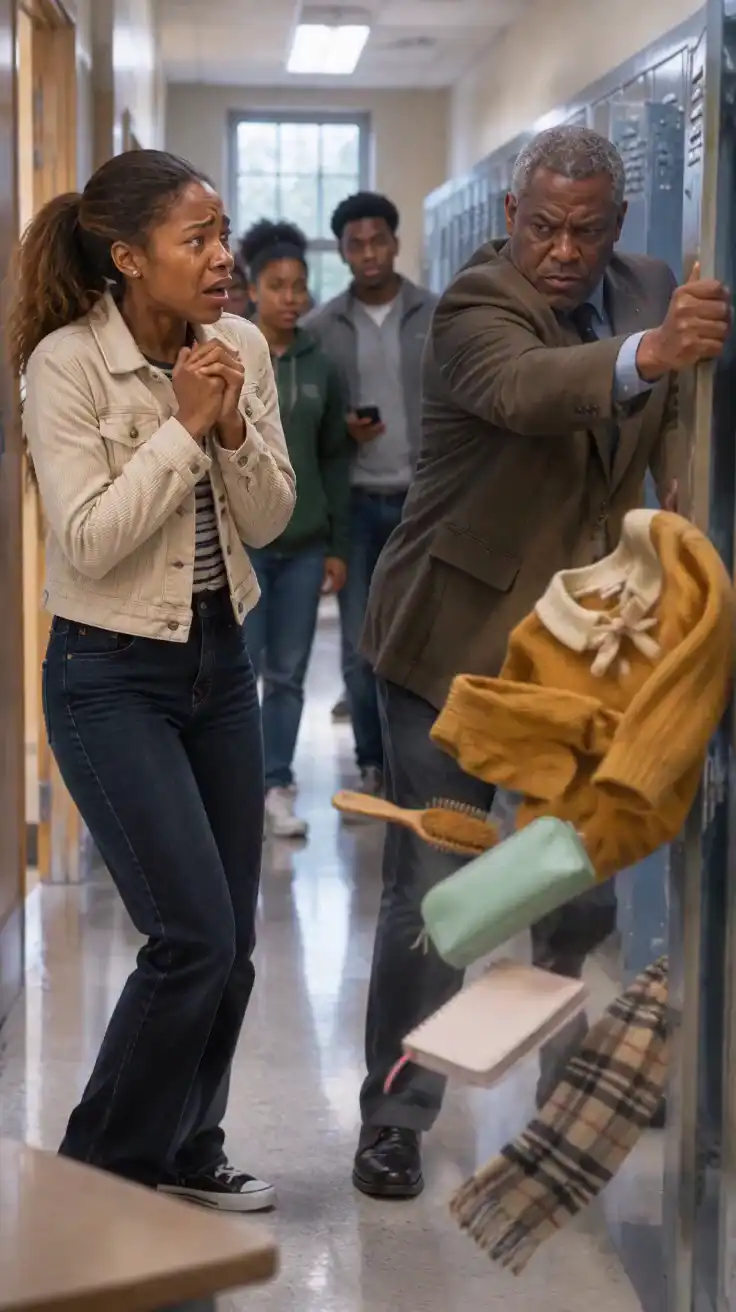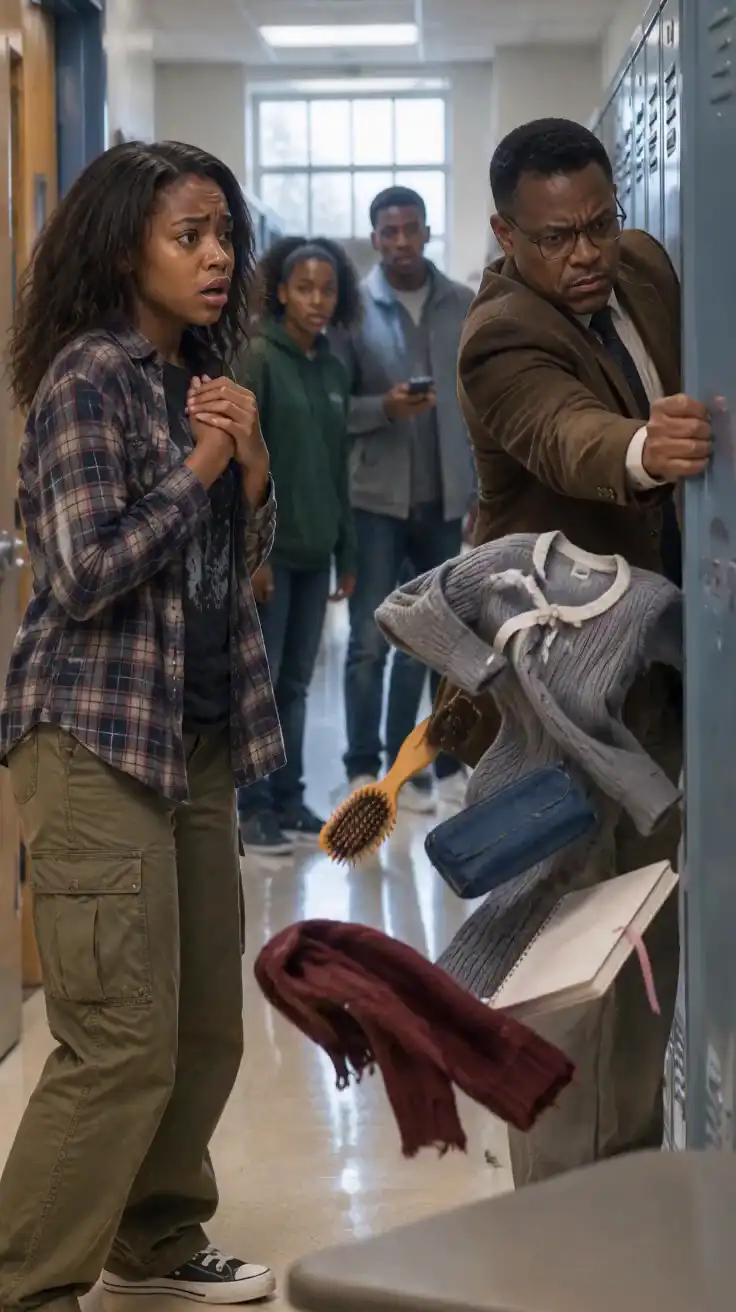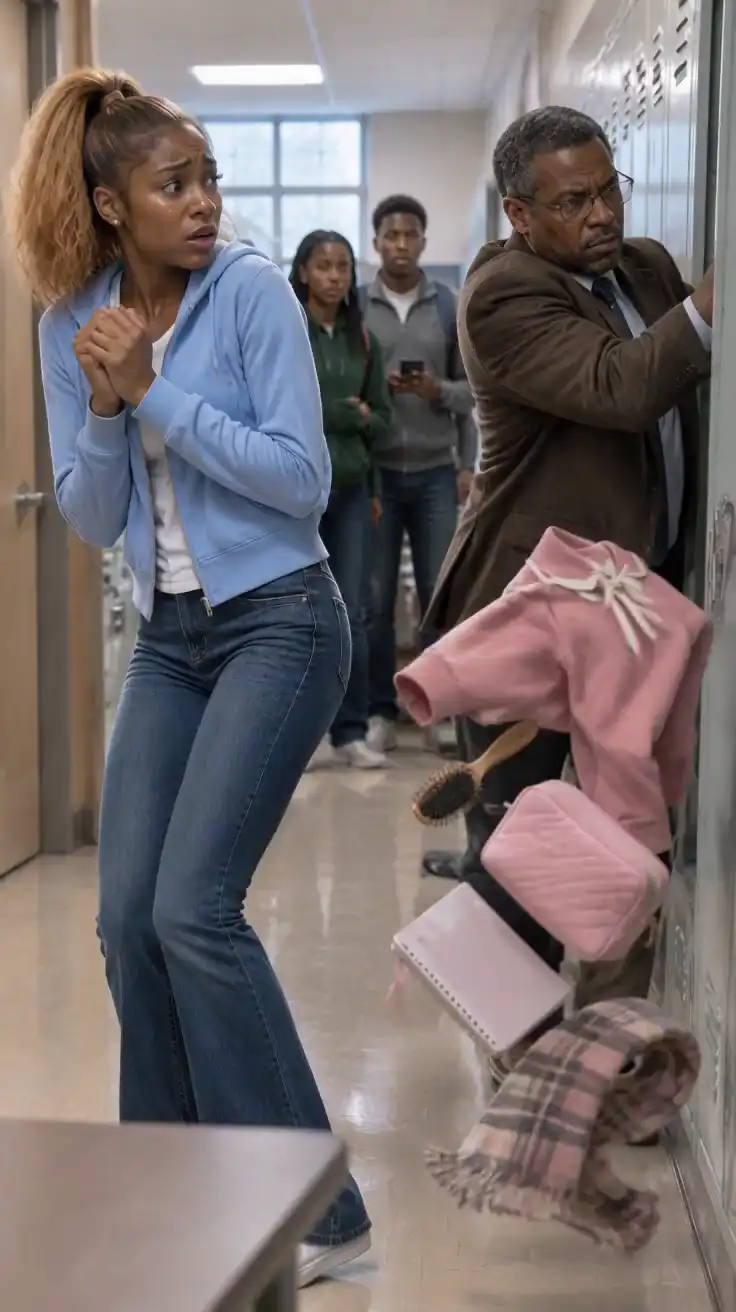
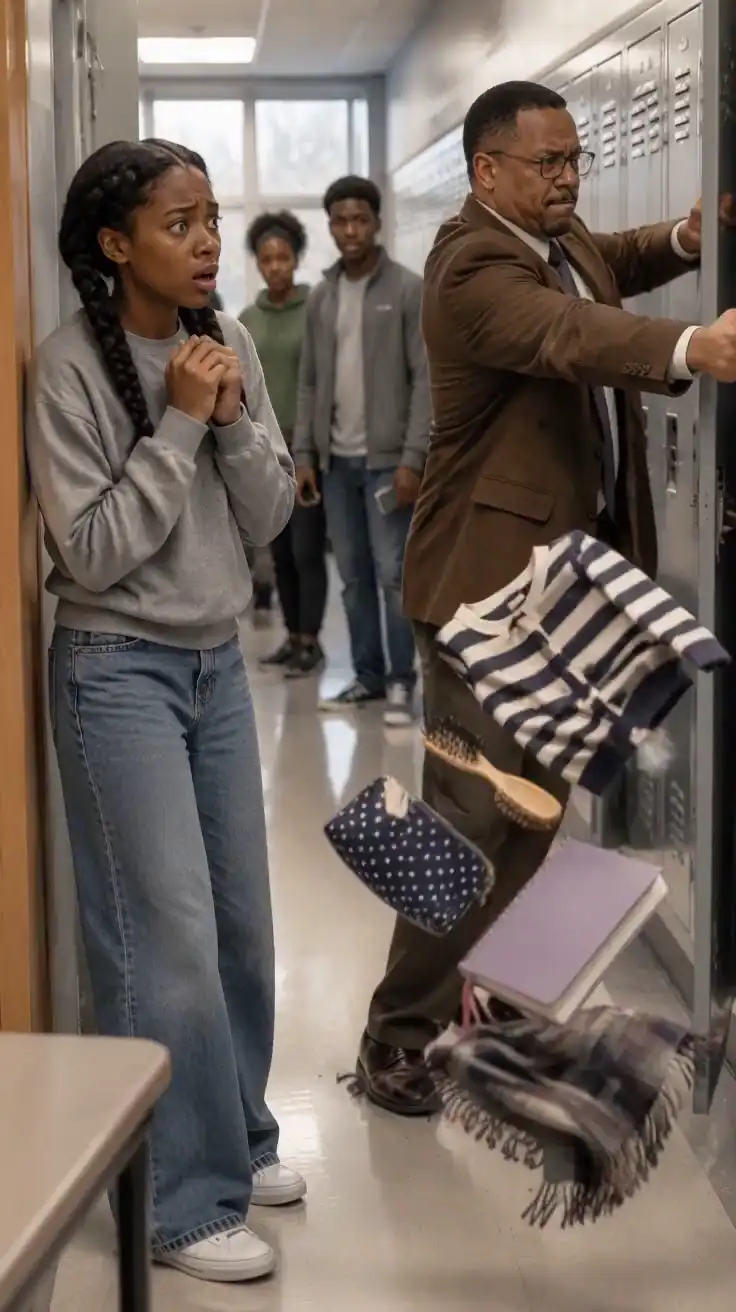
The bracelet lay on the tile between my daughter’s knees and the dean’s polished shoes.
For three seconds, nobody moved.
The hallway had been loud before that moment. Lockers were slamming. Shoes squeaked against the floor. Somebody farther down the hall laughed too loudly, the kind of laugh people use when they are pretending not to watch something. But after the bracelet fell, the entire scene seemed to hold its breath.
My daughter, Amara, looked at it first.
Then she looked at the girl who had accused her.
Sophie stood with one hand still raised from pointing. Her face had gone pale, but she did not look surprised. That was the part I noticed later, after watching the video enough times to see what I had missed the first dozen times. She looked frightened, yes. She looked caught. But she did not look confused.
The dean, Mr. Bell, bent down and picked up the bracelet.
It was a thin gold chain with a small oval charm. Sophie’s mother had given it to her for her sixteenth birthday. Sophie had worn it nearly every day since then. Amara had helped choose the charm at the jewelry store because the girls had gone together with Sophie’s mother.
I remember that day because they came home arguing over whether the charm looked like a moon or a raindrop.
“A moon,” Sophie had said.
“A raindrop pretending to be a moon,” Amara had replied.
They had spent the rest of the afternoon trying to draw it from memory.
Now Mr. Bell held that same bracelet between two fingers and stared at Sophie.
“Where did that come from?” he asked.
Sophie looked at the floor.
“Your sleeve,” one of the students said.
“I know where it came from,” Mr. Bell snapped. “I asked where it came from.”
Sophie’s mouth opened, but no answer came out.
Amara was still kneeling beside her belongings. One of her college folders had landed in a puddle near the drinking fountain. A page of her personal statement had separated from the folder and stuck to the wet tile. The title of the essay was visible even from where I stood in the doorway of the dean’s office later, after I arrived: “The Places We Build.”
That title had been on my refrigerator for three weeks. Amara had printed it out and taped it there while she revised it. I had read every draft. In one version, she wrote about community gardens. In another, she wrote about rebuilding a vacant lot near our block. In the final version, she had written about the women in our family and the way each of them had made something out of whatever they had been handed.
The page on the floor had a shoe mark across the middle.
I was not there when the bracelet dropped. I was at work, sitting in a conference room with my supervisor and two people from accounting, when my phone began vibrating against the table. I ignored it the first time because I thought it was a message from the pharmacy. The second time, I glanced down and saw the school’s number.
The third time, I answered.
“This is Amara’s mother.”
“This is Ms. Alvarez from the main office,” a woman said. Her voice was hurried. “There has been an incident involving Amara. You need to come to the school.”
“What kind of incident?”
“There was a search.”
“What kind of search?”
She hesitated long enough for my stomach to tighten.
“Amara’s locker was searched,” she said. “And there was some kind of confrontation in the hallway.”
“Is my daughter safe?”
“She is not physically injured.”
“That was not my question.”
Another pause.
“She is safe,” Ms. Alvarez said.
I stood up so fast my chair hit the wall behind me.
My supervisor asked what happened, but I was already gathering my purse. I called Amara. She did not answer. I called again. Still nothing. Then I called my sister, who worked twelve minutes from the school.
“Go,” my sister said after I explained. “I’ll meet you there.”
I drove faster than I should have, though I kept telling myself not to give the police, if I passed them, a reason to stop me. The roads were wet from a morning rain, and the sky had that gray color that makes every building look unfinished. I kept hearing the words from the office in my head.
There was a search.
Not “there was a misunderstanding.” Not “Amara is upset.” A search.
I knew what searches meant in schools like ours. I knew how quickly suspicion could attach itself to a Black child and become an excuse for humiliation. I knew how adults said procedure as if procedure could not be cruel.
By the time I reached the school, my sister was already standing outside the main entrance. Her arms were folded tightly across her chest.
“Where is she?” I asked.
“They said the dean’s office.”
“Did you see her?”
“No. They wouldn’t let me through.”
A security guard stepped toward us as we entered.
“I’m Amara Bennett’s mother,” I said. “I was called.”
He looked at a list on a clipboard.
“Dean Bell is handling it.”
“Then take me to Dean Bell.”
“I need to call the office.”
“You called me. I’m here.”
My sister stepped forward. “She is the child’s parent. You don’t need to make her stand in the lobby while you confirm that her child exists.”
The guard looked annoyed, but he picked up the phone.
I could hear my own breathing. I could hear the copier running behind the office counter. I could hear students moving through the lobby, and I wondered how many of them had already seen the video.
My daughter’s phone was not answering because, as I learned later, Mr. Bell had taken it when he stopped her. He said he had done it to prevent her from “contacting other students or altering evidence.”
She had been walking to English class when Sophie approached the dean. Sophie said the bracelet was missing from her bedroom and that Amara had stolen it during a visit the previous afternoon.
That was the first lie.
Amara had not been inside Sophie’s house that week.
The second lie was that Sophie had seen Amara put the bracelet into her bag.
The third was the one that started the search: Sophie told Mr. Bell she had noticed Amara hiding something in her locker that morning.
None of those statements was true.
At the time, Mr. Bell did not know that. Or he chose not to care enough to find out.
He had Amara open the locker. He searched it in front of the other students because, according to the explanation he later gave, he believed the bracelet might be “in immediate danger of being moved.” He did not call me before beginning. He did not ask Amara to step into a private room. He did not ask whether there was another student who could be present as a witness. He did not tell her the specific allegation until after he had emptied her locker.
He also did not search Sophie.
That fact became important later.
When the guard finally let us through, I saw Sophie’s mother, Denise Harper, standing near the dean’s office. She looked as if she had aged ten years since I last saw her. Her coat was buttoned incorrectly. One side of her blouse was tucked in and the other was not.
She looked at me.
“I’m so sorry,” she said.
I walked past her.
“What happened?” my sister asked.
“I don’t know,” Denise said.
“You do know,” I told her. “Your daughter accused mine.”
Denise flinched.
Before she could answer, the dean opened the office door.
“Ms. Bennett,” he said. “Please come in.”
I stepped inside and saw Amara sitting in a chair beside the wall. Her face was wet, though she was no longer crying. Her hands were clenched in her lap. Her braids had come loose around her shoulders. She looked younger than seventeen, and I hated everyone who had made her look that way.
I went straight to her.
“Are you hurt?”
She shook her head.
“Did he touch you?”
“No.”
“Did anyone touch you?”
“No.”
“Did you take anything out of your locker?”
“No.”
Mr. Bell stood behind his desk. He was a large man with silver hair and a habit of pressing his lips together before speaking, as if every sentence had to pass through a filter of irritation.
“Mrs. Bennett, I understand that you are upset—”
“Do not start with that sentence.”
His eyebrows lifted.
“My daughter was searched in a hallway,” I said. “Her belongings were dumped on the floor. She was made to kneel while students recorded her. You do not get to begin by explaining my emotions to me.”
“We were responding to a report of theft.”
“Then why is she the only child who was searched?”
“We had credible information.”
“From whom?”
He looked toward the glass wall of the office. Sophie and Denise were still outside.
“From another student.”
“The student who claims to have lost the bracelet?”
“Yes.”
“The student whose bracelet just fell out of her sleeve?”
Mr. Bell’s face tightened.
“I was going to explain that.”
“No. You were going to explain why this happened without first telling me that the supposed stolen item was found on the person who accused my daughter.”
Amara reached for my hand. Her fingers were cold.
Mr. Bell said, “The situation changed when the bracelet was discovered. We are investigating.”
“Where is it?”
He held it up in a clear evidence bag.
“Did you photograph it before touching it?”
He paused.
That pause told me enough.
“Did you search Sophie?” I asked.
“We are speaking with her.”
“That is not what I asked.”
“She is a minor.”
“So is my daughter.”
“We did not have reason to believe Sophie possessed the bracelet.”
“It was inside her sleeve.”
He had no answer for that.
My sister came into the office behind me. “Where are the students who recorded this?”
“Those videos are not part of the official process,” Mr. Bell said.
“Then why are you asking students to delete them?” she asked.
His eyes moved to her. “I have not asked anyone to delete anything.”
One of the students had already sent me the video. Her name was Laila, a girl Amara knew from chemistry. She sent it with one sentence: I’m sorry I didn’t stop them.
I watched the video in the car before going into the school. I watched it with the sound off first, then with the sound on. I saw my daughter’s lips form the words, “Please don’t.” I saw Mr. Bell reach toward her sleeve. I saw Sophie point. I saw the bracelet fall.
I also saw what happened immediately afterward.
Sophie turned toward the nearest hallway camera.
That detail mattered because she had later told her mother that the bracelet slipped out by accident and that she had not realized it was there. But in the video, before the bracelet dropped, Sophie’s right hand moved toward her left wrist. Her fingers pressed against the fabric of her sleeve. She was checking to make sure the bracelet was still hidden.
We did not know that yet.
At the dean’s office, Mr. Bell called Sophie in.
She entered with Denise behind her. Sophie’s face was blotchy. She had been crying, but her posture was rigid, almost defiant.
“Sit down,” Mr. Bell said.
Sophie sat in the chair across from Amara.
Amara immediately looked away.
I wanted to ask Sophie why. I wanted to ask how she could stand there after watching Amara kneel on the floor. I wanted to ask what she had expected would happen when the search began.
Instead, I said, “Tell the truth.”
Denise looked at me. “She is scared.”
“So is my daughter.”
Sophie’s eyes filled again.
“I didn’t steal anything,” she said.
“Then why was the bracelet in your sleeve?”
“I don’t know.”
Amara let out a short, broken laugh. It was the first sound she had made since we entered the office.
“You don’t know?”
Sophie looked at her.
“I didn’t put it there.”
“Your arm did it by itself?”
“Sophie,” Denise whispered.
Mr. Bell raised his hand. “We need to keep this calm.”
“No,” I said. “We need to keep this honest.”
The bracelet had not disappeared from Sophie’s bedroom that morning. Sophie had taken it from the jewelry box on her dresser before leaving for school. She had put it in the inside pocket of her backpack at first. Then, after she arrived at school, she moved it into the cuff of her sweater.
That was what she admitted later.
At the time, she said only, “I was wearing it earlier.”
“Where?” Mr. Bell asked.
“In my room.”
“Did you remove it?”
“No.”
Denise looked at her sharply.
“Sophie.”
“I don’t remember.”
Amara’s head lifted. “You accused me because you don’t remember?”
Sophie stared at the floor.
There had been a time when I knew every expression on that girl’s face. She had eaten dinner at our table so often that I knew she hated mushrooms and loved extra gravy. I knew she cried during animated movies and pretended she did not. I knew she could never keep a secret from Amara for more than a day because guilt made her talk too quickly.
The girl sitting in that office looked familiar and completely unknown.
The history between them had started before either of them could remember.
Our houses stood next to each other on a narrow street lined with sycamore trees. Their front porches faced the same patch of cracked sidewalk, and the girls had met before they knew the word neighbor. Sophie’s family moved in when she was three. Amara was four.
According to Denise, Amara had been sitting on our front steps wearing a yellow raincoat and red boots. Sophie walked over holding a plastic shovel. She gave Amara the shovel without saying anything and sat down beside her.
That was how it began.
For years, they moved between houses without knocking. Their mothers kept extra clothes for each other in case one girl got soaked in the rain or stayed overnight unexpectedly. Denise used to call our home “the second address.” I used to joke that Sophie knew our Wi-Fi password better than some of our relatives.
They rode bikes in the driveway. They made chalk cities across the sidewalk. They slept in tents in our backyard and whispered until midnight. In middle school, they started taking the bus together, though both families lived close enough to walk.
They were different in ways that made them close.
Amara was careful, observant, and stubborn about fairness. Sophie was impulsive, funny, and comfortable being the center of attention. Amara could spend three hours working on a school project without speaking. Sophie could walk into a room full of strangers and leave with six new friends.
When they were younger, those differences balanced each other. As they got older, they began to irritate each other.
The first serious argument happened in ninth grade over a group project. Sophie missed two meetings, and Amara told the teacher she could not receive equal credit. Sophie called her disloyal. Amara called Sophie irresponsible. They did not speak for four days.
Then Sophie showed up at our door with a plate of brownies.
“I have an apology,” she announced.
Amara took one bite and said, “This apology tastes like too much salt.”
Sophie burst out laughing, and the argument ended.
There were other conflicts after that, but they always repaired the damage. They understood how to return to one another.
Senior year was different.
Everything had become a competition, even when no one said so directly. Grades. Scholarships. Test scores. Leadership positions. Recommendation letters. College visits. The girls had once assumed they would go to the same university, or at least attend schools within driving distance. Then their plans began to separate.
Amara wanted to study urban planning or public policy. She had been accepted into a summer program at a university two states away and had started talking about leaving home with a seriousness that frightened me.
Sophie wanted to study communications. She applied to several schools with strong journalism programs, including one that had also been Amara’s first choice.
Neither of them admitted how much that bothered the other.
The final break came over a recommendation letter.
Sophie had asked Amara to read an essay she planned to send to a scholarship committee. Amara read it and suggested that Sophie add specific examples of her volunteer work instead of describing herself as “a natural leader” three times.
Sophie said Amara was trying to make her sound less impressive.
Amara said she was trying to help.
Sophie told her, “You only help when it makes you feel superior.”
Amara answered, “And you only ask for help when you want praise.”
That sentence ended the friendship.
They still lived next door. They still saw each other at the bus stop and on the sidewalk. But they stopped speaking.
A week later, Sophie’s mother asked why Amara no longer came over.
Denise told me about it while we were bringing groceries from our cars.
“I think the girls are just stressed,” she said.
“They are,” I replied.
“Do you think Amara said something to her?”
“I’m sure Amara said something. She has been speaking in full sentences since she was two.”
Denise smiled, but it faded quickly.
“I don’t know how to fix it,” she said.
“Maybe we don’t fix it for them.”
That was easier to say before the bracelet.
In the dean’s office, Mr. Bell asked Sophie again where she had last seen it.
“Yesterday afternoon,” she said.
“Where?”
“In my room.”
“Was Amara there?”
“No.”
The word came out too quickly.
Mr. Bell looked at her.
Sophie swallowed. “No.”
“Did you leave your room unlocked?”
“I don’t know.”
“Did anyone else have access?”
“My brother. My mother. My father.”
“Did Amara ever have access?”
“She used to.”
“Recently?”
Sophie’s eyes flicked toward Amara.
“No.”
That was the first answer she gave that was true.
Mr. Bell turned to me. “We will need statements from both students.”
“You will need more than that,” I said. “You will need to explain why my daughter was searched publicly before you had evidence.”
“We are not discussing disciplinary action against the school right now.”
“We are discussing everything.”
He said the matter would be reviewed by the principal. He said the school had to protect students’ property. He said he had acted in good faith.
Good faith did not put my daughter’s papers back into their folders. Good faith did not erase the phones held up around her. Good faith did not stop students from calling her a thief before the bracelet even touched the floor.
And good faith did not explain why the girl who made the accusation had hidden the bracelet in her sleeve.
The school suspended Sophie before lunch.
Mr. Bell told us in the conference room while the principal, Dr. Hargrove, sat beside him. Denise was there. Sophie was there. Amara and I sat across from them.
“Effective immediately,” Dr. Hargrove said, “Sophie will be placed on a five-day out-of-school suspension pending a formal investigation.”
Denise stared at her. “Five days?”
“The allegation involved theft and a false report that resulted in a student search.”
Sophie began crying.
I watched Amara’s face. She did not look relieved. She looked exhausted.
Dr. Hargrove continued. “She is not to return to campus during the suspension. We will also be reviewing whether additional disciplinary action is warranted.”
Denise turned to Sophie. “Why did you do this?”
Sophie shook her head.
“Answer me.”
“I didn’t mean for it to happen like this.”
That was the first honest thing she said.
Amara looked at her.
“How did you mean for it to happen?”
Sophie pressed her hands together. “I wanted them to believe me.”
“Believe what?”
“That you took it.”
“Why?”
Sophie’s face crumpled. “Because you always get believed.”
The room went still.
Amara stared at her as if she had spoken another language.
“What does that mean?”
“You get to be the responsible one,” Sophie said. “Everyone thinks you’re perfect. Teachers love you. Your mother trusts you. You have everything planned. You act like you’re already better than everyone.”
“I did not take your bracelet.”
“I know that now.”
“You knew it before.”
Sophie looked down.
That was when I understood the bracelet had not been hidden in her sleeve by accident.
It was not a misunderstanding. It was not forgetfulness. It was not a lost item that had somehow traveled from her dresser to the hallway.
Sophie had put it there.
I said, “Tell us exactly what you did.”
Denise closed her eyes.
Sophie’s voice dropped. “I took the bracelet from my room this morning.”
“Why?”
“I wanted to scare her.”
Amara’s expression changed. “Scare me?”
“I thought if the school searched you and found nothing, maybe you would understand what it feels like when people suspect you.”
“People suspect me?”
“You made me feel like I was stupid.”
“So you decided to make me look like a thief?”
“I didn’t think they would search your locker.”
Mr. Bell shifted in his chair.
I turned to him. “What did you think would happen?”
He did not answer.
Sophie continued. “I thought I could say I saw her put it in her bag. I thought they would call her in and ask questions. Maybe she would panic. Maybe she would admit she took it.”
Amara’s voice was low. “You planned this.”
“I was angry.”
“You planned it.”
“Yes.”
“Why was it in your sleeve?”
Sophie rubbed her eyes. “I was going to put it in your locker.”
That answer surprised all of us.
She said she had come to school wearing a loose gray sweater. The bracelet was in her backpack at first. During homeroom, she moved it into her sleeve because she was afraid someone would see it when she opened the bag. Her plan was to wait until the hallway was crowded, open Amara’s locker with the spare combination she still remembered, and slip the bracelet inside.
She had known Amara’s locker combination because, before the friendship ended, Amara had asked Sophie to grab a book for her while she was out sick.
The plan had changed when Sophie saw Amara in the hallway.
“I told Mr. Bell before I put it there,” Sophie said. “I thought if he searched her before I had to do anything, then it would be easier.”
“Easier for whom?” I asked.
She did not answer.
She had pointed at Amara because Mr. Bell was beginning to look inside the locker and had not found anything. Sophie said she was afraid he would stop. She had wanted him to search Amara’s pockets, her bag, her sleeves. She wanted the humiliation to become proof.
Then she stepped backward, and the bracelet fell.
Sophie said she had not realized it was visible. She had expected it to stay inside the cuff until she reached Amara’s locker.
The whole plan had lasted less than twenty minutes.
The damage would last much longer.
The first consequence was the video.
By the end of the school day, students had shared it through group chats and private messages. Some added captions. Some slowed down the part where Amara knelt. One person posted a version with music. Another wrote, “Imagine accusing someone and dropping the evidence from your own sleeve.”
That version spread farthest.
Amara’s phone filled with messages. Some students apologized. Others asked for details as if her humiliation were a story they had been waiting to hear. A boy she had never spoken to sent her a laughing face and wrote, “You almost got locked up.”
I reported that message to the school.
The school sent a general email asking students not to share “content related to a student disciplinary matter.” It did not name Amara. It did not acknowledge that an adult employee had allowed the search to happen in public.
When I complained, the principal said the email was “carefully worded to protect student privacy.”
“Whose privacy?” I asked.
“Everyone’s.”
“My daughter’s privacy was already violated in a hallway.”
“We are addressing the situation.”
“You are addressing it by asking other children not to discuss it. You are not addressing why your dean treated my daughter like a criminal.”
Dr. Hargrove said Mr. Bell had followed school policy.
I asked for the policy.
She sent me a document with sections about reasonable suspicion, student safety, and the handling of personal belongings. The language was broad enough to justify almost anything. It said a search should be conducted in a manner that preserved the student’s dignity “to the extent practicable.”
I circled that sentence and sent it back.
“Explain why dignity was not practicable,” I wrote.
No one answered that email.
Amara did not want to return to school.
The morning after the search, she stood in the kitchen wearing the sweatshirt she had worn the day before. Her backpack was on the floor beside her, untouched.
“I can’t go,” she said.
I was making toast, but I turned off the stove.
“You can stay home today.”
“What about tomorrow?”
“We will decide tomorrow.”
“They’re going to look at me.”
“Some will.”
“They’re going to think I did it.”
“They know who had the bracelet.”
“That doesn’t mean they know me.”
She sat at the kitchen table.
“I keep seeing the floor,” she said. “The page in the water. My things everywhere. I keep thinking about how everyone was standing there.”
I sat beside her.
“You did nothing wrong.”
“I know.”
“But knowing doesn’t make it feel better.”
She shook her head.
“I wanted senior year to be normal.”
I reached for her hand.
“Normal was already overrated.”
She smiled a little, but it did not last.
The college applications were the part that frightened her most. Her early application deadlines were only weeks away. She had essays to revise, financial aid forms to complete, teacher recommendations to request, and a scholarship interview scheduled for the following Monday.
“What if someone sends the video to a college?” she asked.
“Then we explain what happened.”
“What if they don’t believe me?”
“Then we make them believe you.”
“You can’t make everyone believe me.”
“No,” I said. “But I can make sure they hear the truth.”
Her English teacher, Ms. Patel, was the first person at school to help without making Amara explain herself. She came to our house that afternoon carrying a paper bag with soup, crackers, and two folders.
“I brought the work you missed,” she said.
Amara looked embarrassed. “I was only gone one day.”
“Then you have one day of work.”
Ms. Patel sat at the kitchen table and reviewed the personal statement with her. She did not mention the bracelet until Amara did.
“I’m sorry,” she said. “I should have been there.”
“You weren’t responsible for it.”
“I know. But I should have made sure you knew you had somewhere safe to go.”
That sentence stayed with Amara.
The next day, Ms. Patel arranged for Amara to enter through the counseling office instead of the main hallway. She got permission for her to use a private room during lunch. She asked teachers not to call on her unexpectedly.
It helped, but it did not erase the shame.
Sophie’s suspension became more complicated.
Denise called me three days after the incident. I almost did not answer. When I saw her name, I let the phone ring twice before picking up.
“I know you don’t want to talk to me,” she said.
“That has not stopped you before.”
“I deserve that.”
“What do you want?”
“I want to apologize.”
“You can apologize to Amara.”
“I have.”
“Not in a text.”
“I know.”
There was a long silence.
“Can I come over?”
I looked toward the window. Our two houses were separated by a narrow strip of grass and a wooden fence the girls had painted together when they were eleven. The paint had faded, but I could still see the uneven blue flowers they had added along the bottom.
“Not today,” I said.
“Will you tell me when?”
“I don’t know.”
She began crying.
“I should have known,” she said.
“What should you have known?”
“That Sophie was capable of this.”
“You are her mother. You are not responsible for every decision she makes.”
“But I believed her.”
“So did the dean.”
“I told the school I thought Amara had taken it.”
“That is true.”
“I was angry.”
“You were.”
“I saw how upset Sophie was, and I didn’t question anything.”
“Neither did the school.”
“That does not make it right.”
“No.”
The truth was that Denise had added to the harm, even if she had not intended to. She had called the school that morning after Sophie told her the bracelet was missing. She had said Amara had been in their home many times and had access to Sophie’s room. She had asked the school to “take the situation seriously.”
She later told me she believed she was asking them to investigate, not punish Amara.
But adults do not get to separate intention from impact when a child is the one carrying the impact.
The Harper family did eventually come to our house.
It was a Sunday afternoon. Denise arrived with Sophie and Sophie’s younger brother, Marcus. Her husband, Tom, stayed in the car for several minutes before joining them. He looked uncomfortable, as if he had been asked to enter a courtroom.
Amara was upstairs. She had agreed to come down only if she could leave whenever she wanted.
Sophie stood on our porch holding something in both hands.
It was a folder.
Inside were handwritten pages, printed messages, and a statement she had written for the school. She had also brought the gray sweater. She handed it to me.
“I want you to see it,” she said.
I did not touch it.
“You need to give that to the school.”
“I did.”
“Then why bring it here?”
“Because I want Amara to know I’m not going to say it slipped out by itself.”
That was the first thing she did that showed me she understood the difference between being caught and telling the truth.
I let them in.
Amara came downstairs wearing sweatpants and a large T-shirt. She sat on the far end of the couch, with a cushion between her and Sophie.
Sophie stood in front of her.
“I’m sorry,” she said.
Amara looked at the folder.
“What did you write?”
“Everything.”
“Everything?”
“I wrote that I planned it. I wrote that I took the bracelet from my room. I wrote that I lied about seeing you put it in your bag. I wrote that I told the dean to search you. I wrote that I wanted you to feel scared and embarrassed.”
Amara’s jaw tightened.
“You wanted that?”
“Yes.”
“Why?”
Sophie’s eyes filled.
“Because I thought you had embarrassed me when you said my essay was weak.”
“I said it needed examples.”
“I know.”
“You told me I was jealous.”
“I was angry.”
“You told everyone I thought I was better than you.”
“I wanted them to think that.”
“Why?”
Sophie looked at her.
“Because if I was the hurt one, then I didn’t have to admit I was jealous.”
Amara sat back.
“Jealous of what?”
“Everything.”
“That is not an answer.”
“Your grades. Your applications. Your plans. The way adults trust you. The way you can say no to people and still have them respect you. I kept thinking that if I made you look selfish, then maybe I wouldn’t feel so small next to you.”
Amara’s eyes hardened.
“You lived next door to me. You were my friend. You could have told me.”
“I thought you would judge me.”
“I would have been angry.”
“I know.”
“I would have listened.”
Sophie nodded. “I know that now.”
Amara looked toward me. I could see that she wanted permission to end the conversation.
“You don’t owe her forgiveness,” I said.
Sophie lowered her head.
“I’m not asking for forgiveness,” she said. “I’m asking you to know that I know what I did.”
That mattered to Amara more than I expected. Not enough to restore the friendship. Not enough to erase the search. But enough to let the conversation continue.
They spoke for nearly an hour.
I stayed in the room, but I did not interrupt unless one of them asked me something. They talked about the essay, the college applications, the comments they had made to other friends, and the way their friendship had become a contest neither of them knew how to stop.
At one point Amara said, “You didn’t just hurt me. You made it possible for people to believe the worst about me.”
Sophie said, “I know.”
“You gave them a story they already wanted.”
“I know.”
“Do you understand why that is different for me?”
Sophie looked at her for a long time.
“Yes,” she said. “I didn’t understand before. I do now.”
That answer was imperfect. It was also the first one that did not try to protect Sophie from the full truth.
The school’s formal investigation lasted six weeks.
The district interviewed students, reviewed the hallway video, collected copies of the messages, and examined the security footage from the corridor. The footage showed Sophie approaching Mr. Bell, speaking to him, and then watching while Amara was stopped.
It also showed Sophie checking her sleeve several times.
The dean denied noticing that movement.
He said the bracelet falling from Sophie’s sleeve had been “an unexpected development.” He said he had believed Amara was the more likely suspect because Sophie’s report had been specific.
When asked why he did not search Sophie after the bracelet was found, he said he was focused on “stabilizing the scene.”
The district report concluded that he had failed to follow best practices. It did not use the word humiliation. It did not say racial bias. It did not say that Amara had been treated differently because she was Black.
Instead, it said the school should revise its procedures for searches and provide additional training on implicit bias and student dignity.
I read the report three times.
Then I called the district office.
“Your report describes what happened without naming why it happened,” I said.
The investigator said they could not determine intent.
“Intent is not required to identify unequal treatment.”
“We found no conclusive evidence that race was a motivating factor.”
“You found evidence that a Black student was publicly searched based on an accusation from a white student, while the accusing student was not searched even after the alleged stolen property fell from her clothing.”
“We did not find that the dean acted with discriminatory intent.”
“You keep saying intent as if it is the only thing that matters.”
There was a pause.
“I understand your concern.”
“No, you understand my words. That is not the same as understanding what happened.”
The district offered Amara counseling, a written apology, and the option to have the search removed from any internal disciplinary record.
There had never been a disciplinary record against her, but I asked for that statement in writing anyway.
They also offered to let her complete the rest of senior year through an independent study program if she felt unsafe returning.
Amara refused.
“I’m not leaving,” she said. “I didn’t do anything.”
She returned to school the Monday after the investigation ended.
The first day was difficult. Some students looked away. Some looked too long. A girl in her history class whispered, “That’s her,” as Amara walked past.
But something else happened too.
Laila, the student who had sent me the video, stood outside the classroom.
“I saved the original,” she said. “The one without the captions.”
“Why?”
“Because I thought someone might need it.”
Amara thanked her.
Then two more students approached. One had been in the hallway. The other had seen Sophie tell Mr. Bell, “She has it.”
They gave statements to the district.
A week later, six students had come forward.
That did not undo what happened, but it changed the story. Amara was no longer the only person carrying it.
Sophie returned after her suspension to a different school than the one she had left.
Some students defended her. Some called her a liar. A few told her she had ruined her own life. She stopped eating lunch in the cafeteria and spent most of her free periods in the library.
The school revoked her student leadership position and removed her from the peer mediation program. Her suspension was recorded in her discipline file. She was required to complete restorative justice sessions, though the sessions did not include Amara.
She lost her early admission offer from the university that had accepted her.
That part caused serious damage between the Harper family members. Denise blamed the school for not considering that Sophie had been “emotionally overwhelmed.” Tom said Sophie had made the decision and had to live with it. Marcus stopped speaking to his sister for nearly a month because students had started teasing him about the bracelet.
Sophie’s parents also received angry calls from other families. Some said they were overreacting by allowing the school to suspend her. Others said the school was being too lenient.
There was no version of the aftermath in which Sophie was the only person punished.
Her mother had to explain to relatives why their daughter had lied. Her father had to attend meetings with the district. Marcus had to walk past students who knew his sister’s name. The Harper family began keeping their curtains closed because strangers had started slowing down in front of the house.
I did not feel satisfaction watching that happen.
People sometimes expect a mother to feel triumphant when the truth vindicates her child. I felt relieved, furious, protective, and tired. I felt the unfairness of how quickly the accusation had spread compared with how slowly the truth moved.
Amara had been called a thief in seconds.
It took weeks to prove she was not one.
The college applications survived.
Ms. Patel wrote an additional letter for Amara, not describing the incident in detail but explaining her character, resilience, and commitment to her education. The counselor submitted the district’s statement to the schools that requested information. Amara rewrote the personal essay about places we build.
She changed the title.
The new title was “What We Carry.”
She did not write about the bracelet. She wrote about the papers on the hallway floor and the way people had assumed that once they were scattered, they could never be put back in order. She wrote about learning that rebuilding did not mean pretending something had not been broken.
When she read the final version to me, I cried before she reached the end.
“Is that too much?” she asked.
“No.”
“Too personal?”
“No.”
“Too angry?”
“Not angry enough,” I said.
She smiled.
She was accepted into three universities, including her first choice. The one two states away offered her a scholarship for community development. On decision day, she sat at the kitchen table with her laptop open and called me, my sister, Ms. Patel, and her grandmother one by one.
When she accepted the offer, she cried.
I cried too.
The bracelet itself was returned to Denise.
The school had kept it in an evidence bag until the investigation ended. Denise placed it in a small box and brought it to our house. I did not want it, but Amara asked to see it.
Sophie had polished it before she took it from her room. That detail made everything worse. She had prepared it. She had chosen the sweater. She had rehearsed what she planned to say.
Amara held the bracelet in her palm.
“I used to like this,” she said.
“You can still like it,” I told her.
“It doesn’t feel the same.”
“You don’t have to keep it.”
She looked at me. “It isn’t mine.”
“No.”
“Then I don’t want it.”
We returned it to Sophie’s family.
The girls did not become friends again.
That is one of the truths I had to accept. Reconciliation is not always the ending people want. Sometimes the most honest ending is distance with boundaries.
They remained neighbors. They passed one another on the sidewalk. They attended the same graduation. They knew when the other family’s car left in the morning and when the porch light came on at night.
By spring, they could stand in the same room without leaving.
That was enough.
At graduation, Sophie’s name was called before Amara’s. Denise and Tom applauded. Amara’s family applauded too. Sophie walked across the stage with her shoulders straight. She did not look toward us until she returned to her seat.
When Amara’s name was called, I stood with everyone else.
She wore a blue cord for academic honors and a small gold pin from the community service club. The pin caught the light as she crossed the stage.
For one terrible second, I thought of the bracelet falling from Sophie’s sleeve.
Then I thought of something else.
Amara had not let that moment become the definition of her senior year. She had finished her applications. She had gone back to school. She had kept her grades. She had accepted a future that was larger than the hallway where people had tried to shrink her.
After the ceremony, Sophie approached us near the gym doors.
She had a folder in her hand.
“I wanted to give this to you,” she said to Amara.
It was a copy of the statement she had written for the district, along with a second letter addressed to the college admissions offices that had asked about her disciplinary record.
Amara did not take it immediately.
“What does it say?”
“That I lied. That you did not steal anything. That the bracelet was in my sleeve because I put it there. I wrote that the search happened because of me, but that the school made its own decisions too.”
Amara glanced at me.
I said nothing.
Sophie continued. “I don’t expect you to forgive me. I just don’t want anyone to think the truth was that you almost got caught. The truth is that I tried to make you look guilty.”
Amara took the folder.
“Why are you giving this to me now?”
“Because I should have given it to you before graduation.”
“That doesn’t answer the question.”
Sophie’s eyes moved toward the gym, where families were taking pictures.
“Because I kept telling myself I was sorry, but I was still trying to control how the story ended. I wanted you to forgive me so I could feel better. This is the first thing I’ve done without asking you to make me feel better.”
Amara looked at her for a long moment.
“Are you going to college?”
“Yes.”
“Where?”
“State school. Communications.”
“That’s still good.”
“It is.”
“Are you going to be a journalist?”
“I hope so.”
“Then learn to check your facts before you accuse someone.”
Sophie nodded.
“I will.”
They stood there with the folder between them.
Then Amara said, “I’m not your friend.”
“I know.”
“I’m not going to be your friend next semester, either.”
“I know.”
“But I don’t hate you.”
Sophie began crying.
Amara did not hug her. She did not say everything was okay. She did not make the scene easier for anyone.
She simply handed the folder back.
“Keep it,” she said. “You’re the one who needs to remember what happened.”
Sophie took it.
That was the last time I saw them speak before Amara left for college.
The school never gave me the apology I wanted. Dr. Hargrove sent a letter that said the administration regretted “the distress experienced by all involved.” Mr. Bell transferred to another campus at the end of the year. No one told us whether that transfer was connected to the search.
The district revised its search policy. Students were no longer to be searched in open hallways except in an immediate emergency. Parents were to be notified before a search whenever possible. Administrators were required to document the reason for the search and the names of all students who provided information.
Those changes were written in clean language on clean paper.
They did not undo the video.
They did not undo the way Amara’s classmates had looked at her.
They did not undo the question she asked me that first night: “What if they believe the wrong version of me?”
But they were something.
I still have the video on my phone. I have it backed up in two places because I learned early that truth needs witnesses. I do not watch it often anymore. When I do, I stop before the bracelet falls.
I watch Amara’s face.
I watch her kneeling on that floor, trying to protect her dignity while adults talked over her. I watch the moment she looks toward the camera, not knowing who is recording or whether anyone will help. I watch her refuse to say something she does not mean.
Then I remember her at four years old, standing on the front steps in a yellow raincoat while Sophie offered her a plastic shovel.
I remember the girls drawing the bracelet charm on our kitchen table.
I remember them racing between our houses, certain that the space separating them was too small for anything bad to grow.
They were children then. The distance between their homes seemed simple. One porch, one fence, one patch of grass. As they got older, that same distance held resentment, comparison, silence, and finally a lie.
The bracelet was never really about gold.
It was about what Sophie wanted to take from Amara. Her credibility. Her confidence. Her senior year. The future she had worked toward. Sophie wanted to make Amara feel the same uncertainty and humiliation she had been carrying inside herself.
Instead, the lie exposed the person who created it.
That does not make the harm disappear. It does not make Sophie evil or Amara untouched. It does not turn the school into a hero because the truth happened to fall onto the tile in front of a camera.
It only means that, for once, the evidence did not stay hidden.
And when the bracelet slid from Sophie’s sleeve, my daughter was still on her knees, surrounded by her scattered papers.
She had not yet stood up.
But she did.