I did not hear the bracelet hit the floor.
I heard it in the video later, after I had watched the dean’s hand leave my daughter’s locker and after I had watched my daughter kneel beside her things. The sound was small, almost delicate. A little bright click against the tile. In the hallway, it was swallowed by the hum of the lights.
The girl pointing at my daughter stopped speaking.
So did everyone else.
The bracelet lay between them. Its gold links were twisted around themselves, and the tiny clasp was open. The girl looked down at it. My daughter looked down at it. Then the dean looked down at it, and his face changed.
That was the moment the accusation ended. It was not the moment the damage did.
I was not there when the bracelet fell. I was at work, standing in a supply closet with my phone pressed to my ear, listening to the school receptionist tell me there had been “an incident.” I had been asked to come in. She did not say my daughter was being searched. She did not say the search was happening in front of students. She did not say the dean had told her to kneel.
I learned those parts from the video.
Before I tell you what happened after the bracelet hit the floor, I have to tell you how it got into that sleeve.
The girl who pointed at my daughter was named Lila Mercer. Her little brother, Owen, was eleven. My daughter, Anna, was fourteen. Anna and Lila had been friends since they were both nine, when they joined the same cheer squad at the community gym on Maple Street.
It was not the kind of squad people picture when they hear the word cheerleading. We did not have a bus, a mascot, or a school gym with a polished floor. We had a multipurpose room that smelled like rubber mats and old coffee, and a coach named Renee who kept spare hair ties in a plastic tub by the door. The uniforms were red and white, with a little silver stripe down the side. The girls practiced twice a week and performed at town games, fundraisers, and the winter parade.
Anna had always been small for her age, but she was strong. She could hold a flyer steady above her head while the other girls adjusted their grips. Lila was taller, quick, and fearless in a way that made Coach Renee keep a hand near her elbow.
They were a good pair. Anna could count under her breath without losing the rhythm. Lila could make a routine look like it had been invented just for her. They learned each other’s timing so well that if one of them stumbled, the other was already there.
When they were ten, they practiced a lift in our driveway because the gym was closed for a plumbing repair. I watched from the kitchen window. Anna stood in the middle, hands braced at Lila’s waist. Lila leaned back into her, trusting her completely. When Lila wobbled, Anna shifted her feet and steadied her.
“Got you,” Anna said.
“I know,” Lila answered.
I remember that because I heard it through the open window. I remember thinking how much trust those three words held.
They were together at practice, together at the school bus stop, together on weekends. They made friendship bracelets with embroidery floss and gave each other ridiculous nicknames. Lila called Anna “Captain” after Anna insisted on running a practice when Coach Renee was sick. Anna called Lila “Rocket” because she always seemed to be moving before anybody else had decided to go.
They also shared a locker at school.
The locker was number 214, in the hall outside the music rooms. It was wide enough for two girls if they kept their things organized. They decorated the inside with a strip of red tape down the middle, though neither one respected the border for long. Anna kept her books on the left, her gym shoes underneath, and a notebook wedged against the back wall. Lila kept a spare sweater and a small pouch with hairpins and lip balm on the right. They both used the top shelf for things they were supposed to take home and often forgot.
The family photograph was behind Anna’s notebook.
It was not a remarkable photograph. There was no special lighting, no studio background, no important occasion. We were at a picnic table in the park beside the river. My husband, Mark, had one arm around Anna and the other around our son, Ben. Ben was four and missing a front tooth. Anna was nine, with her hair in two uneven braids because I had done them in the car. I was holding a paper plate and laughing at something outside the frame.
The picture had been taken two years before Mark died.
Anna kept it because she said she liked the way we looked before we knew what was coming. I never asked what she meant. I knew what she meant.
After Mark’s death, I put photographs in frames around the house. Anna took that one down from the hallway and slipped it into her binder. Then it went into a drawer, then a book, then the back of her locker. She said she did not want it where everybody could see it. She also did not want it at home, where Ben might pick it up or where I might ask about it.
It was the only picture she had of all four of us together. Our old phone had stopped working, and the account where we kept the rest of the photographs had been closed. I had tried to get them back. I had called the company, found the old email, answered security questions, and been told the files were no longer available. The picnic picture was a print, and Anna had carried it from place to place like something breakable.
She never told Lila what it meant. Lila knew it was a family photo. She did not know it was the only one.
The first thing that changed between the girls was not the bracelet.
It was the police.
In February, Ben was twelve and had started spending time with a boy named Cody who lived two blocks over. Cody was thirteen, though he seemed older to Ben. He had a father who was always gone and a set of keys he was not supposed to have. He knew which back doors at the shopping plaza did not latch properly. He knew how to make a person feel foolish for being cautious.
Ben was not a bad kid. He was a lonely one. After Mark died, he started watching me too closely. He noticed when I was tired, when the bills came in, when I sat in the car after work and did not go inside right away. He did not ask for much. He tried to make himself easy to take care of.
Cody noticed that and knew how to use it.
The first time Ben went with him behind the pharmacy, he thought they were going to meet another kid. Cody had found a shopping cart with a broken wheel and wanted to push it down the service lane. Then Cody suggested they go inside through the delivery door. He said he had done it before. He said they were just looking for a place to sit.
Ben went in because he was scared that saying no would mean Cody would tell the others he was a baby.
They came out with two boxes of cough medicine and a bag of candy. Ben said he did not know what Cody planned to do with them. He said he tried to put them back, but a store employee saw them. He said the employee grabbed Cody’s sleeve, Cody yanked away, and the two of them ran.
The police came to our apartment that evening.
The officer was calm. She spoke to Ben at the kitchen table and asked him who had gone inside. Ben looked at me, and I saw him fold in on himself. He had gone white around the mouth. He was frightened enough that he could hardly speak.
I told the officer Ben had been with me.
It was a lie. It was an obvious lie, and the officer knew it. She asked me again. I kept saying it. I said I had picked him up from the library. I said he had been home before dinner. I said I must have confused the days.
Ben stared at the table.
The officer took my name and number and left. She told me not to lie to her again. I nodded, and when the door closed, Ben cried so hard he hiccupped.
I told him I was not protecting him from consequences. I told him he could not go with Cody again. I told him I had made the situation worse by lying, and that I would fix it. I did not fix it. I kept hoping the store would decide not to pursue anything, and that the police would stop asking questions.
They did not stop asking.
For months, they called to confirm details. A detective came to our apartment once. Ben was never arrested, but he knew the police had his name, and he was terrified that one bad answer would make them take him away. I told him they were not going to take him. I told him he could tell the truth. I told him I would be with him.
Then, when they asked whether he had been inside the store, I said no.
I had started it, and then I kept doing it.
Anna knew I had lied. She knew because she had been there the first time the officer asked. She heard me say Ben was with me, and she watched Ben look at the table. She did not challenge me in front of him. Later, she came into the kitchen while I was washing dishes.
“You’re going to get in trouble,” she said.
“I know.”
“Then why are you still doing it?”
“Because he’s scared.”
“So are you.”
I turned off the water. “I’m trying to keep him from being scared.”
“That isn’t the same as keeping him safe.”
She said it without raising her voice. That was what made it hard to dismiss. Anna had always been careful with words. She usually knew when not to say something. I told her the matter was between me and the police.
She looked at me for a long time.
“It won’t stay between you and the police,” she said.
She was right.
I took her warning as criticism. I thought she was angry that I had lied, or that she believed I was putting Ben above her. What I did not understand was that she had started carrying the fear too. She was checking the front window when a car slowed outside. She flinched at knocks on the door. If she heard a police siren, she looked toward Ben’s room before she looked at me.
She was fourteen. She did not have the words to tell me that she thought our family might come apart if one of us told the truth.
For a while, she tried to keep life ordinary. She went to school. She went to practice. She did her homework. She helped Ben with his math. She put the family photograph back in her locker after I asked her to bring it home, and she told me it was safer there.
Then Lila’s bracelet disappeared.
It happened on a Wednesday after practice. Lila had arrived wearing the bracelet, a thin gold chain with a small oval charm. It had belonged to her grandmother, who had died the year before. Lila wore it most days, though Coach Renee made her take it off for stunts. She had a habit of tucking it into the front pocket of her gym bag.
At the end of practice, she could not find it.
The girls searched the mats and the changing room. Coach Renee checked the lost-and-found bin. Lila emptied her bag twice. Anna helped her look under the bleachers and along the edge of the floor, where things sometimes got kicked.
They did not find it.
Lila was quiet on the ride home. She was quieter the next morning. At school, she asked Anna if she had seen it. Anna said no. Lila asked if she remembered when she had last seen it.
“Before warm-ups,” Anna said. “You took it off and put it in your bag.”
“Did you see me do that?”
“I saw you put something in your bag.”
It was a small distinction, but it seemed to bother Lila. She asked again later, in the hallway by their shared locker. Anna told her she had not touched the bag.
“I didn’t say you did,” Lila said.
“You asked me three times.”
“Because I’m trying to figure out where it went.”
“Then ask Coach Renee.”
“I did.”
“Ask the girls who were changing near us.”
“I did.”
“Then why are you asking me?”
Lila looked away. “I don’t know.”
They stopped walking. The bell rang, and students flowed around them.
Anna told me about the exchange that evening. She said Lila was upset and that she was trying not to take it personally. I said she should give Lila time. People could become unreasonable when they were scared about losing something important.
Anna said, “I know.”
She did not say that the phrase sounded familiar.
A week went by. Lila stopped sitting with Anna at lunch. When Anna asked what was wrong, Lila said she did not want to talk about it at school. Their coach noticed they were no longer partnering without being asked. Coach Renee moved the girls around in practice and told them to focus on their routines.
The friendship did not end with a fight. It narrowed. They stopped sharing snacks. They stopped saving each other seats. Lila moved her things to a different locker, but the red tape stayed on the inside of number 214. Their names were still written in marker on the top shelf.
Then came the accusation.
I was at work that Monday, trying to get through a list of phone calls before lunch. The school number came up on my screen. I thought Anna had forgotten her lunch again.
The receptionist told me the dean, Mr. Harlan, wanted to speak with me about a missing item. I asked what item. She said it was a gold bracelet belonging to another student. I asked if Anna had been accused of taking it. The receptionist paused for a moment.
“She is being asked about it,” she said.
I asked if Anna was in trouble. The receptionist said Mr. Harlan would explain when I arrived. I told her I could be there in twenty minutes.
I called Anna on the way. She did not answer. I called again. Nothing.
I drove faster than I should have. I remember that because I kept both hands tight on the wheel and watched the speedometer rise. I was not thinking clearly. I was thinking about the police officer at our kitchen table. I was thinking about the way Ben had stared at his hands. I was thinking about all the times I had believed that if I could get somewhere quickly enough, I could keep the worst thing from happening.
When I pulled into the school lot, I saw three students outside the main doors. They were not watching me, but they were standing close together and looking toward the building. I went inside and told the receptionist my name.
She said, “They’re in the south hall.”
I asked who was with them.
“Mr. Harlan, Ms. Price, and the girls.”
“Which girls?”
“Anna and Lila.”
I started down the hall. The receptionist followed me for a few steps, saying there had been a concern and that the dean was trying to establish what happened. I told her I wanted to speak to Anna.
“I’m sure you will,” she said.
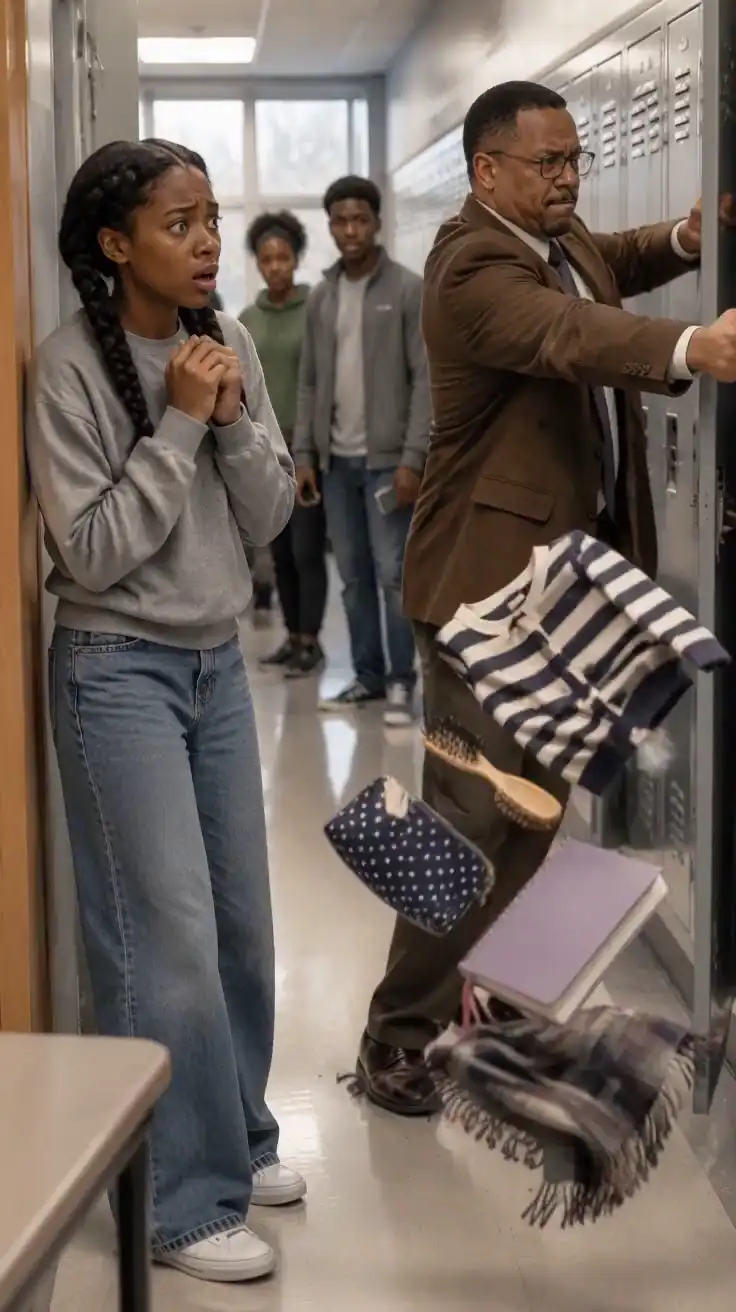
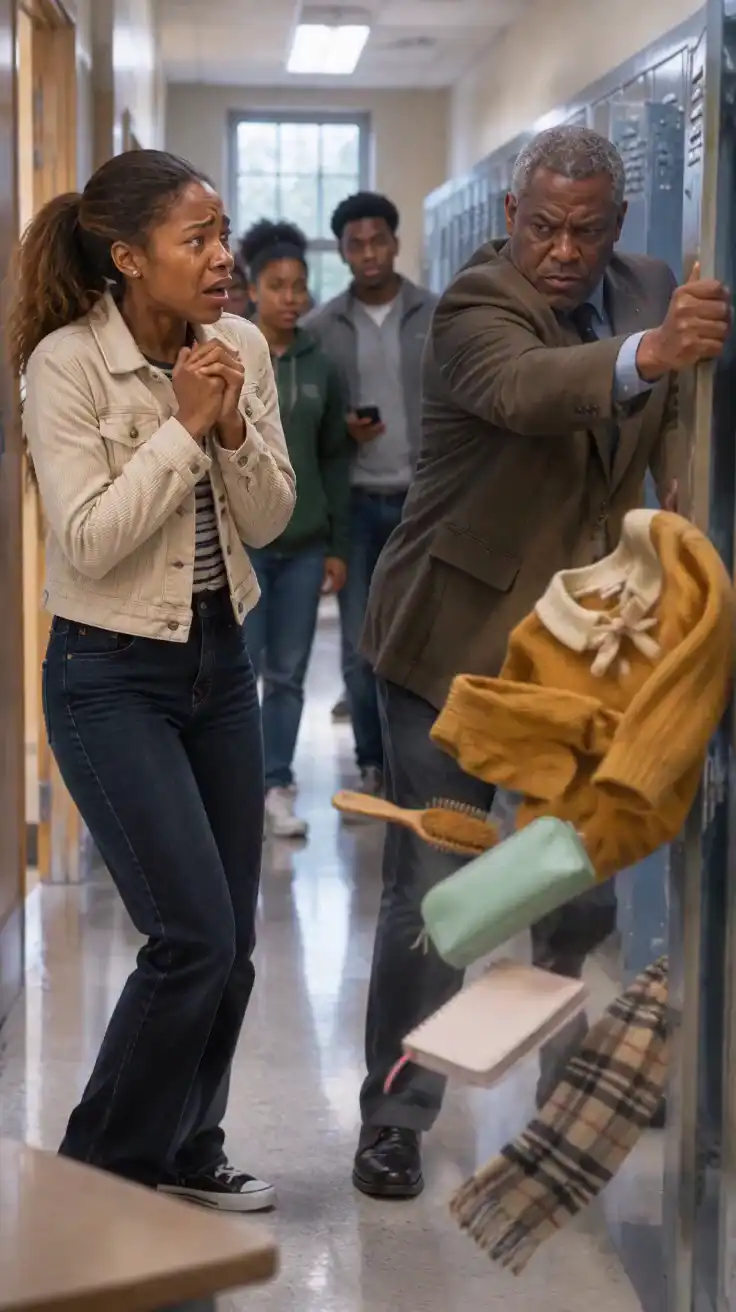
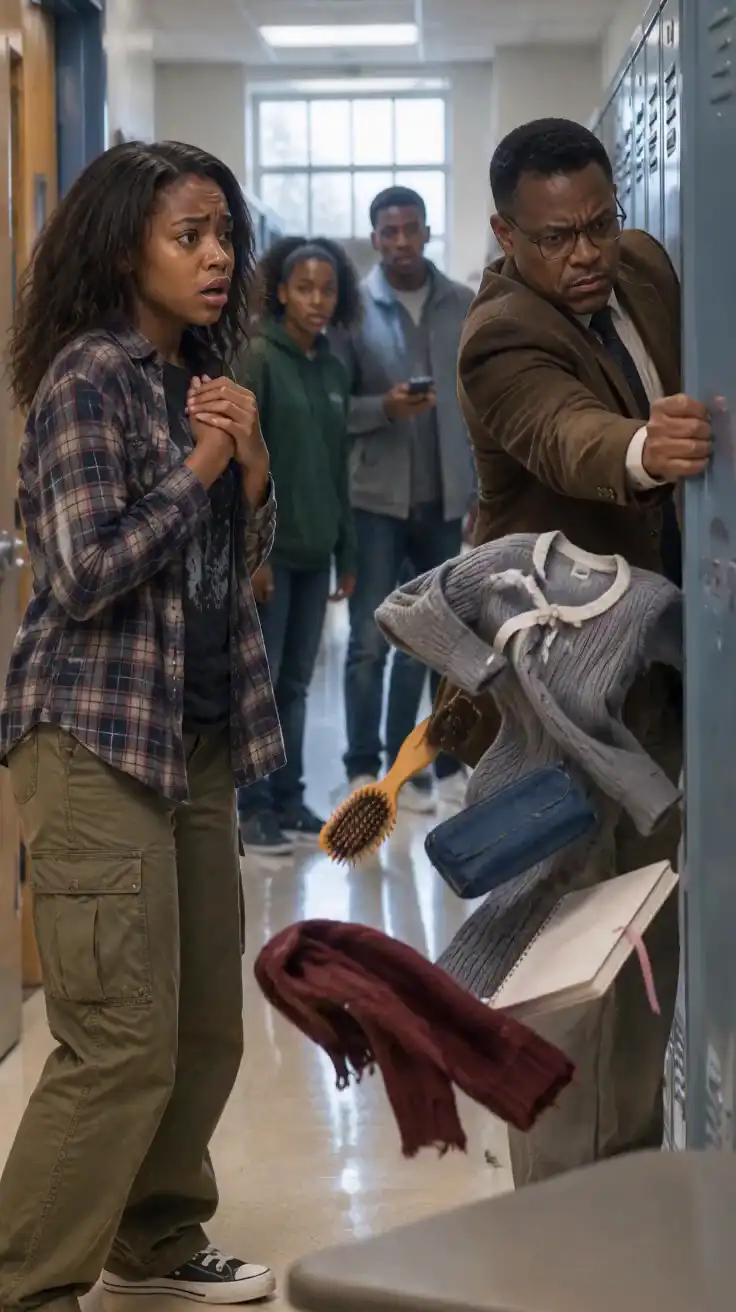
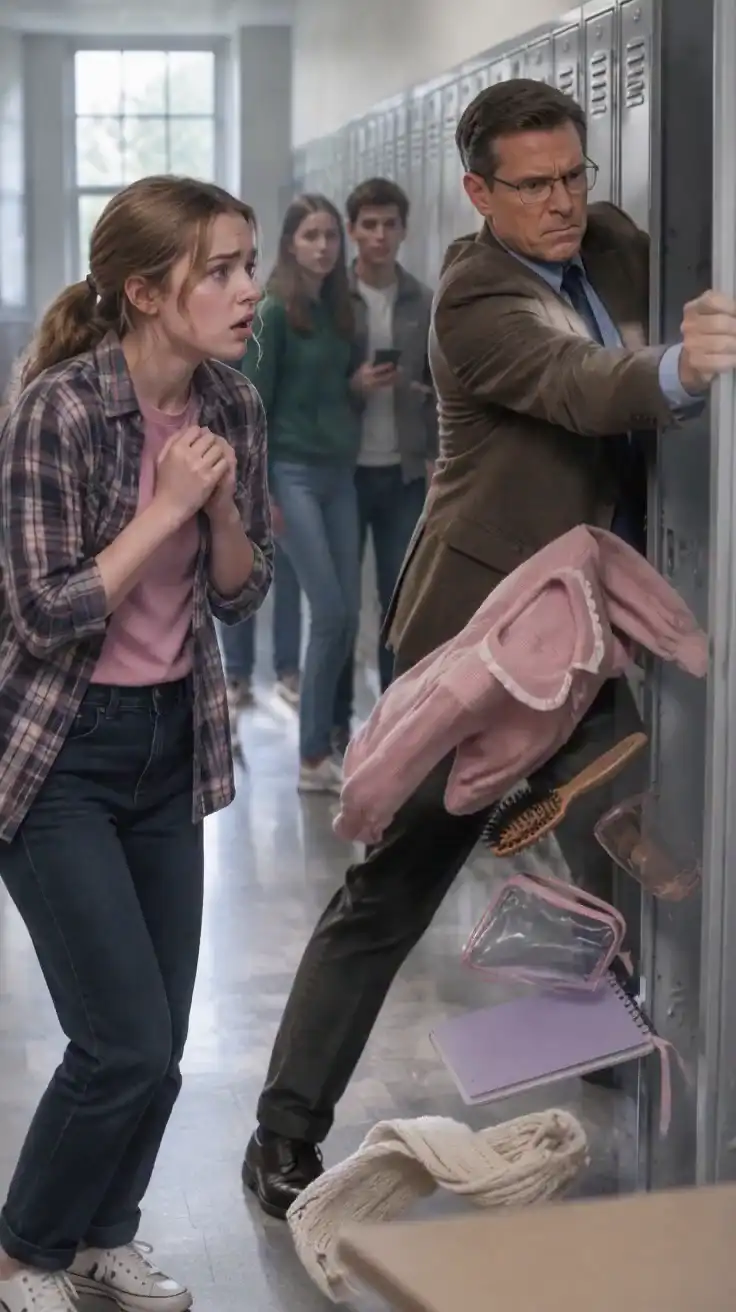
The south hall was not empty. Students were moving between classes. Some had stopped at their lockers. A teacher stood by the music-room door, talking to a student. At the far end, near locker 214, I saw Mr. Harlan. I saw Ms. Price, the school resource officer. I saw Lila. I saw Anna.
I was still several yards away when Mr. Harlan opened the locker.
The door swung wide. The red tape split the inside in two, a neat line that no longer seemed useful. He reached in and pulled out Anna’s sweatshirt. He put it on the floor. Then a notebook. Then her shoes. The lunch container came next. One lid popped open when it hit the tile, and a folded napkin slid out.
Anna stood still.
“Please wait,” I said.
Mr. Harlan looked up. “Mrs. Bell, I’m glad you’re here.”
“What is happening?”
“We’re conducting a search for a missing item.”
“Did you get my permission?”
“We have authority to search a student’s school locker when there is reasonable cause to believe it contains a missing item.”
“Did you tell her I was coming?”
“We tried to reach you.”
“You called me ten minutes ago.”
“We have to respond in a timely manner.”
I looked at Anna. She was watching me, but she did not move. The other students were watching, too. A couple of them held their phones. I saw one phone pointed toward us and said, “Put that away.”
The student lowered it. I did not know whether the camera was still on.
Lila stood behind Mr. Harlan, her arms folded tight against her chest. She had on a gray school cardigan. Her eyes were red. I thought she had been crying.
“Is this about the bracelet?” I asked.
Mr. Harlan said, “Lila reported that it was missing and that Anna had access to it.”
Anna finally spoke. “We both had access to the locker. That’s why we shared it.”
“You were the last person she remembers seeing it,” Mr. Harlan said.
“No, I wasn’t.”
“Lila said you were present when she put her bag down.”
“I was there. That doesn’t mean I took it.”
Lila shook her head, almost too slightly to see. “I didn’t say you took it.”
Anna turned toward her. “You told him I had it.”
“I said you were there.”
“You said you saw me take it.”
“I said I don’t know what I saw.”
“That’s not the same thing.”
Mr. Harlan asked Anna to step back. She did. He took a small pouch from the locker and opened it. Inside were two hair ties, a pen cap, a few loose pins, and a folded paper. He put it on the floor with the rest.
I asked him to stop. He said he needed to finish. I told him the room was full of students and asked whether they could move the search to the office. He said he needed to establish what was in the locker before anything was moved.
“Everything in here belongs to her,” I said.
“Not all of it,” he said. “This is a shared locker.”
He had a point, but it was the wrong point. I was looking at my daughter’s belongings in a pile on the floor. I was looking at her hands, which were shaking. I was trying to get between her and the hall, but there was nowhere to stand that did not make me part of the spectacle.
Then Mr. Harlan lifted the notebook from the back.
The photograph slipped out.
It landed face down near the toe of Anna’s shoe.
Anna took one step toward it, and Ms. Price told her to stay where she was.
“Please,” Anna said.
Mr. Harlan looked at the photograph. He picked it up by one corner.
“Don’t,” Anna said.
It was the first time I had heard her sound frightened.
I reached for the picture, but Mr. Harlan held it away from me. “We need to make sure it isn’t connected to the item we’re looking for.”
“It’s a photograph,” I said.
“It was tucked behind a notebook.”
“Because it belongs to her.”
He turned it over. His eyes moved across the picture, then to Anna. I saw his expression shift. I saw him understand there was no bracelet in it. I saw him understand, too, that he had made her ask in front of everyone.
He placed it on the pile.
Anna’s face was pale. She was looking at the photo as if it had been left somewhere she could not reach.
The whole search probably lasted less than five minutes. It felt longer. Mr. Harlan continued through the locker. He pulled out a small paper bag, two pencils, and a thin folder. He checked the top shelf. He checked the pockets of the sweatshirt.
Then he looked at Anna and told her to kneel.
I have watched the video so many times that I know what the movement looks like before it happens. I know the way Anna’s shoulders go stiff. I know the way she glances toward me. I know the pause before she lowers herself.
She did not kneel immediately.
“Please don’t,” she said.
Mr. Harlan repeated the instruction. He said they needed to make sure nothing had fallen behind the belongings and that she needed to step away from the locker. Anna looked around the hall. There were adults there. There were students there. I was there. She searched all of us with her eyes, and none of us stopped it.
I said, “She can move without kneeling.”
Mr. Harlan said, “This is a standard procedure.”
It was not. I know that now. At the time, I was too stunned to challenge every word.
Anna knelt.
Her knee touched the tile beside the family photograph. She put both hands on the floor, not because anyone told her to but because she had to steady herself. A notebook lay near one hand. Her shoes were beside the other. The photograph was between them, facedown.
The girl who had accused her was three feet away.
Lila pointed at Anna. “I know you did it.”
That was the line I could not hear clearly in the video. I could hear it when I was there. I heard her voice crack at the end.
Anna looked up at her. “You don’t know that.”
“I know you had it.”
“No, you don’t.”
“I saw you take it.”
“You told Mr. Harlan you didn’t know what you saw.”
Lila raised her voice. “I know you did it.”
Anna whispered, “Please don’t.”
That was when Lila pointed again.
The bracelet slipped from the sleeve of the hand doing the pointing. It dropped between them, flashed once under the hallway lights, and hit the floor.
I did not understand what I was seeing. For a second, neither did anyone else.
The bracelet sat there on the tile, its open clasp catching the light.
Lila froze with her finger still extended.
Mr. Harlan looked down. Ms. Price moved forward. I heard a student let out a sound that might have been a laugh, then stop when nobody joined in.
Mr. Harlan said, “Lila, what is that?”
She lowered her hand. “I don’t know.”
It was a foolish answer. It was also a frightened one.
Ms. Price picked up the bracelet with a tissue. She asked Lila to step into the office. Lila looked at Anna, then at me. She looked at the bracelet. She did not move.
Mr. Harlan finally told Anna she could stand.
Anna did not stand right away. She reached for the photograph first. I stepped forward and picked it up before anyone could stop me. It was bent along one corner. There was a gray mark on the front from the tile. I handed it to her.
She pressed it against her chest.
The students were still there. I turned to them and said, “You’ve seen enough. Go to class.”
They moved slowly. Some looked back. One girl put her phone into her pocket. The teacher by the music room finally came over and began directing students down the hall.
Mr. Harlan asked me to come to the office. I said I wanted Anna with me. He said she needed to be interviewed separately. I said I was not leaving her alone. Ms. Price said she would stay with Anna while I spoke with the dean.
I did not go.
I stayed beside Anna while she picked up her things. I put the lid back on her lunch container. She wiped the napkin with her sleeve. She took her sweatshirt from the floor and folded it once before putting it over her arm. She did these things with a carefulness that looked like control from a distance and like shock up close.
Lila was led toward the office by Ms. Price. She was crying by then. I did not want to see her crying. I did not want to comfort her. I did not want to hate her. I wanted somebody to explain what had happened and why all of us had been standing there while my daughter was made to kneel.
At the office, Mr. Harlan closed the door. The secretary gave Anna a chair and brought her water. Anna sat with the photograph in both hands. I sat beside her.
For several minutes, nobody spoke.
Mr. Harlan said, “We need to understand how the bracelet came to be in Lila’s sleeve.”
I said, “Ask Lila.”
He told me the bracelet had been reported missing the previous week. He had spoken to the girls and to Coach Renee. He had looked at the school camera footage, though it did not show the inside of the locker room. Lila had said she believed Anna had taken the bracelet, but she had not been able to explain when or where.
“Why did you search her in the hall?” I asked.
He said he had been trying to locate the bracelet quickly and that the locker was shared. He said he had not expected the situation to escalate.
“She was told to kneel.”
“I understand.”
“No, you don’t.”
He started to answer, but Anna spoke first.
“Can I go home?”
I said yes. Mr. Harlan told us he would call when he had more information. I told him not to call my daughter’s phone. He could call me.
We left without speaking to Lila.
Outside, Anna walked beside me with her backpack held against her stomach. She did not cry in the parking lot. She did not cry in the car. I asked if she wanted me to take her home or to get food. She said home.
At a red light, I asked whether her knee hurt. She said no.
“Are you sure?”
“Yes.”
“Did Mr. Harlan touch you?”
“No.”
“Did anyone tell you not to call me?”
“No.”
She turned her face toward the window. I watched the light change and drove.
At home, she put the photograph on the kitchen table. She ran a thumb along the bent corner. Then she went to the bathroom and shut the door. I heard the lock click.
I wanted to go after her. I wanted to tell her she did not have to keep everything in. But I was afraid she would say what I already knew.
I had let the school do to her what I had been trying to protect Ben from: make a child carry an adult’s fear and call it necessary.
I sat at the table with the photograph in front of me.
A little later, Anna came out. Her eyes were dry. She asked where Ben was. I said he was at school. She nodded and went to her room.
The school called me that afternoon. Mr. Harlan said he had spoken with Lila and her parents. He said the bracelet belonged to her grandmother and that it had been in her possession the whole time. He said there was a misunderstanding.
I asked what misunderstanding.
He said the bracelet had fallen from Lila’s sleeve during the search.
“That isn’t a misunderstanding,” I said.
“No,” he answered. “I’m sorry.”
I asked him to say that to Anna.
“I will.”
“You should say it where everyone heard you tell her to kneel.”
There was a silence.
“I can speak with her privately.”
“No. You can apologize in front of the office. She was humiliated in front of the hall. You can tell her in front of the people who saw it.”
He said that would be appropriate. I did not believe he meant it yet, but he agreed.
I spent that evening trying to understand why Lila had the bracelet. I had several theories, none of them good. I thought maybe she had taken it and hidden it because she regretted accusing Anna. I thought maybe she had been trying to return it without admitting what she had done. I thought maybe the bracelet had never been missing in the first place.
I did not think of Owen.
I learned the truth the next morning, from Lila’s mother, Denise.
She asked if she could come by. I almost said no. Then I pictured Anna in the hall, waiting for an adult to see her as a person, and I said yes.
Denise arrived with Lila. Lila kept her eyes on the floor. She had the bracelet in a small plastic bag. Her mother looked tired and embarrassed. She did not sit down until I asked her to.
Denise began by saying she was sorry. She said she had heard what happened from the school and from Lila, and that she had not known the bracelet had been kept from the police. I looked at Lila.
“Why was it in your sleeve?”
She pressed her palms together.
“Lila,” Denise said.
Lila took a breath. “Owen took it.”
Her mother closed her eyes.
“From where?” I asked.
“From the gym,” Lila said. “He said he found it.”
“Did you believe him?”
“No.”
“Then why did you keep it?”
She looked down at her hands. “He said he was going to give it back.”
“When?”
“He kept saying he was going to.”
“Why didn’t you take it back yourself?”
“I tried.”
“When?”
“The next day. He had it in his room, and I told him to put it back in the lost-and-found. He said people would know he took it.”
I asked her why she had not told her mother.
She started crying. “Because my mom would call the police.”
Denise said, “I would have called the school first.”
“You said you’d call them when I got caught with the car keys.”
“That was different.”
“I didn’t know it was different.”
The story came out in pieces.
Owen had been spending time with two older boys in their apartment complex. They had taught him to lift small things from bags and coat pockets. Owen thought it was a game, until one of the boys stole a wallet at the gym. Lila had found the bracelet in Owen’s bedroom, under a loose floorboard. She had recognized it from the squad. She confronted him. He begged her not to tell their mother because he was afraid the police would come to the house and take him away.
He had already been questioned once by police about a bicycle that went missing from the building. He had not stolen it, but he had ridden it after one of the older boys brought it over. He was scared that if anyone knew he had lied about the bicycle, they would decide he was responsible for everything else.
That was why Lila hid the bracelet.
At first, she tucked it in the inside pocket of her jacket. Then her mother found the jacket on the floor and started asking what was in the pocket. Lila put the bracelet in the small zippered pouch she carried to practice. But Coach Renee had asked the girls to keep their bags on the wall, and Lila was afraid Owen might go through the pouch if she left it unattended. She took the bracelet out and slipped it into the cuff of her cardigan.
She meant to return it. She meant to talk to Owen again. She meant to tell her mother once she had worked out a way to keep her brother from being arrested.
Then she saw Anna helping her search for it.
At first, she had wanted to believe Anna had taken it. That would mean Owen had not. She could blame the person she had been fighting with instead of the little boy she loved and had helped raise. It was easier to look at Anna’s locker than at her brother’s bedroom floor.
But when the school started asking questions, Lila knew the bracelet would have to be found. She could have brought it forward. She could have told the dean the truth. She did not.
She thought if the bracelet appeared in Anna’s locker, she could say she had been right. If Anna was blamed, the school would stop looking at her family. She would keep Owen out of it. She would also avoid admitting she had hidden the bracelet and lied to everyone.
The bracelet had never been in Anna’s locker. It had been in Lila’s sleeve because Lila was protecting Owen from the police.
She had pointed at Anna because she was trying to protect herself, too.
“Why did you say you saw Anna take it?” I asked.
“I don’t know,” she whispered.
“You said it in the hall.”
“I was scared.”
“Anna was scared.”
“I know.”
“You were her friend.”
“I know.”
“You knew about the photograph?”
She shook her head. “I knew it was important. I didn’t know it was the only one.”
That was the first time I had felt anger toward her that was not tangled with something else. It was clean, for a moment. Then I saw her hands shaking and remembered she was fourteen. I remembered Anna at fourteen, carrying an adult-sized fear through school because I had not been able to set it down.
Lila’s mother leaned forward. “I’m sorry. I should have noticed. I should have known what was happening with Owen.”
Denise had not hidden the bracelet. She had not made the accusation. But she was sitting in my kitchen with a child who had done both, and she was not asking me to call it a mistake.
“I don’t know what to say,” I told her.
“You don’t have to say anything.”
Lila looked up at me. “Can I apologize to Anna?”
I wanted to say yes. I wanted to say she could not. I thought of Anna standing in the hall while Lila pointed at her.
“I’ll ask her,” I said.
Anna did not want to see Lila that day. She said she did not know whether she wanted to see her at all.
“I’m not going to make you,” I said.
“She hid it in her sleeve and blamed me.”
“Yes.”
“She said she knew I did it.”
“Yes.”
“I was on the floor.”
“I know.”
She looked at me as if she were waiting for me to explain what I had done with the hours before the search. I did not try.
The next morning, Mr. Harlan asked us to come to the office before classes began. I told him Anna would decide whether she wanted to attend. She did not. She said she could not face the hall again yet.
I went without her.
The office was crowded with people who did not need to be there. Mr. Harlan was there. The principal was there. The school counselor was there. The receptionist was at her desk. Two teachers stood near the doorway. I saw the student who had filmed the search, and I saw the girl who had stood near the music room. I did not know whether they had been asked to come or whether they had heard about the meeting.
Mr. Harlan stood by the front counter.
He said, “I want to apologize for the way we handled yesterday’s search.”
I told him that was not specific enough.
He looked down briefly, then started again.
“I told Anna to kneel in front of other students. I allowed her belongings to be emptied in the hallway, and I did not stop the search when the situation became public and humiliating. The bracelet was not hers. We should have handled the search in a private space and with greater care. Anna did not deserve to be treated as if she had already done something wrong. I am sorry.”
The receptionist looked at the desk. One of the teachers watched him carefully. The girl who had filmed the search had her hands folded in front of her. Nobody moved.
I said, “Thank you.”
I did not forgive him. I did not think the apology was enough. But he had said it in front of the office, as he had been asked. He had not blamed a policy. He had not called it a misunderstanding. He had said what he had done.
The school also gave Anna a written apology. Mr. Harlan offered to arrange a meeting with Lila, but Anna declined. She went to school for the rest of that week, though she asked to use a different locker. The school gave her a locker near the library.
The video was online before lunch.
The student who had recorded it posted a short version to a private account. It spread from there. By the time I found out, it had been sent to at least two group chats and somebody had posted a copy on a public account. I did not know how many students had watched it. I knew it was enough that Anna heard a boy whisper “kneel” when she walked past him.
The video did not show the bracelet falling. The version online ended a few seconds before that. It showed the search, the shoes, the notebook, the photograph, and Anna on the floor. It showed Lila pointing. It did not show what happened next.
I asked the school to make sure the video was removed. They said they could request that students take it down, but they could not control every copy. The student who posted it came to our apartment with her mother and apologized. Her mother said she understood why I was upset. She also said the video had already been shared beyond their control.
There was no way to pull the moment back into the hallway.
Anna stopped going to cheer practice for a while. She said she could not look at the red and white uniforms without seeing the locker. Coach Renee called and said Anna could return whenever she wanted. She said the squad was not the same without her, but she did not pressure her.
Anna told her she might come back later.
Lila did not return immediately either. Her mother took her off the squad for a month, though Lila wanted to keep practicing. Denise said she needed to understand that staying on the team was not more important than facing what she had done. She also started taking Owen to counseling. She met with the school counselor and told him the whole story about the bracelet.
Owen was never arrested. The school handled the matter with his mother. The bracelet was returned to its owner, Lila’s mother, who brought it to the gym and apologized to Coach Renee. She said it had been in a drawer at home all along, which was not true. She was trying to protect Owen from the police, too.
I understood that instinct more than I wanted to.
That understanding did not make it right.
A few weeks later, the police came to our apartment again. The detective had found out that Ben had been with Cody at the store. A security camera had shown them entering the delivery lane. The detective asked to speak with him.
Ben sat on the couch with his hands tucked under his legs. I sat in the chair beside him. I did not answer for him. I did not say he had been home. I did not tell the detective I had picked him up from the library.
When Ben got stuck, I asked if he wanted a minute. When he looked at me, I said, “Tell her what happened.”
He told the truth.
He said Cody had asked him to go inside. He said he had followed him. He said he had taken the candy but not the medicine. He said he had tried to leave when the employee came out. He said he knew it had been wrong.
The detective did not take him away. She spoke to him about being honest. She spoke to me after, and I admitted that I had lied before. I said I had been trying to protect my son and had made the situation worse. She told me she appreciated the correction, but she did not let me off the hook.
Ben received a referral to a youth program, and he had to go with me to the store and apologize to the manager. Cody’s family moved before the end of the school year. Ben did not see him again.
I thought the truth would make Ben feel relieved. It did not. He was ashamed. He was angry with me for letting the police come back. He was angry with himself for making it possible. For a while, he did not trust me when I said something would be all right.
Anna was angry with me, too, but she did not say it right away. She said it one night while I was putting away dishes.
“You told the police he was with you.”
“Yes.”
“You said you picked him up from the library.”
“Yes.”
“But he was with Cody.”
“Yes.”
“And then you let them look for the bracelet in the hall.”
“I didn’t let them,” I said.
She put a cup in the cupboard harder than she needed to. “You were there.”
“I was.”
“You’re the adult.”
“I know.”
“You could have stopped them.”
“I tried.”
“Not enough.”
I set down the plate I was holding. “No. Not enough.”
She stood with her back to me for a few seconds. I wanted to explain that I had been frightened, that I had never seen the dean do that before, that I had not understood how far the school would go. Those things were true. They were also not an answer.
“I’m sorry,” I said.
She turned around. “You say that after.”
“I know.”
“You said you were protecting Ben. Did you ever think you were asking me to protect him, too?”
The question went through me. I wanted to say no. I wanted to say I had never asked her to lie. But I had. Not in a sentence. Not directly. I had let her hear me tell a lie and then made her share the fear of keeping it intact.
“I didn’t think about what it was doing to you,” I said.
“That’s not the same as not knowing.”
“No.”
She left the kitchen. I stayed there with the plates.
I do not have a clean answer for what kind of mother I was that spring. I was a mother who loved her children and made choices out of fear. I was a mother who thought she could absorb the consequences for one child and accidentally handed them to the other. I wanted to protect Ben from the police. I wanted to protect Anna from humiliation. I had tried to do both by controlling what other people knew, and I had not protected either of them.
The families did not repair themselves in one conversation.
Denise and I spoke once about the girls. She said Lila was ashamed and had started seeing the school counselor. I told her Anna was not ready to meet. Denise said she understood. She did not ask me to hurry Anna.
Owen sent Anna a note. It was folded in half and written in pencil. He said he was sorry his sister had put the bracelet in her sleeve and that he was sorry he had taken it. He said he had been scared and did not want anybody to know he had done something bad. He said Anna had been blamed because he had done it, and that was not fair.
Anna read the note and put it in a drawer. She did not write back.
Lila sent a longer letter. She wrote that she had been afraid of what would happen to Owen, and that she had been selfish because she had also been afraid of getting in trouble herself. She wrote that when she pointed at Anna, she knew the bracelet was in her sleeve. She said she had thought the school would make Anna bring it out, and that she could then tell everyone it had been a mistake. When the bracelet fell, she had not known what to do. She had said she did not know because she was trying to buy a few seconds.
She wrote that she knew none of that made what she did forgivable.
Anna kept that letter, too. She did not answer it.
For months, she did not wear her cheer uniform. She kept the new locker near the library. The family photograph sat on her desk at home, face down at first. The corner was bent. I offered to replace it with a scan from my phone, but she said she wanted the original. I took it to a print shop and asked if they could repair the crease without changing the picture. They did what they could. The gray mark faded, but the crease stayed.
One afternoon in October, Anna came downstairs wearing her uniform. She said Coach Renee had called and asked if she wanted to come watch practice. She did not say she was going to join. I did not ask her to.
I drove her to the gym. She sat on the bleachers while the squad practiced. Lila was not there. She had left the team over the summer. Coach Renee said she had not forced her out, but Lila had decided she could not return while Anna was still on the squad.
Anna watched the girls do their warm-ups. When Coach Renee called for the first stunt, she moved forward on the bleacher without realizing it. Her hands lifted slightly, counting the beat.
After practice, she told me she wanted to go back.
She did not go back to the shared locker. She did not resume the friendship as if it had been a small disagreement. She returned to the squad because it had been hers, too. She went twice a week and kept her locker key on a ring with the house keys.
She and Lila saw each other occasionally at school. They did not speak for a long time. Then, in December, Lila came up to Anna after class and apologized again. Anna said she had read the letter. Lila said she was not asking to be friends. She just wanted Anna to know she was sorry.
Anna told her, “I know you’re sorry. I don’t know what I want yet.”
Lila nodded. She did not ask for more.
That was the first honest conversation they had had in months.
They are not close the way they were. They do not share a locker. They do not ride together to practice. They do not call each other Captain and Rocket. Sometimes they talk in the hall. Sometimes they do not. They are girls who loved each other, and then one of them made a choice that cost the other more than she understood.
Their families are still in each other’s lives because our town is small. Denise and I see each other at school events. We say hello. We do not pretend nothing happened. Ben and Owen are in different grades now. They once played basketball on the same outdoor court. They were stiff around each other at first, then they started arguing about the score, which was probably a better sign than either family knew how to interpret.
Ben has not been in trouble again. He still gets nervous when police are nearby. I do, too. We talk about what happened more honestly now. I have told him that protecting him does not mean telling a lie for him. He has told me that he thought I lied because I did not trust him to survive the truth.
I told him he was right.
Anna has not forgiven me completely. I do not expect her to do it on a schedule. I have tried to listen without explaining myself. It is harder than it sounds. When she tells me how alone she felt in the hall, I want to describe everything I was thinking. I want her to know I was trying. But the important thing is not whether I was trying. The important thing is that she looked at me, at the adults, at the students, and still had to kneel.
That is what I keep returning to.
People sometimes ask me whether I blame Lila. I do. I also understand why she did it. Those two things can sit beside each other. She was trying to protect her brother from the police. She was frightened that he would be labeled a thief, that her mother would be angry, that the school would call someone, that one mistake would turn into a story about what kind of family they were. She knew what she was doing when she accused Anna. She also knew she was doing it because the truth had become too frightening to face.
I understand the fear. I do not excuse the harm.
And I do not excuse the school. The bracelet falling from Lila’s sleeve proved that Anna had not taken it, but it did not prove the school had acted properly. It proved the adults had searched first and asked enough questions later. It proved that a child could be made to kneel because a grown man wanted an answer quickly. Mr. Harlan apologized. He changed the way he handled searches. He met with the parents and the staff. I heard about those changes through the principal.
The apology mattered. The changes mattered. Neither of them erased the video.
For a while, Anna would not let anyone take her picture. She said she hated knowing that somebody might be recording. At school events, she watched the phones in the crowd. At practice, she kept her backpack in sight. She was not afraid of the bracelet. She was afraid of the moment when a room decided what she was before she could speak.
The family photograph was the only picture she had of the four of us together, and for a time she could not look at it. She said it reminded her of the locker, because it had been lying on the floor when the search happened. I put it in a frame and left it on the kitchen shelf. She moved it to her room. A month later, she took it back and set it on the table beside her bed.
I asked once whether she wanted another copy.
“No,” she said.
“Okay.”
“It’s not the picture that got ruined.”
I understood what she meant.
The picture had not been ruined. The school had not taken it away. Lila had not taken it. It was still a photograph of a day when all four of us had been together, before Mark died, before Ben followed Cody through a delivery door, before I lied to a police officer, before a gold bracelet disappeared and a friendship cracked open.
Anna could look at it when she was ready. She could turn it face down when she was not. It belonged to her either way.
The video ends just after the bracelet hits the floor. The first time I watched it, I thought that was where the story ended. A gold chain on the tile, a girl caught in a lie, my daughter standing up. The truth was more complicated. The bracelet had come from a boy who was afraid of the police. It had been hidden by a girl who loved him. It had been used to accuse another girl who had spent months trying to protect her own brother from the same fear.
There were several children in that hallway, and every one of them had been trying to protect someone. Only one of them was told to kneel.
That is what I wish the video could show: not an explanation that makes it all right, but the chain of fear that brought us there. My fear. Ben’s fear. Lila’s fear. Owen’s fear. The school’s rush to produce an answer. The girls’ silence after trust had gone missing.
The bracelet fell from Lila’s sleeve. Anna stood up. I picked the photograph off the floor. None of those things put the day back the way it was.
But the photograph came home with us.
And the next time the police came to our door, I told the truth.