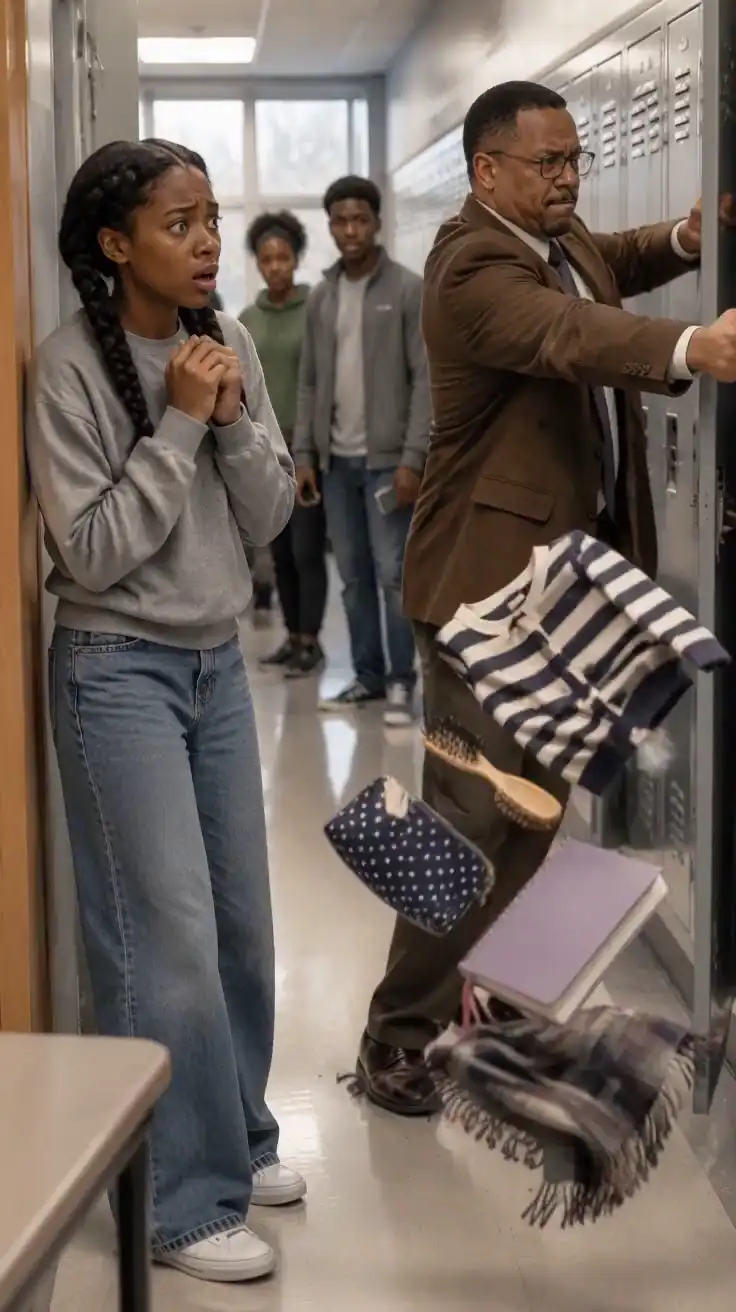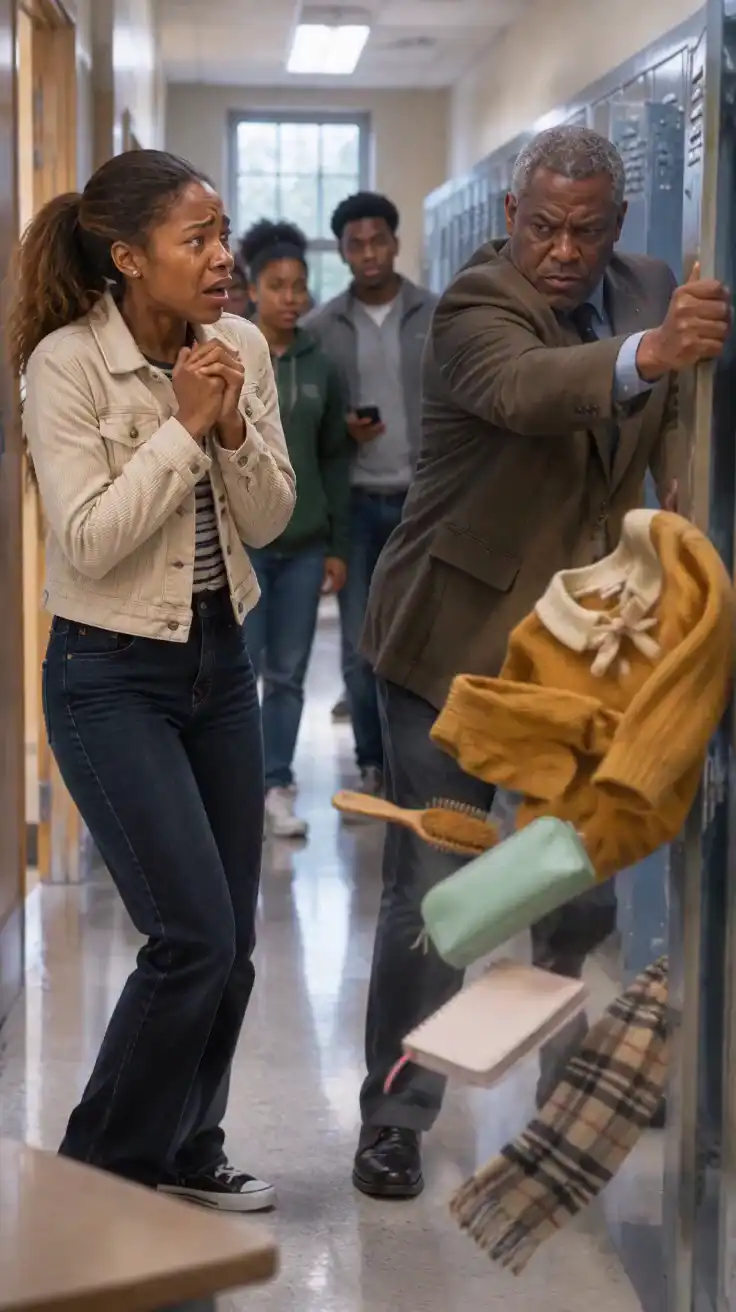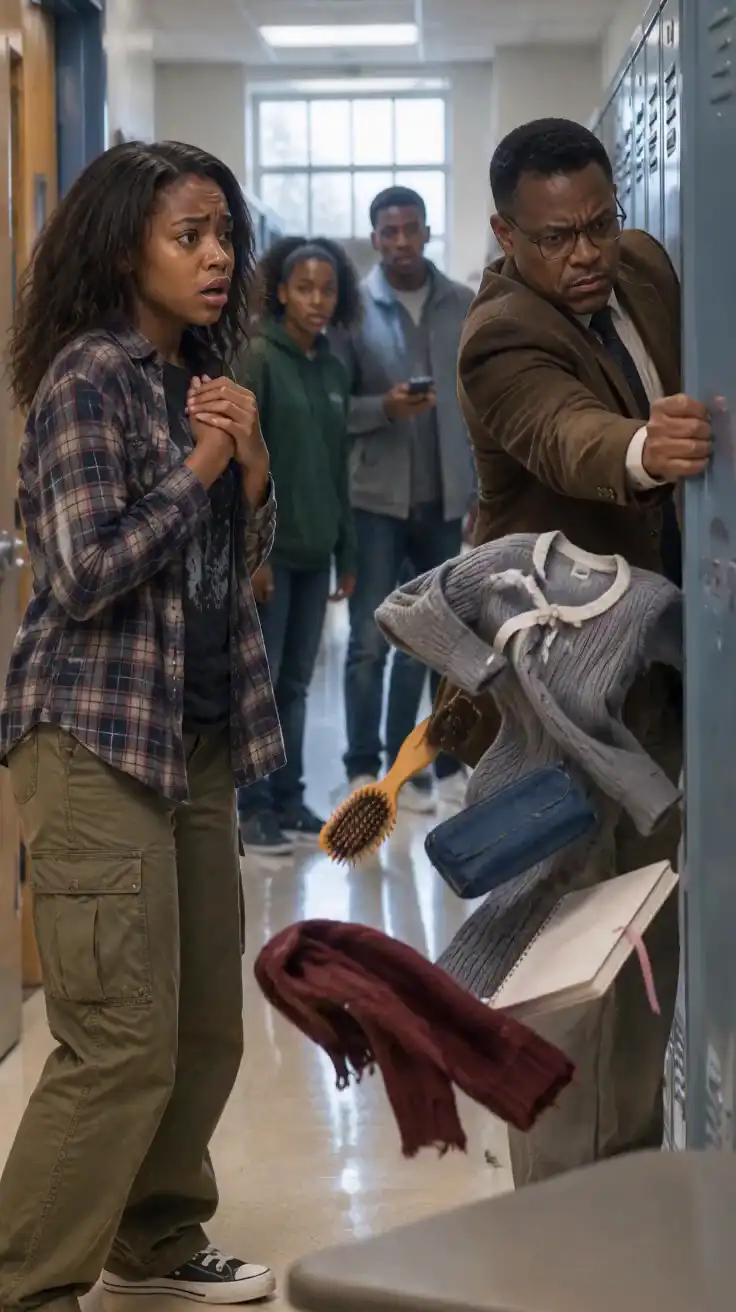
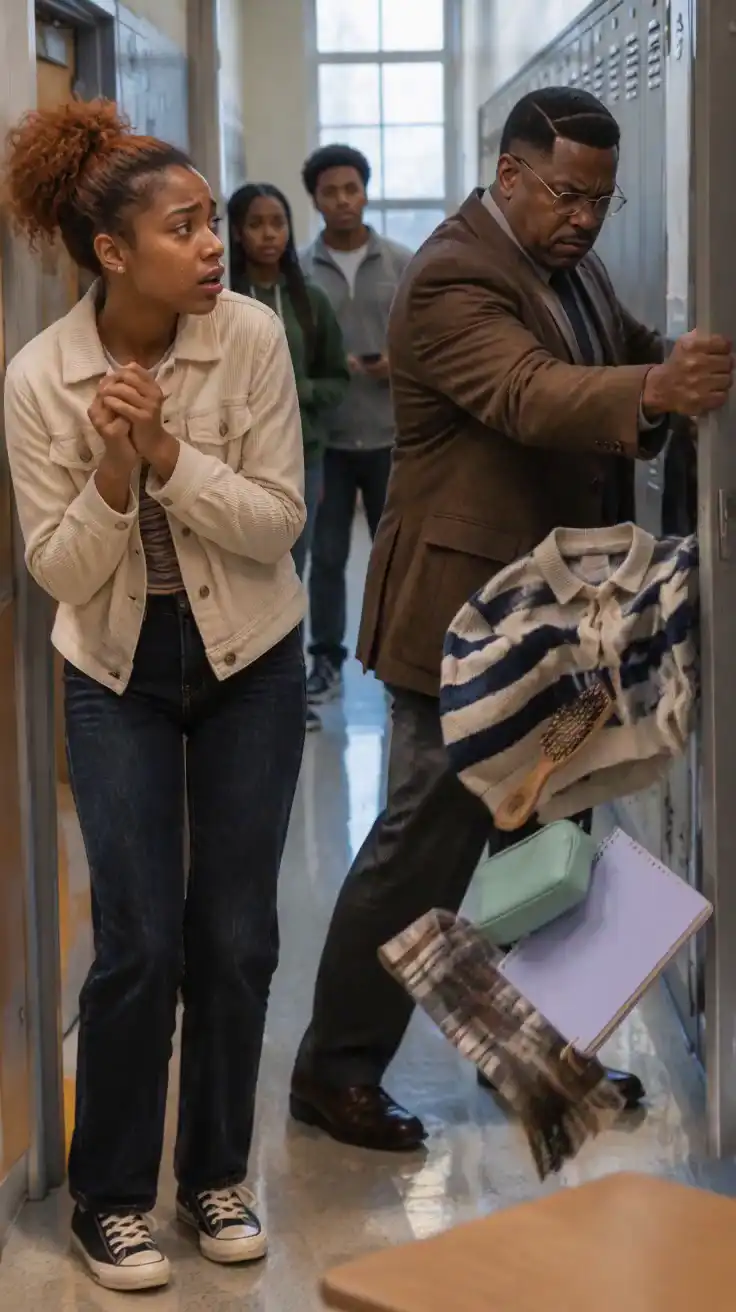
The bracelet hit the tile with a small, bright sound.
Nobody moved.
My niece, Tessa, was still on her knees. The dean had one hand half raised, as if he had been about to reach for something in the pile and had forgotten what. The girl who had accused her, Maren, stared at the bracelet near her shoe. Her face had gone pale under the fluorescent lights.
Then Maren said, “It fell.”
The dean looked down at the bracelet, then at her sleeve. It was the kind of sleeve with a narrow cuff, fitted close to the wrist. Nothing about it looked loose enough for a bracelet to slip out by accident.
“You said it was in Tessa’s locker,” he said.
“I thought it was.”
“You told me you saw her take it.”
Maren’s mouth opened, but no words came out. Behind her, students had stopped in the hallway. A couple of them had their phones up. One boy lowered his when the dean looked his way.
Tessa reached for the photograph.
That was when I got out of the car.
I had been watching the video from the parking lot outside the school office, one hand over my mouth and the other gripping my phone so hard my fingers hurt. I had arrived after the search began. I hadn’t seen the beginning. The first message I got was from Tessa, sent at 10:17 that morning.
Aunt Jo can you come here
A minute later came another.
Please
I had called her. She didn’t answer. I had called the school office and been told that Tessa was “in a meeting with the dean.” I asked what kind of meeting required her aunt to be kept outside, and the secretary said she wasn’t able to discuss student matters over the phone.
I was twelve minutes away. I drove there in nine.
When I parked, I saw three students outside the entrance, whispering. One of them glanced at my car and then at the phone in my hand. I knew then that whatever was happening inside had already become a show.
I pushed through the front doors and heard the voices before I reached the main hall.
“Everybody back to class,” the dean said.
I turned the corner. The bracelet was on the floor. Tessa was still on her knees. Maren looked as if she wanted to disappear into the wall. The dean saw me coming and took a step toward the pile, perhaps to block the view, perhaps to stop Tessa from picking up her things. I couldn’t tell.
“What is going on?” I said.
My voice came out louder than I meant it to. The hallway quieted around us.
The dean straightened. “Are you Tessa’s guardian?”
“I’m her aunt. I’m the adult she lives with. What is going on?”
Tessa looked up at me. She had a red mark across one knee from the tile and a strand of hair stuck to her cheek. The family photograph was under her hand, the plastic sleeve bent at one corner.
“Get her up,” I said.
The dean glanced toward the office. “We can discuss this privately.”
“You’ve already searched her locker in front of half the school. There’s no private version of what you’ve done.”
He looked past me at the students. “Everyone, move along.”
Some did. Others took their time. A girl in a maroon jacket kept her phone pointed toward the floor but not far enough to hide it.
I stepped between Tessa and the dean. “Tess, can you stand?”
She nodded. I held out my hand. She took it and rose carefully. Her knees shook, though she tried to hide it. She kept the photo tucked against her chest.
“What happened?” I asked her.
She looked at Maren first.
Maren was staring at the bracelet. It was gold, thin, with a tiny oval charm. Even from where I stood I could see the charm was scratched.
Tessa swallowed. “They said I stole it.”
“Who said?”
“Maren.”
Maren flinched at hearing her name.
The dean said, “Maren reported that she had seen Tessa take her bracelet. She said it was missing from her bag after practice yesterday. We had reason to believe it might be in Tessa’s locker, so I asked Tessa to open it.”
“You asked her to open it,” I said, looking at the books and clothes scattered across the floor.
“I was attempting to resolve the matter.”
“By making her kneel?”
The dean’s face tightened. “I did not tell her to kneel.”
Tessa made a small sound beside me.
I turned to her. “He told you to kneel?”
She nodded once.
The dean looked down at the floor. “I told her to pick up her belongings. I may have said she needed to get down there and start gathering them.”
“That is the same thing when you’re standing over a fourteen-year-old in a hallway with her things dumped at your feet.”
He didn’t answer. He looked at Maren instead. “Why was the bracelet in your sleeve?”
“I don’t know,” she said.
The dean’s expression changed. “Maren.”
“I don’t know. It must have gotten caught.”
“You told me it was missing.”
“It was missing.”
“And you told me Tessa took it.”
Maren’s eyes flashed toward Tessa. “I thought she did.”
Tessa’s hands tightened around the photograph. She still hadn’t said anything about Maren’s brother. I understood then that she wasn’t going to say it in front of the school. Maybe she wouldn’t say it at all.
The dean picked up the bracelet with a tissue from his pocket. He held it at arm’s length, like it might tell him what to do.
“Everyone needs to go to class,” he said again.
Nobody moved.
I looked at the bracelet. “No. First you’re going to tell us why you searched her locker in public, why you dumped everything on the floor, and why you made her get down on her knees.”
“I didn’t make her—”
“Stop.”
He did.
I had worked in a dentist’s office for nineteen years. I wasn’t a lawyer. I wasn’t a teacher. I wasn’t someone who could make a school administrator nervous by mentioning policy numbers from memory. But I knew what it looked like when an adult tried to make a child feel small enough to stop asking questions. I’d seen it at the front desk, with patients who thought no one would challenge them, and I’d seen it in the way my own niece went quiet when she expected people to decide she was trouble before they heard her.
Tessa had started living with me three years earlier, after her mother died. Her father was alive, but he had been out of the picture for a long time and was not in a position to take her. It had been paperwork, phone calls, court dates, and people asking her where she wanted to go as if she had any reasonable choice. She came home with one duffel bag, a shoebox of photographs, and a box of her mother’s things that she wouldn’t let anyone touch.
The photograph in her locker was the last picture she had from a family gathering that included her mother, her father, and Tessa all in the same frame. It had been taken at my sister’s thirtieth birthday barbecue, before my sister got sick. Tessa was eight, missing one front tooth, with a paper plate balanced on her lap. Her parents were on either side of her. My sister’s arm was around her shoulders. My brother-in-law had one hand lifted to block the sun.
It wasn’t a rare photograph. It wasn’t the only photograph of any one of us. It was the only one Tessa had left of the three of them together.
After the funeral, pictures had been divided, misplaced, packed away, and lost in the move. Tessa kept that one in a clear plastic sleeve in her school locker because she could look at it between classes. She had told me once that the locker was the only place she could keep it without anyone asking her why she still carried it around.
That morning, the dean had put it on the floor beside a pile of notebooks.
I looked at him and said, “We’re going to the office now. You are going to call the principal, and you are going to make sure nobody touches her things again.”
He seemed ready to argue, but a woman from the office had appeared at the end of the hall. She was already speaking into a radio.
“I’ll call the principal,” she said.
“Good,” I said. “And please ask him to come to the office, not to a conference room where we can’t see the door.”
The dean’s jaw worked, but he nodded.
Tessa didn’t want me to pick up the photo. She wanted to do it herself. She brushed the tile with the hem of her sleeve, though it was already clean, and slipped the picture back into its plastic cover. I watched her straighten the bent corner with her thumb.
The rest of her things were still on the floor. Her books had fallen open. A green sweatshirt was partly under a stack of papers. A pack of gum, a pencil case, a folded list of practice drills, and a small bottle of hand lotion had rolled toward the lockers opposite hers.
“I’ll get it,” I said.
“I can.”
“I know. I’m not taking it from you. I’m helping.”
She crouched beside me. Her movements were careful and deliberate. She put the notebooks into a stack, tapped their edges against the tile, and closed the open one without looking at its pages. Her hands had a faint tremor. She pinned the photograph under her left arm so she wouldn’t have to set it down again.
Maren was still standing where she had been. The dean had the bracelet in his tissue. I looked at her.
“Do you want to explain what happened?”
She glanced past me toward the office. “I didn’t steal anything.”
“I didn’t say you did.”
“You’re acting like I did.”
“You accused Tessa of stealing. Now the bracelet is coming out of your sleeve. You can explain it to me, or you can explain it to the principal.”
Maren looked at Tessa. “I’m sorry.”
Tessa’s face didn’t change.
The dean said, “We’ll sort this out in the office.”
“I want her there,” Maren said.
The dean turned to her. “That isn’t up to you.”
That was the first time I saw Maren look frightened. Not guilty. Frightened.
The principal, Mr. Hale, came out of his office while we were still in the hallway. He had his tie half loosened and a folder tucked under one arm. He glanced at the mess, then at the gathering students, then at me.
“Let’s move this to my office,” he said.
I kept my voice even. “Tessa isn’t going anywhere alone.”
“Of course not.”
“And her things come with us.”
“Of course.”
“Then you can start by getting people out of this hallway.”
Mr. Hale looked at the secretary. She called down the hall again, and this time the students began to move. The girl in the maroon jacket put her phone away. A boy at the far end said something to his friend, and both of them laughed. Tessa watched them go.
I knew that look. She had learned young not to ask what people were laughing about.
We gathered what was left and carried it to the office. I kept the photo in my hand because Tessa had put her hands full of books. When we reached the office, I set the picture on the desk in front of her.
She picked it up immediately and put it into the inside pocket of her backpack.
The principal closed the door. He asked if anyone needed water. No one answered. The dean stood by the window, still holding the bracelet in the tissue. Maren sat in a chair near the filing cabinet, arms folded tightly across her chest. Tessa sat beside me.
Mr. Hale started with, “I want to make sure I understand what happened.”
I said, “Then let Tessa tell you.”
He looked to her. “Tessa?”
She sat very straight. “Maren said I stole her bracelet. Mr. Carden searched my locker. He dumped everything out. He told me to get down and pick it up. I said, ‘Please don’t.’”
The dean moved his weight from one foot to the other.
“And the bracelet?” Mr. Hale asked.
“It fell out of Maren’s sleeve,” Tessa said.
Maren stared at her own hands.
Mr. Hale turned to her. “Is that what happened?”
“I put it in my sleeve.”
The room changed. Not dramatically. There was no gasp. No one slammed a hand on the desk. But the explanation stripped away the last bit of uncertainty the adults had been sheltering behind.
“Why?” the principal asked.
Maren’s gaze flicked to the dean. “I don’t want to talk about it here.”
“You made an accusation in a hallway,” I said. “You told people Tessa stole from you.”
Maren looked down.
Mr. Hale was quiet a moment. Then he asked the dean, “What basis did you have for searching the locker?”
“She was identified by Maren.”
“Did you ask Tessa to open it?”
“Yes.”
“Did she agree?”
The dean hesitated. “She opened it.”
“That wasn’t the question.”
“I told her that we needed to check it.”
Tessa said, “He told me I had to.”
The dean turned toward her. “I didn’t say you had to.”
“You said, ‘Don’t make this harder.’”
He went still.
I looked at the principal. “I want that noted.”
Mr. Hale wrote something in the folder. “It will be.”
The dean lowered the tissue-wrapped bracelet onto a side table. “I was trying to prevent this from becoming a bigger issue.”
“It became a bigger issue when you decided to empty her locker onto the floor,” I said.
“I understand that.”
“Do you?”
He didn’t answer.
The principal asked Maren if she wanted to call her parents. She said yes. He told the secretary to get them on the phone. Maren’s mother arrived twenty minutes later, moving fast enough that her coat was still unbuttoned when she came into the office. She went directly to her daughter.
“What happened?” she asked.
Maren didn’t speak.
Her mother looked at the bracelet on the side table. “Is that yours?”
“Yes.”
“Why was it in your sleeve?”
Maren’s face crumpled, though she didn’t cry. “I don’t know.”
Her mother looked at me, then at Tessa. “Did she take it?”
“No,” I said.
Maren’s mother gripped the strap of her bag. “Then why did you say she did?”
“Mom, stop.”
“I need to know what’s going on.”
“I said stop.”
Mr. Hale intervened. He explained that the bracelet had been found on Maren, that Maren had accused Tessa, and that the school was reviewing how the search had been handled. He kept his voice careful and formal. He didn’t say “made to kneel.” He didn’t say “in front of the whole hallway.” He did say, “The way the search occurred was not appropriate.”
The dean looked at him. “I was acting on a report.”
“You were responsible for how you acted on it,” the principal said.
Maren’s mother sat down. “I’m sorry,” she said to me. “I don’t know what to say.”
“Say it to Tessa.”
She turned to my niece. “I’m sorry this happened.”
Tessa nodded, but she didn’t say it was okay.
That mattered. I had spent years hearing adults tell children to accept apologies before the children were ready. I didn’t make Tessa do it.
The principal asked Maren why she had made the accusation. She pressed her lips together.
“I can’t,” she said.
“Did you take the bracelet from your own bag and put it in your sleeve?” he asked.
“No.”
“Did someone else put it there?”
“No.”
“Then we need a truthful explanation.”
Maren looked at her mother. Her mother’s expression was no longer angry. It had become worried, which seemed worse.
I said, “If this is about something outside school, you can tell us that. But you need to be clear that Tessa did not take the bracelet.”
“She didn’t,” Maren said quickly. “She didn’t take it.”
“Why did you say she did?”
Maren pulled at the edge of her cuff. “I needed it to look like she had it.”
Her mother stood halfway, then sat again. “Why would you need that?”
Maren’s eyes went to the window. “I don’t want the police to ask about Eli.”
Her mother stopped moving.
The dean looked from Maren to her mother. “What does her brother have to do with this?”
Maren didn’t answer.
Tessa’s hand found mine under the desk. Her fingers were cold.
Mr. Hale said, “Maren, if your brother is in danger or someone is threatening him, you need to tell us.”
“He’s not in danger.”
“Then why are you worried about the police?”
“Because he was there.”
“Where?”
Maren’s mouth tightened.
“Where was he?” I asked.
She stared at Tessa. “She knows.”
Tessa’s hand went rigid in mine.
That was the first time she looked afraid.
I turned to her. “You don’t have to answer that here.”
Maren’s mother leaned forward. “Tessa, what is she talking about?”
My niece pulled her hand out of mine. “I don’t know.”
It was a lie, and it was the first one I had heard her tell in a long time.
Mr. Hale noticed. So did I. The dean noticed too, but he said nothing.
Maren’s mother looked at her daughter. “What happened with Eli?”
“Nothing.”
“Then why would the police ask?”
“Because his name came up.”
“Where?”
Maren pressed both palms over her eyes. “Can we go?”
The principal said, “We can’t leave this unresolved.”
“I’m not talking.”
“Then your mother and I will speak with you privately.”
Maren glanced at Tessa again. Her eyes held a plea that she did not put into words. Tessa looked down at the photo pocket in her backpack.
I understood only pieces then. There had been a night. Eli had been somewhere. Tessa knew where. Maren had put the bracelet in her sleeve and pointed to my niece because she wanted the adults looking in the wrong direction.
I didn’t know what she believed the police would find. I didn’t know why the bracelet mattered. I didn’t know whether Eli had done something terrible or merely something stupid. But I knew Tessa had been carrying the knowledge alone, and I knew Maren had used that silence as a shield.
The principal asked us to wait in another office while he spoke with Maren and her mother. I refused.
“We’re not leaving Tessa alone,” I said.
“You won’t. We can give you a room nearby.”
“No. We’re staying here.”
He looked tired. I was tired too, but I wasn’t going to let anyone move us around like furniture.
Maren was taken to the small conference room across the hall with her mother. The dean stayed behind. Mr. Hale stayed with us. For a few minutes no one spoke. I sat close to Tessa, shoulder against shoulder. She kept her backpack in her lap and wrapped both arms around it.
“Is the picture all right?” I asked.
She nodded. “The corner’s bent.”
“We can flatten it at home.”
“I know.”
“You’re not in trouble.”
“I know.”
She said it the way people say something they want to believe.
The dean finally spoke. “Tessa, I’m sorry.”
She didn’t look at him.
“I shouldn’t have handled the search like that.”
“You shouldn’t have searched it at all,” I said.
“I was told the bracelet was stolen.”
“You were told an accusation. There’s a difference.”
“I understand.”
I looked at him. “No, I don’t think you do. You could have asked questions. You could have called her guardian. You could have closed the locker and waited. Instead, you made a public accusation look like fact.”
He swallowed. “I thought we needed to act quickly.”
“Why? Was the bracelet going to run away?”
He looked down.
Tessa sat still, her face turned toward the office door. Whatever the dean was saying, she didn’t want to help him feel better about it.
A few minutes later, Mr. Hale left to speak with the school counselor. I stayed with Tessa. We could hear the low voices from the conference room, not the words. Maren’s voice rose once, then stopped.
Tessa opened her backpack and checked the photograph again.
“You don’t have to keep checking it,” I said.
“I want to.”
“Okay.”
“I thought it was going to get stepped on.”
“I know.”
“It was right there.”
“I know.”
She ran her thumb along the plastic sleeve. “They were all smiling. Mom had just burned the corn.”
I remembered that day. My sister had insisted she could manage the grill, and she had charred the corn so badly the husks smoked. We ate around it anyway. Tessa’s father had taken the picture. He was just outside the frame in most of the shots from that day, because he was always the one carrying the camera.
“I remember,” I said.
“Mom hated that picture.”
“She hated that she had barbecue sauce on her shirt.”
“She said it made her look like she’d been in a fight.”
“She said that about every picture.”
Tessa gave a small, dry laugh. It vanished almost immediately.
From the conference room, Maren said, “I’m trying to keep him out of it.”
Her mother said something too quiet to hear.
The door opened. Mr. Hale came back in, followed by the school counselor, Ms. Byrd. She introduced herself to me though I knew her from previous meetings. She said Tessa could stay with her in a room nearby if she wanted to talk. Tessa said no.
“Not today,” she said.
“That’s all right,” Ms. Byrd replied. “You can decide later.”
When they asked me what Tessa needed right then, I said, “She needs her belongings, an apology, and a clear statement that she is not accused of stealing anything.”
Mr. Hale nodded. “We can do that.”
“And I want the school to tell her teachers what they need to know so she isn’t walking into class with rumors ahead of her.”
“We’ll speak to them.”
“Not ‘we’ll see.’”
“We’ll do it today.”
The dean stood near the doorway, his hands clasped in front of him. “I am sorry, Tessa.”
This time she looked at him. “You were looking at me like I was already guilty.”
He opened his mouth, then shut it.
“You didn’t even ask if I wanted to call my aunt,” she said.
“I should have.”
“You didn’t care where my picture went.”
“I didn’t see it as—”
“Don’t.” Her voice remained quiet, but there was no hesitation in it. “It was on the floor. You could have stepped on it.”
The dean looked at the photograph in her backpack. “I’m sorry.”
Tessa turned away.
For a while the adults continued discussing what should happen next. I heard phrases like “student conduct,” “procedural review,” and “family contact.” I listened, but I kept one eye on Tessa. She had gone quiet again, but it was no longer the silence she had kept for Maren. This silence was something she was holding on to for herself.
The principal said the school would document the search, contact Maren’s family, and review the dean’s actions. He offered to have the secretary escort Tessa to her next class.
“She’s leaving with me,” I said.
“I can walk,” Tessa said.
“I know. You’re leaving with me.”
She didn’t argue.
Before we left, Mr. Hale asked to speak with me privately. Tessa waited by the office entrance with her backpack. I remained where I could see her.
“I want to apologize on behalf of the school,” he said. “What happened was wrong.”
“Then say that in front of her.”
“I will.”
“And in front of the office staff.”
He paused. “Yes.”
“And the dean?”
Mr. Hale glanced at him. “He will be part of the apology.”
“Good.”
He seemed surprised that I was asking for anything beyond a private word. I had no interest in the kind of apology that protected adults from being embarrassed. The embarrassment had already been handed to a fourteen-year-old.
Mr. Hale walked out with us. The office was full. The secretary was at her desk, two counselors stood near the copy machine, and a few students sat in chairs along the wall. The dean came behind us. Maren and her mother were still in the conference room.
Mr. Hale faced the people in the office. He didn’t use a microphone or make a speech. He said, “I need to acknowledge that Tessa was treated unfairly today. Her locker was searched in a way that should not have happened, and her belongings were handled carelessly. The bracelet accusation was not substantiated. We have confirmed it was with the student who reported it. I’m sorry, Tessa. The school is sorry.”
The dean stepped forward. “Tessa, I’m sorry I searched your locker in front of other students, and I’m sorry I emptied your things onto the floor. I should have stopped and asked for your guardian. I should not have spoken to you as if you were already guilty.”
The office had gone quiet. Everyone heard it.
Tessa’s eyes stayed on him. “Thank you,” she said.
It wasn’t forgiveness. It was acknowledgment.
The secretary had tears in her eyes. One counselor nodded. The dean’s face was flushed. Mr. Hale said they would follow up with me the next day and make sure the rumor was corrected.
Then Tessa and I left.
On the drive home she didn’t ask about Maren. She held the photo on her lap and watched the road through the passenger window. I didn’t ask her about Eli. Not yet. I wanted to wait until she was somewhere safe, away from school staff and other families and the pressure of the hallway.
We sat at the kitchen table when we got home. I put the bent photograph between two sheets of clean paper and placed a heavy cookbook on top of it. Tessa watched me do it.
“Will that fix it?” she asked.
“It might help.”
She nodded.
I made grilled cheese because it was the only thing I could think of that didn’t require much talking. She ate half of hers. I ate all of mine, mostly because I was trying to keep my hands busy.
When she finished, she carried her plate to the sink and stood there without turning on the water.
“Do you want to tell me what happened with Eli?” I asked.
She took a long time to answer.
“Not because the school wants to know,” I said. “Not because Maren wants you to cover for him. I’m asking because you’ve been alone with it.”
She turned the faucet on. “He was at the underpass.”
“What underpass?”
“By the old paint store. The one near the river path.”
“What night?”
“Thursday.”
I sat back down. “Was Maren there?”
“No.”
“Did you see what happened?”
“I heard it.”
“What did you hear?”
Tessa rinsed the plate. She seemed to be measuring each answer before she let it leave her.
“Eli got into a fight with a boy from Eastview. Nolan Price. They’d been messaging about something. I don’t know what. Eli said Nolan had taken his headphones, but I think it was about Maren.”
“Why do you think that?”
“She told him Nolan was sending her things. He kept asking her to show him the messages. She said she had deleted them.”
“Did Eli hurt him?”
“I don’t know. I heard them yelling. Then there was a thud, and Nolan said he couldn’t move his hand. I came around the path from the bus stop. Eli was there. Nolan was on the ground. Eli told me to call 911, but then he heard a car and said, ‘Don’t, don’t call, they’ll find the other stuff.’”
“What other stuff?”
“I don’t know.”
“Did you call for help?”
“I called my mom.”
She shut off the tap. Her back was still to me.
I didn’t correct her. She meant my sister, and she knew I understood.
“What happened?”
“She didn’t answer. I called you, but it was late. I think I called you twice. Then I called an ambulance.”
I remembered that night. I had been asleep with my phone on the nightstand. There had been two missed calls from Tessa at 11:48 and a voicemail with nothing but wind and a muffled voice. I had called back. She had said she was okay, that she was at a friend’s house. I had believed her because I was exhausted and because she sounded steady.
“The police came,” she said. “Eli ran before they got there.”
“Did Nolan go to the hospital?”
“Yes.”
“Did you tell the police Eli was there?”
“No.”
“Why not?”
She finally turned around. “He was scared.”
“So were you.”
“He didn’t have anybody.”
“Tess, that doesn’t mean it was your job to protect him.”
“I know.”
“You could have gotten hurt. You were a kid standing there with someone bleeding.”
“I know.”
“And Maren used that to make you keep quiet.”
“She didn’t tell me to.”
“Did she know you were there?”
“Yes.”
“Did she ask you not to say anything?”
“She said her brother would be arrested. She said their mom would lose it. She said if Eli got expelled, he’d never get into the electrician program.”
“That’s a lot to put on you.”
“He didn’t mean to hurt Nolan.”
“Did you see what happened?”
“No. I came after.”
“Then you don’t know what he meant.”
She leaned against the counter. “He was asking me not to say anything. He was shaking.”
“That doesn’t answer the question.”
“I don’t know what he meant.”
I stood up and walked around the table. “You did the right thing calling an ambulance. You don’t have to decide what happens to Eli. You don’t have to invent a story. You can tell the truth about what you saw and what you heard.”
“I told Maren I wouldn’t say anything.”
“You didn’t promise a judge. You were fourteen and scared, and she was asking you to protect her family.”
“She said I was the only person who knew.”
“You weren’t. Nolan knew. The ambulance crew knew. The police knew there was a fight.”
“She said they didn’t know Eli was there.”
“Maybe they didn’t. That doesn’t mean you owe her silence.”
Tessa sat down at the table. “I don’t want him to go to jail.”
“I don’t want you carrying this by yourself.”
She looked at the cookbook covering the photograph. “You’ll call the police?”
“I’m going to call a lawyer first. Then we’ll figure out how to tell the truth in a way that protects you as much as possible. I’m not going to put you on the phone with anyone without explaining what’s happening.”
She nodded.
That night, I called a family attorney whose name had been given to me by a coworker. He returned my call the next morning. He told me that if Tessa was a witness to an assault, it was better for her to have an adult and legal guidance before speaking to police. He also told me not to coach her, not to rehearse the story, and not to discuss it with other students. I wrote that down.
The school called at 8:30. Mr. Hale said they had spoken to Tessa’s teachers and told them she was not responsible for the bracelet. He said the school would not share disciplinary details about Maren, but they had told the students who had witnessed the hallway search that the accusation had been withdrawn and the bracelet had been found on Maren.
“What did you tell them about the search?” I asked.
“That the school was addressing it.”
“That’s not the same thing.”
“I know.”
“Will you tell the staff what happened?”
“Yes.”
“Will you tell the students that Tessa’s locker search was inappropriate?”
“We can’t make a public announcement that singles her out.”
“You already singled her out. You can correct the public part without making her a spectacle.”
He promised to speak with Tessa before the end of the day. I asked him to email me the exact wording. He did.
The message said: “The bracelet was not taken by Tessa. The allegation was incorrect. The school is addressing the incident.”
It didn’t mention that Maren had accused her knowingly. It didn’t mention the search. But it did remove the charge from Tessa’s name.
The dean was taken off student-facing duties for the rest of that week while the school reviewed what had happened. Mr. Hale wouldn’t say whether he had been disciplined. I didn’t ask for confidential personnel details. I wanted to know what would change so it couldn’t happen again.
They changed the procedure for locker searches. A guardian would be contacted unless there was an immediate safety emergency. A second staff member would be present. The student’s belongings would be handled by the student when possible. The school sent a notice about the changes to families, but it did not mention Tessa.
At school, the story kept changing.
Some students said Maren had stolen her own bracelet. Some said Tessa had hidden it in Maren’s sleeve. Others said the dean had found drugs in Tessa’s locker, which was absurd, though it spread for two days. A girl from the squad told Tessa that she should have said something sooner.
Tessa came home that afternoon and dropped her backpack by the door.
“What did she mean?” I asked.
“Which girl?”
“Someone said you should have said something sooner?”
“Lana. She said if I knew Maren was lying, I should have told people.”
“What did you say?”
“Nothing.”
“That’s okay.”
“I wanted to say I was busy trying not to cry in the hallway.”
“Maybe you can say that next time.”
“I don’t want to talk to anyone.”
“Then you don’t have to.”
The squad had been the place where Tessa and Maren had first become friends. They were both on the junior dance line, which performed at basketball games and school assemblies. Tessa had started because my sister had danced in high school and Tessa wanted to try the same thing. Maren had already been on the team for a year. She was good at remembering counts and fixing formations. Tessa was good at picking up the steps quickly, even when she was tired.
They practiced in the auxiliary gym on Tuesdays and Thursdays. The floor smelled like rubber and old dust. They kept their bags along the wall and shared a bottle of spray deodorant because Maren always forgot hers. Tessa would pin Maren’s hair back when the clips in her bag broke. Maren would bring two granola bars because Tessa sometimes skipped lunch.
The year before, they had been inseparable. They sat together on the bus after away games. They made up a handshake that had four steps and a spin, which neither could do without laughing. At my kitchen table, Maren had eaten pasta from the pot when she was late for practice. She had slept over once after her mother worked a night shift. Tessa had helped Maren study for a history test. Maren had helped Tessa with a turn she couldn’t land without wobbling.
I had liked her. I thought she was good for Tessa.
Their friendship started changing after Eli got in trouble at school. He was two years older than Maren, a senior who had already been suspended twice for fights. His mother, Denise, was raising both kids alone. She worked nights at a care home and weekends at a grocery store. Eli had been talking about an apprenticeship program, but he had missed enough school that the counselor warned him he might not graduate on time.
Maren said her brother was trying. She said he had a temper but wasn’t a bad person. Tessa listened because Tessa understood what it was like to love someone complicated. Her father was not dead, but he had disappeared from her life with the kind of slow, careless cruelty that was difficult to explain. She didn’t talk about him much. She knew that people could make a mess and still be people you missed.
Before the fight at the underpass, Tessa and Maren had argued about a text. Tessa wouldn’t tell me the details at first. Later she said Maren had shown her messages from Nolan, a boy from Eastview. He had been sending her pictures and making comments about her body. Maren had asked Tessa not to tell the coach. She said she would handle it herself.
Eli found out. He told Maren he was going to confront Nolan. Maren told him not to. Tessa heard about it during practice because Maren had stepped into the equipment closet to take a call. When she came back, she was crying. Tessa asked what happened. Maren said Eli was going to make everything worse.
“Should I tell Coach?” Tessa asked her.
“No,” Maren said. “Please. He’ll get kicked off the team.”
“Then tell your mom.”
“She’ll call the police.”
“Maybe she should.”
Maren had shaken her head. “You don’t understand what happens when people get involved.”
That was the first time she asked Tessa to keep a secret for her brother. The second time was the night at the underpass.
The bracelet had belonged to Maren’s grandmother. Denise had given it to her after a family visit, with the warning that it wasn’t for school or practice. It had a tiny oval charm engraved with an M. Maren wore it anyway, tucked under the cuff of her warm-up jacket. She told Tessa the charm was ugly. She also touched it whenever she was nervous.
When the bracelet went missing from her bag, she knew where it was. Eli had taken it.
He had been at her house the night before, looking for money. Denise kept a small envelope in a kitchen drawer for emergencies. Eli knew where it was. Maren told me later that he had taken cash from it and the bracelet had gotten tangled in his jacket when he pulled out the envelope. She had found it on the floor near the back door after he left.
She had put it in her sleeve at school because she didn’t want anyone to see it. She didn’t know what she was going to do with it. She was afraid Denise would ask where it had been, and she was afraid Eli would hear that she had told anyone about the money.
Then she saw Tessa’s locker open.
The dean had already asked Maren to identify the bracelet. She said it was hers. He asked when she had last seen it. She told him it had been in her bag after practice. Then he asked if anyone could have taken it.
Maren said, “I saw Tessa near my bag.”
That part was true. Tessa had moved Maren’s bag out of the way during practice because it was blocking the bench. Maren turned that small fact into an accusation.
The dean asked whether she wanted to report it. Maren said yes.
Later, when she watched the dean begin searching Tessa’s locker, she realized the situation was moving faster than she expected. She could have stopped it. She could have said she wasn’t sure. Instead, she watched Tessa’s books and clothes hit the floor.
When the bracelet slipped from her sleeve, the lie was over. But Eli’s name was already in the room.
Maren told me all this two weeks later, at a meeting with her mother, the principal, and a youth advocate who had been assigned to the school. She asked if Tessa would come. I said she could decide for herself. Tessa said she would go if I stayed.
The meeting took place in Mr. Hale’s office. Maren arrived with her mother. She looked tired. Her hair was in a low ponytail, and she kept twisting the elastic around her fingers.
She apologized to Tessa before anyone else spoke.
“I knew you didn’t have the bracelet,” she said. “I knew it was in my sleeve. I told the dean you took it because I wanted them looking at your locker instead of asking about Eli.”
Tessa stared at her. “You let him empty my locker.”
“I know.”
“You watched.”
“I know.”
“You knew about the picture.”
Maren’s eyes filled. “I didn’t think about it.”
“That doesn’t make it better.”
“I know.”
The principal didn’t interrupt. Maren had to sit with the words. Her mother kept her hands folded tightly in her lap.
“Why did you think they’d ask about Eli?” I said.
“Because the police had called our house the night before. They asked my mom if Eli was home.”
Denise closed her eyes.
“They didn’t say why,” Maren continued. “But he wasn’t home. I thought maybe someone had seen him.”
“And the bracelet made you think the police would be involved?”
“I thought if people started asking questions about theft, they’d ask why it was missing. Mom would find out Eli took it. Then she’d tell the police he had been at the underpass.”
Denise turned toward her. “I would have told them the truth.”
“I know.”
“No, you don’t. You thought I would cover for him.”
“I didn’t want him to get arrested.”
“He already hurt someone.”
“He didn’t mean to.”
“You don’t know that,” I said.
Maren looked at me. “Neither do you.”
“That’s true. Tessa doesn’t know either. That’s why she shouldn’t have to decide what happened for him.”
Maren looked back at Tessa. “I’m sorry.”
Tessa said, “I don’t know if I can be your friend.”
“I know.”
“I don’t want you sitting next to me at practice.”
“Okay.”
“I don’t want you asking me to keep anything else secret.”
“I won’t.”
“Don’t say you won’t. You already did.”
Maren looked down. “You’re right.”
The youth advocate asked Maren what she wanted to do about the accusation. She said she wanted to correct it. The principal asked what she meant. She said she wanted the students who had seen the search to know that Tessa had not taken the bracelet and that she had lied.
The school arranged for Maren to make a statement to the squad before practice. Tessa didn’t attend. She said she didn’t want to watch Maren tell people what she had done.
I didn’t make her.
A coach called me afterward. She said Maren had told the team that the bracelet had been with her and that she had accused Tessa because she was afraid her brother would get in trouble. She had not described the fight at the underpass. She had not said where Eli had been. She had said the accusation was false and that Tessa had done nothing wrong.
The coach asked if Tessa wanted to come back to the squad. I asked Tessa. She said no.
She moved to a different activity the following term, the school’s stage crew. She liked the work better than she expected. There was a ladder to climb, ropes to tie, lights to focus. No one cared whether she smiled. She made friends with a girl named Asha who wore paint on her jeans and always carried a screwdriver in her pocket.
For several weeks, Tessa avoided the hallway where the locker search had happened. She took the longer way to science class. When the bell rang, she waited for the crowd to pass before going to her locker. The school counselor offered to walk with her. Tessa declined, then accepted two days later, then declined again. We let her decide.
The photograph came out of the book after a week. The bend was still visible at one corner, but it had flattened. Tessa moved it from her locker to the top drawer of her desk at home. She said she didn’t want to keep it somewhere other people could reach.
A month later, she asked me to help her scan it.
“Why?” I asked.
“So if something happens to this one, I’ll have another.”
I found an old scanner in the closet. We made a digital copy, then a print. She chose a frame from the drugstore, plain black, and set it on the shelf above her bed. The original went back into its sleeve in the drawer.
It was the first time she had framed any family picture.
The police called me about the underpass two days after the meeting with Maren. The officer said they were following up on the assault involving Nolan Price. They already knew Tessa had called emergency services. They wanted to ask her some questions.
I told him we had spoken with an attorney and would arrange an interview with counsel present. He said that was fine.
The interview happened in a small room at the police station. Tessa sat between me and the lawyer. The officer asked her what she had seen and heard. She described arriving from the bus stop, hearing voices, seeing Nolan on the ground, seeing Eli near him, hearing Eli say not to call, hearing him say something about “the other stuff,” and then calling for an ambulance.
She did not say that Eli had struck Nolan. She had not seen that.
The officer asked whether she knew what “the other stuff” meant.
“No,” Tessa said.
“Did Eli have anything in his hands?”
“I saw a jacket and a phone.”
“Did you see a weapon?”
“No.”
“Did he threaten you?”
“No.”
“Did he ask you to lie?”
“He asked me not to say he was there.”
“Did you agree?”
“I didn’t say anything.”
The officer asked whether Maren had asked her to keep quiet.
Tessa said, “She told me her brother would be arrested if I said what I knew.”
“Did you believe her?”
“Yes.”
“Do you still?”
Tessa thought for a moment. “I don’t know.”
The interview lasted less than an hour. The officer thanked her and said they might need to speak with her again. We left without being told whether Eli would be charged.
On the ride home, Tessa stared at the glove compartment.
“Did I do something bad?” she asked.
“No.”
“I waited before I called.”
“You called.”
“I should’ve called right away.”
“You were a kid who walked into a frightening scene. You called your mother. Then you called me. Then you called an ambulance. You don’t have to be perfect to have done the right thing.”
She pressed her lips together. “I wish Mom had answered.”
“So do I.”
I had no better answer than that.
Eli was arrested three weeks later. The police found him at home. He had been charged with assault and with taking money from his mother. The “other stuff” turned out to be a small bag of pills he had bought from someone he knew. No one could tell me whether he had brought them to the underpass or whether they had been in his jacket from earlier. Nolan had suffered a broken wrist and a concussion. He was out of school for a while.
Denise called me after Eli’s arrest. She said Maren wanted to speak with Tessa, but Tessa wasn’t ready. Denise said she understood. She sounded exhausted.
“I should have known he was taking money,” she said. “I knew some was missing. I kept telling myself I’d misplaced it.”
“You were working two jobs,” I said. “You were doing what you could.”
“That doesn’t change what happened.”
“No.”
“I’m sorry about the school.”
“Thank you.”
“I’m sorry about Maren.”
“She has to do her own apologizing.”
“She knows.”
I didn’t know what else to say. Denise had never been cruel to Tessa. She had been kind when the girls were friends. She had picked them up from practice, packed extra snacks, and sat through a dance performance with her work badge still clipped to her shirt. I could feel sorry for her and still be angry about what her daughter had done.
At the end of the call, she said, “I hope Tessa is okay.”
“Me too,” I said.
The consequences for Maren came in pieces. She was suspended from the squad for the rest of the season and required to meet with the school counselor. She had to correct the accusation with the students who had heard it. Her mother made her apologize to Tessa, though I told her an apology should not be a punishment delivered on demand.
Maren’s family lost Eli’s income, whatever little it had been, and Denise had to take time off work to attend court dates. The electrician program would not hold his place while he was dealing with the charges. Maren stopped coming to practice for a while. She told the coach she couldn’t concentrate.
At home, Denise and Maren argued about how long they had protected Eli. Maren told the youth advocate that she had been trying to keep her mother from having one more crisis. Denise said there had already been too many crises and hiding them had only made each one worse.
They were not villains in a story. They were a family in trouble. That didn’t make what Maren had done to Tessa less wrong. It meant the harm had roots deeper than one bracelet, one lie, or one hallway.
Eli pleaded guilty to the assault several months later. The court ordered restitution for Nolan’s medical costs and put him on probation. He had to complete a program and stay away from Nolan. He did not go to prison. I heard this from Denise, not the school. She called to tell me because she didn’t want Tessa finding out through rumor.
“He says he’s sorry,” she said. “He says he didn’t mean for Nolan to get hurt.”
“Did he tell Tessa?”
“He wants to.”
“Does Tessa want to hear it?”
“I don’t know.”
“Then don’t make her.”
“I won’t.”
She said Eli had started working with a contractor who knew him through the program. He was still angry, still defensive. He had moved in with an uncle for a while because Denise needed space and because Maren said she couldn’t live with the way he blamed everyone around him.
Maren stayed with her mother. She had to decide whether she wanted to try out for the squad again the following year. She didn’t. The coach told me she had stopped dancing altogether.
Tessa and Maren did not become friends again. They did not have a dramatic confrontation in a parking lot or a conversation where every hurt was forgiven. They passed each other at school. Sometimes Maren nodded. Sometimes Tessa looked away. Once, in the spring, Maren said, “I’m sorry,” as they crossed paths by the library.
Tessa said, “I know.”
That was all.
A year after the search, Tessa asked me if we could go to the park where my sister’s family had taken the photograph. It was a small city park with a red picnic shelter and a row of sycamore trees. The shelter had been repainted, but the picnic table was still there.
We brought sandwiches and sat at the same end of the table where Tessa had sat as a child. She brought the framed copy of the photograph in a tote bag. I asked why she’d brought it.
“I wanted to see if I remembered it right,” she said.
“Remembered what?”
“Everybody being there.”
She set the frame on the table. In the photograph, my sister’s hair was pinned up badly, and Tessa’s shirt had a yellow stain at the collar. Her father was at the edge of the picture, one shoulder and part of his face visible. He had been trying to block the sun with his hand.
“They were all there,” I said.
“I know.”
“You don’t have to decide what any of this means.”
“I know.”
She looked at the picture for a while. Then she said, “I used to think if I told someone about Eli, something terrible would happen to Maren.”
“And then you told the truth.”
“Something terrible still happened.”
“Something hard happened. That’s not always the same thing.”
She turned the frame over, checking the backing. “I still feel bad.”
“You can feel bad for her family and still know you weren’t wrong.”
“I know.”
She leaned back and looked up at the trees. “I miss practice sometimes.”
“Do you miss dancing, or do you miss being there with Maren?”
“Both, maybe.”
“You could dance somewhere else.”
“Maybe.”
We sat for a while. I thought about my sister. I thought about what she would have said if she had seen the video. She would have been furious. She would have gone straight to the principal’s office and not left until someone told her exactly why her daughter had been made to kneel. Then she would have taken Tessa for fries, because that was how she handled anything that had no easy fix.
I wished she had been there. I wished she could have lifted Tessa off the floor herself. I wished the picture could have stayed safe in the locker, where Tessa had put it.
But the picture had not been lost. It was with us on a park table, showing a family that had been imperfect and alive and gathered close together, before we knew how much we would miss that day.
The school changed the hallway policy after the search. The dean completed additional training and returned to his role after the review. I didn’t know whether the training changed him. The next year, Tessa said he stopped students when they mocked someone’s things and made them pick up what they had knocked down. She said he was stricter about calling guardians before a locker search.
I didn’t thank him for that. It was the minimum.
Mr. Hale sent me an email at the end of the year, asking whether Tessa felt the school had addressed what happened. I told him the apology had mattered because it was made in front of the office, not hidden in a private room. I also told him that the way the school managed rumors afterward had been too cautious. Correcting the accusation without acknowledging how it had been made left students free to invent their own explanations.
He wrote back that he understood and that the school would consider a broader response in future cases. I was not sure what that meant. I saved the email anyway.
Tessa carried a smaller version of the family photograph in her wallet for a while. She didn’t take it out often. One day I noticed it was gone and asked if she had lost it.
“No,” she said. “It’s in my desk.”
“Why?”
“I don’t want it getting bent.”
“That’s sensible.”
She smiled a little. “It was in my locker because I thought it would be safe there.”
“I know.”
“I guess I was wrong.”
“You trusted a place that should have been safe. That isn’t the same as being wrong.”
She thought about that, then nodded.
Sometimes, when people ask about the bracelet, they want the neat answer. They want to know who took it, who lied, who apologized, and whether everything went back to normal. They want the story to settle into a shape they recognize: a bad girl exposed, a good girl vindicated, adults corrected, families moving on.
That wasn’t what happened.
Maren put the bracelet in her sleeve because she was trying to protect Eli from police questions. She used Tessa’s name because she thought Tessa’s silence would hold. The dean believed a student’s accusation quickly and acted as if his belief gave him permission to humiliate another student. The school apologized, then made changes, but the people who had seen the search still made their own stories out of it. Maren’s family faced the consequences of Eli’s choices. Tessa had to tell the truth about a night she wished she could forget. Neither girl got their old friendship back.
The bracelet went home with Maren’s mother. Denise told me she put it in a small box and gave it back to Maren after Eli’s court hearing. Maren wore it on a chain for a while, not around her wrist. I don’t know whether she still has it.
Tessa kept the photograph.
It stayed in the drawer for months, then went back on the shelf above her bed. She didn’t bring it to school again. The picture was not proof of anything. It did not prove that her family had been happy all the time, or that nothing had gone wrong, or that the people in it had always known how to take care of one another. It showed one afternoon when we had all managed to fit around a picnic table. That was enough.
The day of the search, I had watched Tessa get down on the floor and say, “Please don’t.” I had watched a bracelet fall from another girl’s sleeve and heard the quiet after it hit the tile. For a long time, I remembered that sound more clearly than anything else.
Now I remember what came after it too.
Tessa stood up. She picked up her photograph. She told the truth when she was ready. The principal apologized in front of the office. Her teachers corrected the rumor. Her aunt drove her home.
The photograph was bent at one corner, but it was still there.