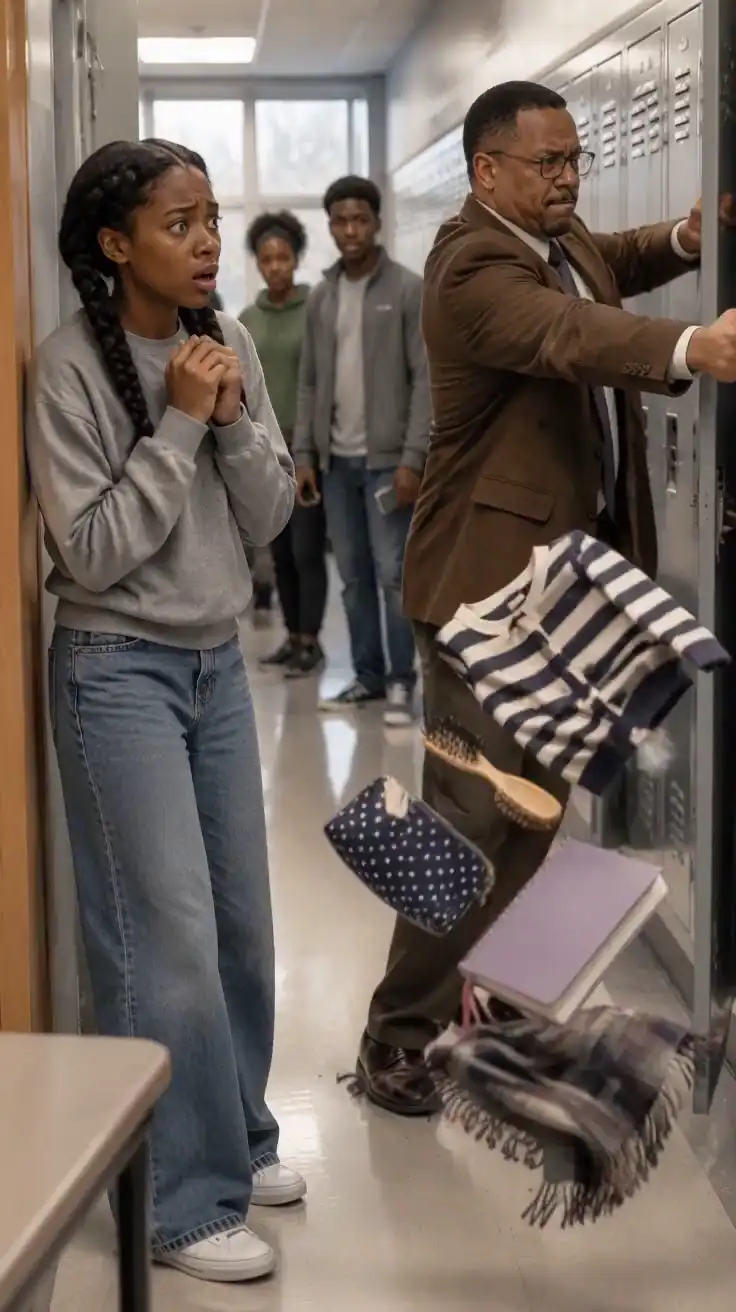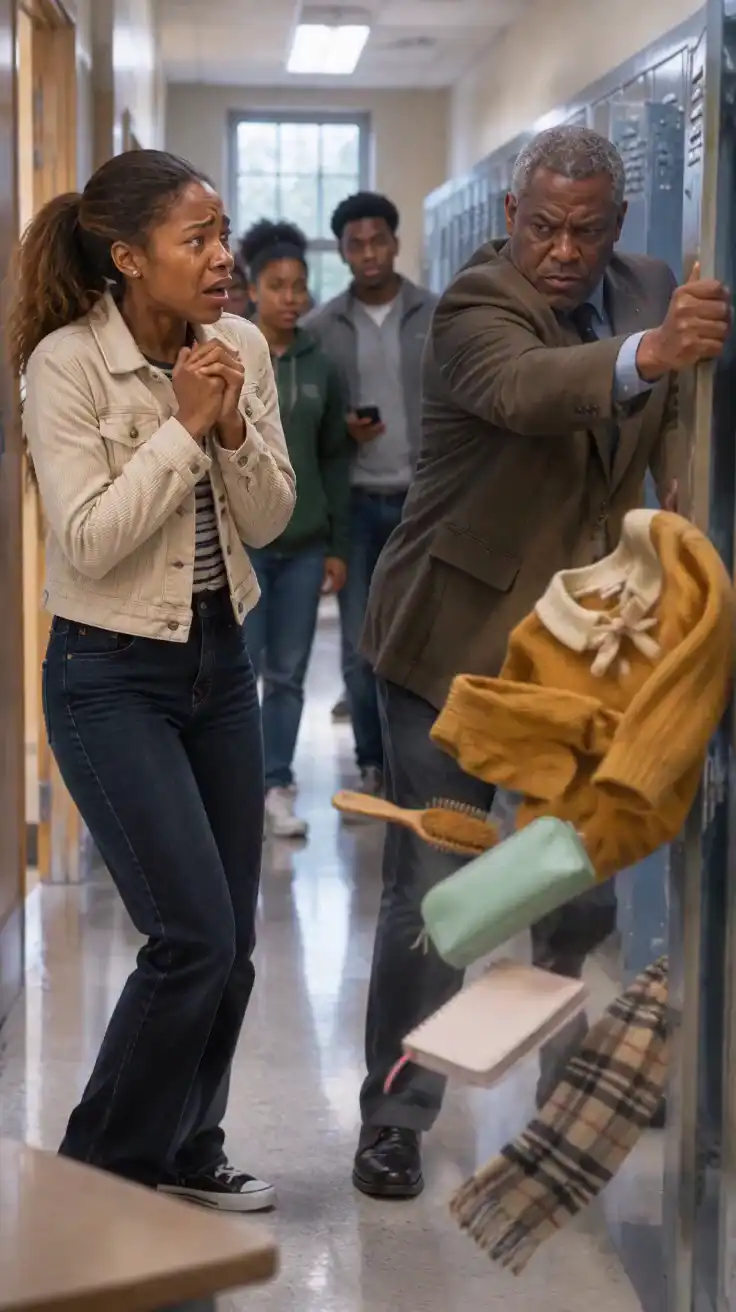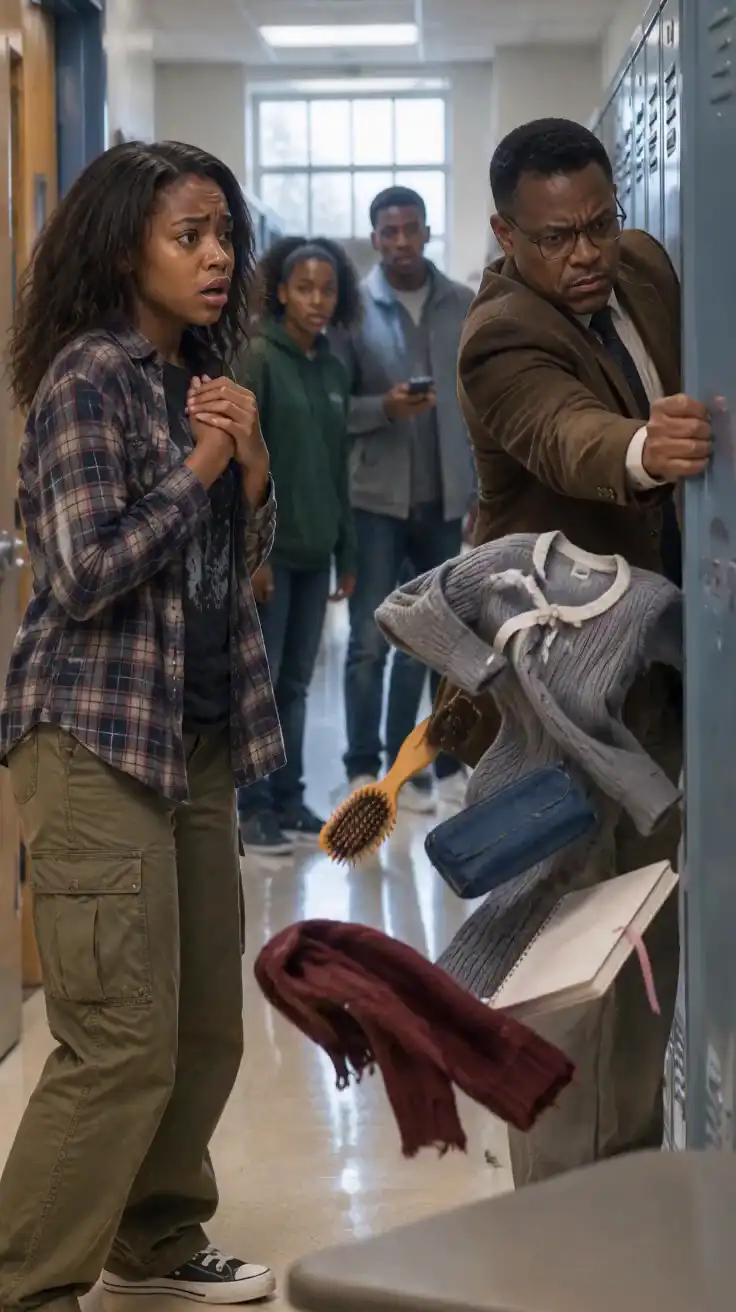
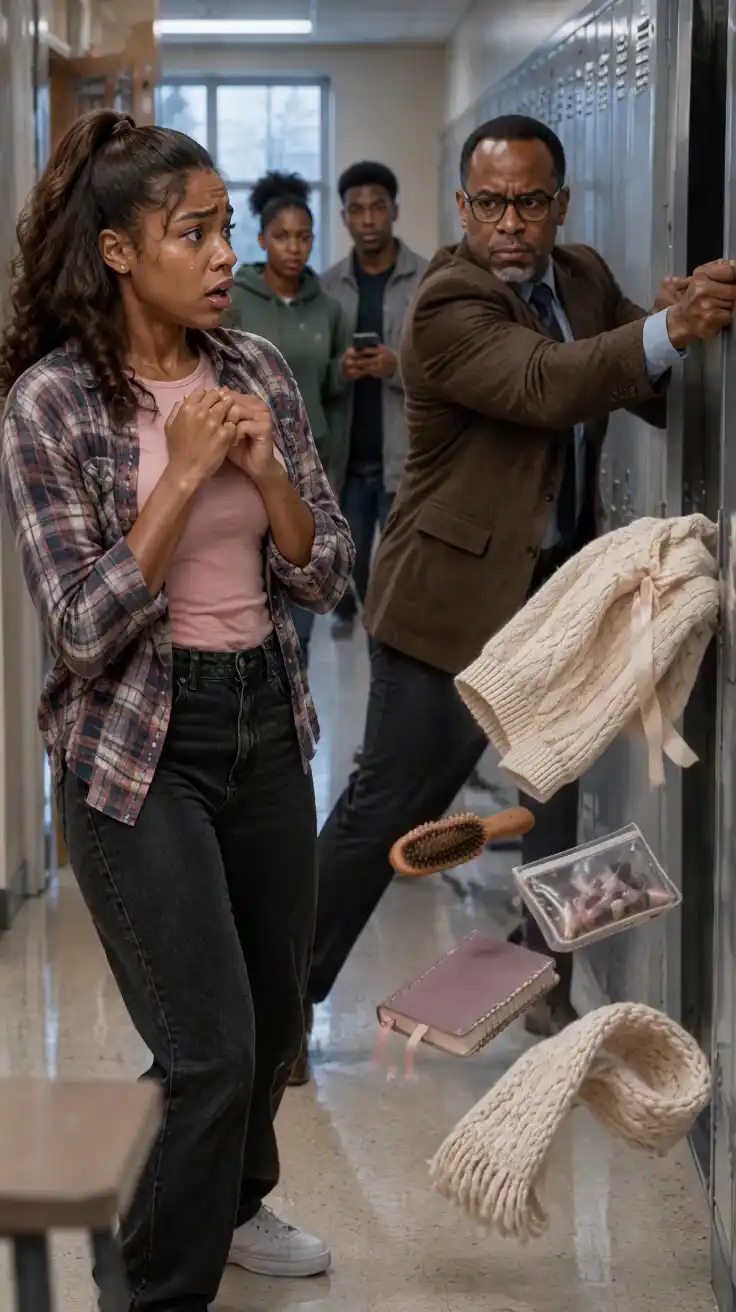
The bracelet struck the floor between them.
The little cross landed faceup.
For one second, nobody moved. Not the students with their phones raised. Not the dean. Not my daughter. Not the girl who had been shouting.
Then my daughter said, “That’s mine.”
Her voice was so quiet that the hallway seemed to make room for it.
The girl looked down at the bracelet as if she had never seen it before. Her mouth opened, but nothing came out. The dean, Mr. Bell, bent to pick it up. He held it by the chain, careful not to touch the cross.
“Where did you get this?” he asked.
The girl’s name was Marnie Cole. I had known it for years. I had known her since she was eleven years old, when she and my daughter, Leah, sang a Christmas duet at church and forgot the second verse because they were both trying not to laugh.
Marnie looked at Mr. Bell, then at Leah.
“It’s mine,” she said.
Leah’s face changed. Not dramatically. She did not scream or point or tell everybody she had been right all along. She just looked tired.
“It has my grandmother’s initials on the back,” she said.
Mr. Bell turned the bracelet over.
There, beneath the cross, were three tiny letters stamped into the gold.
E.M.W.
My mother’s initials.
I had watched those initials being stamped at a jeweler’s counter when I was nineteen. My mother had been alive then. She had stood beside me in a winter coat and complained that the jeweler was charging too much for something so small. She wore that bracelet for thirty-eight years. After she died, I gave it to Leah when she turned sixteen.
Marnie had seen it hundreds of times.
She had eaten at our kitchen table while Leah wore it. She had sat beside her in the church choir loft. She had held Leah’s wrist once during a prayer because Leah was crying and Marnie wanted her to know she was not alone.
Now she looked at those initials and said, “I didn’t know that was there.”
Leah laughed once, but there was no humor in it.
“You said you saw it in my room.”
“I never said that,” Marnie answered.
“You said it to my mother.”
“I said I thought I saw it.”
“You said you saw me put it in my desk drawer.”
Marnie’s eyes filled. “I was confused.”
Mr. Bell looked toward the students gathered near the lockers.
“Everybody put your phones down,” he said.
Nobody did.
He raised his voice. “Phones down. Now.”
A few hands lowered. Others stayed in the air. One boy near the water fountain kept recording until Mr. Bell walked toward him and said his full name.
I was in the office when it happened.
I had arrived at the school ten minutes earlier, after a secretary called and told me there had been “a development” in the bracelet matter. That was the phrase she used. A development. As if we were discussing a construction project instead of our daughter being publicly searched while half the school watched.
I had been sitting in a plastic chair outside the dean’s office, gripping my purse so tightly that the metal clasp had marked my palm. Mr. Bell had told me he was handling the situation. He had told me the search was necessary because Marnie had made a formal accusation and because Leah had denied taking the bracelet.
I asked him where my daughter was.
He said, “She is in the hallway.”
I asked why she was in the hallway if the matter was being handled.
He said, “We are checking Marnie’s locker.”
I asked why Leah needed to be there.
He said, “Because she is the person who reported the item missing.”
That answer had bothered me, but I was still trying to believe the adults in the building understood what they were doing. I had already spent two weeks trying to be reasonable. I had told myself that the truth would eventually become heavy enough to sink through all the noise.
Then I heard the students.
At first it was just a low roar, the sound teenagers make when they are gathered around something they have been told not to gather around. I stood up. The secretary looked at me and said, “Please wait here.”
I did not wait.
I walked through the office doors and saw my daughter on her knees.
That is the image that stayed with me more than the bracelet. Leah was on the tile, her skirt folded beneath her, her hands resting over a pile of papers and makeup and loose pencils. Marnie’s locker stood open behind her. Everything from it had been placed on the floor.
Leah’s backpack was against the wall.
Marnie was standing over her.
The dean was looking inside a purple makeup bag.
I remember thinking that no child should ever have to prove innocence from the floor.
I remember saying, “What is happening?”
Nobody answered me because at that exact moment Marnie pointed at Leah and shouted, “See? She’s hiding something!”
Then she lifted her arm.
The bracelet slid out.
I had watched the video later, because a student sent it to me before the school could decide whether it was “appropriate” for me to see. The video was only forty-six seconds long. It had been recorded from behind a row of lockers, and the picture shook whenever the student holding the phone breathed.
In the video, I saw the gold bracelet fall.
In person, I saw the aftermath.
Mr. Bell picked it up and walked toward me.
“Mrs. Warren,” he said.
I could not speak.
He held the bracelet out. I recognized the tiny cross immediately. The chain had a slight bend near the clasp because Leah had caught it on the zipper of her coat the previous winter. I had fixed it with a pair of tweezers at the kitchen table.
I took it from him.
It was warm.
That detail may sound strange, but it was warm from Marnie’s arm. I could feel the heat of her skin still caught in the gold. I held my mother’s bracelet in my palm and realized that Marnie had been wearing it while she accused my daughter of stealing it.
Leah was still on the floor.
“Get up,” I told her.
She looked at Mr. Bell.
He nodded.
She stood, but her knees shook so badly that I reached for her. She leaned against me, and I put one arm around her shoulders. Her hair smelled like the vanilla shampoo she had used that morning. She was crying without making a sound.
Marnie’s mother, Beth, arrived three minutes later.
She came through the office doors wearing the same red coat she wore to Sunday service. I had seen that coat every week for two years. She looked from me to the bracelet, then to Marnie.
“What happened?” she asked.
No one answered right away.
Mr. Bell said, “Marnie, tell your mother where the bracelet came from.”
Marnie’s face folded.
“I found it,” she said.
“Where?” Beth asked.
“In the hallway.”
“When?”
“I don’t know.”
“Why were you wearing it?”
Marnie looked at Leah.
Leah turned her face away.
Beth put both hands on her daughter’s shoulders. “Marnie.”
“It was on the floor,” Marnie said. “I picked it up.”
“You said Leah stole it from your bag,” I said.
Marnie began crying then. It was not a dramatic cry. It was the kind that makes a person’s whole body go rigid because they are trying to keep it from happening.
“I didn’t mean for it to get this big,” she said.
There it was.
Not an explanation. Not an apology. But the first honest sentence anyone had heard from her in two weeks.
I looked at her.
“What did you mean for it to be?” I asked.
She wiped her cheeks with the backs of her hands. “I don’t know.”
“You knew enough to tell people she took it.”
“I was scared.”
“Of what?”
She looked at the floor.
“Answer her,” Beth said.
Marnie’s voice dropped. “I was scared she would win.”
Leah stiffened beside me.
“Win what?” I asked.
“The vote.”
The hallway seemed to grow quiet again, even though students were still moving and teachers were still telling them to leave. Everyone heard her.
The prom court vote was that night.
Leah and Marnie were both on the final ballot for junior representative. The school called it prom court, although the students treated it like a campaign for mayor. There were posters in the cafeteria, homemade videos online, candy bags with names printed on them, and groups of students arguing about who had the better chance.
Leah had not wanted to run at first. Her friends had talked her into it. She liked planning things, and she had helped organize the winter charity drive, so people kept saying she would be good at it. Marnie had wanted the spot since the beginning of the school year.
I knew Marnie wanted it because she had told me herself.
She told me at church in November, while the two girls were arranging candles near the altar.
“I am going to be on prom court,” Marnie said.
I smiled. “That sounds exciting.”
“It is not just exciting. It matters.”
“Why?”
She looked over at Leah, who was kneeling on the other side of the altar and trying to untangle a string of white lights.
“Because people need to know I can be more than what they think I am.”
I did not understand what she meant then.
Marnie had always been treated as the responsible one. Her father was a deacon. Her mother ran the church food pantry. Marnie sang in the youth choir, kept her grades high, and never missed a Sunday unless she was sick. She had a carefully arranged life. Leah was less polished. She forgot permission slips. She left shoes by the back door. She once submitted a history paper with my grocery list still attached to the last page.
But Leah was kind in a way that made people come to her. She remembered birthdays. She noticed when someone was sitting alone. She could make a nervous person laugh without making them feel laughed at.
The girls were different, but they had been close.
They met at church when they were eight. They attended the same Sunday school class, then the same middle school, then the same youth group. For years, Marnie spent nearly as much time at our house as she did at her own.
She knew where we kept the extra blankets. She knew that Leah hated mushrooms. She knew my husband snored when he was tired, although she had never mentioned it in front of him because she was too polite. She and Leah used to sit on the kitchen floor after youth group and split a bag of cheese crackers while they worked on school projects.
When they were thirteen, they made a list of places they wanted to visit together. Paris was first, then New York, then a beach in Oregon because Marnie had seen a picture of it in a magazine.
At fifteen, they stopped walking home from church together every Sunday because Marnie joined the dance team and Leah joined the stage crew. But they still texted. They still sat together during services. They still called each other best friends when other people asked.
The change came quietly.
Marnie started comparing herself to Leah.
She asked what grade Leah had received on a test. She asked how many votes Leah thought she would get. She asked whether Leah’s friends had already promised to support her. When Leah was selected to speak at the school’s Veterans Day assembly, Marnie smiled and congratulated her, then spent the entire drive home telling Beth that the teacher had only picked Leah because my husband had volunteered at the school.
I did not know that then.
I knew only that Marnie had begun looking at Leah as if every good thing that happened to her was something taken away from Marnie.
The day the bracelet disappeared was a Thursday.
Leah wore it to school because she had a history presentation and my mother had always told her the cross brought courage. I had repeated that story so many times that Leah rolled her eyes whenever I said it, but she still touched the cross before tests.
The bracelet had a delicate clasp. We had talked about replacing it, but my mother’s jewelry was not ordinary jewelry to me. Every repair felt like changing it. Leah had promised to be careful.
At lunch, Leah noticed it was gone.
She thought it had fallen in the girls’ bathroom or caught on her sweater. She searched her backpack, her locker, and the path between the library and the cafeteria. Marnie helped her look for it.
That was the part that made the accusation so cruel.
Marnie helped her search.
She crouched beside Leah beneath the lunch tables. She checked under the vending machine. She asked two girls from the dance team whether they had seen anything gold on the floor.
Then she said, “Maybe someone took it.”
Leah told her, “Nobody would take it.”
Marnie said, “People take things.”
By the end of lunch, Marnie was telling people Leah had taken something from her.
The first version was that Leah had borrowed Marnie’s bracelet and refused to give it back. That made no sense because everybody knew the bracelet belonged to my mother. When somebody challenged her, Marnie changed it.
She said Leah had seen the bracelet in Marnie’s bag.
Then she said Leah had opened the bag.
Then she said Leah had been angry because Marnie was getting more votes for prom court.
By the time the school called me that afternoon, the story had become that Leah had stolen Marnie’s bracelet and planted it in the bathroom.
I asked Marnie why she was saying these things.
She told the assistant principal that Leah had been acting jealous.
Leah sat beside me in the office, gripping the hem of her sweatshirt.
“I wasn’t jealous,” she said.
Marnie looked at her with tears in her eyes. “You know what you did.”
“I don’t.”
“You looked through my bag.”
“I didn’t.”
“You asked me if I had your bracelet.”
“Because you were helping me look for it.”
“You were trying to make me look guilty.”
The assistant principal, a woman named Mrs. Ruiz, asked both girls to stop speaking over each other. She asked where the bracelet had last been seen. She asked whether there had been witnesses. She asked whether any cameras covered the lunch hallway.
There were no cameras in the cafeteria.
Marnie’s bag had been in the girls’ locker room during dance practice, and Leah had not been there.
Still, the rumor moved faster than facts.
That night at church, Beth called me aside.
“I hope you understand that Marnie is very upset,” she said.
I looked at her. “My daughter is the one being accused.”
“I know, but she says Leah has been making comments about the prom vote.”
“Leah is not responsible for Marnie’s feelings.”
“Neither is Marnie responsible for Leah losing a bracelet.”
I had to take a breath before I answered.
“You are saying Leah took it?”
“I am saying Marnie believes she did.”
“That is not the same thing.”
Beth’s mouth tightened. “You seem very defensive.”
“I am her mother.”
“And I am Marnie’s mother.”
“I know.”
We had stood beside each other in that church nursery for years. We had taken turns bringing snacks to youth group. We had sat through Christmas pageants and Easter programs and graduation ceremonies. We knew each other’s ordinary lives.
That night, she walked away from me without saying goodbye.
The next morning, Marnie told several girls that Leah had confessed to stealing the bracelet but that I had made her deny it.
Leah came home from school and sat at the bottom of the stairs.
“I didn’t say anything to her,” she told me.
“I know.”
“She keeps changing it.”
“I know.”
“What if people believe her?”
“Some people already do.”
She put her hands over her face.
I sat beside her on the step.
“What do you want me to do?” I asked.
She looked at me through her fingers. “Nothing.”
“That is not an answer.”
“If you call her mother, it will get worse.”
“It is already worse.”
“I just want it to stop.”
I wanted that too. I wanted to go back to the day before the bracelet vanished, before the girls had begun studying each other like enemies.
But there was no going back.
The school opened an investigation. Mr. Bell interviewed students. He asked Leah to write down where she had been that day. He asked Marnie to do the same. He requested access to their lockers.
Leah’s locker was searched first.
She stood beside it while Mr. Bell removed every notebook and folder. He looked inside her backpack. He checked the pockets of her coat. He opened a small fabric pouch where she kept hair ties and bandages.
Nothing was found.
Leah did not complain. She kept saying she understood.
When Marnie’s locker was searched, it became a spectacle.
Someone posted in the senior group chat that Leah was being forced to identify the stolen bracelet. Students came out of classrooms. A teacher tried to clear the hallway, but no one moved quickly enough. The search happened in front of an audience because everyone had already decided the story was entertainment.
Marnie had been warned that the school would search her locker. She had time to remove something if she wanted to. She had time to make a phone call, throw something in a trash can, or ask to speak with her mother.
Instead, she came to the hallway wearing the bracelet under her sweater.
When Mr. Bell started pulling items out of her locker, she stood with her arms crossed. She watched Leah arrive with the secretary. She watched Leah see the crowd. She heard the whispers.
I do not think she planned for the bracelet to fall out in front of everyone.
I think she had worn it for days because she had convinced herself that if she kept it close, she could control the story.
Marnie told us the full truth later.
The bracelet had come loose from Leah’s wrist during lunch. Leah had taken off her sweater because she was hot and hung it over the back of her chair. Marnie saw the bracelet catch on the sweater cuff. When Leah picked the sweater up, the bracelet fell beneath the table.
Marnie saw it.
She picked it up before Leah could.
At first, she meant to return it. She put it inside the sleeve of her own sweater because she did not want another girl at the table to step on it. Then Leah asked whether anyone had seen it.
Marnie had the bracelet against her wrist.
She could have handed it over.
Instead, she said, “No.”
Leah asked her again.
Marnie said, “Why would I have it?”
That was the first lie.
Then she saw the prom posters hanging near the cafeteria. Leah’s name was printed in large blue letters on one of them. Marnie’s name was printed beneath it in smaller red letters because of the way the students had arranged them.
Marnie said that seeing those posters made her angry.
She told us she had spent weeks believing Leah was going to win. She said people kept telling her that Leah was more likable. She said one of her dance teammates had joked that Marnie only wanted the position because she needed attention.
“I thought if people believed she stole from me, they would not vote for her,” Marnie said.
We were in the church’s small meeting room when she told us.
The room had beige walls and a table with a water stain shaped like a cloud. Beth sat beside Marnie. My husband sat beside me. Leah sat across from them with her hands folded in her lap.
Mr. Bell had asked both families to meet before the school sent an official notice to the parents of the students who had filmed the search.
Marnie had cried through most of it.
“I told one person,” she said.
“No,” Leah answered. “You told everyone.”
“I told Casey.”
“Casey told the dance team.”
“I didn’t know she would.”
“You told her again when she asked.”
Marnie covered her face.
Beth looked at me. “She was afraid.”
“So was Leah,” I said.
“I know.”
“She was afraid to walk into school. She was afraid to eat lunch. She was afraid that if she defended herself, people would call her dramatic.”
“I know.”
“Do you?”
Beth’s eyes filled. “Yes.”
For the first time in two weeks, she did not defend Marnie.
That did not make it better. It only made the room more honest.
Marnie told us she had worn the bracelet every day after the first lie.
She kept it hidden beneath her sleeve during school. At home, she placed it on her wrist while she did homework. She said she could not bring herself to put it in a drawer because then it would feel like admitting what she had done.
She said the bracelet made her feel powerful for the first day.
After that, it made her feel trapped.
“Why didn’t you return it?” I asked.
She looked at me. “I thought nobody would believe me anymore.”
“You were right.”
She flinched.
I regretted saying it, but I did not take it back.
Marnie had believed that the first lie was small enough to survive. Then every new detail required another lie to protect it. She told students that Leah had stolen from her bag because that made the missing bracelet look like a crime instead of an accident. She told them Leah had been jealous because jealousy gave the story a motive. She told them she had seen the bracelet in Leah’s room because people believed things more readily when they could picture them.
She had built a whole house out of sentences.
Then the bracelet fell out of her sleeve.
The prom court vote was postponed before the meeting ended.
That decision made the students furious.
There were posts online saying the school was punishing everyone because two girls could not get along. There were comments saying Leah had manipulated the administration to delay the vote. Someone wrote that Marnie had been framed because the bracelet had “magically” appeared at the exact moment Leah needed sympathy.
Leah read the comments once.
Then she handed me her phone.
“Delete the app,” I said.
“I want to know what they’re saying.”
“You already know.”
She sat on her bed with her knees pulled up.
“I don’t understand how they can still think I did it.”
“Some people would rather protect the story than change their minds.”
“Why?”
“Because changing their minds means admitting they helped hurt you.”
She looked down at the bracelet in her hand.
It had been cleaned at the jeweler after Mr. Bell gave it back to me. I had asked them to check the clasp. They found that the jump ring had stretched slightly, which explained why it had come loose so easily.
Leah had not wanted to wear it again.
“Maybe you should keep it,” she said.
“It is yours.”
“I don’t want people looking at it.”
“People are going to look at you for a while no matter what you wear.”
She was quiet.
Then she asked, “Did Grandma ever have people lie about her?”
I smiled despite myself. “Your grandmother once accused the mailman of stealing a birthday card because she forgot she had put it in the freezer.”
Leah laughed, and for a moment she looked like herself.
That was the first laugh I had heard from her since the bracelet disappeared.
The school held a second meeting with the families of the students who had recorded the search. Mr. Bell admitted that the search had been mishandled.
He said he should not have allowed the students to gather. He said Leah should not have been required to kneel on the floor and examine the contents of Marnie’s locker. He said the accusation did not justify humiliating either girl.
I asked him why he had let it happen.
He said he believed the situation had become volatile and that he was trying to establish the facts quickly.
“Facts do not require an audience,” I told him.
He nodded. “You are right.”
It was not enough, but it was honest.
The next morning, Mr. Bell made an announcement over the school intercom.
He did not name Marnie or Leah, but everyone knew who he meant. He said students were not permitted to record disciplinary matters. He said spreading unverified accusations was harassment. He said the school would not tolerate retaliation against either student.
Some students applauded.
Others laughed.
Leah sat in English class and stared at the page in front of her.
At lunch, Mr. Bell asked her and me to come to the office.
He wanted to apologize in front of the staff.
I expected a private conversation. Instead, when we entered the main office, the secretaries were standing near the reception desk. Mrs. Ruiz was there. The assistant principal was there. Two teachers who had been in the hallway were there. Marnie and Beth stood near the conference room door.
Mr. Bell faced Leah.
“I owe you an apology,” he said.
Leah looked at me.
I nodded once.
He continued. “I allowed you to be placed in a humiliating position during a search that should have been conducted privately. I asked you to kneel on the floor while other students watched. I failed to protect you from a crowd. That was wrong.”
The office was so quiet I could hear the printer clicking behind the reception desk.
“I am sorry,” he said. “And I am sorry to your mother for making her daughter prove herself in a situation we should have handled with greater care.”
I had been angry at him for days.
I had rehearsed what I would say if he apologized. I had imagined telling him that an apology could not erase the video or the whispers or the way Leah’s knees had pressed against the dirty tile.
But when he stood there in front of the office staff, I realized he was not asking me to erase anything.
He was admitting what he had done.
“Thank you,” I said. “You also need to say it to her where the students can hear it.”
He looked surprised.
Leah looked at me.
I continued. “The humiliation happened in public. The correction cannot stay private.”
Mr. Bell nodded.
He called the students into the auditorium during the last period. He did not identify Marnie by name, but he described the incident clearly enough that nobody had to guess.
He apologized to Leah in front of them.
He apologized for the search.
He apologized for letting a rumor become a disciplinary event before the facts were established.
Marnie sat in the second row with her hands clasped between her knees.
When Mr. Bell finished, she stood.
Her face was blotchy, and her hair was pulled back unevenly. She looked younger than she had in the hallway.
“I started it,” she said.
A murmur moved through the auditorium.
Mr. Bell took one step toward her. “Marnie, you do not have to speak right now.”
“I want to.”
She turned toward the students.
“I found the bracelet,” she said. “It fell from Leah’s sweater at lunch. I picked it up. I knew it was hers. I lied because I wanted people to vote for me instead of her.”
Someone in the back said, “Why did you say she stole it?”
Marnie swallowed.
“Because I was scared nobody would believe I had found it.”
“That doesn’t make sense,” another student said.
“I know.”
“Why did you wear it?”
Marnie looked at Leah.
“I don’t know.”
Leah did not answer.
Marnie’s voice broke. “I thought if I gave it back, everyone would know I had lied. Then I kept lying because I didn’t know how to stop.”
No one applauded.
No one rushed to comfort her.
That was probably appropriate.
An apology is not a performance that earns immediate forgiveness. Sometimes it is simply the first time a person stops adding to the damage.
The vote was held the following Monday.
The school gave students the option to vote for both positions again, and the candidates were allowed to submit a written statement. Leah almost withdrew.
She sat at the kitchen table with the paper in front of her for an hour.
“What would you write?” I asked.
“I don’t know.”
“You do not have to explain the bracelet.”
“I know.”
“You do not have to attack Marnie.”
“I know.”
“You can write nothing.”
She looked at the blank page.
“If I withdraw, people will say I was afraid.”
“People will say things either way.”
“That is not helpful.”
“No,” I said. “But it is true.”
She rested her forehead on the table.
“I wanted to be on prom court because it seemed fun. Now it feels like a trial.”
“Then decide whether you still want the fun part.”
She thought about it.
That night, she wrote six sentences. She thanked the students who had supported her. She said she hoped the school would become a place where people asked questions before choosing sides. She said she was running because she liked organizing events and wanted everyone to feel included.
She did not mention Marnie.
She did not mention the bracelet.
She did not mention that people had called her a thief.
Leah won the vote by thirty-seven ballots.
Marnie came in second.
When the results were announced, the students cheered for Leah. A few cheered for Marnie too, but the applause was scattered and uncomfortable. Marnie stood near the stage with her hands folded.
Afterward, Leah found her in the hallway.
I was a few feet away. I could hear them, but I did not move closer.
“Congratulations,” Marnie said.
“Thank you.”
“You deserved it.”
Leah looked at her.
Marnie began crying again. “I am not saying that because I have to.”
“I know.”
“I am sorry.”
Leah looked down at the floor.
“Are you ever going to forgive me?” Marnie asked.
Leah took a long breath.
“I don’t know.”
Marnie nodded.
“I understand.”
“No, you don’t,” Leah said. “You keep asking me for an answer because you want to feel better. I don’t know if I can forgive you. I don’t know when I can trust you. I don’t know if we will ever be friends again.”
Marnie wiped her eyes.
“But I don’t hate you,” Leah said. “I need you to know that.”
Marnie nodded again, and this time she did not ask for anything else.
The consequences at school were not dramatic. Marnie was removed from the prom court planning committee. She received detention for spreading the accusation and violating the school’s conduct policy. The students who had recorded and shared the search had to attend a meeting about privacy and harassment.
Some parents wanted Marnie suspended.
Some wanted Leah punished for “creating division” by refusing to forgive Marnie immediately.
There was no outcome that satisfied everyone.
There rarely is when a lie passes through a whole community. Everybody wants the punishment to fall on the person who started it, but by then the damage has usually been carried by many hands.
Beth withdrew Marnie from the dance team for the rest of the season.
That decision caused another argument at their house. Marnie said she had already lost enough. Beth said that was exactly why she needed time away from the group that had helped spread the story.
Marnie’s father stopped serving as a deacon for a month.
He told the church board that he needed to focus on his family. I do not know whether that was his decision or theirs. I only know that he stopped looking at us during Sunday service.
Beth and I stopped sitting together.
At first, people tried to place us on opposite sides of the sanctuary. Then the pastor asked whether we could attend separate services for a while.
I agreed.
Church had been part of our lives for so long that losing the ordinary rhythm of it felt like another kind of grief. Leah had gone there since she was a baby. Marnie had too. Their voices were still printed in the youth choir program. Their names were still on the volunteer schedule for the spring food drive.
The building held too many memories to feel neutral.
For three Sundays, Leah stayed home.
She said she did not want people whispering when she walked in. I told her nobody had the right to make her leave a place she loved, but I did not force her to go.
On the fourth Sunday, she came with me.
We sat near the back.
Marnie was on the other side of the sanctuary with Beth. They did not look at us during the service. Afterward, Pastor James came to speak with me.
He said he was sorry.
I told him that several people at church had repeated the accusation without asking whether it was true.
He said he knew.
“Some of them are still saying the school handled it badly because Leah was favored,” I told him.
His face tightened. “I have heard that.”
“What are you doing about it?”
He looked uncomfortable. “I have spoken with the youth group.”
“Privately?”
“Yes.”
“That is not enough.”
He was quiet.
I did not want another public spectacle. I did not want Leah or Marnie placed in front of the congregation and asked to represent a lesson about forgiveness. But I also did not want the adults who had fueled the rumor to hide behind silence.
The following Sunday, Pastor James spoke about gossip during the service. He did not name the girls. He said truth was not made more true by repetition and that adults were responsible for what they carried into their homes and passed to their children.
After the service, two women apologized to me.
One had told her daughter that Leah was probably jealous of Marnie. The other had said the school would not have investigated if Leah had not done something suspicious.
Neither apology repaired what had happened, but both women looked embarrassed enough to understand that their words had consequences.
Marnie’s family also had to deal with people who treated them as if they were all responsible for her decision.
Beth told me that someone left a note on their windshield calling Marnie a liar and a thief.
That was wrong.
Marnie had lied. She had stolen the bracelet in the moment she chose not to return it. But public cruelty did not become justice just because the target had done something terrible.
I called Beth after she told me.
“I am sorry,” I said.
She sounded exhausted. “You don’t have to be.”
“Yes, I do.”
“You did not write the note.”
“No, but I know what it feels like to have your child discussed by people who do not know the whole story.”
There was a pause.
“Are you asking me to forgive her?” Beth asked.
“No.”
“Are you asking Leah to forgive her?”
“No.”
“Then what are you asking?”
“I am asking you to make sure Marnie tells the truth every time, even when the truth makes her look worse.”
Beth began to cry.
“I am trying.”
“I know.”
“And I am sorry.”
“I know.”
We did not become friends again.
That is one of the parts people do not like to hear. They want every story to end with two mothers hugging in a church parking lot while the girls promise to rebuild their friendship. Sometimes that happens. It did not happen with us.
Beth and I could be polite. We could sit in the same room. We could discuss school meetings and church schedules. We could say happy birthday when the girls’ birthdays came around.
But the easy trust was gone.
She had defended Marnie when she should have questioned her. I had assumed that because we had shared years of friendship, she would understand immediately that Leah was telling the truth. Both of us had learned that history did not guarantee honesty in the present.
Marnie and Leah did not become friends again either.
They were civil.
They worked on the prom decorations in the same room. Leah was responsible for the schedule, and Marnie volunteered to help with the centerpieces because she wanted to finish the year without abandoning every commitment she had made.
The first time they had to work together, Leah came home and said, “It was awkward.”
“Did she behave?”
“Yes.”
“Did you?”
She gave me a look. “Mom.”
“I am asking.”
“I behaved.”
That was enough for me.
A month later, Marnie wrote Leah a letter.
She did not send it through a friend. She handed it to her outside the library.
Leah brought it home unopened.
“Do you want to read it?” I asked.
“No.”
“Then don’t.”
“What if it says something important?”
“You can read it when you are ready.”
She kept the letter in a drawer for three weeks.
When she finally opened it, she did not tell me everything inside. She said Marnie had written about being jealous, about feeling like she had spent years standing next to Leah and watching people choose Leah first, and about how ashamed she was that she had turned that feeling into a weapon.
“She says she still thinks I am better than her,” Leah told me.
“That is not your responsibility.”
“I know.”
“She needs to learn that your success does not require her failure.”
“She says she is trying.”
“People can try and still need to stay away from you.”
Leah folded the letter.
“Do you think I am cruel if I don’t answer?”
“No.”
“What if I answer but don’t forgive her?”
“Then you answer honestly.”
Leah wrote back two weeks later.
I never read the letter. I only know she gave it to Marnie after church. Marnie read it in her car. Beth told me later that Marnie sat there for twenty minutes before she could drive.
The girls did not hug.
They did not promise to be friends.
But after that, they could speak without one of them looking like she was about to run.
The bracelet stayed in my jewelry box for a long time.
Leah did not want to wear it at school. She wore it at home once, then took it off when she saw her reflection in the hallway mirror.
I told her she did not owe the bracelet a public appearance.
“It is not ashamed,” I said.
“I am not ashamed.”
“I know.”
“I just don’t want it to be part of the story anymore.”
That made sense.
The bracelet had belonged to my mother before it belonged to Leah. Then, for two weeks, it belonged to a rumor. It had become evidence, a weapon, a symbol, a piece of a story that strangers felt entitled to interpret.
Leah needed to decide what it meant to her again.
In May, she wore it to the senior awards ceremony.
No one knew she would. She had a dark blue dress and a plain cardigan. Before we left the house, she fastened the bracelet around her wrist and checked the clasp twice.
“Are you sure?” I asked.
She nodded.
“It is my bracelet,” she said.
“Yes.”
“I want it back.”
She did not mean physically. I understood.
At the ceremony, Marnie sat three rows ahead of us with her parents. When she saw the bracelet, she looked down.
Leah noticed.
She did not cover it with her sleeve.
After the ceremony, Marnie approached us in the parking lot.
The sun was low, and the church windows reflected orange light onto the pavement. Parents were loading folding chairs into trunks. Children ran between cars. It was an ordinary evening, which somehow made the moment feel more important.
Marnie looked at the bracelet.
“It looks nice,” she said.
Leah touched the cross.
“Thank you.”
“I am glad you are wearing it.”
Leah studied her.
“Are you?”
Marnie took a breath. “Yes.”
That was all.
Marnie did not ask whether Leah had forgiven her. She did not ask whether they could be friends. She did not ask Leah to tell her parents that she was a good person.
She simply stood there and let the bracelet remain Leah’s.
Beth waited near their car.
I expected her to say something, but she only nodded to me. I nodded back.
Then the two of them left.
The last time I saw Marnie before summer, she was helping pack boxes at the church food pantry. Leah was there too, sorting cans at another table. They did not work side by side, but they were in the same room without tension filling every space between them.
A year has passed since the hallway.
People still bring it up sometimes.
A new student found the video online and asked whether it was real. Someone mentions the prom vote whenever the school holds an election. A parent who was not there will repeat a version of the story and get one detail wrong.
I correct them when I have the energy.
Sometimes I do not.
Leah is in college now. She keeps the bracelet in a small wooden box beside her bed. She wears it when she wants to, which is often but not always. The clasp has been replaced, and the cross sits flat against her wrist.
Marnie attends a different college. From what Beth tells me, she is studying social work. That choice surprised me at first, but perhaps it should not have. Marnie knows what it means to cause harm while believing you can still control the outcome. She knows how quickly a frightened person can turn a private mistake into a public wound.
I do not know what kind of person she will become.
Neither does she.
That is the truth about the longer aftermath. The bracelet did not magically fix either family. The school’s apology did not erase the video. The church sermon did not rebuild the friendship. Marnie’s confession did not make Leah trust her again.
But the lie stopped growing.
That mattered.
For two weeks, it had moved through every place where people knew our names. It had entered classrooms and kitchens, church pews and group chats. It had made my daughter question whether telling the truth was enough. It had made Marnie protect a lie even after it began hurting everyone around her.
Then the bracelet fell out of her sleeve.
Not because the truth always reveals itself at the perfect moment. Not because justice is automatic. The bracelet fell because the clasp caught on a locker door, and Marnie had hidden it against her skin for too long.
But when it struck the floor, she had a choice.
She could have kicked it away.
She could have said it was a fake.
She could have accused Leah again.
Instead, after all the damage, she said, “I didn’t mean for it to get this big.”
It was not enough.
It was only the beginning of enough.
My daughter’s grandmother’s bracelet is still thin gold. The cross is still small. The initials are still nearly invisible unless you know where to look.
I know where to look.
So does Leah.
And now, so does Marnie.