The dean called me at 10:17 on a Thursday morning.
I remember the time because I was standing in the produce aisle at Bell’s Market, deciding whether the bruised apples were worth the discount. My phone buzzed against my palm. The school’s number came up, and I stepped away from the cart before I answered.
“Mrs. Bennett? This is Dean Mercer. I need you to come to school.”
She spoke carefully, like each word had been selected from a drawer. I asked whether Nora was hurt.
“No,” she said. “There’s been an incident involving a student’s property. Your daughter is safe, but I think you should come in.”
I left the apples where they were. I drove with the grocery list still in my coat pocket and one hand gripping the steering wheel harder than it needed to. At the first red light, I called Nora. She didn’t answer. I called again. No answer.
By the time I turned into the school parking lot, I had invented at least six explanations, each worse than the last. A fight. A panic attack. Some kind of accident. I didn’t yet know there was a video.
The front office secretary looked at me with a face that made it clear she knew more than she was permitted to say. She offered to take my coat. I kept it on.
Dean Mercer came out of the conference room. He was a tall man with silver at his temples and a neat blue tie. He had been at the school long enough to know my name, though he had never needed to call me before.
“Nora’s in the conference room,” he said. “She’s upset.”
“What happened?”
“A student reported a bracelet missing. The circumstances suggested it might have been taken from a locker.”
“Whose locker?”
He paused for half a second. “Nora’s.”
I looked past him toward the conference room. The door was shut.
“You searched her locker?”
“We had reason to believe the item could be there.”
“Did you call me first?”
“We were trying to resolve the situation promptly.”
“That isn’t what I asked.”
His expression tightened. “No, I did not call you first.”
I had the feeling he wanted me to acknowledge the difficulty of his position. I was not in a condition to help him feel better.
“Who said my daughter took it?”
“The student who reported it missing.”
“And who searched the locker?”
“I did.”
“Did Nora agree?”
He looked down the hallway toward the office. “She was asked to cooperate.”
I opened the conference room door before he could say anything else.
Nora sat at the far end of the table with both hands tucked under her thighs. Her face was blotchy, and there was a streak of dust on one knee. A woman I recognized as the school counselor sat beside her. Nora looked at me and started crying again.
I went straight to her. “Are you hurt?”
She shook her head.
“Did anyone touch you?”
“No.”
“Did you take anything?”
“No, Mom.”
“I know.”
The counselor put a tissue box near Nora but didn’t touch her. Dean Mercer stayed in the doorway.
“Where is the other student?” I asked.
“She’s in the main office.”
“Is the bracelet missing?”
He didn’t answer.
“Dean Mercer, is it missing?”
At that moment we heard a noise from the hallway: a sharp, small clatter, followed by a voice asking, “What was that?”
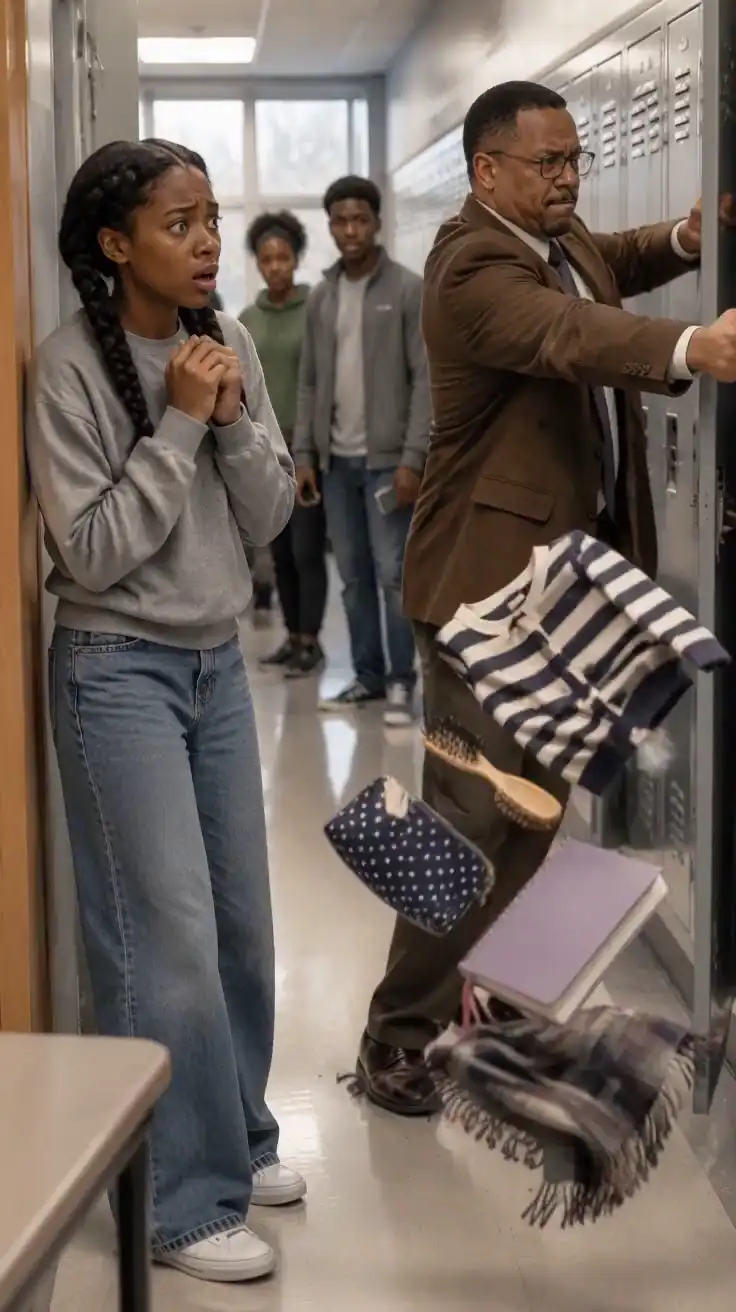
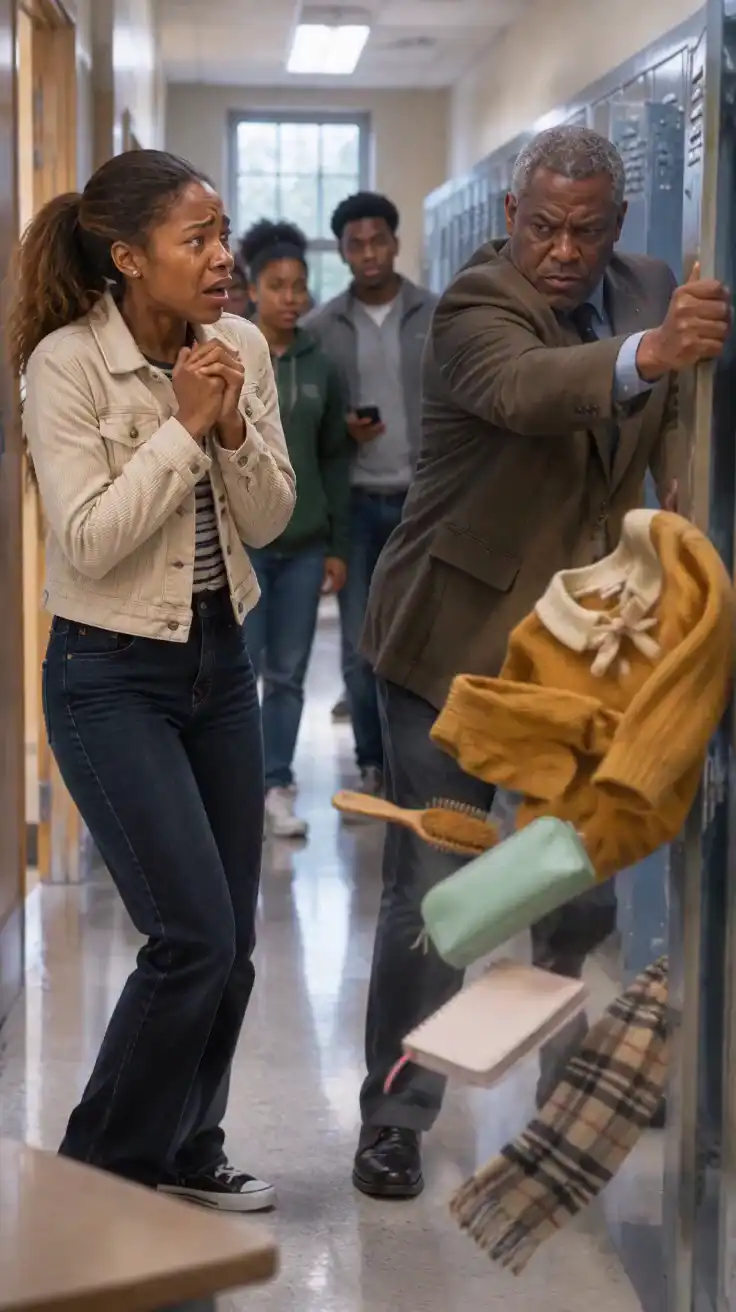
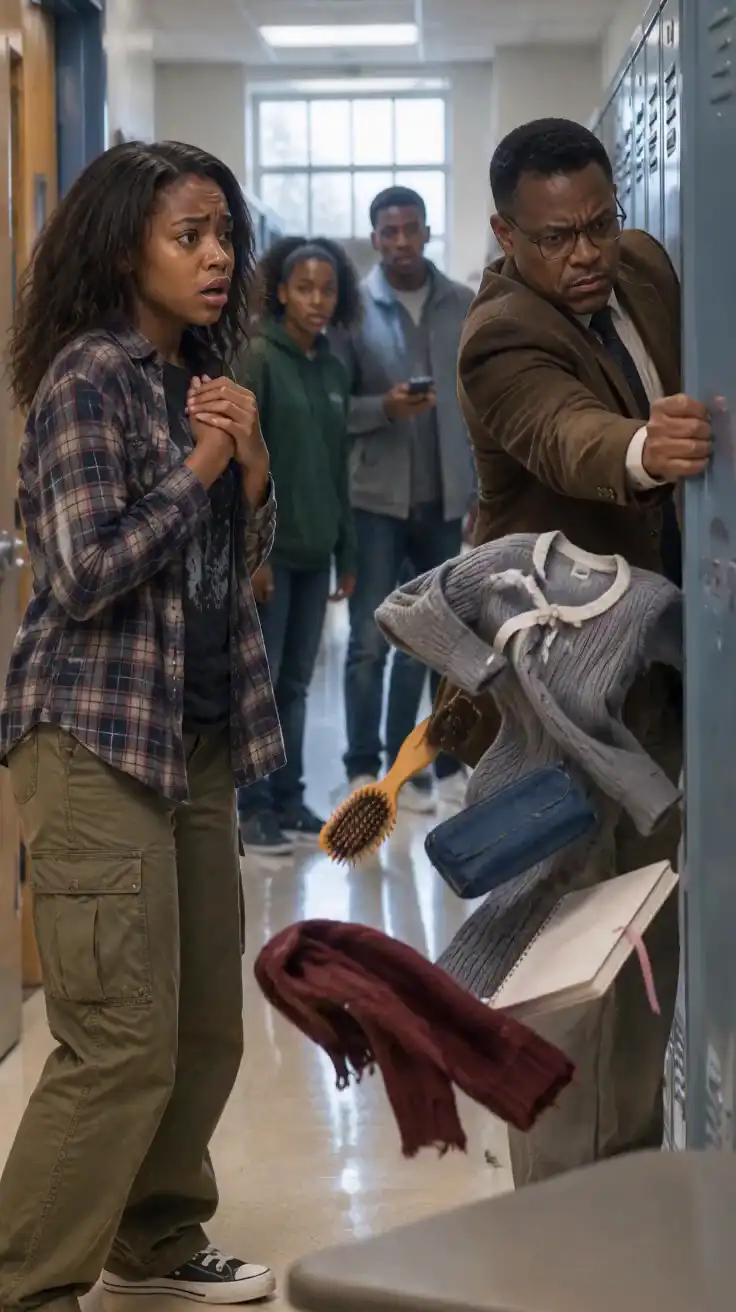
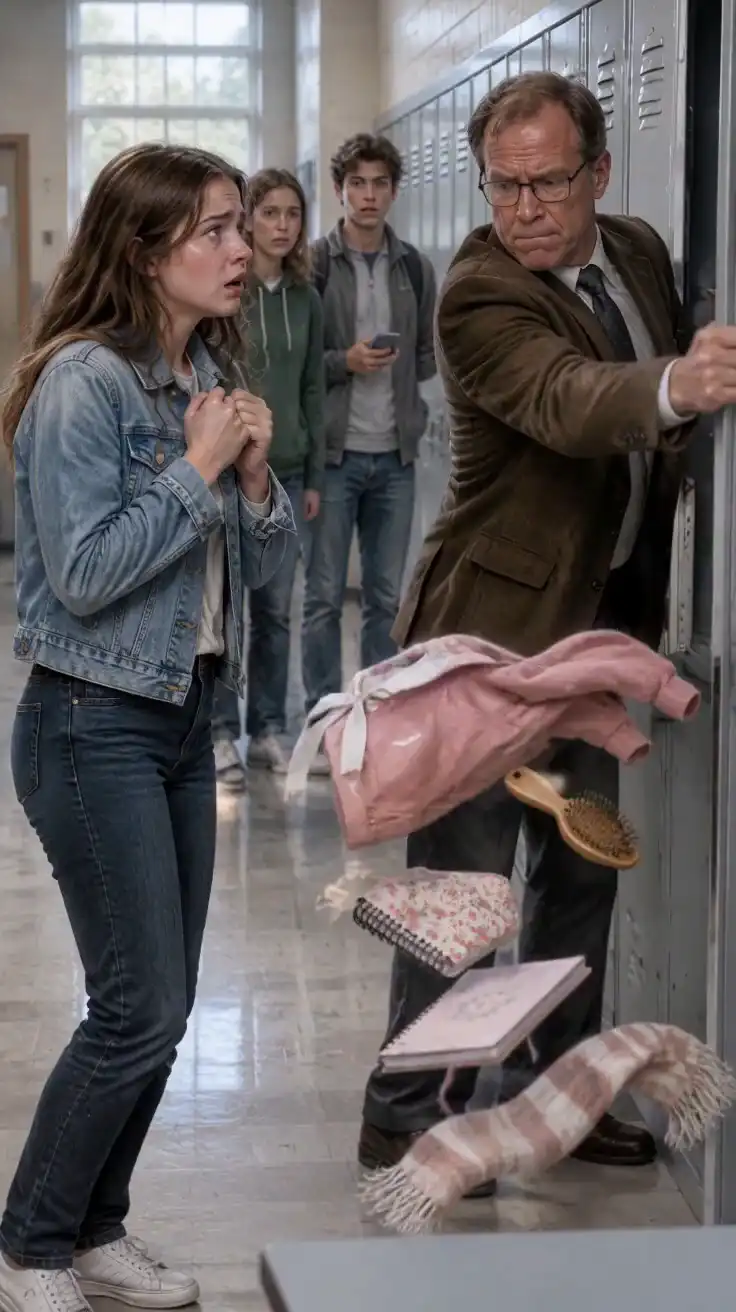
I stepped back out into the hall. A handful of students had gathered near the senior lockers. Someone was holding a phone at chest height. Another student was standing with her arms stiff at her sides, her face so pale it looked flat.
It was Elise Ward.
The bracelet was on the tile near her shoes.
I had known Elise since she was four years old. I had watched her ride a purple bicycle with training wheels up and down the sidewalk in front of our houses. I had handed her snacks at my kitchen table and listened to her explain, in great detail, why Nora was being unreasonable about the rules of a game they had invented. She had slept in our guest room. She had been the first person Nora called when she got her driver’s license.
I knew that face. I knew her eyebrows, her narrow chin, the small scar near her hairline from when she’d fallen off a swing in our backyard. I knew the expression she wore when she was caught doing something she hadn’t planned to be caught doing.
I also knew Nora was still inside the conference room, sitting with her hands beneath her thighs, while the dean had been pulling her things out of her locker.
Elise looked at the bracelet. Then she looked at Dean Mercer.
“Where did that come from?” he asked.
She took a step back. “I don’t know.”
“It came out of your sleeve,” said a student.
Elise stared at her left wrist. Her cuff had slipped back, exposing the pale skin beneath it.
The bracelet lay in the middle of the floor. It was thin gold, with a small oval charm. One side of the charm had a scratch that I remembered from the summer Elise caught it on a metal clasp at our picnic table.
Dean Mercer bent to pick it up. He stopped before his hand reached it.
“Everyone step back,” he said. “And put your phones away.”
Nobody moved.
The phone recording that circulated later started before the bracelet fell. I didn’t see the whole video until that afternoon, but I saw enough in the first few seconds to understand what Nora had been trying not to let happen. You could see her locker open. You could see Dean Mercer holding a stack of notebooks. You could see him drop them onto the tile with the rest of her things. You could see Nora kneel.
The video did not show me arriving. It did not show the way my daughter’s shoulders lifted when she heard my voice in the hallway. It did show Elise’s arm move, and it showed the bracelet slide from the end of her sleeve and fall.
The dean stared at the girl who had accused Nora.
Then he looked at the students watching.
“Ms. Ward,” he said, “come with me to the office.”
Elise didn’t move.
“Now.”
“Why?”
“Because you reported a theft and the item you reported missing has just fallen from your clothing.”
“I didn’t put it there.”
“Then you’ll have the opportunity to explain that in the office.”
She turned to look at me. For a second I thought she was going to say something about the years we had known each other. Instead she said, “This isn’t what it looks like.”
I looked at the bracelet on the floor.
“What does it look like to you?” I asked.
The dean told the students to clear the hallway. The girl holding the phone lowered it but kept recording. One of the office staff came out and picked up the bracelet with a paper towel. Elise walked ahead of Dean Mercer toward the office, moving quickly, her hair falling over one side of her face. She didn’t look back again.
When I returned to the conference room, Nora was standing beside her chair.
“Can we go home?” she asked.
“Yes.”
The counselor looked at me. “We’d like Nora to stay while we document the incident.”
“No,” I said. “You can speak with me and her privately later. She’s leaving now.”
I helped her gather what she could from the pile by the lockers. Her pencil pouch was unzipped. Two pens had rolled under a radiator. The corner of her sweatshirt had landed in a puddle left by somebody’s wet shoes. A folder had split down one side, and papers were bent under footprints.
I picked them up one at a time. Nora stood next to me, holding her backpack open.
“Mom, don’t,” she whispered.
“Don’t what?”
“Don’t clean it up for them.”
I looked at the floor. I had not thought of it that way. I had been gathering her things because they were hers. But she was right. Every item I picked up gave the school a chance to pretend the scene was over.
I put the papers back down.
“Take pictures,” I said to the counselor. “Every part of this.”
The counselor started taking photographs with her phone. The dean came back into the hallway and said he would arrange for the school to gather Nora’s belongings.
“I don’t want you touching them again,” I said.
He looked at the scattered things. “We were following procedure.”
“Then document your procedure.”
“Mrs. Bennett, this is not the place—”
“It was the place when you made my daughter kneel on the floor.”
He glanced at Nora. She was staring at the locker door. Her hands were still shaking.
“I didn’t make her kneel,” he said.
“You opened her locker and emptied it in front of students. She was afraid to refuse you.”
He had no quick answer for that. He looked toward the office again and said someone would call me.
We left with Nora’s backpack, the damp sweatshirt, and what I could carry in my arms. I had left the grocery cart at the store. I had not remembered it until we were in the car and the silence had settled between us.
Nora sat in the passenger seat with her coat pulled over her knees. For the first few minutes she didn’t speak.
Then she said, “I didn’t take it.”
“I know.”
“Everyone saw.”
“I know.”
“She was standing right there. She watched him do it.”
“I know.”
“I told him I didn’t have it.”
I turned onto our street. “Did he ask you whether you had it?”
“He asked if I would cooperate.”
“What did you say?”
“I said I didn’t want him to search my locker without calling you. He said if I had nothing to hide, I should cooperate.”
The words were so familiar they might have come from a hundred school offices. I had heard them at meetings about other people’s children and thought they sounded reasonable. In the car, with Nora beside me, they sounded different.
“What happened before I got there?” I asked.
“He made me stand against the lockers while he opened it. Elise said it had to be there because she saw me near her bag in the cafeteria. Then he started taking things out.”
“Were you near her bag?”
“I walked past it. We were in the library before lunch. Her bag was under the table. I didn’t touch it.”
“Did you tell him that?”
“Yes. He said he had to follow up on a report.”
She leaned her forehead against the window.
“She said I was jealous,” Nora said. “She said I’d been waiting for a chance to get back at her.”
“What did you say?”
“I said she was the one who stopped talking to me.”
Then she began to cry again. I reached for her hand at the red light.
By the time we pulled into our driveway, the Ward house next door looked exactly as it always had. A blue recycling bin sat at the curb. A basketball was trapped beneath the hedge. The front curtains were open in the kitchen window.
Elise had grown up ten steps away from us.
Her mother, Claire, had once kept a spare key to our house because the girls used to walk back and forth without knocking. They would come in through the back door, drop their backpacks beside the mudroom bench, and announce that they were starving. They knew where we kept the granola bars, which shelf had the good cereal, and which cups in the cupboard belonged to whom. When they were eight, Elise insisted the purple cup was hers because she had chosen it first. Nora let her have it. Years later, the cup was still in our kitchen, chipped at the rim.
The girls were born three months apart. Elise’s parents moved into the house next door when the girls were four. Claire was pregnant with their second child and had asked us to keep an eye out for a package while she went to an appointment. The girls met on the sidewalk and began playing together before the package was delivered.
For a long time, the neighborhood treated them as a matched pair. People asked after “the girls” even when only one was with me. At school they sat together on the bus, at lunch, and in the library. In middle school they made a habit of calling each other after dinner, even on days they had been together for six hours.
When they were twelve, Nora broke her wrist during a basketball game. Elise came to the hospital with a paper bag containing two chocolate muffins and a pack of markers. She was not allowed in the examination room, so she sat in the waiting area and drew a cartoon of Nora wearing a cast the size of a tree trunk. Nora taped it above her desk when we got home.
The bracelet was part of that history too.
Elise’s grandmother had given it to her when she turned sixteen. It was not heavy or flashy. It was a thin chain with an oval charm, small enough to disappear beneath a sleeve. Elise wore it often. Nora had helped her choose the charm at a jewelry store with Claire, after Elise’s grandmother gave them money and told them to “get something that won’t turn green.”
A year before the school incident, the girls had stood at our kitchen counter arguing over whether the charm looked more like a leaf or a raindrop. Elise said leaf. Nora said raindrop. They had asked me to settle it, and I said it looked like an olive. They called that answer useless.
That was the kind of history they had.
It didn’t all end in one dramatic fight. I wish it had. A clear betrayal would be easier to describe. There would be a before and an after, a single moment to point to when one girl became the other girl’s enemy.
Instead there were small changes. At the end of junior year, Elise started spending more time with a new group from her theater class. Nora was busy with a physics project and a volunteer shift at the library. They still spoke, but not as often. A plan to go to a concert fell apart when Elise invited other people without telling Nora. Nora found out from a photograph posted online.
When Nora asked her about it, Elise said, “You weren’t free anyway.”
“I could have been,” Nora told me.
“You were always busy.”
“That doesn’t mean you didn’t have to ask.”
It was the first time I heard that something was wrong. Nora said it in the kitchen while she was packing lunch for the next day. She looked annoyed more than hurt.
I asked if she wanted to talk to Elise.
“She knows what happened,” Nora said.
I left it there. They were seventeen. Their friendships were not mine to manage.
Over the summer, the girls stopped coming through each other’s back doors. They stopped sharing rides. Elise began greeting me with a polite “Hi, Mrs. Bennett” instead of calling me by the nickname she had used since elementary school. Nora began taking the longer route to the bus stop rather than walking with Elise.
I asked once if they had fallen out.
“We’re not fighting,” Nora said.
That answer meant they were.
The clearest explanation came in September, when Nora was looking for a photograph on her phone. I sat across from her at the kitchen table, sorting bills.
“Elise says I act like I’m better than her,” she said.
I put the bills down. “Did she say that to you?”
“More or less.”
“What happened?”
“We were at Maya’s birthday dinner. I asked her if she was still applying to State. She said she didn’t know. I said I thought she had already started her application, because she’d asked me to read her essay. She said I was keeping score.”
“Were you?”
“No. I thought she wanted help.”
Nora turned her phone over on the table.
“She told Maya I was always correcting her. Then she said I only talked to her when I needed something.”
“Was that true?”
“No.”
She said it quietly. I believed her, but I also knew that people can hurt each other without intending to. I told Nora she could apologize for the part she recognized without agreeing to something she didn’t believe.
“I did,” she said.
“And?”
“She said she didn’t want to do this anymore.”
I asked what “this” meant.
“She said she didn’t want to be my friend if I was going to make her feel small.”
Nora had gone quiet then. She did not cry. That was somehow worse. She folded the edge of a paper napkin back and forth until the corner tore.
After that, they went through the motions of being neighbors. They nodded when they passed on the sidewalk. At school, they kept enough distance to avoid being forced into conversation. Elise was in the theater group and the student council. Nora was in the science club and on the school newspaper’s editorial team. They had different circles and different schedules.
The school still saw Elise as the girl who brought in canned food for the annual drive, helped organize the winter concert, and had never been sent to the office. Nora was not in trouble either. She had a perfect record, but it was a record built out of quieter things: assignments turned in, deadlines met, teachers’ comments about her careful work. She was not a student who performed goodness in public. She did not organize an event and ask for a photograph beside the principal. She worked, went home, and worried about whether the work was enough.
By senior year, the two girls were no longer friends, but they were not strangers. They knew each other too well for that. They knew which teachers each avoided, which cafeteria table felt crowded, and what they would order at the diner after a school event. Their lives had the shape of a friendship even after the friendship itself had gone.
The accusation came during a month when every conversation in our house involved college.
Nora kept a spreadsheet with application deadlines. She had columns for the school, the essay, the recommendation letter, the financial aid forms, and the day each item was complete. Her laptop lived on the kitchen table. She wrote drafts in a black notebook, then copied them into a document, then printed them to read on paper. She was applying to four schools: the state university, a smaller college two hours away, and two out-of-state schools with strong environmental science programs.
She wanted to study water quality. In tenth grade she had spent a week at a river testing station with her science teacher, and she came home talking about dissolved oxygen and road salt. By senior year, she had decided she wanted work that combined field research with public policy.
I had watched her earn her grades. I had watched her revise essays at midnight, wake up early for the bus, and come home with a headache after studying for exams. She had not been handed a perfect record. She had built it while working two afternoons a week at the library and volunteering at the community garden every other Saturday.
The college applications were due in January. In October, one of Nora’s teachers submitted a recommendation letter to the state university. Her counselor had told us that disciplinary records were not automatically sent to colleges, but serious suspensions could create questions, and any school that asked directly would require an honest answer.
The word suspension had not entered our lives yet. Still, Nora worried about it. She had asked me whether a bad semester could make the colleges reconsider her file. She asked her guidance counselor, too, and wrote the answer in the margin of her spreadsheet.
On the morning of the search, she had a lab report due by the end of the day. She had stayed up late the night before fixing the graphs. When she left for school, she had a folded printout in her backpack and a travel mug of tea in her hand.
That was how I remember her on that day: carrying her work, trying to keep a deadline, expecting an ordinary Thursday.
After we got home, I helped her take the things out of her backpack. I did not want her to have to sort through the mess alone. There was a water stain on one page of her lab report, but the numbers were readable. Her sweatshirt smelled faintly of floor cleaner. The strap of her pencil pouch had come loose.
She looked at each item as though it might tell her how the day had gone wrong.
“Do you want to shower?” I asked.
“No.”
“Do you want tea?”
“No.”
“Do you want me to call the school?”
“I don’t know.”
“Okay.”
She stood by the kitchen counter. Her phone had been buzzing since we left school. She had not looked at it.
“You don’t have to answer anybody,” I said.
“I know.”
She picked it up and read a message. Then she turned the screen toward me.
It was from a girl in her chemistry class: I saw the video. Are you okay?
Nora put the phone down again.
“I hate that it’s a video.”
“I know.”
“I hate that people saw me like that.”
“Like what?”
“On the floor. Looking for something I didn’t take.”
I pulled out the chair beside her. “You did nothing wrong.”
“That doesn’t mean it didn’t happen.”
She sat down.
At 12:46, Dean Mercer called. He said Elise had been removed from class for the remainder of the day and was being asked to return to the office with her parents. He used the phrase “pending review.” He said the school was concerned about the way the bracelet had appeared.
“Appeared?” I said.
“Fallen,” he corrected. “It fell from her sleeve.”
“Did she admit she had hidden it there?”
“Not at this point.”
“Did she admit she knew it was there?”
“We’re still speaking with her.”
“What is happening to Nora’s record?”
“No action will be taken against Nora while we investigate.”
“You searched her locker in front of students. You made her kneel. That has already happened.”
He said he understood my concern. It was the first time he had acknowledged it at all.
“I want a copy of the search policy,” I said. “I want a written account of who requested the search, what they were told, and why I wasn’t contacted. I want the school to preserve the original hallway video and any footage from the security cameras. I want Nora’s counselor and principal included in any future conversation.”
He said he would send what he could.
“Also, do not call this a misunderstanding.”
There was silence on the line.
“I didn’t use that word,” he said.
“You were about to.”
He did not deny it.
The first video reached Nora’s phone shortly after lunch. It had been recorded by a boy from her English class, though he later told us he had only meant to document what he thought was an unfair search. The video started with the dean opening the locker. It captured him removing things, though it did not show what had been said before. It captured Nora’s face as she looked at the other students. It captured the moment she knelt.
The audio was clear enough to hear her ask, “Please don’t.”
Then it showed Elise pointing and saying, “It has to be in there.”
The camera turned toward the floor when the bracelet fell.
Nora watched it once. She stopped it before the end and pushed the phone away.
“Don’t send it to anyone,” she said.
“I won’t.”
By the afternoon, it had been sent to people she didn’t know. Students had shared it in group chats. A parent had forwarded it to me with the message, I think you should see this. I did not reply.
A local news page posted a short clip with a caption about a student accused of theft and an item falling from the accuser’s sleeve. They did not name the girls, but everyone in town knew who they were. It was a small school district. There were only two senior girls who had been next-door neighbors for most of their lives, and only one bracelet like that.
At 3:30, Dean Mercer called again. Elise had been suspended from school for three days while the administration investigated whether she had knowingly made a false report. He said the decision was made by the principal after speaking with the superintendent.
“Suspended?” I asked.
“Effective immediately.”
“Was she suspended for the accusation or for having the bracelet?”
“For the conduct surrounding the report.”
“Did you tell her mother?”
“Yes.”
“Did you tell Elise why?”
“Yes.”
“What exactly did she say?”
“I’m not permitted to discuss another student’s statements with you.”
“You were permitted to discuss my daughter’s locker with her standing beside you. You were permitted to let students watch her search through her things. I don’t think you get to tell me now that there are limits.”
He exhaled through his nose. “I understand.”
“Do you?”
“I should have called you.”
“That would have been a start.”
When I hung up, Nora was at the kitchen table, trying to finish the lab report. She had not eaten. Her eyes were red, and the room was quiet apart from the tap of her laptop keys.
I brought a plate of toast and set it beside her.
“I’m not hungry,” she said.
“You don’t have to finish it.”
“I need to finish this.”
“You can ask your teacher for an extension.”
“I don’t want to ask.”
The lab report was due that day. Her grade in the class was already strong, but she did not want a missing assignment. That was how she had kept her record perfect: not because school was effortless, but because she was afraid to let anything slide.
I sat down across from her.
“Your grade is not more important than what happened today.”
“It is to me.”
“It can matter and still not be all that matters.”
She kept typing.
At six, I drove her to the community garden because she had a scheduled volunteer shift and said she wanted to go. I thought she might be trying to pretend the day was normal. I offered to stay with her. She said no.
When she came back two hours later, she had dirt on her shoes and a paper bag of carrots from the garden coordinator.
“I watered the beds,” she said. “I didn’t talk to anyone.”
“Was that okay?”
“It was fine.”
I put the carrots in the refrigerator. She washed her hands twice.
Across the yard, the Ward house was dark. Their car was gone.
Claire called me the next morning. She did not call from next door, as she had done for years. She called from her car.
“I need to talk to you,” she said.
“About Elise?”
“Yes.”
“Then we need to do it with the girls’ parents present, or not at all.”
“I understand.”
“I’m not ready to talk about this like it’s a private misunderstanding between us.”
“I know. I’m sorry.”
The call was quiet. I could hear the turn signal in her car.
“Did Elise say why she did it?” I asked.
“She says she didn’t take the bracelet off. She says she put it inside her sleeve after she thought she’d lost it. She says she was going to tell the dean she found it.”
“When?”
“I don’t know.”
“Why did she report it missing?”
“I don’t know.”
The words were so thin that I did not answer.
Claire began to cry. She had been a good friend to me once. We had sat through school concerts together, traded emergency childcare, and brought casseroles to each other’s houses when our families were sick. I could hear her trying to steady her breathing.
“Please don’t think she’s always been like this,” she said.
“I don’t.”
“She’s scared. She says she didn’t mean for them to search Nora’s locker.”
“But she said it had to be in there.”
“I know.”
“And she pointed at Nora.”
“I know.”
“She didn’t have to do that.”
“I know.”
I wanted to tell Claire that the girls’ friendship had ended long before the bracelet. I wanted to tell her that I had watched the distance grow and had not known what to do with it. I wanted to ask if she had known Elise was angry with Nora. I wanted to ask what she had said to her daughter about the fall-out.
Instead I said, “I need you to understand that this wasn’t just a bad decision at school. Nora was humiliated in public. The accusation could have affected the colleges she’s applying to. She was afraid to refuse the dean because he was the adult in charge.”
“I understand.”
“Do you?”
There was a long pause. “I’m trying to.”
That was more honest than anything else she could have said.
The school held a meeting the following week. The principal, Ms. Patel, sat at the head of the conference table. Dean Mercer was there, along with Nora’s counselor and me. Nora came because she wanted to hear what the school said. She took a notebook with her and wrote down the names of everyone in the room.
Ms. Patel apologized first.
“I’m sorry we searched your locker in a way that made you feel exposed and powerless,” she said. “We should have called your parent. We should not have emptied your belongings in a hallway.”
Nora looked at her. “Why did you do it?”
Ms. Patel folded her hands. “The report was specific. Elise said she had seen you near her bag. The dean believed the item might be in your locker, and he thought the situation needed to be addressed quickly.”
“I told him I didn’t have it.”
“I know.”
“Did he believe me?”
The principal looked at the dean. He did not answer.
Ms. Patel said, “He should have considered what you said before proceeding.”
“That’s not an answer.”
“No,” Ms. Patel said. “It isn’t.”
Dean Mercer shifted in his chair. “At the time, I had to make a judgment based on the information I had.”
Nora looked at him. “You had information from a girl who was standing there.”
“Yes.”
“You didn’t call my mother.”
“No.”
“You didn’t tell me I could say no.”
“I didn’t.”
“Then I don’t understand how it was a judgment. You had already decided I did it.”
He started to respond, then stopped.
Ms. Patel said the school would remove any notation of the incident from Nora’s disciplinary file. She said they would provide a written statement confirming that Nora was not accused of theft after the bracelet was found. They would review the search policy and train staff on contacting parents. She also said the school was taking Elise’s false report seriously.
“What does that mean?” I asked.
“It means the suspension is in place while we investigate. The school will determine whether further discipline is appropriate.”
“What does ‘false report’ mean in the handbook?”
Ms. Patel opened a folder. “Knowingly making a false statement that causes another student to be investigated can result in suspension or further discipline.”
“Then investigate the statement.”
“We are.”
“Who is speaking to the students who were there?”
“We are gathering statements.”
“Are you preserving the video?”
“Yes.”
“Are you asking the students not to keep sharing it?”
“We have asked them not to distribute it.”
“Have you told them to delete it?”
“We cannot require them to delete evidence before the investigation is complete.”
“That makes sense,” I said. “Have you told them the school has the original and they should not post it publicly?”
“Yes.”
Nora had been taking notes. She set the pencil down.
“Are you going to make Elise apologize to me?”
“That’s not decided,” Ms. Patel said. “We want to understand what happened first.”
Nora nodded once. She did not look satisfied, but she had asked the question she wanted answered.
After the meeting, the dean walked us to the office. He said, “I hope you know I never intended to harm Nora.”
I said, “Intent doesn’t undo what you did.”
He looked at Nora. “I’m sorry.”
She held his gaze for a moment. “You should have called my mom.”
“Yes,” he said. “I should have.”
Nora left without saying anything more.
The investigation lasted nine school days. In that time, the story changed shape several times. At first, Elise said she had not known the bracelet was inside her sleeve. Then she said she had tucked it there because she was afraid it would get lost. She said she planned to take it out before school ended. She said she had reported it missing because she believed Nora had seen it on the cafeteria table.
Those explanations did not fit together. The dean’s office asked Nora to attend a second meeting. She refused.
“They can ask me in writing,” she said. “I already told them what happened.”
The school accepted that.
Elise did not return after the first three days of suspension. Her parents arranged for her to attend classes remotely while the review continued. There was no school rule requiring it, but Claire said she was having panic attacks and could not walk into the building. I believed her. I also believed Nora had been the one sent home with the school’s attention fixed on her.
The girls’ friends divided themselves in familiar ways. Some avoided both of them. Some believed the video and did not need an explanation. Some said Elise was under pressure and had made a mistake. Some said Nora had to have done something to provoke her.
Nora never answered those people. She stopped reading the comments. She blocked a few accounts and turned off notifications.
The college work continued. She had an essay due for the smaller college the following Tuesday. She missed two days of school, then returned. The first morning back, she stood at the end of our driveway holding her bag and watched the street.
“Do you want me to drive you?” I asked.
“No. I’ll take the bus.”
“Elise’s house?”
“I know.”
“Do you want me to wait with you?”
“No.”
She stepped onto the sidewalk. I stayed by the door until she reached the corner.
The Ward house was quiet. Elise’s car remained in the driveway. Claire came out to get the mail and looked toward us. Nora kept walking. Claire lifted one hand, then lowered it.
That evening, Nora told me that the school had moved her locker to another hallway while the investigation continued. She said she had asked for the change. The new locker was near the art rooms, away from Elise’s usual route.
“Does that feel better?” I asked.
“It feels like I had to move.”
“I know.”
“It’s not fair.”
“No.”
She sat on the floor of her bedroom with the college spreadsheet open on her laptop. The early application to the state university was already submitted. She was finishing a supplemental essay about a watershed cleanup project.
I sat on the edge of her bed.
“Do you want me to read it?”
“Not yet.”
“Okay.”
After a few minutes, she said, “I keep thinking that if I had been nicer to her, none of this would have happened.”
“You were not responsible for what she chose to do.”
“I know that.”
“You can know it and still feel responsible.”
She looked at the screen. “I didn’t want to lose her.”
“I know.”
“I thought if I stopped trying to fix things, she’d think I didn’t care.”
“What did you do?”
“I kept asking if she wanted to talk. She kept saying she was fine. Then she said I was pushing.”
I had no good answer. I had watched the girls’ friendship loosen and had assumed they would either repair it or let it go. I had not understood that Nora was trying to find the point where care became pressure.
“Did you tell her that?” I asked.
“Once. She said she didn’t want to have the same conversation every week.”
I wished I could go back and offer them a different conversation, one where nobody had to defend herself. But they were no longer twelve, and I was not the person who could make them friends again.
The school eventually concluded that Elise had intentionally hidden the bracelet in her sleeve after realizing she had it, reported it missing anyway, and named Nora because she was angry with her. It did not conclude that the bracelet had been planted specifically to be found in Nora’s locker. That mattered to the administration because it changed the category of the offense. It did not matter much to Nora.
I read the report in Ms. Patel’s office. It was six pages long. There were statements from students who had seen Elise tuck her hand inside her sleeve before class. There was a statement from a girl who heard Elise say, “Nora will have to explain herself for once.” There was the video. There was a statement from Elise acknowledging she had not lost the bracelet and had known it was in her sleeve when she told Dean Mercer she could not find it.
The report called her conduct “deliberate and harmful.” It said her accusation appeared to have been motivated by anger about the end of the friendship and by an argument two days earlier.
“What argument?” I asked.
Ms. Patel said she couldn’t share details beyond the statements that directly concerned Nora.
Nora read the report later at home. She turned the pages slowly. When she reached the last page, she set it aside.
“Did she say why?” I asked.
“She says she was angry.”
“About what?”
“She says I told her she was acting selfish.”
“Did you?”
“I did.”
“When?”
“On Monday. She asked me to tell the counselor she’d been working on our lab project even though she missed the meeting. I said I wouldn’t lie for her. She told me I always had to be right. I said she was being selfish.”
“That sounds like an argument.”
“It was.”
“Does it explain this?”
“No.”
That was the clearest thing she had said about Elise in weeks. The fact that they had argued did not turn the accusation into a reasonable response. Nora knew that. She also knew that Elise’s anger had not appeared out of nowhere. They had hurt each other, even if only one of them had turned a hurt into a public accusation.
Elise’s suspension was extended to ten school days. She was allowed to return after meeting with the principal, her counselor, and her parents. The school required her to write a statement acknowledging that the report was false and that Nora had not taken the bracelet. The school also required her to complete a restorative process, but Nora was not required to participate.
Ms. Patel asked Nora whether she wanted to meet Elise with a counselor present.
“No.”
“Would you consider a written apology?”
“Maybe.”
“What would you want it to say?”
Nora thought for a moment.
“I want her to say she knew it wasn’t missing. I want her to say she knew I didn’t take it. I don’t want her to say she was confused.”
Ms. Patel wrote that down.
Two weeks later, a letter arrived. It was folded in half, addressed to Nora, and signed Elise.
Nora read it at the kitchen table. She read it once without speaking, then read it again more slowly.
“Do you want to show me?” I asked.
“Not yet.”
She put it in the drawer where she kept old school papers.
That evening she told me Elise had written that she was angry and wanted Nora to be punished. She had hidden the bracelet in her sleeve after putting it on in the morning. She had told Dean Mercer it was missing because she knew he would search for it. She thought Nora would be able to deny it, but she thought the dean would still make her explain herself. She said she did not expect the bracelet to fall out in front of everyone. She said she knew Nora had not stolen it.
That was the reason, finally. Not a misunderstanding. Not forgetfulness. Not a chain of accidents. Elise had wanted Nora to feel what she thought Nora had made her feel: judged, small, and publicly wrong. She had used the bracelet because it was an ordinary object that could make Nora look guilty.
The sleeve had hidden it until the moment Elise pointed at Nora.
The bracelet had never been missing.
I did not ask Nora to forgive her.
She didn’t ask me to.
Claire came to our door the Saturday after the letter arrived. She had a paper bag in one hand and no coat, though the morning was cold. I nearly closed the door when I saw her. I did not. We had been friends too long for either of us to pretend that a door was a conversation.
“Is Nora home?” she asked.
“She is, but she doesn’t want to talk to Elise.”
“I’m not here to ask that.”
“Then what are you here for?”
Claire looked down at the bag. “I brought the things Elise had at your house.”
There were two books, a hair tie, and a small tin of colored pencils. The pencils had been in our kitchen drawer for years. I had not noticed they were Elise’s.
“She doesn’t have to bring those back,” I said.
“I know. I just didn’t want to keep anything that belonged here.”
She held out the bag. I did not take it.
“What did you tell her?”
“I told her she had done something serious. I told her being angry didn’t give her permission to make Nora responsible for it.”
“Did she understand?”
“I think so.”
“What did she say?”
“She said she thought Nora had made her feel unwanted for months. She said she wanted Nora to get in trouble once, the way she felt she had been in trouble for being the difficult one.”
I looked at Claire.
“Was she in trouble for being the difficult one?”
“She says Nora corrected her in front of people. She says Nora would point out when she was wrong and then act like it was nothing.”
“I can’t tell you what happened between them in every conversation.”
“I know.”
“I don’t know what Nora said.”
“I’m not asking you to say Nora did nothing wrong. I’m asking you to understand why Elise got so angry.”
“I understand that she got angry.”
“That’s not the same as understanding her.”
“No,” I said. “It isn’t.”
Claire nodded, as though she expected that answer. She put the bag on the porch.
“I’m sorry,” she said. “I should have spoken to you before this got so far.”
“You didn’t know she was going to do this.”
“I knew she was hurting. I thought it was regular teenage friendship trouble.”
“So did I.”
The sentence surprised me as I said it. It was true, and it was also not enough.
Claire rubbed her hands together. “I don’t know what we do now.”
“Neither do I.”
She looked toward the side yard, where the fence between our houses had a loose board. For years, the girls had slipped through it rather than walk around the front. Now the gap looked too narrow for anyone.
“Do you think the girls will ever talk?” she asked.
“I don’t know.”
“Do you think they should?”
“I don’t know.”
She took a breath and let it go. “I wish we could go back.”
“We can’t.”
“No.”
We stood in the doorway for a few seconds, neither of us moving. Then she went home. I brought the paper bag inside and put it on the table. Nora saw it when she came downstairs.
“What’s that?”
“Things from Elise.”
She looked inside. She pulled out the colored pencils and turned the tin in her hands.
“She used these for the poster we made in seventh grade,” she said.
“I remember.”
“She wanted the whole thing to be orange.”
“You wanted it blue.”
“She was right about the orange.”
“That’s not what you said then.”
“No.”
She put the tin back in the bag.
“Do you want me to give it back?” I asked.
“No. She can have it.”
I carried the bag next door that afternoon and left it on the Ward porch. Claire opened the door after I had already stepped away. We exchanged a nod. I did not stay.
Nora finished her applications. She got into the state university in December, then the smaller college in January. The two out-of-state decisions came in March. One was a rejection. One was an acceptance with financial aid that made it possible for her to attend.
The suspension did not appear on the school transcript. The school wrote a statement confirming that Nora had not been found responsible for misconduct. The admissions offices never asked about it. I still worried each time the mail came. Nora said she didn’t.
“I have the letter from the school,” she told me. “If they ask, I’ll tell them.”
She chose the smaller college. The environmental science department had a watershed research program, and the campus was small enough that she could get to know the people teaching her classes. On decision day, she sat at the kitchen table with the acceptance letters spread out in front of her.
“Are you sure?” I asked.
“No,” she said. “But I’m sure enough.”
She called her aunt first. Then she called the science teacher who had written her recommendation. She did not call Elise.
Elise returned to school. She kept her distance from Nora, and Nora kept hers. The school scheduled their class periods in separate wings where it could. They still passed each other at the bus loop sometimes. They never stopped being neighbors. They just stopped behaving as though that meant they belonged in each other’s lives.
The Ward family did not move. Claire and I stopped having coffee together. We still exchanged messages about neighborhood issues: a fallen branch, a package delivered to the wrong porch, the day the water company shut off the street. We were civil. We were careful. There were no more spare keys.
For a while, the girls’ younger siblings—though Nora was an only child, Elise had a younger brother—kept coming through the side gate. He was eleven and had nothing to do with the feud. I let him in when he wanted to retrieve a soccer ball from our yard. Claire sent him over with a note once when she needed to know whether we had seen a delivery truck hit the mailbox.
I could not make a child responsible for his sister’s actions. I also could not open the door to Elise as if the last year had never happened.
The video remained online longer than I wanted. I reported it to the platform. The school sent a message to families asking them not to share footage of students during disciplinary incidents. Some people deleted it. Others kept copies. One parent sent it to me months later, asking if I had seen the “whole thing.” I asked her to delete it and not send it again.
Nora did not want to watch it. I saw the video enough times to know each angle. I learned the exact moment her knees touched the tile. I learned the sound the bracelet made when it hit the floor. I learned that one of the students in the background said, “Oh my God,” just before the clip ended.
The recording can make the story look simple. A girl accuses another girl. An adult believes the accusation. A search happens. A bracelet falls out of a sleeve. The girl who lied is caught.
The truth was less simple, even if the act itself was plain. Two girls had spent most of their lives close enough to enter each other’s houses without knocking. By senior year they had become strangers who still knew where the other kept her lunch. They had hurt each other in ways that were difficult to prove and easy to resent. One of them had decided that a public accusation would put the other back in her place.
That does not excuse what Elise did. I have never wanted to make that mistake. Her anger was real. So was the damage she caused. Nora had to answer questions about something she had not done. She had to watch a dean empty her locker. She had to kneel in front of people she saw in class the next day. She had to decide whether to keep working on her applications while strangers were sharing a video of her being humiliated.
The dean’s choice mattered, too. He could have called me. He could have asked for the facts before turning suspicion into a search. He could have closed the locker and moved the conversation to an office. He could have treated Nora’s words as information rather than resistance. Instead, he trusted the student with the reputation he understood and made my daughter prove her innocence in public.
He met with us again after the school finished its review. The principal had required him to complete additional training on student searches and parent notification. He had written Nora a letter, which she read and did not answer.
“I handled the situation badly,” he had written. “I should not have made you search through your belongings in front of other students. I am sorry I put you in that position.”
Nora said it was a better letter than the first apology.
“Do you forgive him?” I asked.
“I don’t know him well enough to forgive him.”
I thought that was fair.
In May, on the last week of school, Nora found a photograph in a drawer. It showed her and Elise at age nine, sitting on the grass between our two houses. Their knees were muddy. Elise had a red ribbon in her hair, and Nora was holding up a paper crown she had made from a grocery bag. They were smiling at something outside the frame.
Nora brought it to me.
“I don’t remember this day,” she said.
“You were making a fort.”
“Was that the day it fell down?”
“I think so.”
“Did Elise cry?”
“Not until she saw the crown got wet.”
Nora laughed once, but the sound stopped quickly. She looked at the picture for a long time.
“I miss her,” she said.
I didn’t tell her she shouldn’t. I didn’t tell her to call. I didn’t tell her she would be friends with Elise again one day. I had learned that the truth did not need a hopeful ending to be true.
“I know,” I said.
“She’s also a person I don’t want around me.”
“Those can both be true.”
Nora put the photograph back in the drawer. She did not tear it up. She did not hang it on her wall.
At graduation, the girls sat on opposite sides of the gym. Their families were in different sections. I saw Claire near the back with Elise’s brother. She saw me and nodded. I nodded back.
The ceremony took two hours. Nora’s name was called near the middle. She walked across the stage, took her diploma, and shook the principal’s hand. Dean Mercer stood nearby and clapped. He clapped for everyone. I didn’t know whether he had looked at her. I did not watch him.
Afterward, we took pictures by the school sign. Nora wore her cap crooked. My husband fixed it, and she pushed his hand away. Her friends gathered around her. Someone threw a handful of confetti that had been saved from a club event. It stuck to Nora’s hair.
As we were leaving, Elise passed us on the sidewalk. Her mother was beside her. They both stopped.
“Congratulations,” Elise said.
“Thanks,” Nora answered.
It was the first time I had heard them speak to each other in months. Elise looked as though she wanted to say more. Nora waited. Elise’s mother touched her arm, a small reminder to keep moving, or perhaps to let Nora decide.
“I’m glad you got in,” Elise said.
“Thank you.”
They stood there for one more second. Then Elise walked toward her family’s car.
Nora didn’t call after her. She didn’t cry. She adjusted the strap of her bag and continued toward ours.
The bracelet was eventually returned to Elise’s mother. She kept it in a small jewelry box. I don’t know whether Elise wears it now. I haven’t seen it again. Nora remembers it as the bracelet that fell, not the one we once discussed at my kitchen counter.
That may be what I remember too. I remember its little oval charm and the sound it made against the tile. But I remember the things around it more clearly: the damp sweatshirt, the bent pages of Nora’s lab report, the way she tucked her hands beneath her legs in the conference room so I wouldn’t see them shake. I remember her looking at me when she said she hadn’t taken it, as if she needed to know whether I was going to ask her to prove it.
I did not ask.
The day after the search, Nora left for school with her backpack zipped and her applications on schedule. She still had to walk into the building. She still had to see the people who had seen the video. She still had to finish the work she had been doing before someone decided that a perfect record made one girl believable and the other one suspicious.
The bracelet fell out of Elise’s sleeve in front of everyone.
That moment mattered. It exposed the lie. It ended the search. It made the dean stop and stare.
It did not give Nora back the hallway. It did not restore the friendship. It did not erase the weeks she spent wondering whether one false accusation could undo years of work.
But it did mean that the truth arrived while my daughter was still there to see it.
And when she walked out of that school, she did not have to carry the accusation with her as if it belonged to her.