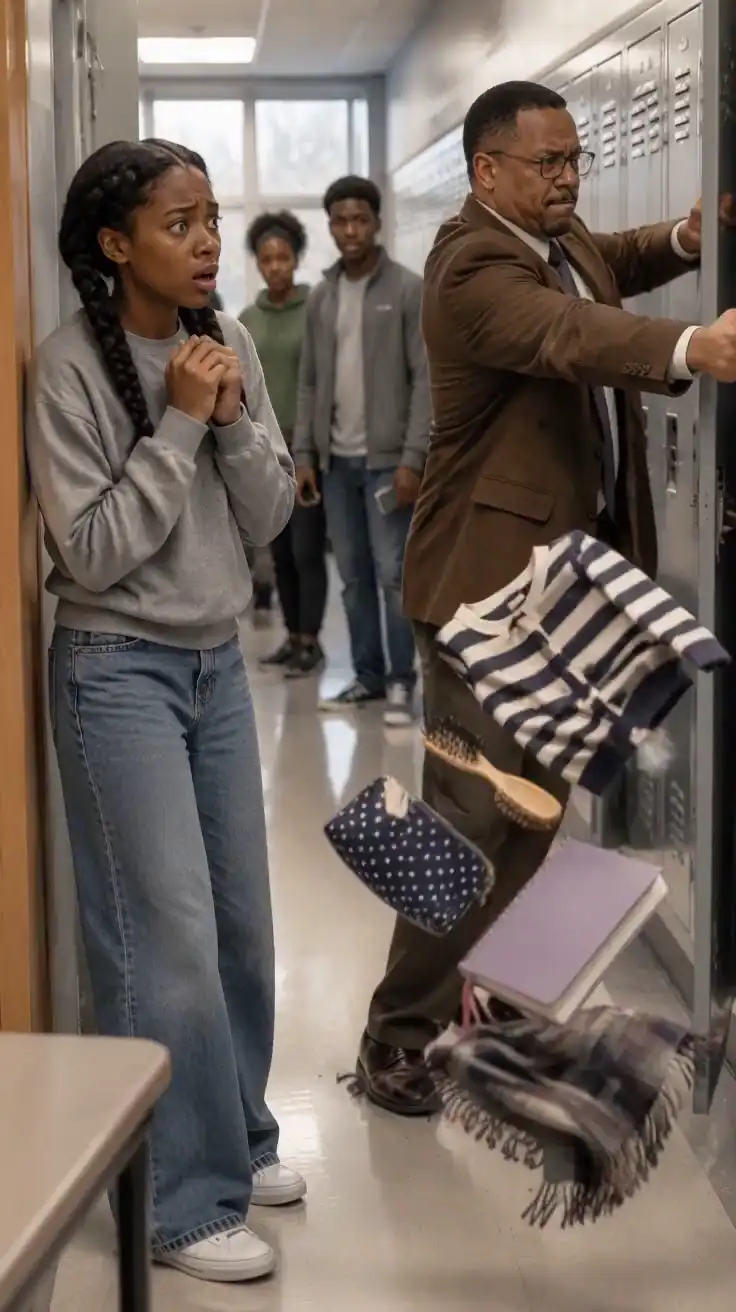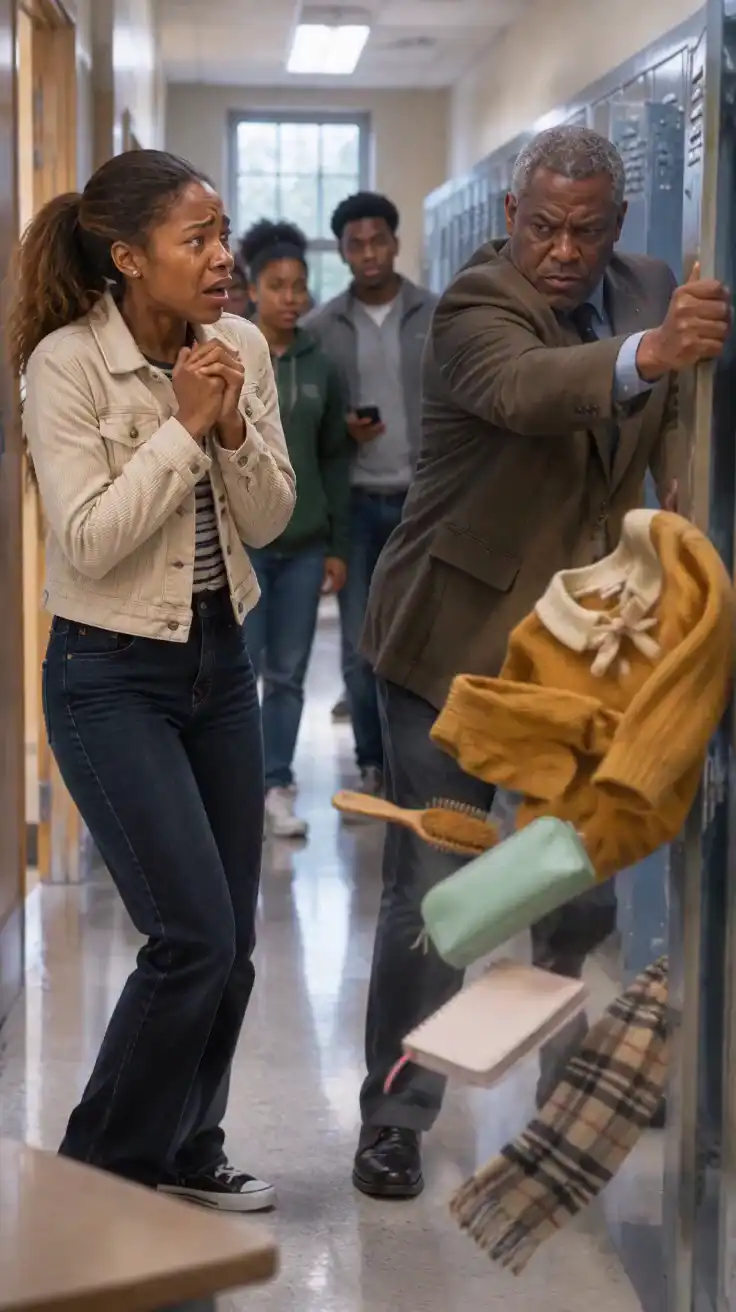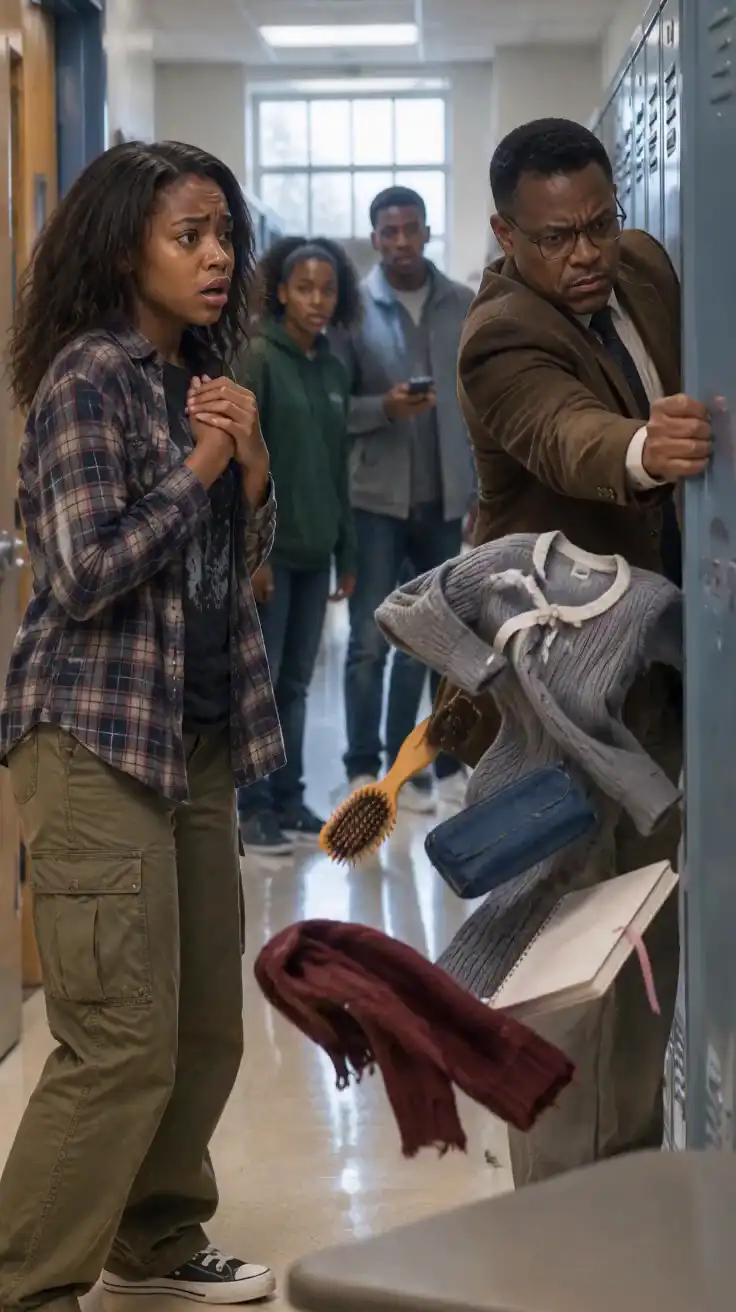
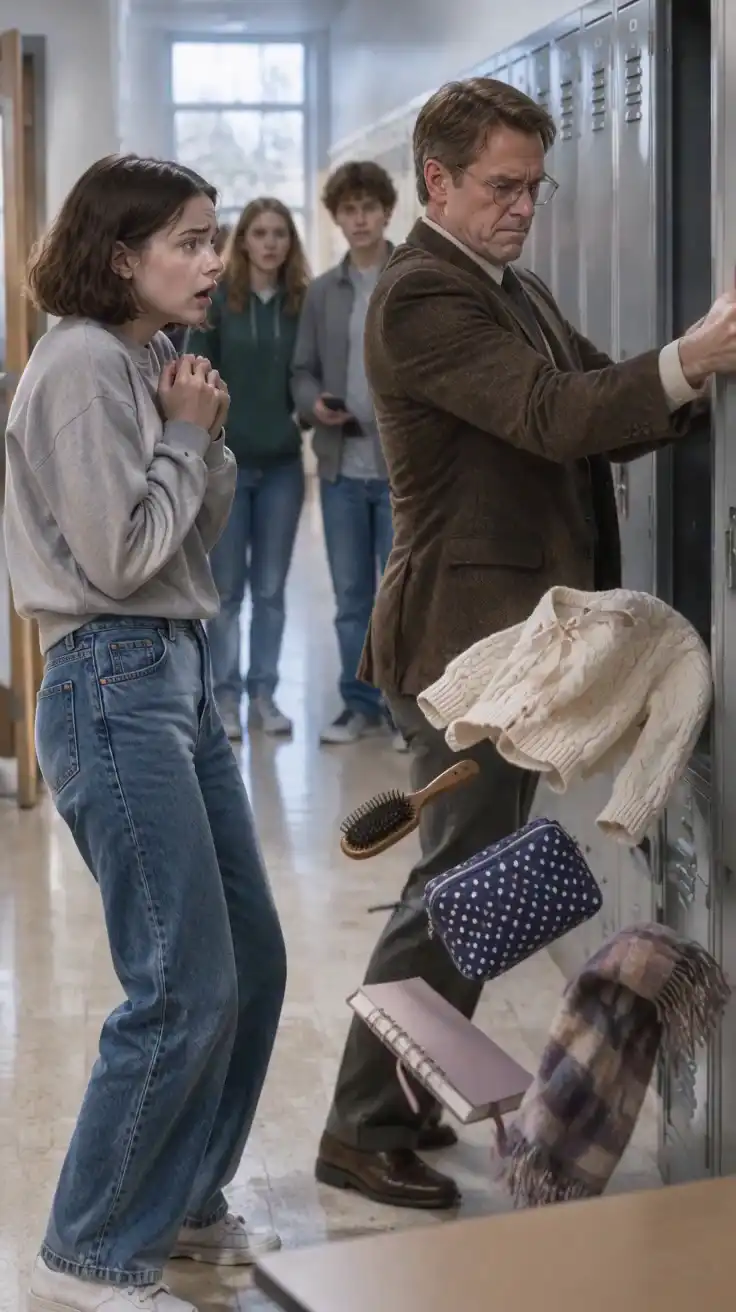
For a second, nobody moved.
The bracelet lay on the tile between my daughter’s shoes and the dean’s polished black ones. It was a narrow gold chain with a little oval charm, the kind that looked ordinary until you knew somebody had worn it every day for years. I heard the small sound it made when it landed. I heard a boy near the water fountain say, “Oh.”
Then Nora looked down at her sleeve.
Her crying stopped.
That was the part I watched over and over afterward. Not the bracelet falling. Not the dean’s hand hovering over my daughter’s shoulder. Nora’s face, changing in less than a second from accusation to calculation. She stared at the charm as if it had appeared there without her permission. Then she looked up, and her eyes found the nearest phone.
“Someone put that there,” she said.
My daughter, Ava, was still kneeling.
Dean Mercer looked at the bracelet, then at Nora, then at the phones held up all around them. He did not bend to pick it up. He said, “Nobody touch anything.”
I was not there to hear him say it. I was at home, still in my work clothes, watching the video on my phone with one hand over my mouth. But that was what happened next, according to the other videos, the students who called me, and Ava, who gave me the story in fragments later that night. The dean had already made a decision about my daughter. Now he was standing in a hallway full of evidence that he had made it too quickly.
Nora took a step back.
“Miss Hart,” he said. “Stay where you are.”
“I didn’t put it there.”
“You said she took it.”
“She did take it.”
“Then why was it in your sleeve?”
“I don’t know.”
“Stay where you are.”
Ava looked at the bracelet. She looked at the notebooks scattered around her, the papers and pencils that the dean had dumped out of her locker. She was still on her knees. Her hands had gone flat against the tile. In the video, I could see her fingers trembling.
“Can I stand up?” she asked.
It was a small question. She had been told to kneel, and no one had told her she could stop.
Dean Mercer glanced at her. “Yes. Get up.”
She stood, slowly, with one hand on the locker door. Her right knee had gone red through the thin fabric of her uniform pants. She did not look at Nora. She did not look at the phones. She bent down and began picking up her science folder.
“Leave it,” I heard a student say from behind the camera.
“I have a test after lunch,” Ava replied.
That was Ava. Even then, even with her things in a heap on the floor and a crowd watching, she was thinking about whether her notes were bent.
The dean ordered the students to put their phones away. That did not happen. He told Nora to come with him to the office. Then he told Ava to come, too. Ava said she wanted to call me first.
“After we speak,” he told her.
“You said I could call my mom.”
“I said we would discuss it in the office.”
“You told me you were calling her.”
There was a pause. I watched him look toward the students, and I understood that he was trying to regain control of the hallway. The first version of the story had been simple: my daughter had stolen a bracelet, the dean had found it, and the school had caught her. The bracelet sliding out of Nora’s cuff had made that version impossible to maintain. Now every next step would have witnesses.
He said, “You can call your mother from my office.”
That was how I got the call.
I had already watched the video three times. I knew Ava was safe, physically, but I did not know if she was suspended, if the police had been called, if the school was still questioning her, or whether she had been allowed to collect her books. My hands were shaking. I kept trying to dial the school and stopping before I hit the number. Then my phone rang.
“Mom?” Ava said.
Her voice sounded far away and too calm.
“I’m here,” I said. “Are you hurt?”
“No.”
“Did he hurt you?”
“No. He didn’t touch me.”
“Are you sure?”
“Yes.”
I could hear a door close on her end. Someone said something in the background. Ava lowered her voice.
“Mom, they’re saying I took Nora’s bracelet.”
“I saw.”
“I didn’t.”
“I know.”
“I didn’t touch it.”
“I know, sweetheart.”
Then she started crying. Not loudly. She made one small, embarrassed sound and stopped herself.
“Can you come get me?”
“I’m coming now.”
I hung up and called the school office. The receptionist told me Dean Mercer was speaking with the students involved and could not come to the phone. I said I was on my way and asked that no one question my daughter until I arrived. She said she would pass that along.
I drove too fast and still felt as if I were moving in place. The video kept replaying in my mind: the books hitting the floor, the girl crying, Ava’s knees on the tile, the bracelet leaving Nora’s sleeve. I could not get past the image of my daughter asking permission to stand.
At a red light, I called my sister. I told her what had happened in a rush, as if speed might make the facts more manageable.
“Did they accuse Ava of stealing it?” she asked.
“Yes.”
“Did they search her?”
“They made her open her locker. The dean dumped it out. I don’t know if they searched her.”
“Are you there yet?”
“No.”
“Drive. Don’t call anybody else until you’re parked.”
She was right. I hung up.
At the school, there were parents’ cars lining the curb for afternoon pickup, and students spilling through the front entrance. I walked past them into the office. The secretary looked up when she saw me.
“Dean Mercer is with them.”
“I need to see my daughter.”
“I understand.”
“I don’t think you do. Where is she?”
The secretary stood. “I’ll check.”
She disappeared down the hall and returned with a woman I recognized as the assistant principal, Ms. Delgado. She had a folder tucked against her chest.
“Ms. Reed,” she said. “I’m sorry this is upsetting.”
“My daughter is in your office after being made to kneel in a hallway. I’m not looking for a phrase that describes how I feel.”
Her mouth tightened. “Of course. Come with me.”
The dean’s office was at the end of the hall. The door was open. Ava was sitting in a chair, her knees together, hands folded on her backpack. She looked up when I came in. I went straight to her and put my hand on her shoulder.
“Hi,” I said.
“Hi.”
I checked her face, her wrists, her knees. There was a faint red patch on the right one. She was trying not to look at me too long. She did not want to cry again in front of them.
Nora was sitting across the room. Her mother stood behind her, one hand on the back of the chair. Nora’s eyes were swollen, but her face had gone hard. Dean Mercer was at his desk. A second staff member, a counselor named Mrs. Bell, stood near the window. A plastic evidence bag lay on the desk with the bracelet inside it.
I looked at the bag.
“Is that the bracelet?”
“Yes,” Dean Mercer said.
“Who removed it from the floor?”
“I did.”
“After you told everyone not to touch anything?”
He looked down at his hands. “I put on gloves.”
The answer was so small, so carefully shaped, that I nearly laughed. I didn’t.
“Why was my daughter made to kneel?”
“We were looking for the bracelet.”
“She told you she didn’t have it.”
“We had a report that it had been placed in her locker.”
“From Nora?”
“Yes.”
“And you believed her?”
“We were responding to a serious allegation.”
“Then why didn’t you check the locker before making her kneel? Why did you dump her belongings onto the floor in front of students?”
He looked at Ava, perhaps expecting her to answer for me. She stared at the edge of the desk.
Ms. Delgado intervened. “We will be reviewing the process. Right now, we’re trying to determine what happened.”
“What happened is visible on multiple students’ phones.”
Nora’s mother shifted behind her chair. “My daughter is very upset.”
“So is mine.”
“I know,” she said, and for a moment her face softened. “I’m sorry this happened.”
Nora turned around. “Mom.”
Her mother lowered her voice. “Let her talk.”
“I didn’t put it in my sleeve,” Nora said.
No one had asked her yet. She had offered it without being prompted, as though repeating it might make it true.
Dean Mercer leaned forward. “Nora, we need you to tell us what happened. You reported that Ava took the bracelet and hid it in her locker. The bracelet was in your sleeve.”
“I don’t know how it got there.”
“You were wearing it?”
“I was wearing a sweater. It must have fallen in.”
“Did you know it was there?”
“No.”
“Did you take it from your mother’s jewelry box?”
Nora’s eyes lifted sharply to his.
Her mother said, “That isn’t what we’re discussing.”
“It may be relevant,” I said.
“It’s a family matter,” Nora’s mother replied.
“What my daughter is accused of is also a family matter, until you bring it to school and accuse her in front of a hallway full of students.”
“I didn’t want this,” Nora said.
Ava finally looked at her. “You said you saw me put it in my locker.”
Nora’s face crumpled again. “I thought you had.”
“You said you saw me.”
“I was upset.”
“That’s not the same thing.”
“I didn’t know it was in my sleeve.”
Ava’s hands were clasped so tightly that her knuckles were white. I touched her back. She took a breath.
“Why did you say it was in my locker?” she asked.
Nora turned her gaze to the floor.
The room went quiet.
“Because I couldn’t tell my mom,” she said.
“Tell her what?” Dean Mercer asked.
Nora’s mother took a step forward. “We are not discussing this here.”
“Mom, I already told you.”
“You told me you were going to talk to me about it at home.”
“I can’t keep doing this.”
Her mother’s fingers tightened on the chair back. “Nora.”
Nora rubbed her sleeve where the bracelet had been. “I took things from your jewelry box.”
Her mother did not move.
“Not the whole box,” Nora continued. “Just little things. The earrings you don’t wear, the cash in your wallet. I took the bracelet last week. I didn’t mean to keep it. I was going to put it back.”
“You told me that money was missing because of the cleaners,” her mother said.
“I know.”
“You told me you had no idea where the bracelet was.”
“I know.”
“You told me Ava had been asking you about it.”
“I know.”
Each answer came quieter than the one before.
The school had become the place where Nora could finally say what she had been hiding, but she had not chosen to tell the truth freely. The bracelet had told it for her. That mattered. It did not erase the fact that she had accused my daughter.
Nora looked at Ava. “I was scared.”
“You could have told me,” Ava said.
“I thought you’d hate me.”
“I hate that you said I stole from you.”
“I’m sorry.”
Ava swallowed. “You said it in front of everyone.”
“I’m sorry.”
The apology did not settle anything. It was real, I think, but it came after the whole school had been given a reason to look at my daughter with suspicion. Sorry could start a conversation. It could not reverse the hallway.
Dean Mercer asked Nora to explain how the bracelet ended up inside her sleeve. She said she had put it on that morning before school because she planned to return it to the jewelry box after class. She had been wearing a loose knit sweater over her blouse. The bracelet’s clasp was damaged, and the chain had caught on the inside of the cuff. When she reached up to point at Ava, the chain slipped loose and fell out.
“Why did you wear it to school?” her mother asked.
Nora’s face tightened. “I don’t know.”
“You took it from me and brought it here?”
“I was going to give it back.”
“When?”
“I don’t know.”
“Were you going to wear it all day?”
“I thought I could put it back before you noticed.”
Her mother closed her eyes for a moment. The truth had not made her less hurt. It had only changed the shape of the hurt.
I asked Dean Mercer whether Ava had been told she was free to leave.
“She can leave with you,” he said.
“Is she suspended?”
“No.”
“Is she being investigated?”
“We will need to review the report and speak to the students.”
“Which students?”
“Those who witnessed the incident.”
“And who made the accusation?”
He glanced at Nora. “We’ll need to hear from her, too.”
“That’s convenient. You have already heard from her. You heard her loudly in the hallway. You heard her say Ava had stolen the bracelet, and you acted on it before checking. How long was my daughter made to kneel?”
“I did not intend to humiliate her.”
“You told her to kneel in a public hallway.”
“I wanted to make sure she did not move items around while we searched.”
“She had already opened her locker. You were the one moving her things.”
The dean’s expression stiffened. “I understand you’re upset.”
“Do not explain my tone to me.”
Ms. Delgado stepped between us, not physically, but with the practiced calm of someone trying to stop a meeting from becoming a confrontation. “We are going to conduct an investigation. We will review the video, speak with students and staff, and follow up with both families.”
“What happens to Nora now?”
“That will depend on what we learn.”
“What happens to the adult who told my daughter to kneel?”
“That will also be reviewed.”
I looked at the bracelet in its bag. “She confessed to taking it from her mother. She confessed to accusing Ava because she was scared. The accusation is not in question. The hallway is not in question. What exactly are you still investigating?”
“We have to document what happened,” Ms. Delgado said.
“You have a video.”
“And we will review it.”
Ava stood. I could see that she had been waiting for me to do it first, as if the meeting had its own rules she did not want to break. I picked up her backpack and put it over my shoulder.
“We’re leaving,” I said.
“Mrs. Reed,” Dean Mercer started.
“No. You have her statement. You have your video. You have my number. We’re leaving now.”
He nodded, perhaps because he had no reason to stop us.
As we reached the door, Nora said, “Ava.”
My daughter paused, but she did not turn around.
“I’m really sorry.”
Ava held on to the strap of her backpack.
“I don’t know what to say,” she replied.
Then she walked out with me.
That should have been the end of the day. It was not. It was only the first hour.
In the car, Ava sat with her hands in her lap and stared out the window. She kept her backpack at her feet, though I offered to put it in the trunk. When I asked if she wanted to go straight home, she said she had a chemistry quiz the next morning and wanted to get her notes out before they were mixed up.
At a stoplight, I turned to look at her. “You don’t have to think about school right now.”
“I know.”
“You can be upset.”
“I am.”
“I’m here.”
“I know, Mom.”
She was looking at the red light. Her voice was steady, but her thumb kept rubbing the seam of her pants over the red mark on her knee.
“Did you know Nora was taking things from her mother?” I asked.
“No.”
“Did she ever tell you she was in trouble?”
“No. She told me her mom was strict, but that’s not the same thing.” She paused. “She said they’d been arguing about money. I didn’t know why.”
The light turned green. I drove.
“Were you worried about the honors program before today?” I asked.
“I didn’t think this was going to happen.”
“That’s not what I asked.”
She pulled her hands apart and then laced them again. “The program rules say an investigation for theft could put your place on review.”
“Did you know that?”
“Yes.”
“Did the dean tell you?”
“No. They sent a letter at the beginning of the year.”
The honors program was not just a line on Ava’s report card. It was a small, demanding program with its own classes, extra lab hours, and a teacher who had helped Ava apply to a summer science placement. She had been there since eighth grade, and this was her first year at the high school. She had worked through the summer to place into advanced chemistry. She stayed late twice a week to finish projects. She had a binder organized by tab color. She knew the program’s policies better than I did because she had read them all.
If the school marked her as having been involved in theft, even before any formal discipline, she could be removed from the program pending review. She knew that. She had done the math in her head while the dean emptied her locker.
At home, she went straight to her room. I did not follow her. I made tea I did not drink and called the school district’s family liaison, whose number I found on the district website. I left a message that was factual and careful. My daughter had been accused of stealing a bracelet. The bracelet had fallen from the accuser’s sleeve during the search. The dean had ordered my daughter to kneel in a public hallway. I wanted a written account of the school’s actions and confirmation that no disciplinary notation would be placed in her record.
Then I called Ava’s father, Daniel. He and I had been divorced for five years. We disagreed about plenty, but we had agreed early on that school issues were not a place for scorekeeping.
“I’m leaving work,” he said after I explained.
“She’s home with me.”
“I’m still coming.”
He arrived twenty-five minutes later with his tie loose and his laptop bag over one shoulder. Ava came out to see him. He hugged her. She leaned into him for a few seconds and then stepped back.
“What do you need?” he asked.
“I need everyone to stop asking me what happened.”
“Okay,” he said. “We can do that.”
We ordered food. Ava ate half a bowl of soup and then went back to her room. Daniel and I sat at the kitchen table and listened to the first video once. He watched it without speaking. When it ended, he pushed his chair back.
“I’m calling a lawyer,” he said.
“Not tonight.”
“Why not?”
“Because I want to know what the school says in writing before we decide what to do.”
“They made her kneel.”
“I know.”
“That’s enough.”
“It may be. But I don’t want to turn Ava’s whole life into a public case before we ask her what she wants.”
He looked at the hallway, toward her room. “She’s fifteen.”
“She’s still the person this happened to.”
He sat down again. “You’re right.”
Neither of us liked the answer. It felt too small for what we had watched.
The next morning, Ava went to school. I asked if she wanted to stay home.
“I don’t want people deciding I’m afraid to go back,” she said.
“You don’t have to prove anything to them.”
“I know. I just want to go.”
She wore the same uniform skirt and sweater she had worn the day before, with a different blouse. I dropped her at the side entrance. Before she got out, she said, “Don’t come in unless they call.”
“I’ll be here.”
“Mom.”
“I’ll be here.”
“I mean, don’t sit in the office. I don’t want everyone thinking you came to fight.”
“I can wait at home.”
She nodded and got out.
I did not go home. I parked at a coffee shop a block away, bought a coffee I did not finish, and stayed near my phone. At 9:20, Ms. Delgado called. She said the dean wanted to meet with us that afternoon.
“What is the meeting about?”
“Reviewing the incident and next steps.”
“Has Ava been questioned today?”
“No. She has not.”
“Has Nora?”
“I can’t discuss another student’s interview.”
“I’m not asking for her private information. I’m asking whether you are still treating my daughter as a suspect.”
“We are reviewing the report.”
“That is not an answer.”
Ms. Delgado exhaled. “Ava is not being disciplined. She is attending classes. The school has not found that she took the bracelet.”
“Has anyone told her that?”
“I can ask the dean to speak with her.”
“Please don’t send him to her alone. We will meet this afternoon.”
The meeting took place in a conference room with a long table and no windows. Dean Mercer sat at one end, Ms. Delgado at the other, and a district student-services director joined by video. Daniel and I sat beside Ava. Mrs. Bell, the counselor, took notes.
They told us the school had interviewed six students and two staff members. Three students had recorded the hallway from different angles. One video included the whole search. Another began just before the bracelet fell. The dean’s office had collected statements from Ava, Nora, and the students who had been closest to the lockers.
Dean Mercer spoke carefully.
“We have determined that the bracelet came from Nora’s sleeve and that Ava did not take it.”
I waited.
“We have also determined that the search was not handled appropriately. Students should not have been asked to gather around. Ava should not have been told to kneel.”
“Who asked them to gather around?” I said.
“No one did.”
“Then why were they allowed to stay and watch?”
He looked at his hands. “I should have moved the students.”
“Did you tell Ava she could call me before the search?”
“I told her we would contact you.”
“You told her she could call me from your office after you had already searched the locker.”
“I understand that.”
He said it in a flat, institutional voice. He did not argue. Somehow that made me angrier.
The district director said the school would remove any incident report from Ava’s discipline file and put a written clarification in her student record. She would not be removed from the honors program. The program coordinator would be told that she had not been found responsible for any misconduct.
“Why does she need a clarification in her record?” Daniel asked. “Why not just no record?”
“Because the report was entered yesterday,” the director replied. “The correction documents that it was entered and then withdrawn.”
“Then the report exists,” I said.
“The correction will be visible to anyone authorized to review the record.”
“Will that affect her application to the summer program?”
“No.”
“Can you put that in writing?”
“Yes.”
Nora was not in the meeting. Her mother had requested that school staff keep the families separate. The school had told us that Nora would be suspended from school for three days, pending a parent meeting, for making a false accusation that led to an unjustified search. She had been suspended that morning. Dean Mercer had made that decision the day of the incident, after the bracelet fell and Nora admitted taking it from her mother.
He had told her, “You are going home. This is a serious and deliberate accusation.” Nora’s mother had been called to pick her up. The school’s written notice referred to “dishonesty and misuse of the reporting process.” The suspension was not for the theft from her mother’s jewelry box. The school had no authority over what happened at home. It was for telling the school that Ava had stolen the bracelet when Nora knew the bracelet was hers and knew she had not seen Ava take it.
I learned that from the report. I learned, too, that Nora had admitted the accusation was a cover. The moment she saw her mother’s name on the dean’s call log, she had panicked. Her mother had already asked her about the missing bracelet that morning. Nora said she had seen it in Ava’s locker, and she hoped the school would find nothing and the bracelet would somehow be returned before her mother knew.
That explanation was not as neat as it sounded. Nora had not simply wanted the bracelet back in her mother’s jewelry box. She had wanted time. She had been taking things from home for weeks, not because she needed money for food or was being coerced, but because she had started selling small items to a girl she knew through a resale app. She had spent some of the money on clothes and makeup and used the rest to replace cash she had borrowed from her mother’s purse. The more she took, the more she needed to cover.
Her mother had noticed money missing. She had asked Nora about two pairs of earrings and a ring that had disappeared. Nora had blamed a house cleaner once, then said she had loaned the earrings to a cousin. When the bracelet went missing, her mother told her that if it had been taken, they would have to report it to the police and search the house.
Nora thought of Ava.
That was what she told the school counselor in a later meeting. She did not say she planned the accusation in advance. She said Ava was the person who seemed most likely to be believed as “a good student” if Nora cried and acted certain. She also knew Ava would not shout back. They had spent months together in the lab, and she knew Ava would be more likely to say, “I didn’t do it,” than to expose Nora’s private problems in a hallway.
It was a calculation made out of fear, but it was still a calculation.
For most of the school year, Ava and Nora had been lab partners in advanced biology. They were assigned together in September, when the teacher made pairs based on a lab-safety survey. Nora wrote with a purple pen and pressed so hard the ink showed through two pages. Ava wrote in black and kept a ruler clipped into the spine of her notebook. They had been given the same bench, at the back of the room beside the emergency eyewash station.
At first, they were polite because the teacher was listening.
Then they became funny.
Nora named a set of fruit flies “the committee.” Ava told her they were not in a position to vote. Nora made up elaborate speeches for the committee whenever one of them escaped. They argued about who had to wash the beakers, which mattered because Nora hated the smell of the detergent and Ava thought that was an excuse. They shared notes when one of them missed class. Ava once helped Nora rebuild a lab report after a computer crash. Nora had once lent Ava a hair tie before a presentation and told her she could keep it because she had a whole drawer at home.
They did not tell each other everything. Ava knew Nora fought with her mother. She knew Nora sometimes had to be home early and did not get to stay after school. She knew Nora was worried about her grades. She did not know about the missing money or the jewelry. Nora did not know much about Ava’s family beyond the fact that her parents were divorced and that Ava lived with me most of the time.
They were not lifelong best friends. They were not strangers, either. They were two girls who had built a routine together, a small working trust made from shared lab tables and repeated afternoons. It had been enough for Ava to think Nora would not knowingly make her the center of an accusation.
When the school search happened, Ava told me later, she had been surprised by how quickly the hallway emptied around her and filled with people. She had just come from English and was looking for her chemistry folder before lunch. Nora approached her near the lockers and said, “You have to give it back.”
Ava thought she meant the notes from the lab they had finished the day before.
“Give what back?” she asked.
“The bracelet.”
Ava laughed once, because she assumed Nora was making some kind of joke. “What bracelet?”
“My mom’s bracelet. You took it.”
“I didn’t.”
“I saw you.”
“No, you didn’t.”
Nora’s voice got louder. She said the bracelet had been missing since the previous evening. She said Ava had been in her house once for a study group, months before, and must have remembered where her mother kept it. That was not true. Ava had never been inside Nora’s house. The study group had been in the school library.
“You know I didn’t take it,” Ava told her.
Nora said, “Then open your locker.”
Ava heard students moving toward them. She could see phones coming up. She knew the school handbook said an accusation of theft could trigger an investigation. She thought if she opened the locker, everyone would see it was empty of anything that belonged to Nora, and the accusation would end.
Instead, Dean Mercer arrived and asked her to open the locker. Ava did. He looked inside, shifted her books, and told her to step aside. When she did, he started taking things out. Ava tried to explain. He said, “I need you to stay calm.”
“I am calm,” she said.
He said the locker had to be checked.
“Then check it. You don’t need to throw everything on the floor.”
He told her to move back.
She did. He removed the books, her science folder, a pencil case, her lunch bag, the cloth pouch where she kept hair ties, and a small bottle of hand lotion. The granola bar had split open at one end. Its crumbs scattered across her notebook.
The bracelet was not there.
Nora said it had to be hidden under something. The dean turned to Ava and said they needed to make sure she was not concealing it on her person.
That was when he told her to kneel.
Ava told me later that she did not understand the instruction at first.
“What?”
“Kneel down.”
“Why?”
“So we can see whether anything fell out of your pockets.”
“I don’t have it.”
“Just do it.”
She looked around. She could see two teachers at the far end of the hall. One of them had her phone in her hand. She could see a boy from her chemistry class standing with his mouth open. She could see Nora crying.
“I don’t want to,” Ava said.
“I’m not asking you to want to.”
That was the line she remembered most clearly.
She knelt. The tile was cold through her pants, and there was a little grit under one knee. She put her hands beside her. She wanted to stand, but she thought if she did, the dean would say she was refusing to cooperate. She thought if she argued, they might suspend her for insubordination. She thought about her place in the honors program. She thought about the summer science placement. She thought about her mother having to explain to people that her daughter had been accused of stealing.
She whispered, “Please don’t.”
She did not know if she meant don’t make me do this, don’t let everyone watch, or don’t believe her.
Then Nora lifted her arm and pointed. The sleeve shifted. The bracelet fell.
Ava stood, but she did not look at Nora because she was afraid that if she looked, she would say something she could not take back. She picked up her notes. She heard the crowd reacting. She heard the dean tell everyone to put their phones away. She heard a student say, “That was in her sleeve.”
The school’s response after the meeting was mixed. They did what they said they would do on paper. Ava stayed in the honors program. The incident was marked as withdrawn. The program coordinator sent her a brief email confirming that her standing had not changed. The school reviewed Dean Mercer’s handling of the search. He was removed from hallway duty while the review was underway, then required to attend additional training on student searches and reporting procedures. He also had to issue Ava a written apology.
It was one paragraph.
“I regret that my actions on March 14 caused you embarrassment and distress. I did not intend to single you out or make you feel unsafe. I will follow school procedures more carefully in the future.”
Ava read it at the kitchen table. She folded it once and set it down.
“Does that feel like an apology?” I asked.
“It feels like he got assigned homework.”
I laughed despite myself. Then I felt guilty for laughing, and she said, “You can laugh. It’s fine.”
Dean Mercer asked to speak with her privately after the written apology. Ava said she did not want to. The school respected that. He later asked whether she would accept an in-person apology with me present. She said no. I told the principal that she did not owe him a meeting to make his paperwork feel complete.
The videos spread through the school before the end of the day. Students sent them to each other, then to parents, then into group chats. The school asked families not to share them. By then, that request had no force. I did not post anything. I did not need to. The students who had been in the hallway had already recorded the story from more than one angle.
One video showed Ava’s whole locker being emptied. Another focused mostly on Nora. In that one, the bracelet’s fall was clear. The sound was faint, but the movement was not. I stopped watching after the first week. Daniel saved the videos in case we needed them. I asked him to keep them off his phone’s main screen.
Ava’s classmates were kinder than I expected, though kindness came awkwardly. One girl left a note in Ava’s locker that said, “I’m sorry I watched and didn’t say anything.” A boy from biology asked if she wanted him to sit with her at lunch. Ava said yes, then spent the whole meal discussing the next lab.
Some people avoided her. She understood why. They had seen a girl accused of theft and then they had seen the bracelet fall from someone else’s sleeve. The images made the facts seem simple. The people who had not watched the video, or who had watched only the first one, carried a version of the story that lasted longer.
Ava did not want me to call Nora a liar in front of her friends. She did not want me to send a message to the class group. She did not want me to explain the situation on social media. She wanted to go to school, do her work, and stop hearing her own name in the hallway.
For several days, she did not speak to Nora. They were still assigned as lab partners. Their teacher, Mr. Keane, moved Nora to another bench after the incident. He said he wanted to give both of them space. Ava did not object. She asked for the lab notes she had shared with Nora to be returned.
That request hurt Nora more than I expected. She wrote a message saying she still had the notes and would give them back. Ava replied, “Leave them with Mr. Keane.”
At home, Ava’s reaction arrived in uneven pieces. On the first night, she was quiet and practical. The next morning, she could not find her pencil case and got so frustrated that she snapped at me when I asked whether she wanted help. On Saturday, she asked if she could go to the library with a friend, then changed her mind when she saw a group of students from school in the parking lot.
She did not want therapy at first. I told her that was fine. I said we could find someone to talk to if she wanted, and that she did not have to decide while she was still angry. Two weeks later, she asked if the school counselor could help her find a therapist outside the school. She did not want to talk about the incident with someone employed by the people who had mishandled it.
We found a licensed counselor near our house. Ava went once a week for a month, then less often. She was not broken. She was not suddenly a different child. But she had begun to question whether people would believe her when she told them the truth. She wanted a room where she could say that without having someone point out that the bracelet had eventually been found.
I did not tell her to be brave. She had been brave enough. I told her she had the right to be angry, the right to miss the friendship, and the right not to accept an apology.
Nora’s suspension lasted three days. Her mother picked her up from school on the afternoon of the incident and drove her home. They did not speak much on the way. At home, her mother put the bracelet on the kitchen table and asked Nora to tell her everything.
Nora’s mother, Celeste, had known something was wrong for months. She had found cash missing and noticed pieces of jewelry were gone. She had suspected a housekeeper, then suspected her own sister, then wondered if she had misplaced things. She had asked Nora directly, and Nora had denied it each time. Celeste had been angry, but she had also been embarrassed. She did not want to accuse her daughter without proof. She did not want to tell anyone that things were disappearing from her house.
The bracelet was the point at which she had decided she could not pretend the problem would pass. She had said, that morning, “If it’s missing because somebody took it, I’m going to report it. I’m not going to let this keep happening.”
Nora had taken the bracelet to school because she thought she could return it before her mother noticed. She had clipped it badly, and it worked loose inside her cuff. When Celeste called to tell her the school had found it, Nora told her first that the bracelet had been in Ava’s locker. Then the dean called. Then the school called again.
At home, Celeste asked her to take off the sweater and turn out the sleeves.
Nora did.
The bracelet was not there anymore.
“Did you put it in Ava’s locker?” her mother asked.
“No.”
“Did you ask her to take it?”
“No.”
“Did you know it was yours?”
“Yes.”
“Then why did you say she took it?”
Nora sat at the kitchen table and cried. Her mother did not hug her. She did not shout. She asked the same question again, and Nora answered it.
“Because I couldn’t tell you I had it.”
Celeste said, “You let a school accuse another child because you were afraid I would be angry.”
“Yes.”
“You watched her get searched.”
“Yes.”
“You watched her kneel.”
“Yes.”
“And you still let it go on.”
Nora did not answer.
That night, Celeste found a small box of jewelry in Nora’s closet. There were earrings, a chain, a ring she had not seen in months, and two hundred dollars in cash folded into an envelope. Nora had sold some items and kept others. A few pieces were things Celeste had given her, and some were not. Celeste called her sister, who came over and sat with Nora while Celeste went upstairs to cry.
They were not a cruel family. They were a family that had lost trust in a frightening, ordinary way. Celeste had been proud of Nora, and Nora had been trying to keep a version of that pride intact. In the process, she had made someone else pay for her fear.
After the suspension, Celeste wrote me a letter. She did not send it through the school. She gave it to the principal’s office with a request that it be passed to me. I read it twice before I let Ava decide whether she wanted to see it.
Celeste wrote that she was sorry her daughter had accused Ava. She wrote that the bracelet had been taken from her jewelry box and worn to school without her permission. She wrote that Nora’s other thefts had been brought to light and were being addressed at home with professional help. She said she understood that none of those details changed what Ava had experienced. She did not ask me to forgive Nora. She said she would not pressure Ava to accept an apology.
The letter was not perfect. It used the phrase “a poor decision,” which sounded too small for what had happened. But Celeste did not hide behind that phrase. She named the accusation. She named the search. She acknowledged that Ava had been made to kneel while Nora stood nearby and allowed the accusation to continue.
I asked Ava if she wanted to read it.
“Not yet,” she said.
So I put it away in the drawer with the school’s records.
A month later, Celeste called me. I considered not answering. I had no obligation to speak with her. But Ava had asked me to find out whether Nora wanted to apologize in person, and I thought we could decide after we talked.
“I want to apologize directly,” Celeste said. “Not to make you reassure me. I know you don’t owe me that.”
“I appreciate that.”
“I also want to tell you what we’re doing at home, but only if you want to hear it.”
“I can listen.”
She told me Nora was seeing a counselor and had returned the money from the items she had sold. Celeste had spoken with the people who had bought them and recovered some of the jewelry. She had contacted the school counselor and arranged for Nora to have check-ins during the week. She had not told the rest of the family the full story. She said she had been tempted to explain away Nora’s actions because she was ashamed. She was trying not to do that.
“I failed to see how far it had gone,” she said. “I kept finding reasons that the things were misplaced. I want to say that because I don’t want you to think Nora was the only person responsible for the silence. But she was responsible for what she did to Ava.”
I thanked her for saying that.
There was no easy sisterhood between us, no sudden understanding that turned the whole event into a lesson. Celeste and I were two mothers who had been handed different versions of the same painful truth. Her daughter had taken from her. My daughter had been accused. We could understand one another’s fear without pretending our losses were the same.
“What would Ava want?” she asked.
“She doesn’t know.”
“That’s fair.”
“Please don’t ask Nora to approach her at school.”
“I won’t.”
“She may not want an apology in person.”
“I understand.”
When I told Ava about the call, she listened without interrupting.
“Do you want to read the letter now?” I asked.
She thought about it. “Not today.”
“Okay.”
A few days later, she asked for it. She read it alone in her room and gave it back without comment. At dinner, she said, “Her mom sounds like she’s trying.”
“I think she is.”
“She still let Nora say she saw me do it.”
“I know.”
“She could have stopped it sooner.”
“Yes.”
Ava took a bite of rice. “I don’t want to talk to Nora.”
“You don’t have to.”
That was the answer she needed for a while.
In biology, Mr. Keane assigned Ava a new lab partner. Nora worked with another student. The first time they were in the same lab room, Nora’s hand shook while she put on her gloves. Ava noticed, but did not comment. Their teacher kept them apart without making a display of it.
By April, the school had added a new procedure for searches: an administrator could not ask a student to empty a locker in a public hallway; a parent had to be contacted before a personal search unless there was an immediate safety concern; and a second staff member had to be present. The school also said staff should separate students from spectators when handling a report. Those rules had been in place in some form already, according to the district. The new document made them harder to ignore.
I did not think a revised policy made the day less harmful. I did think it might make the next child’s day different.
Dean Mercer sent a second apology through Ms. Delgado, this one longer and more direct. He acknowledged that he had treated the accusation as established fact, had failed to check the source of the claim, and had used language that made Ava feel she had no choice but to kneel. He said he had not intended to target her, but that intention did not change the effect of his actions.
Ava read it. She put it in a folder. She did not write back.
I wondered whether I should have demanded more. A suspension? A public apology? A statement to the students who had watched? I wondered whether quiet acceptance would be interpreted as approval. Daniel wanted to ask the district for a formal review. The school had not given us every document we requested, and there were still questions about what the dean had written in his first report.
But Ava wanted the attention to end. She did not want to be the center of another meeting. She had exams, labs, and plans for summer. She wanted the chance to go to class without the adults around her making the story bigger.
So we followed her lead. We sent one letter to the district confirming that we accepted the corrected record but did not consider the incident resolved by that correction. We asked the school to preserve all relevant video and written reports. The district confirmed in writing that Ava had not been found responsible for any wrongdoing and that her honors placement was unaffected.
That was enough for her. It was not everything she deserved. It was enough for the next month.
Nora returned to school after her suspension. She came back with a different haircut and a dark mark under one eye that she said came from a basketball. Ava did not ask about it. The first few days, Nora took longer routes between classes to avoid passing Ava’s locker. Ava noticed that too. They did not speak.
Their teacher eventually had to pair them for a short exercise because the class was uneven. He asked Ava first if she could work at a table with Nora. Ava said yes, provided they kept the work focused on the assignment. He asked Nora separately. She said yes.
They worked for twenty minutes without incident. They divided the tasks. Ava took the first set of measurements. Nora recorded them. When Nora’s pen ran out, she asked for a spare. Ava slid one across the table. They did not discuss the bracelet.
After class, Nora waited until the room had mostly emptied.
“I want to say I’m sorry again,” she said.
Ava packed her notebook into her bag.
“I know you are,” she said.
“I know that doesn’t fix it.”
“No.”
“I was scared my mom would find out what I’d done.”
“You knew what you were doing.”
“Yes.”
“You didn’t just say something because you were scared. You kept saying it after the dean came.”
“I know.”
“And you watched him make me kneel.”
Nora’s eyes filled, but she did not cry loudly. “I know.”
Ava stood. “I don’t want to be your friend again right now.”
“I understand.”
“I don’t know if I will later.”
“I understand.”
Ava left.
She told me about the conversation that evening. She was not pleased with herself for being so cold, though I did not think she had been cold. She had been clear.
“You can miss who somebody was and still not want them near you,” I told her.
She looked at me. “Do you think she’s changed?”
“I think she’s trying to change.”
“That’s not what I asked.”
“No,” I said. “I don’t know whether she’s changed yet. I think one apology and a few weeks of counseling are beginnings, not proof.”
Ava nodded. She liked that answer better than a comforting one.
The two families did not become close. Celeste and I exchanged a few messages about schedules and the school’s follow-up. We did not meet for coffee. We did not attend a school event together. I did not want to turn our daughters’ pain into a story about how the parents learned to understand each other. We had responsibilities to them. That was enough.
Celeste continued working with Nora. She set clear limits at home, but she also tried to understand why Nora had begun taking things. Nora had been anxious for months. She had been struggling with her mother’s recent separation from her stepfather and had started spending money to feel more like the girls she thought had everything together. That did not excuse what she did. It did help explain why the behavior had continued after the first time.
There were consequences. Nora had to return what she could, repay the rest, and stop selling items online. Her mother restricted access to money and checked the house inventory for a while. Nora resented the monitoring. Celeste said she expected resentment. They had family counseling in addition to Nora’s individual sessions.
I heard these details only because Celeste told me. I did not ask for them. I did not need a full account of Nora’s treatment to believe my daughter.
For Ava, the honors program was the place where the accusation had most clearly threatened her future. Once the district confirmed she was staying, her shoulders lowered a little. She still worried whenever a teacher asked her to stay after class. She still kept her locker neat, perhaps neater than before. She stopped leaving her lunch bag on the top shelf. When she opened the door, she checked that nothing had slipped behind the books.
A small part of me wanted to tell her she did not need to live as if she were on trial. I kept that to myself. She had enough people telling her how to process things. I could let her decide what helped.
The summer science program accepted her. She received the confirmation email on a Tuesday and read it at the kitchen counter while I was making dinner.
“Mom.”
“What?”
“I got in.”
I put the spoon down. “You did?”
She handed me her phone. I read the message and looked at her.
“I’m proud of you.”
“Thanks.”
“You worked for this.”
“I know.”
She smiled then, briefly, and the smile was not about proving anything to the school or to Nora. It was about six weeks in a university lab and the small satisfaction of having earned a place she wanted.
In June, the school held its end-of-year awards assembly. Ava received a certificate for academic achievement and one for her biology project. Nora was there, sitting with her class. She did not clap more loudly than anyone else. She did not leave when Ava walked to the stage. Afterward, she waited near the exit with her mother.
Ava saw her and stopped.
Nora did not come closer. “Congratulations,” she said.
“Thank you.”
“Your project was good.”
“You saw it?”
“Mr. Keane showed the class.”
“Oh.”
There was a pause.
“I’m glad you got in,” Nora said.
“Thanks.”
Nora’s mother stood a few steps behind her. She gave me a small nod. I returned it.
Ava turned toward me. We walked to the parking lot. She did not say anything until we were in the car.
“That was okay,” she said.
“Good.”
“I don’t think I want to be friends.”
“You don’t have to.”
“I don’t hate her.”
“You don’t have to.”
“I just don’t trust her.”
“That makes sense.”
She looked through the windshield at the parents crossing the lot with flowers and camera phones. “Maybe that will change. Maybe it won’t.”
“Either way is allowed.”
We went home.
That was not the last time Ava and Nora spoke. They had two classes together the following year, and they were courteous in the way people can be courteous when they know there is history between them. They exchanged notes once when a teacher was out. Nora returned a book Ava had left in the lab. Ava thanked her. They were never assigned as partners again.
In the second semester, Nora’s mother sent a message that Nora had completed her repayment plan and was continuing with counseling. She said Nora had asked whether she could write Ava a letter that Ava would not be expected to answer. I showed the message to Ava.
“Do you want to read it if she writes?” I asked.
“Maybe. She can leave it with the counselor.”
The letter came in an envelope two weeks later. Ava put it on her desk and left it there for several days. When she opened it, she read it once, then again. She did not tell me what it said. Later, she said Nora had admitted she knew the accusation was false and had kept going because she thought changing her story would make her look guilty about the bracelet. She had written that she understood if Ava never trusted her again. She did not ask Ava to forgive her.
Ava kept the letter in a drawer. She did not reply.
Nora’s family did not emerge from the incident untouched. Celeste told me that the school’s suspension had become a source of shame for Nora. A cousin heard about it and asked questions. Celeste had to decide how much to share with the family. Nora had to explain why she no longer wore certain things and why her mother kept checking the jewelry box. There were evenings when they argued about whether every missing item needed to be discussed again. There were also mornings when Celeste drove Nora to school and they talked about ordinary things: music, homework, the grocery list.
The theft had cracked something between them, and the accusation had made that crack public. It took longer than either of them wanted to rebuild trust at home. Celeste had to let Nora make small choices again without pretending the past did not matter. Nora had to accept that being forgiven would not mean being instantly believed.
Ava’s family changed, too. Daniel and I had always been able to speak about school without a fight, but after the search, we became more deliberate. We agreed to ask Ava what she wanted before making calls or demanding meetings. We agreed not to let our anger become another event she had to manage. I learned that protecting her did not always mean being the loudest adult in the room. Sometimes it meant insisting on records. Sometimes it meant showing up. Sometimes it meant letting her leave.
I had to confront my own certainty about what the video proved. The video showed the bracelet falling from Nora’s sleeve, but it did not show why it was there. That came from the conversations, the confession, and the way Nora’s story unfolded. I had been right that my daughter had not taken it. I had also been right to worry that the school had decided too quickly. But certainty did not make the days afterward simple.
I thought about the part I had included when I first told people what happened: that we are a white family, and that I knew it did not make Ava perfect or protect her from humiliation. I had said it because I did not want to pretend we were untouched by the ways schools can judge children differently. I had also said it because I knew that if I described the hallway without that sentence, some people might turn the story into proof of something it could not prove. What happened to Ava was wrong. The fact that it happened to her did not erase what other students face, or make her story a universal one.
I did not want the school to learn only that it should be more careful when a parent might complain. I wanted them to understand that a student could be guilty of nothing and still be treated as guilty because an adult wanted to resolve a problem quickly. Ava’s grades did not protect her. Her good record did not protect her. Her willingness to cooperate did not protect her. The honors program did not protect her. Those things made the accusation more frightening because she had something to lose.
The school’s review did not include a public account of the dean’s actions. The students who watched the video knew. Their parents knew. The district knew. Ava knew. I do not know whether Dean Mercer ever understood the difference between intending to search a locker and using your authority to make a child feel she had no choice. I hope he did. I do not know if he did.
I saw him once in the hallway the next fall. He was speaking with a student near the office. He looked up when I passed. He did not stop me. I did not stop him.
For a while, I thought that meant the story had ended badly. I wanted a clean ending where the dean learned something, Nora repaired everything she could, and Ava walked away untouched. There was no such ending. Ava was touched by it. Nora was touched by it. Both families were. The school responded in ways that mattered and failed in ways that still mattered. None of that made the bracelet disappear from the floor.
I still see the video sometimes, even though I do not watch it anymore. In my memory, the hallway is always too bright. Ava’s blue folder hits the tile and opens. The granola bar lands on its side. The students gather. Nora points. The dean looks at my daughter and decides that the next thing she must do is kneel.
Then the bracelet comes loose.
It did not fall because justice had finally arrived. It fell because the clasp was broken and Nora lifted her arm. The sound was small. The consequences were not.
When I think of that day now, I think first of what Ava said in the car. She was not afraid to go back to school, she told me. She was afraid that the adults there had stopped listening before she finished speaking. That distinction stayed with me. A school can say it has procedures, a handbook, and a reporting system. A student standing in front of a locker can still be alone.
The next morning, Ava went back because she wanted to. She walked through the same entrance and carried the same backpack. She sat in chemistry, took the quiz, and marked the correct answer to a question about chemical bonds. Her place in the honors program remained hers. She finished the year with the same teachers, the same carefully tabbed binder, and a new lab partner.
She did not become fearless. She became more careful about whom she trusted, which is not the same thing. She learned that an apology can matter without being enough, that another person’s reasons can be understandable without being an excuse, and that she could refuse to make peace on someone else’s schedule.
Nora learned that fear does not make a lie harmless. She had to face her mother, her school, and the girl she had accused. She had to see that being caught was not the same as being helped. I hope she is still learning how to tell the truth before panic makes the decision for her.
I do not know whether the two girls will ever be close again. I stopped asking. They shared a lab bench for months and a hallway for one terrible afternoon. They were lab partners, not strangers. They had been kind to one another before Nora made a choice that hurt Ava. Those facts sit beside each other. They do not cancel each other out.
The bracelet went back to Celeste. She had the clasp repaired and put it in a small box in her bedroom. Nora did not wear it again. When Celeste told me that, I thought of the way the chain had caught in the sweater cuff, the way it had slid out when Nora pointed, the way the hallway had gone silent.
The dean suspended Nora on the spot. That was the first consequence anyone could see. What followed was slower: the record corrected, the apologies written, the counseling appointments, the uneasy walks past one another, the question of whether trust could be rebuilt and what it would even look like. The suspension ended after three days. The aftermath did not have a calendar.
Ava still keeps a hair tie pouch in her locker. It is a small fabric one, patterned with yellow stars, and she keeps it beside her notebooks. She told me she considered taking it home after the search, but then she decided she did not want to reorganize her life around one bad day.
That is where she landed, not because the day did not matter, but because it did not get to decide everything.
I can live with that answer. I cannot make the memory smaller. I can only remember what happened after the accusation, after the search, after the bracelet fell: my daughter stood up, picked up her own things, and asked to go home. The next day she went back. Later, when people offered to tell her how she should feel about Nora, she told them she would decide for herself.
She was right.