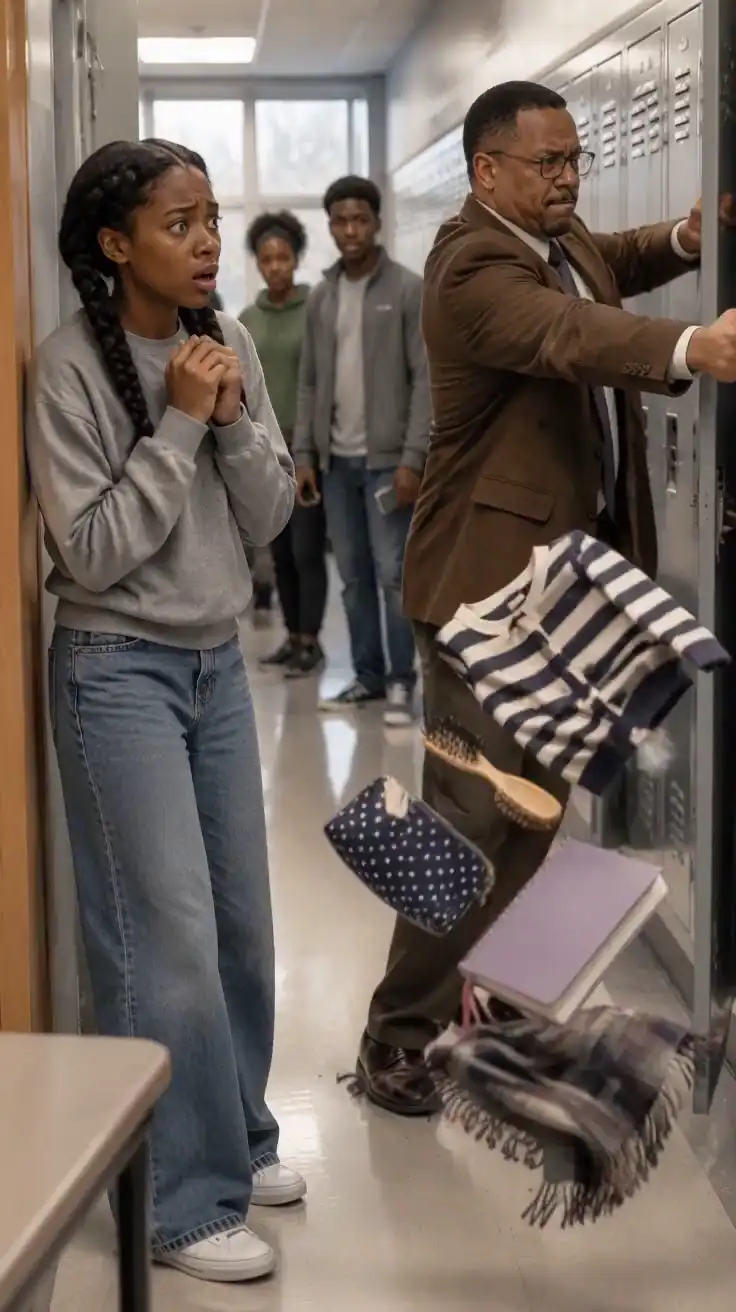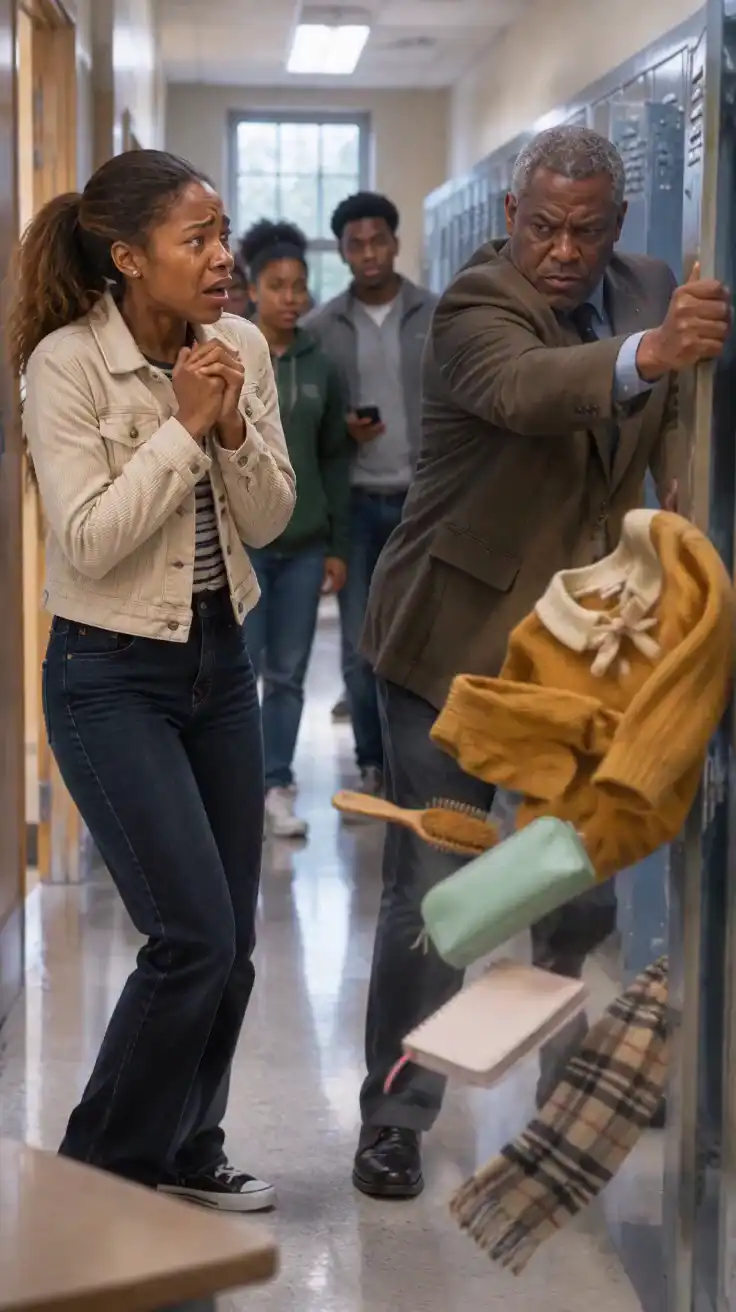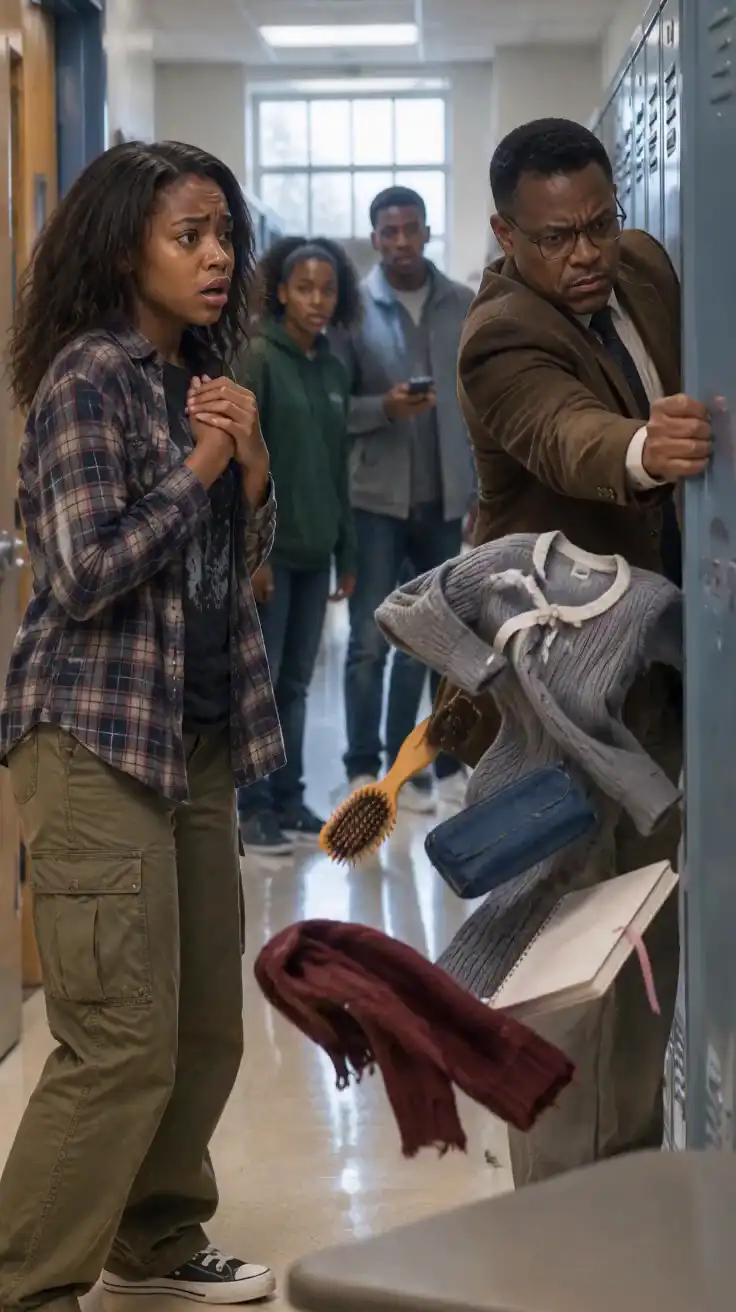
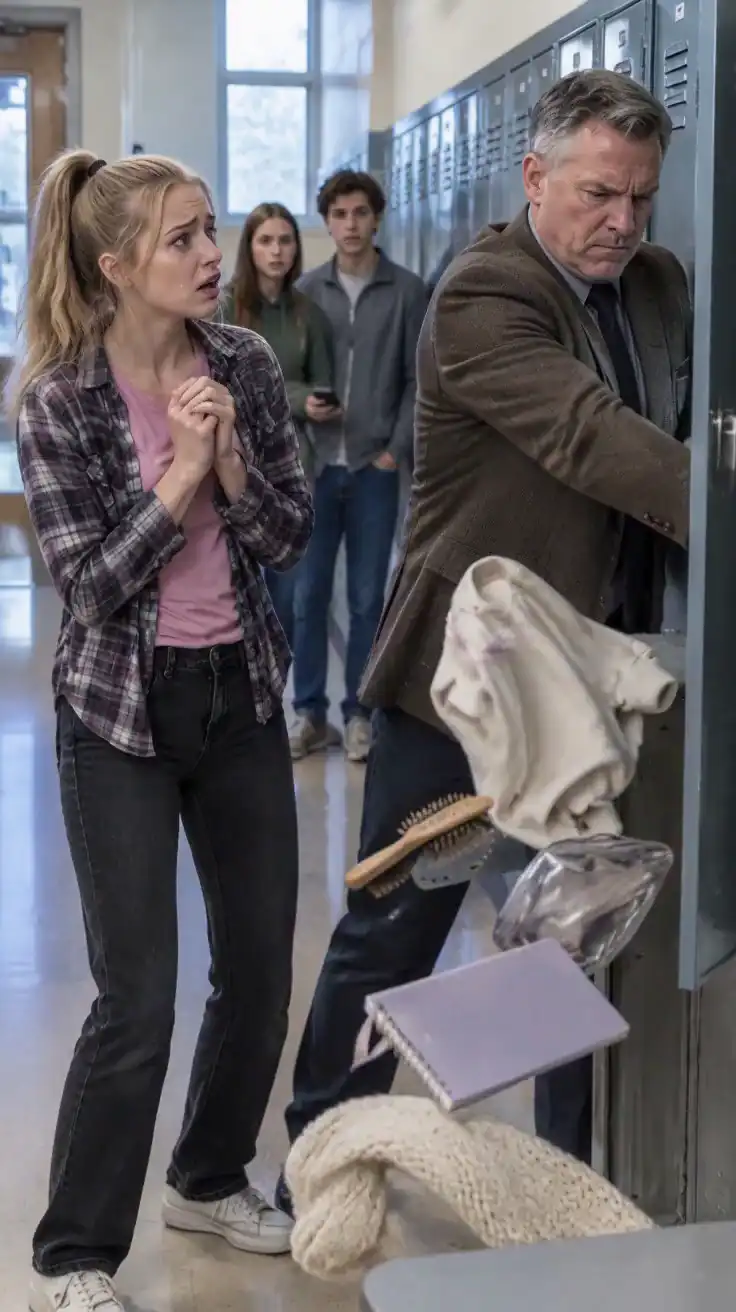
The dean stares at Claire as the gold bracelet hits the floor.
For one second, nobody moves.
The bracelet spins in a thin circle, catching the fluorescent light each time it turns. It makes a tiny metallic sound against the tile, almost too soft to hear over the hum of the hallway.
Then it falls flat.
My daughter is still kneeling beside the open locker.
Her sweatshirt is on the floor. Her dance shoes are separated from each other, one pointing toward the water fountain and the other toward the dean’s shoes. The canvas pouch lies upside down, its zipper open, with three hair ties, two safety pins, a lip balm, and a broken pencil scattered around it.
Claire’s arm is still raised.
Her sleeve has stopped moving.
The dean looks from the bracelet to Claire, then to my daughter. After that, he looks toward the security camera mounted above the office doors, as if he expects it to explain what he is seeing.
Claire is the first one to speak.
“That isn’t what it looks like.”
Nobody says anything.
She lowers her arm slowly. The cuff of her black dance jacket hangs loose around her wrist. The bracelet must have been tucked into the fold, because the sleeve is too narrow for it to have slid out any other way.
The dean bends down and picks it up.
I see the moment he recognizes it. He has seen the photograph I emailed him that morning. He has heard my daughter describe the oval charm. He has probably looked at it on the school’s missing-property report while deciding whether to accuse her of theft.
His fingers close around the gold.
“Where did you get this?” he asks Claire.
Claire’s face changes. It does not collapse immediately. At first, she looks angry, as if he has asked her something insulting.
“You know where I got it.”
“No,” he says. “I don’t.”
“You said it was in her locker.”
“I said it was reported missing from her locker.”
Claire glances at my daughter.
My daughter has not gotten up. Her hands are pressed against the floor, palms flat, as though she is afraid that if she moves, the whole hallway will move with her.
Claire’s expression flickers.
“She took it,” Claire says.
The dean’s voice is quiet now. “Then why did it fall out of your sleeve?”
“She gave it to me.”
My daughter finally looks up.
“I did not.”
Claire’s eyes fill with tears, but she does not look frightened yet. She looks offended. She has always been good at that. Even when we were little, I used to think she could turn hurt into anger before anyone else had time to decide what had happened.
“She gave it to me to hold,” Claire says. “She didn’t want anyone to see it.”
My daughter’s mouth opens.
Nothing comes out.
I am standing at the end of the hallway with my coat still on and my purse hanging from one shoulder. I had arrived ten minutes earlier after getting a call from the school office telling me there had been “an incident involving my daughter.” They had not explained what kind of incident. I had driven through two red lights because the secretary sounded nervous, then spent three minutes in the parking lot trying to get my hands to stop shaking.
I had expected to find my daughter embarrassed.
I had not expected to find her on the floor.
I had not expected to see the bracelet.
The dean turns to me.
“Mrs. Bennett,” he says.
His face is pale.
I do not answer him right away. I walk toward my daughter instead.
She is wearing the blue warm-up jacket from the dance team, the one with her last name stitched across the back in white thread. Her hair is pulled into a tight bun, and the pins are coming loose near her left temple. She looks younger than sixteen. She looks like the child who used to crawl into my bed during thunderstorms and insist that she was only checking on me.
I hold out my hand.
“Come here.”
She pushes herself up. Her knees are red from the tile. For a moment, she sways, and I catch her by the elbow.
“Are you hurt?”
She shakes her head.
“Did he make you kneel?”
Her eyes move to the dean.
The dean opens his mouth, but my daughter answers first.
“He told me to empty it.”
“That’s not what I asked.”
“He said if I didn’t, he’d call the police.”
The dean flinches.
Several students have stopped at the end of the hall. Some are holding phones. One girl has both hands over her mouth. Another is whispering to a boy in a varsity jacket. I recognize the boy as one of the basketball players. He had been in the cafeteria when the bracelet first went missing, and he had told my daughter that Claire said she watched her steal it.
I turn toward the dean.
“Did you threaten to call the police on my daughter?”
“I said we might have to involve them if the property wasn’t recovered.”
“You searched her locker.”
“We were trying to locate—”
“You dumped her things on the floor and ordered her to empty a pouch while students watched.”
“Mrs. Bennett, I understand that this is upsetting.”
“No, you don’t.”
My voice is not loud, but the hallway goes quiet anyway.
Claire looks at the dean. “You said she had it.”
“I said there was reason to believe it was in her possession.”
“You told everyone she stole it.”
“I did not tell everyone anything.”
“You told me.”
“You were the person who reported it.”
“You told me she was lying.”
“That is not what happened.”
Claire’s chin trembles. She wipes at her cheek with the back of her hand and smears black mascara beneath one eye.
My daughter is staring at the bracelet in the dean’s hand.
“Is that mine?” she asks.
The dean turns toward her.
“Yes.”
“Can I have it?”
He looks as if he has forgotten that it belongs to her.
“Yes,” he says. “Of course.”
He puts it in my palm instead.
The gold is cold. The tiny oval charm rests against my skin. My mother had worn it every day for nearly thirty years. When she died, I had it cleaned and gave it to my daughter on her fifteenth birthday. I had told her that my mother used to touch the charm whenever she was nervous, as if she could steady herself through it.
My daughter had smiled and said, “Then I’ll do that too.”
Now I close my hand around it.
Claire starts crying for real.
Not the dramatic tears she had used in the hallway. These come fast and soundless. Her shoulders fold inward. She looks at the floor.
The dean asks her again, “Where did you get the bracelet?”
She does not answer.
“Claire.”
“I found it,” she whispers.
“Where?”
“By the lockers.”
“Which lockers?”
She looks at my daughter. “Near hers.”
“When?”
“After the flood.”
My daughter makes a small sound beside me.
I turn to her. “You didn’t tell me you saw Claire near your locker.”
“I didn’t,” she says. “I didn’t see her.”
The dean keeps his attention on Claire. “You said you saw Maya take it.”
Claire’s face twists at the name.
“I thought she had it.”
“You didn’t think. You said you saw her.”
“I was angry.”
“That isn’t an answer.”
“I was angry,” Claire repeats. “I knew she had it.”
My daughter’s hand finds mine. Her fingers are cold and damp.
The dean looks at me again. “We need to go to the office.”
“No,” I say. “You need to come to the office. My daughter and I are leaving.”
“Mrs. Bennett, we still need a formal statement.”
“You can take one with her father and our attorney present.”
“I’m not trying to make this more difficult.”
“You made it difficult when you searched her in front of half the school.”
He looks down the hallway. Several students immediately pretend not to be watching.
The dean’s jaw tightens, but he does not argue. He gestures toward the office.
“Please. Five minutes.”
I almost refuse.
Then my daughter squeezes my hand.
“Mom,” she says quietly. “I want to know why.”
So we go.
The dean walks ahead of us, holding the door open. Claire follows, with her head down. I stay between her and my daughter without meaning to. The office secretary looks up from her computer and then quickly looks away.
The dean’s office is small, with two chairs in front of a desk and a bookshelf filled with binders no one touches. A framed photograph of the school sits behind him. In it, every student is smiling in the same direction beneath a banner that says WE ARE ONE.
My daughter sits beside me.
Claire sits across from us.
The dean remains standing.
He places the bracelet on a stack of papers between us.
“Claire,” he says, “I need you to tell us exactly what happened.”
She wipes her face again.
“I saw it after the water was cleaned up.”
“Where?”
“On the floor near the lockers.”
“Which floor?”
“The girls’ locker room.”
My daughter turns toward her. “You weren’t in there when we changed.”
“Yes, I was.”
“No, you weren’t. Coach kept the freshmen out because the pipes were still leaking.”
“I went back in.”
“Why?”
Claire’s eyes flash. “I forgot my bag.”
“You didn’t have a bag.”
“I had my phone.”
“You were holding it when we went to the gym.”
“Maybe I went back for something else.”
The dean raises one hand. “Let her finish.”
Claire looks down at the bracelet.
“I saw it under the bench,” she says. “It was wet. I picked it up.”
“You recognized it as Maya’s?”
“Yes.”
“Why didn’t you give it to Coach?”
“I was going to.”
“When?”
She does not answer.
“Why did you say Maya stole it?”
“I didn’t say that at first.”
My daughter gives a short, disbelieving laugh.
“You told everyone before practice.”
“I said I saw you take it.”
“That is the same thing.”
“You were the only person who knew where you put it.”
“Everyone knew. I told the girls at the lockers.”
“You told Claire,” my daughter says. “You told her because she was standing next to you.”
Claire looks up sharply.
The room seems to shrink around the two of them.
This is the first time I have seen them face each other since the accusation began.
They used to be inseparable. They had shared a locker since seventh grade, when the dance program assigned them numbers 214 and 215 and discovered that the girls’ jackets were too thick to fit separately. They had complained about the arrangement for exactly one day. By the second week, they were trading snacks between classes, doing homework on the floor outside the gym, and hanging matching ribbons from the locker handles.
Maya had a purple ribbon.
Claire had a yellow one.
They called the space between their lockers “the apartment,” and they kept a tiny plastic plant on top of it. The plant was missing three leaves because they had used them to decorate a science project, but neither girl would let me throw it away.
They shared everything that year. Hair spray. Hand lotion. Granola bars. Phone chargers. One pair of black tights when Claire forgot hers. A notebook filled with choreography counts and jokes that made no sense to anyone else.
Claire came to our house most Fridays. She would sit at the kitchen island while I made grilled cheese, and Maya would put music on the speaker even though both girls were supposed to be studying.
I remember Claire laughing so hard one night that milk came out of her nose.
I remember thinking there was no version of my daughter’s adolescence that did not include that girl.
The friendship changed during the winter.
Not all at once. There was no single argument, no slammed door, no message that ended it. Claire started missing practices. She stopped staying after school. She returned borrowed things without speaking. Maya would ask if she was all right, and Claire would say she was tired.
Then Claire’s father’s truck disappeared from their driveway.
A month later, Claire told Maya that her father had moved out.
Maya came home upset but refused to explain why. I found her sitting on the laundry-room floor with her knees pulled to her chest.
“Did something happen?” I asked.
“Claire’s family is having money problems.”
“Did she tell you that?”
“She doesn’t have to.”
That answer worried me more than a confession would have.
I learned pieces over the next few weeks. Claire’s mother had lost her job at the dental office. The rent was late. Their electricity had been shut off twice. Claire had stopped buying lunch and started saying she wasn’t hungry.
Maya began packing two sandwiches.
I found out when I opened her dance bag and saw one wrapped in foil.
“Is this for Claire?”
Maya had looked embarrassed. “She doesn’t like people knowing.”
“Does she need more than a sandwich?”
“She needs you not to make a big thing out of it.”
So I did what she asked. I packed an extra sandwich, fruit, and sometimes a protein bar. I put the food in a plain paper bag and wrote nothing on it.
Claire accepted it at first.
Then she stopped.
“I’m not charity,” she told Maya.
Maya came home with the paper bag still in her backpack.
A week later, Claire pawned a necklace that had belonged to her grandmother.
Maya told me that part in a whisper, sitting on the edge of her bed with her knees pressed together.
“Claire made me promise not to tell.”
“What happened to the necklace?”
“She sold it.”
“Are you sure?”
“She showed me the receipt.”
The necklace had been a thin silver chain with a small blue stone. Claire’s grandmother had given it to her before she died. Claire used to wear it during competitions, tucked beneath her costume.
Maya said Claire had needed money for the electric bill.
I wanted to call Claire’s mother. I wanted to send groceries. I wanted to do a dozen things that would have made me feel like an adult who could fix a child’s life.
Maya stopped me.
“She’ll never forgive me if I tell.”
“She shouldn’t have to carry this alone.”
“She’s already carrying it. If you tell, you’ll only make her carry being embarrassed too.”
I did not tell the school. I did not tell Claire’s mother. I did not tell anyone.
I thought I was protecting Claire.
Now, in the dean’s office, I wonder if silence had protected her or simply allowed every adult around her to misunderstand what was happening.
The dean asks, “What did you do after you found the bracelet?”
Claire presses her lips together.
“I took it.”
“Why?”
“I needed to keep it safe.”
“Safe from what?”
She looks at me then.
There is shame in her face, but also something harder.
“I didn’t know what I was going to do.”
My daughter whispers, “You were going to pawn it.”
Claire’s eyes fill again.
“I didn’t.”
“You put it in your sleeve.”
“I didn’t pawn it.”
“You took it.”
“I said I didn’t pawn it.”
“You accused me because you took it.”
“I thought you would tell.”
“Tell what?”
“That I had the necklace.”
The words drop into the office and stay there.
My daughter goes still.
Claire looks at the dean, not at her.
“I thought you would tell them I sold my grandmother’s necklace,” she says. “I thought you would tell them I needed money, and then everyone would know.”
Maya’s expression changes from anger to confusion.
“I never told anyone.”
“You knew.”
“I knew because you told me.”
“You knew where the money went.”
“I knew you needed to pay the bill.”
“I said I would get it back.”
“You said you were going to pawn it for a week.”
“I was going to.”
“You sold it.”
Claire’s fingers curl into the fabric of her jacket.
“I had to.”
My daughter looks down at the bracelet.
“Then why did you take mine?”
Claire’s answer is so quiet that I almost miss it.
“Because you were going to nationals.”
Maya looks up.
The dean glances between them. “What does that have to do with the bracelet?”
Claire’s face crumples.
“They were posting the roster today,” she says. “Maya knew she was going. She practiced every day. Coach told her she was probably in the top group. My name wasn’t certain.”
“That still doesn’t explain the bracelet.”
“I thought if I had something valuable, I could replace the necklace before my mother found out.”
“You thought you could sell my bracelet?”
“I didn’t know what else to do.”
“You could have told me.”
Claire laughs once, bitterly.
“You would have given me money.”
“Yes.”
“That would have been worse.”
“Worse than stealing from me?”
“I didn’t think you would understand.”
Maya’s voice breaks. “I understood enough to bring you lunch.”
“I didn’t want lunch.”
“You ate it.”
“I was hungry.”
“You could have said thank you.”
Claire turns toward her.
“I was ashamed.”
That stops my daughter.
Claire looks at her for a long moment.
“You kept looking at me like I was someone you had to save,” she says. “Every time you handed me something, you looked sorry for me.”
“I did not.”
“You did.”
“I was worried.”
“You were always worried. You started asking if I was okay in front of everyone.”
“Because you weren’t.”
“I was fine.”
“You sold your grandmother’s necklace.”
“I was fine before you found out.”
Maya’s hands begin to tremble. I put my hand over them.
Claire’s voice rises.
“You had your mother’s bracelet. You had your place on the nationals roster. You had a father who still came home and a house where the lights stayed on. I had nothing, and everyone kept pretending not to notice.”
“I never pretended.”
“No. You tried to fix it.”
“I was your friend.”
“I didn’t need a friend who felt sorry for me.”
“I never felt sorry for you!”
“Then why did you keep bringing things?”
“Because I loved you!”
The words come out of my daughter with such force that the secretary outside the office looks through the glass panel in the door.
Claire stops crying.
Maya has both hands over her mouth now.
The dean sits down slowly.
I have heard my daughter say she loves people before. She says it to me every night, usually while walking upstairs, already distracted by homework or music. She says it to her father on the phone. She says it to our dog.
She had never said it like that.
Claire looks away.
“You don’t get to steal from someone because you’re ashamed,” I say.
My voice is calmer than I feel.
Claire nods.
“You don’t get to accuse someone else because you’re afraid of being caught.”
She nods again.
“And the school does not get to search a student in public because an accusation is convenient.”
The dean looks at me.
“You’re right.”
The words are immediate enough to surprise me.
He stands. For a moment, I think he is going to leave the office. Instead, he walks around the desk and opens the door.
The hallway has not cleared.
Students are still gathered near the office. A few teachers are standing by the trophy case. The secretary rises from her chair.
The dean steps outside.
“Everyone, I need your attention.”
The hallway quiets.
My daughter remains inside, but I stand in the doorway. Claire stays in her chair, her head bowed.
The dean holds the bracelet in one hand.
“An accusation was made against a student today,” he says. “That accusation was not supported by the facts. The item reported missing was found in the possession of the student who made the accusation.”
A murmur moves through the hallway.
The dean continues.
“Maya Bennett was searched in public and was treated in a manner that was inappropriate. That was my decision, and I was wrong.”
My daughter looks at me.
I can see her trying to understand whether he is really saying what she thinks he is saying.
The dean turns toward her.
“Maya, I apologize. I apologize for ordering you to empty your belongings on the floor. I apologize for threatening to involve the police before we had established the facts. I apologize for allowing other students to witness a disciplinary search. You did not deserve that.”
He pauses.
Then he says it again, louder.
“I am sorry.”
Nobody laughs. Nobody whispers.
The secretary starts crying at her desk.
The dean looks at Claire.
“Claire, you will not be making any further statements until your parent or guardian is present. We will contact your mother.”
Claire nods without lifting her head.
The dean faces the students.
“And anyone who recorded or distributed video of this incident is expected to delete it immediately. The school will be following up.”
A boy near the water fountain lowers his phone.
My daughter steps into the hallway.
The dean moves aside.
For a moment, the students part to let us through. I put my arm around my daughter’s shoulders. She is still shaking, but she is standing straight.
As we pass Claire, she says, “Maya.”
My daughter stops.
Claire’s eyes are red.
“I’m sorry.”
Maya does not answer at first.
Then she says, “You should have told me.”
“I know.”
“You should have told me before you took it.”
“I know.”
“And you should have let me explain to the school.”
“I know.”
Maya looks at her.
“I didn’t steal anything.”
“I know.”
That is all.
We leave the office together.
In the parking lot, my daughter gets into the passenger seat and closes the door. She does not put on her seat belt. She just sits there with her hands folded in her lap.
I start the car but do not pull out.
The bracelet is still in my palm.
“Do you want to go home?” I ask.
She looks through the windshield at the brick wall of the gym.
“The roster is supposed to be posted at noon.”
I check the clock.
11:47.
“We can go home.”
“I want to see it.”
“Maya.”
“I practiced for it.”
“I know.”
“If I go home, everyone will say I couldn’t handle it.”
“Everyone who?”
She shrugs.
“Everyone.”
I take a breath.
“Do you want me to come with you?”
She gives me a look that says the question is ridiculous.
“Yes.”
We drive around to the front of the school. The nationals roster is posted on a large bulletin board outside the athletic office. By the time we reach it, students are already gathering.
The school has not announced what happened. Not officially. But news travels faster than any announcement. The students who were in the hallway have told their friends. The students who were not there are watching the faces of those who were.
Maya walks beside me.
Her ankle is still wrapped under her warm-up pants. She had sprained it during rehearsal three weeks earlier and refused to sit out. I had taken her to a sports clinic, and the doctor had told her to rest for ten days. She rested for two and then started practicing in the basement.
“You are not going to dance nationals on that ankle if you make the roster,” I had told her.
“I’ll tape it.”
“That is not what I said.”
“You heard what I said.”
The nationals team would travel in six weeks. The roster determined who danced in the group routine, who was listed as an alternate, and who stayed home. For the girls in the program, it was the line between being seen and being left behind.
Maya had known that Claire’s name might be on the list too.
Even after they stopped speaking, she had watched for Claire’s name whenever Coach posted practice groups.
Now they stand near the bulletin board.
The paper is taped behind a clear plastic cover.
Maya reaches for it, then stops.
“You read it,” she says.
“No.”
“Mom.”
“You should read it.”
“I can’t.”
“Then neither can I.”
That almost makes her smile.
A girl from the senior team, Jasmine, comes through the crowd. She looks at Maya, then at me, then at the office behind us.
“I heard,” she says.
Maya’s shoulders tense.
Jasmine raises both hands. “I’m not asking.”
“Good.”
“I just wanted to say the dean was wrong.”
Maya looks away.
Jasmine lowers her voice. “Are you going to check the list?”
Maya nods.
Jasmine steps aside.
Maya pulls back the plastic cover.
Her name is third on the list.
MAYA BENNETT — NATIONALS TEAM
Below it, in the second section, is CLAIRE HART — ALTERNATE.
Maya stares at the paper.
I do not know what I expect her to feel. Happiness, perhaps. Relief. Anger that Claire’s name is still there. Guilt that she wants to celebrate when Claire is standing somewhere in the office with her mother being called.
Instead, she reaches for her phone.
“What are you doing?” I ask.
“I’m texting Coach.”
“What are you going to say?”
“That I accept.”
She types for a few seconds.
Then she adds, “And that I want to talk about Claire.”
I touch her arm.
“You don’t have to fix this.”
“I know.”
“Do you?”
She looks at her name on the list.
“I don’t know what I’m supposed to do with being happy.”
“You’re allowed to be happy.”
“Even though she’s an alternate?”
“Her being an alternate is not something you did to her.”
“She thinks I did.”
“Claire made her own choices.”
Maya’s eyes remain on the paper.
“I still love her.”
“I know.”
“That doesn’t mean I trust her.”
“No.”
“I don’t know if I can be her friend.”
“You don’t have to decide today.”
She nods.
A few minutes later, Coach Alvarez comes out of the athletic office. She is a short woman with silver hair and the habit of holding a clipboard against her chest like a shield. She has coached Maya since she was eleven. She has also known Claire almost as long.
She sees the two of us and comes straight over.
“Maya, I’m sorry.”
Maya’s face tightens.
“Did you know he was searching me?”
“No. I was in the equipment room. When I came out, it was already happening.”
“Claire told you I stole it.”
“She did.”
“And you believed her.”
Coach looks at me. “I should have asked more questions.”
“Yes,” I say.
She nods. “I should have.”
Maya folds her arms.
“What happens now?”
“That depends on the investigation.”
“Am I still on the team?”
“Unless you choose not to be.”
Maya looks at the list. “And Claire?”
“Her alternate position remains under review. We will not decide anything until her mother is here and the school completes its process.”
“Are you going to take her off?”
“I don’t know.”
Maya looks upset.
“Don’t punish her because she’s poor.”
Coach’s face changes.
“I am not going to punish her for her family’s circumstances,” she says. “But stealing from another dancer and making a false accusation are serious.”
“She’s already being punished.”
“No,” Coach says gently. “She is being held accountable. Those are not the same thing.”
Maya looks at me.
I can see the thought forming in her face: the same thought she has had since the beginning, the one that tells her she can prevent Claire from losing anything if she gives up enough of herself.
I reach for her hand.
“Let Coach do her job.”
Coach nods.
A black sedan pulls into the nearest parking space. Claire’s mother gets out.
I recognize her from the winter showcase. She had stood in the back of the auditorium in a gray coat, clapping harder than anyone when Claire danced. She looks exhausted now. Her hair is pulled into a loose knot, and she is still wearing the blue scrubs from the medical clinic where she works part time.
She sees Claire through the office window.
Claire stands up.
Her mother reaches the door, and the secretary lets her in. I see them speak briefly. Then Claire comes out.
Her mother looks at the bracelet in my hand.
Her face goes white.
Claire says something to her. Her mother closes her eyes.
I expect her to come over and apologize. Instead, she goes to Claire and takes her by both shoulders.
“What did you do?” she asks.
Claire begins crying again.
“I’m sorry.”
“What did you do?”
“I took it.”
Her mother looks at the bracelet.
“Where were you going to sell it?”
Claire covers her face.
Her mother turns away for a moment. When she turns back, her expression is not angry. That makes it worse.
“Did you tell me the truth about the necklace?”
Claire shakes her head.
“Did you tell me how much you got for it?”
Another shake.
Her mother looks toward the ceiling.
I know that posture. It is the posture of someone trying not to fall apart in front of other people.
I walk toward them with Maya beside me.
“Mrs. Hart,” I say.
She looks at me.
“I’m sorry,” she says immediately. “I am so sorry.”
“I know.”
“No, you don’t. I should have known she was desperate.”
“You were working.”
“That is not an excuse.”
“It’s not your fault that she made this choice.”
“She stole from your daughter.”
“Yes.”
The truth sits between us.
Maya steps forward.
“Mrs. Hart, I didn’t tell anyone about the necklace.”
Claire looks at her.
Her mother’s eyes move from Maya to Claire.
“What necklace?”
Claire closes her eyes.
There it is. The part I had tried to protect her from.
Claire’s mother looks at me.
“What necklace?”
I do not answer for Claire.
Claire’s voice is barely audible. “Grandma’s.”
Her mother grips the strap of her purse.
“You sold your grandmother’s necklace?”
“I was going to get it back.”
“With what?”
“I don’t know.”
“You lied to me.”
“I was scared.”
“You lied to me, and then you stole from Maya?”
Claire is crying so hard now that she cannot speak.
I put a hand lightly on Maya’s back.
“We’re going to give you some privacy.”
Claire’s mother catches my eye.
“Please don’t leave.”
I stop.
She looks at Maya.
“Please.”
My daughter stays.
Claire’s mother takes a breath.
“The power bill was due,” she says. “I thought I had another week. I didn’t. The notice came after she sold the necklace, but I didn’t know about the necklace. I thought my sister had helped us.”
Claire whispers, “I didn’t tell Aunt Lisa.”
“You let me believe your aunt paid it?”
“I was going to tell you.”
“When?”
“I don’t know.”
Her mother rubs both hands over her face.
“I have been trying to keep this family together with money I don’t have and time I don’t have. I should have seen you were scared.”
Claire looks at the floor.
“I didn’t want you to see.”
“You are my daughter. I am supposed to see.”
The sentence breaks something in Claire. She bends forward, and her mother pulls her into her arms.
Maya watches them.
I can feel her wanting to go over. She takes one step and stops.
Claire’s mother looks at her over Claire’s shoulder.
“Maya, I am sorry she dragged you into this.”
“She did it herself,” Maya says.
Her voice is not cruel.
It is simply tired.
Claire lifts her head. “I’m sorry.”
Maya looks at her for a long time.
“I need you to tell the truth.”
“I will.”
“Not just today.”
“I will.”
“And don’t talk to me about being friends.”
Claire nods.
“I’m not ready,” Maya says.
“I know.”
“I might not ever be.”
“I know.”
Those words seem to hurt Claire more than the rest, but she accepts them.
Coach Alvarez speaks to Claire’s mother about taking Claire home. The dean comes outside and joins us. He is holding a folder now, and his expression has changed from defensive to formal.
He tells Claire’s mother that the school will provide a written summary of the incident and that the investigation will include the false accusation, the public search, and the video recordings. He says the school counselor is available. He says Claire will not be questioned alone.
Then he turns to Maya.
“I want to repeat my apology.”
My daughter looks at him.
“You already did.”
“I know. I should have apologized before you left.”
“You apologized in front of everyone.”
“That was the least I could do.”
“Yes,” I say.
He accepts that.
“There will also be a meeting with your father and you,” he says. “We will discuss the school’s disciplinary procedures and how this happened.”
“Will you write down that she was lying?” Maya asks.
The dean glances at Claire.
“I will write down the facts.”
“The facts are that she accused me because she took it.”
“Yes.”
“And the facts are that you searched me before checking her.”
“Yes.”
Maya nods.
“I want those in the report.”
“They will be.”
That evening, the school sends an email to every parent in the dance program.
It does not name Claire or Maya. It says that a missing personal item was recovered and that an earlier allegation had been determined to be unfounded. It says the school regrets the handling of the search and reminds families that students should not share or distribute recordings of disciplinary incidents.
The email is careful.
Too careful.
By eight o’clock, three parents have called me.
The first is the mother of a girl who had been at the end of the hallway. She tells me her daughter saw the search and has been crying because she did not know what to do.
The second is a father who says his son had recorded part of the confrontation and wants to know whether I am going to sue the school.
The third is a mother I have never met. She says Claire has always been jealous of Maya and that “this was bound to happen.”
I hang up before she finishes.
My husband, Daniel, comes home after nine. He has been at work all day and had only received my short text: COME HOME. SCHOOL INCIDENT. MAYA SAFE.
He stands in the kitchen while I tell him everything.
When I finish, he looks at Maya.
“Did the dean apologize?”
“In the hallway.”
“In front of people?”
“Yes.”
Daniel nods slowly.
“Good.”
Maya is sitting at the table with an ice pack on her ankle. She has changed out of her dance clothes and is wearing one of Daniel’s old college sweatshirts. The bracelet rests in front of her on a folded towel.
Daniel reaches for it but stops before touching it.
“Can I?”
She nods.
He picks it up and studies the oval charm.
“Your grandmother wore this every day,” he says.
“She wore it until the clasp broke.”
“And then your mother had it fixed.”
Maya nods.
Daniel puts it down.
“Do you want to report Claire to the police?”
Maya looks at me.
“That’s your decision,” I say. “Not because the school is asking. Not because Claire’s mother is afraid. Not because you think it will make anyone happy or unhappy.”
“I don’t know.”
“That’s okay.”
“If we report her, she could get arrested.”
“She is a minor,” Daniel says. “That does not mean there are no consequences, but it does not automatically mean that.”
Maya looks at the bracelet.
“She didn’t sell it.”
“No,” I say. “But she took it.”
“I know.”
“And she lied.”
“I know.”
“I don’t want you to decide based on whether you feel sorry for her.”
Maya’s eyes fill.
“I don’t feel sorry for her.”
I wait.
“I feel sorry that she thought stealing was the only thing she could do.”
That is different, but not entirely.
Daniel sits beside her.
“Feeling sorry for someone does not mean you have to trust them.”
“I know.”
“You can care about what happens to Claire and still protect yourself.”
Maya nods.
We decide not to call the police that night. We tell the school we want the matter documented and handled through the district’s process. We reserve the right to change our minds.
The longer aftermath is not clean.
There is no single meeting where everyone says the right thing and the damage disappears.
For several weeks, Maya walks through school with the feeling that people are looking at her. Some are. Some are looking at Claire. Some only want the story because it is more interesting than their own lives.
A video still circulates despite the dean’s warning. It shows Claire pointing down the hallway and the bracelet falling. It does not show the search, which means some students decide that the important part is Claire being caught, not Maya being humiliated.
Maya refuses to watch it.
I watch it once because the district asks me to identify the students visible in the background. Then I delete it.
The school holds a formal meeting in a conference room with gray walls and a pitcher of water nobody touches.
The dean is there. So is the principal, the district student-services director, Coach Alvarez, Daniel, Maya, Claire, and Claire’s mother.
The district director begins by reading the incident report.
It says that a student reported a bracelet missing. It says another student made an accusation. It says a locker search was conducted. It says the bracelet was recovered from the accuser.
It does not say that Maya was made to kneel.
I interrupt.
“That needs to be included.”
The dean looks down.
The district director asks him to explain.
He does.
He says he believed the bracelet might be in Maya’s locker. He says Claire’s statement appeared credible because of the history between the girls. He says the public search was a poor decision.
I ask, “Why did her history with Maya make her more credible?”
He does not answer immediately.
“Because they had shared a locker,” he says finally. “Because Claire knew Maya’s routines.”
“That gave her access to information. It did not make her honest.”
“Yes.”
“And why was my daughter searched before Claire’s clothing or belongings were checked?”
“We did not know Claire had the bracelet.”
“You knew she had accused Maya.”
“Yes.”
“You knew the girls were no longer friends.”
“Yes.”
“You knew there had been conflict.”
“Yes.”
“Did anyone ask Claire whether she had been near the locker?”
“No.”
The room is silent.
I can feel Maya’s knee moving under the table. I put my hand over it.
The district director says the school will revise its procedure for student searches and require a second administrator to be present. She says staff will receive training on public humiliation and coercive questioning.
Those words sound polished.
They also sound necessary.
Claire is asked to speak.
She keeps her hands folded in her lap.
“I took the bracelet because I thought I could sell it,” she says. “I accused Maya because I was scared she would tell people about my grandmother’s necklace. I knew she wouldn’t, but I was angry that she had something valuable and I didn’t.”
Her mother closes her eyes.
Claire continues.
“I knew the nationals roster was being posted. I thought if Maya was removed from the team, people would stop asking why I wasn’t on it. I didn’t plan to make her kneel. I didn’t plan for the dean to search her. But I started it.”
Maya looks at her.
“You did plan to accuse me.”
“Yes.”
“You told Coach I was a thief.”
“Yes.”
“You told people in the hallway.”
“Yes.”
“Why did you shout today?”
Claire swallows.
“Because I saw you looking at the roster.”
Maya’s face tightens.
“You were afraid I would make the team.”
“Yes.”
“You wanted me to lose my place.”
Claire nods.
“I did.”
That is the hardest part.
Not the money. Not the necklace. Not even the bracelet.
The fact that Claire had wanted Maya to lose something.
Maya looks down at the table.
The principal asks if she has anything else to say.
She takes a long time.
“I understand that Claire was scared,” she says. “But being scared doesn’t erase what she did. I don’t want anyone to tell me she made a mistake like she dropped a glass. She chose to take it. She chose to lie. She chose to point at me. And the adults chose to believe her without checking.”
The dean nods.
Maya looks at him.
“I don’t need you to say you’re sorry again. I need you to make sure you don’t do this to someone else.”
He says, “We will.”
She says, “That’s not a promise you can make alone.”
The district director answers.
“It is a promise the district will be responsible for.”
The school’s consequences for Claire are not public. Claire is removed from the team for the rest of the season and required to attend counseling sessions. She is allowed to remain an alternate for nationals only after an appeal meeting, but Coach ultimately tells her that she will not travel with the team.
That decision hurts Maya more than she expects.
When Coach tells her, Maya sits in the passenger seat of my car with her hands locked around the bracelet.
“Did you ask her to do that?” she asks.
“No.”
“Did you say you didn’t want Claire there?”
“No.”
“Did you tell Coach she should remove her?”
“No.”
“Then why do I feel like I caused it?”
“Because Claire’s choices happened near you.”
“That doesn’t mean you caused them.”
“I know.”
“Everyone keeps saying that.”
“Because you keep trying to take responsibility for things you didn’t do.”
She looks out the window.
“Claire says she can’t dance anymore.”
I turn off the engine.
“When did she tell you that?”
“She texted me.”
“What did you say?”
“I said she should talk to Coach.”
“Good.”
“She said Coach hates her.”
“Coach does not hate her.”
“I know.”
“She may be disappointed. That is not the same thing.”
Maya is quiet.
“Do you want to answer her?”
“I already did.”
“What did you say?”
“I said I hope she keeps dancing.”
I look at her.
“That was kind.”
“It wasn’t forgiveness.”
“I didn’t say it was.”
“I don’t forgive her yet.”
“You don’t have to.”
“She keeps apologizing.”
“She may need to apologize for a long time.”
“But I don’t want to hear it every day.”
“Then you can tell her that.”
Maya nods and sends another message.
PLEASE STOP TEXTING ME FOR NOW. I NEED SPACE. I HOPE YOU GET HELP, BUT I AM NOT READY TO TALK.
Claire responds with one word.
Okay.
After that, the messages stop.
Claire’s family begins receiving help through the school counselor and a community assistance program. Claire’s mother finds full-time work at a rehabilitation clinic, though the commute is long and the pay is not enough to erase their debt. The electricity stays on. They move out of the apartment in May and rent a smaller duplex across town.
The grandmother’s necklace is not recovered.
That loss remains.
Claire’s mother tells me that when she found out about it, she went to the pawnshop and asked whether they still had the piece. The shop had already sold it. The owner remembered the blue stone but could not tell her where it went.
Claire writes an apology to my mother, though my mother has been dead for years.
She gives it to Maya in an envelope.
Maya leaves it unopened in her desk drawer for almost a month.
When she finally reads it, she does not show me the whole thing. She lets me see only the last paragraph.
I wanted something that belonged to someone who had enough. I thought taking it would make me less afraid. It only made me become someone I was afraid of.
Maya folds the letter back up.
“Do you think she means it?” she asks.
“I think she may mean it now.”
“That’s not the same as before.”
“No.”
“Do people get to change after they hurt you?”
“They can.”
“Do you have to let them back in?”
“No.”
She puts the letter away.
Maya continues with the nationals team. Her ankle heals slowly. Coach makes her sit out one rehearsal, and she is furious about it until the physical therapist explains that dancing through pain is not courage if it causes a permanent injury.
At the first full-team practice after the incident, the girls are awkward around her. Some apologize. Some avoid eye contact. Jasmine brings her a coffee and says nothing.
The roster is still on the bulletin board.
Claire’s name has been removed.
Maya asks Coach to leave it there until the final travel list is posted. Coach refuses.
“It is not your job to keep looking at it,” she says.
Maya tells me this in the car.
“She’s right,” I say.
“I know.”
“You can know that and still be angry.”
“I’m angry at the whole hallway.”
“What did the hallway do?”
“It watched.”
That answer stays with me.
The hallway did watch.
The dean watched. The students watched. I watched later on a screen. Even Claire watched while my daughter knelt on the floor.
There are moments when being a witness feels like being innocent, but it is not always that simple.
At the end of the school year, the district sends us a letter confirming that the dean’s conduct violated the school’s student-search policy. He is required to complete additional training and is removed from handling disciplinary investigations involving the dance program.
He remains dean.
Some parents think that is too lenient. Others think the school did enough. I stop reading comments.
The school also sends a written apology to Maya.
She reads it at the kitchen table.
“It says they regret the misunderstanding,” she says.
“It was not a misunderstanding.”
“No.”
“They should change that.”
“I’m not sending it back.”
“Why not?”
“Because I don’t want another meeting.”
She folds the paper.
“Can I keep the bracelet at home now?”
“Of course.”
“I don’t want to wear it for a while.”
“You don’t have to.”
“I thought wearing it meant Grandma was with me.”
“It still can.”
“It also means everyone knows I have something worth stealing.”
I sit beside her.
“That bracelet is not responsible for what Claire did.”
“I know.”
“But you are allowed to feel differently about it.”
She rubs her thumb across the oval charm.
“I think I’m going to wear it when we go to nationals.”
“Why?”
“Because I want to choose.”
That is what she does.
She wears it under her costume at nationals, tucked against her wrist with a layer of athletic tape over the clasp. The team places fourth. Maya cries afterward, not because they lost, but because she had never danced in front of that many people before.
When we call Daniel from the hotel, she tells him the bracelet stayed on.
He says, “Your grandmother would have been proud.”
Maya looks down at it.
“I was scared.”
“Being scared doesn’t mean you weren’t brave.”
She glances at me.
“That’s what everyone says.”
“Your father is allowed to say it.”
She smiles.
Claire is not there.
For a while, I think that will be the final shape of their story: two girls who shared a locker, shared lunches, shared secrets, and then stood on opposite sides of an accusation that neither of them could undo.
But in September, Claire sends Maya a letter.
Not a text. Not an apology repeated through someone else. A real letter, written in blue ink on lined paper.
She says she has started working with a counselor. She says her mother has found a better job. She says she has not returned to dance yet because she is not sure whether she wants to.
She says she does not expect Maya to answer.
Maya reads the letter twice.
Then she puts it in the same drawer as the apology to my mother.
A week later, she asks me to drive her to the old school after hours.
The lockers have been moved. The dance program has been assigned a different hallway because the school is replacing the pipes. The space where Maya and Claire kept their plastic plant is empty.
Maya stands in front of locker 214.
“Do you remember this?” I ask.
She nods.
“Claire used to keep gummy bears in the vent.”
“She said they were emergency supplies.”
“They melted in July.”
“She blamed the heat.”
We both laugh, and the sound surprises us.
Maya touches the locker door.
“I miss her,” she says.
“You can miss someone and still know they hurt you.”
“I know.”
“I’m not going to tell you whether to be friends again.”
“I know.”
“I’m not going to tell you to forgive her.”
“I know.”
She looks at me.
“I might want to talk to her.”
“Then you can.”
“What if she wants everything to go back to the way it was?”
“It won’t.”
“She’ll be disappointed.”
“Maybe.”
“What if I am?”
“You may be.”
Maya opens the locker. It is empty except for a strip of yellow ribbon stuck to the back wall with old tape.
She pulls it loose.
For a moment, she holds it between her fingers.
Then she folds it and puts it in her pocket.
She does not call Claire that night.
She waits three days.
When she finally does, she asks Claire to meet her at a café near the library. I drive her there and sit in the car while they talk. Maya is inside for forty-seven minutes.
When she comes back, I do not ask for every word.
“How was it?” I ask.
“Hard.”
“Did she apologize?”
“Yes.”
“Did you forgive her?”
“No.”
“Did you want to?”
“Maybe someday.”
She closes the car door.
“Are you going to be friends?”
“I don’t know.”
“That’s okay.”
“She said she doesn’t want to dance anymore.”
“What did you say?”
“I told her she doesn’t have to decide yet.”
She looks out the window.
“She said she thought I would hate her.”
“What did you say?”
“I told her I was angry.”
“That’s honest.”
“I told her I loved her.”
I turn to her.
“Was that honest too?”
“Yes.”
The bracelet is on her wrist.
She has started wearing it again, not only on competition days. She wears it to school, to the grocery store, and once while painting her bedroom, even though I tell her to take it off before getting paint on the chain.
The clasp has been repaired again.
We keep the receipt in the same drawer as the insurance papers.
Sometimes, when she is nervous, she touches the oval charm.
I do too.
I still think about the moment it fell from Claire’s sleeve.
I think about the sound it made on the tile. I think about the students watching. I think about my daughter’s hands pressed against the floor while an adult searched through her things. I think about the difference between finding the truth and repairing the harm caused while the truth was hidden.
The bracelet came back to us.
That does not mean the day disappeared.
Claire’s family is still paying off its debt. Her mother still works long hours. The missing necklace is still missing. Claire still has to live with the fact that she chose to hurt someone who loved her because she was afraid of being seen as poor.
Maya is still learning that compassion does not require surrender.
I am still learning that protecting a child’s dignity sometimes means speaking the truth even when the truth embarrasses someone else.
At the end of the year, the school holds its annual dance showcase. Claire attends, but she does not perform. She sits near the back with her mother.
Maya sees her before the show begins.
She touches the bracelet.
Then she walks over.
I watch from the side of the auditorium as the two girls speak quietly. I cannot hear what they say. Claire cries once. Maya does not hug her, but she puts a hand on her shoulder.
Afterward, when Maya returns to me, I ask if everything is all right.
“No,” she says.
The answer is so immediate that I smile.
“No?”
“Not all right. Just honest.”
She looks toward Claire, who is standing beside her mother near the exit.
“I think that’s better.”
The lights dim.
The music begins.
Maya walks onto the stage with the bracelet hidden under her costume, the gold charm resting against her skin. She takes her place in the line. For a second, she looks toward me.
Then she lifts her chin.
And when the dancers move, she does not dance like someone who has never been hurt.
She dances like someone who knows exactly what was taken from her, exactly what was returned, and exactly what still belongs to her.