The dean stared at the girl.
For one second, nobody moved. The bracelet lay on the tile between my daughter’s hand and the dean’s polished shoes. It was small enough to disappear beneath a sneaker, but the gold caught the fluorescent light and made sure no one could pretend not to see it.
The girl who had accused my daughter looked down at it.
Her name was Brooke Ellis.
She and my daughter, Hannah, had been friends since they were eight years old. Not casual friends. Not girls who had once sat together in science and exchanged birthday cards. They had grown up in the same church, attended the same Sunday school class, gone to the same summer mission trips, and spent enough afternoons in each other’s homes that Brooke knew which cabinet held our drinking glasses.
Brooke’s face changed before she said anything. The certainty drained out of it. Her mouth opened, but whatever answer she had prepared did not come.
The dean bent down and picked up the bracelet.
“Brooke,” he said quietly, “why is this on the floor?”
She looked at me, then at Hannah, then toward the office where several adults had gathered behind the glass. Her mother was not there yet. My husband was still at work. I was the only parent standing in that hallway, and for the last twenty minutes I had been treated as if my presence was the inconvenience.
“I was bringing it,” Brooke said.
“Bringing what?”
“The bracelet.”
“To whom?”
She swallowed. “To you.”
The dean held the bracelet in his palm. “Why?”
Brooke’s eyes filled with tears, but she did not cry. “Because I found it.”
Hannah was still kneeling. Her hair had fallen over one side of her face, and she pushed it back with a shaking hand.
“Where did you find it?” she asked.
Brooke did not answer.
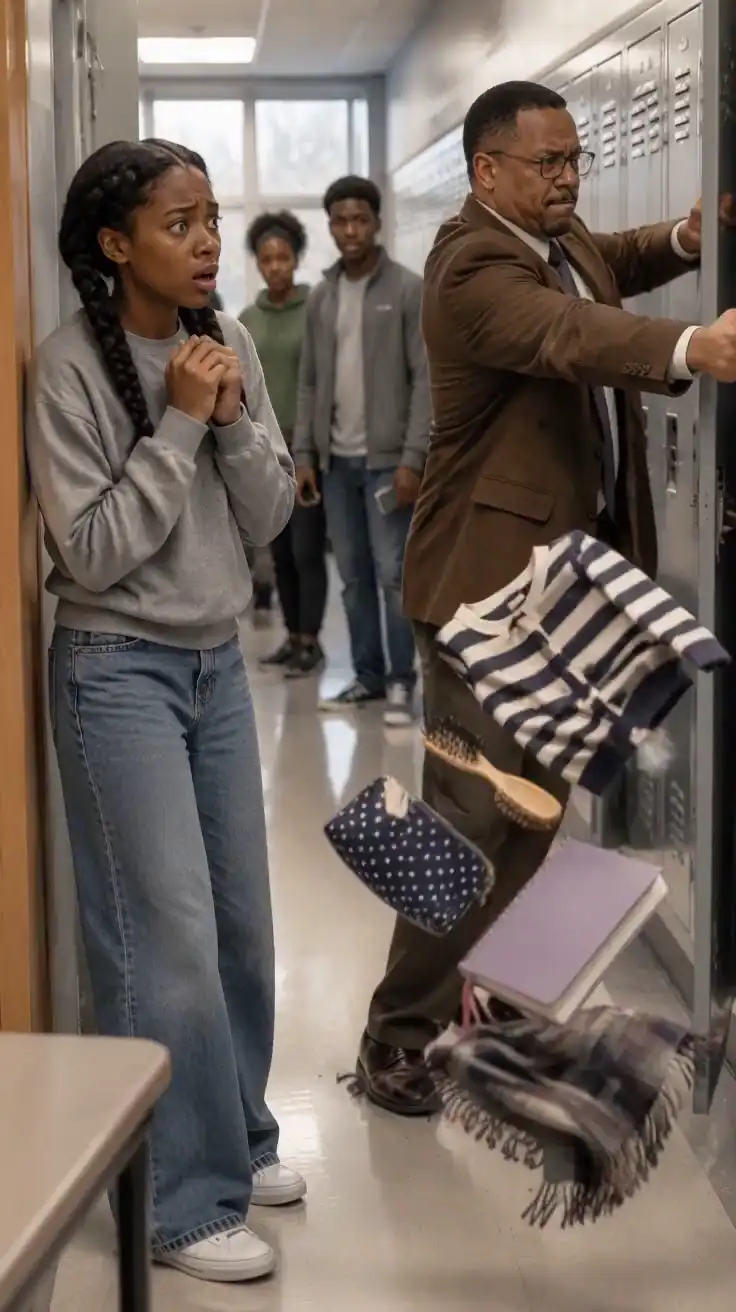
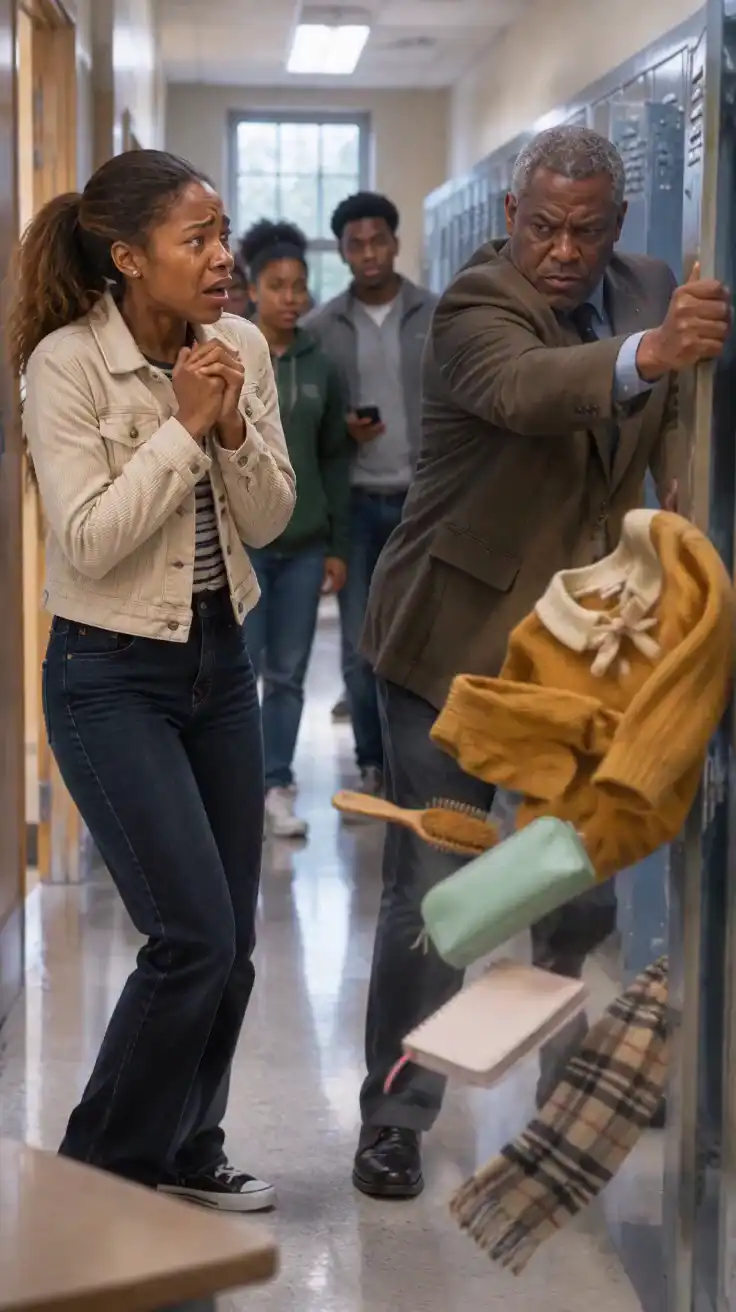
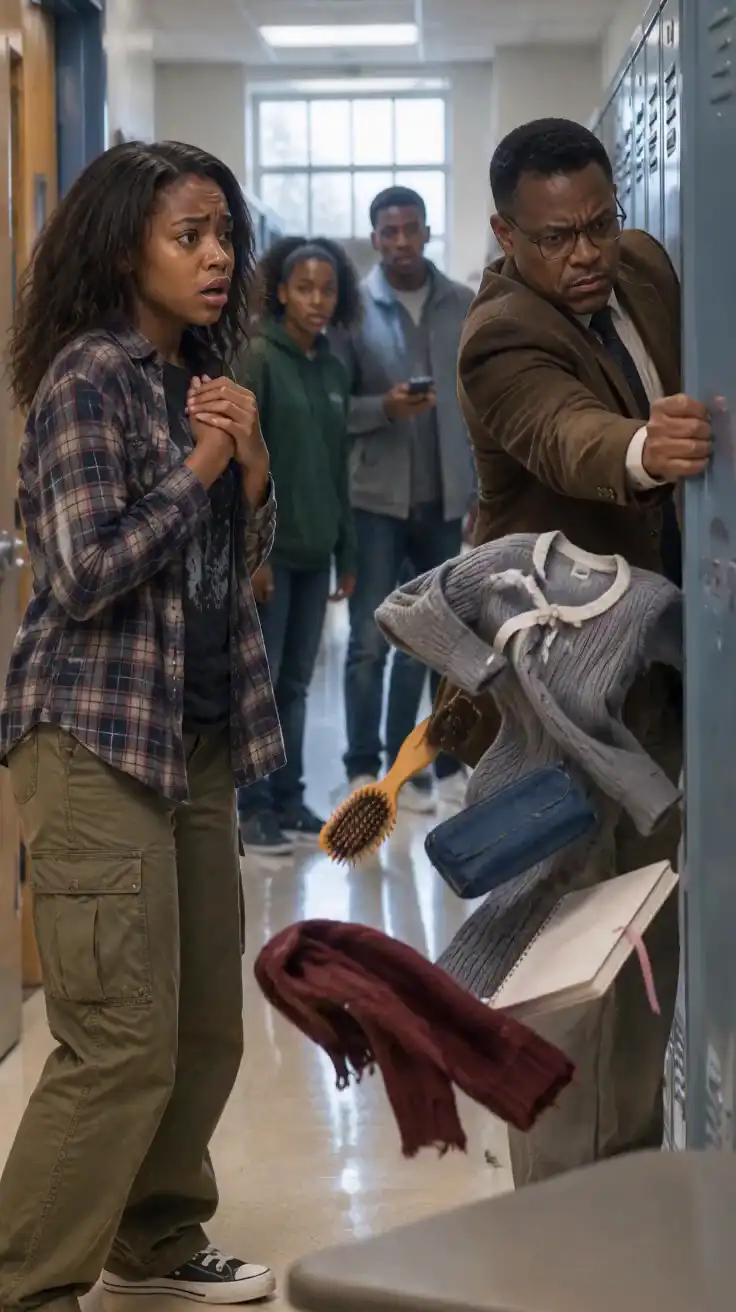
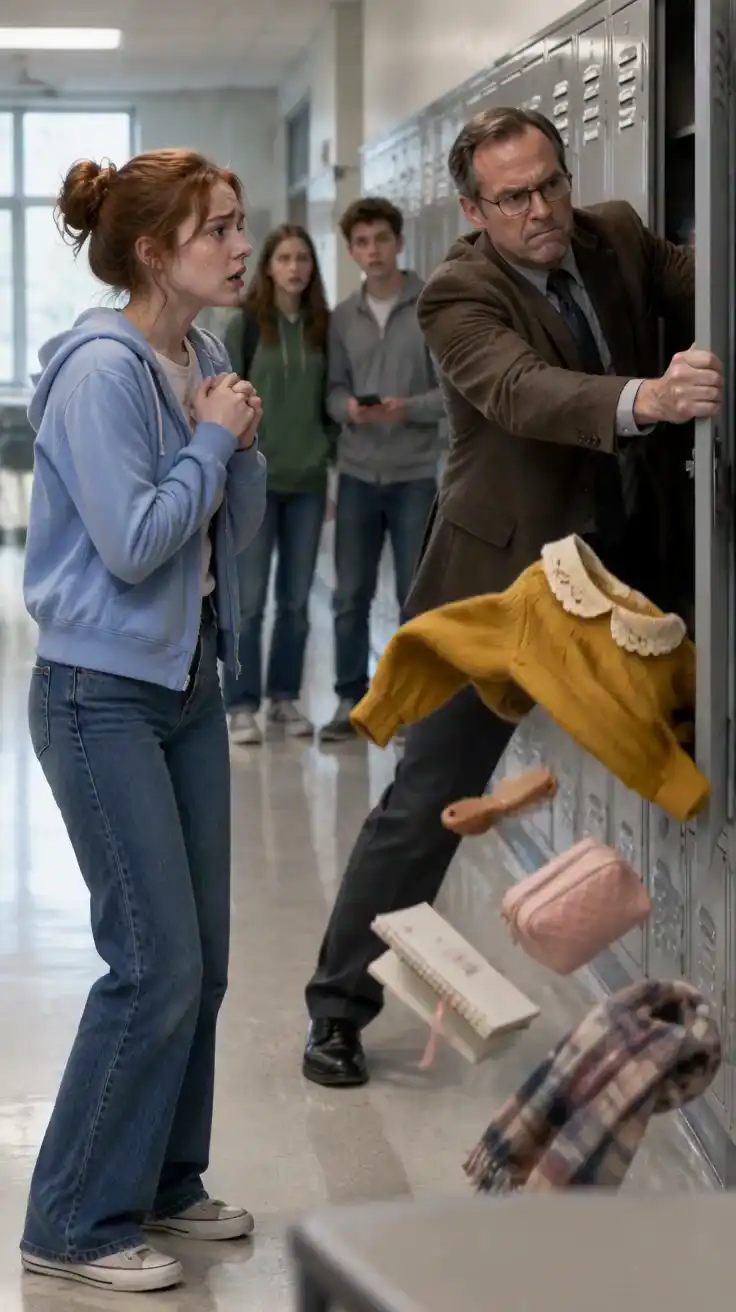
Hannah stood up slowly. The hem of her uniform skirt had gathered dust from the floor. One of her books was open beside the locker, facedown on a page she had been reading during study hall. Her hair-tie pouch had spilled its contents. Little black elastics, two pink clips, and a silver barrette were scattered among the pages of her algebra notebook.
“Where did you find it, Brooke?” Hannah asked again.
The dean turned to her. “Hannah, let me handle this.”
“No,” she said. Her voice was quiet, but it did not tremble. “She said I stole it.”
Brooke started to cry then. Not loudly. Tears slipped down her cheeks, and she wiped at them with the sleeve that had hidden the bracelet.
The dean looked from one girl to the other.
“Brooke,” he said, “we are going to the office.”
“I didn’t mean for this to happen.”
“That is not an answer.”
“I didn’t mean—”
“You told me this morning that you saw the bracelet in Hannah’s locker.”
“I thought I did.”
“You told me you saw it in her backpack.”
“I thought—”
“You told me she admitted she had taken it.”
Brooke shook her head quickly. “I didn’t say she admitted it.”
“You said she told you she was sorry.”
“I said she might have.”
The dean’s face went still. He had the bracelet between two fingers, as if it were something contaminated.
I looked at him. “You searched my daughter’s locker based on this?”
He tried to speak, but no words came out.
Hannah bent down to pick up her books. I reached for them first. My hands were shaking so badly that I dropped the algebra notebook again.
The hallway had gone almost silent. Students were watching from both ends. Some had their phones out. A teacher near the stairwell told them to put them away, but no one moved quickly.
Brooke covered her face.
“I found it under my bed,” she said.
The dean looked at her. “When?”
“Yesterday.”
“Yesterday?”
“I didn’t know what to do.”
I felt something inside me go cold.
Hannah had not slept the night before. She had stood in our kitchen at ten-thirty, still wearing her pajamas, and asked me if I believed she had stolen something. She had not asked if I believed she had stolen the bracelet. She had asked the larger question, the one children ask when a rumor has started swallowing the truth.
“Do you believe them?” she had said.
I had told her no. I had held her face between my hands and told her I knew her.
But the school had believed Brooke enough to search her locker in front of everyone.
And Brooke had known the bracelet was in her own room.
The dean turned to me. “Mrs. Carter, I—”
“Not yet,” I said.
He closed his mouth.
Brooke was crying harder now. “I was going to tell someone.”
“When?” I asked.
Her eyes lifted to mine.
“When?”
“I don’t know.”
“You knew yesterday.”
“I was scared.”
“You were scared of what?”
She looked toward the students in the hallway. “Everyone thought Hannah did it.”
“No,” I said. “Everyone thought it because you told them.”
Brooke flinched as though I had slapped her.
Hannah stood beside me with her books pressed to her chest. I could feel her shoulder against my arm.
The dean took a breath. “We need to go inside.”
“No,” I said. “You need to apologize to her here.”
His expression tightened. “Mrs. Carter, this is not the place to—”
“This is exactly the place.”
He glanced at the students, the teachers, the open office door. “We can discuss this privately.”
“You searched her publicly.”
“That was not my intention.”
“You made her empty her locker in front of half the school. You told her to kneel on the floor. You questioned her while everyone watched. You allowed Brooke to stand here and point at her. If you want to correct what happened, you will do it where it happened.”
The dean’s face turned red.
Hannah whispered, “Mom.”
I looked at her. “You don’t have to ask for an apology.”
“I’m not.”
“I know.”
The dean looked down the hallway. Students were still staring. A few teachers had come closer. Mrs. Alvarez from the attendance office stood near the doorway with one hand over her mouth. Mr. Bell, the assistant principal, had stepped out of the office.
“What is going on?” he asked.
The dean held up the bracelet.
“This was found in Brooke’s possession,” he said.
Mr. Bell looked at Brooke. “Brooke?”
She cried silently.
The dean turned toward Hannah. “Hannah, I am sorry.”
The words were so soft that I almost missed them.
“What?” I said.
He straightened. “I am sorry that I searched your locker in the manner that I did. I am sorry that I allowed you to be questioned and humiliated in the hallway before the facts were established. You did not steal this bracelet.”
The students around us shifted. I could hear the hum of the vending machine and the distant bell signaling the next class.
“Louder,” I said.
His eyes met mine.
“I am sorry,” he said louder, “that I accused you before the facts were established. You did not steal the bracelet. The bracelet was in Brooke’s possession.”
Hannah stared at the floor.
“Tell them what you told everyone,” I said.
The dean looked at the students. “Hannah Carter did not steal Brooke Ellis’s bracelet. The allegation was false, and the school handled the situation improperly.”
That was when Hannah began to cry.
Not the loud crying Brooke had done. Hannah’s tears came without sound. She held her books against her chest and stared down at the tile where the bracelet had fallen.
I put my hand behind her neck and pulled her close.
The dean kept speaking, but I only heard pieces.
“There will be a formal review…”
“We will contact the families…”
“The prom court process will be suspended…”
The words prom court made Hannah pull away from me.
She looked at the dean. “Suspended?”
He nodded. “Until we understand what happened.”
“Tonight is the vote.”
“I know.”
“People are going to say my mom made them cancel it.”
“No one is saying that.”
“They will.”
Brooke wiped her face. “I’m sorry.”
Hannah looked at her.
The two girls stood less than three feet apart, but they seemed farther away from each other than they had ever been.
Brooke took one step forward. “Hannah, I swear, I didn’t mean for them to search you.”
“You told them I stole it.”
“I thought it was gone.”
“You knew it wasn’t.”
“I found it yesterday.”
“Then why did you keep saying it was in my locker?”
Brooke’s lips began to shake.
“I had already told people,” she said.
That answer was so plain that for a moment none of us knew what to do with it.
She had already told people.
Not because she had proof. Not because she had seen Hannah take anything. She had said the words, and then the words had traveled farther than she could control. By the time she found the bracelet under her bed, the rumor had become a story other people believed. Hannah had stolen it. Hannah had lied. Hannah had a history of taking things. Hannah was only pretending to be innocent because she wanted to stay on prom court.
Brooke had created a version of events that gave her a choice between admitting she had been wrong and protecting herself from embarrassment.
She protected herself.
The dean told Brooke to come inside. She did not move.
“I’m sorry,” she said again.
Hannah looked at me. “Can we go home?”
“Yes,” I said.
We left her books on the floor for a moment because neither of us could bear to kneel there again. Mr. Bell gathered them and carried them into the office. I signed something without reading it. The dean said he would call me that afternoon. I told him he could call my husband too.
In the parking lot, Hannah walked so fast I had to hurry to keep up.
She reached the car and stood beside the passenger door without opening it.
“Do you want me to drive?” I asked.
She shook her head.
“Do you want to sit for a minute?”
She nodded.
We got inside. The school windows reflected the morning sun, and students moved behind the glass like people in an aquarium. Hannah kept her hands folded in her lap.
After a few minutes, she said, “She knew.”
“I know.”
“She knew yesterday.”
“I know.”
“She could have stopped it.”
“Yes.”
Hannah looked out the window. “Why didn’t she?”
I did not want to give her a simple answer. I did not want to say Brooke was jealous, or cruel, or evil. None of those words would explain why someone who had once slept on our living room floor during a snowstorm could stand in a hallway and point at my daughter.
“She was afraid of admitting she had been wrong,” I said.
“That’s it?”
“No. That’s part of it.”
“She was afraid people would think she lied.”
“She did lie.”
“I know.”
“She was afraid of the consequences of telling the truth after she had lied.”
Hannah looked at me. “So she let me take the consequences instead.”
I put my hand over hers. “Yes.”
She pulled her hand away.
I did not blame her.
We drove home in silence. At a red light, she said, “I don’t want to go to prom.”
“You don’t have to.”
“I don’t want to be on court.”
“You don’t have to be.”
“They’ll say I’m quitting because I’m guilty.”
“They can say whatever they want.”
“That doesn’t make it not matter.”
“No,” I said. “It doesn’t.”
When we got home, Hannah went upstairs. She did not change clothes. She did not eat lunch. I sat at the kitchen table and waited for my husband, Daniel, to come home.
He called twenty minutes later.
“I’m on my way,” he said.
“I need you to drive carefully.”
“What happened?”
“I’ll tell you when you get here.”
“Is Hannah okay?”
“She’s home.”
That was enough to make him hang up.
While I waited, my phone began to ring. The first call was from the dean. I let it go to voicemail. The second was from Brooke’s mother, Karen Ellis. I did not answer that one either.
The third was from the pastor.
I answered.
“Mrs. Carter,” Pastor Reed said, “I heard there was an incident at the school.”
“There was.”
“I wanted to check on Hannah.”
“She is upstairs.”
“I’m very sorry.”
“So am I.”
He paused. “Karen told me Brooke made a mistake.”
“A mistake is forgetting a homework assignment.”
“I understand.”
“No, I don’t think you do.”
“I’m trying to.”
“Brooke accused Hannah of stealing. She told students, teachers, and the school administration that Hannah had taken the bracelet. She knew yesterday that the bracelet was in her room. She let my daughter be searched anyway.”
“I know.”
“Do you?”
“I’m not defending her.”
“Then what are you calling to say?”
He took a breath. “I’m calling to say that the church will not tolerate this kind of behavior.”
I looked toward the stairs. “It happened in the church too.”
“What do you mean?”
“The rumor started at youth group. It was repeated at Sunday school. Girls came up to Hannah and asked what she had done. One of them told her that maybe she should apologize to Brooke before the vote.”
Pastor Reed was quiet.
“We have been telling these girls that church is a family,” I said. “That means something when a child is hurting. It cannot only mean we sit together on Sunday and smile for pictures.”
“You’re right.”
“I don’t want Hannah pulled into a meeting where adults tell her to forgive before anyone asks Brooke to take responsibility.”
“I would never ask that of her.”
“You may not. Someone will.”
He did not deny it.
Daniel came through the front door while I was still on the phone. He looked at me, then at the stairs.
“I have to go,” I told Pastor Reed.
“I’ll come by this evening, if that’s all right.”
“I’ll let you know.”
I hung up.
Daniel put his keys on the counter. “Tell me.”
I did.
I watched his face change as I described the locker, the hallway, Brooke’s pointing finger, the bracelet falling from her sleeve, and the apology.
When I finished, he asked, “Where is Brooke now?”
“At school, I assume.”
“Did they send her home?”
“I don’t know.”
“Did anyone call us before they searched Hannah?”
“No.”
He stared at the floor.
Daniel was not a man who raised his voice easily. He could be angry without showing it, which sometimes frightened me more than shouting would have.
“What does Hannah need?” he asked.
“She says she doesn’t want to go back.”
“We’ll keep her home.”
“Her exams are next week.”
“Then we’ll deal with that.”
“And the prom vote is tonight.”
“She doesn’t have to attend.”
“I know.”
“Do you?”
I looked at him.
He shook his head. “Sorry. That came out wrong.”
“It’s all right.”
“No, it isn’t.”
He went upstairs. I heard him knock on Hannah’s door.
“Can I come in?” he asked.
There was a long pause.
“Okay.”
I sat at the kitchen table and listened to the muffled sound of their voices. A few minutes later, Hannah came down wearing an oversized sweatshirt. Her eyes were red.
Daniel followed her.
“I told Dad I don’t want to go to prom,” she said.
“You don’t have to,” he said.
“What if I don’t go and they say I’m embarrassed?”
“People are going to say things no matter what you do,” he told her. “Your job is not to manage their mouths.”
She gave a humorless laugh. “That’s easy for you to say.”
“No, it isn’t.”
She looked at him.
“I work with people who talk about everyone,” he said. “I know what it feels like. But I also know that if you make every decision based on what the worst person might say, the worst person gets to run your life.”
Hannah sat at the table.
“I don’t know if I can stand in front of everyone,” she said.
“You don’t have to decide today.”
“They already made me stand in front of everyone.”
That was the sentence that stayed with me.
Not the accusation. Not even the bracelet.
They had made her stand in front of everyone.
The school sent an email to families by three o’clock. It did not name Brooke or Hannah, but no one needed names.
“Due to an ongoing student conduct matter,” it said, “tonight’s prom court vote has been postponed until further notice.”
By four, my phone was full of messages.
Some people wrote to apologize. Some wrote to tell me what they had heard. Some wanted to explain that their daughters had only repeated the rumor because they thought it was true.
One mother wrote, “I’m sure this has been hard for your family, but Brooke was very upset about the bracelet.”
I stared at that sentence for a long time.
Then I deleted it.
The girls had created a group chat called Prom Court. Hannah had been in it since nominations were announced. That afternoon, someone added a message.
“Can everyone stop making this about the bracelet?”
Another student replied, “It was already handled.”
A third wrote, “Brooke said she found it in her own room, so I don’t know why people are acting like she planned it.”
Hannah showed me the messages.
“She didn’t plan it,” she said.
“She put it in her sleeve.”
“She didn’t plan for it to fall out.”
“No,” I said. “But she planned to bring it into that hallway.”
Hannah looked down at the phone. “She was going to put it in my locker.”
The thought had occurred to me, but I had not said it aloud.
The dean later confirmed that Brooke had told him the bracelet might be inside Hannah’s locker. She had offered to identify it if they found it. She had asked to be present during the search.
That detail made my hands go numb.
Brooke had not merely allowed the accusation to continue. She had positioned herself to witness the proof she intended to create.
The bracelet had been found under her bed the afternoon before. Brooke told the school she had discovered it inside a sweatshirt box. Her mother later told me it was actually tangled in the lining of an old cardigan, but Brooke had kept that cardigan in a storage bin under her bed for weeks. Either way, she knew it was not missing.
She had taken it from the box, put it in her sleeve that morning, and gone to school with the intention of placing it somewhere Hannah would be blamed for having it.
That was what Brooke eventually admitted.
Not all at once.
At first she said she had only wanted to “show the dean.” Then she said she had wanted to “make Hannah tell the truth.” Then she said she had not known what she was going to do.
Finally, during a meeting with the school counselor, she said, “I was going to put it in the side pocket of her backpack.”
Hannah was not in that meeting. I was grateful for that.
The original accusation had started four days earlier, on a Tuesday afternoon after youth group.
Brooke had worn the bracelet that night. It had belonged to her grandmother, who had died the previous summer. The bracelet was a delicate gold chain with a small oval charm. Brooke had shown it to Hannah in the church bathroom because the clasp kept opening.
Hannah had helped fasten it.
“I wish I had one like this,” Hannah had said.
Brooke told her she could try it on.
That was the last moment anyone could point to and say Hannah had touched the bracelet.
They had gone back into the youth room. They had played a game involving index cards and candy. They had helped clean up afterward. Brooke had gone home wearing a cardigan over her shirt.
The next morning, she could not find the bracelet.
She searched the bathroom, her backpack, and the top drawer of her dresser. She called Hannah before school.
“Did I leave my bracelet at your house?” Brooke asked.
“I don’t think so,” Hannah said.
“Can you check?”
“Sure.”
Hannah checked the couch cushions, the bathroom counter, the entryway table, and the laundry room. She did not find it.
At lunch, Brooke told two girls that Hannah had been the last person to touch it.
One of those girls told another girl during gym.
By Wednesday morning, the story was that Hannah had asked to wear the bracelet and then refused to give it back.
By Wednesday afternoon, Brooke had told someone that Hannah had said, “Finders keepers.”
Hannah had never said that.
On Thursday, Brooke told the dean that Hannah had stolen it.
The dean called Hannah out of class and asked whether she knew where it was.
“No,” she said.
“Brooke says you were the last person to handle it.”
“I helped her fasten it.”
“Did you take it?”
“No.”
“Are you sure?”
Hannah came home and told me about that conversation. She was confused more than upset.
“Why would he ask me if I took it?” she said.
“Because Brooke told him it was missing.”
“I told him I didn’t have it.”
“Did he believe you?”
Hannah had shrugged.
That evening, Brooke’s mother called me. Karen sounded uncomfortable.
“Brooke is very upset,” she said.
“I’m sorry the bracelet is missing.”
“She thinks Hannah may have taken it by accident.”
“Hannah says she didn’t.”
“I’m not accusing her.”
“You just said she may have taken it.”
“I’m trying to understand.”
“So am I.”
Karen sighed. “Could you ask Hannah to look again?”
“I already did.”
“Maybe she put it somewhere and forgot.”
“I know my daughter.”
“I know.”
That sentence had seemed harmless at the time. We had both said it. We had both been mothers trying to protect our children.
The next day, Brooke told the school that Hannah had stolen from her before.
When I heard that, I called the dean.
“Has Hannah been accused of stealing other things?” I asked.
“She has not had a formal disciplinary report,” he said.
“Then why is this being discussed as if she has a history?”
“I can’t discuss other students.”
“You are discussing my daughter.”
“I’m gathering information.”
“From whom?”
“I can’t disclose that.”
By then, the rumor had grown beyond the bracelet.
A pencil case had supposedly gone missing from a locker last year. A pair of earrings had disappeared at a sleepover. Someone’s cash had been short after a church fundraiser.
None of those things had anything to do with Hannah. Two of them had not even happened. But when people want a pattern, they build one out of unrelated pieces.
Brooke had supplied the first piece.
She had been afraid that if she admitted the bracelet was under her bed, everyone would ask why she had accused Hannah. So she gave them another reason to believe her.
She told them Hannah had always been jealous of her.
That part was not entirely invented.
The girls had been close, but they had not been equal in Brooke’s mind. Brooke was outgoing, polished, and comfortable in front of a crowd. She had been elected student council secretary and led worship twice at church. Hannah was quieter. She did well in school, played clarinet, and preferred sitting at the edge of things until she understood the room.
When they were younger, Brooke spoke for both of them.
When they got older, Hannah began making friends outside the friendship.
She joined the library committee instead of student council. She started spending lunch with a group from band. She was nominated for prom court after a teacher encouraged several students to put her name forward.
Brooke had expected to be nominated. She had not expected Hannah to be nominated too.
The first time they discussed it, they were sitting in the church parking lot after youth group.
“You’re really on the ballot,” Brooke said.
Hannah laughed. “Apparently.”
“Who nominated you?”
“I don’t know.”
“You must know.”
“I don’t.”
Brooke looked at the printed list on her phone. “It’s weird.”
“What is?”
“You’ve never cared about that stuff.”
“I didn’t say I cared.”
“You’re going to vote for me, right?”
Hannah smiled. “You know I am.”
“That’s not what I asked.”
“I’ll vote for you.”
Brooke had stared at her.
“What?”
“Nothing.”
But it was not nothing.
The vote was scheduled for Friday night during the basketball game. Students would choose two girls and two boys from the court nominees. The winners would be announced at halftime. Hannah had tried to act as if it did not matter, but she had spent twenty minutes choosing between two dresses and had asked me whether a blue one made her look washed out.
Brooke wanted to win. She had told everyone she wanted to win.
Hannah had not campaigned. That made people like her. It also made Brooke nervous.
By Thursday, Brooke had begun telling friends that Hannah was only nominated because teachers felt sorry for her.
By Friday morning, the bracelet accusation had become a way to remove Hannah from consideration without making it look like a competition.
If Hannah was a thief, no one would vote for her.
That was what Brooke had placed at stake. Not only Hannah’s reputation, but the one public moment of their senior year that both girls had been allowed to want.
When Karen Ellis arrived at our house that evening, she came alone. She stood on the porch with both hands clasped in front of her.
I almost did not open the door.
Daniel was in the living room with Hannah. He came to stand behind me.
Karen’s eyes were swollen.
“I need to apologize,” she said.
I stepped outside and closed the door behind me.
“Is Brooke with you?”
“She’s in the car.”
“Why?”
“She wanted to come.”
“Does she know what she’s apologizing for?”
Karen looked down.
“That matters,” I said.
“She knows she lied.”
“Does she know she tried to plant the bracelet?”
Karen’s face crumpled.
“She told us everything,” she said.
“Everything?”
“She told her father and me. She said she took it from the storage box and put it in her sleeve.”
“Why did she say she was going to do that?”
“She said she didn’t know.”
“Karen.”
“She said she wanted people to believe her.”
I looked past her toward the driveway. Brooke sat in the back seat of their SUV, her head bowed.
“Did you know the bracelet was found yesterday?”
Karen shook her head. “She told me this morning that she still couldn’t find it.”
“Why?”
“I don’t know.”
“You didn’t see it?”
“No.”
“Did she tell you she had accused Hannah?”
“She told me she thought Hannah had it.”
“That isn’t what I asked.”
Karen closed her eyes. “She said Hannah had been the last person to touch it. I thought she was telling me the truth.”
“I know.”
“I should have called you. I should have asked more questions.”
“Yes.”
She accepted that without defending herself.
“Can Brooke come in?” she asked.
“No.”
Karen nodded.
“Not tonight,” I said. “Hannah cannot be expected to receive an apology in our living room because Brooke’s family is ready to give one.”
“I understand.”
“I don’t know if you do.”
“I’m trying to.”
“That is what the pastor said.”
She looked at me. “I’m sorry.”
“Your daughter hurt mine.”
“I know.”
“She did not just make a mistake. She made a choice every day after she knew the bracelet was in her room.”
Karen began to cry. “I know.”
“And the school failed her too.”
“Yes.”
“And I don’t know what happens next.”
“Neither do I.”
For the first time, she looked like a mother who had lost control of the person she thought she understood.
“I kept telling myself Brooke was just scared,” she said. “Then I realized she was scared because she knew what she was doing.”
I did not answer.
Karen wiped her face. “She says Hannah hates her.”
“Hannah does not hate her.”
“She says she deserves that.”
“Hannah is allowed to feel whatever she feels.”
“I know.”
“Please stop saying you know.”
Karen nodded. “All right.”
We stood there in the cold until the porch light attracted moths.
Finally, I said, “You need to take her home.”
Karen looked toward the SUV. “She wants to talk to Hannah.”
“Hannah is not ready.”
“I’ll tell her.”
“She may not be ready for a long time.”
“I understand.”
I almost corrected her again, but I did not.
After they left, I went inside. Hannah was sitting on the floor beside the coffee table, holding the old church photo album.
She had opened it to a picture from the summer mission trip when the girls were fourteen. Brooke and Hannah stood together in front of a wooden sign that said WELCOME TO CAMP GRACE. Both of them had wet hair from the lake. Brooke’s arm was around Hannah’s shoulders.
“We were happy,” Hannah said.
“You were.”
“Was it real?”
I sat beside her.
“Yes.”
“Then how can it end like this?”
“Sometimes something can be real and still not be safe anymore.”
She turned the page.
There they were in matching costumes at a church Halloween party. There they were holding paper plates at the fall festival. There they were in our kitchen, flour on their cheeks, making cookies for the youth group.
Hannah traced a picture with one finger.
“I knew she liked being better at things than me,” she said.
“Did you?”
“I knew she liked when people chose her.”
“That doesn’t mean you expected this.”
“She was angry when I got nominated.”
“What did she say?”
“She said it was weird.”
“That wasn’t kind.”
“I thought she was joking.”
Hannah closed the album.
“Did you ever notice?” she asked.
“Notice what?”
“That she only wanted me around when I made her look good.”
I thought about it.
There had been times Brooke came to our house after an argument with another friend and wanted Hannah to take her side. There had been times she had ignored Hannah at church when more popular girls were nearby. There had been times Hannah came home quiet and said Brooke had made a joke at her expense.
I had noticed pieces. I had not assembled them.
“I noticed some things,” I said. “I did not understand all of them.”
“Neither did I.”
“You were growing up.”
“So was she.”
“Yes.”
Hannah leaned her head against the couch.
“I don’t want to forgive her,” she said.
“You don’t have to.”
“Pastor Reed will say forgiveness is part of healing.”
“Pastor Reed can be wrong.”
She looked at me with surprise.
“Adults in churches sometimes confuse forgiveness with access,” I said. “Forgiving someone does not mean you have to sit beside them, trust them, or let them tell you when you’re done being hurt.”
Hannah took that in.
“Can I forgive her later?”
“You can forgive her never if that is what you honestly feel.”
“Is that allowed?”
“I don’t know if it’s allowed. I know it’s honest.”
The school’s formal meeting took place the following Monday. Daniel and I sat on one side of a conference table. The principal, Mr. Bell, the dean, the school counselor, and the superintendent’s assistant sat across from us.
Hannah did not come.
Brooke’s parents sat beside us, not across the room. Karen had asked if she could sit near us, and I had said yes because I did not want the meeting turned into a courtroom with two opposing families.
The dean began with an apology.
He said he had relied too heavily on Brooke’s statements. He said the school had failed to separate an allegation from evidence. He said a locker search should not have been conducted in the hallway, and that Hannah should not have been required to kneel while the investigation was ongoing.
I listened.
When he finished, I said, “You also allowed the accusation to become public before you had verified anything.”
“Yes.”
“You told students she was being questioned about a missing item.”
“Yes.”
“You did not call us.”
“That was an error.”
“You asked her if she was sure she hadn’t taken it.”
He looked down. “Yes.”
“That is not an investigation. That is pressure.”
“I understand that now.”
“No,” I said. “You understand that because the bracelet fell out of Brooke’s sleeve. If it had not, my daughter would still be the girl who stole it.”
No one answered.
The superintendent’s assistant took notes.
“We will be issuing a written correction to the student body,” she said.
“Will you name Hannah?”
“With your permission.”
“Yes.”
Daniel looked at me, but I had decided.
“If you correct the rumor without naming her, people will fill in the blank. They will say the school found no proof, not that she was innocent. Say clearly that she did not steal the bracelet.”
They agreed.
We also asked for the school to investigate the way the rumor had spread and to address the students who had repeated it. Not with a general lecture about kindness. We wanted the school to explain that repeating an accusation could cause harm even when the person repeating it had not started it.
Brooke received a suspension. The school did not tell us how long. She was removed from the prom court ballot. Hannah’s name was restored when the vote was rescheduled.
The principal asked whether Hannah wanted to remain on the ballot.
I told him that decision belonged to her.
For three days, she said no.
Then, on Thursday night, she came downstairs while I was folding laundry.
“I want to stay on it,” she said.
I stopped folding.
“Are you sure?”
“No.”
“That’s not the same thing.”
“I don’t want Brooke to be the reason I quit.”
“That’s a good reason not to quit. Is there another reason?”
She thought about it.
“I want to know if people would vote for me when they know the truth.”
“That might not be possible to know.”
“I know.”
“You don’t owe anyone a performance.”
“I know.”
“You don’t have to prove you’re not ashamed.”
“I know.”
She looked at the laundry basket.
“I still want to go to prom,” she said.
“Then you should go.”
“I don’t know who I’ll go with.”
“You don’t have to go with anyone.”
“I know.”
She sat beside me.
“I keep saying I know,” she said.
“It’s a useful phrase.”
She smiled for the first time since the hallway.
The vote was rescheduled for the following Friday.
The school held it during lunch in the gym. Hannah did not campaign. She did not post anything online. She went to class, played in the band concert that evening, and tried to live as if the week had not changed her.
Brooke did not return to school until the next Monday.
When she did, the hallway went silent around her.
That was one of the consequences no adult could control. Students who had once crowded around her now watched from a distance. Some were angry because they had believed her. Some were embarrassed because they had repeated the story. A few were angry at Hannah for making them feel guilty.
Brooke’s family had begun attending a different church by then.
Pastor Reed told us they had requested privacy. He said Brooke was meeting with a counselor. Karen sent me one letter. It was four pages long, handwritten.
She wrote that she had failed to ask basic questions. She wrote that she had wanted to believe her daughter because believing her felt like loving her. She wrote that she understood now that love without accountability could become another form of harm.
She did not ask me to forgive her.
That mattered.
I did not answer right away. I kept the letter in a drawer for nearly a month.
Brooke also wrote Hannah a letter. She gave it to the counselor, who asked whether Hannah wanted to read it. Hannah said no. Then she changed her mind. Then she read it two weeks later while sitting at the kitchen table.
The letter began, “I don’t expect you to answer.”
Brooke admitted she had found the bracelet under her bed. She admitted she had put it in her sleeve. She said she had planned to put it in Hannah’s backpack because she believed that if people saw it there, they would stop questioning Brooke.
She wrote, “I kept telling myself I was only proving what I already knew. But I didn’t know it. I wanted it to be true because I was angry you were nominated.”
Hannah read the letter twice.
“What do you think?” I asked.
“She told the truth.”
“That’s something.”
“It doesn’t fix it.”
“No.”
“She says she misses me.”
“Do you miss her?”
Hannah folded the letter.
“Yes,” she said. “I miss who I thought she was.”
That was the clearest answer she ever gave me.
The prom vote took place on a Friday afternoon. The school had made the gym available, and every student received a paper ballot. Hannah went in alone. Daniel and I waited in the car because she had asked us not to stand near the doors.
She came out twenty minutes later.
“Well?” I asked.
“They’ll announce it tonight.”
“How was it?”
“Quiet.”
“Did anyone say anything?”
“Two girls apologized.”
“Did you want them to?”
“I didn’t know I wanted it until they did.”
She got into the car and stared out the window.
“Did you vote for yourself?” Daniel asked from the driver’s seat.
“No.”
“Why not?”
“It felt strange.”
“You were allowed,” he said.
“I voted for Mia and me.”
Daniel smiled. “That’s a good answer.”
At halftime that evening, Hannah stood with the other nominees on the basketball court.
I watched from the bleachers beside Daniel. The gym smelled like popcorn, floor polish, and the perfume of hundreds of teenagers. The band played a short fanfare. The principal opened the envelope.
The first name was Hannah Carter.
I pressed both hands to my mouth.
The second girl was Mia Alvarez, one of Hannah’s friends from band.
The boys chosen were two students from the soccer team.
Hannah looked stunned. Mia grabbed her hand. The crowd applauded, but the sound was uneven at first. Then it grew.
I did not look for Brooke.
I knew she was not there.
Hannah received the small silver crown and stood beneath the bright lights while someone took pictures. She smiled, but it was not the same smile she had worn in the old photographs with Brooke. It was steadier. More careful.
Afterward, she came into the bleachers and sat between us.
“I thought I was going to throw up,” she said.
“You looked beautiful.”
“I almost walked off.”
“But you didn’t.”
“No.”
“Are you glad?”
She considered that.
“I’m glad I got to choose.”
That was enough.
The longer aftermath did not end with the vote.
People still brought it up. Sometimes they used careful language.
“After what happened with Brooke…”
Sometimes they used it as gossip.
“Wasn’t that the girl whose friend planted the bracelet?”
Sometimes they tried to make it inspirational.
“You handled that with such grace.”
Hannah hated that most of all.
“I didn’t handle it with grace,” she told me once. “I cried in the bathroom and threw my hairbrush at the wall.”
“Grace is not the absence of throwing hairbrushes.”
“I yelled at Dad.”
“You did.”
“I said I hated school.”
“You did.”
“I wanted everyone to feel as bad as I felt.”
“That is not unusual.”
She looked at me. “You don’t think I’m a bad person?”
“No.”
“Even when I wanted Brooke to lose everything?”
“Wanting someone to face consequences is not the same as wanting them destroyed.”
“What if it was?”
“Then we would talk about it.”
That was how the weeks went. We talked about it when she wanted to. We did not talk about it when she did not.
She stopped going to youth group for the rest of the year. Pastor Reed continued to send messages, but he did not pressure her. When the church held its spring fundraiser, he asked whether she wanted to participate. She said no.
Daniel and I went without her.
A few people approached us and apologized. One woman cried and said she had told her daughter that Hannah was probably guilty because “girls like that often hide things.”
I asked what she meant by girls like that.
She had no answer.
That conversation stayed with me. The rumor had found a place to live because people were willing to make a certain kind of child believable as guilty. Hannah was quiet. She was not popular in the obvious way. She did not defend herself loudly. She wore thrift-store sweaters and sometimes forgot to put her phone away in church. She was easy to turn into a story because people had already decided what someone like her might do.
We were a white family in a town that liked to think knowing one another meant understanding one another. But familiarity was not the same as fairness. People could sit beside you every Sunday and still reach for the worst explanation when someone offered it.
Brooke’s family moved that summer.
Karen told me in a final phone call. They were relocating two counties away because her husband had accepted a new job. She said the move was not only because of the school. Brooke needed distance, and they wanted to give her a chance to start again somewhere no one knew the story.
I asked how Brooke was doing.
“She’s in counseling,” Karen said. “She still feels ashamed.”
“I imagine she does.”
“She wants to apologize in person.”
“I don’t think Hannah wants that.”
“I know.”
“You’re learning not to push.”
“I am.”
There was a pause.
“Karen,” I said, “I hope you don’t teach her that starting over means leaving the consequences behind.”
“I don’t.”
“I hope she understands that the people she hurt don’t owe her relief from her guilt.”
“She’s beginning to.”
“Good.”
“I’m sorry,” Karen said.
This time, I believed she understood what she was apologizing for.
Hannah did eventually answer Brooke’s letter. She did not write a forgiveness letter. She did not tell Brooke everything was okay.
She wrote, “I hope you become someone who tells the truth before it is convenient.”
Then she added, “I hope you stop thinking being chosen is the same as being loved.”
She asked me whether it was too cruel.
I told her it was honest.
Brooke wrote back. Hannah did not show me that letter.
By the end of summer, the bracelet had been returned to Brooke’s family. The school had photographed it as part of the investigation and then placed it in an envelope for Karen. Hannah did not want to touch it.
One afternoon, I found her standing by the kitchen sink, looking at the envelope on the counter.
“Do you want me to mail it?” I asked.
“No.”
“Do you want me to throw it away?”
“No.”
“What do you want to do?”
She picked up the envelope and turned it over.
“I want it to stop being important.”
“I don’t know if you can make that happen.”
“I know.”
She carried it outside. I followed her to the trash bin.
She did not throw it away. She placed it on top of the lid.
“What are you doing?” I asked.
“Leaving it here.”
“For who?”
“I don’t know.”
The next morning, it was gone. Either the garbage truck had taken it or someone from the Ellis family had come for it. I never learned which.
Hannah went to college that fall in another state. She did not attend the same church. She joined a campus ministry but told me she chose it because no one there knew about the bracelet.
When she came home at Thanksgiving, she brought a new friend with her. Her name was Rachel. They had met in a literature class. Rachel knew the whole story because Hannah had told her.
I watched them sit at our kitchen table, laughing over a burnt pie.
At one point, Rachel asked, “Do you still talk to Brooke?”
Hannah shook her head.
“Do you think you ever will?”
“I don’t know.”
“Would you want to?”
Hannah looked toward the window.
“I want the story to belong to the past,” she said. “That’s different from wanting her back.”
Rachel nodded.
I had learned not to offer an opinion unless Hannah asked for one.
After Rachel went upstairs, Hannah stayed in the kitchen with me.
“Do you think I’m still angry?” she asked.
“Yes.”
“Is that bad?”
“No.”
“Do you think Brooke is sorry?”
“Yes.”
“Does that matter?”
“It matters to who she becomes. It does not erase what happened to you.”
Hannah ran her finger along the rim of her mug.
“I used to think if she apologized, I would feel better.”
“And now?”
“Now I think I wanted her apology because I thought it would give me back the week before.”
I looked at her.
“The week before the bracelet,” she said. “When we were still friends. When I didn’t know she could do that.”
“You can’t get that week back.”
“I know.”
This time, the words did not sound like surrender. They sounded like recognition.
The school changed some procedures after the incident. Parents were to be contacted before searches unless there was an immediate safety concern. Students could not be questioned in public areas about alleged misconduct. The dean completed a training program and sent Hannah a separate letter acknowledging that his apology in the hallway had been necessary but late.
I kept that letter too.
Not because I wanted to punish him. Because I wanted a record of what had happened.
The dean remained at the school. Some people thought he should have been fired. Others said he had made one bad decision. I did not know what the correct answer was.
I knew one thing: adults liked to describe harm as a bad decision when the harm happened to someone else.
The dean later asked whether I would speak at a staff training session about the incident. I said no.
Not because I had nothing to say. Because I did not want Hannah’s worst week turned into a lesson people could consume and then congratulate themselves for learning.
I told him that if he wanted to improve the school, he should start by believing that humiliation was not an acceptable investigative tool.
He said he would.
I hope he did.
The following spring, Hannah came home from college and found an old box in the attic. Inside were the church photographs, the mission trip programs, and a stack of notes from youth group.
She sat on the floor and read them for an hour.
Then she brought the box downstairs.
“Do you want to keep these?” I asked.
“Some.”
“What about the pictures of Brooke?”
She separated them into two piles.
“These I’m keeping,” she said.
“And these?”
“I don’t want them.”
She was not tearing them up. She was not burning them. She was simply making a decision about what belonged in her life now.
One photograph showed the two girls at thirteen, standing beneath the church Christmas tree. Brooke was holding a paper angel. Hannah was laughing at something outside the frame.
Hannah studied it for a long time.
“She was my best friend,” she said.
“Yes.”
“And she hurt me.”
“Yes.”
“Both are true.”
“Yes.”
She put the photograph in the pile she was keeping.
That was the closest thing to forgiveness I ever saw. Not an absolution. Not an invitation back in. Just the refusal to erase the truth in either direction.
Years later, people in town still remembered the bracelet. Stories linger in small places because they give everyone a role. The dean was the man who apologized. Brooke was the girl who lied. Hannah was the innocent girl who won prom court. I was the mother who made the school correct itself.
But real life had been messier than those roles.
Hannah had been innocent, but she had not always been calm. Brooke had lied, but she had not been born cruel. The dean had failed, but he had eventually admitted it. The students who repeated the rumor were not all malicious, though some had enjoyed having someone to talk about.
Knowing that did not make the harm smaller.
It only made the story harder to finish.
The last time I heard from Brooke, she was twenty-one. She sent Hannah a message through an old email account.
“I have thought about the hallway every week since it happened,” she wrote. “I used to think the worst part was that everyone found out I lied. Now I understand the worst part was that you were on the floor while I was standing there, and I still let it continue.”
Hannah showed me the message.
“Do you want to answer?” I asked.
She looked at the screen.
“No.”
“Then don’t.”
“Is that cruel?”
“No.”
She closed the laptop.
“I used to think not answering meant I was punishing her.”
“Maybe it means you’re protecting your peace.”
She smiled faintly. “That sounds like something Pastor Reed would say.”
“It does.”
“Except he would tell me to answer.”
“Then I withdraw the phrase.”
She laughed.
That night, we made dinner together. She chopped vegetables while I stirred soup. The kitchen filled with the smell of garlic and onions, and for a while we talked about ordinary things.
Her classes. Daniel’s knee. The neighbor’s new dog.
Before she went upstairs, she hugged me.
“I’m glad you made him apologize,” she said.
“The dean?”
“Yeah.”
“I was angry.”
“You were right to be.”
I held her a little tighter.
“I’m sorry I couldn’t stop it before it happened.”
She pulled back and looked at me.
“You didn’t put the bracelet in her sleeve.”
“No.”
“You didn’t start the rumor.”
“No.”
“You didn’t search my locker.”
“No.”
“Then stop apologizing for all of it.”
I wanted to tell her that mothers apologize for what they cannot prevent. We apologize for the illness, the betrayal, the lonely lunch table, the teacher who does not listen. We apologize because standing beside a child in pain can make helplessness feel like guilt.
Instead, I said, “I’ll try.”
She nodded.
That was all we could promise each other.
I still remember the sound the bracelet made when it hit the tile.
It was a tiny sound. Barely more than a bright little tap beneath the fluorescent lights.
But it divided our lives into before and after.
Before, Brooke was the girl who had grown up with my daughter. Before, the school was a place where I believed adults would ask questions before making accusations. Before, church was where our children learned to trust one another.
After, Hannah learned that friendship did not protect anyone from jealousy. I learned that familiar faces could choose convenience over truth. The school learned that a public search could wound someone even when nothing was found.
And Brooke, I hope, learned that a rumor does not remain harmless just because the person who starts it is afraid.
She had found the bracelet under her bed and could have ended everything with one sentence.
“I was wrong.”
Instead, she hid it in her sleeve.
She carried it into the hallway because by then the rumor had become larger than her courage. She believed that if she let the lie become evidence, she could escape the shame of having told it.
But lies do not disappear when they become complicated. They gather weight. They pull at your clothing. They fall out in front of everyone.
And when they do, someone has to kneel in the mess they made.
My daughter was the one kneeling that morning.
She should never have had to be.