By the time I reached the school, the video had already been sent to me by three different parents.
The first message came from a number I didn’t recognize: “Is this Emma?” The second was from another mother, who wrote, “I’m so sorry. Call me when you can.” The third was from my sister, who didn’t write anything at all. She just sent the video.
I watched it in the parking lot of the grocery store, with the engine running and my shopping list folded beside me in the cup holder. I had gone in for milk and apples. I sat there with the phone in my hand, hearing the same ten seconds over and over: the clatter of Emma’s things on the floor, the girl’s voice, the dean’s voice, the bracelet landing.
The school receptionist transferred me to the dean’s office. I told her I was Emma’s mother and asked if Emma was all right. She said Emma was “upset but safe.”
That was not an answer to my question.
“Can I speak to her?”
A pause. Papers shifting. Then: “She’s with the counselor right now.”
“Was she hurt?”
“No.”
“Was she accused of stealing?”
Another pause.
“I understand you’re concerned,” the receptionist said.
“I’m not concerned in the abstract. I saw the video. I’m asking whether she was accused of stealing a bracelet.”
“I can have the dean call you.”
“Please do.”
The call ended with a soft click. I called my husband, Mark, and told him to meet me at the school. He asked whether Emma was okay. I told him I didn’t know. Then I started driving.
I remember thinking that I should have stayed calm. I know that is what people say afterward, when they want the story to fit into a tidy shape. A mother sees something frightening, takes a breath, calls the right person, and makes a reasonable request. I did take a breath. I did call the school. I also drove through a yellow light because I couldn’t stand being one more minute away from my daughter.
At the front desk, I gave my name. The receptionist looked at her computer, then at me.
“She’s with the counselor,” she said again.
“I know. I’d like to see her.”
“I’ll let them know you’re here.”
I waited on a hard chair beside a rack of old school newsletters. There was a poster behind the desk about the spring musical. Emma had auditioned for it as a freshman and gotten a small part. Kayla had been in the chorus. They had spent a week practicing their lines in our kitchen, arguing cheerfully about who had the better costume.
That was the version of them I kept seeing in my head: Emma and Kayla at our table, their knees bumping under it, passing a bowl of popcorn back and forth. They had been nine when they became friends. They were twelve when they learned to braid each other’s hair, fourteen when they went to their first school dance together, sixteen when they started pretending they didn’t care what the other one thought.
The counselor came to get me. She was a small woman named Mrs. Patel, with a silver bracelet of her own and a tissue box balanced in one hand.
“She’s embarrassed,” she said quietly. “She’s having a hard time talking.”
“Did the dean search her locker?”
Mrs. Patel glanced toward the office hallway. “I wasn’t present for the search.”
“I watched the video.”
“I’m sorry you had to see that.”
“I don’t want an apology for seeing it. I want to know why it happened.”
She brought me into a room with a round table and a window that looked out onto the courtyard. Emma was sitting with her arms wrapped around herself. Her hair had come loose from the clip she’d worn that morning. One side of her face was blotchy from crying. Her backpack was on the floor beside her.
When she saw me, she stood up quickly, then stopped, as though she had forgotten what she meant to do.
I crossed the room and held out my arms. She came into them and pressed her forehead against my shoulder. I could feel her shaking.
“I’m sorry,” she whispered.
I pulled back enough to see her face. “You have nothing to apologize for.”
“I should’ve known she’d do something.”
“No. You are not responsible for what she did.”
“I could have just handed over my bag. I could have—”
“Emma.” I held her shoulders. “Stop. You did not make this happen.”
Mrs. Patel stayed near the door, giving us room without leaving us alone. I asked Emma if she was hurt. She said no. I asked if she wanted to go home. She nodded.
Then I asked about the interview.
Her eyes filled again. “It’s at three.”
“I know.”
“I can’t go like this.”
“Then we’ll see what we can do.”
“I don’t want them to think I’m—” She stopped.
“Think you’re what?”
She shook her head.
“Emma, look at me.”
She did.
“You are still you. You are still prepared. You are still going to that interview unless you decide you can’t. And whatever happened in the hallway does not tell them who you are.”
She looked down at the sleeves of her sweater. “It probably does now.”
I didn’t have a good answer. I had spent years telling my daughter that people would judge her by her work, her choices, her effort. I believed that. I still believe it. But I knew in that moment that it was not the whole truth. People see what they expect to see, and a video can become a verdict long before anyone hears a full sentence.
Mark arrived a few minutes later. He had come straight from work, still wearing his company badge. The first thing he did was ask Emma whether she wanted him to sit beside her. She nodded. He sat down, and she leaned against him. For several minutes, none of us spoke.
The dean came in after that. Her name was Mrs. Bell. I had met her at parent nights and once when Emma had a question about course registration. She was in her fifties, with short gray hair and a careful manner. Now she looked as though she had been awake for two days.
“I’m sorry,” she said.
I didn’t invite her to sit.
Mrs. Bell glanced at Emma. “I want you to know that we take this seriously.”
“Then tell me what you did,” I said.
She took a breath. “A student reported that a bracelet was missing and said Emma had taken it. I spoke with both students. I asked Emma if she had seen the bracelet.”
“She said no,” Emma said.
Mrs. Bell nodded. “She did.”
“And then you emptied her locker.”
“I asked her to open it while I looked for the item.”
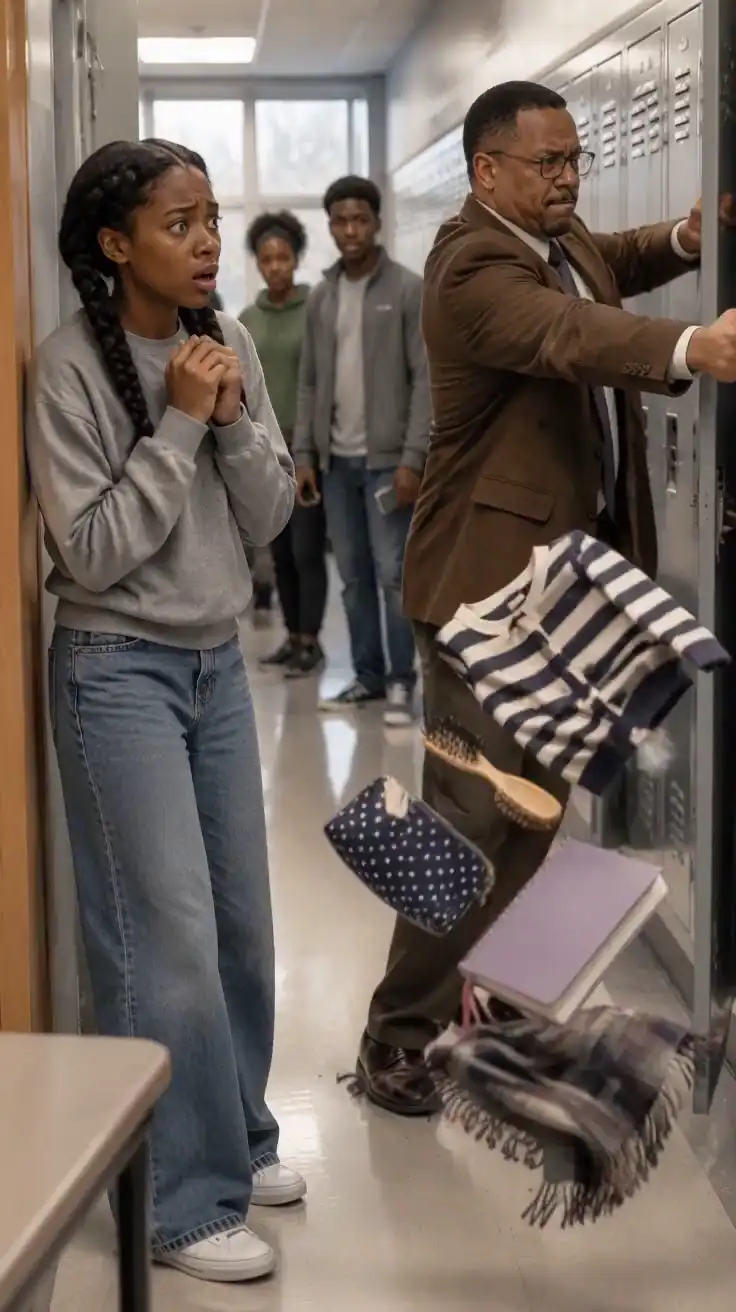
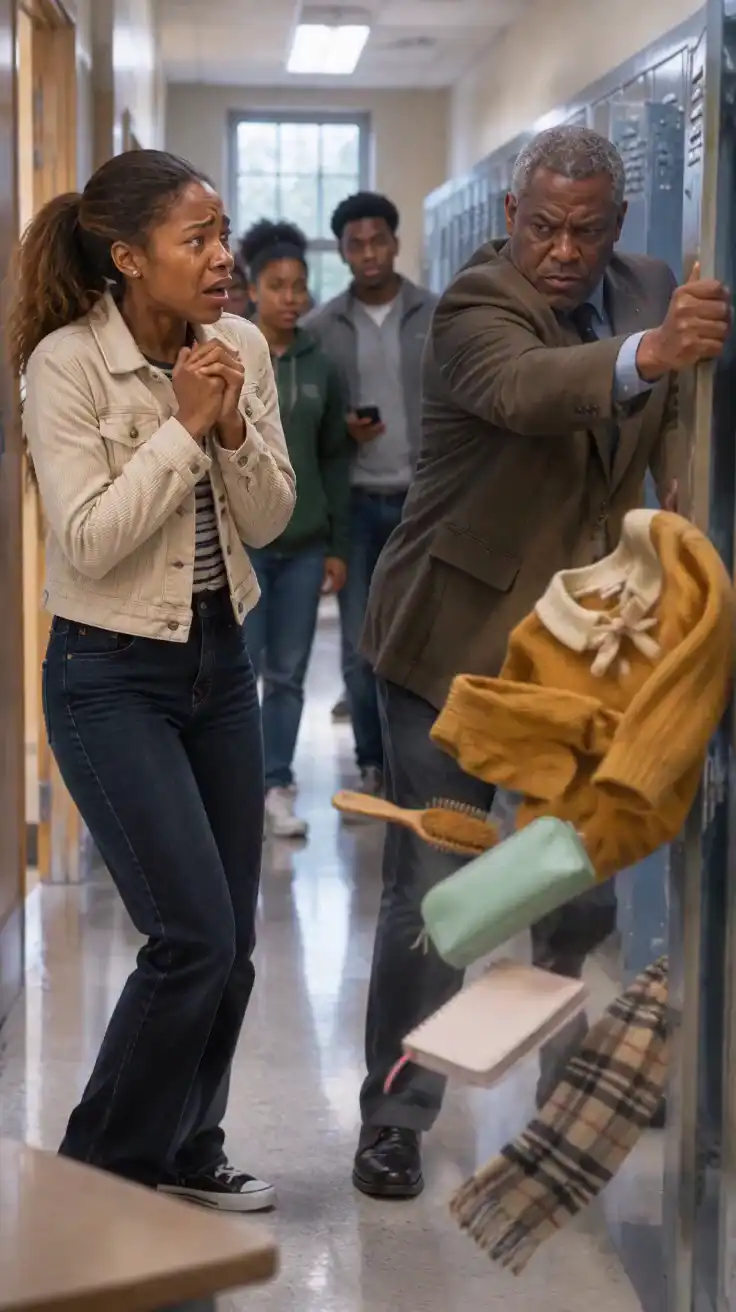
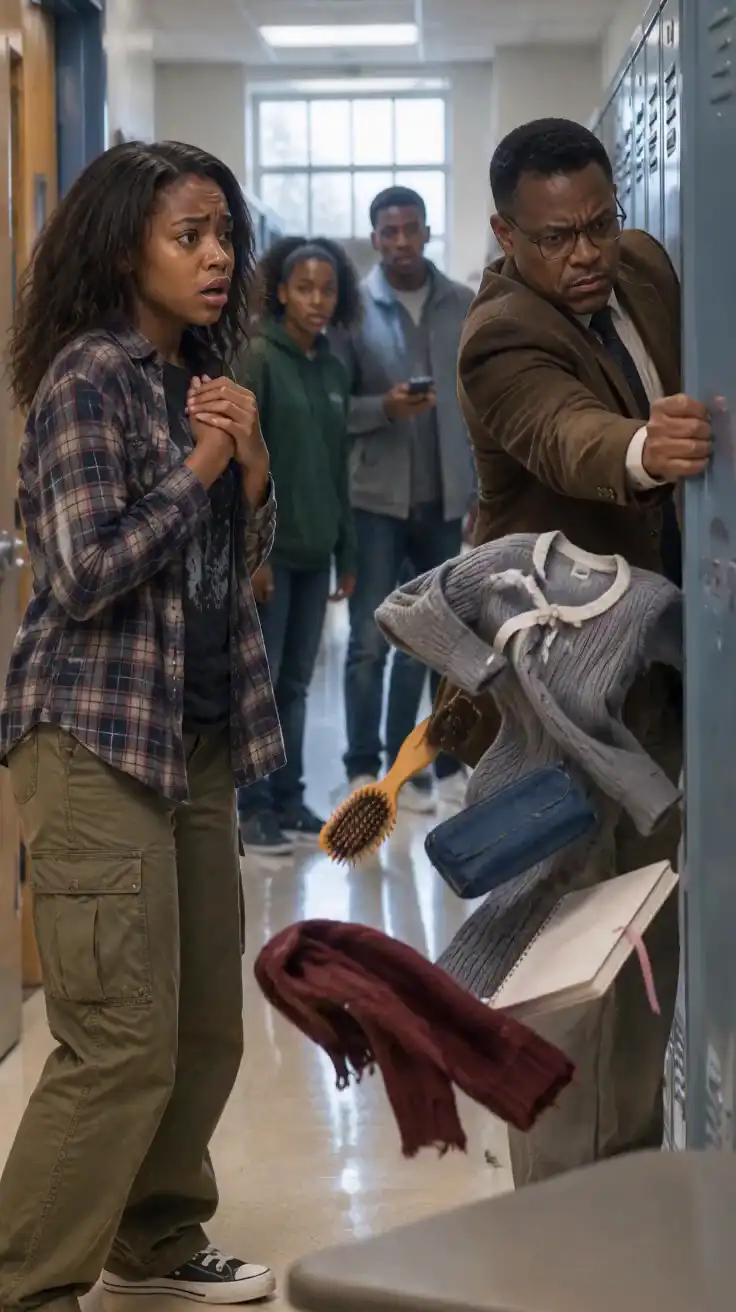
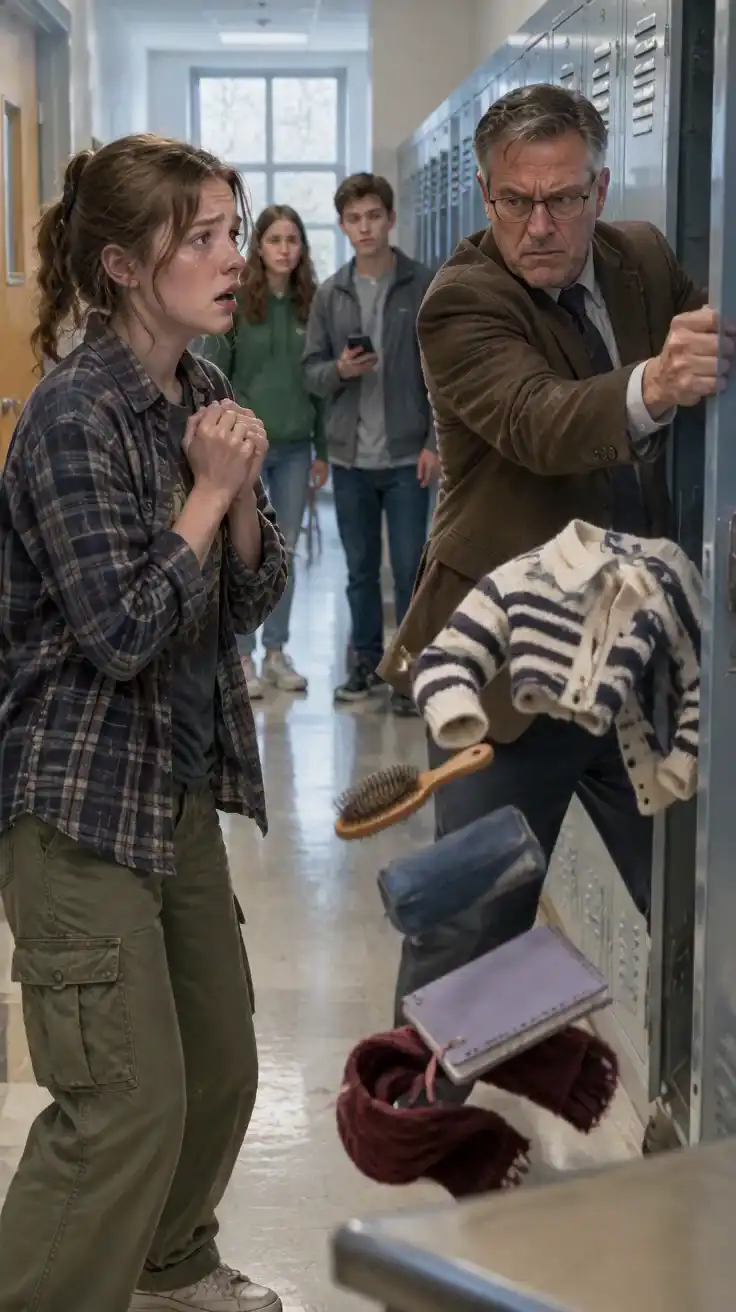
“On the video, you’re pulling her things out and putting them on the floor.”
“I understand that it looks upsetting.”
“It looked upsetting because it was upsetting.”
Mrs. Bell didn’t argue with me. That made me angrier, somehow. I wanted a defense I could reject. I wanted her to say something so plainly unreasonable that I could point to it. Instead, she looked at Emma and said, “I should have stopped sooner.”
“You should not have started,” Mark said.
Mrs. Bell nodded. “You’re right.”
She explained that Kayla had told her the bracelet was valuable and had accused Emma of taking it from her bag during lunch. Kayla had said she saw Emma near the bag. Mrs. Bell had spoken to the two girls separately, then asked Emma to show her the contents of the locker. She said she had believed that finding the bracelet would settle the matter quickly.
I asked why Emma had to kneel.
“I didn’t tell her to kneel,” she said. “I told her she could help me look.”
“She told Emma to look through the mess,” I said. “That’s what I heard.”
Mrs. Bell lowered her eyes. “I should have put the items back. I should have asked another staff member to be present. I should have handled it differently.”
“Why didn’t you stop when the bracelet came out of Kayla’s sleeve?”
“I did.”
“After it had already fallen on the floor.”
“Yes.”
“And after everyone had recorded Emma’s things dumped out of her locker.”
“Yes.”
There was a small silence. Then Emma said, “You made me open everything.”
Mrs. Bell looked at her. “I did.”
“I told you I didn’t take it.”
“I heard you.”
“Then why didn’t you believe me?”
The dean started to answer, but no words came. Mrs. Patel shifted beside the window. Mark put one hand on the table, palm down, as if he were holding himself there.
Finally Mrs. Bell said, “I thought the quickest way to find out what had happened was to look. I was wrong.”
The truth was, it was the quickest way for the school to get what it wanted. It was not the quickest way to find out what had happened to Emma.
The school had called Kayla’s mother before we arrived. She had come in and was waiting in another office. Mrs. Bell said she had spoken to her and would speak to us separately. I told her that I wanted Emma to leave with us now. Mrs. Bell agreed.
Before we got up, I asked what would happen next.
“Kayla has been suspended pending a review,” she said. “Effective immediately.”
“Suspended for what?”
“For bringing the bracelet into the situation and making a false accusation.”
“Did she admit she put it in her sleeve?”
“She said it was an accident.”
Emma let out a short, disbelieving laugh. It was the first sound she had made that wasn’t a sob.
Mrs. Bell continued. “She said she had the bracelet because she had picked it up from the table and forgotten it was in her sleeve.”
“Did she pick it up from the table?”
“No. Her mother says the bracelet belongs to her.”
“I didn’t ask whose bracelet it is. I asked whether Kayla said she picked it up from a table.”
Mrs. Bell looked uncomfortable. “She didn’t say that.”
“Then it wasn’t an accident.”
The dean did not respond.
We left with Emma’s backpack and her coat. Her locker was still open, her things piled on the floor. A custodian had been told not to touch them until we returned. I asked whether someone could gather everything and bring it to the office. Mrs. Bell said she would do it herself.
I told her no. “Have the counselor do it with another staff member. You don’t need to handle her belongings again.”
She nodded.
Emma walked between Mark and me through the front entrance. A couple of students in the lobby stopped talking when they saw her. One looked down at a phone. I wanted to say something to them, but Emma held tight to my sleeve.
“Please don’t,” she said.
So I didn’t.
In the car, she sat in the back seat. She had always sat in front when she was younger, always wanting to choose the music. Now she pressed her forehead to the window and watched the school disappear behind us.
At home, she went upstairs and closed her bedroom door. Mark and I stood in the kitchen. The shopping bag I’d left on the counter still had the milk inside. I put it in the refrigerator because it was something I could do with my hands.
Then my phone rang. It was Kayla’s mother, Denise.
I’d known Denise since the girls were in elementary school. We had sat beside each other at soccer games, taken turns driving them to birthday parties, and stood in the same line at school concerts. We had shared coffee at the diner after the girls’ fifth-grade graduation. When Emma had the flu in seventh grade, Denise dropped off soup because Kayla had told her I was too busy to make dinner. We were never as close as the girls, but we were friendly in the way parents become friendly when their children’s lives keep crossing.
“I’m so sorry,” Denise said immediately. Her voice was thin, unsteady. “I don’t know what to say.”
I was quiet for a moment. There were many things I could have said. I chose the one I could mean.
“Is Kayla all right?”
“She’s home. She’s in her room.”
“Did she say why she had the bracelet?”
“She said she forgot she had it.”
I looked at Mark. He shook his head once.
“Denise, the video shows it sliding out of her sleeve when the dean was searching Emma’s things.”
“I know.”
“Kayla said she forgot it was there?”
“She said she took it off because it was bothering her. She was going to give it back to me. Then she got upset, and it was still in her sleeve.”
“Upset about what?”
“I don’t know.”
“Has she told you she accused Emma?”
“She says she didn’t mean to make it into this.”
“That isn’t the same thing.”
“I know,” Denise said. Then she started crying. “I know, I’m sorry.”
I sat down at the kitchen table. “I’m sorry she’s hurting. I am. But Emma has an interview today. She’s been preparing for it for weeks. And now there’s a video of my daughter kneeling on the floor while people watch her.”
“I know.”
“She was standing there accusing her while the dean searched her locker.”
“I know.”
“I don’t think you do.”
The phone went quiet. Then Denise said, “You’re right. I don’t. I’m not trying to make excuses for Kayla.”
“I think you’re trying to find one.”
“I’m trying to understand what happened.”
“So am I.”
We ended the call without an agreement. Before she hung up, Denise said she would make Kayla apologize. I told her not to ask for an apology yet. Emma had to decide whether she wanted to hear one.
I went upstairs and knocked on Emma’s door. She opened it a few inches.
“Your interview is in a couple of hours,” I said. “Do you want to talk about it?”
“I don’t know.”
“Do you want to go?”
“I don’t know.”
“Do you want to get dressed and decide afterward?”
She looked at me for a long moment, then opened the door wider. “Maybe.”
Her interview was for the Hartwell Foundation scholarship, a local award for students planning to study public health or nursing. The scholarship paid tuition and books for four years at one of three state universities. Emma had been interested in nursing since she was ten, when her grandfather spent several months in and out of the hospital. She had liked the nurses who explained what was happening without talking down to him. She came home from those visits asking how a blood pressure cuff worked and why one medicine made him sleepy.
The application required grades, a short essay, two references, and an in-person interview. Emma had written her essay at the kitchen table. She had revised it seven times. Her teachers had read it. I had read it once and suggested she fix a sentence. She had told me she knew that already.
For weeks, she had practiced answers to questions she thought they might ask. Why nursing? What does service mean to you? Tell us about a time you made a mistake. What would you do if you disagreed with a supervisor? She had written notes in a small envelope because she didn’t want to carry loose pages. It was the envelope I had seen in the video, lying on the floor beside her shoes.
The interview panel had three people. One worked at the hospital, one was a retired teacher, and one was on the foundation board. They were meeting at the community center because the school was also a partner in the scholarship program. The meeting had been arranged months earlier.
When Emma got dressed, she chose a navy blue blouse and black slacks. She had laid them out the night before, along with the shoes she had brought to school. She took off the small gold studs she wore every day and put on a pair of plain pearl earrings. Then she stood in front of the mirror and stared at herself.
“I look like I’ve been crying,” she said.
“You have been crying.”
She tried to smile. It didn’t hold.
“I can drive you there and wait outside,” I said. “Or we can call and ask to reschedule.”
“They’ll think I couldn’t handle the interview.”
“They won’t.”
“You don’t know that.”
“No, I don’t. But if you ask to reschedule, it will be because something serious happened, not because you couldn’t handle it.”
She returned to the mirror. “I want to go.”
“Then we’ll go.”
She was quiet on the drive. The community center sat beside the public library, a plain brick building with a flagpole and a ramp leading up to the entrance. Mark drove us. I sat in the back with Emma, although she usually told me that was unnecessary. She held her notes inside the envelope and kept both hands around it.
At a stoplight, she said, “Do you think they’ve seen the video?”
“I don’t know.”
“What if they have?”
“Then they’ll see a girl who kept telling the truth.”
“What if they don’t?”
“Then you’ll tell them who you are.”
She looked at me. “That’s what you said in the counselor’s office.”
“I know.”
“It sounds stupid now.”
“It may sound too simple. That doesn’t mean it’s wrong.”
She looked back out the window. “I don’t want to be the story they remember.”
“I understand.”
“You don’t.”
She was right. I didn’t understand exactly. I had been embarrassed, frightened, and angry. I had not been the person standing in the hallway with everyone’s phones pointed at me.
We arrived ten minutes early. The woman at the desk checked Emma’s name and led her to a small waiting area. She was kind, but Emma’s shoulders tightened when she saw the open doorway into the main hall. I asked if I could sit with her until they called her. The woman said that was fine.
We sat beneath a framed photograph of a lake. Emma opened her envelope, looked at the top page, then put it away again.
“Are you sure?” I asked.
“No.”
“That’s allowed.”
“I don’t want to tell them about school.”
“You don’t have to.”
“What if they ask what’s wrong?”
“Tell the truth without giving more than you want to give.”
The panel called her name. She stood up and turned to me.
“Do I look okay?”
“You look like yourself.”
“That wasn’t my question.”
“You look composed. You look prepared. You look tired, because today has been hard. But you look okay.”
She nodded, then followed the woman into the meeting room.
The interview was scheduled to last twenty-five minutes. It lasted forty. I knew because I watched the clock above the desk and then checked the time on my phone, though I had promised myself I wouldn’t. Mark paced once around the hallway and then sat down. When Emma came out, she had her envelope under one arm and her hair pushed back behind her ears.
“How was it?” I asked.
“Fine.”
“That sounded almost believable.”
She let out a breath. “The first question was about why I want to study nursing. I said I like being able to make things less frightening for people. The woman from the hospital asked what that meant to me, so I told her about Grandpa.”
“How did it feel?”
“Okay. After that, I stopped thinking about the school for a while.”
“Did they ask?”
“No. One of them asked if anything had made the application process difficult this year. I said balancing school with family stuff, because that’s true. I didn’t want to explain the rest.”
“You didn’t have to.”
“They said they’d be in touch next month.”
She wasn’t smiling, but her face had changed. Some of the tightness had gone out of it. I was relieved, although I knew the interview was not the same as the scholarship, and the scholarship was not the same as what had happened that morning.
We went home. By late afternoon, the video was posted on a local parent group. Someone had added the caption “This is how our school treats kids accused of theft?” Someone else had written, “Wait for the end.” A third person asked why the student had not just turned out her pockets.
The video showed the moment the bracelet fell. It did not show what happened before the dean started recording or what she had said to either girl. It did not show what Emma had said. It did not show Kayla’s face while she watched the search, though it showed enough to make clear she was there. The clip began after the girls were already in the hallway.
By dinner, a parent I barely knew had sent me a message asking for Emma’s full name so she could “make sure the right people are held accountable.” I didn’t answer. Another person said she had seen the clip and that “kids do stupid things when they’re jealous.” I didn’t answer that one either.
The boy at the center of the jealousy was named Noah. He was in Emma and Kayla’s history class and played on the school’s soccer team. I had seen him at our house twice, once when he came over with Emma and Kayla to work on a group project and once when he dropped off a book Emma had left in his car. He seemed polite, a little shy, and unaware of how much space he was taking up in the lives of two girls who had been friends for eight years.
Emma had liked him first, or at least she told Kayla first. That had happened in October, after a school football game. The girls had come home together, and Kayla had sat in the passenger seat beside me while Emma was in the back. Kayla turned around and asked, “So are you going to tell him?”
Emma had laughed. “No.”
“You like him.”
“I know.”
“Then why not?”
“Because I like things how they are.”
“Maybe they don’t have to change.”
I remember that conversation because Kayla sounded sensible and kind. Emma had told me afterward that she thought Noah liked Kayla. I said she couldn’t know that. She said, “He always laughs at her jokes.”
I thought it was ordinary teenage observation. I didn’t realize she was already measuring the distance between the two of them.
In November, Noah asked Kayla to a winter dance. Kayla said yes. She told Emma on the phone, and Emma congratulated her. I know because I was there when she hung up. She didn’t cry or throw anything. She put her phone down and went back to her homework.
“You okay?” I asked.
“Of course.”
“Do you still like him?”
“Maybe a little. It doesn’t matter.”
It seemed like a normal disappointment. It seemed like the kind that would fade once the dance was over and the photos had stopped appearing online.
Kayla and Noah went to the dance. They took a picture together in the school gym, standing beneath silver streamers. Emma liked the photo. She told me she was happy for Kayla. I believed her because I wanted to believe that hurt could be managed with good manners and enough time.
Then, in January, Noah asked Emma if she wanted to get coffee after school. He had ended things with Kayla over winter break. Emma told me she didn’t know what to say.
“Do you want to go?” I asked.
“I do.”
“Then go.”
“Kayla’s going to be upset.”
“You’re not responsible for deciding who he likes.”
“I know. But she’s my friend.”
“Then talk to her.”
Emma did. She called Kayla. I heard only Emma’s side, but I could tell the conversation had gone badly.
“I’m not trying to hurt you,” she said. Then, after a pause, “I know you dated him. I know. But you said you were done.” Another pause. “No, I’m not saying your feelings don’t count.” She turned away from me and lowered her voice. “I don’t want to have this conversation with you yelling.”
After she hung up, she told me Kayla had said she could do whatever she wanted, then accused her of waiting for a chance to take Noah away. Emma said that Kayla had already told people she didn’t like him anymore, so she thought it was over.
I said I was sorry. I told her friendships at that age could be intense and messy. I said they had known each other long enough to get through one argument.
I didn’t ask more. I should have.
Emma and Noah went for coffee once. The next week they went to a basketball game. They weren’t dating, as far as Emma told me, but there was a change in how she talked about him. She checked her phone more often. She smiled at messages. When I asked how things were with Kayla, she said, “Fine.”
The word was doing a lot of work.
In February, Kayla stopped sitting with Emma at lunch. She told people she was changing tables because she wanted to sit with friends from her art class. Emma said she understood. She ate lunch with two girls from her chemistry class instead. She did not seem devastated, but she seemed quieter.
Then Kayla started making comments. Some were small enough to be dismissed as jokes. She said Emma always had to make everything about herself. She told Noah that Emma had been “waiting in line” for him while Kayla was dating him. She said Emma was only interested now because Kayla had been.
Emma heard about those comments from other students. She didn’t tell me immediately. When she did, I asked why she hadn’t said anything earlier.
“Because it sounds petty,” she said. “I don’t want to make a big deal.”
“It sounds hurtful.”
“Yeah.”
“Have you asked her to stop?”
“She won’t.”
“How do you know?”
“Because I asked.”
She told me that she had spoken to Kayla after school outside the library. Kayla said Emma had used their friendship to get close to Noah. Emma said that wasn’t true. Kayla told her not to act innocent. Emma said she was done talking about it and walked away.
That was the last time they had a private conversation before the bracelet incident.
They had been close enough to know where each other kept things. Kayla knew Emma’s locker combination from a year when they shared a locker for a few weeks during a schedule change. Emma knew Kayla’s house code because she had been there so often. They had shared passwords once, then changed them, then told each other they had changed them. It was the ordinary intimacy of children who had grown up together, and it made the separation harder to recognize. They were still using old habits with one another after the trust that had supported those habits had begun to break.
The bracelet was Kayla’s mother’s. Denise had given it to her for her sixteenth birthday. It was gold, thin, and simple, with a small flat charm. Denise said it had belonged to her own mother. Kayla wore it often. I had noticed it on her wrist at our house and once told her it was pretty.
The day of the search, Kayla said, she had taken it off in the girls’ bathroom because the clasp was catching on her sweater. She tucked it into the cuff of her sleeve, then forgot it was there.
The school did not learn that version until later. At the time, the story was that she believed Emma had taken it from her bag. Kayla told the dean that she had left it in her backpack at lunch, then came back and found it missing. She said she had seen Emma near the bag. She also said that Emma had been in a bad mood with her, and that she thought Emma might have taken it to get even.
That was enough for the dean to start asking questions. It was not enough to justify the way the questions were asked.
Emma told me later that Mrs. Bell had first called her into the office during third period. She asked whether Emma had seen Kayla’s bracelet. Emma said she hadn’t. Mrs. Bell asked whether Emma had been near Kayla’s bag at lunch. Emma said she had walked past it to get to the table. Mrs. Bell asked why she and Kayla were no longer friends.
Emma said, “We had a fight.”
“About what?”
“I don’t want to talk about it.”
Mrs. Bell told her that if she had nothing to hide, answering the question would help.
Emma said, “It doesn’t have anything to do with a bracelet.”
Mrs. Bell told her she would need to check her locker.
Emma asked whether she could call me. Mrs. Bell said they would deal with the situation first and contact me if necessary. That was the point at which Emma started to feel that no answer she gave would make a difference.
When she walked back to the office, Kayla was already there. Kayla was standing near the wall with her arms crossed. She didn’t look at Emma. Mrs. Bell said she wanted to check Emma’s locker, and they went down the hallway together.
The video starts before the search, but it doesn’t include the part where Mrs. Bell told Emma to open the locker. It doesn’t include Emma asking if the counselor could come. It doesn’t include the dean saying, “This will be quick.” It starts as a student nearby begins recording.
At first, Emma reached for her books. Mrs. Bell took them out and set them on the floor. The books were stacked at the bottom of the locker, and there were more items behind them. Then came her makeup bag, a notebook, her lunch, the folded shoes, and the envelope. By the time the video begins, the floor is already cluttered. Emma is holding a folder. Kayla is standing several feet away, partly turned toward the camera.
Emma said, “I told you I don’t have it.”
Mrs. Bell said, “We’re just checking.”
Kayla said, “You took it.”
The girl filming shifted her phone and said something I couldn’t make out. Another student laughed nervously. Emma asked the dean to stop. The dean told her that she needed to look through the things on the floor. When Emma started to reach for her notebook, the envelope slipped from the top of a pile and landed near her shoe.
Kayla pointed at her.
“See? She’s trying to hide it.”
Emma had not been hiding anything. She was trying to pick up her notes.
Then the bracelet slid from Kayla’s sleeve.
It landed close enough to Emma that anyone watching without sound might think it had come from the locker. That was one of the first arguments people made online. The bracelet came out in the same frame as Emma’s belongings, so people decided it must have come from there. But the video shows the motion. It comes down from Kayla’s sleeve as she points.
The school suspended Kayla in the dean’s office before lunch was over. It happened quickly, and then it happened again in a slower way over the next two weeks, as the school completed its review.
That afternoon, the school issued a brief statement to families saying it was aware of an incident and was investigating. It did not mention Emma’s name. Students already knew her name. Parents knew it by dinner. The statement did not say that the bracelet had come from Kayla’s sleeve, that Emma had denied taking it from the beginning, or that the dean’s handling of the locker search was being reviewed.
The following morning, Mrs. Bell called and asked to meet with us. I told her we would come if the principal and a district representative were present. She agreed.
The principal was Dr. Cole, a tall man with a soft voice and a habit of clasping his hands together when he spoke. The district representative was Ms. Hsu, from student services. They had watched the video. They had spoken with the dean and with several students who were in the hallway. They had also spoken with Kayla and her mother.
Dr. Cole began with an apology. He said the school should have called me when the allegation was made. He said a parent should have been present before a locker search unless there was an immediate safety concern. He said the dean should not have allowed the search to turn into a public spectacle.
I asked why the school had let students gather and record.
“We didn’t know they were recording until afterward,” he said.
“They were recording in front of the dean.”
“Yes.”
“So you knew.”
He nodded. “She knew students had phones out.”
“And she continued.”
“Yes.”
Ms. Hsu said the school had removed the video from its official communication channels, which was a strange thing to say because the school had not posted it. She clarified that they had asked the students who recorded it not to share it. I asked whether they had been told they could not share it. She said they could not control personal posts, but they could remind students about privacy.
“What about Emma’s privacy?” I asked.
Ms. Hsu said she understood. I asked whether they would contact the scholarship committee to explain that the video had been recorded during a school investigation. Dr. Cole said they did not want to spread the situation further without Emma’s permission. I told him the situation was already spreading. He agreed to ask Emma what she wanted.
Emma was in the room, sitting between Mark and me. She had not spoken much. When Dr. Cole asked what she wanted the school to do, she said, “I want you to say I didn’t steal it.”
“We can state that our review found no evidence you took the bracelet,” he said.
“But you know I didn’t take it. The video shows where it came from.”
“Yes,” he said. “The video is clear.”
“Then say I didn’t steal it.”
He looked at Ms. Hsu. “We can say we found the accusation was unfounded.”
“That’s not the same.”
There was another silence. Then Ms. Hsu said she would check the wording with the district’s communications office.
I asked about the suspension. Dr. Cole confirmed Kayla had been sent home that day. She was suspended for five days while they investigated the accusation and the fact that she had concealed the bracelet during the search. Her suspension began immediately, as Mrs. Bell had told us.
I asked whether Kayla had admitted she put it in her sleeve to make Emma look guilty.
He said she had not admitted that.
“Then what exactly are you suspending her for?”
“For making an untrue accusation and bringing the bracelet into the school’s investigation without disclosing that she had it.”
“Those are two different ways of saying the same thing.”
He said the school had to follow its process. I understood that. I also understood that the process could not tell us what Kayla had intended. The school could discipline her for what it proved. It could not make her tell us the truth.
Denise called me again that evening. She asked if we could meet without the school. I said yes, but not at our house. We met at the diner where we had sat together after the girls’ fifth-grade graduation.
She arrived alone. She looked tired and older than she had a few months earlier. I ordered tea. She ordered coffee and left it untouched.
“Kayla says she didn’t mean for Mrs. Bell to search Emma’s locker,” Denise said.
“What did she mean to happen?”
“She says she wanted Emma to get in trouble.”
I waited.
Denise looked down at the table. “She told me she wanted Noah to see that Emma wasn’t who he thought she was.”
I felt my face go hot. “So she knew there was no theft.”
“She says she knew she had the bracelet in her sleeve.”
“Did she put it there before accusing Emma?”
Denise rubbed her forehead. “She says she had taken it off in the bathroom and forgot. Then when she saw Emma, she got angry and said Emma took it. She told me she thought the school would search Emma’s backpack, find nothing, and then Emma would be embarrassed.”
“Why would a search find anything?”
“She thought Emma might have something else of hers. A note. Something.”
I stared at her. “She thought she could make up an accusation and search my daughter’s things because she was angry about a boy?”
“She says it got out of hand.”
“It got out of hand when the dean emptied the locker. It began when Kayla chose to lie.”
Denise nodded. “I know.”
“What has she said about the bracelet falling out?”
“She said she didn’t know it was still in her sleeve until it slipped. Then she panicked.”
“Did she want Emma to get in trouble?”
Denise was quiet.
“Denise.”
“She said she did.”
I watched her break down. She covered her mouth with one hand and tried to steady herself. I did not reach across the table. I had known her for a long time, but I had no comfort to offer that would not make Emma’s pain easier to dismiss.
“I’m sorry,” she said. “I know that doesn’t fix it.”
“No, it doesn’t.”
“I don’t know how she became this person.”
“She is still your daughter.”
“I know.”
“But she hurt mine.”
“I know.”
“Emma is not going to sit down with her because we want them to be friends again.”
“I understand.”
“I don’t know whether she’ll ever want to talk to Kayla.”
Denise looked up. “I’m not asking you to make her.”
We sat without speaking for a while. Then Denise told me Kayla had been crying on and off since she got home. She said Kayla was ashamed. I told her that shame was not the same as remorse. She said she knew. I hope she did.
The district sent a letter the following week. It said the school had determined that the bracelet was never in Emma’s possession and that no evidence supported the theft accusation. It also said the school had found that the locker search was handled inappropriately and that staff would receive additional training on student privacy and investigation procedures.
The wording was formal. It did not mention the hallway full of phones or Emma asking the dean to stop. It did not say that the accusation had been made because Kayla was jealous. It did not say that the girls had been friends since third grade. But it said Emma had not stolen the bracelet. We asked the school to send the letter to the scholarship committee with Emma’s permission. They did.
The scholarship committee did not contact us about the video. A month after the interview, Emma received an email saying she had been named a finalist. Two weeks later, she was awarded the scholarship. She showed me the email in the kitchen, where she had written her interview notes at the same table. She looked at me as though she expected me to react in a way that might make the day less complicated.
I put my hand over hers. “You did it.”
“I know.”
“You did it on the day you thought you couldn’t.”
“I almost didn’t go.”
“But you did.”
She folded the printed email and put it in the envelope. She had kept the envelope from the day of the search. The crease across its flap was still there. She said she wanted it because it reminded her she had finished the interview.
“I don’t want to remember the hallway,” she said.
“You don’t have to.”
“I do, though. It’s on everyone’s phone.”
I had no answer for that.
Kayla served her five-day suspension. The school required her to attend counseling and complete a restorative conference before she returned to some extracurricular activities. She was also moved out of Emma’s history class, though she had not asked for that. The school said it was a temporary measure to reduce contact while the families decided what they wanted.
Emma did not want a restorative conference. She said she could not sit in a room while adults asked her to explain how she had been harmed so that Kayla could understand the consequences. She did not want to be responsible for teaching Kayla how to be sorry.
The school accepted that. They arranged separate schedules and asked the girls not to contact each other while the review was open.
For the first few weeks, Emma’s phone buzzed often. Some messages were from students who had seen the video and wanted to say they were sorry. Some were from kids who wanted details. A few were from people who asked why Emma had not said anything when Kayla accused her, as if silence were proof of guilt. Emma blocked two accounts and deleted the video from her own messages. She asked me not to read the comments aloud.
One afternoon, she came home and sat at the kitchen table with her backpack still on.
“People keep asking if I’m okay,” she said.
“What do you tell them?”
“I say yes.”
“Are you?”
“No.”
I sat down across from her. “You don’t have to say yes.”
“I don’t want to make it a whole thing.”
“It already was a whole thing. You’re allowed to be affected.”
She looked at her hands. “I don’t want to be known as the girl whose locker got dumped out.”
“You’re not.”
“That’s what people say when they know something else.”
I took that in. “You’re right. Some people may remember the video first. But they don’t get to decide that it’s all you are.”
“I’m tired of having to prove I’m not a thief.”
“You shouldn’t have to.”
“I know.”
That was one of the hard parts of being her mother. There was no sentence that could return her to the morning before the search. There was no way to make the school hallway private again. There was no argument I could make that would make her feel entirely safe in a place where an adult had ignored her denial.
Mark and I met with the school twice more. The first meeting was about the search. The second was about how staff would respond to student accusations in the future. I wanted more than a policy. I wanted them to understand that treating a student with dignity was not an optional extra after an investigation. The school said it would revise its guidance on locker searches, parent notification, and the involvement of a second staff member.
I asked whether the staff would be trained to avoid conducting searches in front of other students.
The district representative said yes.
I asked how they could avoid a situation where a child was pressured to cooperate while other students watched.
She said staff would be taught to move the student to a private area and wait for a parent or administrator when there was no immediate safety concern.
I asked what would happen if an accusation turned out to be false.
The principal said the school would document that and communicate the result to the people who had been told about the allegation. I asked whether it would communicate the result to students, too. He said it would depend on the circumstances.
That answer did not satisfy me. The accusation had been public. The correction should not be private. I said so.
The school did not promise to make a public announcement. It did send a note to the students in Emma’s grade that the investigation had concluded and the allegation was unfounded. It did not name Kayla. It did not name Emma. Some students knew who the note was about. Others did not.
I was glad the school corrected the record. I was still angry that the correction arrived after the video had been shared and discussed, after Emma had gone to an interview with red eyes, after the school had let her walk out of the building carrying the shame of something she did not do.
The aftermath for Kayla’s family was less visible to me. I know some of it because Denise and I kept talking, though less often. Kayla had to spend the summer doing community service through a youth program and attend counseling. Denise told me the counselor helped Kayla understand how jealousy had turned into a need to punish Emma. She told me Kayla had also been angry at herself for still caring what Noah thought.
I was careful not to make that into an excuse. Jealousy explained the lie. It did not make the lie harmless. A person can feel rejected and still be responsible for what she does with that feeling.
Denise said the hardest part was that Kayla had been lying at home about the friendship. She had told Denise that Emma had become cold and that she was trying to avoid drama. She had left out the comments, the accusation, and the days she spent planning how to make Emma look bad. Denise said she had believed her because she wanted to believe her daughter was the one being hurt.
I understood that instinct. I had my own version of it. For months, I had told myself their friendship would repair itself because it was easier than seeing that Emma was losing someone she loved.
Denise apologized to Emma once, in a short letter she sent through me. She said she had failed to understand how serious the situation was, that she was sorry for defending Kayla’s version before she knew the truth, and that she did not expect Emma to forgive her. Emma read the letter, folded it, and put it in a drawer.
“She was trying,” I said.
“I know.”
“Do you want to answer her?”
“No.”
So she didn’t.
Noah sent Emma a message after the video circulated. He said he was sorry for what happened and that he had no idea the conflict between them had gotten so bad. Emma thanked him. They kept talking for a while, then drifted apart. There was no dramatic ending. He went to college the following year. Emma went to a different university. They are not in touch now.
Emma and Kayla saw each other a few times before graduation. Once in the cafeteria, once at a school assembly, once at the grocery store. They did not speak. At the assembly, Kayla was standing with two girls from her art class. Emma saw her and stopped walking. I was there to pick Emma up afterward, and she told me that Kayla looked smaller than she remembered.
“Did you feel like you wanted to talk to her?” I asked.
“No.”
“Did you feel anything?”
“Mostly tired.”
That was how the friendship ended. Not with a final argument or a dramatic apology. It ended in the spaces where they used to stand beside each other. It ended with Emma deciding not to answer a message, then another. It ended with the girls learning each other’s schedules so they could avoid being alone in the same hallway.
At graduation, their families sat on opposite sides of the gym. I saw Denise when we were leaving. She came over and told Emma she looked lovely. Emma said thank you. Denise told her she was proud of her. Emma nodded. Then we kept walking.
The video still exists. It appears occasionally when someone reposts it, usually with a new caption and the old arguments underneath. A stranger once messaged me to ask whether Emma had “gotten the scholarship anyway.” I did not answer. Another said the dean was a hero for suspending Kayla immediately. I did not answer that either. The suspension mattered, but it did not erase the search. It was the right immediate response to Kayla’s accusation. It was not the whole response Emma needed from the school.
The day after the video, a girl from Emma’s biology class stopped her in the hall and said she was sorry she had recorded. Emma told me the girl had been holding her phone up, but she had only recorded the last part. She hadn’t posted it. She had sent it to her older sister, who shared it with another parent, and the chain went further than she expected.
Emma said she understood how it happened. Then she said she still wished it hadn’t.
I told her both things could be true.
The day of the search returns to me in pieces: the grocery bag on my counter, the school receptionist saying “upset but safe,” the hard chair beneath the musical poster, Emma’s hair coming loose, the envelope under her arm, the way she asked whether she looked okay before the interview. I remember the school meeting more than I want to. I remember the phrase “unfounded allegation.” I remember Denise saying Kayla wanted Noah to see Emma differently. I remember being relieved that the scholarship interview lasted longer than scheduled, as though the extra fifteen minutes could prove Emma had not been broken by the morning.
But she had been changed by it. I don’t mean she became stronger in a way that makes the story neat. I mean she became more cautious about trusting people who once had permission to know her. She learned that adults can say they want to help and still make you feel trapped. She learned that being right does not protect you from being watched. She learned that you can be deeply hurt and still show up for an interview.
I changed, too. I stopped telling myself that a friendship was fine because the girls still texted sometimes. I asked more direct questions when Emma said something was “fine.” I learned that her reluctance to talk was not always a sign that she wanted privacy. Sometimes it meant she didn’t know yet how to explain what she was carrying.
I also stopped trying to make the end of the story sound fair. Kayla was suspended. The school apologized. The scholarship committee chose Emma. Those things mattered. They did not restore the years when the girls trusted each other. They did not remove the video from the phones that held it. They did not change what Emma saw in Kayla’s face when the bracelet hit the floor.
Years later, Emma still has the envelope. It is in a box with her scholarship letter and the program from her graduation. The envelope is empty now. The notes are gone. Sometimes she says she keeps it because it reminds her that she went to the interview. Sometimes she says she just hasn’t thrown it away.
I have not asked her which answer is the real one.
Denise and I are still on speaking terms. We see each other at school events and occasionally in town. We don’t talk about the girls unless one of them brings it up. We used to be able to fill an hour with stories about what they were doing. Now we talk about work, parents, the weather, and which coffee shop has changed owners. I don’t blame her for loving Kayla. I would have loved Emma through anything. But there is a difference between loving your child and refusing to see what she has done. Denise did not understand that at first. She does now, or says she does.
Kayla and Emma have not become friends again. They have not had the conversation that would let one of them say the perfect thing and the other one forgive her. There is no speech in which the hurt becomes worthwhile. There is no moment when the friendship returns exactly as it was in third grade, before either of them knew what it meant to want the same person to like them.
I hope Kayla has grown. I hope she learned to name jealousy before it became an excuse. I hope she understands that a lie can become an event in someone else’s life, even if the person who tells it thought she was only trying to cause a little embarrassment. I hope she has learned that being ashamed is not the same as repairing what you damaged.
I hope Emma keeps the parts of herself that were hers before all this. Her stubbornness. Her care for people who are frightened. Her habit of preparing carefully, then acting as if it was no trouble. Her dry sense of humor. The way she still asks questions when something doesn’t make sense.
On the day of the interview, when she came out of the meeting room, she told me she had answered the first question honestly. She said she wanted to become a nurse because she liked making frightening things feel less frightening. She had said it before the school called her a thief, before the hallway filled with phones, before the dean searched her locker. She said it again after all of that.
That mattered to me. Not because it made the day good. It didn’t. Not because the interview canceled what happened. It didn’t do that either. It mattered because she was still able to say what she believed, even when the room in her mind was full of noise.
The bracelet fell in the hallway, and the school acted quickly after it did. The dean suspended Kayla on the spot. Kayla’s mother came to understand that her daughter’s explanation was not the truth. The school reviewed its actions and admitted that the search should have been handled differently. Emma made it through the interview and won the scholarship. Those facts are important. They are the parts people often want to hear first, because they give the story an ending.
But I still think about the moment before the bracelet fell. Emma was kneeling beside her belongings, trying not to cry. Kayla was standing there, pointing at her. The dean was looking at the mess she had made. And my daughter was asking, quietly, for the adults around her to stop.
I wish someone had listened before the bracelet gave them a reason.