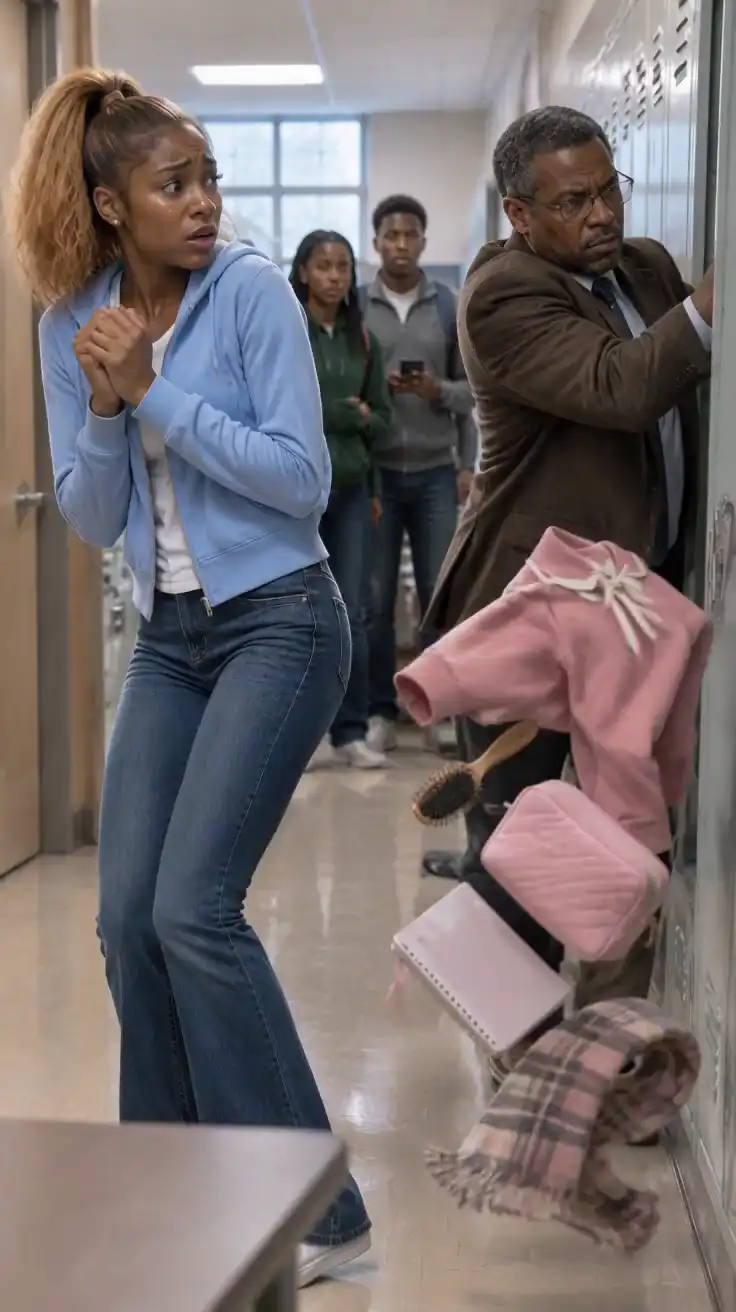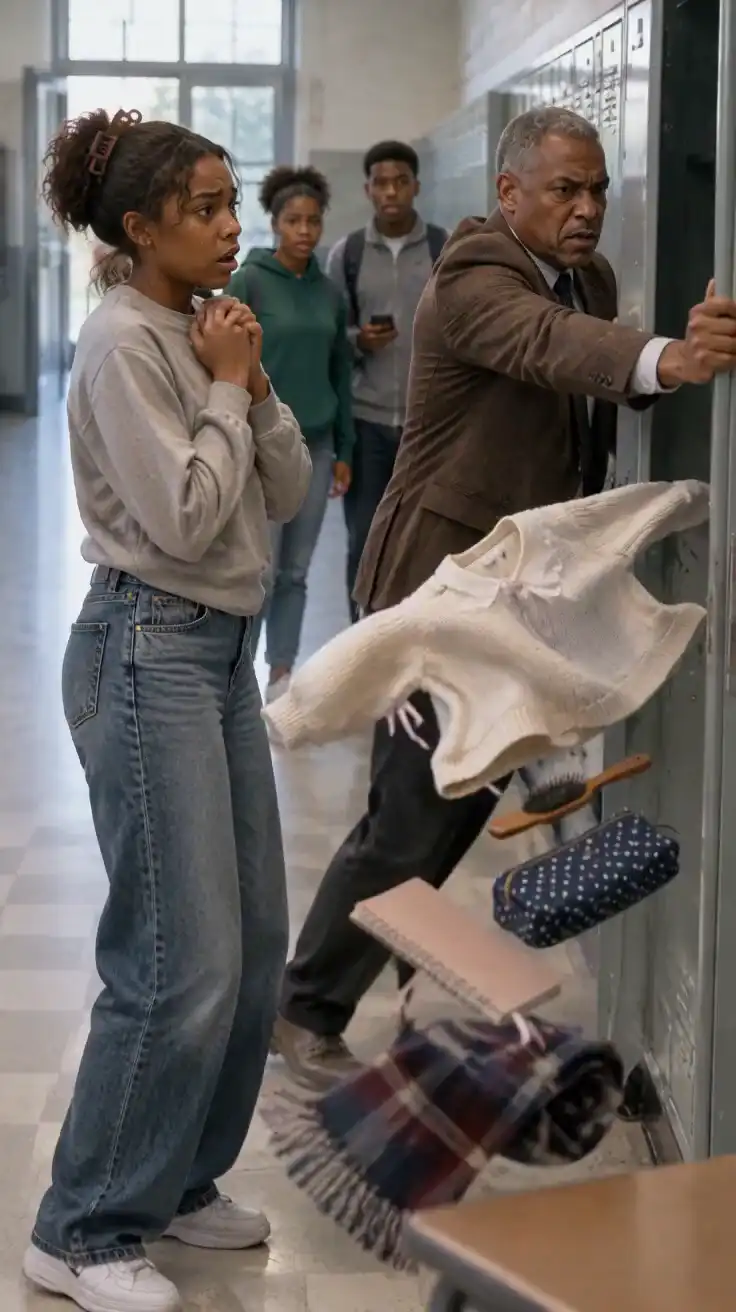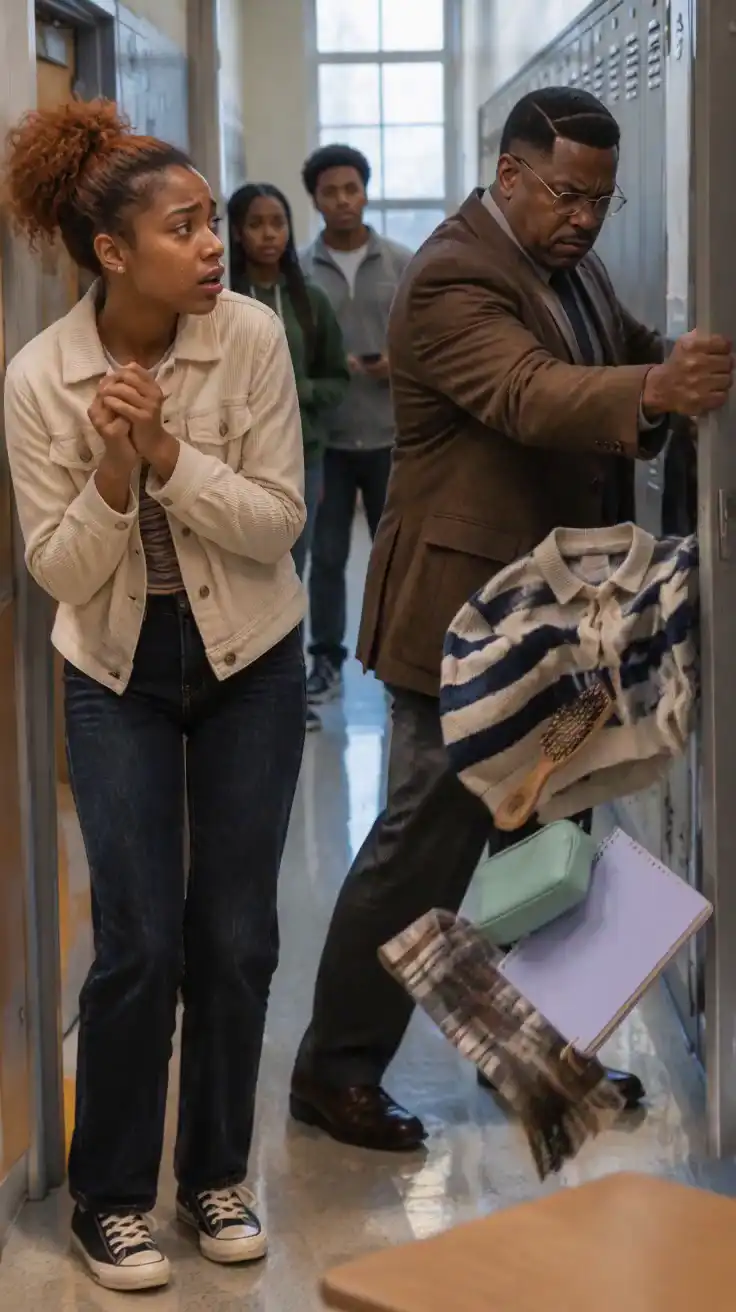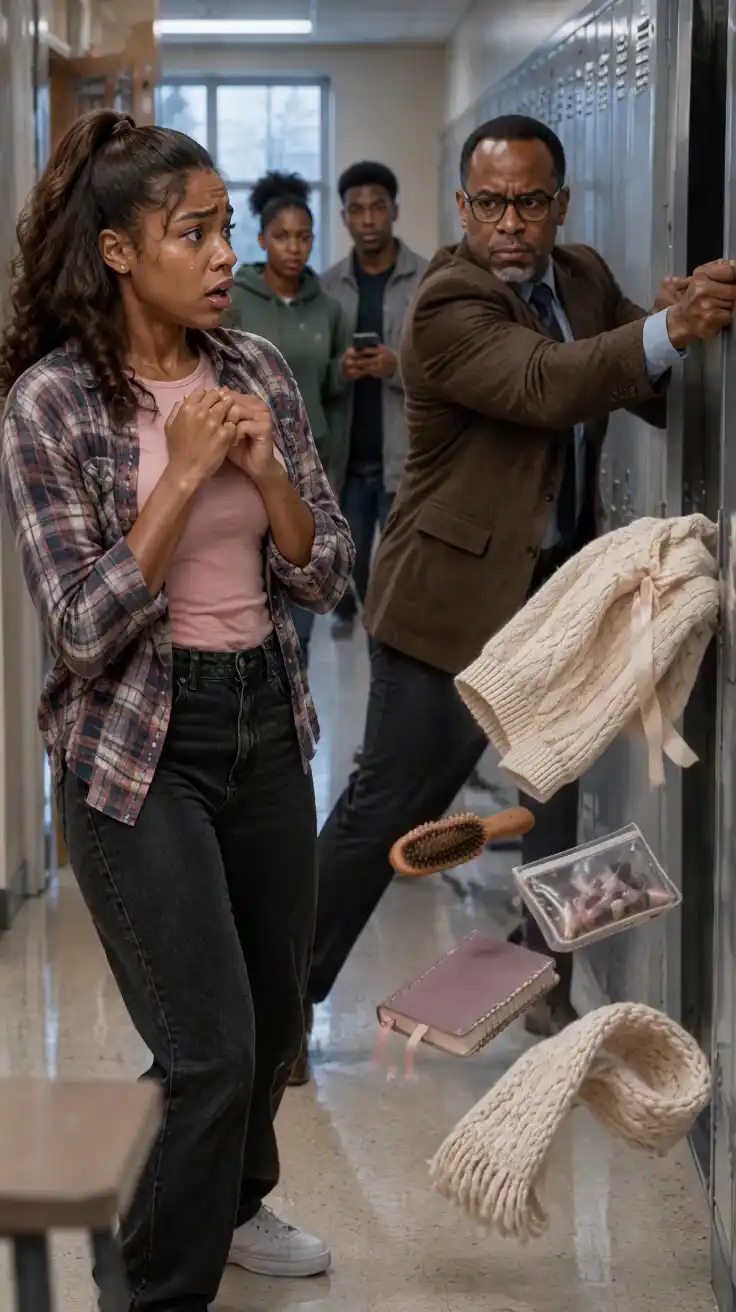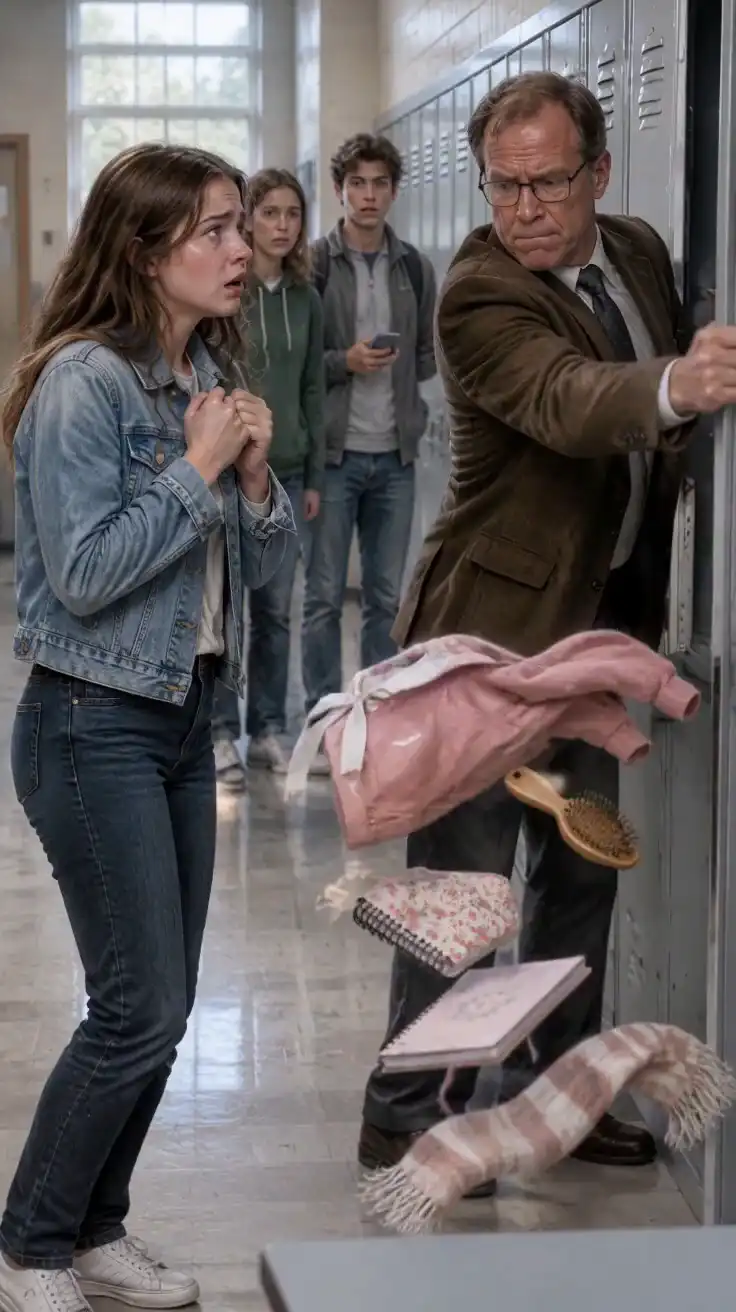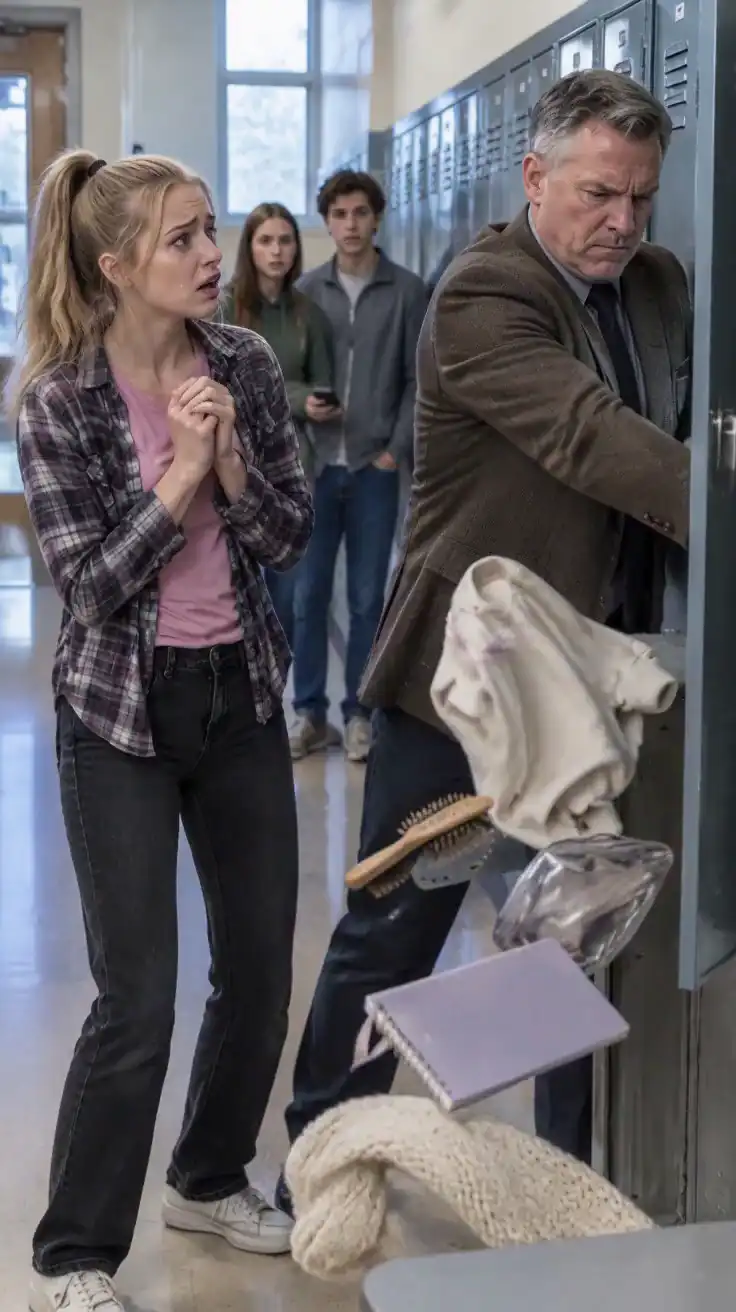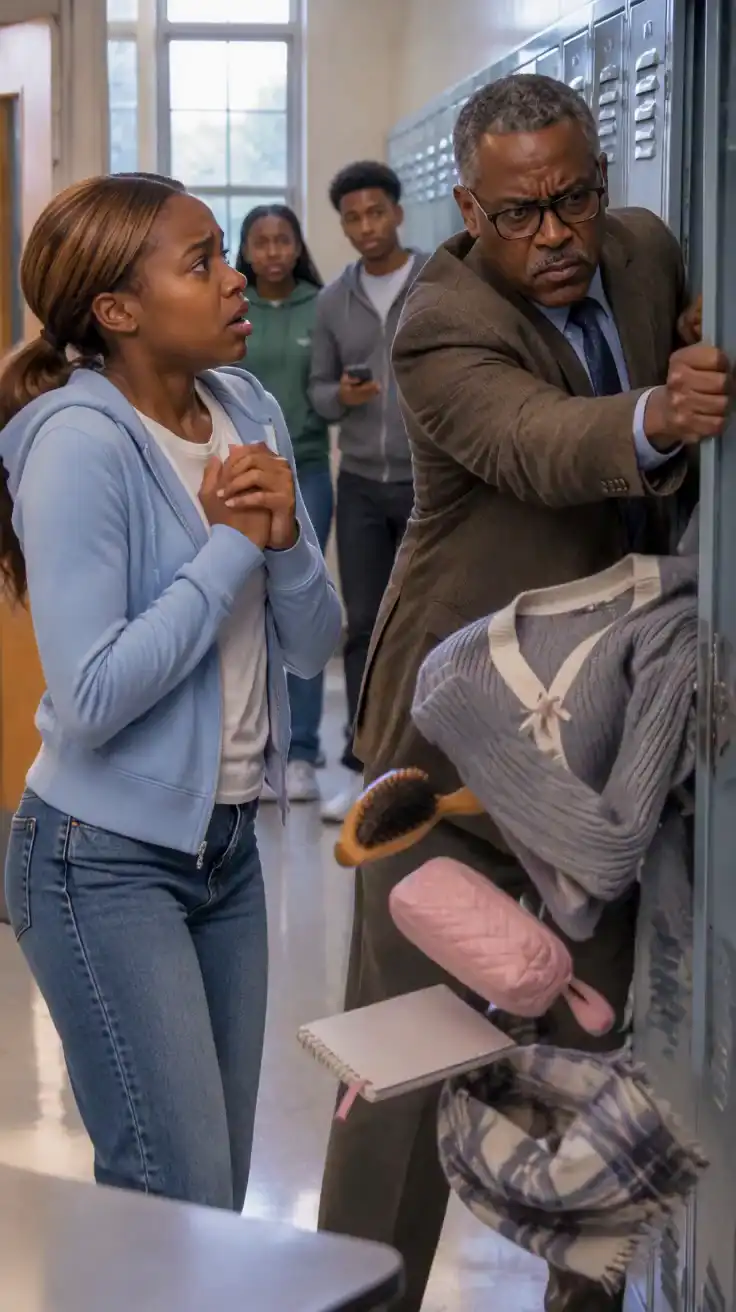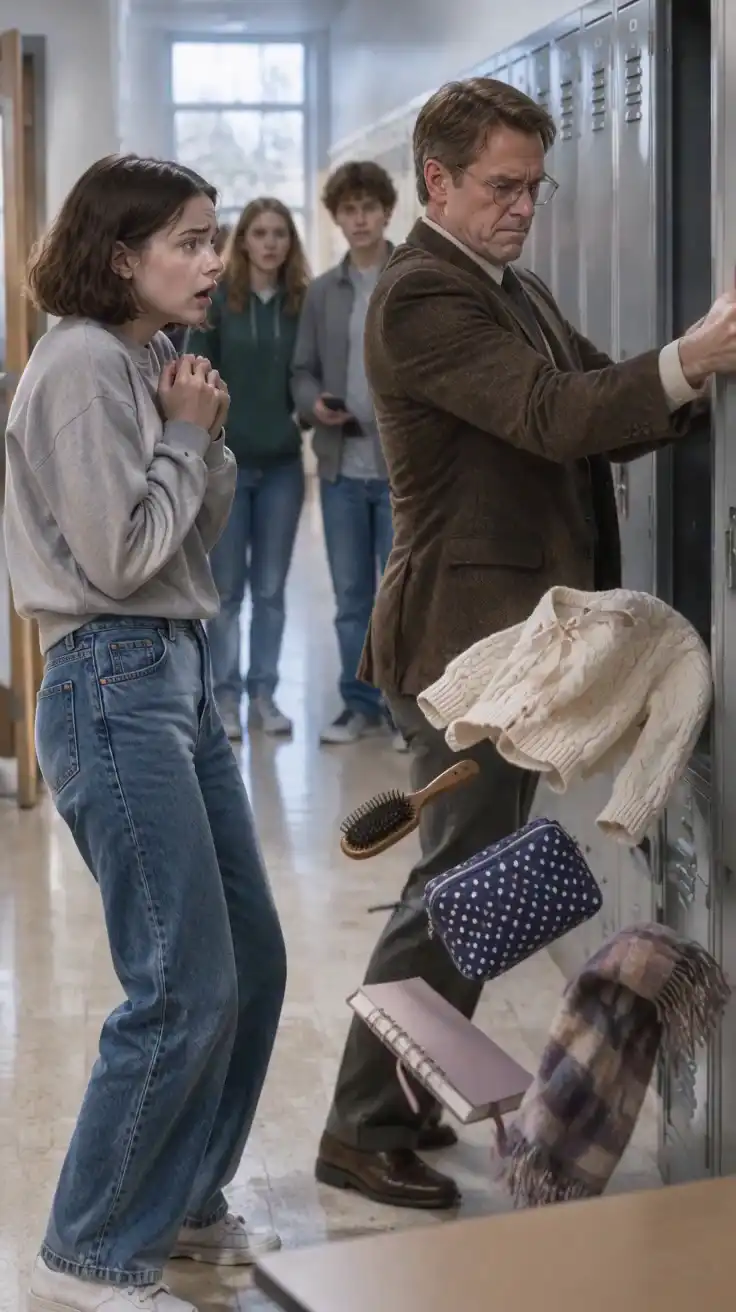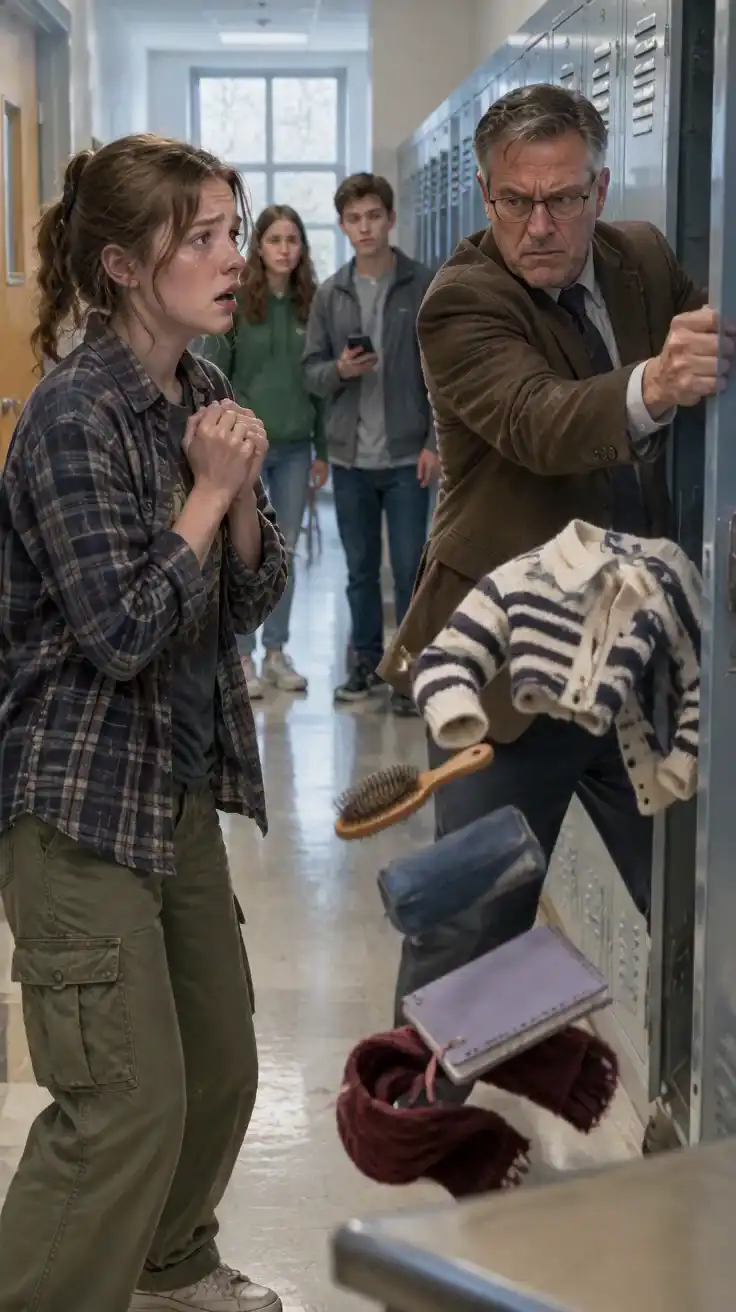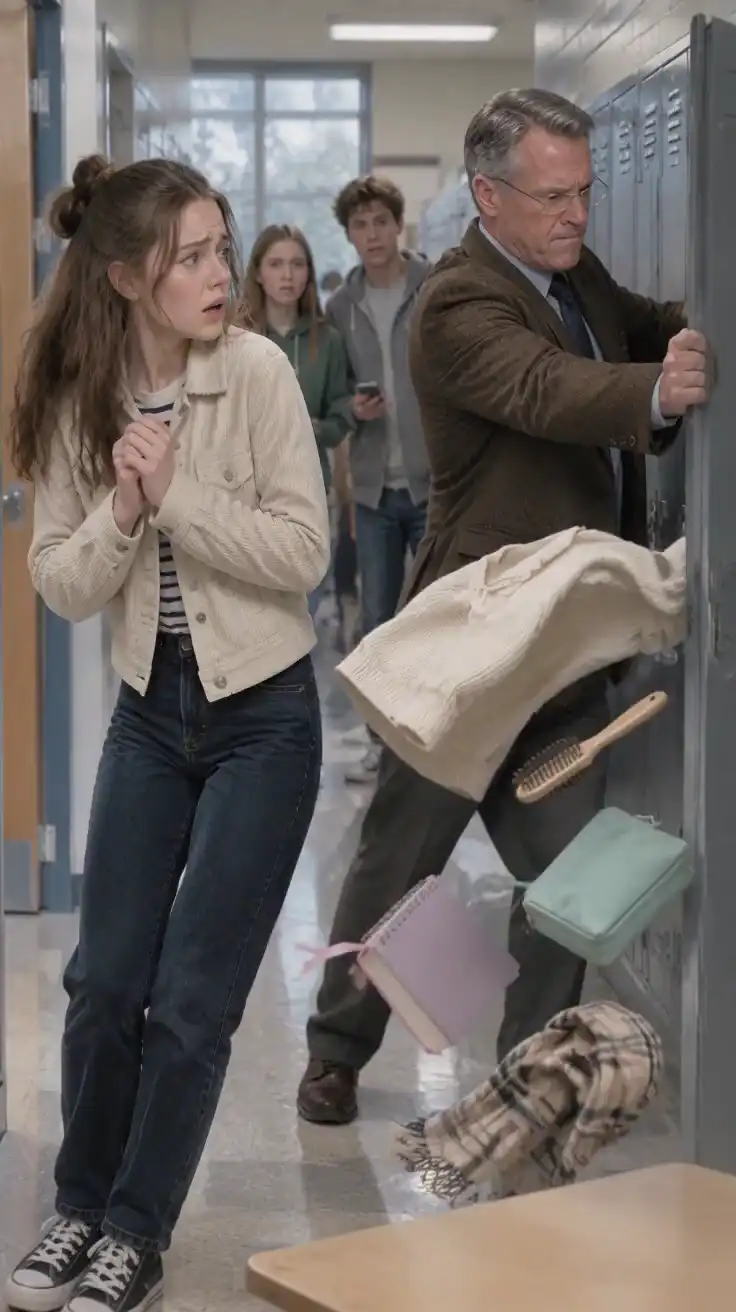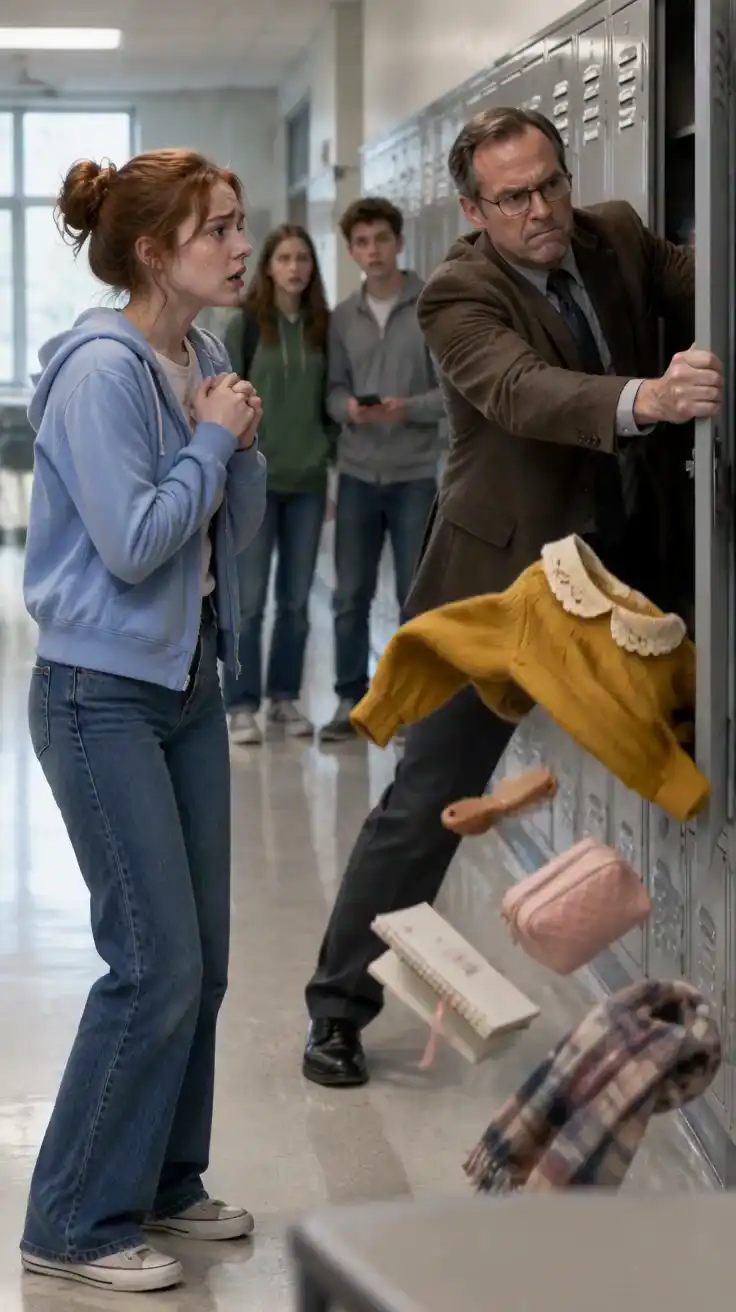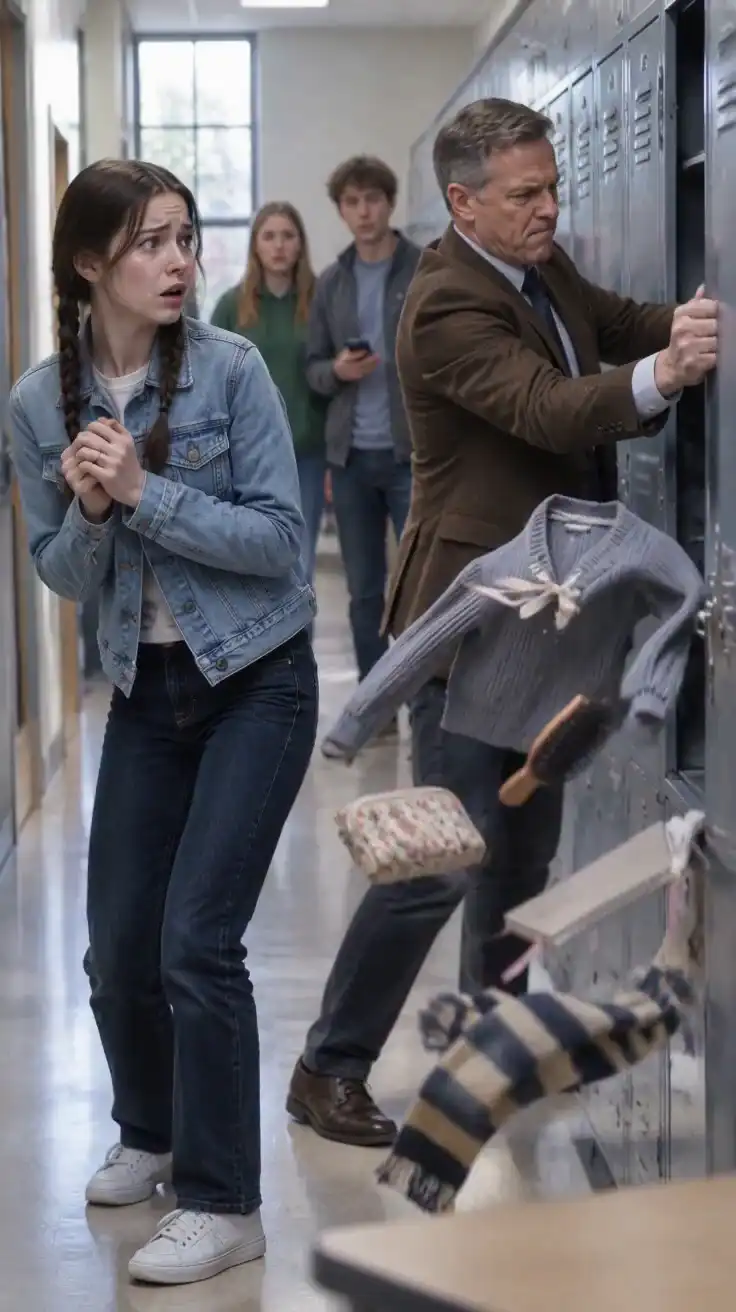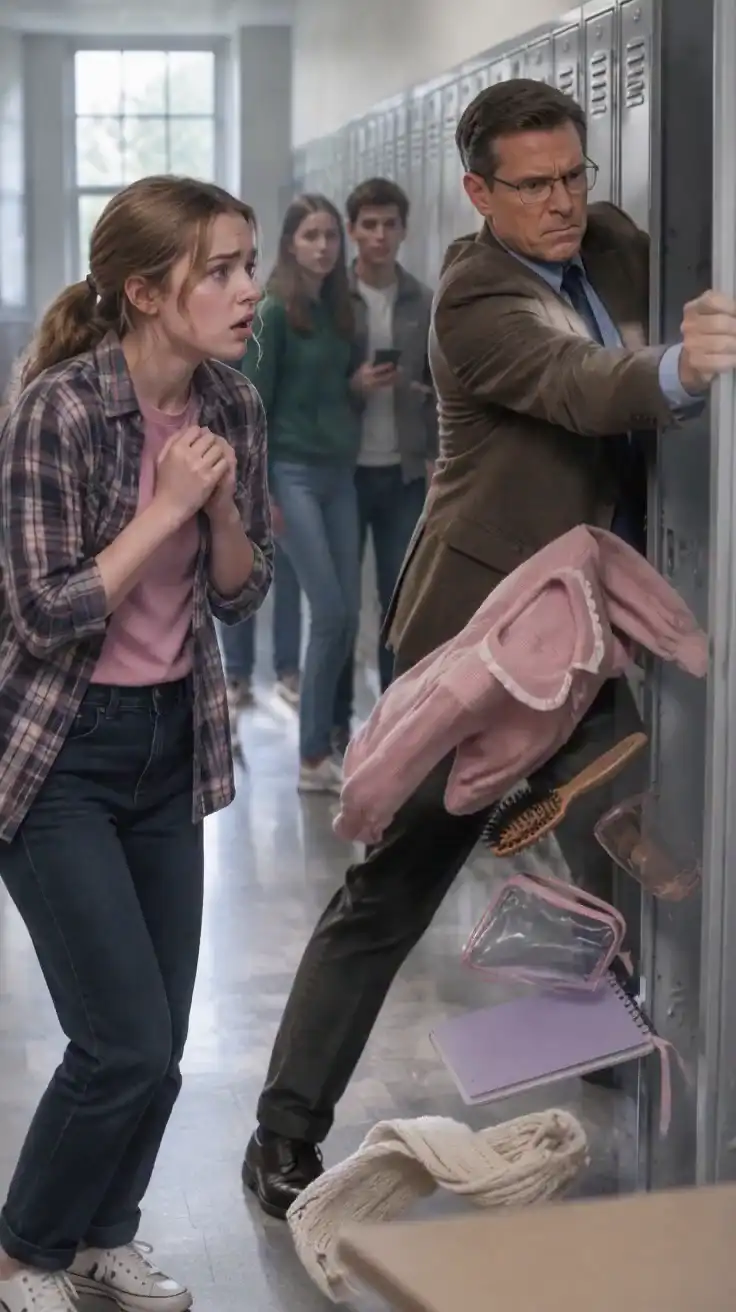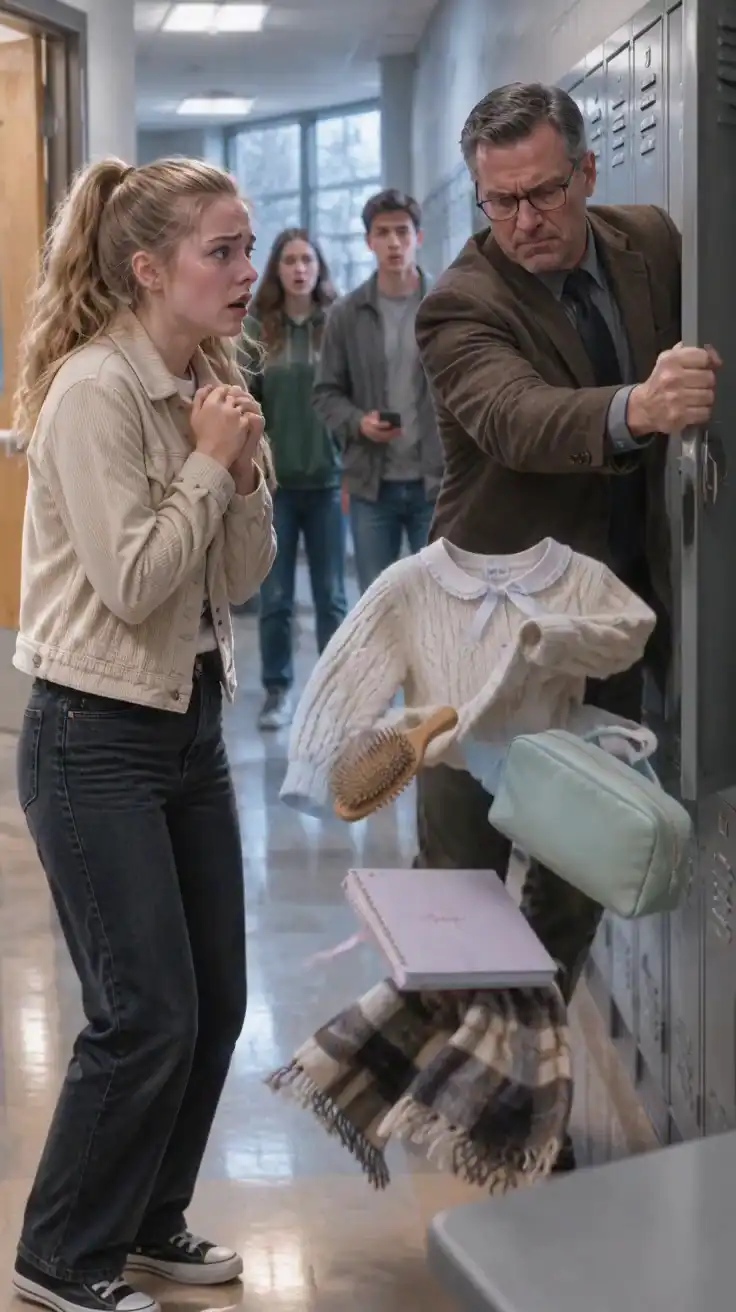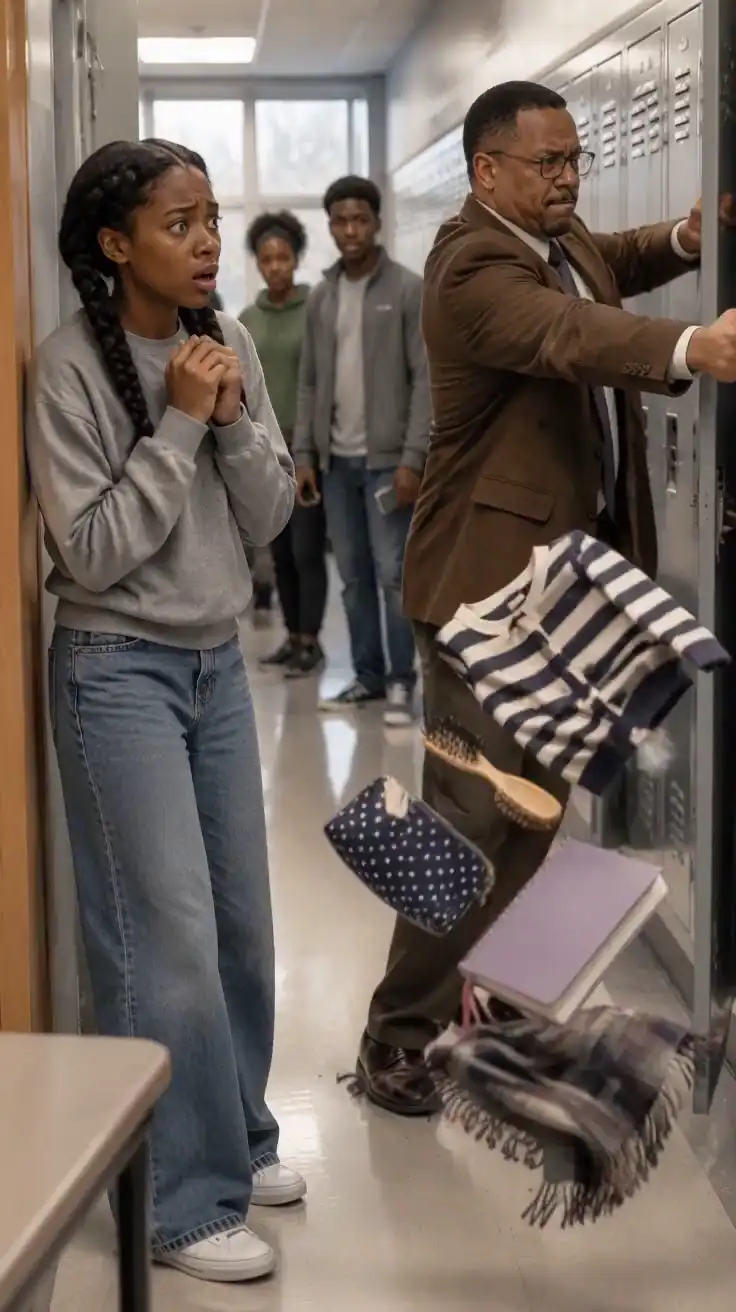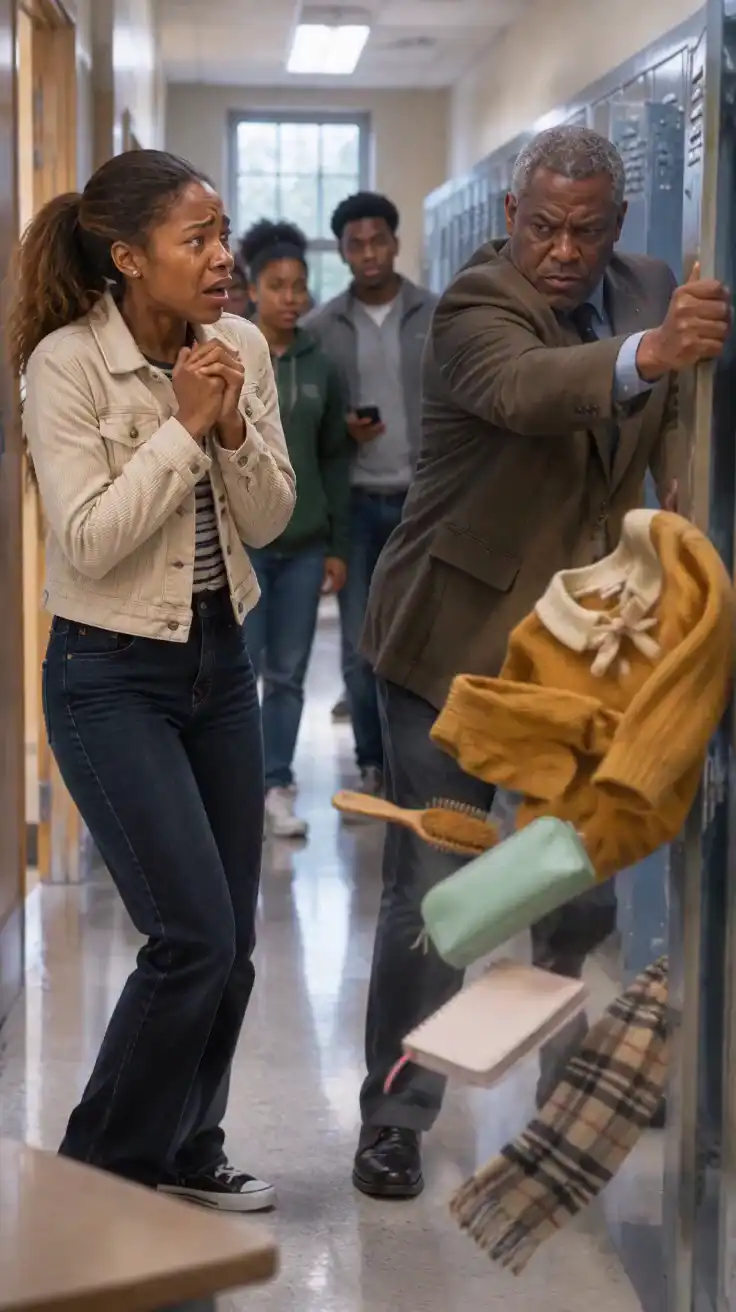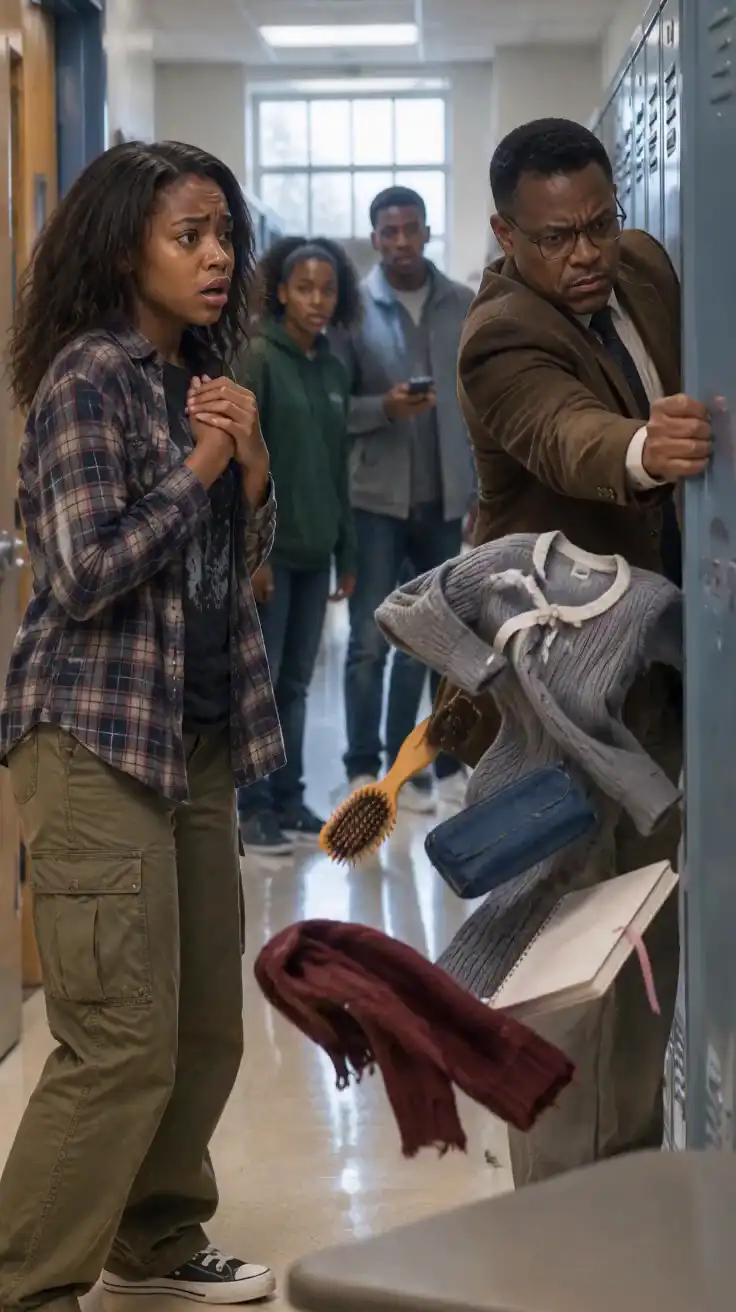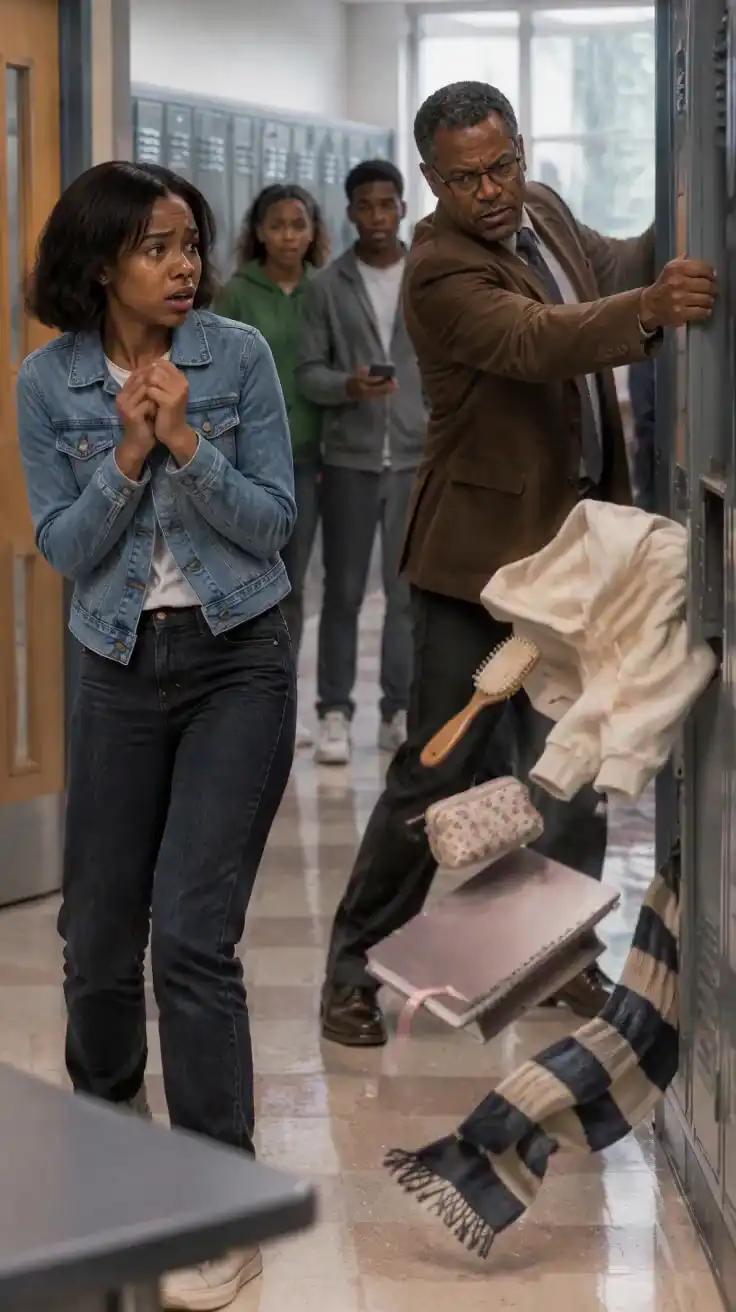
The bracelet hit the floor, and for half a breath the hallway went quiet.
Then Nia’s pencil case rolled off the pile of books. A purple pen skittered under a locker. Someone near the stairwell said, “Oh my God.”
The dean bent toward the bracelet as if it might explain itself. The girl who had pointed at Nia—Tessa Vaughn—had her arm still raised. Her sleeve had fallen back to her elbow.
“That’s yours?” Dean Mercer asked.
Tessa’s mouth opened. She looked at the bracelet on the floor, then at Nia, then at the faces gathering around them.
“I don’t know how it got there,” she said.
Nia was still kneeling. Her hands were on her thighs, fingers spread. She looked at the dean.
“You told me to show you my sleeves,” she said. Her voice was quiet, but it carried. “I did.”
Nobody answered.
I had watched that moment twice on the video before I called the school. I kept rewinding the few seconds before the bracelet dropped, as if some detail might appear that would make what I was seeing less ugly. I heard Nia ask, “Please don’t,” and I heard Dean Mercer say, “If you have nothing to hide, this will be quick.”
It was not quick. It was not private. And the bracelet was never in Nia’s possession.
But I did not know any of that when the first call came.
I was at my kitchen table with a stack of papers for the custody hearing spread out in front of me. The hearing was six days away. I had arranged the papers in three piles: school records, medical records, and anything that showed where Nia had been living and who had been caring for her. I had written dates in the margins in blue ink. I had a cup of tea gone cold beside my elbow and a pen balanced across the top of the folder.
The phone rang at 10:18.
The number on the screen belonged to Calder High.
I answered before the second ring. “This is Denise Carter.”
“Ms. Carter, this is Dean Mercer,” a man said. “I’m calling about Nia.”
I stood up so fast the chair scraped backward. “Is she hurt?”
“No. She’s safe.”
“Then tell me what happened.”
There was a pause. I could hear voices behind him, muffled and close. “There’s been an allegation that Nia took another student’s bracelet. We’re looking into it.”
“An allegation by whom?”
“A student.”
“Is Nia with you?”
“She’s in my office.”
“Can I speak to her?”
“Not yet. I need to finish gathering information.”
I looked down at the papers on my table. The top page was a school attendance report. I had printed it because the hearing officer wanted a full picture of Nia’s school year. There were no unexcused absences. I had checked that line three times.
“Dean Mercer,” I said, “I need you to tell me whether you searched her.”
“We’re following school procedure.”
“That is not what I asked.”
He said something that sounded like “we’re handling it,” and I understood then that the call was being managed. He wanted me to stay calm, to trust his process, and to wait until he decided I could know more.
I knew how to wait. I had waited on hold with doctors and social workers. I had waited in court hallways with folders in my lap. I had waited for people who said they would call back. This was different. My granddaughter was sitting in a school office while an adult decided what questions she was allowed to answer.
“Put Nia on the phone,” I said.
“I can’t do that until we’ve—”
“Then I’m coming to the school. Do not question her again until I arrive.”
“We’re not questioning her in a disciplinary sense.”
“Do not question her again.”
I hung up before he could answer. My hands were shaking, and I could feel the same old heat move through my chest, the kind that came whenever I realized someone had mistaken my patience for permission. I took my keys from the bowl by the door and left the hearing papers open on the table.
I did not know the bracelet had already fallen. I did not know Tessa’s accusation had come apart in a hallway full of students. I did not know Nia had been made to kneel beside the remains of her school day.
I knew only that the dean had called me about theft and had not let me speak to my granddaughter.
On the drive to Calder High, I called Nia’s mother, my daughter, Renee. She did not answer. I called again at the first red light. Straight to voicemail. I left her a message.
“Renee, it’s Mama. The school called about Nia. I’m on my way there. Call me now.”
Then I called the attorney who was helping me with the custody hearing. She answered with a rustle of paper in the background.
“Denise?”
“The school says there’s an allegation against Nia. I don’t know the details.”
“Is she suspended?”
“I don’t know.”
“Don’t discuss the hearing with the school. Don’t sign anything before we’ve seen it. Ask what the allegation is, who made it, who was present, and what evidence they have. Keep it factual.”
“I’m trying.”
“I know. Write down the times. And ask to see your granddaughter.”
I put the phone on speaker and set it in the passenger seat. At the next light, I wrote 10:18 on the back of a grocery receipt. It seemed ridiculous, writing down the time while I was driving to a school where my granddaughter might be in trouble. I did it anyway. Dates and times are easy for people to deny when you have not written them down.
The custody hearing was not something I talked about around Nia more than I had to. She knew it was coming. She knew her mother had been struggling, and she knew I had asked the court to let her stay with me while her mother got stable. She knew school reports and attendance and “home environment” could come up. She knew any trouble at school could be turned into a question about whether I was providing enough supervision.
She did not need every detail. She had enough.
Nia had been living with me since March, when Renee called at eleven at night and said she could not keep pretending everything was fine. She had been moving between a friend’s apartment and a motel, and she had been missing work because she did not have reliable transportation. I went to get Nia that same night. She came downstairs with a duffel bag and a plastic grocery sack of school clothes. She did not cry. She sat in the passenger seat and watched the road.
At my house, she put her things in the small bedroom at the back. The room used to be my sewing room. I had a twin bed, a narrow desk, a lamp, and a dresser. The next morning, we went to school and spoke with the attendance secretary. I signed the temporary caregiver form. The school made copies of my ID and the court papers Renee had signed. I was careful to ask what the school needed and to bring it in a folder.
I had been careful about everything.
I kept a calendar on the refrigerator. I bought the shampoo Nia liked. I learned what time her bus came and which days she stayed for debate practice. I called the pediatrician about transferring her records. When the court sent a notice for the hearing, I put it in the kitchen drawer beside the rent receipts.
None of that made me a perfect grandmother. I was sixty-eight years old. My knees complained when I went up the stairs, and I sometimes forgot to buy milk until breakfast. But I could get her to school. I could make dinner. I could be home when she walked in. I could answer the phone.
At the stop sign outside the school, I saw the late bus pass in the opposite direction. I gripped the steering wheel. My mind had started arranging possible disasters. Suspension. Police. A record in her file. Some note that could be read in court as “unstable placement.” My attorney had told me not to borrow trouble, but it was difficult not to borrow it when the school was already charging interest.
The office receptionist recognized me as soon as I walked through the door.
“Ms. Carter,” she said, standing up. “Dean Mercer is with Nia.”
“I need to see my granddaughter.”
“I’ll let him know you’re here.”
“I don’t need you to tell him I’m here. I need you to take me to her.”
She looked at the closed door beside the copy machine. “I’ll check.”
I did not sit down. She made a call, spoke softly, and listened. Then she said, “He’ll be out shortly.”
I looked at the wall clock. It was 10:43. I wrote it on the grocery receipt beneath the other time.
The door opened after a minute. Dean Mercer came out. He was a tall man with silver at his temples and a school badge clipped to his belt. He had met me at the beginning of the year when I brought in Nia’s paperwork. He had shaken my hand then and said, “We’re glad to have her here.”
Now he had his folder held against his chest.
“Ms. Carter,” he said. “Thank you for coming.”
“Where is Nia?”
“She’s in my office.”
“Is she all right?”
“She’s upset.”
“Then I’m going to see her.”
“I’d like to explain the situation first.”
“You can explain it while we walk.”
He glanced toward the receptionist. She found something to do with the forms on her desk.
“There was a report that a bracelet was taken from a student’s backpack,” he said. “The student believed Nia may have taken it.”
“Did anyone see Nia take it?”
“We’re still determining what happened.”
“Did you search her?”
“We asked her to empty her pockets.”
“That is a search.”
“We asked her to cooperate.”
“Did she agree?”
“She complied.”
I pictured Nia in my kitchen, standing at the counter after school with her backpack beside her, telling me how she had kept her voice level when another girl tried to bait her. I pictured her hands, narrow and quick, turning pages of her history notebook. I did not know yet that she had been on the floor. I did not know there had been a video.
“I want to see her,” I said.
He stepped aside. “Of course.”
His office door opened onto a small room with two chairs and a desk. Nia stood when she saw me. Her backpack was on the floor. A wet shine gathered in her eyes, but she did not let the tears fall.
“Grandma.”
I crossed the room and took her shoulders in my hands. “I’m here.”
“I didn’t take it.”
“I know.”
“I didn’t.”
“I know, baby.”
She was trying to speak without crying. I could hear the effort in her breath.
“Did you touch the bracelet?” I asked.
“No.”
“Did you go near Tessa’s backpack?”
“No. I was at my locker.”
I looked at the dean. “What happened?”
He took a moment before answering. “A bracelet was reported missing. Tessa said she saw Nia near her backpack.”
“That is not what I asked.”
“She identified Nia as the student who took it.”
“Did you check the hallway cameras?”
“There isn’t a camera pointed at the lockers on that corridor.”
“Did you ask Tessa what time she last saw it?”
“Yes.”
“What did she say?”
“That she had it during first period and noticed it was missing before fourth.”
“Where was her backpack during that time?”
“Near the classroom.”
“Was anyone else near it?”
“I can’t discuss another student’s statements.”
I turned back to Nia. “What happened between the call and now?”
She swallowed. “Mr. Mercer said the bracelet was missing. He asked if I knew anything. I said no. Then he said Tessa saw me by her bag. I said I had never touched it. He asked me to empty my pockets.”
“Did you?”
“Yes.”
“Then what?”
“He said we should check my locker.”
“Did you say yes?”
“I said I didn’t have anything that belonged to her.”
“Did he ask you if you agreed to the search?”
“I don’t remember him saying it like that.”
Mercer cleared his throat. “We had reason to believe the item could be in her locker.”
“Based on one student’s statement,” I said. “And you called me afterward.”
“I called you when the situation was already developing.”
Nia glanced at me. I saw the quick look she gave whenever adults began speaking over her. She was checking whether there was room for her voice.
I held her hand. “Keep telling me what happened.”
She spoke more slowly. “We got to my locker. Mr. Mercer told me to open it. He pulled out my books. Then he took my notebooks out. My pencil case fell. He asked me to show him my sleeves.”
I looked at the dean. “He asked her to kneel?”
“No,” Nia said.
The answer came too fast. I understood that there was more.
“Nia,” I said, not loudly. “Tell me exactly.”
“He said the bracelet could be inside my sleeve. I said it wasn’t. He told me to raise my arms. The students were watching, and people had their phones out. I didn’t know what to do. Then he said, ‘Kneel down and show me.’”
My fingers tightened around hers.
“I asked if you could be there,” she said. “He said this would be over in a minute. I said, ‘Please don’t.’”
A line of anger opened up inside me. I kept my voice level. It was not because I was unangry. It was because the school had already treated my granddaughter’s fear as a reason to press harder.
“You made her kneel in the hallway?” I asked.
“I was trying to locate the bracelet,” Mercer said. “Students had gathered, and I needed to determine whether she had the item.”
“Did you find it?”
“No.”
“Where did you find it?”
He looked at the floor for a moment. “Tessa’s sleeve.”
“After she accused Nia?”
“Yes.”
“Then why is Nia in your office?”
“She is not being disciplined at this time.”
“Did you call me because she was being searched, or after you had already done it?”
He did not answer.
Nia’s hand was cold in mine. I wanted to turn around and take her home. I also knew that leaving without a clear account could become another blank space in the file, another phrase somebody could use later: guardian removed student before inquiry was complete.
I pulled my phone from my purse. “I’m calling my attorney.”
“Ms. Carter, we can resolve this internally.”
“I do not know what ‘resolve’ means yet.”
I stepped into the hall, made the call, and explained what I knew. My attorney told me to ask for the names of every adult present, a written summary of the school’s actions, a copy of any incident report, and preservation of any video captured by students or school cameras.
When I went back in, the dean was standing by the desk. Nia had sat down.
“Do not delete or overwrite any camera footage from the east corridor,” I said. “I want that in writing. I also want the names of the staff who were present.”
“The school will follow its retention policy,” he said.
“Then confirm that in writing.”
“I can do that.”
“And nobody will question Nia again today without me present.”
“We have not been questioning her.”
“Then you won’t have any difficulty agreeing.”
A knock came at the office door. A woman from student services stood there with a tablet. She said she was Ms. Patel, the assistant dean.
“I was there,” she said. “I want you to know I did not touch Nia or her belongings.”
I turned toward her. “Did you see the search?”
“Yes.”
“Did you object?”
Her eyes dropped, then lifted. “I asked that we keep the students back.”
“That wasn’t my question.”
“No,” she said. “I didn’t object to the search.”
It was a straight answer. I respected her more for giving it. It did not make the answer easier to hear.
“Were there other staff members?” I asked.
“The hall monitor came up, and Mr. Lewis was coming from the science wing. I think a counselor was there too.”
“You think?”
“There were a lot of students in the hallway.”
Mercer said, “We can identify everyone who was present.”
“Please do.”
Nia spoke from the chair. “Tessa was there the whole time.”
The dean looked at her. “Tessa was asked to remain in the area.”
“She was standing right there,” Nia said. “She kept saying I took it.”
“We’ll speak with her.”
“She already told you what she wanted you to hear,” I said.
The phone rang in the office. Mercer answered it, listened, then said, “Bring her down.”
Nia looked at me. “She’s coming here?”
“I don’t know,” I said. I did not take my hand away.
A few minutes later, Tessa came in with a counselor. She was tall and narrow-shouldered, with dark hair tied back in a low ponytail. She wore the school sweater over a white shirt. The cuff on her left sleeve had a small pull in the knit.
Her father was not with her. She looked at the floor, then at the chair beside the door. She did not sit.
Dean Mercer said, “Tessa, we need to clarify what happened.”
“I already told you what happened,” she said.
“Your bracelet was found in your sleeve.”
“It must have slipped in there.”
“You told me Nia took it.”
“I saw her near my bag.”
Nia sat very still. I felt her thumb move against mine.
“When did you see her near your bag?” I asked.
Tessa looked at Mercer. “This is a school meeting.”
“It became a family matter when you accused my granddaughter.”
“Ms. Carter,” Mercer said, “let me handle the questions.”
“I’m listening.”
He turned to Tessa. “Did you see Nia take the bracelet from your backpack?”
Tessa hesitated. “I saw her by the desk.”
“That’s not what I asked.”
“I didn’t see her take it.”
“Did you tell me you saw her take it?”
“I said I thought she had.”
“Did you say you watched her do it?”
Tessa’s eyes moved toward Nia. “I don’t remember.”
Nia gave a small, incredulous laugh. It was not quite a laugh. It was a breath that had caught on the way out.
“Tessa,” I said, “why did you say it was her?”
“I thought it was her.”
“Because?”
“She’s been watching me.”
Nia turned her head toward her. “I have not.”
“Enough,” Mercer said.
I looked at him. “You’re telling Nia to stop responding, but you haven’t told Tessa to stop making claims.”
“I’m making sure we don’t turn this into an argument.”
“Then ask the question plainly.”
He did not. The meeting ended with the school saying it would continue reviewing the incident. Nia was allowed to return to class, though she did not want to. I asked for her things to be placed in a paper bag, not carried through the hall in another pile. A staff member brought them to the office. I gathered the notebooks and papers. The family photo had a crease through the corner. It was a picture of Nia and her mother at the beach when Nia was seven. The photo had come loose from its frame the year before, and Nia had put it in her pencil case because she wanted to keep it safe.
I smoothed it with my palm.
The school did not suspend Tessa that day. The first time I heard that she had been suspended was when the video was sent to me.
I got home around noon. Nia went upstairs without taking off her jacket. I placed her books on the kitchen table and checked the phone for messages. Renee had called twice. I called her back.
“What happened?” she asked.
“The dean searched Nia’s locker in the hallway. Tessa accused her. The bracelet fell out of Tessa’s sleeve.”
“What?”
“That’s what happened.”
“Is Nia okay?”
“She’s home. She’s shaken.”
“Did they suspend her?”
“No.”
“Did they call the police?”
“No.”
“What do you mean, no? Did they—”
“They did not suspend her. They haven’t called the police. I’m waiting for the school to put the incident in writing.”
Renee went quiet. I could hear her breathing. “I should have been there.”
“You weren’t told. I called you when I got the call.”
“I should have answered.”
“You can’t go back and answer a phone call that already happened. You can call your daughter now.”
I heard her make a small sound, half a sob and half a breath.
“Let me talk to her,” she said.
“She’s upstairs. I’ll ask.”
I went to the bedroom and knocked. Nia was sitting at the desk, still wearing her school sweater. Her books were stacked beside her. The pencil case had been emptied and put back together.
“Your mom wants to talk.”
“Okay.”
I handed her the phone and went downstairs. I did not listen in. I had already learned that care could turn into hovering if I was not careful. I made a grilled cheese sandwich and left it on a plate. When Nia came down, the phone was in her hand.
“Mom says she’s sorry,” she said.
“She is.”
“She said she should have come to the school.”
“You don’t need to make her feel better.”
“I know.”
She sat at the table. Neither of us touched the sandwich.
“Grandma,” she said, “is this going to hurt the hearing?”
I sat across from her. “I don’t know what the school will write down yet. I’m going to make sure the truth is in the record.”
“But if they write that I was involved?”
“Then we’ll correct it.”
“What if they don’t believe me?”
“Then they will have to explain why they don’t believe you.”
She looked down at her hands. “I don’t want you to lose.”
“I’m not going to lose you.”
“I mean the hearing.”
“I know what you mean.”
She had learned the language of court without ever entering a courtroom. She knew that adults could make your life the subject of a meeting and talk as though you were not sitting there. She knew that “temporary” could become a long time. She knew that each person had an opinion about what was best for her, and that sometimes those opinions did not match what she wanted.
I reached for the sandwich and pushed it closer to her. “You have a hearing with your mother and me about where you stay. You do not have a hearing about whether you deserve to be believed. Those are not the same thing.”
She nodded, though I could tell she was not sure she believed me.
That afternoon, at 3:17, my phone chimed with a message from a number I did not recognize. It was a link to a video. The text said: “I’m sorry this happened to Nia. This is what I got.”
I opened it. It was the hallway recording I would watch twice before calling anyone. It began with the sound of lockers, shoes, and a voice asking what was going on. The camera moved in short, uncertain jerks. Nia’s books were scattered on the tile. Her pencil case was open. The dean stood over her locker. Tessa was several feet away.
“Show me your sleeves,” the dean said.
Nia put her arms out. Her hands trembled.
“Please don’t,” she whispered.
“If you have nothing to hide, this will be quick.”
Then the video caught Tessa raising her arm. The bracelet slipped from her cuff and dropped to the floor.
I watched it twice before I could make myself call anybody.
The person who sent it was a student named Jordan Ellis. His message said he had recorded because he thought the dean was being unfair and had not known what else to do. He had sent the video to his mother first. His mother told him to send it to me and not post it anywhere.
I called him back. He answered on the second ring.
“Jordan?”
“Yes, ma’am.”
“Thank you for sending this.”
“I’m sorry I didn’t say anything in the hallway.”
“You were a student in a crowded corridor. I’m not going to blame you for not knowing what to do.”
“I should’ve told him to stop.”
“You are not responsible for making the adults in that hallway behave like adults.”
He went quiet.
“Did you record the whole thing?” I asked.
“Most of it. My phone was in my hand already. I missed the part before the dean started pulling things out. I have the second part too, where the bracelet drops.”
“Please don’t post it.”
“I won’t.”
“Have your mother keep the original. Don’t edit it, don’t forward it to other students. My attorney may ask for a copy.”
“Okay.”
“Did you see who put the bracelet in Tessa’s sleeve?”
“No. She had her arm down. I didn’t see anything until it fell.”
That night I emailed Dean Mercer, copied my attorney, and asked for a written incident report, the names of all staff and students present, the school’s search policy, and confirmation that the video had been preserved. I included the time of the phone call, the time I arrived, and the words Nia had reported hearing. I did not write that the dean had humiliated her, though that was what I wanted to write. I wrote that he had directed a sixteen-year-old student to kneel in a public hallway while her belongings were searched.
The response came the next morning at 8:06.
It said the school was “reviewing the circumstances” and “would not comment on student discipline.” It thanked me for “bringing concerns to the administration’s attention.”
The tone made it sound like I had reported a broken water fountain.
At 9:12, Dean Mercer called again.
“Ms. Carter, I wanted to speak with you about the video.”
“You’ve seen it?”
“I have.”
“Then you know what happened.”
“I know what the video shows.”
“What does that mean?”
“It shows a difficult interaction. I wish it had not happened in the hallway.”
“Do you wish Nia had not been made to kneel?”
“I should have handled the search differently.”
“Did you have authority to search her locker?”
“We have authority to inspect school property when there’s reasonable suspicion.”
“Did you have reasonable suspicion?”
“We had a student report.”
“A student report that the student later changed.”
“That’s part of what we’re investigating.”
“Why did you call me after you searched her?”
“I should have called before.”
“Why did you tell her to kneel?”
“I thought the bracelet might be concealed in her sleeve.”
“Did you think she had stolen it, or did you think you could make her prove she hadn’t?”
There was a pause.
“I understand how it looked,” he said.
“It looked like what you did.”
He did not answer.
The school called Tessa and her parents in that morning. I was not invited, and I did not expect to be. I knew Tessa was sixteen too. I knew that one accusation did not make her a monster. I also knew that being young did not remove the harm she caused.
At 12:40, Nia’s phone buzzed while she sat at the kitchen table doing homework. She looked at the screen and turned it over.
“Who is it?” I asked.
“Lana.”
“What did she say?”
Nia picked up the phone and read the message. “She said Tessa’s suspended.”
I stopped cutting carrots. “How does she know?”
“Her brother’s in Tessa’s math class.”
“Maybe wait until we hear from the school.”
At 12:52, Dean Mercer emailed. He wrote that Tessa had been suspended pending further investigation for “knowingly making a false report and interfering with a school inquiry.” The suspension began immediately. The school had also taken her account of events and notified her parents. Nia was not being disciplined. The school said it would provide support for her return to class.
I read the message twice.
The opening post said the dean suspended Tessa on the spot because that was the part Nia repeated at dinner. But the truth was less tidy. Tessa did not receive a suspension in the hallway while the bracelet was still on the floor. The dean let her leave that day. He called her family in the next morning and issued the suspension after reviewing the video and speaking with students.
Still, from the time the bracelet slipped free, the accusation could no longer stand on its own. And when the dean finally made the decision, he made it without waiting for the school board or a long disciplinary panel. He said he was suspending Tessa pending investigation. In the time it took for one email to travel from his office to my kitchen, Tessa was off school grounds.
The video changed what the school could pretend it had not seen.
Nia returned to school the next day. I drove her. She asked me to drop her at the side entrance because she did not want to walk through the main corridor. I told her I would wait in the car until she was ready.
“I can’t do that,” she said. “If people see you waiting, they’ll think I’m scared.”
“You are allowed to be scared.”
“I know. I just don’t want to look like I’m scared.”
She reached for the door handle, then stopped. “Grandma, can you tell me what you’d do?”
“I’d go in, keep my shoulders down, and talk to the people who need to hear from me. But I’m not sixteen. You get to decide what feels possible today.”
She nodded. “I’ll go in.”
At the front doors, two girls from her English class stood by the windows. One of them looked at Nia and then looked away. The other kept looking. Nia did not change her pace.
When she came home, she put her bag on the chair and said, “Nobody asked me about it.”
“That’s good.”
“Not really. They stared. They just didn’t ask.”
I made tea. She sat at the kitchen table.
“Did you see Tessa?”
“No.”
“What about your classes?”
“Fine.”
“Did your teachers say anything?”
“Mr. Bell asked if I was all right. I said yes. He told me to let him know if I wanted to talk.”
“Did you?”
“No.”
She took a sip of tea and winced because it was hot.
“Tessa’s desk is empty,” she said.
I waited.
“I keep thinking about the test.”
That was when she told me the whole story.
Tessa and Nia had known each other since freshman year. They had both been placed in advanced English and honors biology. They had similar grades, though Nia had always been stronger in writing and Tessa in math. They had both wanted the student seat on the academic council. They competed for the same summer research program and the same place on the debate team. A teacher once asked them to partner on a project because she said they were “two of the sharpest students in the room.” They completed the project, earned an A, and did not speak to each other for three days afterward.
There was no single beginning to their rivalry. It came from small things that accumulated until each girl knew exactly where the other was strongest and where she could be made to feel weak.
Freshman year, Tessa won the school’s fall writing prize. Nia placed second. Tessa’s essay was about the day her family moved into a new apartment, and the teacher read a paragraph aloud during class. Nia told her afterward that she liked the ending. Tessa answered, “You don’t have to pretend you’re happy for me.”
“I wasn’t pretending,” Nia told her.
“You always say the right thing so teachers like you.”
Nia did not tell me about that conversation until much later. At the time, she called Tessa “intense.”
The next month, Nia won a place in the debate team’s travel squad. Tessa had been an alternate. She congratulated Nia in the hallway and then asked if Nia’s grandmother had made the speech for her.
Nia said, “No.”
Tessa said, “You know what I mean.”
Nia had answered, “I do, actually. You think I didn’t write it.”
That was the first time they had argued in front of other people.
The years after that brought plenty of reasons for them to be near each other. Both families lived in the same part of town. Both girls took the same bus. They entered the same academic competitions and earned similar grades. Tessa’s mother, Linda, worked in a dental office. Her father, Peter, supervised a warehouse. They lived in a newer development across the main road from our neighborhood. Tessa always had what she needed. That did not mean she had an easy life. Her parents were strict about grades, and her father had a habit of calling a B a “warning.”
Nia’s life changed when her mother became unreliable. The shift did not happen all at once. Renee started canceling plans. She stayed out later. She left Nia waiting after practice. Sometimes she came back with a reason. Sometimes she came back with no explanation and a bag of groceries she could not afford.
Nia had already learned to cover for her. She told teachers that her mother had a schedule change, that the car was in the shop, that everything was fine. She tried not to let other students know.
Tessa noticed.
At the end of sophomore year, both girls applied for a summer scholarship to a state science program. Nia got it. Tessa did not. When the school announcement went up, Tessa said, “Must be nice to have a sob story.”
Nia told her, “Don’t talk about my family.”
“I didn’t mention your family.”
“You did.”
“I said the program likes a good hardship story.”
Nia had been awarded the scholarship on the strength of her grades and the essay she had written about public health. The program had not asked about hardship. But Tessa had heard her mention her mother’s missed appointments to a counselor, and she knew enough to make the comment land.
Nia came home angry that afternoon. She walked in, put her bag on the floor, and said, “I should have pushed her into a locker.”
“You should not,” I told her.
“I know.”
“Being right does not make you safe if you put your hands on somebody.”
“I know.”
“Do you want to tell me what she said?”
“No.”
I did not make her. I had taught her that she could ask for me, and that she had to answer clearly when someone in authority asked her a question. I also tried to teach her that silence could be a choice, not only a failure.
The cheating happened last month, in chemistry.
Nia had told me Tessa was still acting strange after the semester exams. She had not described it as an accusation. She said Tessa was “trying to make everyone think I’m after her.” I asked what she meant.
“Nothing. She said I was looking at her paper. I wasn’t.”
“What did you say?”
“I said she could ask Mr. Bell if she wanted. She didn’t.”
“That sounds like the end of it.”
“It should have been.”
It was not. During a chemistry test, Nia sat two rows behind Tessa. The teacher had handed out a set of problems and reminded students that they could not use notes or calculators with saved equations. About twenty minutes into the test, Nia looked up from her work to get a tissue from the box on the teacher’s desk.
She saw Tessa’s paper angled toward the student beside her. Tessa’s left hand covered the upper corner, but the page was turned enough that the student could see the answers. Tessa tapped one line with her pencil. The other student wrote something down. Then Tessa moved her paper back.
Nia did not say anything in the room. She finished the test, handed it in, and went to class. At the end of the period, she waited while the other students left. She went to Mr. Bell’s desk.
“I saw Tessa showing answers during the test,” she said.
Mr. Bell looked up. “Did you see her paper clearly?”
“I saw her turn it toward Mia. I saw Mia copying. I didn’t see what they wrote.”
“Are you certain it was intentional?”
“She covered the top with her hand and pointed at the answer.”
He put his pen down. “Do you want to make a formal report?”
“I don’t want to get her in trouble just because I don’t like her.”
“That is not what I asked.”
“I know. I want you to check. If she didn’t do it, then she didn’t. If she did, she shouldn’t get a different grade from the rest of us.”
Mr. Bell thanked her and said he would speak with both students separately. He also told her not to discuss it with classmates.
Nia came home and told me. She seemed uncomfortable about it. I asked whether she was sure.
“Yes.”
“Could she have been showing a formula?”
“It was the answer.”
“Could she have been explaining something to Mia after she was done?”
“She wasn’t done. The timer was still running.”
“Then you did what you thought you should.”
“She’s going to know I told.”
“Possibly.”
“She’ll say I’m doing it because I’m jealous.”
“Are you?”
“No.”
“Then you know your reason.”
Two days later, Tessa told Nia that the teacher had called her in. She did not say what the teacher asked. She said, “You always have to make yourself the hero.”
Nia answered, “I told Mr. Bell what I saw.”
“You had no business reporting me.”
“I had every reason.”
“You didn’t see anything.”
“I did.”
“You just wanted the teacher to think you’re honest.”
Nia said, “I wanted him to know what happened.”
Tessa walked away, and neither of them said anything more about it.
Mr. Bell investigated. He spoke with Mia, the student sitting beside Tessa. He reviewed the seating chart and looked at the test papers. He did not tell Nia what discipline, if any, had followed. He told her only that he had addressed the matter and that she should bring future concerns to him privately.
Nia went home unsettled. She thought she might have been wrong to tell. I told her that reporting what she saw was not the same as deciding what punishment Tessa deserved.
Now she sat at my kitchen table with both hands around her tea.
“I think she thought I wanted to ruin her,” she said. “She kept saying I was trying to get her kicked off the academic council.”
“Were you?”
“No. I wanted Mr. Bell to know.”
“Then that is what you did.”
“She said she’d remember.”
I looked at her. “Did she say that before the bracelet?”
“No. Not exactly. She said, ‘People remember who gets them in trouble.’”
The school had moved quickly after the video surfaced, but not quickly enough to undo the search. Tessa was suspended on the morning after the incident. The suspension lasted three school days while the administration spoke with her, Nia, the teacher who had witnessed part of the search, Jordan, and several students who had been in the hallway. The school also reviewed what it could from the camera at the end of the corridor. The camera did not show the lockers directly, but it showed the students gathering and the dean going toward Nia’s locker.
I asked the school for the full account. They sent me a summary instead. It said the bracelet belonged to Tessa and had been found in her sleeve. It said Tessa had reported that she believed Nia took it. It did not state whether she had knowingly lied. It said the dean had “used poor judgment in the location and manner of the search.”
That phrase did not satisfy me.
I asked for an apology in writing. The dean called me instead.
“I have apologized to Nia,” he said.
“Did you apologize for making her kneel?”
“I said I was sorry for the way it happened.”
“That is not the same thing.”
“I told her I should have handled it differently.”
“Did you tell her that what you did was wrong?”
“I did.”
“Did you tell her you were wrong to treat her fear as evidence?”
He went quiet.
“I understand this was very upsetting,” he said.
“I am not asking you to understand that she was upset. I am asking you to understand what you did.”
The next day, he met with Nia and me in the principal’s conference room. The principal, Dr. Sloan, was there. Ms. Patel came too. Nia sat between me and the window. She held a notebook on her lap but did not open it.
The dean began. “Nia, I want to apologize for how I handled the search.”
Nia looked at him. “You made me kneel in front of everyone.”
“Yes.”
“You said if I had nothing to hide, it would be quick.”
“Yes.”
“You said that after I told you I didn’t take it.”
“I should not have said that.”
“You didn’t believe me.”
“I thought I needed to find the bracelet. I did not slow down and consider how I was treating you.”
“Why did you make me kneel?”
He rubbed his palms together. “I was concerned it might be in your sleeve.”
“You could have asked me to lift my arms. You had already done that.”
He nodded.
“You didn’t have to pull everything out of my locker.”
“I agree.”
“Then why did you do it?”
“I made a poor decision.”
Nia looked down at the notebook. “That is what adults say when they don’t want to say what they did.”
The room stayed quiet.
Dr. Sloan folded her hands on the table. “Nia, I want you to know that we are reviewing our procedures and that you should have been treated with more dignity.”
“I don’t want a poster about dignity,” Nia said. “I want to know it won’t happen again.”
“Fair,” Dr. Sloan said. “We’re adding a requirement that a guardian be contacted before a search of a student’s personal belongings unless there is an immediate safety concern. We’re also requiring a second administrator to be present.”
“Is that for everybody?” I asked.
“Yes.”
“Will you tell the students?”
“We’ll review the procedure at the next staff meeting and in our student handbook.”
“Will the handbook say what happened to Nia?”
“No. We cannot share another student’s private information.”
“I’m asking about the procedure, not the other student.”
“Yes, we can publish the procedure.”
Nia looked up. “Are you going to tell people I stole it?”
“No,” Dr. Sloan said. “You were not found responsible for stealing the bracelet.”
“Will you tell people I didn’t?”
“We can confirm that you were not disciplined and that no stolen property was found in your possession.”
“People don’t hear the second part,” Nia said. “They hear the first thing they already believe.”
Dr. Sloan did not try to argue. “I can’t control what students say. I can make sure the school’s record is accurate.”
“I want the report to say I denied taking it and that the bracelet fell out of Tessa’s sleeve.”
“It will say that.”
“Not ‘was recovered near Tessa.’”
Dr. Sloan turned toward the dean. “We can be specific.”
Nia had prepared for the meeting. She had written the things she wanted to say in her notebook. She did not read them from the page. She spoke in a low voice, without apologizing for the time she took. I was proud of her, and I did not tell her that until we got to the car.
The school promised a corrected report. It took three weeks to arrive.
By then, the custody hearing had taken place.
I had been afraid of the hearing before the school called. After the call, I was afraid in a more specific way. I imagined the other lawyer asking whether Nia had been accused of theft. I imagined the word “search” written in a report and read aloud without the part where the bracelet fell from Tessa’s sleeve. I imagined the school saying it was still investigating and the court deciding uncertainty was enough.
My attorney told me to bring the documents and not let anyone turn a false accusation into a finding.
The hearing room was small, with a round table and two chairs for the adults. Nia sat beside our attorney. Renee sat on my other side. She had worn a navy blouse and had her hair twisted up. She looked tired, but she was there.
The hearing officer, Ms. Bishop, went through the recent history. She asked Renee about her housing, work, and treatment plan. Renee answered honestly. She had a part-time job at a grocery store and had moved into a room at a friend’s apartment. She was attending appointments and had arranged transportation to work. She did not say things were fixed. She said she was working on them.
When it was my turn, I described the routines I had established for Nia. I gave dates and records. I answered questions about my income and health. I said I could care for Nia for as long as necessary, but I would support her relationship with her mother.
“Does Nia want to live with you?” Ms. Bishop asked.
I looked at my granddaughter.
“I want to stay with Grandma while Mom gets stable,” Nia said. “I want to see Mom. I don’t want to have to choose between them.”
The other attorney asked about the school incident. I had expected it.
“Isn’t it true that Nia was involved in a theft investigation?”
“No,” I said.
“Wasn’t a bracelet reported missing?”
“Yes.”
“Was Nia suspected?”
“She was accused by another student. The bracelet fell from that student’s sleeve while Nia was being searched.”
“Was Nia formally cleared?”
“She was not disciplined. The school’s corrected record states that no stolen property was found with her and that the bracelet was found on the accusing student.”
The attorney glanced at her papers. “And you say this had nothing to do with the home environment?”
“It happened at school. My granddaughter was placed in a situation that should not have happened. I took her home, contacted the school, and made sure the record was corrected.”
“Do you think the incident upset her?”
“Of course.”
“Could the stress at home have contributed to it?”
“No.”
“You don’t think having an unstable home could affect a student’s behavior?”
“I think what happened was caused by the false accusation and the search. I won’t pretend the rest of Nia’s life has been stress-free. But she did not take that bracelet.”
The attorney moved to another question.
Afterward, Renee and I sat in the courthouse hallway while Nia went with our attorney to speak briefly to the hearing officer. Renee had both hands folded in her lap.
“I hate that she knows the court might use something like that against her,” she said.
“So do I.”
“I hate that I made things harder.”
“You are trying to make them better now.”
She looked at me. “You don’t have to make me feel better.”
“I’m not. I’m telling you what I see.”
Renee nodded and stared at the floor.
The court allowed Nia to remain with me for six months, with a review after that. Renee was granted visits and agreed to a schedule that started with two afternoons a week. The decision did not make our family whole. It did give Nia a place to sleep without worrying that she would have to pack her bag again the next morning.
When the hearing officer read the decision, Nia squeezed my hand. She did not smile. She looked tired.
On the ride home, she said, “I don’t want to be the reason Mom has to keep proving herself.”
“You are not the reason.”
“She has to do all these things because I can’t live with her right now.”
“Your mother is doing them because she needs to get stable. The court is paying attention because you need a safe place to live. You are not the cause of the adults’ problems.”
She watched the passing houses. “It still feels like it’s about me.”
“I know.”
The school made its own decisions about Tessa. After the three-day suspension, she returned with a behavior agreement. The school did not share all the details with me, and I did not ask for them. I knew she had to meet with a counselor, and that she was removed from the academic council for the remainder of the semester. She was also required to make a written statement to the school acknowledging that her accusation had not been supported.
The school did not call it a confession. Tessa’s parents objected to that word. They said she had been confused and embarrassed, not malicious. They said the bracelet had been hers and that she had not planned to frame anyone.
I did not know whether she had planned it.
The fact I knew was that Nia saw her cheating on a test, reported what she saw, and then Tessa accused Nia of taking a bracelet that was hidden in Tessa’s own sleeve. I could not prove what Tessa had meant to do when she put the bracelet there. I could see what she did when she pointed at Nia.
The school counselor called me after the investigation. “We want to offer a mediated meeting,” she said.
“No.”
“Would Nia be willing?”
“You can ask Nia, but I’m not agreeing for her.”
“I understand. We think a restorative conversation could help both students.”
“Help them how?”
“It would give each student a chance to explain the impact and discuss how they can move forward.”
“Has Tessa taken responsibility for making a false accusation?”
“She has acknowledged that she was wrong to say Nia stole the bracelet.”
“That is not the same thing.”
“I can’t share the details of her meeting.”
“Then I can’t agree to send Nia into a room with her.”
“I hear that.”
Nia did not want the meeting either. She said she was willing to be in the same class but did not want to sit across a table while Tessa explained why she had accused her.
“I don’t need an explanation from her,” she said. “I need her to stop coming after me.”
The school moved their seats in history class and made sure they were not assigned as partners. It also told both families that harassment or retaliation would be handled separately from the bracelet investigation.
The longer aftermath reached beyond the school office.
Tessa’s parents called me about a week later. Her mother introduced herself as Linda. Her voice was strained but controlled.
“Ms. Carter, I’m calling about the incident with the bracelet.”
“All right.”
“I wanted to say that we are very sorry Nia was put through that.”
I waited.
“Tessa has been under a lot of pressure,” she continued. “She’s a good girl. She has never been in trouble before.”
“I’m not here to decide whether she is a good girl.”
“I know. I just want you to understand that this isn’t how she normally behaves.”
“I understand that teenagers can make terrible decisions. I also understand that Nia was the person who had to kneel in the hallway.”
“Yes. I know.”
“Does Tessa understand that?”
There was a pause.
“She knows she made a mistake.”
“What does she call it?”
“She says she got confused.”
“Confused about whether Nia stole it?”
“She says she thought Nia was near her bag.”
“Did she see Nia take the bracelet?”
“No.”
“Did she tell the dean that she saw Nia take it?”
“She says she doesn’t remember saying that.”
“She pointed at my granddaughter and shouted that she took it. That is on the video.”
Linda exhaled. “We have seen it.”
“Then you know why I’m asking.”
“I do.”
She said Tessa had been humiliated by the video and did not want to return to school. She said some students were sharing it in group chats. She said Tessa had received messages calling her a liar.
I could not tell her it was fine. It was not fine. But I also knew what it was to watch a child become the story other people told about her.
“I don’t want anyone threatening Tessa,” I said. “I don’t want students harassing her. But I’m not going to tell Nia she has to comfort her.”
“I wouldn’t ask that.”
“You called to apologize. I’m listening to the apology. I’m not promising forgiveness on Nia’s behalf.”
“I understand.”
Before she hung up, she said, “I wish I’d known it was this serious.”
“It was serious when the school called me.”
The next week, Tessa’s father, Peter, sent me an email. It was four sentences. He said he was sorry Nia had been falsely accused and that he and his wife were making sure Tessa understood the consequences. He did not make excuses. I appreciated that more than Linda’s long call, though I understood why she had made it.
Nia did not read the email. I told her it had come.
“Do they want me to answer?”
“No.”
“Then I don’t need to.”
“That’s right.”
Tessa returned to school quietly. She stopped sitting with her old group at lunch. Her friends still spoke to her, but there was a shift in the way they watched her. A few students had shared the video despite Jordan’s mother asking them not to. Someone edited the clip into a short loop of the bracelet dropping. That version spread through the sophomore group chat. It was not funny to Nia. It was not funny to Tessa either.
The school sent a message telling students not to circulate the video. The message included no names, which meant everybody knew whose video it was. Jordan’s mother came to a school meeting with him. She said he had recorded the incident because he was worried about Nia, not because he wanted to expose Tessa. The school asked them not to share the full video further. Jordan’s mother said she would comply, but she would not delete the original.
“I want it preserved in case the family needs it,” she said.
That was the first time I saw a parent in that school building insist on something without lowering her voice.
I called her afterward and thanked her. She said, “I just thought about what I’d want if it were my son.”
I told her, “I hope someone would do the same for him.”
Tessa’s family had their own troubles after the incident. The suspension had to be explained to her father’s employer because the school had initially arranged for her to stay home during work hours. Her mother took unpaid time off. Their older son, who attended another school, said classmates were asking him whether his sister was a thief. Linda told me this when we spoke again, but she did not ask me to fix it.
I knew that consequences could spill over to people who had not made the choice. That did not make the choice less harmful. It meant the adults around both girls had work to do.
Tessa’s family met with the school. They asked for the video to be removed from student chats and for Nia not to post about Tessa. Nia had not posted anything. She had not even told her friends the full story. The dean confirmed that she had not been disciplined and had not been found to have taken the bracelet. He also told Tessa’s parents the school would not erase the incident from its record.
That was the right thing to do. A school record should not become a place where the truth gets softened until it disappears.
The school’s corrected report took longer than promised. I followed up twice. The first time, the secretary told me it was being reviewed. The second time, I copied the principal and my attorney. A week later, I received a one-page document.
It read:
“On October 14, a student reported a missing bracelet and identified Nia Carter as the person she believed had taken it. During a search of Nia Carter’s locker, no bracelet was found in her belongings. The bracelet was recovered from the reporting student’s sleeve. Nia Carter was not disciplined in connection with the incident. The school found no evidence that she took the bracelet.”
That last sentence mattered. I made two copies and placed one in the custody folder.
The school also added the new search procedure to its handbook. It said administrators should contact a parent or guardian before searching a student’s personal belongings unless there was a safety emergency. A second administrator had to be present. A search was to be conducted in a private location whenever possible. The school did not name Nia.
The handbook language did not change what happened in the hallway. It did mean that the next student would have a better chance of keeping their dignity.
In the weeks after the incident, Nia kept going to class. She still competed with Tessa, though they no longer had the same sort of competition. She finished a history presentation and earned a 94. She missed one debate practice because she had a headache and told me before the coach called. She went to her mother’s apartment two afternoons a week and came home with stories about the meals Renee had made.
The first time I asked how the visit went, she said, “Fine.”
The next time, she said, “Mom bought me socks.”
By the third visit, she told me that Renee had taken her to the library and they had sat at the same table for an hour without arguing. It was not a great dramatic reunion. It was a quiet afternoon with two cups of vending-machine coffee and a book Nia wanted to read.
I was glad for it. I was also jealous in a way I had to admit to myself. I had spent months making sure she ate breakfast and had clean uniforms, and she was still her mother’s child. No amount of care I gave her could make me the person she wanted in every moment.
I did not tell her that. I just asked whether she wanted to go again the next week.
“Yes,” she said.
When the six-month review came, the court allowed the arrangement to continue, but the adults had to bring updated information. Renee had secured steadier work by then. She had moved into a small apartment with a lease. She had completed the first part of her treatment program and had kept the appointments. Nia still wanted to live with me through the school year. She wanted the option of longer visits with her mother.
The hearing officer asked if the bracelet incident had affected Nia’s school life.
Nia answered herself.
“It made me feel like people thought I stole something before they knew anything,” she said. “The video showed what happened, but it also made everything public. I don’t want that to happen again.”
“What did the school do after?” Ms. Bishop asked.
“They corrected the report and changed the search policy. Dean Mercer apologized. I don’t know if I trust him like I did before.”
“Do you feel safe at school?”
“Mostly.”
“Why mostly?”
Nia looked at me, then back at the hearing officer. “Because I know an adult can decide something about me before asking enough questions.”
That answer sat in the room. Ms. Bishop did not rush to fill the silence.
She asked if there was anything else Nia wanted to say. Nia shook her head. The hearing ended with the arrangement unchanged and a review date set farther out.
On the drive home, she leaned her head against the window.
“Did I say too much?” she asked.
“No.”
“Did I make it sound like I’m scared of the dean?”
“You told the truth.”
“I don’t want people thinking I can’t handle things.”
“Handling things doesn’t mean they don’t affect you.”
She looked at the trees passing by. “I know.”
By spring, Tessa and Nia had managed to share a room without making it everyone else’s business. They did not become friends. They did not have to. They passed each other in the hall, did the work assigned to them, and kept their comments to themselves.
Once, Tessa apologized to Nia in the hallway. I was not there. Nia told me about it afterward.
“She said, ‘I’m sorry I accused you.’”
“What did you say?”
“I said, ‘Okay.’”
“Did she say anything else?”
“She said she got scared when the bracelet fell and she didn’t know what to say.”
“Did you believe her?”
“I don’t know. I think she was scared. I don’t think that explains why she said I took it before that.”
“That makes sense.”
“She asked if I hated her.”
“What did you say?”
“I said I didn’t want to talk about us.”
“That was clear.”
“She said, ‘That’s fair.’ Then we went to class.”
I did not ask Nia to forgive her. I did not say they should put the past behind them. People use those phrases because they want a clean ending. Sometimes the clean ending belongs to everyone except the person who was hurt.
Tessa stayed off the academic council for the rest of the year. Nia kept her position. She did not celebrate that. She earned it through her work, and she did not owe anybody a smaller life because another student had made a bad choice.
That summer, Nia attended a writing program at the community college. The application required a short essay, and she asked me to read her draft. It was about a hallway, though she did not name the school or the girls in it. She wrote about a person trying to stand still while other people decided what her shaking hands meant.
I read the essay at the kitchen table.
“You don’t have to submit this,” I said.
“I know.”
“It’s yours.”
“I know.”
“Are you sure you want strangers to read it?”
“I want someone to read it. I just don’t want the school to own it.”
“They don’t.”
She changed two sentences and submitted it. She got in.
On the last day of school, she came home carrying a certificate and a box of books. She set the certificate on the counter and went to her room.
I followed with the box. “You want these on the shelf?”
“Yeah.”
The family photo was still in her pencil case. I had offered to frame it, but she had said no. She took it out and put it on her desk, face up. The crease in the corner was still there.
“Do you want me to buy a new frame?” I asked.
“No. It’s okay.”
I stood in the doorway. “How are you feeling about school being out?”
“Ready for a break.”
“Good.”
She picked up the photo and looked at it. “I was so little.”
“You were seven.”
“I remember that day. Mom let me get ice cream even though it was cold.”
“I remember.”
“Do you think this year is going to come up again in court?”
“Probably.”
She set the photo down. “I don’t want the hearing to be the main thing people know about me.”
“It isn’t.”
“It feels like it sometimes.”
“I know.”
I sat on the edge of the bed. “You are a student who worked hard. You are a daughter who loves her mother. You are a granddaughter who makes tea too strong and leaves books on the stairs. A false accusation is one thing that happened to you. It is not your whole story.”
She nodded. “I know. I just have to remember it.”
“You don’t have to remember it alone.”
She leaned her shoulder against mine. We sat there for a minute, looking at the photograph.
The school year did not end with a grand speech or a perfect apology. Dean Mercer stayed at Calder High. The school updated the handbook. Nia finished her classes. Tessa finished hers. Jordan kept the original video in a folder his mother had saved. Linda and Peter kept meeting with their daughter. Renee kept her appointments. I kept the custody papers in the kitchen drawer, though I no longer added every small thing to the folder.
The article I might write now would have to hold more than the moment the bracelet hit the floor. It would have to hold what came before it and what came after. Nia had seen a girl cheat on a test and told the teacher what she saw. Tessa had understood that Nia’s word could carry weight. She had been angry about it. A month later, she pointed at Nia and called her a thief.
I cannot tell you what was in Tessa’s mind when she put the bracelet in her sleeve. I know she had it on her wrist earlier that day. I know she later said it must have slipped inside her cuff. I know she accused Nia before the bracelet fell. I know the bracelet came from Tessa’s own sleeve, not from Nia’s locker, not from Nia’s backpack, and not from Nia’s hands.
The difference between what I know and what I suspect matters. I would not let the school turn suspicion into proof against my granddaughter. I will not do that to another child either. But I will say this: Tessa had a reason to resent Nia. Nia had told a teacher what she saw during the test. The two girls had been competing since freshman year, and their rivalry had built a small collection of old insults and fresh grievances. The accusation did not happen in a vacuum.
It happened in a hallway where the dean thought the fastest way to solve a problem was to make a girl prove her innocence. It happened while Nia was carrying the fear that any school trouble might be brought into a custody hearing. It happened while I was at home organizing the papers that were supposed to show she had a steady place to live.
The hallway video could not show any of that. It could show the pile of books. It could show her shaking hands. It could show Tessa’s arm and the bracelet slipping down past her wrist.
I still hear the sound it made against the tile when I think about the day. Not because it was loud. It was not. It was a small metal click, almost lost beneath the shuffling shoes and the voices around it.
But after that click, the room changed. The adults had to look at what they had done. The students had to reconsider what they believed. Tessa had to live with an accusation that did not hold. Nia had to return to the same school and walk past the same lockers.
And I had to keep the custody hearing separate from the school’s failure, even when I feared other people would not.
A few weeks after the semester ended, Dean Mercer sent me a letter. It was short. He wrote that he had reviewed the incident and understood that he had acted too quickly. He said he should have contacted me before searching Nia’s belongings, and that he should not have directed her to kneel in a public hallway. He said he was sorry for the harm caused to Nia and for the loss of trust.
I read it once, then handed it to Nia.
She read it at the table. “Do you think he means it?”
“I think he wrote what he meant to say.”
“That’s not the same.”
“No.”
She folded the letter along its original crease. “I don’t want to write back.”
“You don’t have to.”
I put the letter in the school folder. Not in the custody folder. It belonged to the school.
By the time the next term began, the dean’s letter was no longer something we talked about every week. The video remained on my phone and in my email. I did not delete it. I hoped never to need it again.
At our first conference of the new school year, Dr. Sloan asked Nia how she was doing. Nia said, “Fine.” Then she added, “I know where to go if something happens.”
Dr. Sloan told her she could speak with Ms. Patel, Mr. Bell, or the counselor. Nia said, “I know.”
When we left, she said she was glad the new schedule put her in a different hallway. I said I was glad too. We walked to the car, and she asked what we were having for dinner.
“Chicken and rice.”
“Can we have the green beans with garlic?”
“If you help me wash them.”
“I’ll do it.”
The ordinary question mattered. The ordinary answer mattered. For a long time after the incident, every call from the school made my stomach tighten. Every time Nia came home quiet, I tried to work out whether she was simply tired or carrying something she had not yet said. The hearing remained in the calendar. Renee kept trying. We all did.
What I did not do was keep Nia’s life organized around the bracelet. She did not need a permanent monument to the day an adult made her kneel. She needed a home where she could complain about homework, leave a glass by the sink, and ask to borrow my charger without first proving she deserved to be there.
The custody hearing had been one of the stakes that day. It was not the only one. Nia’s sense of whether adults would listen to her was at stake too. The trust she had placed in a school that knew her name and her grades was at stake. Her chance to tell the truth without being treated as a problem was at stake.
For Tessa, the stakes were different. She faced school discipline, embarrassment, conflict at home, and the loss of a role she had worked for. She also had to return to classes beside the person she had accused. Her family had to respond to a public mistake made by their daughter without demanding that another teenager carry the weight of protecting her from the consequences.
For our family, the incident became another date in the file, but it also became a test of what we were willing to say plainly. Renee had to show up and keep showing up. I had to tell the school when it was wrong without pretending that the court hearing did not frighten me. Nia had to make a choice about how much of her story she wanted to tell.
I wish the first adult who saw the bracelet fall had looked at Nia before looking at the floor. I wish the dean had said, “I was wrong. I’m sorry,” before he said anything about procedure. I wish Tessa had told the truth before a crowd saw it happen.
None of those things happened in the order I wanted.
What happened was that the bracelet hit the tile. The dean stared at Tessa. Nia stayed kneeling for one more second, then stood up by herself. She did not pick up the books. She did not speak. She looked at the people watching, then at the dean.
“You can call my grandmother now,” she said.
This time, he did.