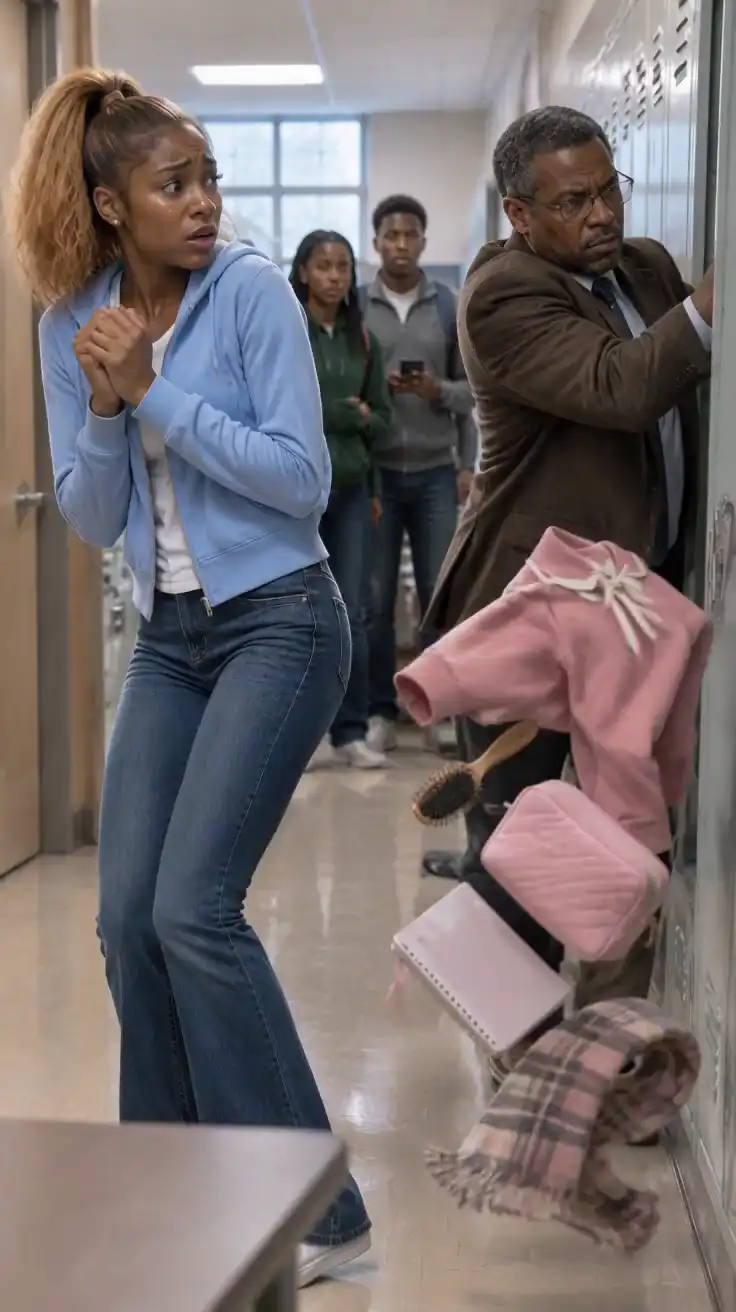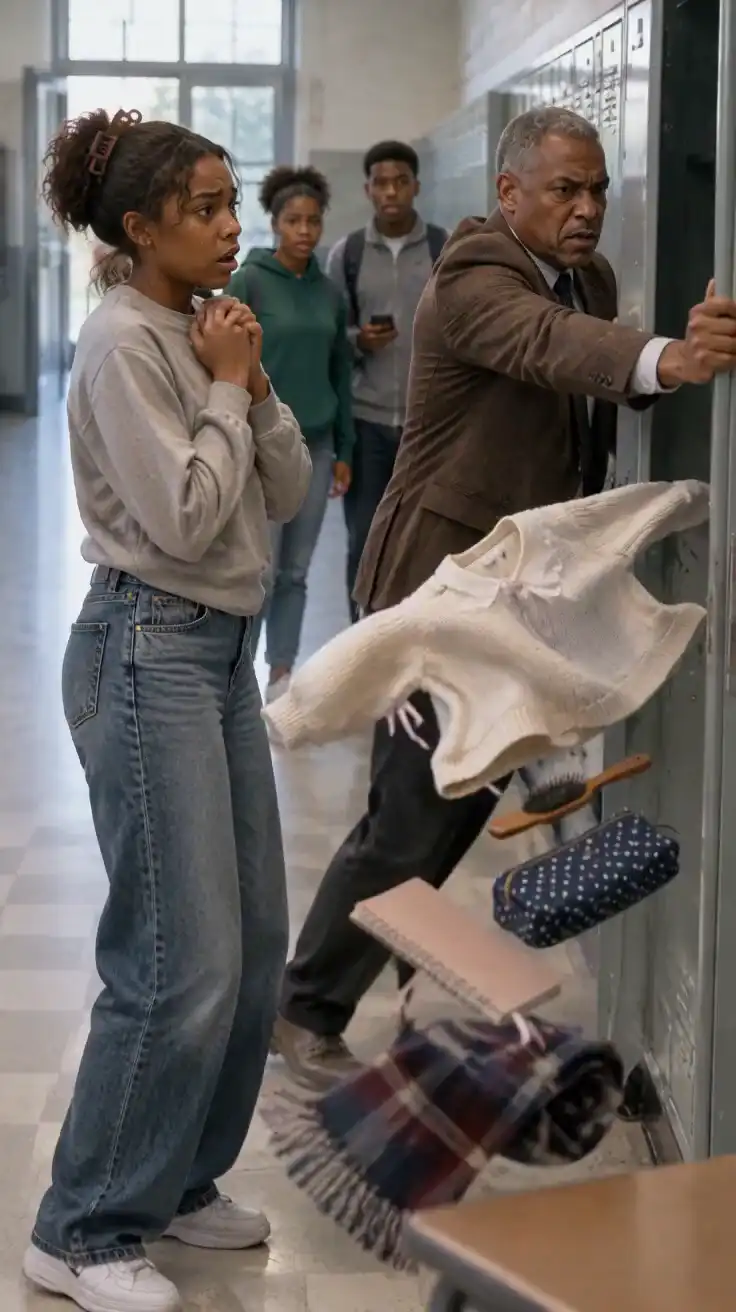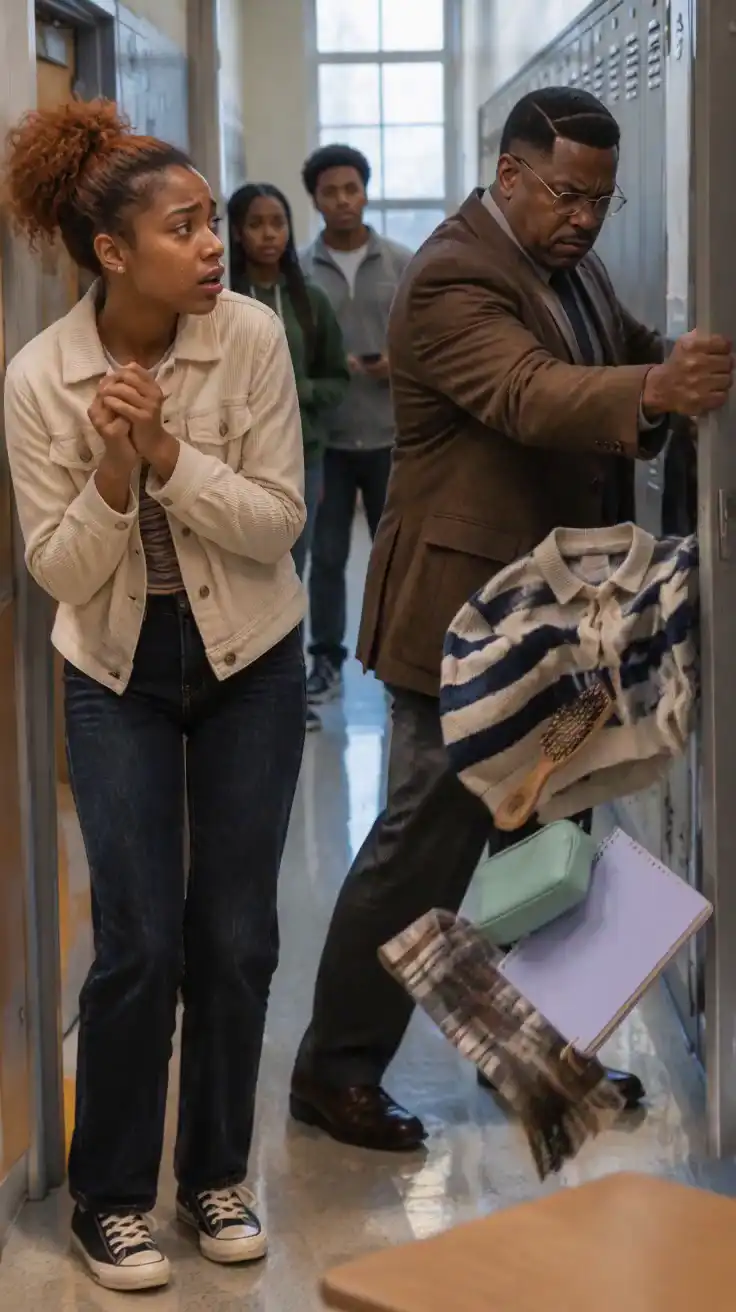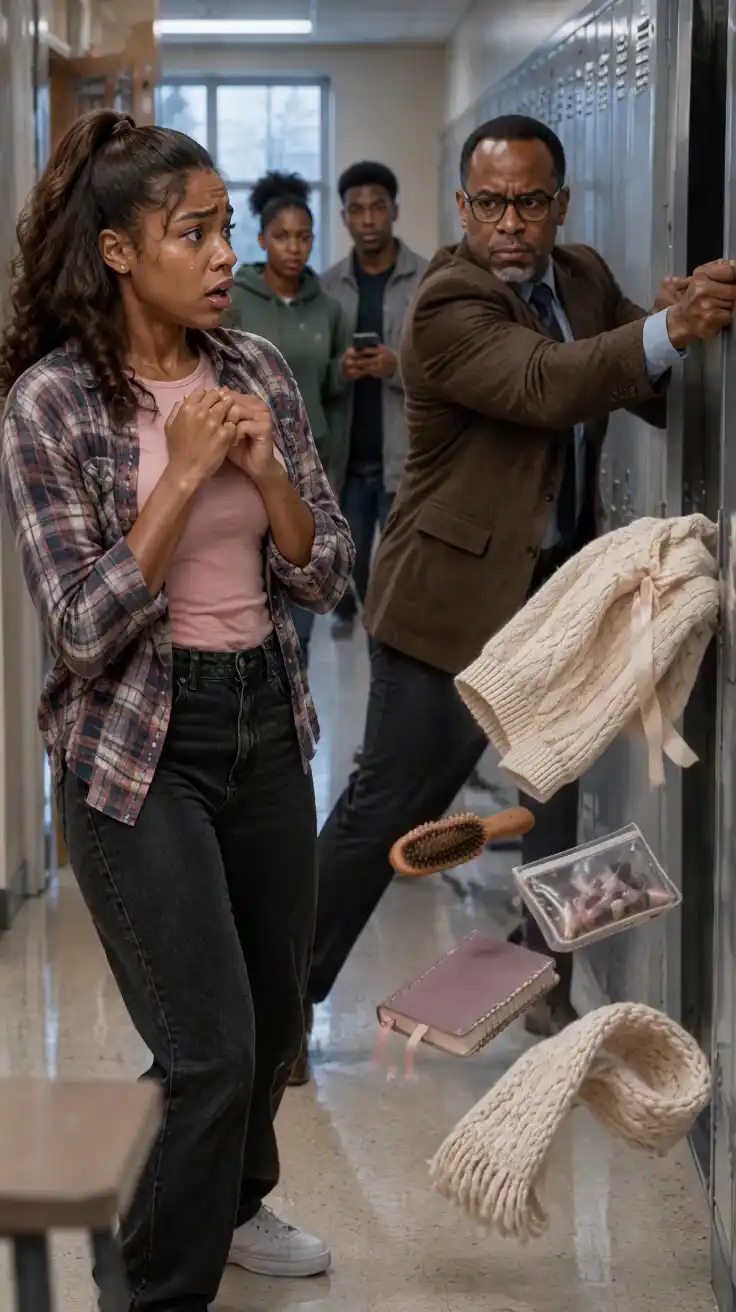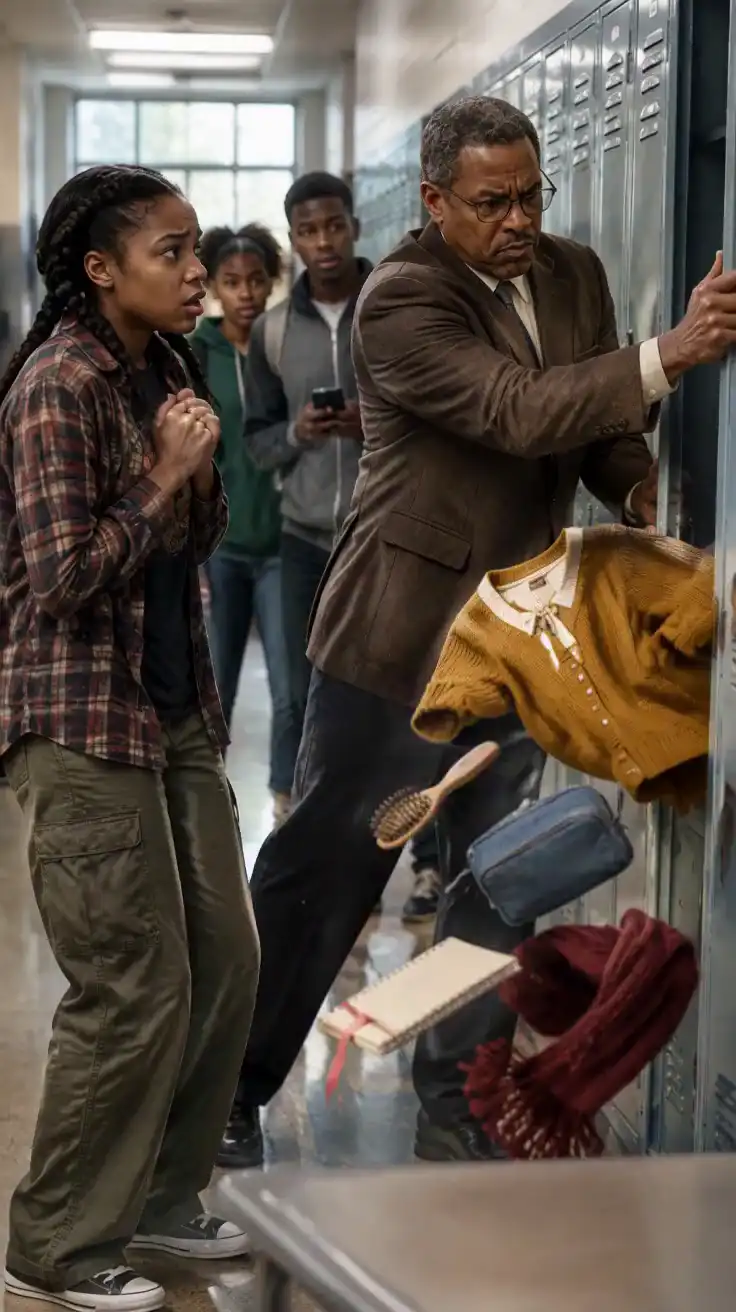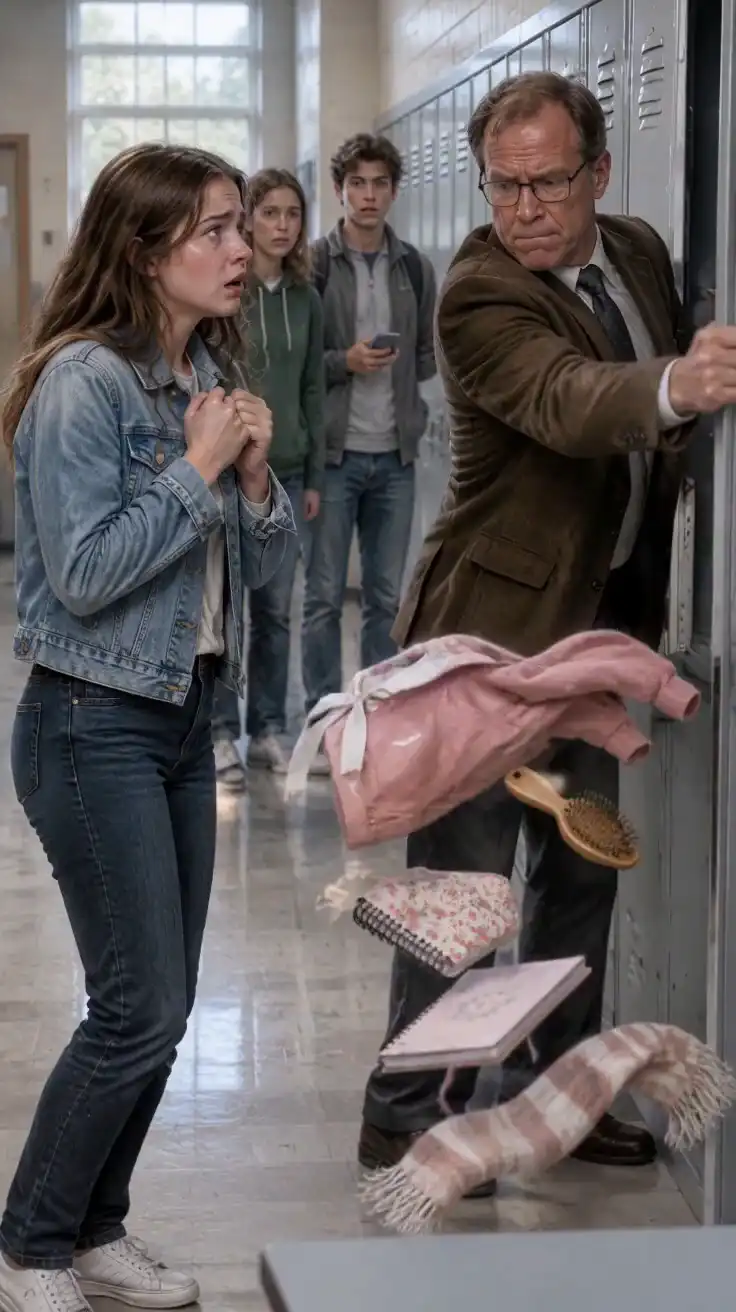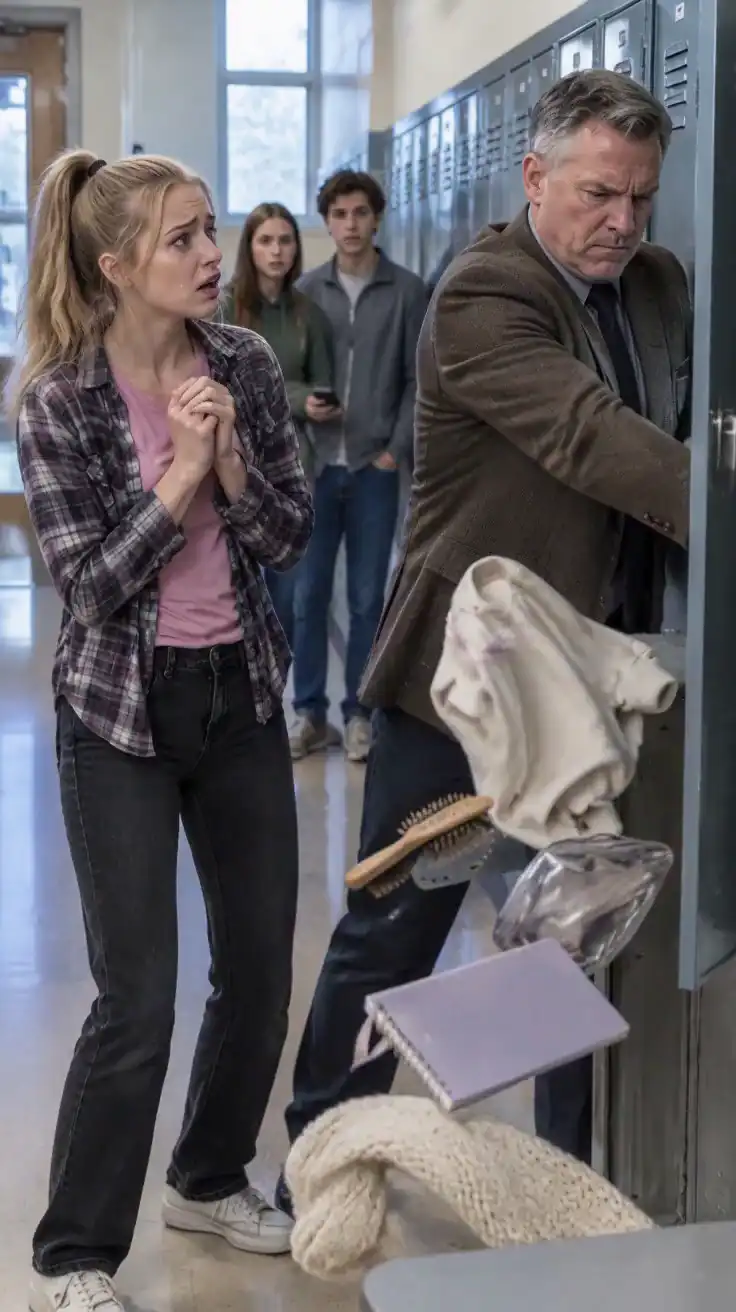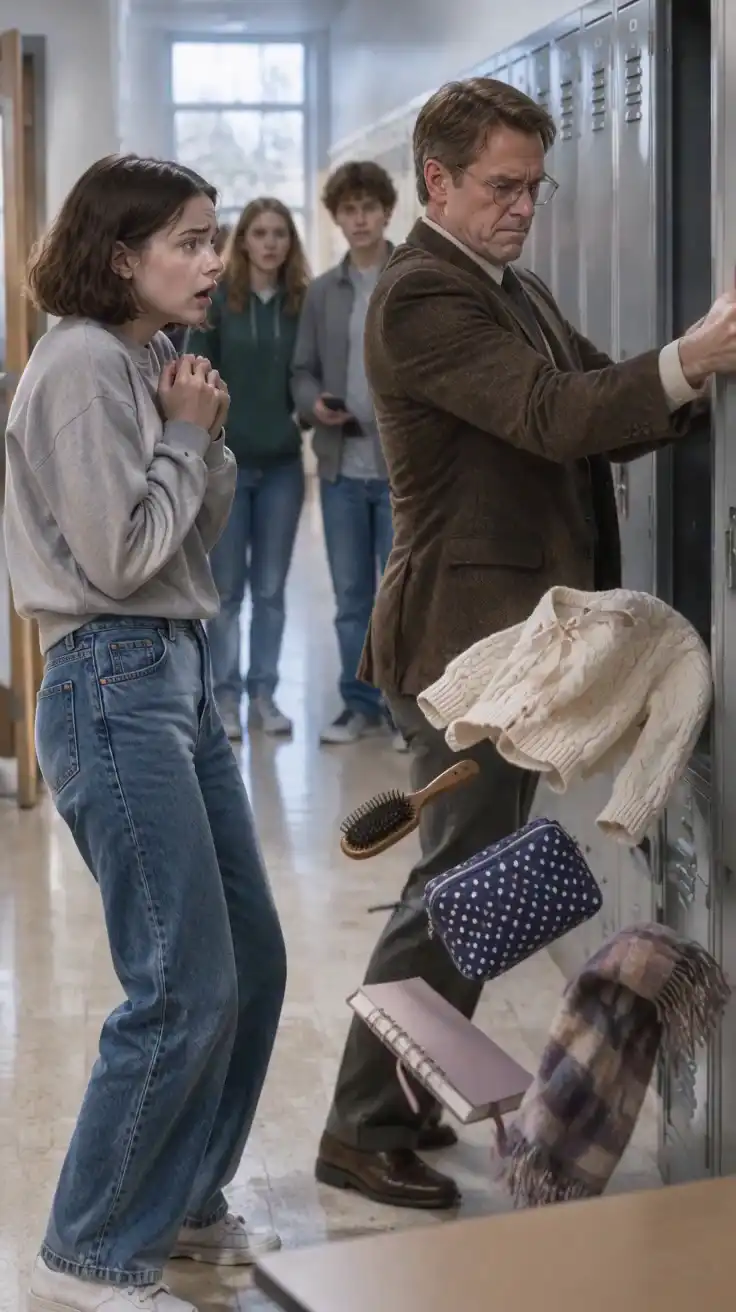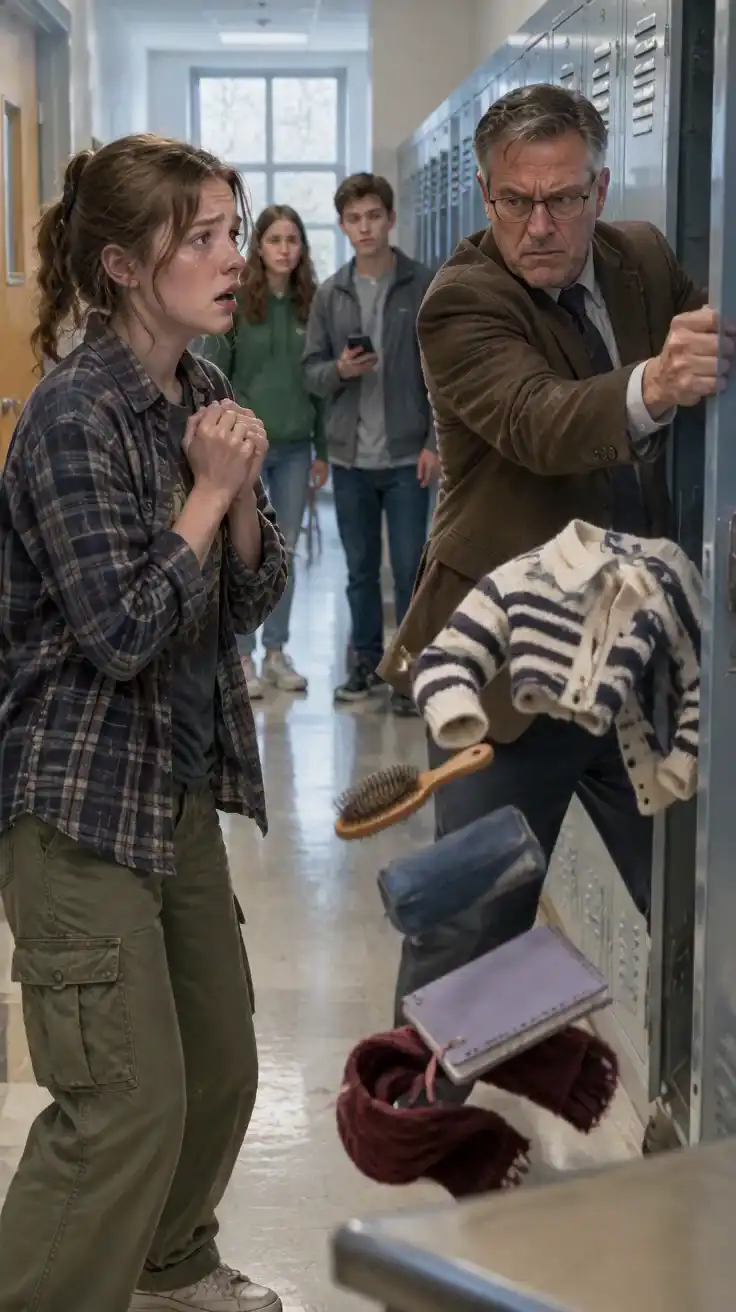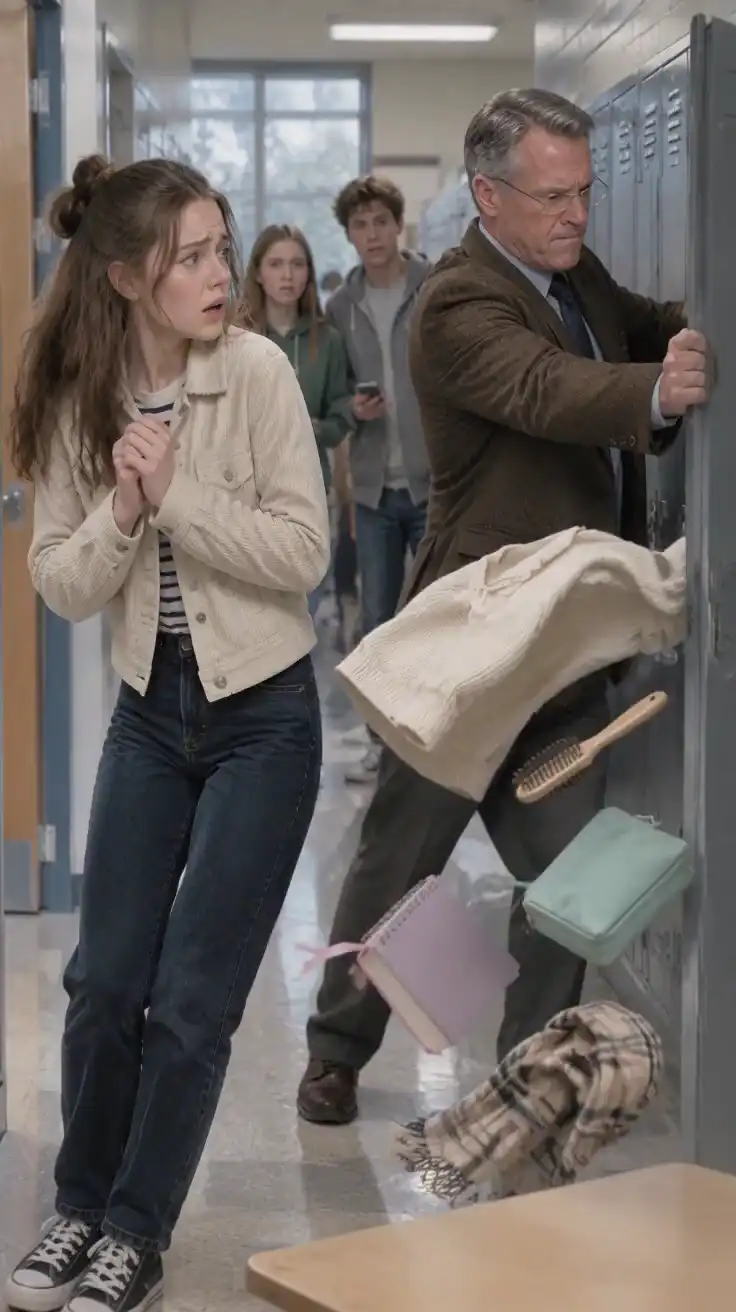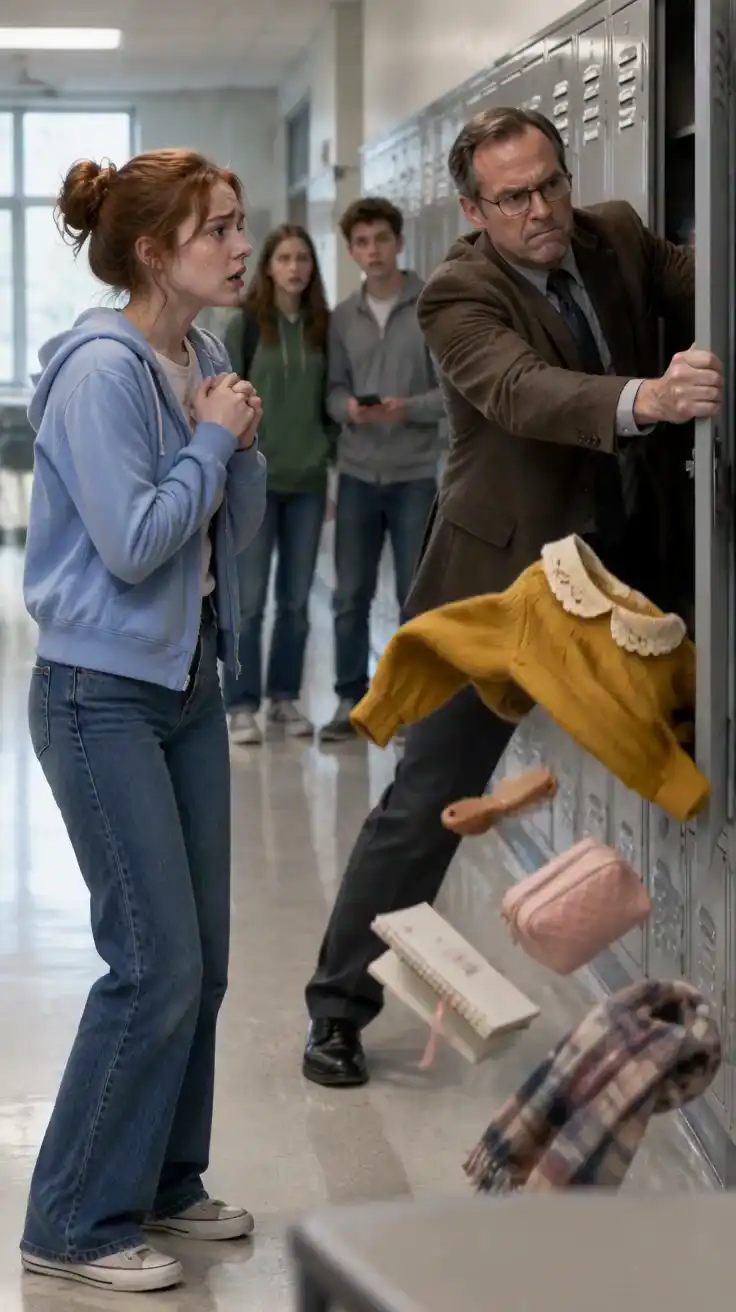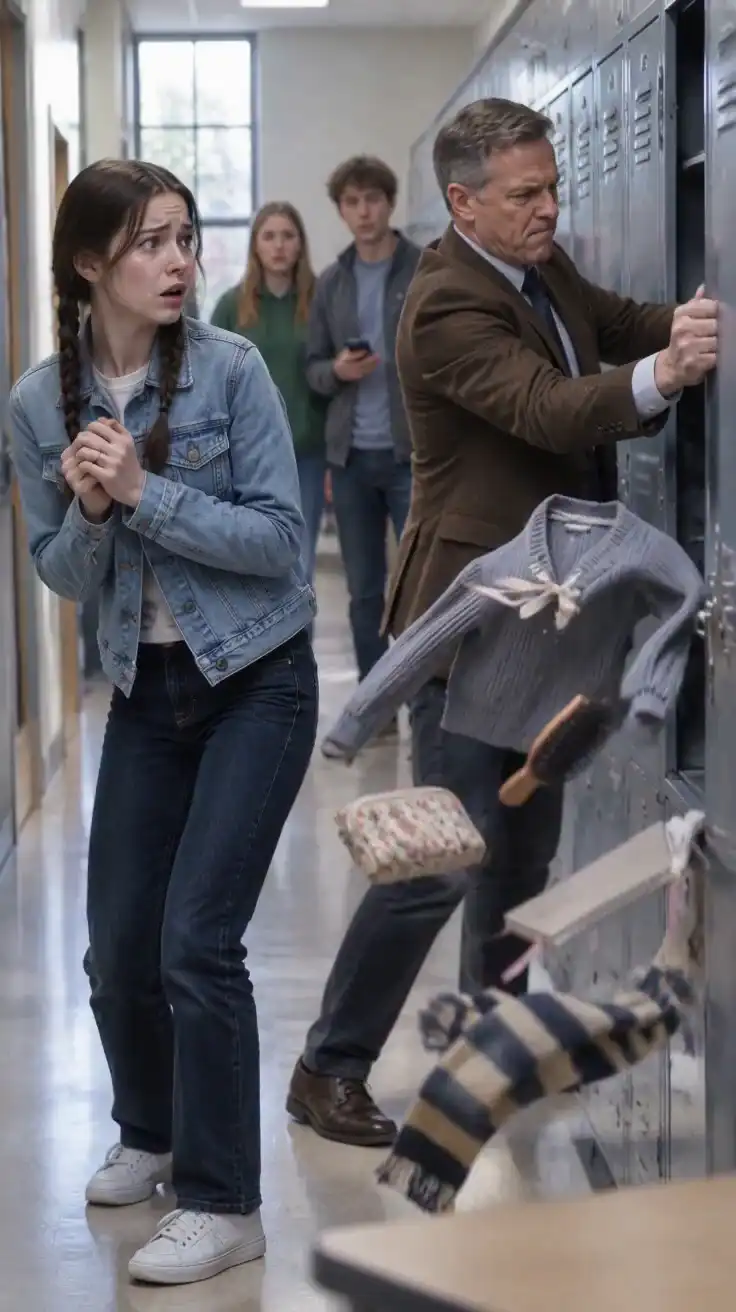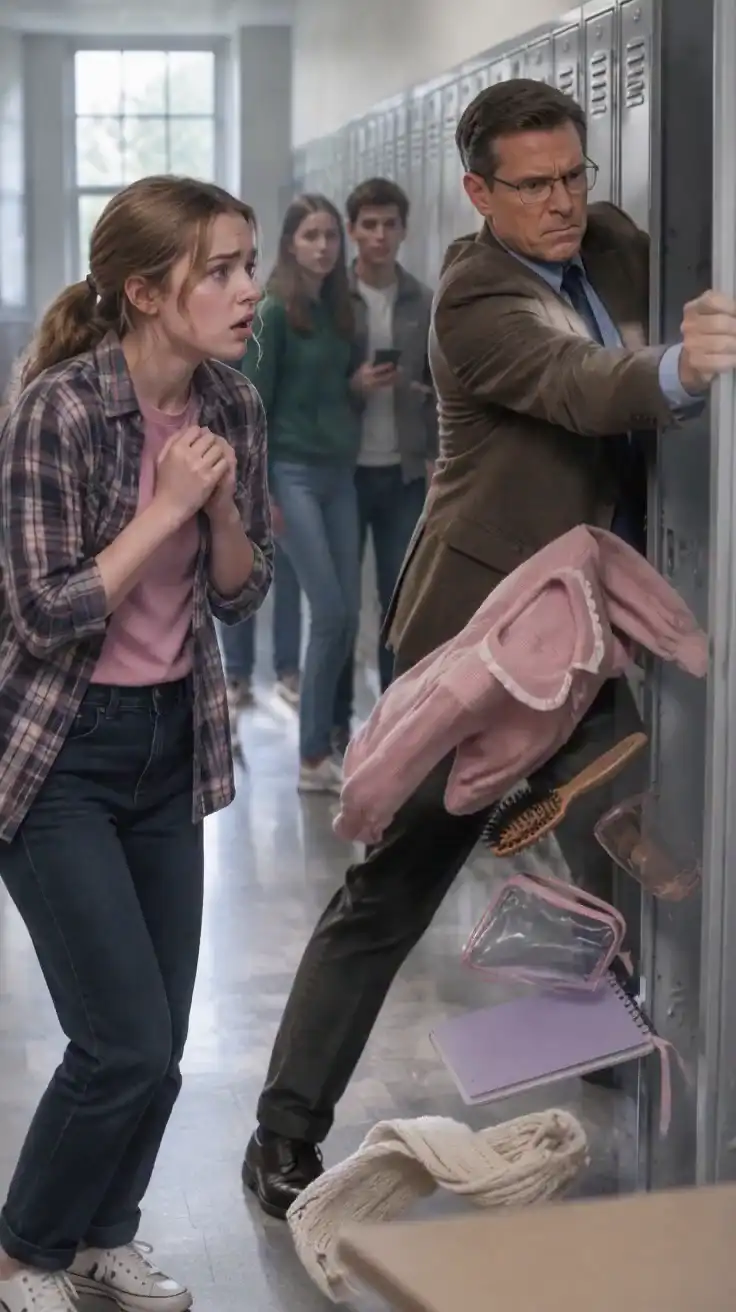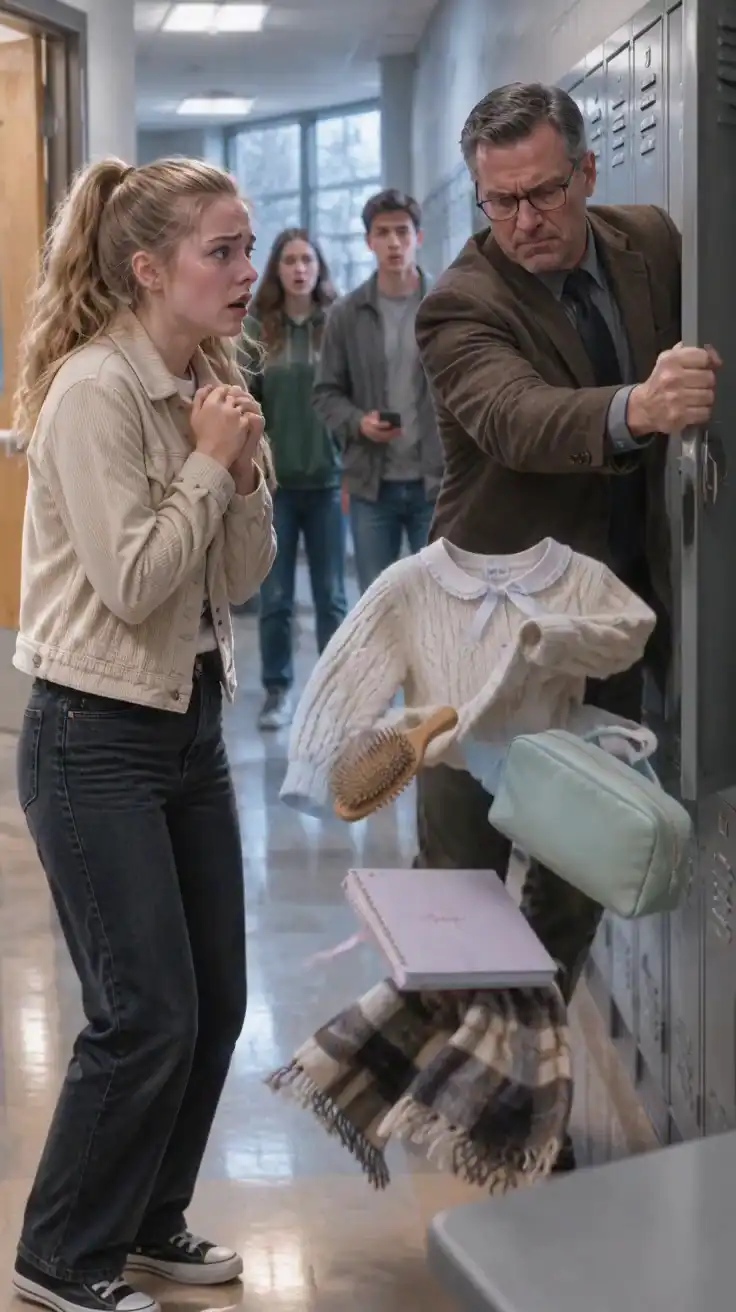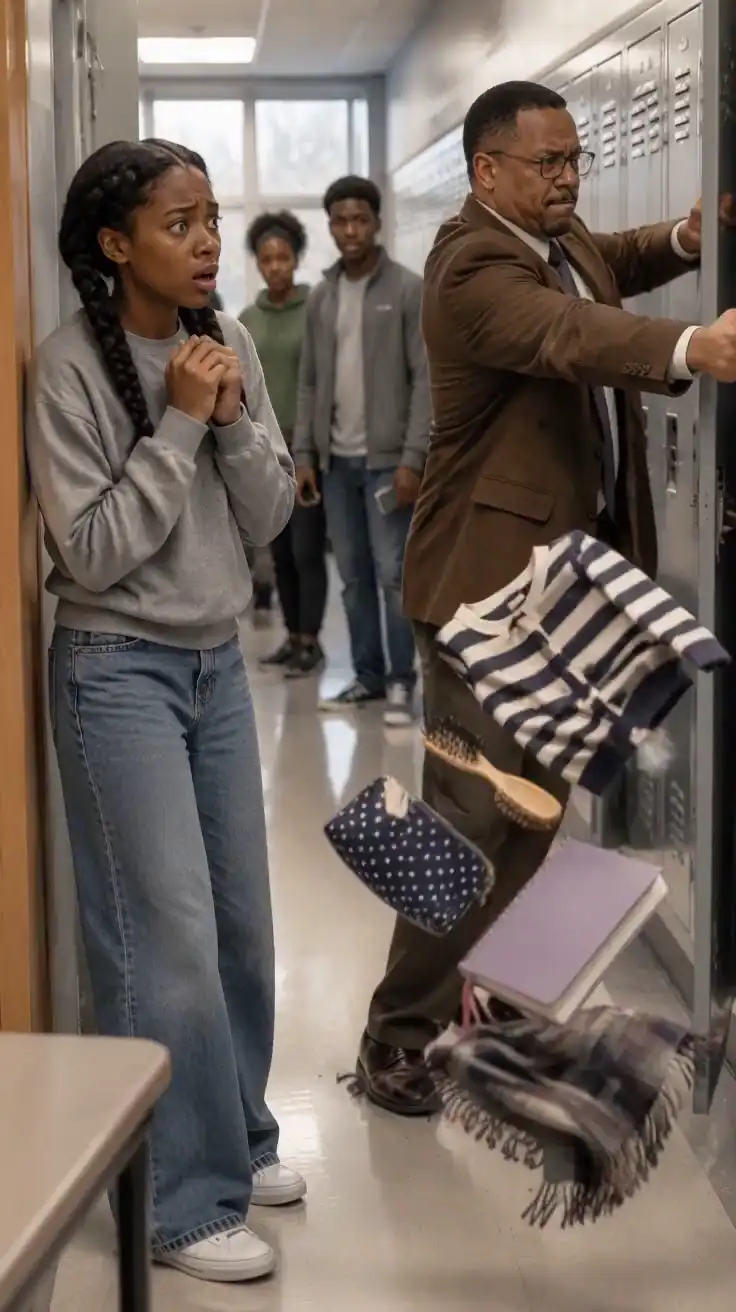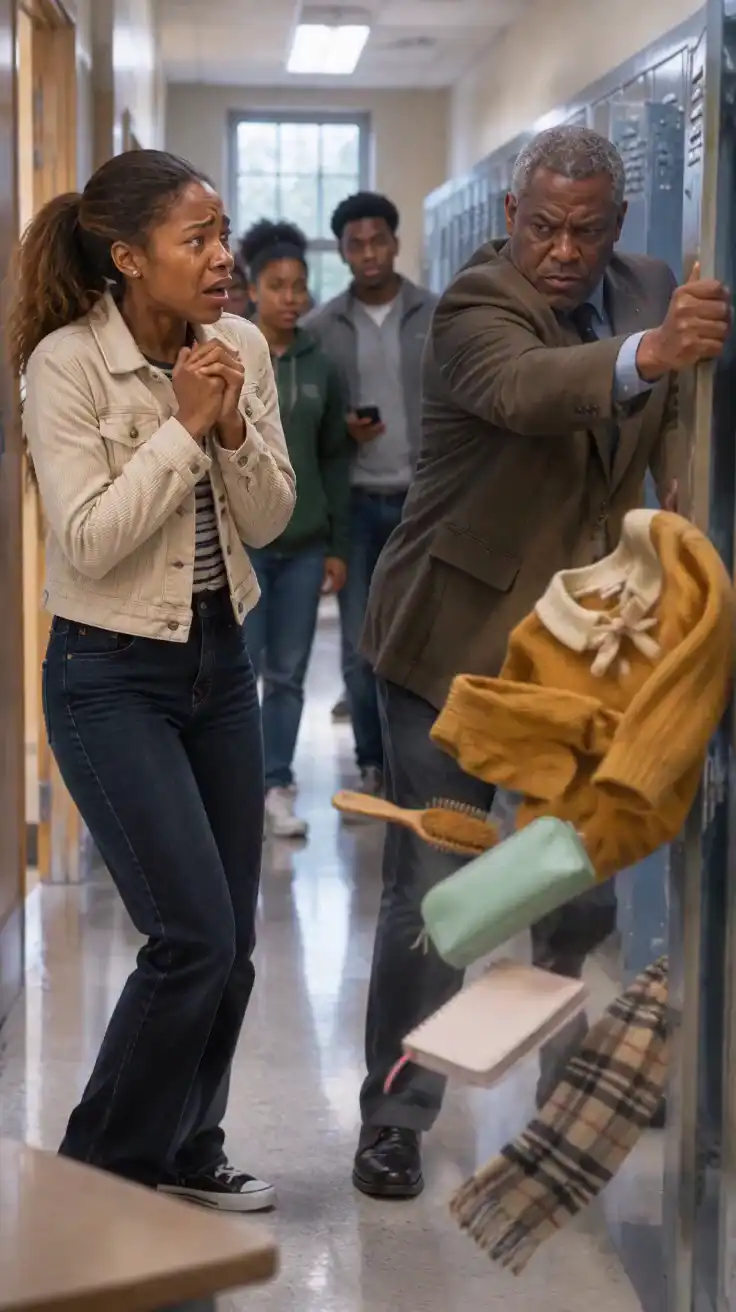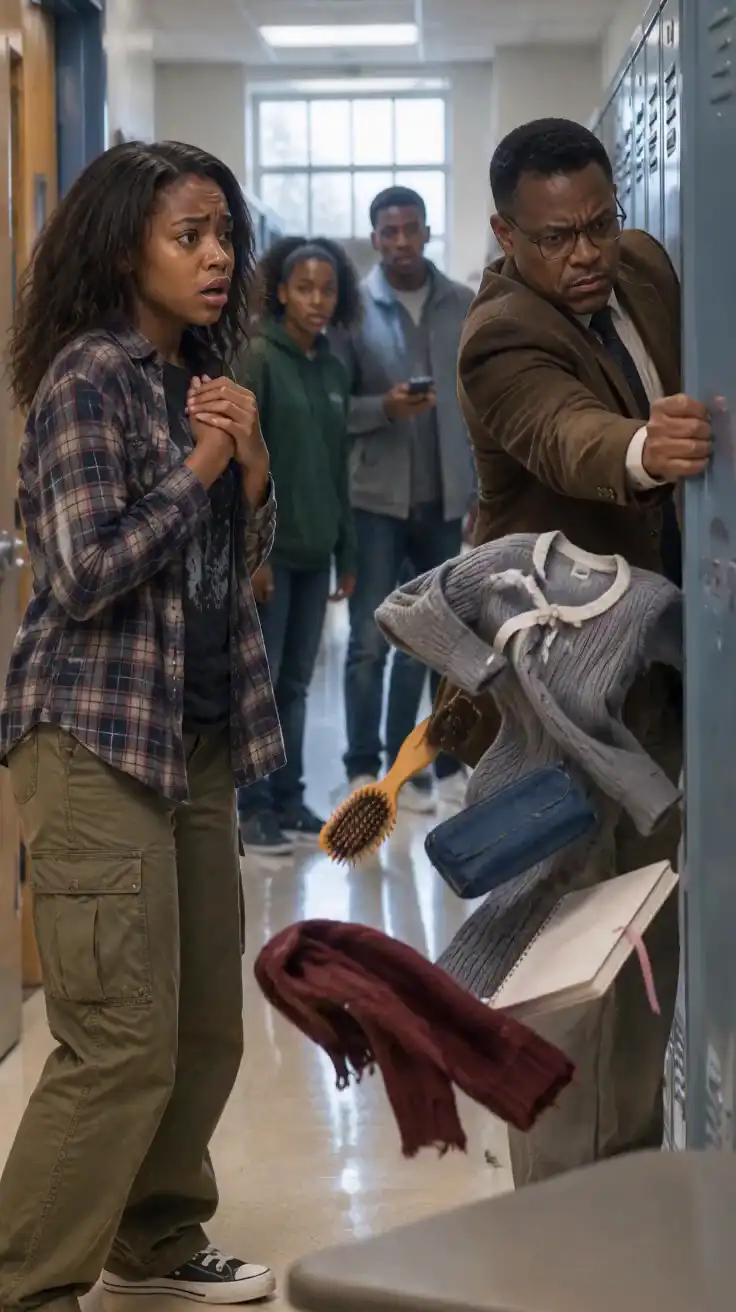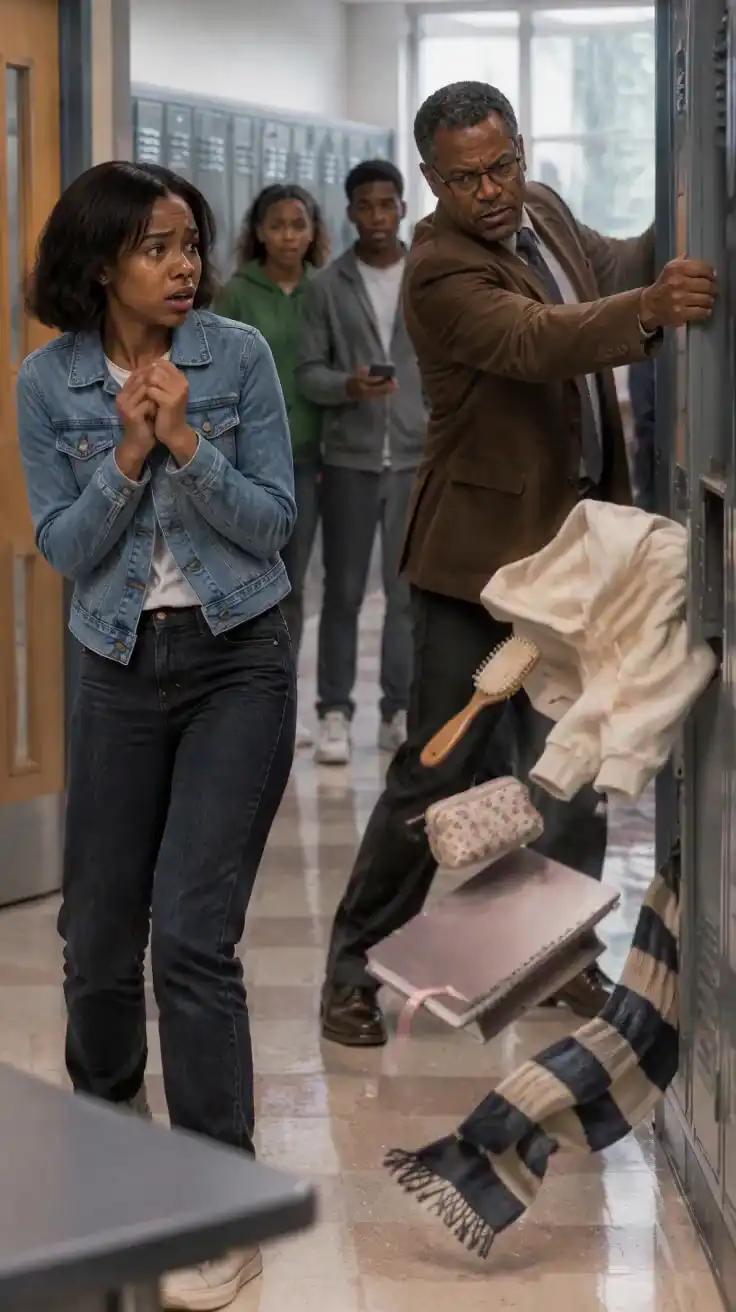
The bracelet rolled once and stopped.
For one second, nobody moved.
The hallway was still loud around us, lockers slamming and shoes squeaking on the tile, but the space around that bracelet went silent. My daughter stared at it as if she could not make sense of what she was seeing. The dean’s hand was still inside the side pocket of her canvas bag. The girl who had been shouting at her had one arm folded across her chest and the other hanging stiffly at her side.
Her fingers were spread.
The sleeve of her sweatshirt had ridden up.
And there, just above her wrist, was the empty space where the bracelet had been hidden.
I knew that bracelet. It belonged to Tessa Bell.
She had told everyone it was missing from her bedroom that morning. She had described it to the dean as a thin gold chain with a small oval charm, something her grandmother had given her. She had cried when she reported it missing. She had said she knew who took it.
She had said my daughter.
Now the bracelet lay on the floor between them.
The dean looked down first. Then he looked at Tessa. Then he looked at my daughter, who was still kneeling among the contents of her bag.
“Is that it?” he asked.
His voice was different now.
It was not the hard voice he had used with Nia. It was not the voice that had told her to stop making excuses or the voice that had demanded she empty every pocket. It was softer, almost confused.
Tessa did not answer.
The dean bent down and picked up the bracelet. He turned it over in his hand, as though there might be another explanation engraved into the metal.
“Tessa,” he said.
She looked toward the office at the end of the hall.
That was when I knew the bracelet had not slipped accidentally.
She was looking for her mother.
Carla Bell was the school’s attendance secretary. She sat behind the glass window near the main office, where she signed students in when they arrived late and called parents when they were absent. She knew every student’s name, every teacher’s schedule, every camera location, and every rule that administrators liked to quote when it suited them.
She also knew my daughter.
Carla had been part of the family for years before she ever became an employee at the school. Tessa’s father, Leon, was married to my husband’s older sister, Patrice. The family tree required explanations at almost every gathering, but the short version was that Tessa and Nia were cousins by marriage. They had spent birthdays together, eaten from the same trays at cookouts, and sat next to each other during holiday dinners.
They had once shared a room at a family reunion because the adults assumed they were close.
They had been close.
That was part of what made the hallway scene so cruel.
Tessa knew exactly how Nia looked when she was scared. She knew Nia went quiet before she cried. She knew Nia hated being touched by strangers. She knew Nia would rather be blamed than make a scene defending herself.
She had counted on all of that.
The dean stood up with the bracelet in his hand.
“Everyone back to class,” he said.
Nobody moved.
Phones were still raised. Some students had lowered theirs, but most were watching the bracelet instead of the girl on the floor. A boy near the drinking fountain whispered, “She planted it,” and someone else said, “No way.”
Tessa finally spoke.
“I don’t know how that got there.”
Nia lifted her head.
“You put it there.”
Her voice was hoarse, but it carried.
Tessa’s face changed. The anger disappeared first. Then the confidence. What remained was fear.
The dean looked at Nia.
“Did you put this bracelet in Tessa’s sleeve?”
Nia gave him a stare I will never forget.
“No.”
He seemed to realize how absurd the question sounded only after he had asked it.
Behind him, the office door opened. Carla stepped out.
She was a small woman with straightened hair cut just below her chin, and she wore the blue cardigan she kept at work for cold mornings. Her eyes went from Tessa to the bracelet to my daughter on the floor.
For a moment, she looked as though she might faint.
“Tessa,” she said.
Tessa turned toward her.
“Mom, I didn’t—”
“Do not say another word.”
Carla said it quietly, but everybody heard her.
The dean took one step toward them.
“Ms. Bell, I need you to come inside.”
Carla looked at my daughter.
Nia was still on her knees. Her books were open around her. One of her hair clips had snapped in half. The small bottle of edge control she kept in her bag had rolled underneath a locker. Her gym shoes were lying on opposite sides of the pile.
Carla’s mouth opened.
For half a second, I thought she might apologize.
Instead, she said, “I want to speak with my daughter privately.”
The dean’s face hardened.
“You are not acting as her parent right now. You are an employee in this building.”
That was the first time the room understood that Carla’s job was in danger.
It was not just a family fight anymore.
The dean had sent a message over the school radio before they searched Nia. He had called it a theft investigation. He had involved students in it. He had allowed Carla to stand near the accusation because she was Tessa’s mother and because everyone assumed her knowledge of the school made her trustworthy.
If the bracelet had not appeared, Nia might have been suspended.
Carla might have been praised for helping solve the theft.
Now the school had to explain why an employee’s daughter had made an accusation, why an administrator had searched a Black student in front of a crowd, and why the employee had been close enough to influence the process.
The dean looked toward the students.
“Back to class. Now.”
This time, people moved.
They moved slowly, turning their heads as they went. A few students kept filming until the dean threatened to confiscate their phones. Someone whispered, “That’s Nia’s cousin,” and another person answered, “Her mom works here.”
I stayed in my car for almost four minutes after the school called me.
I had been in the middle of a grocery pickup when my phone rang. The number showed the school. I assumed Nia had missed a bus or forgotten a permission slip. The dean’s assistant told me there had been an incident and asked me to come immediately.
She did not say theft.
She did not say search.
She did not say my daughter had been made to kneel on the floor.
By the time I pulled into the parking lot, I had already called Nia twice. She did not answer. I called again as I walked through the front doors. A seventh-grade boy was sitting in the lobby beside his backpack, and when he saw my face, he looked down.
The receptionist told me to wait.
I said, “Where is my daughter?”
She looked toward the hallway.
“In the administrative office.”
“Why?”
“I’m not at liberty to discuss—”
“She’s my child.”
The woman glanced at the phone in my hand.
“Mr. Harris will speak with you.”
“Is she hurt?”
“No.”
“Has anyone touched her?”
The receptionist hesitated.
That hesitation told me enough to stop waiting.
I walked down the hallway.
The crowd was already breaking apart, but I could see the mess before I reached it. Nia’s things were scattered in a wide circle around her locker. Her math notebook was open to a page where she had written the date and a list of practice drills. A pencil had rolled under the bench. Her black hoodie was crumpled against the wall.
Nia saw me before anyone else did.
“Mom.”
She did not call out loudly. She did not run to me. She simply said my name in a small, exhausted voice.
I went to her.
The dean stepped in front of me.
“Mrs. Reed, we need to move this conversation into the office.”
“I’m not moving anywhere until my daughter stands up.”
He looked at Nia.
“Are you okay?”
That question made something inside me snap.
“You asked her to empty her bag in a hallway full of students,” I said. “You made her kneel on the floor. You went through her personal things without calling me. You can stand there while she collects them.”
His jaw tightened.
“We had reasonable suspicion.”
“Reasonable suspicion of what?”
“The bracelet was reported missing.”
“By whom?”
He did not answer.
I looked past him at Tessa. She was standing beside Carla now. Her face had gone pale, and she kept rubbing the empty place on her wrist.
“Ask her,” I said.
The dean’s eyes followed mine.
Carla moved closer to Tessa.
“Not here,” she said.
I looked at her for the first time.
“Not here?” I asked. “You had no problem with it happening here when my daughter was the one being accused.”
Carla flinched.
Tessa started crying.
I had seen her cry many times over the years. At birthday parties, after falling off her bike, when she lost a basketball game. This was different. She was not crying because she was hurt. She was crying because the story she had built was collapsing around her.
Nia pulled herself upright.
Her knees were red from the tile.
She began picking up her things, and I knelt beside her. The dean opened his mouth as if he wanted to stop me, but I gave him a look that made him think better of it.
I picked up her books. Nia reached for the broken hair clip.
“Leave that,” I said.
“It’s mine.”
“I know.”
She put it in her palm anyway.
That was my daughter. Even humiliated, even shaking, she was still trying to gather every piece of what belonged to her.
I wanted to take her home immediately. I wanted to put her in the car, drive away, and never let that school see her again.
But the part of me that had learned to survive institutions knew leaving would make the story easier for them.
If I left, they could say the misunderstanding had been resolved.
They could say emotions ran high.
They could say everyone made mistakes.
So I stood up with the books pressed against my chest and said, “We are going into the office.”
The dean led us inside.
Carla sat on one side of the conference table with Tessa beside her. The dean sat at the head. Another administrator, a woman named Ms. Alvarez, brought in a folder and placed it in front of her. She was the assistant principal, and she looked more uncomfortable than anyone else in the room.
Nia and I sat across from them.
The bracelet was in a clear plastic evidence bag on the table.
It looked almost delicate.
That was the thing that kept bothering me. Such a small object had been used to turn my daughter into a spectacle.
The dean folded his hands.
“I want to begin by saying the school takes allegations of theft seriously.”
I raised my hand.
“Stop.”
He blinked.
“You don’t begin with the school’s policy. You begin with what happened to my child.”
He glanced at Ms. Alvarez.
She looked down at the folder.
The dean tried again.
“Nia was identified by Tessa as having taken the bracelet.”
“Identified how?”
“Tessa stated that Nia had been in her bedroom during a family gathering on Sunday.”
“She was. So was Tessa. So was everyone else.”
“She stated that Nia handled the bracelet.”
“That is not the same as stealing it.”
“No, but given the circumstances—”
“What circumstances?”
He paused.
This was the part I had been hearing for weeks without anyone admitting it plainly. The circumstances were that my daughter had new basketball shoes. The circumstances were that she had a new tablet for school. The circumstances were that she had joined the travel basketball team and was no longer invisible.
The circumstances were that an adult had told a story about a Black girl having things she supposedly had not earned, and everyone else had treated the story like evidence.
The dean looked at Nia.
“Tessa said the bracelet disappeared after you left the room.”
Nia shook her head.
“I didn’t touch it.”
“You told me that in the hallway,” the dean said. “I’m asking you now.”
“You already asked me.”
“I need you to answer clearly.”
“I did not take it.”
Tessa turned toward her.
“You were the only person standing next to my dresser.”
“That’s not true.”
“You opened the drawer.”
“To get the charger.”
“You knew where the bracelet was.”
“I had seen it before.”
“You were asking about it.”
“Because you showed it to me.”
“Why were you looking at it?”
“Because you put it in my hand.”
Tessa’s face twisted.
“I did not.”
“You did. You said it was old and ugly.”
“It was not ugly.”
“I didn’t say it was stolen.”
“I never said you did.”
“You told your mom I asked how much it cost.”
“I didn’t say that.”
The dean lifted both hands.
“Enough.”
Nia leaned back in her chair. Her eyes were fixed on the bracelet.
I asked the dean, “When did Tessa report this?”
“First thing this morning.”
“And when did you pull my daughter out of class?”
“During second period.”
“Did you call me before searching her?”
“We attempted to reach you.”
“No, you did not.”
He looked at the assistant principal.
Ms. Alvarez opened the folder and checked a page.
“There is one outgoing call,” she said. “It went to voicemail.”
“What time?”
“Ten forty-two.”
The search had happened at ten thirty-eight.
“You called me after you searched her.”
The dean shifted in his chair.
“We were in the process of contacting you.”
“You were in the process of humiliating my daughter.”
Carla spoke for the first time since we sat down.
“I did not know they were going to search her in the hallway.”
I turned toward her.
“You were there.”
“I came out when I heard Tessa was upset.”
“You stood there while they emptied her bag.”
“I thought they were trying to find the bracelet.”
“And you did not say, ‘Call her mother first’?”
Carla’s eyes filled.
“I believed Tessa.”
There it was.
Not proof. Not procedure. Belief.
She had believed her daughter because her daughter had cried. She had believed her daughter because my daughter was an easy target. She had believed her daughter because the story fit the version of Nia that Carla had been building in her head for weeks.
I asked, “Why?”
Carla looked at Nia.
“Because things have been changing.”
Nia stared at her.
“What does that mean?”
Carla’s mouth tightened.
“You have been acting differently.”
“Because I made the team?”
“You’ve been showing off.”
Nia’s face went blank.
She had heard that word before.
I had heard it too, from Carla at a family dinner three weeks earlier.
Nia had been excited because the travel team coach had given her a starting position. She had talked about the first tournament and the new warm-up jacket. Carla had smiled without warmth and said, “Just remember, not everybody likes a show-off.”
At the time, I had ignored it.
I told myself Carla was being petty.
I did not know she had already complained to the school.
The dean opened the folder.
“There have been concerns raised about Nia’s conduct on the team.”
“By whom?”
He looked at Carla.
“General concerns.”
“By whom?”
Ms. Alvarez answered quietly.
“By Tessa.”
Nia turned toward her cousin.
Tessa wiped her cheeks.
“I told Coach that she was rude.”
“What did I say?” Nia asked.
“You ignored me.”
“You were asking me to give you my spot.”
“I asked if you would switch drills.”
“You told me I shouldn’t be on the team.”
“Because you were making everyone uncomfortable.”
Nia laughed once, but there was no humor in it.
“You told me Coach only picked me because he felt sorry for me.”
The room went quiet.
The travel team had been a huge opportunity for Nia. She had played basketball since she was nine, usually on community teams where nobody cared enough to watch her closely. The travel team was different. The coach, Mr. Okafor, had seen her speed and court vision. He had told me that Nia could read a play before it developed.
Making that team meant weekend tournaments, better training, and the possibility of being seen by high school coaches.
It also meant Tessa had lost the position she wanted.
Tessa had been trying out for two years. She was talented, but she had not made the final roster the previous season. This year, she had expected her mother’s friendship with the athletic department to help her. Carla had told people that Tessa was a natural leader. She had told me at Christmas that the coaches “needed to understand who had been committed from the beginning.”
When Nia made the team and Tessa did not get the starting guard position she wanted, the family tension became obvious.
At first, Tessa sent messages.
You know you’re not really better than me.
You only got noticed because Coach likes your style.
Don’t act like you’re special now.
Nia showed me the messages, but she asked me not to intervene.
“She’ll get bored,” Nia said.
I should have known better.
A week later, Tessa began complaining to the school that Nia had stolen her headphones. Then it was a silver charm from her pencil case. Both items were eventually found in Tessa’s room. Carla said Tessa was forgetful.
Then Carla came to me at a Sunday dinner and said Nia needed to stop bringing “expensive-looking things” around the family.
I told her I had purchased the items.
She said, “I’m just saying how it looks.”
I said, “It looks like my daughter has a mother who buys her things.”
She did not answer.
Now, sitting in that office, I understood that the bracelet had never been about jewelry.
It had been about removing Nia from the team.
Tessa had told her mother that if Nia were suspended for theft, the school would have to review her place on the roster. Carla had apparently repeated that idea to someone in the athletic office. The dean later admitted that he had been told a theft allegation could affect Nia’s eligibility.
Tessa had not simply wanted Nia embarrassed.
She wanted the accusation to become official.
She wanted the school to label Nia dishonest, because once that label was attached, Nia’s place on the team would be questioned. Her reputation would be questioned. Every future complaint would be believed more quickly.
And Carla had a reason to help.
Her job at the school was already unstable.
The district had recently audited attendance records. Carla had been accused of changing several late marks for students whose parents knew her personally. She insisted she had only corrected clerical errors, but the principal had warned her that another policy violation could lead to termination.
She had also been warned about conflicts of interest.
As the mother of a student, she was not supposed to use her position to access records, influence discipline, or participate in investigations involving her daughter.
When the dean allowed her to stand in the hallway during Nia’s search, he had violated that boundary.
If the accusation had held, Carla could have claimed she was simply a concerned parent.
Once the bracelet appeared from Tessa’s sleeve, the school had to ask whether Carla had used her position to help her daughter manufacture a theft investigation.
That question put her job at stake.
The dean looked at Tessa.
“Tell us exactly where you found the bracelet.”
Tessa’s eyes moved to her mother.
Carla shook her head very slightly.
I saw it.
So did Ms. Alvarez.
“Tessa,” the dean said, “where did you find it?”
“I thought it was in Nia’s bag.”
“That is not what I asked.”
“I didn’t put it there.”
“No one is asking whether you put it in Nia’s bag. I’m asking how it got into your sleeve.”
Tessa began crying again.
“I was holding it.”
“Why?”
“Because I was scared.”
“Scared of what?”
“That she would deny taking it.”
Nia stared at her.
“So you hid it?”
“I didn’t hide it.”
“You put it under your sleeve.”
“I was holding it.”
“You told everyone it disappeared from your room.”
“I thought you took it.”
“You thought I took it, but you had it?”
Tessa’s voice rose.
“I knew you had touched it!”
“That’s not an answer.”
“I wanted people to believe me!”
The words came out before she could stop them.
Everybody in the room heard them.
Tessa covered her mouth.
I watched Nia absorb that sentence.
It did not look like victory on her face. It looked like another injury.
The dean leaned back.
“Why did you want people to believe you?”
Tessa looked at Nia.
“Because she was going to take my place.”
“What does that mean?”
“On the team.”
Nia closed her eyes.
Tessa kept talking, as though once the truth had escaped, she could not hold it in.
“She doesn’t even care about basketball like I do. She only tried out because everybody kept telling her she was fast. I worked for that spot. I’ve been on the team longer.”
“You were not on the travel team,” Nia said.
“I was supposed to be.”
“So you lied about the bracelet because you wanted me removed?”
Tessa shook her head, but she did not deny it.
“I just wanted them to investigate.”
“You wanted them to punish me.”
“I wanted you off the team.”
Carla stood suddenly.
“Tessa, stop.”
The dean looked at her.
“Sit down, Ms. Bell.”
Carla remained standing.
“You are making this worse.”
“No,” I said. “She is telling the truth.”
Carla turned on me.
“You don’t know what happened between them.”
“I know what happened in the hallway.”
“You are making this about race.”
“I don’t have to make it about race. You made it about race when you decided my Black daughter’s new shoes and tablet were suspicious. You made it about race when you treated her possessions as evidence of a crime. You made it about race when you searched her in public instead of calling me.”
Carla’s face crumpled.
“I never said she stole anything because she was Black.”
“You didn’t have to say it.”
The dean sat very still.
I pointed toward the evidence bag.
“You saw a girl with things you thought she should not have. You heard another girl accuse her. You did not ask questions that would have protected her. You asked questions that would confirm your suspicion.”
Ms. Alvarez reached for the folder.
“I need to document everything that was said here.”
“Document the hallway too,” I said. “And preserve the video.”
The dean’s head lifted.
“Mrs. Reed—”
“Preserve every camera recording from this morning. The hallway, the office entrance, the attendance desk, and the corridor outside the locker area. I want the school to retain the video before anyone decides something was overwritten.”
He nodded.
“We will.”
“And I want a copy.”
“We can discuss that through the district.”
“No. We can discuss it after you give me the written policy that says my child can be searched without parental notice and publicly accused based on another student’s statement.”
He had no answer.
Nia had been quiet for several minutes. She was rubbing her knees beneath the table.
I placed my hand over hers.
The dean saw it.
“I owe Nia an apology,” he said.
I looked at him.
“Yes, you do.”
He stood up.
“I would like to give it now.”
“Not in this room.”
He hesitated.
“Where?”
“In front of the office.”
He looked toward the door.
“There are still students nearby.”
“Good.”
“Mrs. Reed, an apology is more appropriate in private.”
“You humiliated her in public. You do not get to correct the record in private.”
Ms. Alvarez nodded slowly.
“She is right.”
The dean looked at her, surprised.
I turned to Nia.
“Do you want to do that?”
My daughter’s eyes were red. She had been holding herself together with the stubbornness that made me proud and worried at the same time.
“Will everybody be there?”
“Not everybody,” I said. “But enough people will hear it.”
She looked down at her hands.
“I want him to say he was wrong.”
“Then that is what he needs to say.”
We walked out together.
Carla and Tessa stayed in the office. I did not ask them to come. This apology was not for them.
The dean stood beneath the office sign while Ms. Alvarez called in the two teachers whose classes had been interrupted. A few students gathered near the lockers. More appeared when the teachers tried to clear the hall. Word had traveled through the school faster than we could.
The dean faced Nia.
His hands were at his sides.
“Nia Reed,” he said, “I accused you of stealing a bracelet based on an allegation that was not properly verified.”
Nia looked at him.
“I searched your belongings without first contacting your parent, and I allowed that search to happen in front of other students. That was wrong.”
The hallway had gone quiet again.
“I am sorry for humiliating you,” he continued. “You did not steal the bracelet. You were not responsible for it. I should have protected your dignity, and I failed to do that.”
Nia did not respond.
The dean swallowed.
“I also apologize to your mother for not following appropriate procedure.”
I said, “Say what you did.”
His face tightened.
“You are right. I searched your daughter before calling you.”
“And?”
“I allowed an accusation to guide my actions without investigating the circumstances fairly.”
“And?”
He looked at the students around us.
“I was wrong.”
The words seemed to cost him something.
Nia’s shoulders dropped a fraction.
“Thank you,” she said.
The dean stepped back.
I wanted to say more. I wanted to tell the students that an apology did not erase the video. I wanted to tell the school that saying sorry after evidence appeared was not the same as protecting my child before it did.
But Nia was standing beside me, and she was tired.
We went home after that.
She did not speak in the car for the first ten minutes. She stared out the window with her forehead against the glass. Her phone kept vibrating in her lap.
“Do you want me to answer anyone?” I asked.
“No.”
“Do you want to read the messages?”
“No.”
“Do you want me to cancel practice?”
She turned toward me.
“No.”
That was the first thing she had said with certainty.
“I want to go to practice.”
I nodded.
“Then we’ll go.”
When we got home, she went straight upstairs. I stood in the kitchen and called my husband, Andre.
He answered on the second ring.
“What happened?”
I had not told him yet because I knew he was working and because I needed to hear my own voice before I explained it.
I told him about the bracelet.
I told him about the hallway.
I told him about the search.
By the time I finished, he was silent.
Then he said, “Where is Nia?”
“Upstairs.”
“I’m coming home.”
“You don’t have to leave work.”
“Yes, I do.”
He arrived twenty-five minutes later carrying a paper bag from the deli near his job. Nia came downstairs when she heard the front door. Andre crossed the room and hugged her without asking questions.
She let him hold her.
That was when she finally cried.
Not the loud kind. Her body shook, but almost no sound came out. Andre held her while I stood beside them with my hand on her back.
After a while, she told him everything.
She told him how the dean had pulled her from class. How Tessa had stood nearby. How students had filmed. How the dean had made her empty the bag twice because he said she was “hiding something.”
She told him the worst part was not the search.
“The worst part,” she said, “was when people started looking at me like they already knew I did it.”
Andre closed his eyes.
“I’m sorry.”
“You didn’t do it.”
“I know. I’m still sorry.”
She looked at him.
“Why do people do that?”
He did not answer immediately.
Because there was no answer that would satisfy a fourteen-year-old who had just learned that innocence did not prevent humiliation.
Finally he said, “Sometimes people decide what they think about you before they look at the facts.”
“Because I’m Black?”
“Sometimes,” he said. “And sometimes because people are selfish or scared or lazy. But none of those things make it your fault.”
She leaned against him.
I went upstairs and found the broken hair clip on the counter. I held it in my hand for a long time.
It was a cheap black plastic clip from a pack of six. Nia had used it to keep her hair out of her face during practice. It should not have mattered.
But it did.
It was proof that something ordinary had been damaged while adults stood around pretending they were conducting a serious investigation.
The next morning, the school district called.
The director of student services introduced herself and said the district was “reviewing the incident.” She asked me to come to a meeting with the principal, the dean, and the district’s compliance officer.
I said I would attend, but only if I could bring an advocate.
She said that was my right.
I asked whether the school had contacted Carla Bell.
There was a pause.
“She has been placed on administrative leave pending review.”
That was how I learned Carla’s job had not simply been put at risk.
She had already lost it, at least temporarily.
The district discovered that Carla had accessed Nia’s attendance record twice in the previous month. She had also looked at the travel team eligibility list before it was officially released. She had sent an email to the athletic coordinator saying Nia’s “recent pattern of conduct” should be considered before finalizing the roster.
Carla claimed she had only been trying to protect students.
The compliance officer found that she had used her employee login to look at information unrelated to her duties.
The dean’s actions were reviewed too. He received a formal reprimand, and the school changed its search procedure. Any search involving a student’s personal belongings now required documentation, a second administrator, and an attempt to contact a parent before the search unless there was an immediate safety concern.
The school also created a rule against conducting searches in public hallways.
It was a good rule.
It was just one my daughter should never have needed.
The district offered Nia counseling. At first, she refused.
“I don’t need counseling,” she said. “I need people to stop acting like I’m a thief.”
The counselor was a Black woman named Ms. Grant who had worked with students at the school for years. She did not push Nia. She let her sit in silence during the first meeting and draw basketball plays on a notepad.
After three sessions, Nia admitted that she had stopped opening her locker between classes because she was afraid someone would accuse her of taking something again.
After five, she said she did not want to eat in the cafeteria because students kept looking at her phone.
The video had spread despite the dean’s warning.
Someone had posted it to a private student account. By the time the school removed it, dozens of students had downloaded it. Nia’s face was visible in every version. The caption on one of them said, “Cousin exposed for stealing bracelet.”
I reported every post I could find.
Some students apologized. One girl sent Nia a message saying she had been standing near the water fountain and had seen Tessa pull the bracelet from her pocket before the search. Another student gave the district a statement that Tessa had asked her earlier that morning whether she thought Nia would be kicked off the team if she got suspended.
That statement changed everything.
Tessa had not acted alone in the sense that she had been planning this with another student. She had told two teammates that she was going to “make sure Nia didn’t play Saturday.” She had complained that Nia was taking the place that belonged to her. She had asked whether the school would remove someone from a team for stealing.
The school could not pretend the accusation was an impulsive misunderstanding.
Tessa was suspended for three days for making a false report and bringing a personal conflict into the school disciplinary process. The punishment was not enough for Carla.
She called me the night the district released its decision.
I almost did not answer.
When I did, she was crying.
“I know you hate me,” she said.
“I don’t hate you.”
“You should.”
“I am angry with you.”
“I didn’t put the bracelet in her bag.”
“No. You stood by while they searched her.”
“I thought Tessa was telling the truth.”
“You did not investigate.”
“I’m her mother.”
“So am I.”
She was quiet.
Then she said, “I needed this job.”
I closed my eyes.
There it was again. The job.
Not the first thing she had said about Nia. Not the humiliation. Not the fear. Her job.
“What does that have to do with what happened?” I asked.
“If the school believed I was involved, I could lose everything.”
“You were involved.”
“I did not tell the dean to search her.”
“You told him she had a history of suspicious behavior.”
“I told him what Tessa told me.”
“You repeated it as fact.”
“I was trying to help my daughter.”
“You were trying to help her win a basketball spot.”
Carla began sobbing.
I let her cry.
There was a time when I would have comforted her automatically because she was family. But family was the word she had used to get close to my daughter’s life while treating her like a threat.
After several seconds, she said, “Tessa was desperate.”
“So was Nia.”
“I know.”
“No, you don’t. You don’t know what it feels like to watch your child kneel on a dirty floor while people decide she is guilty. You don’t know what it feels like to see her trying not to cry because she thinks crying will make everyone believe the accusation.”
“I’m sorry.”
“You need to tell her.”
“I will.”
“And you need to tell the family the truth.”
She did not answer.
That was the answer.
The first family gathering after the incident was at Patrice’s house. It was supposed to be a birthday dinner for Andre’s father, but nobody acted as though it were a celebration. People stood in small groups in the kitchen and living room, speaking quietly until someone entered.
Tessa did not come.
Carla came alone.
Nia stayed home. She said she did not want to sit in a room where everybody would look at her and then pretend not to.
I told Andre I would go by myself.
Patrice opened the door. Her eyes were swollen.
“I’m glad you came,” she said.
“I almost didn’t.”
“I know.”
We sat at the dining table with Andre’s parents, Patrice, Leon, Carla, and two of Andre’s cousins. The birthday cake was untouched on the counter.
Patrice started crying before anyone spoke.
“I should have known something was wrong,” she said.
I looked at her.
“What should you have known?”
“That Tessa had been talking about Nia.”
“She had been talking about her for weeks.”
“I didn’t know it was this serious.”
“You did know she wanted Nia off the team.”
Patrice covered her face.
Carla said, “I never asked her to do this.”
“No,” I said. “You just gave her a reason to believe she could.”
Leon turned toward his wife.
“Did you tell Tessa Nia might be removed from the team?”
Carla looked down.
“I said the school would have to investigate.”
“That’s not what I asked.”
“I said it was possible.”
Leon stood up so quickly his chair scraped the floor.
“You told her that?”
“She was upset.”
“She was jealous.”
“She felt overlooked.”
“She lied about stealing.”
Carla began defending herself, but Leon walked out of the room.
That was the first time I realized the accusation had broken something between them too.
For years, Leon had believed Carla was protective. He had admired how she knew the school system and how she always seemed to know what was happening before anyone else. Now he was learning that the same access he had admired had been used against his niece.
He did not speak to me that night.
He came to our house three days later.
He stood on the porch with his hands in his jacket pockets.
“I owe you an apology,” he said.
I invited him inside.
He sat at the edge of the couch.
“I didn’t know about the messages,” he said. “I didn’t know Carla had complained about Nia. I didn’t know Tessa had told people she was going to get her kicked off the team.”
“Did you know Tessa was upset about the roster?”
“I knew she was disappointed.”
“Everybody knew.”
He nodded.
“She told me Nia was being favored.”
“She told us that too.”
“I believed her.”
I did not say anything.
He looked toward the staircase.
“Is Nia home?”
“Yes.”
“Can I talk to her?”
I went upstairs and asked.
Nia thought about it.
“Is he going to tell me I need to forgive her?”
“No.”
“Then okay.”
Leon sat across from her at the kitchen table. I stayed nearby but did not speak.
He said, “I’m sorry.”
Nia looked at him.
“For believing Tessa?”
“For not asking questions.”
She nodded.
“I should have asked what happened. I should have talked to your mother. I should have told Tessa that losing a position is not the same as being wronged.”
Nia’s hands were folded in her lap.
“Do you think she hates me?”
Leon looked down.
“I think she is ashamed.”
“She still said it.”
“Yes.”
“She knew what they would do.”
“Yes.”
“Why would she do that if we’re family?”
Leon had no easy answer. He took a long breath.
“Sometimes people think family means they can hurt you and still be forgiven.”
Nia looked toward me.
I said, “Being family does not make somebody safe.”
That sentence stayed with us for a long time.
The basketball team held a meeting without Tessa. Mr. Okafor asked Nia whether she wanted to remain on the roster.
She said yes.
He told the team that personal conflicts would not determine playing time and that nobody was permitted to discuss the incident during practices or tournaments.
For a while, Nia played cautiously.
She passed when she should have shot. She checked the bench after making a mistake. She apologized too quickly. She seemed afraid that any confidence would be interpreted as arrogance.
During the first tournament after the incident, her team was down by one point with twelve seconds left. Nia stole the ball near half-court, drove past two defenders, and made a layup at the buzzer.
Her teammates rushed her.
She stood under the basket, stunned.
Then she smiled.
It was the first unguarded smile I had seen from her in weeks.
Mr. Okafor told her, “That is what you do when you stop asking permission to be good.”
I cried in the bleachers.
Carla lost her job at the school after the district review. The official letter cited misuse of employee access, participation in a student disciplinary matter involving her daughter, and failure to report a conflict of interest.
She appealed.
The appeal was denied.
For months, people in the family argued about whether the punishment was too harsh. Some said Carla had only made a mistake. Others said the school had used her as a scapegoat to avoid admitting the dean had acted improperly.
I believed both things could be true.
Carla had made a mistake.
The school had also protected itself by disciplining the person whose actions were easiest to document.
The dean still had his job. He was transferred to a different building at the end of the school year. The principal sent me a letter saying the district had “taken appropriate corrective action.”
I kept the letter.
Not because it comforted me.
Because I wanted a record.
Tessa and Nia did not speak for almost six months.
There were family gatherings where one came and the other did not. There were holidays where presents were delivered through adults. Tessa sent an apology in a text message, but Nia did not answer.
The message said:
I’m sorry for what happened. I was jealous and I wanted your spot. I didn’t think it would get that bad.
Nia showed it to me.
“What do I say?” she asked.
“You don’t have to say anything.”
“Should I forgive her?”
“That is not a question anybody else gets to answer for you.”
“She’s still my cousin.”
“She is.”
“But I don’t trust her.”
“You don’t have to.”
That was the most important thing I could tell her.
Forgiveness was not a key that opened the door back to the way things had been. Trust was not owed because two families shared a last name at the holidays. Nia could forgive Tessa someday and still decide not to leave her backpack unattended around her. She could wish her well and still refuse to be alone with her.
A year later, Tessa asked to meet Nia.
They met at a coffee shop with me and Leon at a nearby table. Tessa looked older than she had the day of the search. Her hair was pulled back, and she kept turning a paper napkin between her fingers.
“I don’t expect you to forgive me,” she said.
Nia said nothing.
“I lied because I wanted you off the team. I thought if the school investigated you, Coach would remove you. My mom knew I was angry, and she didn’t stop me.”
Nia looked at her.
“Did she tell you to hide the bracelet?”
“No.”
“Did she tell you to accuse me?”
“No.”
“Then why did you think she would help?”
“Because she always helped me.”
Nia’s face tightened.
“She helped you hurt me.”
Tessa began to cry.
“I know.”
“You knew what would happen.”
“I knew you might get suspended.”
“You knew people would call me a thief.”
“I didn’t think everybody would see.”
“That is not better.”
“No,” Tessa said. “It isn’t.”
For several minutes, neither of them spoke.
Then Tessa said, “I was mad because you got something I wanted. But I also thought you didn’t deserve it.”
Nia’s eyes hardened.
“That’s what you really thought?”
“Yes.”
“Why?”
“Because I thought if I worked hard, I should automatically get picked. And when you got picked, I decided it meant the coaches were wrong.”
“You decided I had to be wrong because I won.”
Tessa nodded.
Nia looked down at the table.
“I don’t hate you,” she said.
Tessa looked up.
“But I don’t want to be close to you.”
“I understand.”
“I don’t want you at my games.”
Tessa swallowed.
“Okay.”
“And don’t talk about me to people at school.”
“I won’t.”
Nia nodded.
That was the end of the conversation.
It was not a dramatic reconciliation. There was no hug. Nobody said the family was whole again.
But Nia left the coffee shop standing straighter than when she entered.
The families changed after that.
Patrice stopped inviting everyone to gatherings without first asking whether Nia would feel comfortable. Leon moved out of the house for a while after Carla lost her job, though they eventually began marriage counseling. Andre’s parents stopped speaking to Carla for several months. Some relatives said we were being unforgiving. Others admitted they had noticed the jealousy and had stayed quiet because they did not want conflict.
That was another painful lesson.
People often claim they did not know what was happening when what they really mean is that they did not want to become responsible for stopping it.
I had also been guilty of that.
I had noticed Carla’s comments. I had seen Tessa’s messages. I had told Nia to ignore them because I wanted the family to remain peaceful.
Peace had not protected my daughter.
It had only given the problem more time to grow.
The school changed too, though not as much as I wanted. The district held training on racial bias and student searches. Administrators learned that a public accusation could cause harm even when an investigation eventually cleared the student. The principal invited me to speak at a parent advisory meeting.
I almost declined.
Then I remembered Nia on the floor.
I went.
I told the parents that procedures mattered before the truth was known, not only after. I told them that “reasonable suspicion” could not become a permission slip for humiliation. I told them that a Black child should not have to prove her innocence while adults stood around waiting for her to fail.
A few parents thanked me afterward.
One woman said her son had been searched the previous year because a teacher thought his backpack looked too expensive.
Another parent said her daughter had been accused of stealing makeup after a classmate saw her wearing a new lip gloss.
The stories kept coming.
That was when I understood the bracelet had been small, but the system around it was not.
The day after the meeting, the dean sent me another letter. He wrote that he hoped I could recognize the steps the school had taken to repair the harm.
I wrote back.
I said repair was not the same as erasure.
I said my daughter still had the video.
I said students still remembered.
I said the school could improve its policy, but it could not ask us to pretend the damage had not happened.
He never replied.
Nia is older now. She is taller than me and still plays basketball. She has learned how to speak before she is forced to. She has learned that being calm does not mean being silent and that protecting her peace does not require protecting everyone else from the consequences of their choices.
She keeps her valuables in a locked drawer at home, not because she is afraid of being robbed, but because the bracelet changed the way she thinks about trust.
She also kept the broken hair clip.
For a long time, I did not know why.
One afternoon, I found it on her desk beside a stack of tournament programs. The clip was still cracked down the middle, and one side was held together with clear tape.
“You still have that?” I asked.
She looked at it.
“Yeah.”
“Why?”
She shrugged.
“Because it reminds me.”
“Of what?”
She turned the clip between her fingers.
“That I got through it.”
I sat beside her.
She had not said, “It reminds me of what they did.” She had not said, “It reminds me of Tessa.”
She had made it about herself.
That mattered.
I asked whether she ever thought about the bracelet.
“Sometimes,” she said.
“What do you think about?”
“That it was in her sleeve the whole time.”
She paused.
“People thought the truth was complicated. It wasn’t. She wanted me off the team. She knew if she called me a thief, people would believe it.”
“Yes.”
“Do you think she regrets it?”
“I think she regrets what happened to her.”
Nia nodded.
“That’s what I think too.”
She put the clip back on the desk.
Then she picked up a basketball and spun it on one finger.
The image from the video still exists. I know because I have a copy saved in three places. My daughter kneeling on the floor. Her books scattered. The dean reaching into her bag. Tessa pointing at her. The bracelet rolling out of the sleeve.
I watched it enough times to know exactly where the hallway lights reflected on the tile.
But I do not watch it often anymore.
I remember what came after instead.
I remember Nia standing in front of the office while the dean said he was wrong.
I remember her walking into practice the same afternoon because she refused to let Tessa’s lie decide where she belonged.
I remember the first time she made a buzzer-beating layup and smiled without checking who was watching.
And I remember that the truth did not arrive gently. It struck the floor with a sharp little clink, and everybody heard it.
For once, nobody could pretend they had not.