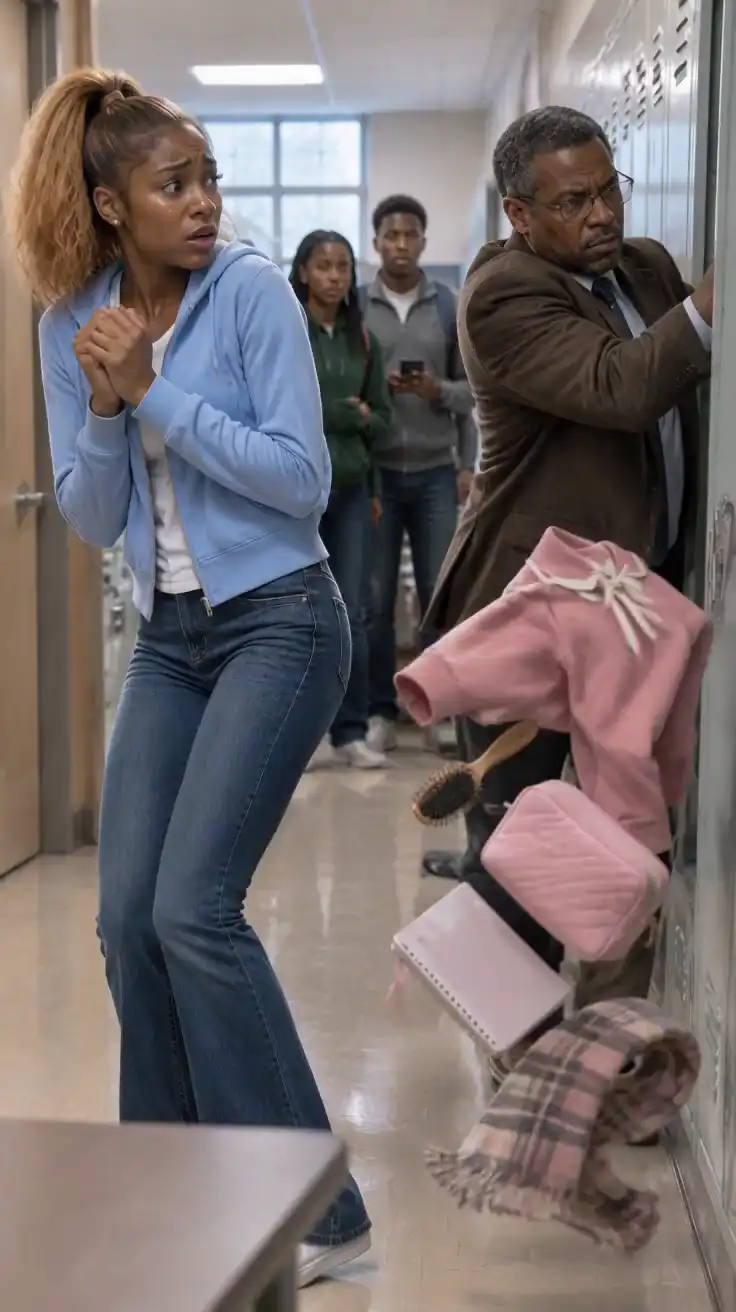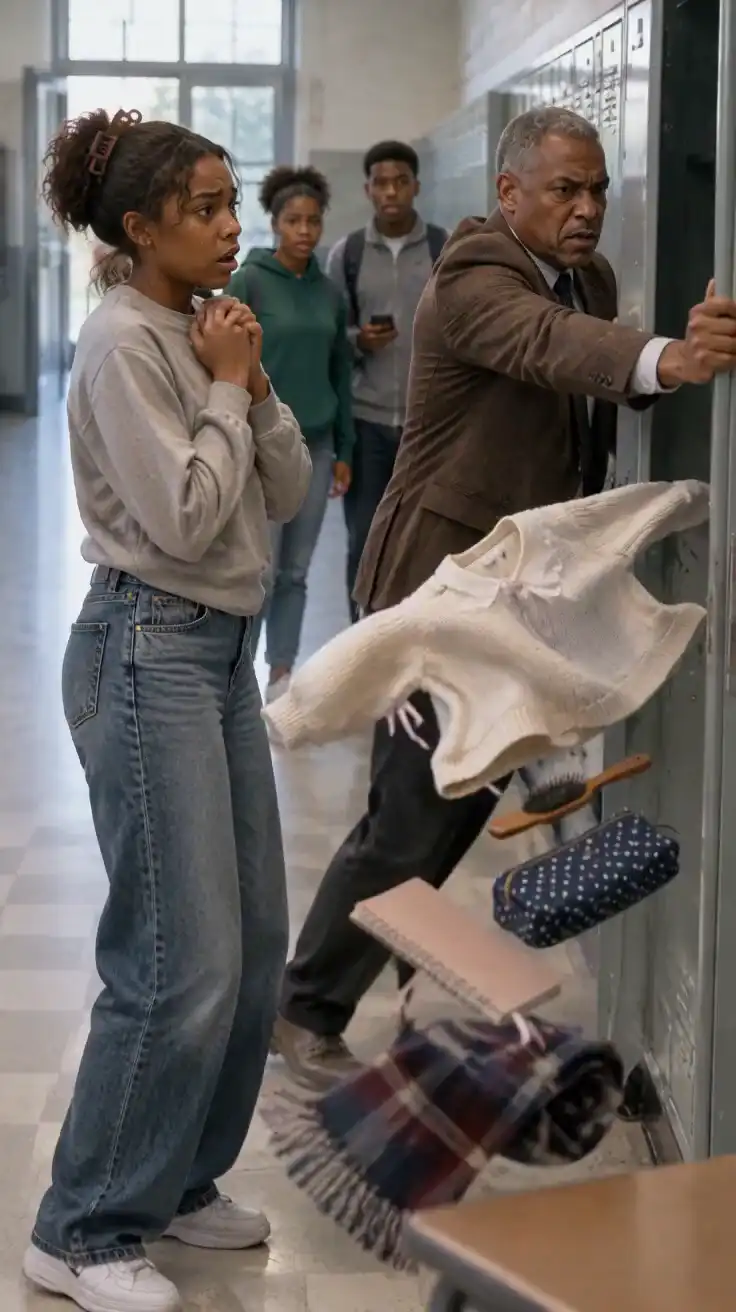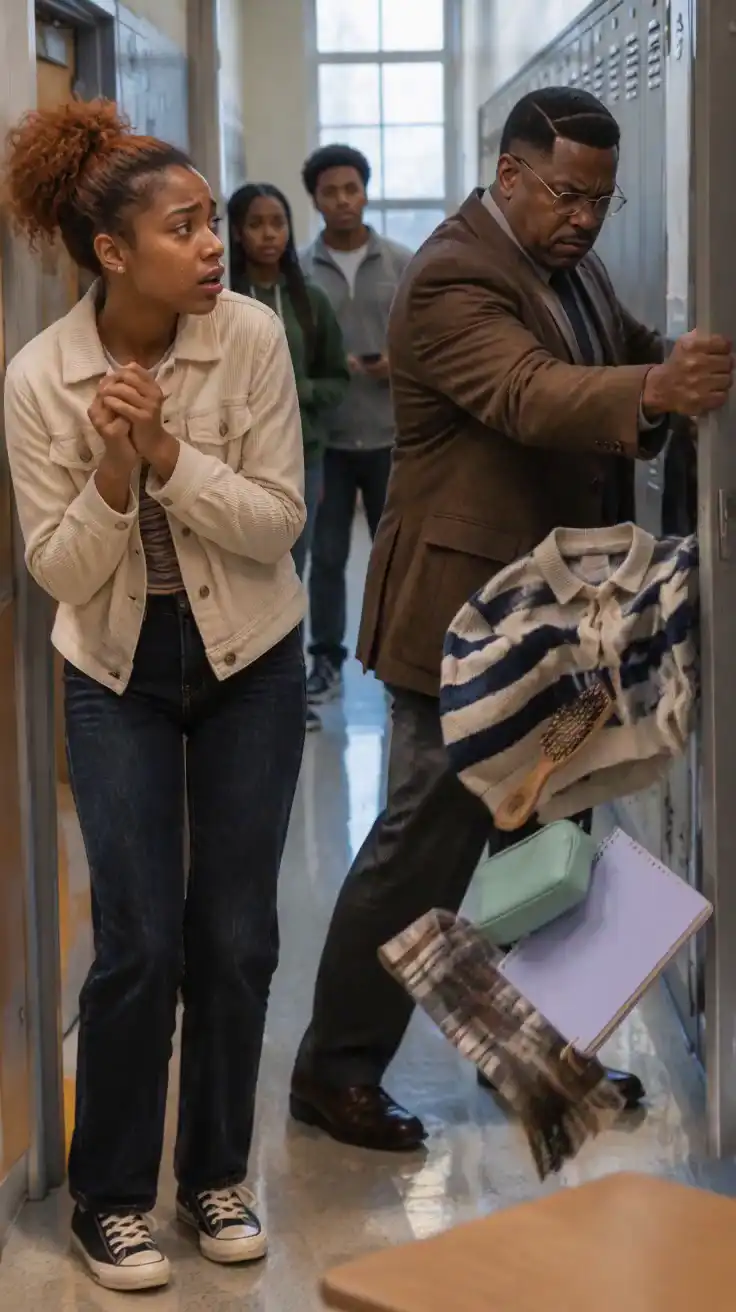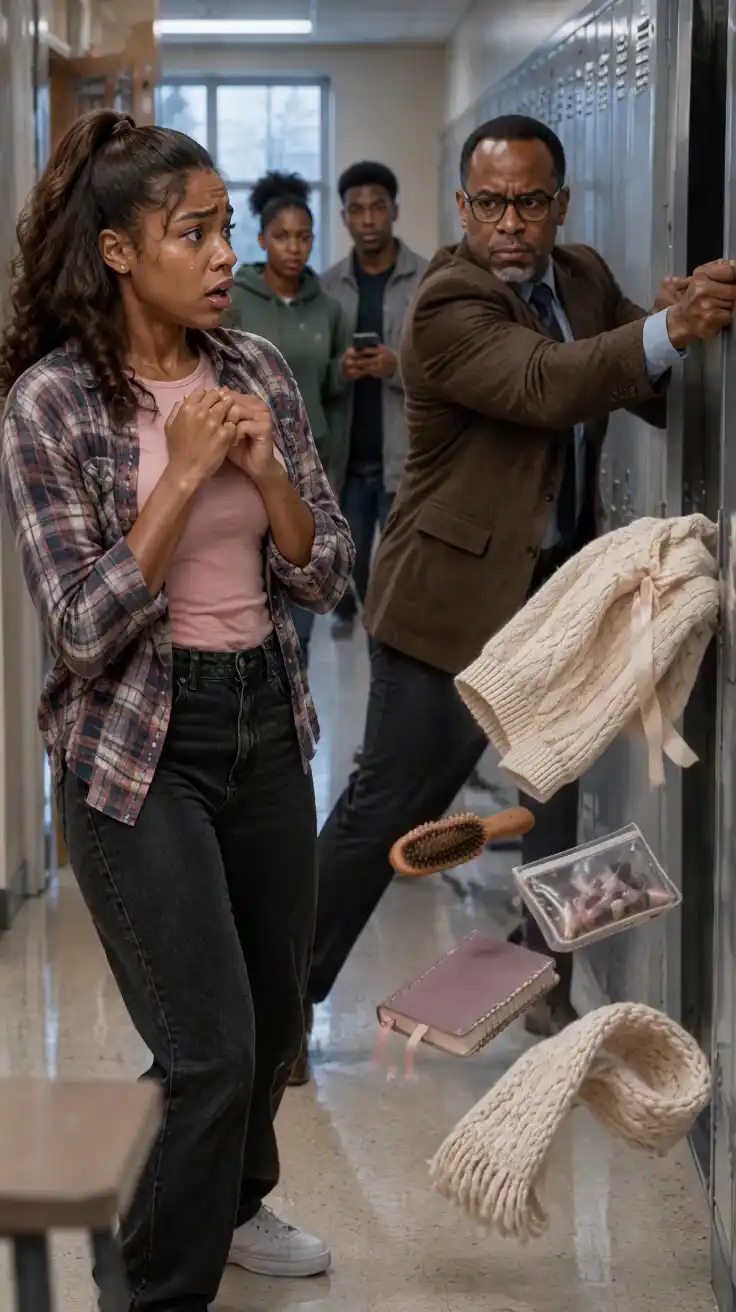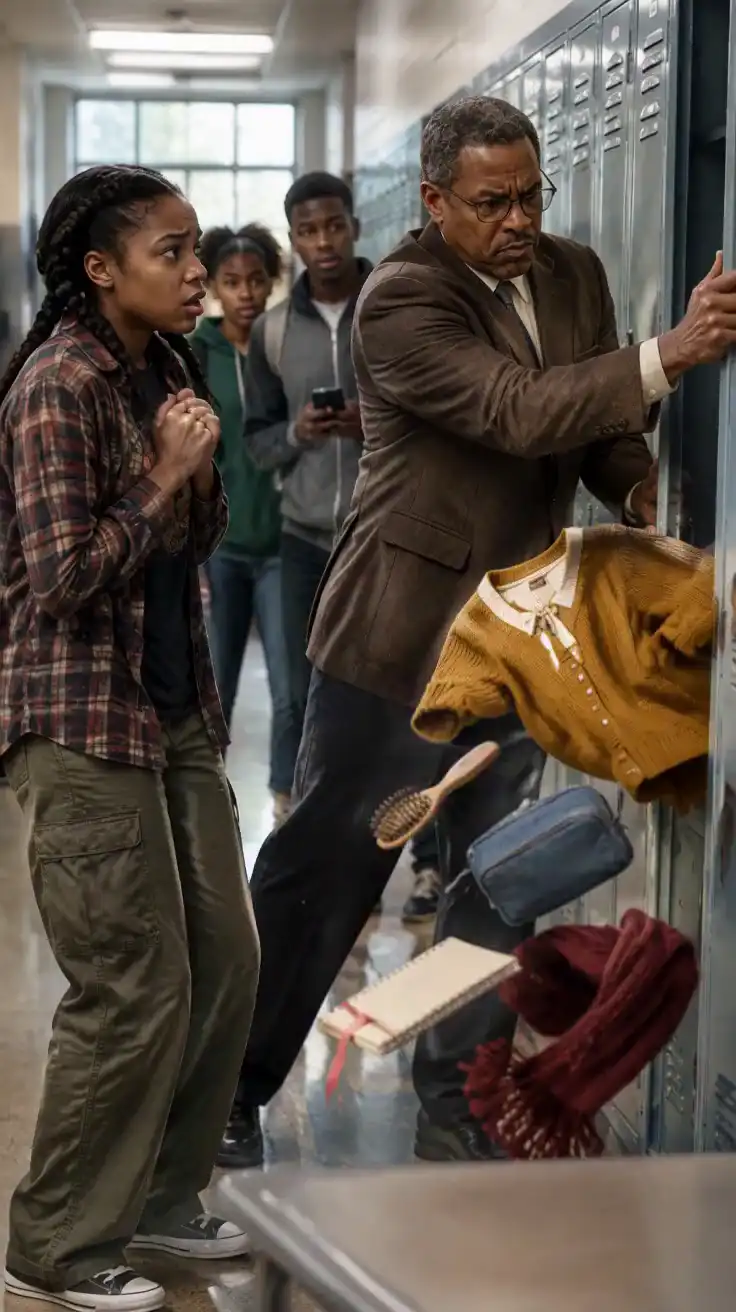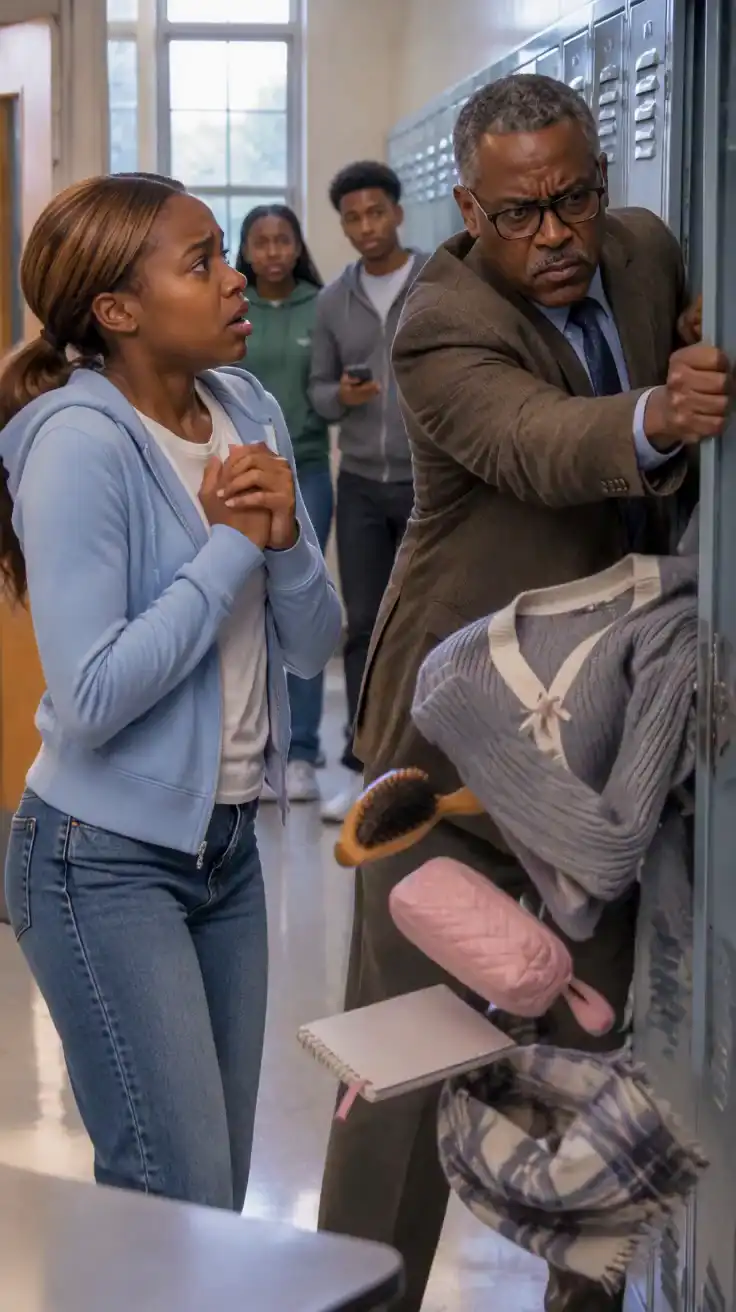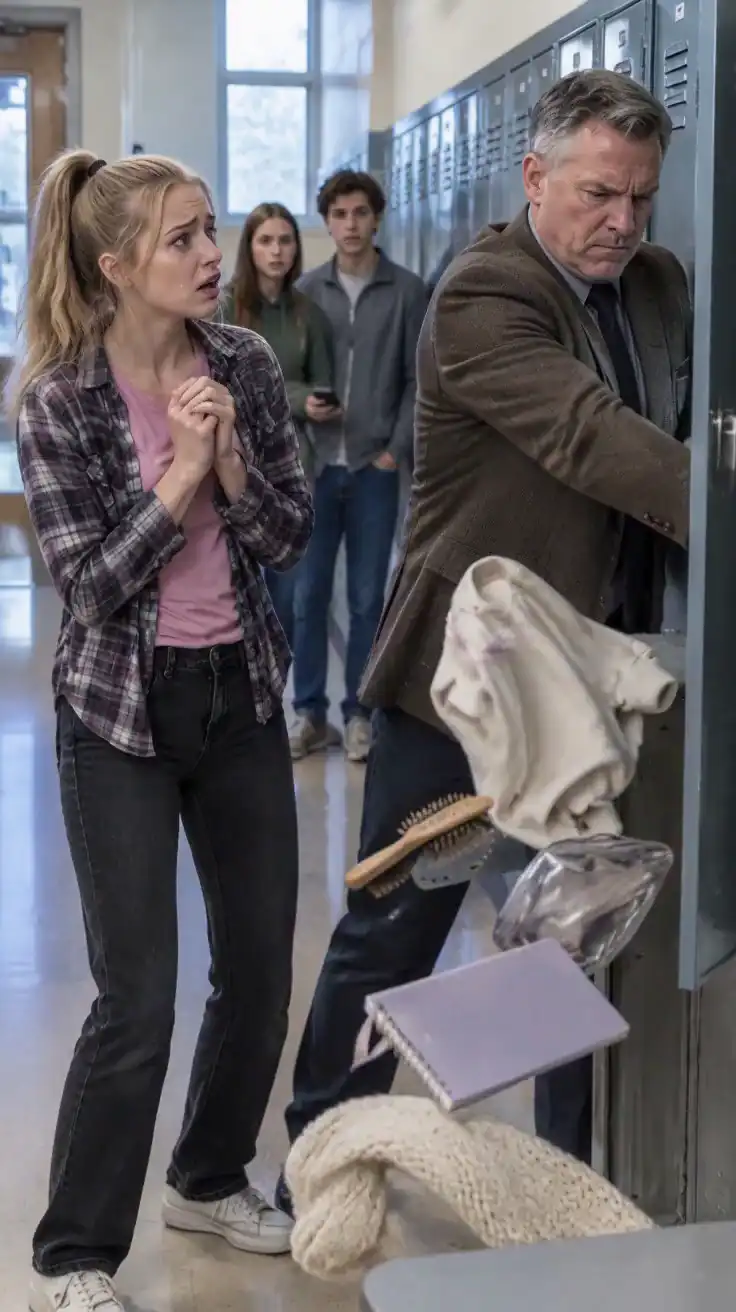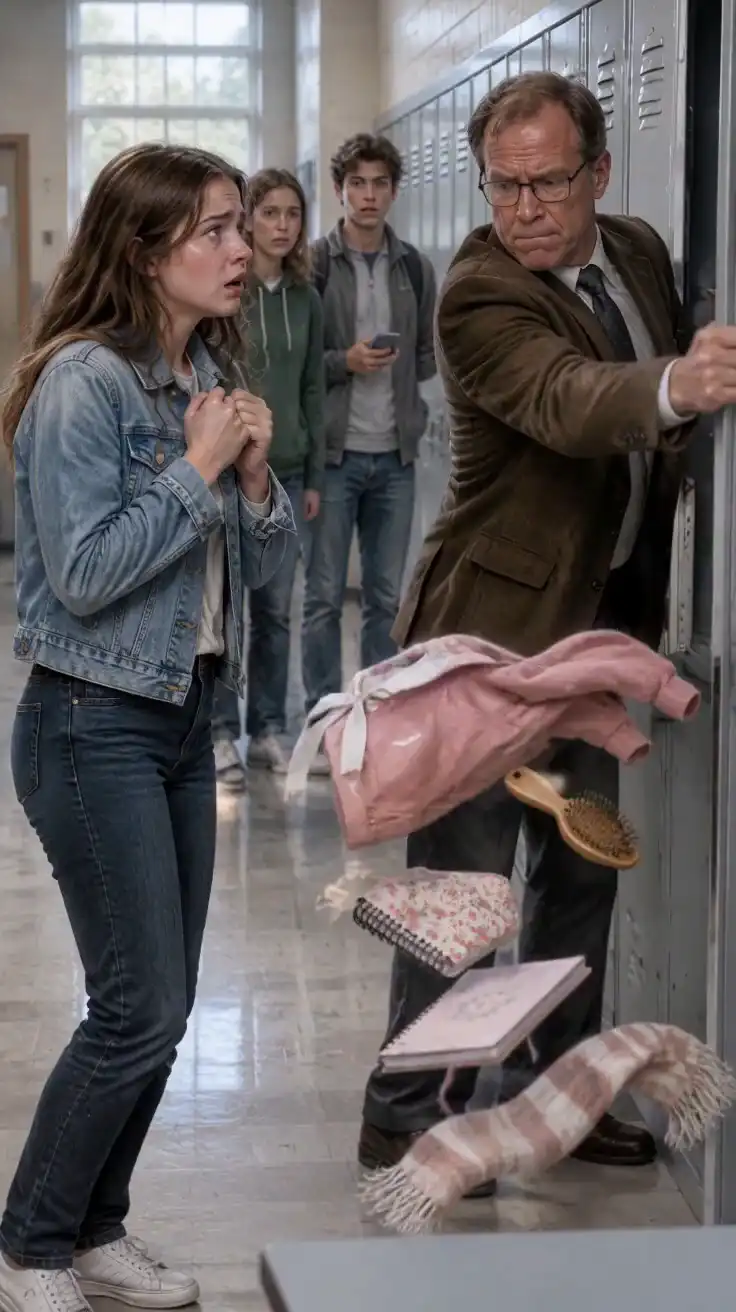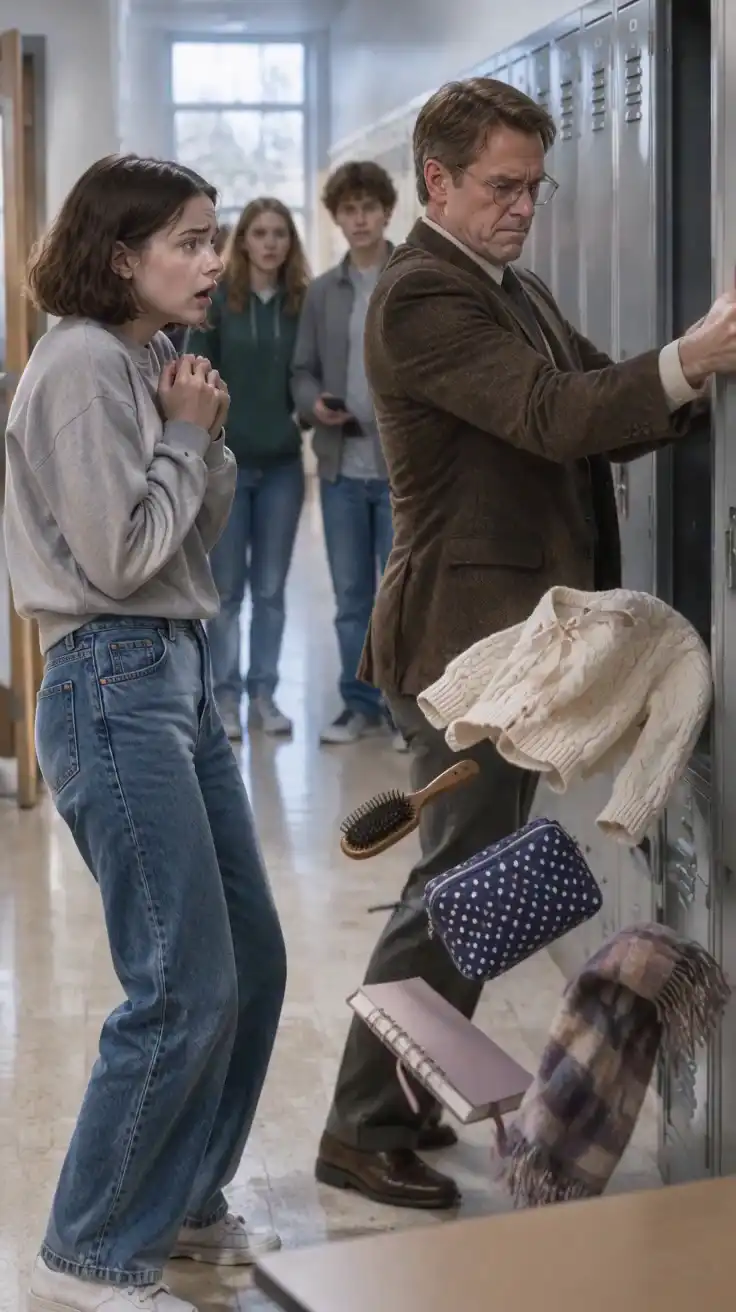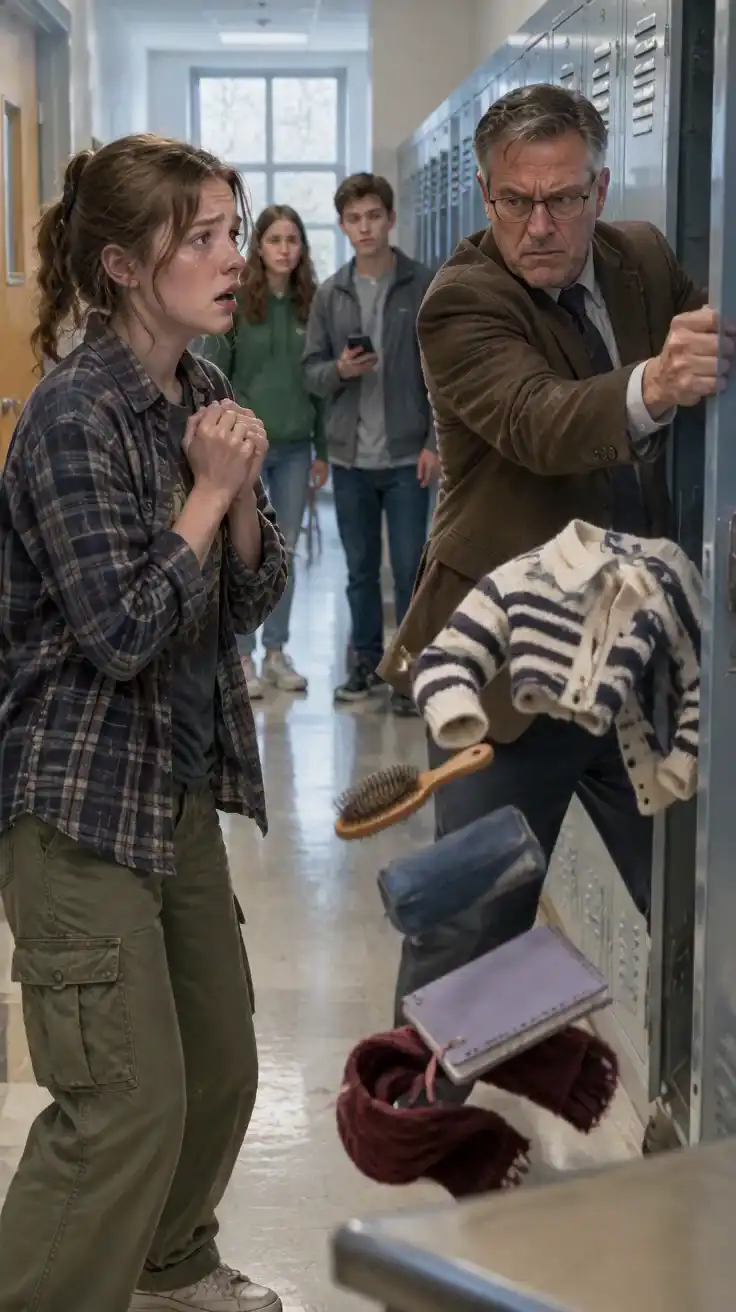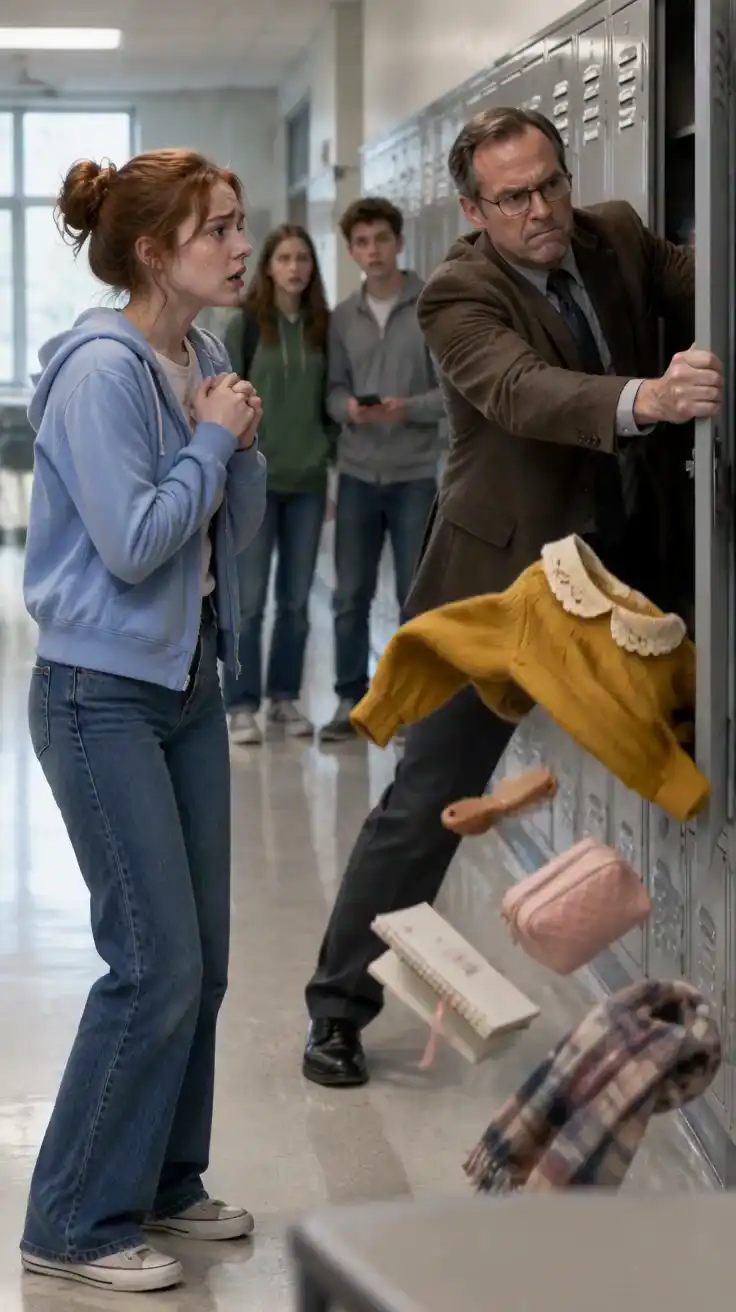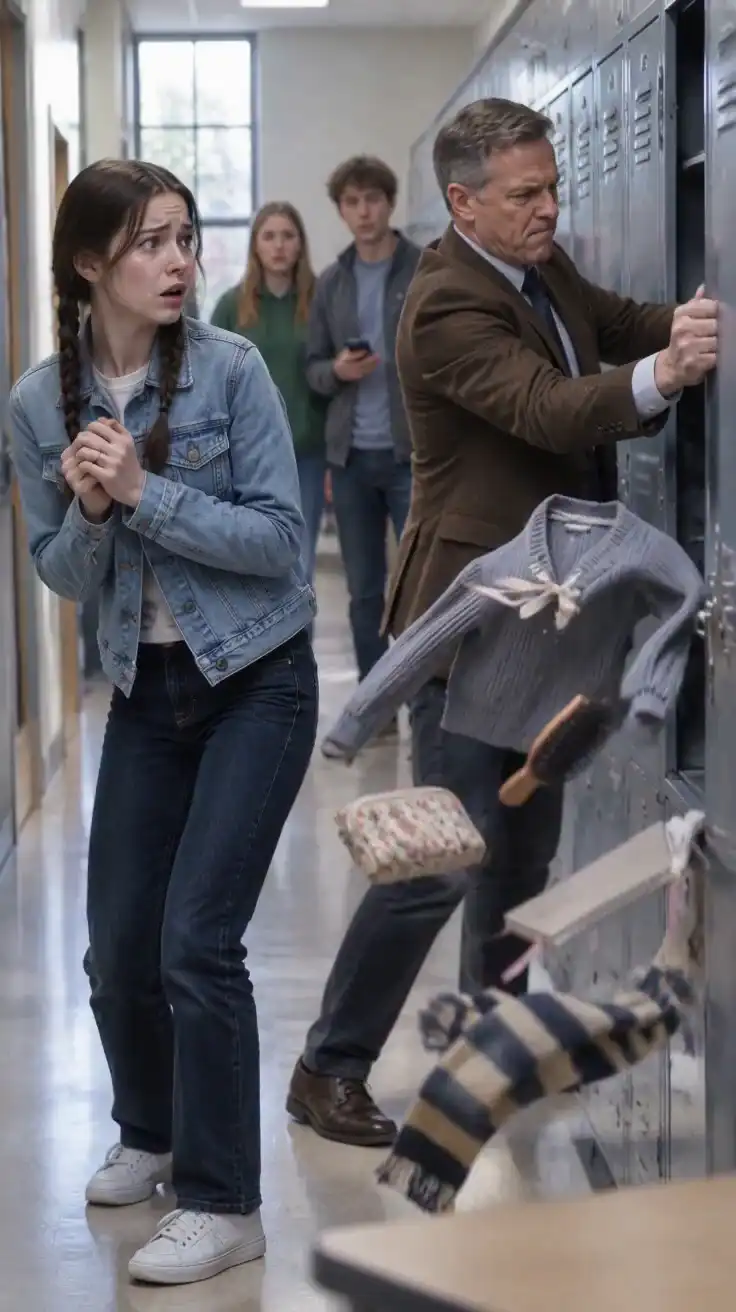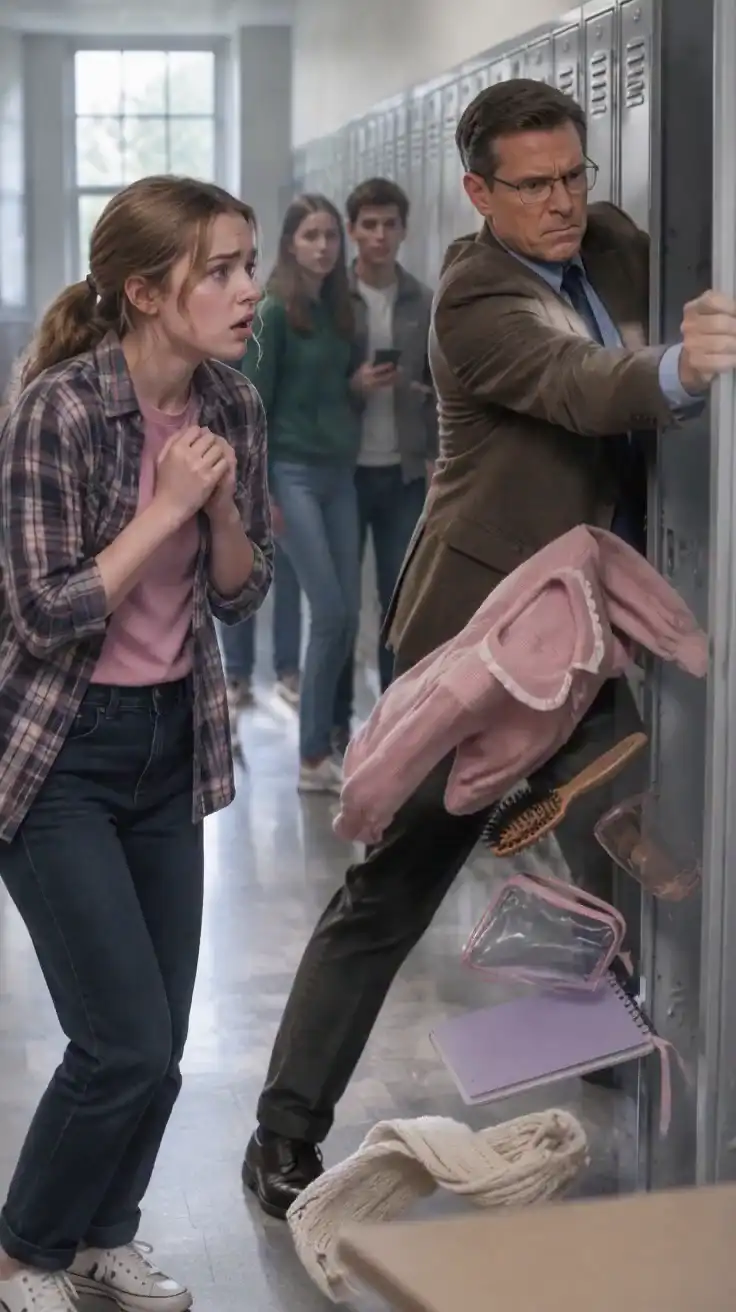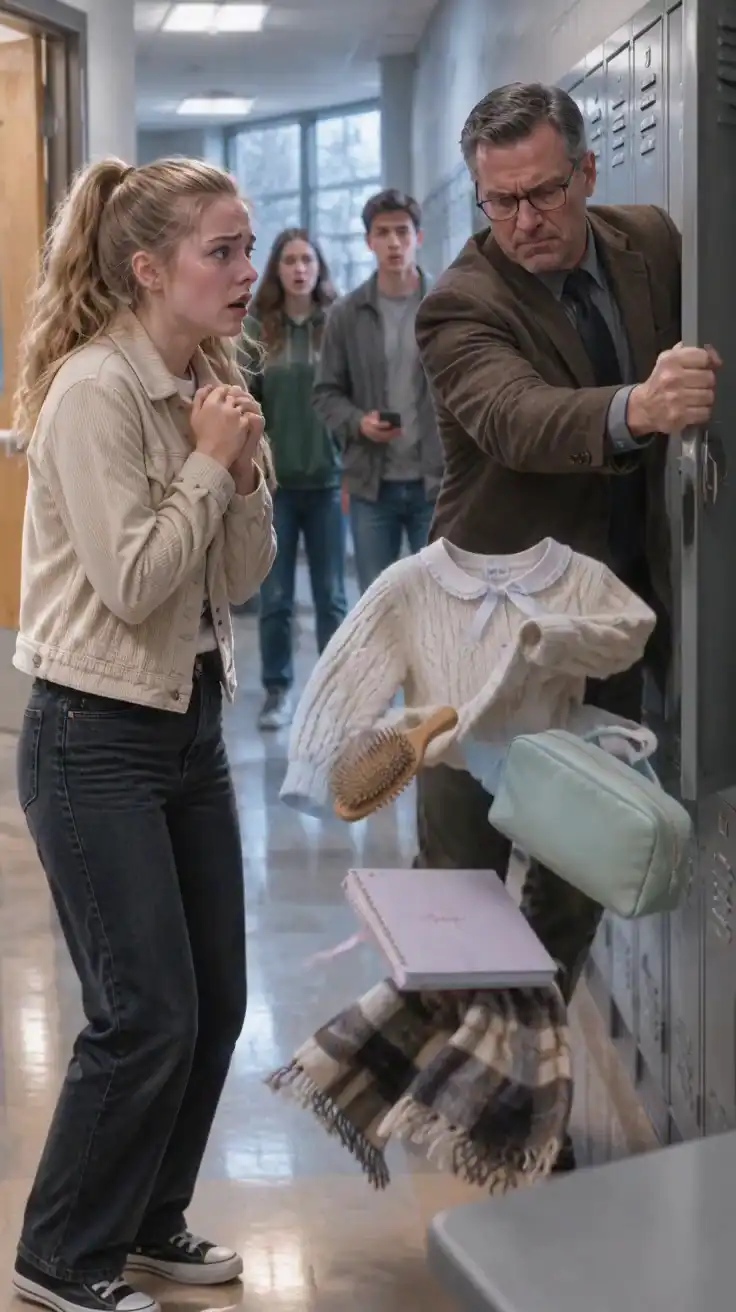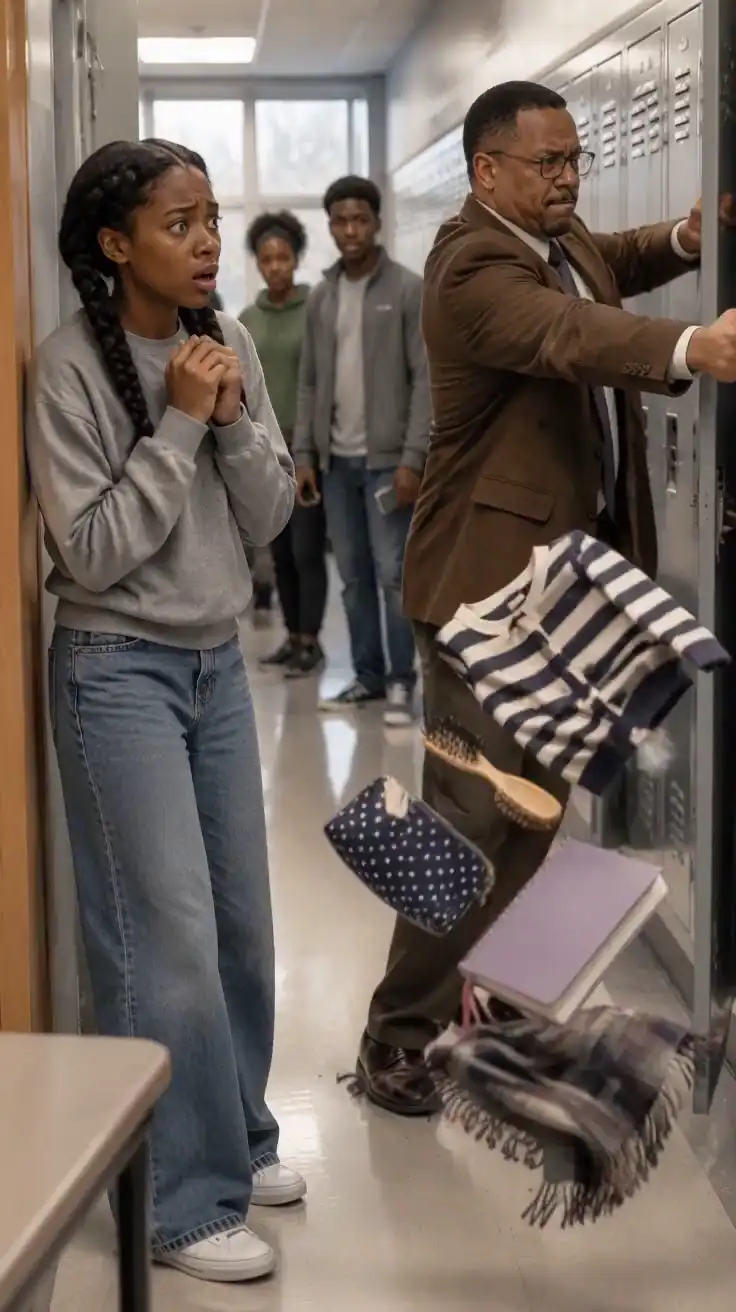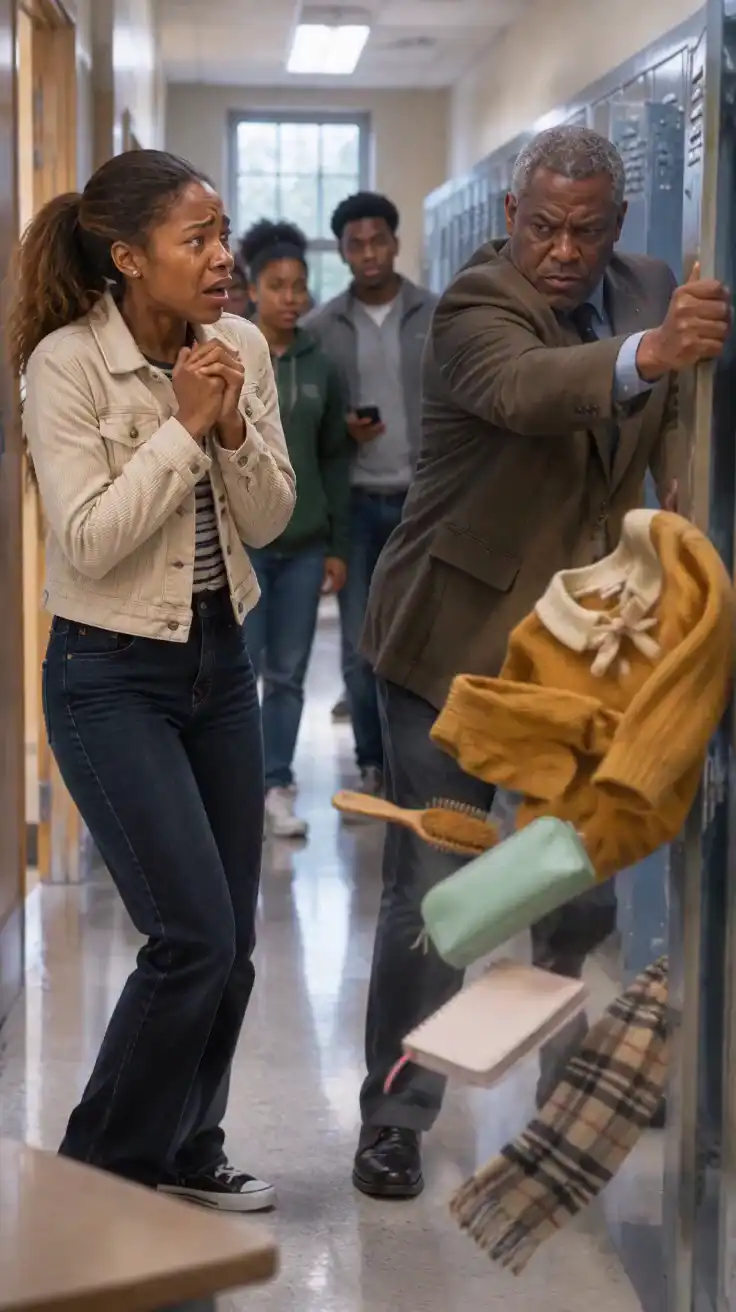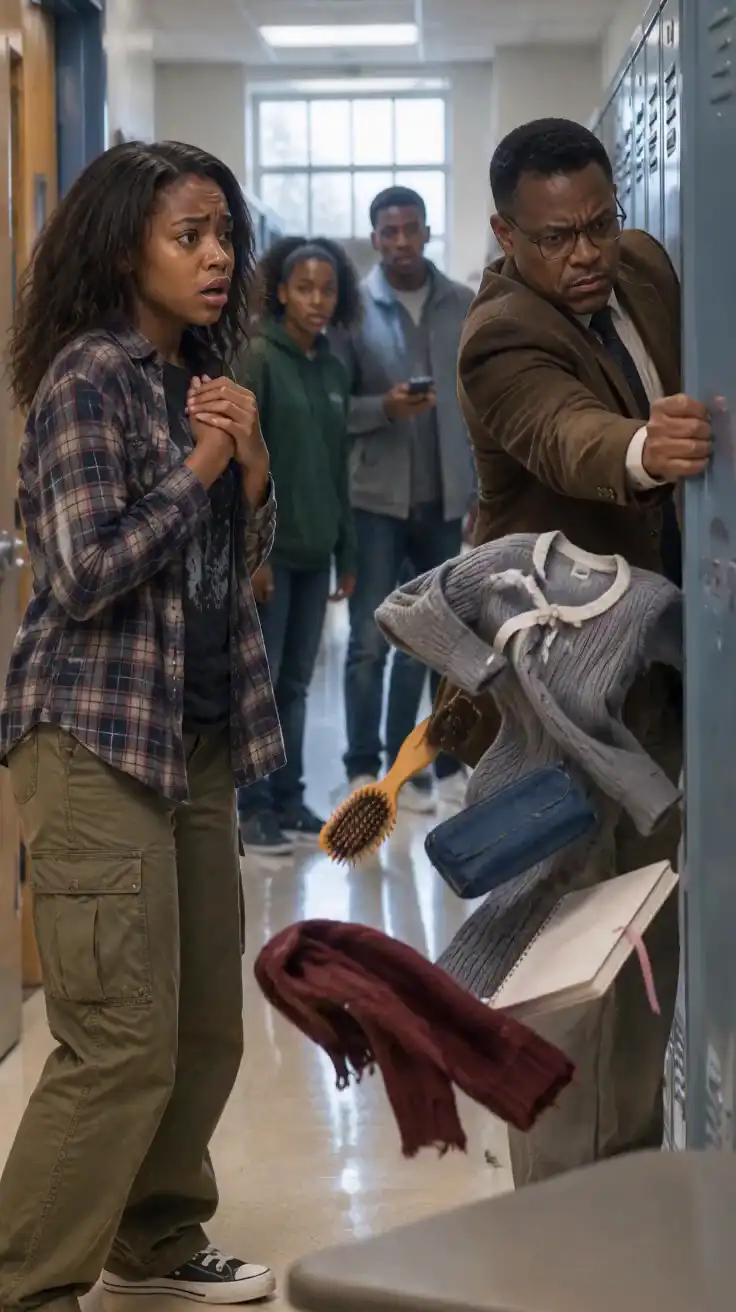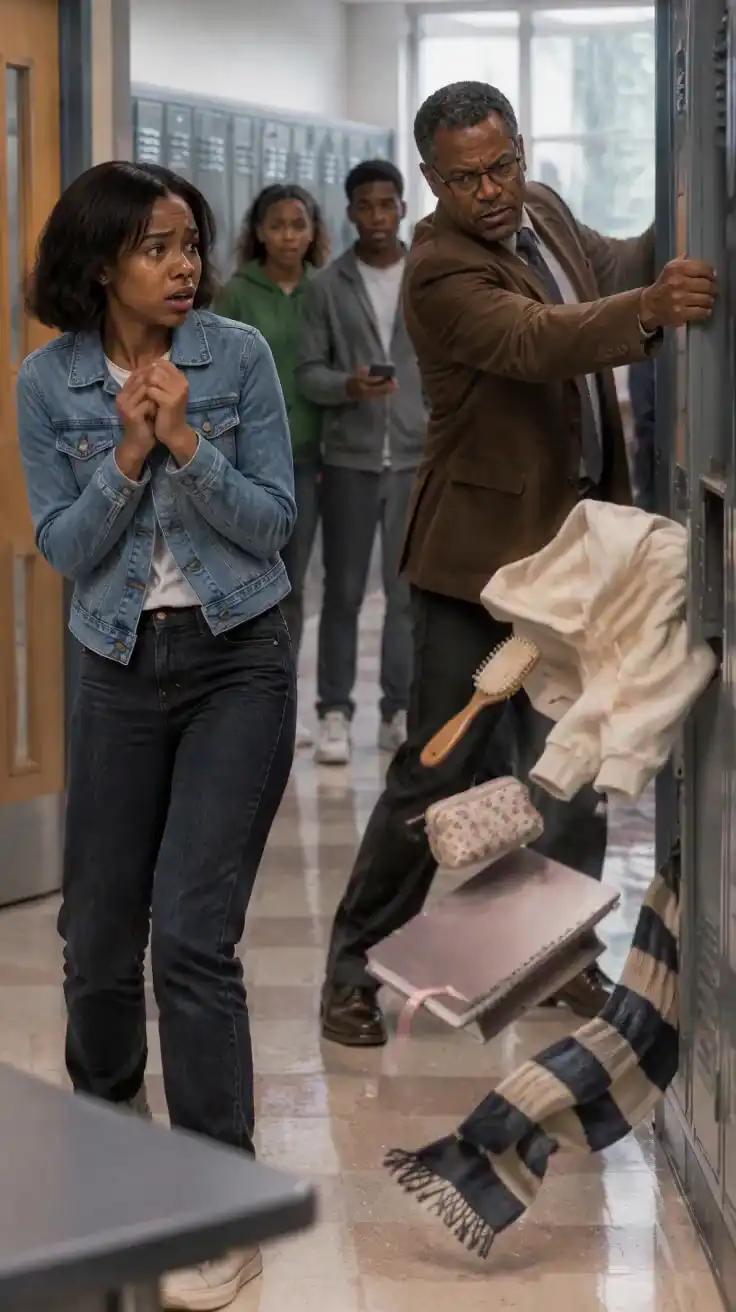
The bracelet struck the tile.
For a second, no one moved.
It made a small, bright sound, much smaller than the noise of the hallway. A few students were still whispering. Someone’s phone kept recording. The dean’s hand was still inside the pocket of Nora’s sweatshirt, and Nora was still on her knees beside the things he had emptied from her locker.
The girl who had pointed at her looked down at the bracelet.
Her name was Camille Mercer. She had been in Nora’s homeroom since September. She was standing close enough to pick it up, but she didn’t.
Mr. Bell pulled his hand from Nora’s sweatshirt. He looked from the bracelet to Camille, then at the students holding their phones.
“Did that come from your sleeve?” he asked.
Camille’s face had gone pale. She shook her head once, too quickly.
“No.”
I can still hear the way she said it. Not frightened. Not confused. Just certain.
Mr. Bell looked down at the bracelet again. It was gold, thin, and set with a little oval charm. It belonged to Tessa Lane, the school’s varsity basketball captain. She had lost it in the gym two days earlier, after practice. She had told the office it was a family bracelet, a gift from her grandmother, and the school had spent the morning looking for it.
That was why Mr. Bell was standing at my daughter’s locker.
That was why my daughter was on the floor.
And now the bracelet was lying beside Camille’s shoes.
I was watching the video from our kitchen table when I first understood what the sound meant. My sister had sent me the clip, and I had already watched it three times. I watched it again, with one hand over my mouth, while Nora sat across from me and stared at the grain of the wood.
When the bracelet hit the tile, I stopped the video.
“Did you know?” I asked her.
Nora shook her head.
“Did Camille say anything to you before this?”
“She was acting weird,” Nora said. “But she’s been acting weird since the scholarship.”
She said it as if she were answering a question about the weather. She had been trying not to make too much of it for weeks. I had been trying not to make too much of it too.
The school had called the bracelet search an investigation. They called the decision about Nora’s enrollment a placement review. They used careful words that made events sound smaller and more orderly than they were.
By then, it was Wednesday afternoon. The transfer decision was due Friday.
Nora had been offered a place at Easton Academy, a small public magnet program across town. The offer came with a scholarship that covered transportation and supplies, and the school had asked us to accept or decline by Friday at four. If we declined, they would offer the place to the next student on the list.
Nora had earned it. She had spent months on the application, written the essays herself, and stayed after school twice a week to work on the portfolio. The scholarship was competitive. Camille had applied too. She had wanted the same place, the same funding, the same clean start at a school where her older brother had graduated.
Nora got the scholarship.
Camille did not.
And on Wednesday morning, when the bracelet was missing, Camille pointed at my daughter.
I did not know any of that when I first saw Mr. Bell reach into Nora’s sweatshirt pocket. I did not know what Camille had done with the bracelet, or why. I knew only that Nora had called me from the office with a voice so quiet I almost didn’t recognize it.
“Mom,” she said. “They think I took something.”
“What thing?”
“A bracelet. They’re searching my locker.”
“Are you there now?”
“Yes.”
“Are you alone?”
There was a pause.
“No.”
I heard another voice in the background. A man’s voice, speaking firmly, but not loudly enough for me to make out the words.
“Put Mr. Bell on the phone,” I said.
“I can’t.”
“Why not?”
“He says I have to stay here.”
“Where are you?”
“Outside the office. By my locker.”
The call ended before I could answer.
I left the dish towel on the counter. I remember because I had been drying a mug, and the towel slipped down onto the floor as I grabbed my keys. I didn’t pick it up. I told my husband, Mark, that the school was searching Nora’s locker and that he needed to come if he could. He was at work, twenty minutes away. I drove there alone.
I had thought about calling the principal. I had thought about calling the school counselor. I had thought about calling the police, though I didn’t know what I would say. I did not do any of those things on the drive. I kept both hands on the steering wheel and drove faster than I should have.
I knew Nora’s voice. I knew the way she sounded when she was worried and the way she sounded when she was trying to make me believe she wasn’t. That call had been both.
At the school, the front office secretary told me Mr. Bell was “handling a situation.”
“What situation?” I asked.
She looked over my shoulder, toward the hallway.
“I’m sorry, Ms. Reed. I don’t have all the information.”
“I’m her mother. Where is she?”
The secretary stood up and came around the desk. She didn’t seem unkind. She seemed uncertain, which was worse.
“She’s in the east hall.”
“By herself?”
“I don’t know.”
I started walking before she could stop me.
The hallway outside Nora’s homeroom had always been loud at that hour. The school was old, and sound seemed to settle into the brick walls and come back twice as sharp. The bell had just rung. Students were moving between classes, but some had stopped near the lockers. A few were holding their phones at chest height.
I saw Nora’s backpack first. It was on the floor, open, with one strap twisted underneath. Then I saw her.
She was on her knees.
The books and notebooks from her locker were spread across the tile. Her lunch container had opened, and an apple had rolled against the wall. Her sweatshirt was partly inside out. A photograph had fallen face down.
Mr. Bell stood over the pile. He was the dean of students, and he was tall enough to make the space around him seem smaller. He had one hand in the pocket of Nora’s sweatshirt and the other holding the fabric away from her body while he checked the lining.
I started toward them.
“Mom,” Nora said.
That was all. She didn’t get up. She didn’t cry. She just looked at me.
Mr. Bell pulled his hand out of the pocket and turned.
“Ms. Reed,” he said. “I understand this is upsetting.”
“You told my daughter to kneel on the floor?”
“I asked her to sit down while I checked the contents of her locker.”
“She’s on her knees.”
He looked at Nora. “I didn’t tell her to kneel.”
“She asked you not to,” said a student behind me.
I turned. A boy in a green jacket lowered his phone. He looked about fifteen.
“Did you record this?” I asked.
He looked at Mr. Bell, then back at me.
“Yes.”
“Keep the video. Don’t post it. Send it to your parents.”
“I’m going to,” he said.
Mr. Bell stepped between Nora and me, not touching me, but close enough that I had to stop.
“We’re investigating the loss of a student’s property,” he said. “I need you not to interfere.”
“My daughter is sitting on the floor in a hallway while you search her clothes.”
“I checked a pocket. I did not search her clothing.”
“Then why is her sweatshirt inside out?”
He glanced down at the sweatshirt in his hand and let it fall.
Nora started to reach for her books.
“Don’t move,” he said.
She froze. Her hand stayed suspended over the floor.
“Why can’t she pick up her things?” I asked.
“We haven’t finished.”
“Finished what?”
“I’ll explain in the office.”
“No. Explain here.”
He took a breath. I could see the effort it took him to keep his voice even.
“Ms. Reed, Tessa Lane reported that her bracelet was missing from the gym after practice. There is reason to believe it may have been taken. Camille Mercer told me she saw Nora with it.”
The students around us shifted. Camille was standing just behind a group of them, close to the wall. She looked at Nora. Then at me. Then at the floor.
“What did you see?” I asked her.
She didn’t answer.
Mr. Bell turned toward her. “Camille?”
Camille lifted her chin and pointed at Nora.
“There. Search her things. She took it.”
Nora looked at her.
“I didn’t.”
“You did,” Camille said.
I remember how easy it would have been to focus on Camille’s voice. It was sharp and confident. But I looked at her hand. Her arm was extended straight out, fingers stiff. She was gripping the sleeve of her uniform cardigan with her other hand.
“Camille, when did you see Nora with the bracelet?” I asked.
“She had it.”
“When?”
“I don’t know.”
“You don’t know when?”
“I saw her with it.”
“Where?”
Camille’s eyes moved to Mr. Bell.
He said, “We’re going to handle this through the proper process.”
“That’s what I’m asking about. What did she say she saw?”
“She said she saw Nora with the bracelet.”
“That’s not an answer.”
The students had stopped pretending they were only passing through. They had formed a loose half circle around us, phones pointed toward the center. I was aware of how I looked to them: an adult in a coat, standing over a school employee, speaking too loudly. I did not care enough to lower my voice.
Nora was still on her knees. Her eyes were on the floor, on the books and papers scattered around her. She had a way of becoming very still when she felt embarrassed, as if any movement might make her more visible.
“Please don’t,” she had whispered in the video. I heard it in my mind before she said it again.
“Mom,” she said, barely audibly.
“I’m here.”
Mr. Bell reached into the pocket of her sweatshirt. Nora flinched. I took a step forward, and he looked at me.
“Don’t,” he said.
I stopped because I knew one sudden movement would become the story. I knew how quickly an adult’s anger could be turned into a different accusation. I stood still, with my fists closed inside my coat pockets.
He checked the pocket, then the lining. There was nothing.
Camille stepped closer. She pointed again and shouted, “It’s not in her locker because she hid it!”
As she lifted her arm, something slid from inside her sleeve.
The gold bracelet struck the tile.
The room went silent around that little sound.
I can’t say that I understood everything in that moment. I understood that the bracelet had come from Camille’s sleeve. I understood that it had not been in Nora’s locker. I understood that the accusation had been pointed at the wrong girl. The reason was still out of reach.
Mr. Bell looked at Camille.
“Is that Tessa’s bracelet?”
“No,” Camille said.
Tessa was in the doorway to the gym hall. She had been standing there with the assistant coach. She came forward, then stopped when Mr. Bell raised a hand.
“That’s mine,” she said.
Camille looked at her. “You said it was lost.”
“I did.”
“Then how do you know?”
“Because my grandmother gave it to me. It has the tiny dent by the clasp.”
Tessa’s voice was shaking, but she did not look away from the bracelet.
Mr. Bell picked it up by the chain. “Camille, come with me.”
She backed away.
“I didn’t take it from her.”
“Then where did it come from?”
“I don’t know.”
“Camille.”
“I found it.”
“Where?”
“I said I don’t know.”
Mr. Bell looked at me. “I need to take her to the office.”
“You need to take my daughter off the floor first,” I said.
That seemed to reach him. He put the bracelet in his hand and stepped back.
Nora didn’t move.
I crouched beside her. “You can get up.”
She looked at me as if she needed the instruction confirmed.
“Your things are yours,” I said. “Pick them up when you’re ready.”
She gathered the photo first. The frame had split at one corner, but the picture inside was unbroken. It was from the summer before, when she and her younger brother, Owen, had taken the train to the lake with us. She pressed the photo against her chest for a second before putting it back into her bag.
The students were still filming.
“Put the phones down,” Mr. Bell said.
A few students did. Most did not.
I took the sweatshirt from the floor and folded it over my arm. Nora put her books into her backpack. The lunch container had leaked a little yogurt onto the tile. A student I recognized from her science class handed her the apple.
“Thanks,” Nora said.
The girl nodded but didn’t speak.
We walked to the office with Mr. Bell behind us and Camille several steps ahead. Tessa stayed in the hallway with the coach. I didn’t know what would happen next. I only knew that I did not want Nora separated from me again.
In the office, the secretary led us into the small meeting room. It was usually used for parent conferences. There was a round table, six chairs, and a box of tissues in the middle. The walls were painted pale blue. A poster about conflict resolution hung beside the door.
Mr. Bell asked Nora to sit in one chair. I sat beside her. Camille sat across from us. A counselor named Mrs. Patel came in with a folder. The assistant principal joined a few minutes later.
At first they spoke as if the event in the hall had not happened.
“Camille says she saw Nora holding the bracelet,” Mr. Bell said.
“Where?” I asked.
He glanced at the folder. “Near the gym.”
“When?”
“This morning.”
“What time?”
“During passing period.”
“Which passing period?”
He looked at Camille. “Could you tell us?”
Camille’s arms were crossed. One cuff was pulled down over her hand.
“I don’t remember.”
“Did you see her holding it, or did you hear someone say she had it?” I asked.
“I saw it.”
“On her wrist?”
“No.”
“In her hand?”
Camille looked down. “I don’t remember.”
Nora stared at the table. She was holding the zipper pull on her backpack and rolling it between her fingers.
“Did you see the bracelet in Nora’s locker?” I asked.
“No.”
“Did you see her put it there?”
“No.”
“Did you see her take it from Tessa?”
“No.”
“Then what did you see?”
“I saw her with it.”
That was the first time her voice sounded uncertain.
The assistant principal, Ms. Crowley, leaned forward. “We’re going to review the hallway footage and speak to the students who were there. We also need to make sure the bracelet is returned to Tessa.”
“It’s in Mr. Bell’s hand,” I said.
He set it on the table.
Tessa had come into the room behind the assistant coach. Her eyes were red, but she didn’t look like she had been crying. She looked tired. She identified the bracelet and asked whether she could take it with her.
“Not yet,” Mr. Bell said. “We need to document it.”
Tessa nodded. “Okay.”
Camille’s face had changed. The confident expression she had worn in the hallway was gone. She was looking at the bracelet as if it might say something.
I asked, “Why did you accuse Nora?”
“I didn’t.”
“You pointed at her.”
“She had it.”
“You just said you didn’t see her take it, didn’t see it in her locker, and don’t remember where you saw it.”
Camille’s jaw tightened.
“I thought she had it.”
“Why?”
She didn’t answer.
The counselor stepped in. “Let’s take a break. Nora and her mother can wait in another room while we speak with Camille.”
“I’m not leaving my daughter,” I said.
“No one is asking you to leave her alone,” Mrs. Patel said. “We can bring her to my office.”
Nora looked at me.
“Do you want to go?” I asked.
She shook her head.
“Then we’ll stay.”
The meeting ended without an answer. Mr. Bell said they would call us. Ms. Crowley asked me not to contact other students while they were investigating. I said I would not, but I wanted a copy of the incident report and the name of the staff member who had approved a search of Nora’s locker.
She said, “I’ll follow up.”
It was late morning when we left. Nora held her backpack close to her body. I held her sweatshirt. In the car, she buckled her seat belt and looked out the window.
“Are you okay?” I asked.
She gave a small shrug.
“Do you want to talk?”
“No.”
“All right.”
We drove home in silence. I turned the radio off even though it had already been off.
At home, Nora went upstairs. I called Mark. He left work and came home. We sat at the kitchen table where the video would later play. He asked what happened, and I told him in pieces. Every time I reached the part where Mr. Bell told her not to move, I had to stop.
“I should have been there,” Mark said.
“You couldn’t have known.”
“I should have been there.”
Nora came down after an hour. She had changed into a clean sweatshirt. Her eyes were swollen, though she insisted she hadn’t been crying.
“Do you want us to call Easton?” Mark asked.
She looked at him. “Why?”
“To ask for more time.”
“I don’t want more time.”
“You don’t have to decide this second.”
“I want to go.”
She said it plainly. She did not say she wanted to leave because of Camille or Mr. Bell or the video. She said she wanted to go because the program had classes in environmental science and a robotics lab, because she had already met two girls who liked the same books she did, and because she wanted to try.
Then she said, “But I don’t want people to think I’m leaving because I did something wrong.”
“You didn’t,” I said.
“I know.”
She looked at me for a moment, then away.
“Do you?”
I had no immediate answer. The honest one was that I believed her. But I could see that believing her privately was not going to fix what had happened in public. A hallway full of students had seen her on the floor. They had seen the dean search her things. They had heard Camille accuse her. Not all of them would stay to see the bracelet fall from the right sleeve.
“I know you didn’t take it,” I said. “And I’ll make sure the school says that.”
The video had already been sent to my sister. By early evening, students had shared it with their parents. The school asked families not to post it. That request did not stop it from spreading. One version had been uploaded to a private account, then shared in a group chat. By dinner, a parent had sent me a screenshot of it.
I did not want the video circulating. I also knew it was evidence. I saved every version I received, wrote down who had sent it, and asked them not to forward it further.
The first call from the principal came at six. His name was Dr. Harlan. He said he was “deeply concerned by the video” and wanted to meet the next morning.
“I need to know what happened,” I said.
“We’re still gathering information.”
“You saw the video?”
“Yes.”
“Then you saw my daughter on her knees.”
“I did.”
“Did you see Mr. Bell tell her not to move?”
“I did.”
“Did you see the bracelet come from Camille’s sleeve?”
“I did.”
There was a long pause.
“We’ll discuss this tomorrow,” he said.
“What will happen to Mr. Bell?”
“I can’t discuss personnel matters.”
“What will happen to Camille?”
“I can’t discuss student discipline.”
“What happens to Nora’s transfer decision?”
“That’s not something I can answer tonight.”
I wanted to keep him on the phone until he said something useful. I knew he was not going to.
“Friday is the deadline,” I said. “We need the school’s written account before then.”
“I understand.”
“I don’t think you do.”
He said he was sorry I felt that way. Then the call ended.
The next morning, Nora did not want to go to school. I did not blame her. We told the office she would be absent, and I asked for her assignments. A teacher sent them before noon. Another teacher wrote that she hoped Nora was “feeling better.” None of them mentioned the incident.
The school asked us not to contact Camille’s family. I was not planning to. I did not know her parents. I knew Camille mostly as a girl with neat handwriting, a quick answer in class, and a habit of leaving before the final bell when her ride arrived early. I knew she had a brother, because he had once come to the homeroom door to bring her a jacket. I knew she and Nora had been friendly at the start of the year.
They had not been close, but they had been classmates in the full sense of the word. They shared a desk row. They sat through morning announcements together. They passed out worksheets together. They had been assigned to the same science group in October, when the class built small water filters from bottles and gravel. Nora had told me Camille was good at making things look polished.
They were together every morning in homeroom. They saw each other before the first class, during lunch, and in the crowded line for the bus. A person can become part of your day without becoming your friend. That was what Camille had been to Nora until the scholarship.
The application process began in the fall. The Easton scholarship was for students entering the academy’s advanced program, and the school had invited several students from Nora’s middle school to apply. Nora had found the announcement on the counseling office bulletin board. She brought it home and left it on the table beside her math homework.
“What do you think?” she asked.
“I think you should apply,” I said.
“I don’t know if I’m good enough.”
“That’s why they have an application.”
She worked on it for weeks. Her essay was about the drainage ditch behind our neighborhood, where trash collected after rain. She had taken photographs of it and written about how runoff moved through the area and into the creek. She described a plan for mapping the litter and testing the water. It was the kind of thing she did naturally: notice a problem, ask how it worked, and then try to measure it.
Camille applied too. Their teacher told me later that Camille’s essay was about starting a peer tutoring group. It was a good essay. She had helped younger students with reading, and she had a strong recommendation from her science teacher.
The scholarship decision came in March. Nora opened the email on her laptop while I sat beside her. She read it twice without speaking.
“You got it?” I asked.
She turned the screen toward me.
“I got it.”
I hugged her. She laughed once, surprised. Mark came into the room and asked what had happened. Nora told him, and he picked her up off the chair. She complained that she was too old for that, but she smiled.
The next day, she told me Camille had been quiet in homeroom.
“I said congratulations to her,” Nora told me that evening.
“You said congratulations to Camille?”
“No. Ms. Larkin announced it in class. She said she was proud of me, and then I went over to Camille after. I told her she’d done a good job on her application.”
“What did she say?”
“She said, ‘You got the scholarship because teachers like you.’”
“What did you say?”
“Nothing.”
“Why not?”
“Because it was awkward.”
I understood the awkwardness. I had been a teenager. I knew that people said things when they were hurt that they might not have said otherwise. I also knew that one comment did not mean a friendship was over.
Over the next few weeks, Nora started coming home with small stories about Camille. A worksheet Nora had put in the shared class bin had gone missing. A group chat had started without her. Someone had written “scholarship girl” on a scrap of paper and left it in her desk.
Nora said Camille had not done those things. She said other people were probably teasing her. She said she didn’t want to make it a big deal.
One afternoon, I found a note in her bag. It was folded in half and written in blue ink.
Must be nice to get everything handed to you.
I showed it to her.
“Where did this come from?”
She looked at it and shrugged. “I don’t know.”
“Did someone put it in your bag?”
“Probably.”
“Do you think it was Camille?”
“I don’t know.”
“Do you want me to call the school?”
“No.”
“Why not?”
“Because then it becomes a thing.”
“It is a thing if someone is leaving notes in your bag.”
“I can deal with it.”
She picked up the note and threw it away. I let her, because I thought I was respecting her. I wish I had written down the date and called the school that day. I wish I had asked the counselor to check in with Nora even if Nora said she didn’t need it. I wish I had recognized that her reluctance to speak was not the same as being fine.
There were other incidents, none large enough to force a response on their own. Camille stopped sharing notes when Nora was absent. She began correcting her in front of the class, even when the correction was wrong. Once, she told Nora that the scholarship committee probably felt sorry for her because her parents were “so involved.”
That one brought Nora to the kitchen in tears.
“What does that mean?” I asked.
“I don’t know.”
“Did she say it today?”
“Yesterday.”
“Why didn’t you tell me?”
“I thought you’d call.”
“I might have.”
“That’s why.”
I felt the sting of that. I was proud that Nora trusted me, but I had also become someone she had to manage. She was thinking about how I would react before she told me what was happening.
I asked her whether she wanted me to contact the school. She said no. Then she said yes. Then she said she didn’t know.
I emailed her homeroom teacher, Ms. Larkin, and asked for a meeting. The response was polite and brief. She said she had not noticed a serious conflict but would “keep an eye on the dynamic.” She did not ask for details. I did not send the note or list the incidents. I regret that, too. I wanted the school to see what was happening without making Nora sound as if she were building a case against another girl. I did not understand that the school would fill the gaps with its own assumptions.
By the time the bracelet disappeared, Nora had been careful around Camille for months. She kept her distance at lunch. She did not respond to comments. She had stopped asking Camille to pass papers down the row.
And still, when the bracelet went missing, the school accepted Camille’s accusation without asking why she was making it.
On Thursday morning, Dr. Harlan met with us in the office. Mr. Bell was not there. Ms. Crowley and Mrs. Patel sat on one side of the table. Nora and I sat on the other.
Dr. Harlan began by saying he was sorry the situation had caused “distress.”
I interrupted him.
“Are you apologizing for what happened, or for how it made us feel?”
He stopped.
“I’m apologizing for what happened,” he said. “Mr. Bell should not have asked Nora to kneel, and she should not have been made to wait while her belongings were on the floor. The search was handled poorly.”
“Did he ask her to kneel?”
“He says he asked her to sit down.”
“She was on her knees.”
“Yes.”
“She said, ‘Please don’t.’”
“I heard that in the recording.”
“Did he hear it?”
Dr. Harlan looked at Ms. Crowley.
“Mr. Bell says he didn’t hear her.”
“Then why did he tell her not to move?”
“He says he was trying to keep the items undisturbed.”
“Her lunch container was open on the floor. Her books were scattered. What was he preserving?”
There was another pause.
Dr. Harlan folded his hands. “We should have stopped the search and called you when the accusation was made.”
“Yes.”
“We should not have had students gathered around.”
“Yes.”
“We should not have allowed the situation to become public.”
I looked at him. “It was already public when he opened her locker in the hallway.”
He nodded.
Nora had not said a word. She was watching the edge of the table.
Dr. Harlan asked if she wanted to say anything.
She looked at me first. I didn’t tell her to answer. I didn’t tell her she had to.
“I didn’t take it,” she said.
“We know that now,” Ms. Crowley replied.
Nora looked at her. “You should have known before.”
Mrs. Patel drew in a breath. Ms. Crowley lowered her eyes.
“You’re right,” she said.
That was the first response from the school that sounded like it belonged to what had happened.
I asked for the incident report, the names of the staff who had been interviewed, and a written statement clearing Nora. Dr. Harlan said he would provide a written letter. He said the school was reviewing its procedures for searches and allegations of theft. He would not tell us what disciplinary action Camille would face.
“Does her family know what happened?” I asked.
“Yes. They were contacted yesterday.”
“Did they see the video?”
“They have been informed of the incident. I can’t say what they have seen.”
“Does Camille admit the bracelet came from her sleeve?”
Dr. Harlan said she had “provided inconsistent accounts.”
“That’s not an answer.”
He took a breath. “She admitted that she had the bracelet in her sleeve. She said she picked it up after it fell near the gym and planned to return it.”
“Then why did she accuse Nora?”
“She said she thought Nora might have taken it.”
“Based on what?”
“She has not given a consistent explanation.”
I knew then that the answer was not going to come from the school. It would come from Camille, if it came at all.
The assistant principal said they were considering whether Nora should remain at the school for the rest of the year. I asked why.
“Given the conflict between the students, we’re looking at options that would reduce contact,” she said.
“What options?”
“A schedule change. A different homeroom. Possibly a transfer.”
The word transfer struck me as if she had thrown it across the table.
“Why would Nora have to leave?”
“It’s one option we’re considering.”
“Is Camille being asked to leave?”
“We can’t discuss another student’s placement.”
“So my daughter is the one whose school is being discussed, and you won’t tell me what you’re doing about the girl who accused her?”
“We’re not asking Nora to leave,” Dr. Harlan said. “We’re trying to make sure everyone feels safe.”
“She was on the floor while students filmed her. She was searched over a bracelet that fell from Camille’s sleeve. She’s the one who needs to feel safe?”
The room went quiet.
That was the first time they mentioned the transfer. It was not the same Easton transfer decision that was due Friday. It was the school’s suggestion that Nora might move out of her current program before the end of the year. The phrase had been introduced gently, as if it were a compromise. But to Nora, it sounded like the school was asking her to go.
On the way home, she said, “I don’t want to transfer.”
I told her the Easton decision was hers and that the school could not make us decline the scholarship. I did not know whether that was entirely true. I knew the school could not force us to give up the place, but I also knew there were forms, records, and approvals. I didn’t want to promise something I couldn’t control.
That afternoon, Easton called. The enrollment coordinator asked whether we were still planning to accept.
“We are,” I said.
“Do you need more time?”
“No. We’ll submit by Friday.”
Nora was standing nearby. She heard me. She took the phone from my hand and spoke to the coordinator herself.
“Yes,” she said. “I want to come.”
When she hung up, she looked relieved. Not happy, exactly. But relieved.
That evening, the school sent a short email. It said Nora had been “fully cleared of any involvement in the loss of the bracelet.” It did not mention the search. It did not mention the students in the hall. It did not apologize for the public accusation.
I replied asking them to include those facts. They did not answer before the end of the day.
On Friday, Mark and I drove Nora to Easton to sign the enrollment papers. The building was newer than her current school, with wide windows and a garden courtyard. The coordinator met us in the office. Nora filled in the forms herself. She asked about the robotics lab and the environmental science elective. She asked whether students could use the library after school.
The coordinator answered each question without hurrying her.
On the drive home, Nora held a folder on her lap. It contained the acceptance letter and a printed map of the campus.
“You seem excited,” I said.
“I am.”
“Are you still worried about people thinking you’re leaving because of the accusation?”
“A little.”
“What do you think you’ll tell them?”
“That it’s a good school.”
“That’s true.”
She looked out the window.
“And I was going to go there anyway.”
That was true too. The bracelet did not create the opportunity. It made the decision more urgent and more difficult. But Nora had wanted Easton before anyone searched her locker.
We turned in the forms before the deadline. At four o’clock, the spot was hers.
The school’s apology came the following Monday.
Dr. Harlan asked us to meet in the front office. I expected another closed-door conversation. Instead, he said he wanted to address the incident “with the people who witnessed it.” I asked who he meant.
“Staff and students who were present,” he said.
“Will the apology be in front of the office?”
He hesitated. “The office area is where the incident began.”
“Then that’s where it should happen.”
The school had not planned to invite all the students who filmed the search. Some had left early that day. A few had been identified through their videos. I asked that the students who were in the hallway be told to come by during advisory, and that no one be required to speak. The school did that.
Nora did not want to attend.
“I don’t want to stand there while everyone looks at me again,” she said.
“You don’t have to.”
“Will you go?”
“Yes.”
“Can I wait in the car?”
“Yes.”
She decided she wanted to come but stay in the small conference room beside the office. She wanted to be nearby, not in front of everyone. Mark came with me.
The office area filled with students and staff. A few people stood near the counter. Others waited by the hallway doors. Mr. Bell stood beside Dr. Harlan. He looked as if he had not slept well. I did not know whether he had, or whether I was reading his face through my own anger.
Dr. Harlan introduced himself and said the school needed to address what had happened on Wednesday. He said the bracelet had been found in Camille’s possession, and Nora had been cleared. He did not say Camille had put it in her sleeve. He did not say she had accused Nora.
Then Mr. Bell stepped forward.
“I want to apologize to Nora Reed and her family,” he said. “I handled the search badly. I should not have conducted it in the hallway. I should not have allowed her belongings to be emptied where other students could see. I should have contacted her mother before taking any action. I also should have stopped when Nora asked me not to continue.”
His voice shook on the last sentence.
“I was trying to recover a missing item,” he said, “but that does not excuse what I did. I’m sorry.”
I had imagined this moment many times. In my imagination, I told him exactly what I thought of him. I asked how a grown man could look at a teenager on her knees and continue. I made him explain why he believed Camille without asking questions.
But when he apologized in front of the office, I found I didn’t want to make the moment about my anger. I wanted Nora to hear that he had said he was wrong. I wanted the students to hear it too.
“Thank you for saying that,” I said. “I hope the school makes sure this does not happen to another student.”
He nodded.
“I hope so too.”
It wasn’t enough to repair what had happened. It did not remove the video. It did not erase the looks Nora had received in the hall. It did not make the school’s first response fair. But it was an apology in the place where the harm had happened, in front of people who had seen it. That mattered.
Afterward, Dr. Harlan asked me to speak privately. I declined. I went to the conference room and sat beside Nora. She had heard the apology through the open door.
“Did he say it?” she asked.
“Yes.”
“Was it real?”
“I think he meant it.”
She nodded, but she did not smile.
I asked whether she wanted to talk to him.
“No.”
“That’s okay.”
“I’m glad he apologized there.”
“So am I.”
She stood up. We left without speaking to anyone else.
The bracelet’s story took longer to come out.
For several weeks, Camille did not attend school. The principal said she was on a temporary schedule while the school reviewed the situation. Nora learned the facts from other students, but I did not trust rumors. I waited until the school provided a written account.
The school said Camille had found the bracelet near the gym after practice. It had been lying close to the bleachers, where the basketball team had left their bags. She picked it up and put it in the cuff of her cardigan. She said she intended to give it back but became worried when Tessa began asking about it.
That still did not explain why she pointed at Nora.
The answer came from Camille’s mother.
She called me one evening. I almost did not answer because I didn’t recognize the number. When she introduced herself, I stood up from the sofa and walked into the kitchen. I did not want Nora to hear the conversation before I knew where it was going.
“My name is Elise Mercer,” she said. “I’m Camille’s mother. I know you may not want to speak with me, but I wanted to apologize.”
I said, “Go ahead.”
She sounded tired. Her voice was quiet and measured.
“I’m sorry for what Camille did. I’m sorry she accused Nora, and I’m sorry the school treated Nora that way. I’ve watched the video. I can’t imagine how she must have felt.”
“Did Camille tell you why she did it?”
A pause.
“She said she thought Nora had been given everything because teachers favored her. She said she was angry about the scholarship.”
“Did she say she planted the bracelet?”
“She says she didn’t plant it in Nora’s locker. She found it and hid it in her sleeve. She says she panicked when the school started asking questions.”
“Why did she point at Nora?”
“She told me she thought the school would believe her. She thought Nora had been the one who took the scholarship from her, and she wanted people to look at Nora instead of her.”
The sentence landed heavily. I put my hand on the counter.
“She thought Nora took the scholarship from her?”
“She knows that isn’t literally true,” Mrs. Mercer said quickly. “She knows Nora didn’t steal it. She said it felt as if Nora had taken something that should have been hers.”
“That’s not the same thing.”
“No. It isn’t.”
“Did she say anything else?”
Mrs. Mercer was quiet long enough that I wondered if the call had dropped.
“She said Nora was good at making teachers feel sorry for her.”
I closed my eyes.
“What does that mean?”
“She said Nora talked about her project and got attention for it. She said the teachers praised her. She felt invisible.”
“Camille’s work was good too. Nora told her that.”
“I know. Camille told me.”
“Then why did she keep saying Nora was handed everything?”
“She thought Nora had an easier life.”
I had not expected that. I asked what she meant.
Mrs. Mercer said that Camille had been under pressure at home. Her older brother had left for college. Her father had been out of work for several months and was now working nights. Camille had been helping look after her younger cousin after school. She had worked hard on the scholarship application because she wanted to get into Easton and believed it would help her family.
“I’m not telling you that as an excuse,” she said. “It doesn’t excuse what she did. I’m trying to tell you what she told me.”
I appreciated that she named the difference. I did not accept the idea that hardship made a false accusation less serious. But it helped me see the shape of Camille’s thinking. She had wanted the scholarship. She had not received it. She had decided that Nora’s success was proof of unfairness. Then, when she had the bracelet hidden in her sleeve and the school was searching for it, she used that story to place suspicion on Nora.
She had not put the bracelet in Nora’s locker. She had not needed to. She only needed people to believe the girl who had won the scholarship was capable of taking something else.
The scholarship was the reason for the accusation. The bracelet was the opening.
Mrs. Mercer said Camille had apologized to Tessa. She had also written a letter to Nora.
“Would you be willing to read it?” she asked.
“I don’t know.”
“I understand. I’m not asking you to answer now.”
I thanked her for calling. We ended the conversation without making plans.
Nora was sitting at the kitchen table when I came back. She had heard enough to know who it was.
“What did she say?”
“That Camille was angry about the scholarship. She felt like you had taken something from her.”
“I didn’t take anything.”
“I know.”
“Did she say that?”
“She knows you didn’t take it literally. She thought you weren’t supposed to win.”
Nora looked at the table.
“Why didn’t she just say she was mad?”
“I don’t know.”
“Why did she have to make everyone think I stole something?”
“I don’t know that either.”
She was quiet for a minute.
“Did she apologize?”
“Her mother apologized. Camille wrote a letter.”
“Do I have to read it?”
“No.”
“Do I have to forgive her?”
“No.”
Nora picked at a loose thread on her sleeve.
“I don’t want to hate her.”
“You don’t have to decide what you feel right now.”
That was the closest I could get to an answer. I didn’t want to turn forgiveness into another demand placed on Nora. I also didn’t want anger to become something she carried around on Camille’s behalf. I told her she could read the letter or leave it unopened. She asked me to put it in a drawer.
The letter arrived two days later. It was in Camille’s handwriting, folded into thirds. Nora kept it in the kitchen drawer for a week. Then she asked me to read it first.
I opened it and read it silently. Camille said she was sorry. She said she had found Tessa’s bracelet and hidden it because she was afraid she would be blamed for taking it. When the school began asking questions, she decided she could make them look at Nora instead. She said she knew Nora had not stolen the scholarship, but she had felt as if Nora had taken something from her. She wrote that she had let that feeling turn into something cruel.
She did not ask Nora to forgive her.
I told Nora that was what the letter said.
“Do you want me to read it to you?”
“No.”
“Do you want to keep it?”
She thought about it. “Not in my room.”
We put it back in the drawer.
Camille returned to school near the end of the semester. The school arranged for her to attend a different homeroom and changed her lunch period. Nora was still in the same homeroom until the end of the year, but they were no longer seated near each other. The school said Camille had received disciplinary consequences. They did not tell us what those were.
I did not ask. I had learned that the details of another student’s punishment would not tell me whether the school had understood its own failure.
A week after Camille returned, Nora saw her in the hallway. Camille stopped when she saw Nora. She did not come closer.
“I’m sorry,” she said.
Nora looked at her.
“For the bracelet?” Nora asked.
“For all of it.”
Nora was silent.
“I was mad about the scholarship,” Camille said. “I thought you got it because everyone liked you. I knew that wasn’t fair. I did it anyway.”
Nora’s hands were in her pockets. She looked tired.
“I didn’t make you lose it,” she said.
“I know.”
“I didn’t tell anyone you were bad at your project.”
“I know.”
“I said your application was good.”
“I know.”
Camille nodded. Her eyes were wet, but she didn’t cry.
“I’m sorry.”
Nora did not say it was okay. She did not say she forgave her. She said, “I heard you.”
Then she walked to class.
That was all. It was enough for the moment.
The longer aftermath was more difficult for the adults than I expected. The school changed its search procedure. Parents were to be contacted before a student’s locker was searched, except in cases of immediate danger. Searches were to take place in a private office, with another staff member present. Students would not be required to empty their belongings in a hallway. The district sent the policy to families in a newsletter.
I wanted to believe the change would last. I wanted to believe that if another student was accused, the adults would pause, ask what the accusation was based on, and protect the accused student’s dignity. I also understood that procedures do not make a person careful by themselves. The adults have to choose to follow them.
Mr. Bell remained at the school. He was absent for several days after the incident, then returned. I saw him once at a school event before Nora left. He came over and apologized again, without making excuses.
“I should have called you,” he said.
“Yes.”
“I should have stopped when she asked me to.”
“Yes.”
“I’m sorry.”
I believed he meant it. I did not tell him that it was all right. I told him I hoped he would remember what he had done when he was in a position to make another decision about a student.
He nodded and said he would.
I did not know whether he did.
The video stayed online longer than I wanted. The students who had recorded it were not the ones who had created the situation, but their phones had turned a humiliating moment into something other people could replay. A parent removed one version after I asked. Another student posted a clipped version that ended before the bracelet fell. The clip showed Mr. Bell searching Nora’s locker and Nora kneeling. It did not show the bracelet sliding from Camille’s sleeve.
I asked the school to contact the student’s family. They did. The clip came down, but there were copies. I was told not to send the video to anyone. I had already saved it, so I kept it in a folder with the school’s emails and the incident report.
For a while, Nora asked me whether anyone had seen it. I did not lie.
“Yes,” I said. “Some students saw it.”
“Did they say anything?”
“Some did.”
“Like what?”
“Some said the school handled it badly. Some asked if you were okay. Some didn’t know the bracelet came from Camille.”
“Did they think I took it?”
“I don’t know.”
She nodded. I could see she was imagining each person who had watched it and deciding what they thought.
I asked whether she wanted to talk with the counselor.
“No.”
“Would you like to talk with someone outside school?”
“Maybe later.”
I made sure she knew she could change her mind. I did not push. She returned to school after two days and finished the year. She had friends who sat with her at lunch. Her teachers gave her work to do at home, and one of them called to say she was sorry for not noticing how tense things had become between the girls. That apology helped more than she expected.
The families did not become close. Mrs. Mercer and I exchanged a few emails. She asked whether Nora would be willing to meet Camille with a counselor present. Nora declined. Mrs. Mercer accepted that without pressure. She told me Camille was working with a counselor herself and had taken responsibility at home. I didn’t ask for details.
I knew some of the people at school believed Camille had acted because she was jealous and that was all. It was a simple explanation, and part of it was true. But jealousy alone did not explain the specific choice she made. She had not only taken the bracelet. She had turned the history between them into a reason to make Nora seem guilty. She had told herself that the scholarship belonged to her, that Nora had received it through favoritism, that the school would believe her if she pointed.
The school had given that belief room to work.
I cannot say what would have happened if Mr. Bell had asked a second question before opening the locker. I cannot know whether Camille would have changed her story. I cannot say the scholarship was the only reason she hid the bracelet. She might have panicked as soon as she found it. She might have been frightened of being accused. But when she pointed at Nora, she knew the bracelet was in her own sleeve. She chose to shift the suspicion to the girl whose success had become a grievance.
That matters.
Nora began at Easton in September. The first morning, she stood at the front door in a green jacket with her backpack over one shoulder. She checked that she had her ID card twice. Mark took a picture of her on the porch. She complained that he was being embarrassing, then asked him to take another because her hair was in her face.
The new school was not a cure for what had happened. Nora still looked up when an adult raised their voice in a hallway. She still checked that the zipper on her backpack was closed. For a while, she avoided wearing the sweatshirt she had worn during the search. She said it was because it was too warm, even in the cold.
But she found her way into the environmental science class she wanted. She joined the robotics club after watching a group of students build a small rover. She made a new friend named Lena, who liked the same fantasy series and asked Nora to sit with her at lunch. Slowly, the details of her days became about more than the search.
In October, she came home with a paper bag of leaves and soil samples. She had been working on a project about runoff around the school. She spread the samples on the table and began explaining how she planned to test them.
I listened. I asked questions. I did not mention the bracelet.
The last time I saw Camille was at the winter concert. She was sitting near the back with her mother. She had cut her hair shorter. When the concert ended, Mrs. Mercer found us in the lobby.
“Hi,” she said.
“Hi.”
She asked how Nora was doing at Easton. I told her Nora was enjoying it. Mrs. Mercer said Camille had been going to counseling and was trying to repair some friendships.
“I’m glad,” I said.
She looked toward the exit where Camille was waiting.
“I know an apology doesn’t fix it.”
“No,” I said. “It doesn’t.”
She nodded. “I’m sorry we put you in that position.”
I appreciated her saying we. I also knew the decision had belonged to Camille. Her mother had not pointed at Nora or hidden the bracelet. She had not made Mr. Bell empty the locker. But the families had been pulled into the same event, and Mrs. Mercer had not tried to tell me it was harmless.
“Thank you,” I said.
Then we left.
For months, I had replayed the hallway from the moment Nora called me. I replayed the drive. I replayed the way she looked at the floor. I replayed every time I had heard about the comments and decided not to make them worse by intervening. I thought about how easily the school had accepted a story that fit what it already believed: a missing bracelet, a girl accused, a locker to search.
I could have arrived sooner. I could have asked more questions months earlier. I could have insisted on a meeting when Nora brought home the note. I could have demanded that the school investigate the scholarship rivalry before it became a reason to suspect her. I have had a year to find all the points where I might have acted differently.
I have also had a year to understand that a parent cannot prevent every unfair thing from happening to a child. We can listen. We can believe them. We can ask questions. We can show up. We cannot always arrive before the harm.
What I can say is that when Nora told me she had not taken the bracelet, I believed her.
What I can say is that the bracelet came from Camille’s sleeve, not Nora’s locker.
What I can say is that Camille had lost the scholarship and had begun to see Nora’s success as a theft. She used that feeling to make a false accusation, and the school treated the accusation as enough to search a child in public.
What I can say is that the school apologized, in front of the office, after we insisted that the apology be given where the students who witnessed the search could hear it.
And what I can say is that Nora still got to choose her next school. She accepted the Easton scholarship by Friday. She went there because it was what she wanted, not because Camille had accused her, and not because the school had asked her to move.
The video ends before the hallway clears. It ends with the bracelet on the tile and everyone looking down at it. There is no sound after that. No one knows what to say. The phone stays pointed at the floor.
That is where the clip stops.
Our lives did not stop there.