THE LITTLE YELLOW SWEATER
The rain had started just before noon, a thin cold drizzle that turned the sidewalks of Spokane, Washington, slick and silver. By two o’clock, the sky hung low and gray over the bus station on Trent Avenue, and people hurried under awnings with their collars raised, their heads down, and their bags clutched close.
Marissa Cole stood near a vending machine with one hand wrapped around a paper cup of weak coffee and the other holding her daughter’s tiny fingers. The child beside her was so beautiful it made strangers smile even on a miserable day—Lila, four years old, with soft blonde hair gathered into two uneven pigtails, hazel eyes bright as honey in sunlight, a dusting of freckles across her nose, and rosy cheeks above the collar of a little yellow sweater. She wore red rain boots with ducks on them and hugged a threadbare stuffed rabbit with one ear bent.
“Mama,” Lila said, peering up at her, “when we get there, will there be pancakes?”
Marissa forced a smile. “Maybe not today, baby. But soon.”
“Soon means after sleeping?”
“Maybe a few sleeps.”
Lila thought about that seriously, the way only little children could. “Five sleeps?”
Marissa tucked a wet strand of hair behind her ear and crouched to button Lila’s sweater all the way to her throat. “Maybe.”
The station smelled like coffee, damp wool, diesel, and old floor cleaner. People came and went in waves. Somewhere a baby cried. A loudspeaker crackled overhead with a garbled announcement. Marissa’s suitcase—everything she still owned that mattered—sat by her leg. Her purse held forty-three dollars, a bus ticket to Boise, and the folded paper with an address she wasn’t even sure was still good.
Lila pressed the rabbit’s face to her cheek. “You look sad.”
Marissa swallowed hard. “I’m just tired, sweetheart.”
“Then I’ll be brave for you,” Lila said.
Marissa nearly broke right there.
The last normal moment of their life happened in that bus station while rain tapped at the windows and strangers brushed by without noticing them. Lila leaned against her mother’s knee and hummed to herself. Marissa rested her hand on her daughter’s warm golden head and prayed for one more miracle.
It did not come.
Marissa had not always been poor enough to count crackers for dinner. There had been a time in Spokane when she worked regular shifts at a diner near the river, paid rent on time, and could buy Lila hair ribbons from the dollar store just because they matched her eyes. But after the diner closed, after her landlord raised the rent, after the old pickup died and the bills from her mother’s illness swallowed what little she had saved, life narrowed into a tunnel of unpaid notices and hard choices.
She had spent the last three months sleeping on friends’ couches, then in a church shelter, then in a motel room paid for three nights at a time. Every day she searched for work. Every night she promised Lila things would get better.
Then she met Doreen Pike.
Doreen was a woman in her late fifties with lacquered nails, a voice like syrup, and a way of speaking that made desperation sound almost respectable. She volunteered at a neighborhood pantry where Marissa sometimes went for canned soup and powdered milk. Doreen wore perfume that clung to the air long after she left and expensive jewelry that flashed under fluorescent lights.
“You’re drowning,” Doreen had said quietly one afternoon while Lila colored on scrap paper nearby. “And that little girl deserves stability.”
Marissa stiffened. “I know what my daughter deserves.”
“I’m not criticizing you,” Doreen replied smoothly. “I’m offering a bridge. I know a couple in Idaho. Good people. They can help for a little while. Just until you’re back on your feet. Room, food, safety. You can visit. You can get settled and bring her back when you’re ready.”
Marissa had stared at her. “You mean foster care?”
“No,” Doreen said quickly. “Nothing official. Just family friends helping family friends. Sometimes paperwork only scares people away. This would be temporary.”
Temporary.
It was the most dangerous word Marissa had ever believed.
By the day at the bus station, she had run out of every other option. The shelter could not keep them longer. Her cousin in Boise had finally written that they could stay in her apartment for a while, but Marissa had no money for a second ticket and not enough for food along the way. Doreen had appeared again like a solution wrapped in kindness.
“Take the bus,” she told Marissa that morning. “I’ve arranged for Lila to stay with my friends for a week or two. You get settled with your cousin, find work, and then we’ll reunite you. It’s the smartest thing. Better than dragging a four-year-old through uncertainty.”
Marissa had hated herself for listening.
Now Doreen stood at the far end of the bus station near the restrooms, her tan coat immaculate despite the weather. Beside her was a heavyset man Marissa had never met before, carrying an umbrella and checking his watch. Doreen waved with a patient smile.
“Time to go talk to the ticket clerk,” Doreen called. “The line’s shorter now.”
Marissa looked down at Lila. “Stay right here, baby. Hold Mama’s hand.”
Lila held tighter. “I come too.”
“Yes, of course.” Marissa stood and pulled the suitcase handle up. For one brief moment she considered grabbing Lila, forgetting Boise, and running anywhere at all. But where? To what? Hunger was still hunger. Cold was still cold. Pride didn’t buy motel rooms.
They crossed the station slowly, weaving through travelers and puddles tracked onto the tile. At the counter, Doreen stepped in beside them before Marissa could even speak.
“There she is,” Doreen chirped to the clerk. “This poor thing is all turned around.”
Marissa frowned. “I’m just picking up my ticket.”
“Of course,” Doreen said without looking at her. Then, to the clerk: “Would you mind checking on a departure delay for Boise?”
The clerk nodded and bent toward his screen.
The heavyset man leaned down to Lila. “That a bunny?”
Lila buried her face in Marissa’s coat.
“Don’t talk to her,” Marissa snapped.
The man straightened. Doreen’s smile cooled. “No one is trying to hurt anyone, Marissa. We’re helping.”
The loudspeaker crackled again, calling for passengers boarding a bus to Missoula. A crowd surged from the waiting area, bodies brushing past. Someone bumped Marissa’s shoulder. Her coffee spilled onto the floor. She gasped and tried to keep her suitcase upright while still gripping Lila’s hand.
Then Doreen touched her arm.
“Your ticket,” Doreen said sharply. “It’s falling.”
Marissa looked down instinctively.
For one terrible second, that was all it took.
A rushing movement. A child’s startled cry. The small hand in hers slipping, damp fingers sliding free.
“Mama!”
Marissa whipped her head up. Lila was being tugged backward through the moving crowd, her yellow sweater flashing between coats and umbrellas. The heavyset man had scooped her under one arm. Lila kicked wildly, clutching her rabbit.
“NO!” Marissa screamed.
She lunged, shoving past people. Her suitcase toppled. The clerk shouted something. Doreen stepped in front of her for half a heartbeat—just enough to block her path.
“You said temporary,” Doreen hissed. “Don’t make this ugly.”
Marissa shoved her so hard she stumbled into a row of plastic chairs. “LILA!”
The child’s face turned toward her, white with confusion and fear. “Mama! Mama, no!”
Her small hand stretched out over the man’s shoulder, fingers opening and closing in the air. Marissa reached with both arms, desperate, wild, feeling the space between them widen with every second.
“I’m coming!” she cried. “Hold on, baby! Hold on!”
Lila sobbed, “Mama, I be brave! Mama!”
Then the crowd swallowed them.
Marissa ran toward the side exit, slipping on rainwater and nearly falling. Outside, buses idled with hissing brakes and clouds of exhaust. Horns blared. The drizzle had turned into real rain. She spotted the heavyset man near the curb forcing Lila into the back seat of a dark sedan.
“Stop!” Marissa shrieked.
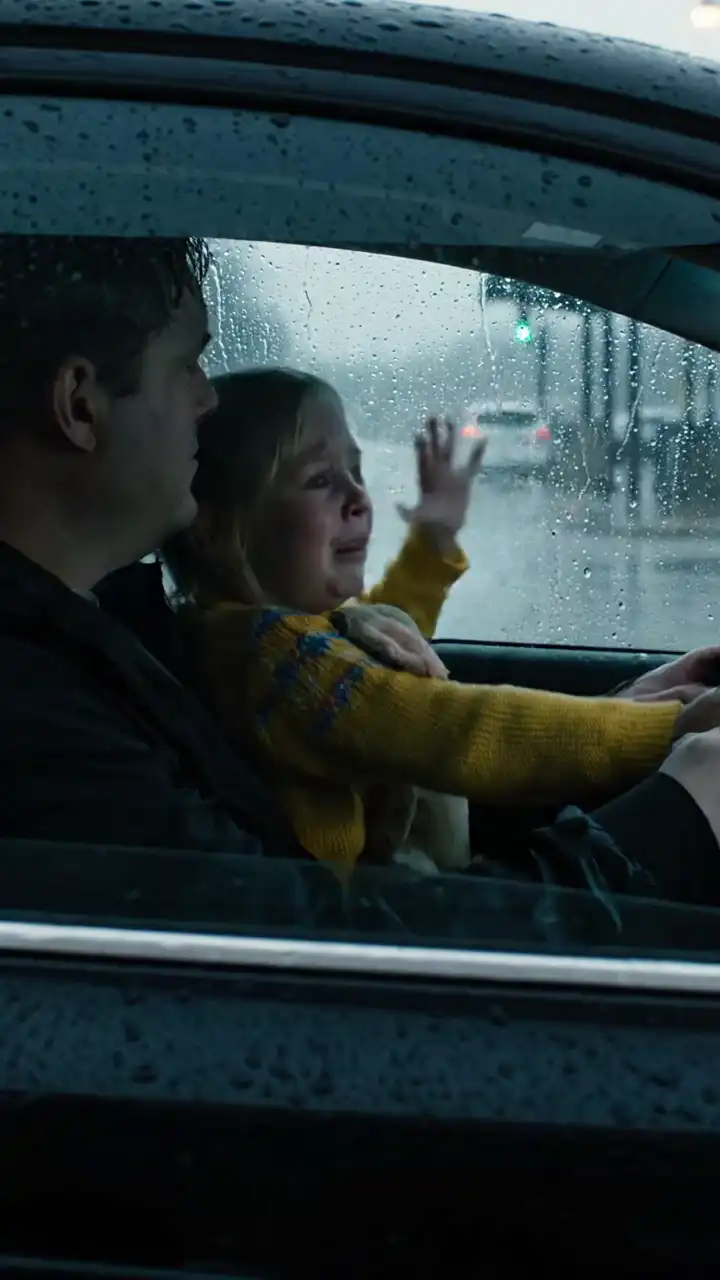
She sprinted, shoes slapping through puddles. Lila’s face appeared at the window, streaked with tears, her little palm against the glass. Her stuffed rabbit fell onto the wet pavement as the car door slammed shut.
“Mama!”
Marissa reached the car just as it lurched away from the curb. She slammed both hands against the trunk, but it sped forward, tires spraying dirty water over her jeans. She chased it into the lot, screaming the license plate over and over so she would not forget. The sedan turned onto the street and vanished into the gray afternoon.
For a moment the world went silent except for rain.
Marissa bent over, gasping. Then she saw the rabbit lying in the puddle.
She picked it up with shaking hands and clutched it to her chest. One bent ear dragged water. The sight of it made something primal rip through her. She stumbled back into the station and screamed for the police.
Everything after that happened both too fast and too slowly. An officer took her statement while another asked for descriptions. Blonde hair, hazel eyes, four years old, yellow sweater, red duck boots. Doreen Pike, around fifty-eight, brown hair, tan coat, rings on both hands. Unknown male, maybe six feet, stocky, gray mustache, dark cap. Dark sedan. Partial plate.
“Did you knowingly hand the child to this woman at any point?” the officer asked.
“No,” Marissa said. “No. She lied. She tricked me. She said it was temporary help. She said—” Her voice shattered. “She took my baby.”
“Do you have any paperwork? Any full names for these friends in Idaho?”
“I don’t know if Idaho was ever real.” Marissa’s teeth chattered. “Please find her. Please.”
Another officer returned with the stuffed rabbit in an evidence bag. “This was outside.”
“That’s hers,” Marissa whispered. “That’s Bun.”
The bus station manager showed security footage, but the angle was poor and a pillar blocked part of the exit. Doreen’s face was clear enough. The man’s was not. The sedan’s plate was blurred by rain. Police sent out alerts. They told Marissa to go to the station for formal interviews. They told her not to lose hope.
She did everything they asked.
By midnight, her voice was gone. Her body shook from cold and shock. She sat in a hard chair under fluorescent lights with Bun in her lap and replayed the last seconds over and over: Lila’s tiny fingers slipping free, Lila’s hand reaching, Lila crying, “Mama, I be brave!”
At three in the morning, a detective with tired eyes and a coffee stain on his tie came to her.
“We’re still working it,” he said carefully.
Marissa stared at him. “But you haven’t found her.”
“Not yet.”
Not yet.
Those two words floated in the stale air between them.
Outside, dawn was beginning to pale the sky over Spokane. Inside the station, Marissa finally understood the shape of what had happened. Her daughter was gone into roads, systems, lies, and strangers. Gone beyond the reach of her voice.
She pressed the soaked rabbit to her face and let out a sound no mother should ever have to make.
The first days after Lila was taken passed in a blur of police stations, phone calls, and terrible waiting.
Marissa slept in clothes that still smelled like rain and diesel. When she closed her eyes, she saw the sedan pulling away. When she opened them, she half expected Lila to come running around a corner, laughing, the whole thing a nightmare born from hunger and exhaustion. But every morning ended the same way: no child-sized shoes by the door, no little voice asking for cereal, no blonde pigtails bobbing toward her.
Detective Owen Mercer became the person she saw most. He was not warm, exactly, but he was steady.
“We located a former address for Doreen Pike,” he told her on the second day. “It was rented under another name. Empty now.”
“So she planned this.”
“It looks that way.”
Marissa gripped the edge of the table. “Then why aren’t you finding them?”
He exhaled slowly. “We’re trying.”
Trying. Another word that began to sound cruel.
Flyers went up around Spokane. LILA COLE, AGE 4. Blonde hair. Hazel eyes. Last seen wearing yellow sweater, red boots. Marissa taped them to grocery store windows, bus stops, laundromats, church bulletin boards. She walked until her feet blistered. Every little girl in yellow made her stop breathing for a second.
Her cousin Tessa drove in from Boise and took over what Marissa could not manage. She made coffee, spoke to officers when Marissa dissolved into tears, forced crackers and soup in front of her.
“You need strength,” Tessa said one night in the tiny motel room. “For when she comes home.”
“When,” Marissa repeated, because “if” would have killed her.
Police questioned pantry volunteers and shelter staff. They uncovered whispers about Doreen targeting struggling mothers, offering help that blurred lines and bypassed agencies. But rumor was not proof, and by then Doreen had vanished. No one knew where she kept records. No one admitted to helping. The heavyset man remained nameless.
A week passed. Then two.
Marissa returned again and again to the bus station, as if standing there could undo the moment. She traced the route to the side exit, counted the steps, stared at the curb where the car had been. Once a security guard gently told her, “Ma’am, you can’t keep doing this to yourself.”
She looked at him with hollow eyes. “Watch me.”
The weeks became months, and hope did not vanish so much as fray.
Detective Mercer called less often, not because he stopped caring, but because there was less to tell. Leads fizzled. A reported sighting in Coeur d’Alene turned out to be another little girl. A tip from a truck driver in Oregon led nowhere. An old woman swore she saw Doreen with a child at a motel outside Yakima, but the registration was fake and the cameras had been taped over.
Marissa found work cleaning rooms at a budget inn. She scrubbed bathrooms and changed sheets and pocketed every spare dollar for investigators, gas, copied flyers, anything that might help. At night she spread maps across the bed and circled places. She kept a notebook filled with dates, names, dead ends, and half-prayers.
Tessa worried over her. “You can’t live only in this.”
“How do I live outside it?” Marissa asked.
There was no answer.
Lila’s fifth birthday came in October. Marissa bought a cupcake with pink frosting and one candle. She placed it in front of the photograph she kept taped to the motel lamp—Lila in a paper crown from preschool, grinning wide enough to show the tiny gap between her baby teeth.
“Happy birthday, baby,” Marissa whispered.
Then she blew out the candle because she could not bear to let it burn alone.
The world proved itself merciless in ordinary ways. Utility bills still arrived. Employers still expected punctuality. People still talked about weather and football and grocery prices as if the universe had not split open. Sometimes Marissa wanted to shake strangers and demand, “How are you all just walking around?”
At Christmas, she stood outside a department store staring at a display of plush rabbits in holiday scarves until a clerk asked if she needed help.
“No,” she said, and hurried away before she started sobbing.
Her mother, already frail, passed away the following spring. At the funeral home, relatives embraced Marissa and spoke softly about “so much loss.” She nodded because she had no energy left to explain that all grief had merged into one wound.
Yet even in the worst months, she never stopped searching.
Every year on the anniversary of the abduction, she returned to the bus station with Bun, now dry and mended but still worn. She sat on the same bench under the same buzzing lights and closed her eyes.
“I’m here,” she would whisper into the rabbit’s bent ear. “If you remember me, I’m here.”
Detective Mercer remained on the case long after it should have gone cold. Once, three years in, he met her at a diner after work. He slid a folder across the booth.
“What is this?” she asked.
“Private investigator notes from a similar complaint in Idaho,” he said. “Doreen’s name came up. Nothing conclusive.”
Marissa opened the folder with trembling fingers. “You really still think she’s alive.”
Mercer looked at her for a long moment. “I think children taken young often survive by adapting. And I think mothers know things evidence can’t prove.”
Marissa clutched the folder. “Thank you.”
“Don’t thank me yet.”
Life became a strange dual existence. On the outside, Marissa eventually rented a small apartment with fading carpet and a noisy radiator. She paid bills. She worked full-time. She learned to smile politely when coworkers asked if she had kids, then answer, “A daughter,” because past tense felt like betrayal.
On the inside, she remained in that rain-soaked parking lot, running.
The years began, and with them came a quieter sorrow—not less painful, only more permanent-seeming. Marissa learned how grief can sit beside you at breakfast, ride with you to work, fold itself into laundry, and stand behind you at the mailbox. She learned that missing a child did not happen in dramatic bursts alone. It happened in every aisle of every store. In every little yellow sweater. In every school playground. In every child’s laugh heard through an open apartment window.
Still, she kept Lila’s room inside her mind untouched. She remembered the exact weight of her daughter on her hip, the smell of strawberry shampoo in fine blonde hair, the way hazel eyes widened when she heard a favorite story. She repeated these things silently, afraid memory itself might blur.
“They told me to move on,” she said once to Tessa.
Tessa reached across the kitchen table and squeezed her hand. “Move forward, maybe. Never move on.”
So Marissa moved forward the only way she could: one day, one flyer, one phone call, one prayer at a time.
And every night before sleep, she said the same words into the dark.
“Be safe. Be warm. Remember me if you can.”
By the time five years had passed, Marissa had become someone people described as strong, though she never felt it.
Strength, she discovered, often looked like routine. She woke at five-thirty, made coffee, tied her hair back, and went to work managing housekeeping at a downtown hotel. She paid rent for a modest apartment in Spokane’s South Hill neighborhood. On Sundays she visited the church pantry where she had once met Doreen—not for food now, but to volunteer, partly from stubbornness, partly because pain had to become something useful or it would consume her.
There was one locked cedar box under her bed. Inside were Lila’s preschool drawings, a pair of red duck boots she had outgrown but left behind at a shelter, and the yellow sweater she had been wearing the day she was taken—except that was gone. Only Bun remained, patched and fading, his bent ear resewn so many times that the thread looked like scars.
Each year Marissa added one letter to the box.
Dear Lila, you would be six now. You’d probably be in kindergarten.
Dear Lila, you would be seven. I saw a girl with your hair at the park and had to sit down.
Dear Lila, you would be eight. I still know your laugh.
The letters had no address. She wrote them anyway.
Detective Mercer retired after thirty years on the force, but before he left he came to her apartment in a pressed shirt and carried a banker’s box of copied files.
“I cleared it the right way,” he said. “These are duplicates.”
Marissa stared. “Why?”
“Because I know what happens when departments reorganize.” He set the box on her table. “And because if anyone keeps looking, it’ll be you.”
She touched the edge of the lid. “Do you really think I should?”
“I think hope is a discipline,” he said. “And you’ve had more of it than most.”
After he left, Marissa sat on the floor for an hour with the box in front of her, both grateful and furious that persistence had become part of her identity.
While Marissa carried the past like a live coal, Lila grew up under another name.
The first years after the abduction were a blur in her own mind. Fear had been too large for memory to hold cleanly. She remembered rain on a car window. A stuffed rabbit disappearing. A woman with rings saying, “You’re safe now.” A man she learned to call Uncle Ray. Different houses. Long drives. New clothes from thrift stores. Her yellow sweater gone.
At first she cried for her mother every night.
“I want Mama,” she would sob.
Doreen would smooth her hair and say, “Honey, your mama couldn’t take care of you. I’m the one who stayed.”
Sometimes Doreen changed the story. “Your mother gave you to me because she loved you.” Other times, colder: “Your mother left. You were too little to understand.”
A four-year-old cannot argue against the adults controlling her world. So Lila, renamed Lily Pike, learned to survive inside confusion.
By the time she was nine, she lived in a small rental house outside Salem, Oregon, with Doreen and a silence full of rules. She knew not to ask too many questions. She knew that official forms were often handled at kitchen tables instead of offices. She knew Doreen disliked schools that “pried,” so lessons happened at home until, eventually, enough paperwork existed for public enrollment.
Lily was a beautiful child—blonde hair now worn loose to her shoulders, hazel eyes that sometimes looked green in the sun, a gentle smile that made teachers warm to her instantly. She was quiet, observant, and startlingly mature for her age. She also carried a shapeless ache she could not name.
Sometimes memories floated up at odd moments. The smell of coffee. The hiss of bus brakes. A voice saying, “I’m coming, baby.” The phrase hurt her chest without explanation.
When she was seven, she asked Doreen at the kitchen sink, “Did I have a different name before?”
Doreen did not turn around. “Why would you ask that?”
“I had a dream.”
“You were always Lily.”
“Are you sure?”
The woman set down a plate with too much force. “Dreams are dreams. Don’t start making up stories.”
After that, Lily learned to keep questions inside.
Still, children sense cracks in lies long before they can prove them. She noticed she looked like no one in the house. She noticed Doreen never spoke of her birth, or baby pictures, or relatives on either side. She noticed her Social Security card came late and with tension. She noticed “Uncle Ray” stopped visiting after she overheard a fight about “old business” and “that Spokane mess.”
At ten, she found a rabbit button in a junk drawer—yellowed plastic, shaped like a bunny face. It meant nothing and everything. She slipped it into her pocket and kept it for years.
The lives of mother and daughter ran in strange parallel across the Northwest.
On one spring afternoon, Marissa drove to Salem on a lead from a volunteer who thought she had seen Doreen at a pharmacy. At nearly the same hour, eight-year-old Lily sat in the back seat of a sedan outside that same pharmacy, reading a library book while Doreen picked up a prescription. Marissa walked through the parking lot twenty yards away, studying faces, her heart racing at every blonde head. Lily glanced up once, saw a tired woman crossing toward a truck, and looked back down at her book.
Neither knew.
Another time, when Lily was in third grade, her class wrote letters to military service members as a kindness project. Instead of that assignment, she wrote one she never mailed.
To whoever had me before, I hope you didn’t forget me.
She folded it into quarters and hid it under her mattress.
In Spokane, Marissa attended a support group for families of missing children. She sat in a church basement with stale cookies and paper cups of coffee and listened to stories that echoed her own in different keys. One mother said, “People think after a few years you stop hearing their voice in your head.” Marissa answered quietly, “Mine got clearer.”
There were near-misses made of modern life too. At nine, Lily’s school in Salem posted a recital photo online. Marissa, who searched faces the way other people scrolled weather reports, paused over the image because one little girl in the back row had familiar eyes. But the caption named her Lily Pike, and the child’s hair was longer than Lila’s had ever been. Marissa saved the photo in a folder marked POSSIBLE and looked at it too many times before forcing herself to let it go.
Both mother and daughter carried absence like a second heartbeat.
Marissa never married. She could not imagine building a new family over an open grave of uncertainty. She dated once or twice, kindly men who sensed quickly that a whole section of her soul remained unreachable. Lily made friends but always held part of herself back, as if trusting too much might cause the ground to disappear.
At night, Marissa still whispered, “Remember me if you can.”
At night, Lily sometimes lay awake staring at the ceiling, trying to summon a face she felt belonged to her. A woman with tired eyes. Warm hands. A smell like soap and coffee. Love wrapped in sadness.
“Who are you?” she murmured into the dark.
The loss traveled both ways, even when only one of them knew its full name.
The beginning of the end of the lie came from a middle-school family tree assignment.
Lily was nine, old enough to read tension but young enough to accidentally expose it. Her social studies teacher handed out a worksheet with boxes for parents, grandparents, and places of origin. Most kids groaned. Lily went still.
That evening she laid the page on the kitchen table. “I need names.”
Doreen was slicing carrots. “Put mine and Ray’s.”
“Ray isn’t here anymore.”
“Then just put me.”
“It says grandparents too.”
Doreen’s knife paused. “Teachers ask foolish things.”
Lily stood there in her socks, hands at her sides. “Where was I born?”
“In Oregon.”
“What hospital?”
Doreen turned around then, face flat. “Why does that matter?”
“Because everyone else knows.”
“Everyone else doesn’t have your life.”
The answer struck Lily as both cruel and revealing. She lowered her voice. “Did you adopt me?”
Doreen laughed, but there was no warmth in it. “Who’s filling your head?”
“No one.”
“You’re my daughter. That’s enough.”
But it wasn’t enough anymore.
Two days later, Lily went to the school librarian, Mrs. Janine Holloway, a soft-spoken woman with silver braids and a talent for noticing wounded children. Lily lingered after lunch pretending to browse biographies.
“Need help finding something?” Mrs. Holloway asked.
Lily hesitated. “How do you know if your family is lying?”
The librarian set down the cart she was pushing. “That’s a big question.”
“I don’t think I’m who they say I am.”
Mrs. Holloway studied her carefully. “Has someone hurt you?”
“No.” Lily twisted the rabbit-shaped button in her pocket. “Not like that. It’s just… when I ask about before I was little, my grandma gets mad. And I have memories she says aren’t real.”
“What kind of memories?”
“A bus station. Rain. Someone calling me baby.” Her voice trembled. “I think I had another mom.”
Mrs. Holloway did not dismiss her. That changed everything.
“Would you feel safe if I asked the school counselor to talk with you?” she said gently.
Lily nodded after a long moment.
The counselor, then child services, then a county investigator entered the picture with careful steps. At first, nothing dramatic happened. There were interviews. Questions about documents. Requests for birth certificates. Doreen became offended, then defensive, then furious.
“This is harassment,” she snapped during one visit. “She’s a child with an imagination.”
But paperwork leaves trails, and hers had holes.
The birth certificate she supplied had inconsistencies. The county where Lily was supposedly born had no hospital record. A delayed registration application contained a witness signature from a man now deceased—Ray’s brother, who had once faced fraud charges. The school counselor contacted law enforcement. Salem police reached out to old databases. One keyword brought up a long-unsolved abduction file from Spokane: female child, age four, blonde, hazel eyes, taken by suspect linked to vulnerable mothers.
Lila Cole.
When Detective Mercer’s former partner received the call and saw the age progression beside a recent school photo, he sat up so sharply his chair scraped the floor. Within hours, Marissa’s phone rang.
She almost didn’t answer because it was an unknown Oregon number.
“Ms. Cole?” a man asked.
Her throat tightened. “Yes.”
“My name is Detective Aaron Bell with Salem Police. I’m calling in reference to a missing child case originally filed in Spokane, Washington.”
The room tilted. Marissa gripped the kitchen counter. “Say that again.”
“We may have located a girl who could be your daughter.”
For a second she couldn’t breathe at all.
“What do you mean, could?” she whispered.
“We need confirmation. There are procedures. But there are strong indicators.”
Marissa slid to the floor, phone shaking in her hand. “Is she alive?”
“Yes.”
The word exploded through every dead place in her.
Alive.
Tessa drove over in record time after Marissa called her sobbing so hard she could barely form words.
“What happened? What happened?”
Marissa pressed both hands to her mouth. “They found her. Tessa, they found her.”
No certainty yet. No official confirmation. But hope, after years of being a coal, became fire.
The next forty-eight hours moved with unbearable slowness. Arrangements were made for a supervised meeting pending identification and emergency placement review. A preliminary DNA request was expedited, but because Lily herself had asked questions and because physical descriptors and timeline aligned strongly, authorities agreed that Marissa could come to Salem to participate in a carefully managed first contact at a child advocacy center.
Before she left, Marissa opened the cedar box under her bed. She took out Bun and one of the letters. Then she changed her mind and put the letter back. Too much. Too soon.
At dawn she started the drive south with Tessa beside her and Detective Mercer, now retired but invited as support, following in his own car because he refused to miss the outcome of a case that had haunted him too.
“She might not remember everything,” he warned at a gas station outside Yakima.
Marissa nodded, eyes swollen from crying. “I remember enough for both of us.”
As the miles passed beneath gray highway and pine-shadowed ridges, her heart pounded so hard she thought it might split. Every possibility fought inside her. What if it wasn’t Lila? What if it was? What if her daughter hated her for not saving her? What if she had been taught to fear her? What if one look into those hazel eyes told the truth before any test ever could?
By the time they reached Salem, Marissa’s hands were ice cold.
At the child advocacy center, a caseworker met them in the parking lot. “She asked to be here,” the woman said softly. “She wants answers.”
Marissa clutched Bun to her chest. “So do I.”
Then she walked inside to meet the child she had lost and never stopped loving.
The child advocacy center did not look like the place where a life could begin again. It was a low brick building beside a row of maples, with a mural of painted animals near the entrance and a waiting room furnished with small chairs, puzzles, and a faded blue rug. The air smelled faintly of crayons and coffee.
Marissa stood in a conference room with windows facing a playground. Her knees felt weak. Bun was tucked under her arm like a relic. Tessa stood behind her. Detective Mercer waited near the door, hat in hand, giving her privacy without leaving entirely.
A caseworker named Elena spoke in a calm voice. “She’s in the room next door. I told her we believe we found someone important from her past. She’s nervous.”
“So am I,” Marissa whispered.
Elena nodded. “You don’t need to rush. If at any point either of you needs space, we stop.”
Marissa swallowed and looked through the glass pane in the door to the hallway beyond. “What does she know?”
“That there are serious questions about her identity. That you may be her biological mother. That none of this is her fault.”
Marissa closed her eyes for one second. Biological mother. The phrase sounded sterile compared to the ache of nine lost years.
The door opened.
A girl stepped in slowly beside another caseworker.
At first Marissa saw only fragments—the long blonde hair, darker now than baby gold but still unmistakably light; the narrow shoulders in a green cardigan; the way one hand twisted in the hem of her sleeve. Then the girl lifted her face.
Hazel eyes.
The room vanished. The years vanished. Those eyes were older, guarded, and searching, but they were the same eyes that had once looked up from under a yellow hood and asked for pancakes.
Marissa made a broken sound.
The girl froze.
No one spoke for several long seconds. They simply stared at each other across the conference table, two lives suspended.
Marissa saw traces of herself and traces of the child she remembered. The shape of the chin. The freckles across the nose. The small crease between the brows when she was uncertain. She was taller, of course. Her cheeks less round. Her hair brushed neatly instead of tied in clumsy pigtails. But there she was.
The girl’s breath hitched. “I know you.”
Marissa’s hand flew to her mouth. “You do?”
“I…” The girl blinked rapidly. “Not from now. From before.”
Tears spilled down Marissa’s face. “Lila.”
The girl flinched at the name, not from fear but shock. “That name…”
Elena spoke gently. “You don’t have to answer right away.”
But the girl never took her eyes off Marissa. “I’ve heard that in dreams,” she whispered. “Or maybe memories.”
Marissa took one careful step forward. “Your name is Lila Grace Cole. You were four years old when you were taken from me at the bus station in Spokane.”
The girl’s lips parted. “Taken.”
“Yes.” Marissa’s voice trembled violently. “I never gave you away. I never left you.”
The child—nine now, old enough to understand some things and too young to carry others—began to shake. “She told me you did.”
“No.” Marissa pressed a fist to her chest. “No, baby. I tried to get to you. I ran after the car. I screamed for you. I never stopped looking.”
The girl covered her mouth with both hands.
Elena glanced at her. “Do you want to sit?”
She shook her head.
Marissa slowly drew Bun from under her arm. The rabbit was faded, patched at the belly, one ear permanently bent.
The girl stared.
“This was yours,” Marissa said. “You called him Bun. He fell from the car when they took you.”
A sound escaped the girl then—a sob mixed with recognition. She stepped forward before stopping herself. “I had a rabbit.”
“Yes.”
“Yellow sweater,” she said faintly.
Marissa nodded through tears. “And red rain boots with ducks.”
The girl gasped and staggered back into the chair behind her. “I remember the boots.”
Marissa knelt so they were closer to eye level but did not touch her yet. “When you were scared, you used to rub Bun’s ear between your fingers. You hated crusts on sandwiches. You called oatmeal ‘hot mush’ and insisted it needed more cinnamon.”
The girl started crying openly now. “How do you know that?”
“Because I’m your mom.”
The words landed in the room like the truth itself had finally found its voice.
Lila—Lily—whatever name could hold her in that moment—looked at Marissa with desperate hunger. “Say something else.”
Marissa blinked. “What?”
“Something only you would know.”
Marissa searched her memory through tears. “When you were three, you couldn’t say ‘spaghetti.’ You called it ‘pasghetti.’ And when I tucked you in, you always made me kiss your forehead, then your nose, then your left cheek, because the right one was, and these were your exact words, ‘for tomorrow.’”
The girl let out a cry and folded over herself. “Oh my God.”
Elena moved toward her, but the child lifted a hand and then looked at Marissa again. “I remember that,” she whispered. “I remember.”
Marissa dared another inch closer. “Can I show you something?”
The girl nodded.
Marissa turned her own wrist upward and pointed. “You have a tiny crescent birthmark behind your left ear. You got it from me. I have one on my wrist.”
With trembling fingers, the girl pushed her hair back behind her ear. Elena leaned in gently, then smiled through tears of her own. There it was: a pale crescent, nearly hidden in the fine hairline.
The girl stared at Marissa’s wrist, then touched behind her ear. Confirmation traveled through her entire body.
“It’s really you,” she said.
Marissa’s face crumpled. “Yes.”
For one heartbeat they remained where they were, suspended between astonishment and grief.
Then the girl stood so abruptly the chair scraped the floor. “Mom?”
Marissa broke completely. “Yes, baby.”
And Lila ran into her arms.
The force of it nearly knocked Marissa backward. She wrapped both arms around her daughter and held on as if the world might try to steal her again. Lila clung with equal desperation, face buried against Marissa’s neck, sobbing in great shuddering waves.
“You came back,” Lila cried.
“I never left,” Marissa wept. “I never left in my heart. I’m so sorry. I’m so sorry.”
“I thought maybe you didn’t want me.”
“Oh, God, no.” Marissa pulled back just enough to cup her face. “Never. Never for one second.”
Lila touched her mother’s cheek with trembling fingertips, as if verifying she was flesh. “Your eyes,” she said. “I remembered your eyes.”
Marissa kissed her forehead, then her nose, then her left cheek.
Lila let out a wet laugh through tears. “For tomorrow.”
“For all the tomorrows,” Marissa whispered.
Behind them, Tessa was crying openly. Detective Mercer turned his face away and cleared his throat. Elena quietly closed the door to give them the room.
They sat together on the blue rug because neither seemed able to stand for long. Lila held Bun with one hand and Marissa’s sleeve with the other, unwilling to lose contact. Questions came in bursts between tears.
“Did you have birthdays?”
“Yes. I celebrated every one.”
“Did you keep my things?”
“All I could.”
“Why didn’t you find me sooner?”
Marissa’s face twisted with pain. “I tried, sweetheart. I tried every day.”
Lila nodded, crying again but not pulling away. “I think I know that now.”
When the first storm of emotion eased enough for breath, Marissa whispered the words she had carried for five years.
“Be safe. Be warm. Remember me if you can.”
Lila looked up sharply. “I used to hear that.”
Marissa brushed damp hair from her daughter’s face. “I said it every night.”
Lila leaned into her hand. “Maybe I heard you anyway.”
And for a moment, impossible as it was, it felt true.
The first hours after reunion were not simple, but they were sacred.
There were forms to sign, officials to consult, and careful explanations about temporary placement while legal custody was sorted. Doreen Pike had been taken into custody that morning after trying to leave town. She denied everything, then changed her story twice. The law would deal with her. Marissa barely spared the woman a thought. Her entire world had narrowed to the girl sitting beside her, sipping apple juice with both hands and glancing over every few seconds to make sure she was still there.
“I’m sorry I keep looking,” Lila said shyly.
Marissa reached across the table. “Look all you want.”
Lila smiled—a small, uncertain smile, but one that struck Marissa straight through the heart. “I like your voice. It sounds like I remember.”
“You can ask me anything,” Marissa said.
So she did.
“What was my room like?”
“Tiny. Purple curtains. Glow-in-the-dark stars on the ceiling.”
“Did I really hate sandwich crusts?”
“You declared them a personal insult.”
Lila giggled for the first time, and everyone in the room froze for an instant under the fragile beauty of it.
Tessa knelt beside her. “I’m your cousin Tessa. I used to bring you those cookies with too much frosting.”
Lila tilted her head. “I remember frosting.”
“That tracks,” Tessa said, wiping her eyes.
Later, when the room had quieted and the professionals stepped out to make calls, Lila asked the hardest question.
“Why did she do it?”
Marissa did not lie. “Because some people see vulnerable families and think they can take what isn’t theirs. Because I was poor, and she used that.”
Lila absorbed that in silence. “So it wasn’t because I was bad.”
Marissa’s entire face softened with pain. “Oh, sweetheart. No. Nothing about this was because of you.”
Lila nodded slowly, as if setting down a burden she had carried too long.
Healing did not arrive all at once. It began in fragments.
In the days that followed, Marissa remained in Salem while emergency hearings moved forward. DNA results confirmed what their hearts had already known. Lila Grace Cole. Child of Marissa Cole. Stolen identity. Years of fraud and coercion. Reporters called; Marissa refused them all. This story belonged first to a child, not the news.
Lila needed time. She had lived nine years one way and could not simply step into another without confusion. She still answered to Lily sometimes. She still startled when adults raised their voices. She still woke from dreams with rain in them. But now there was someone beside her bed who understood why she was afraid.
One evening in the temporary family apartment arranged by the county, Lila sat wrapped in a blanket on the couch while Marissa brushed her hair.
“Am I still Lily?” she asked quietly.
Marissa set down the brush. “You can be whatever feels true to you.”
“I think…” Lila looked at her hands. “I think I was Lila first.”
Marissa kissed the top of her head. “Then Lila it is, if that’s what you want.”
“Can I still like some things from before?”
“Of course.”
“Even if they came from them?”
Marissa’s eyes filled. “Your life is yours, baby. Nobody gets to steal parts of it from you again.”
That answer seemed to settle somewhere deep inside the child.
They grieved too, because reunion does not erase lost time. Marissa grieved first days of school she never saw, fevers she never soothed, front teeth that came out without her keeping them in an envelope. Lila grieved a childhood built on lies and the confusion of loving routines inside an unsafe truth.
“I don’t know how to be normal about this,” Lila admitted one night.
Marissa pulled her close. “Neither do I. We’ll learn together.”
There were practical decisions ahead: counseling in both states, transition planning, school records, legal restoration of identity, a move that would eventually bring Lila home to Spokane if she wanted it. Every step carried tenderness and care. No one rushed her. Love, after all, had already waited five years.
The first time Lila visited Spokane again, it was spring. The rain had stopped and the river carried bright light. Marissa showed her the apartment she had prepared with cautious hope: a room painted pale green, a bookshelf, a quilt Tessa made, and on the pillow, a new stuffed rabbit beside old Bun.
Lila stood in the doorway. “This is for me?”
“For as long as you want it.”
She walked in slowly, touched the quilt, then turned around and launched herself into Marissa’s arms. “I want it.”
Marissa laughed through tears. “Then it’s yours.”
They would have hard days. Memories would come back unevenly. Trust would strengthen, wobble, and strengthen again. Some wounds would scar instead of disappear. But now those wounds had somewhere to go. They no longer floated alone in silence.
On the night Lila slept in her new room for the first time, Marissa tucked the blanket under her chin.
“Forehead, nose, left cheek?” Marissa asked softly.
Lila smiled sleepily. “And the right one can be for today.”
Marissa kissed all four places.
As she turned off the lamp, Lila murmured, “Mom?”
“Yes?”
“I remembered you before I knew your name.”
Marissa pressed a hand over her heart. “I loved you before you were born.”
Lila’s hazel eyes drifted closed. “Good. That seems fair.”
Marissa stood in the doorway watching her daughter breathe, overwhelmed by the ordinary miracle of it. Not every lost thing returns. Not every prayer is answered in the shape we beg for. But sometimes, against rain, hunger, lies, and years, love keeps a trail lit.
And sometimes a child finds her way home.
They say time heals all wounds. But some wounds don't need healing—they need to be found again.
After 5 years, Marissa finally held Lila again. The years apart would never be forgotten, but the years ahead would be filled with the love that never died.
Some losses change a family forever. Some reunions do too.
Like this story? Follow for more tales of families finding their way back to each other.
Disclaimer: Mention of any brand or trademark is for identification only and does not imply partnership or endorsement