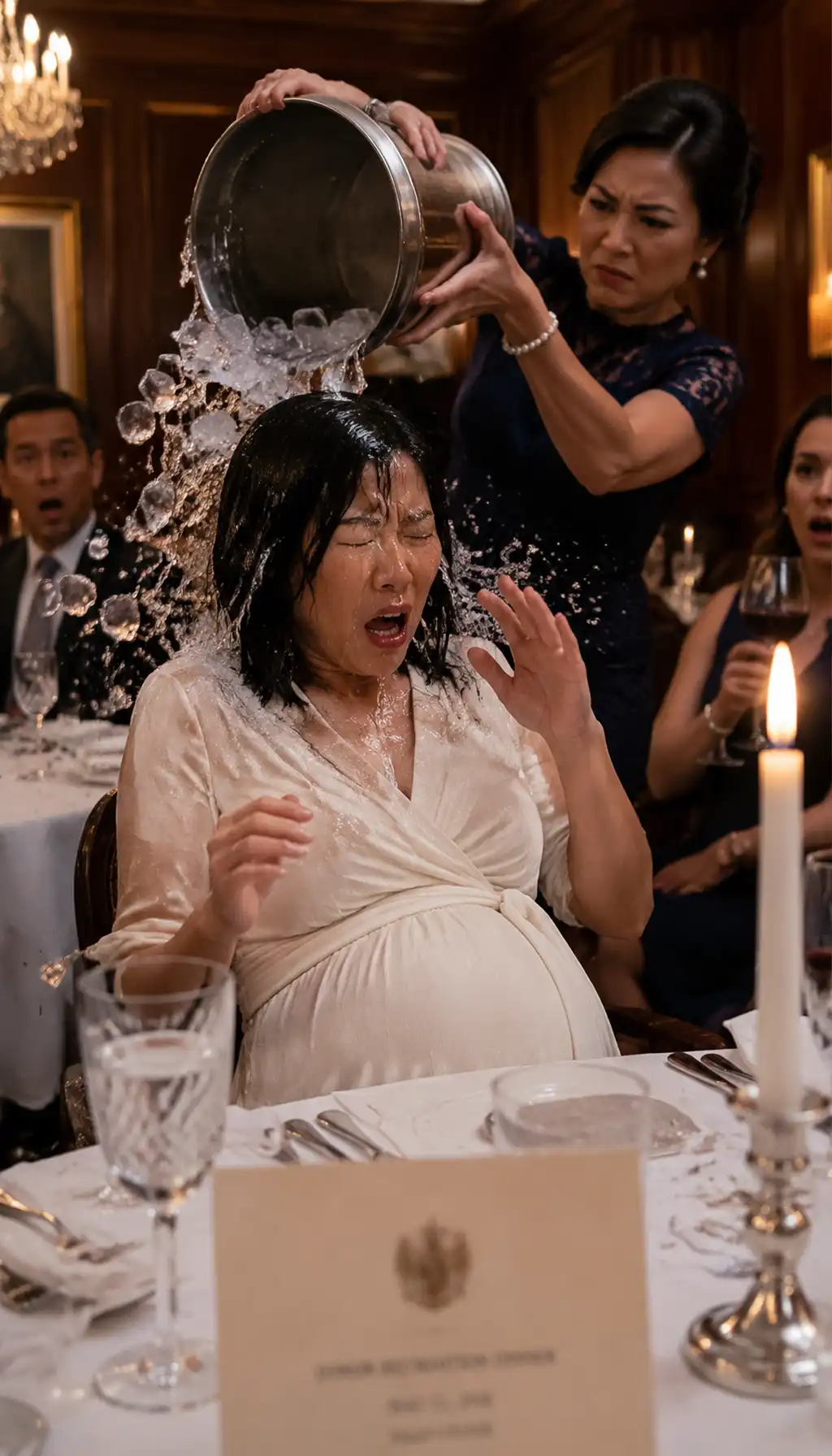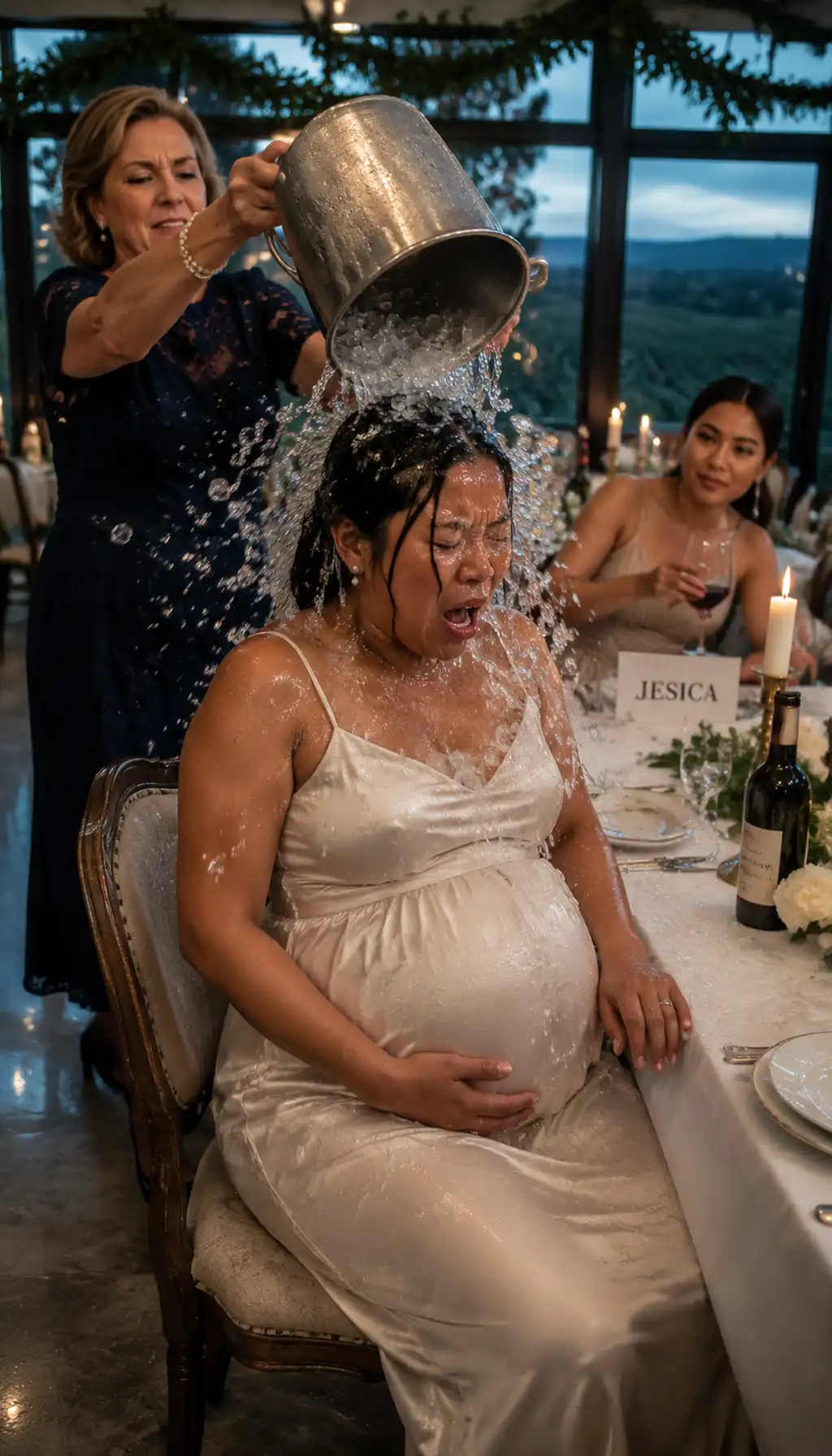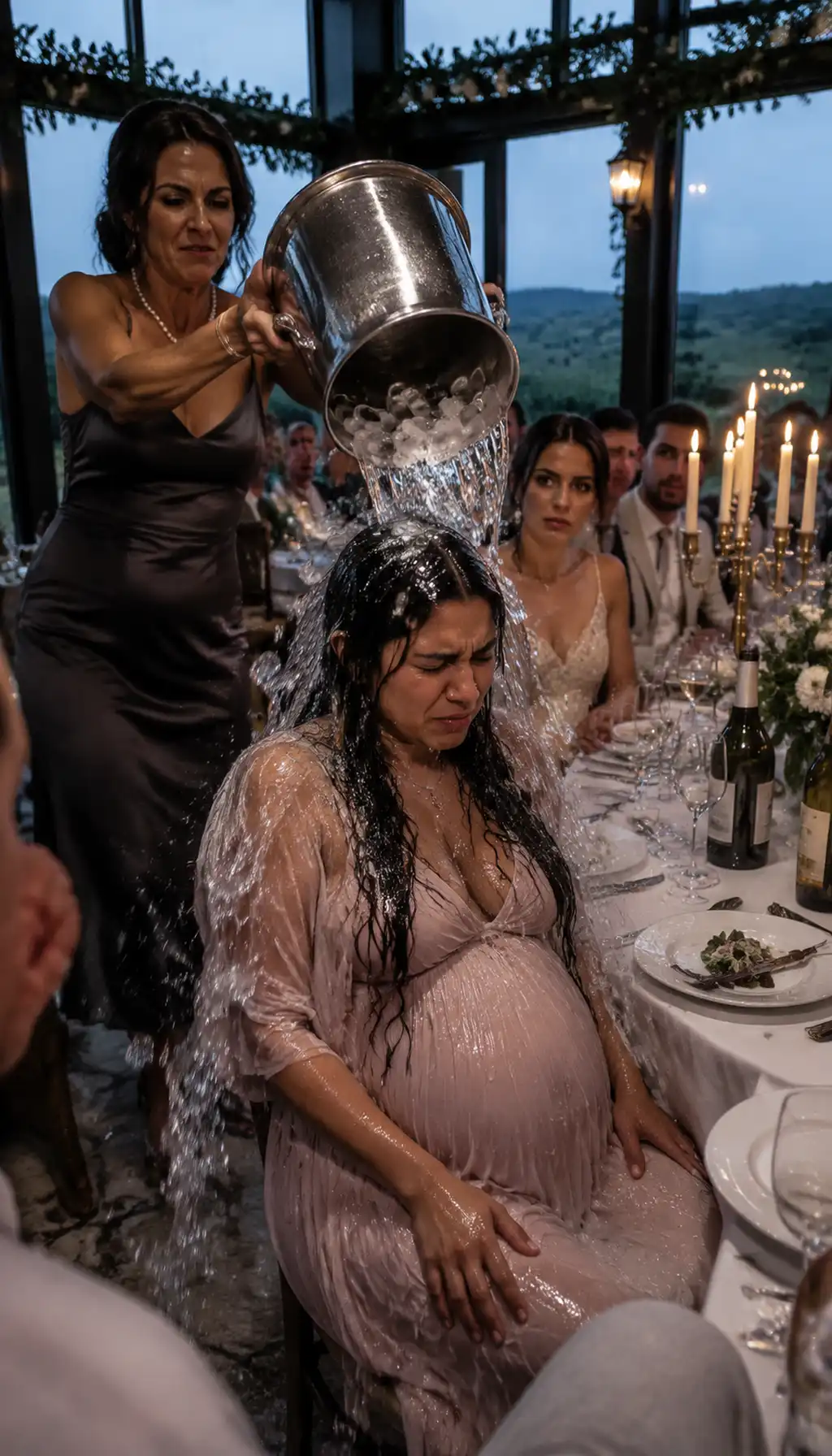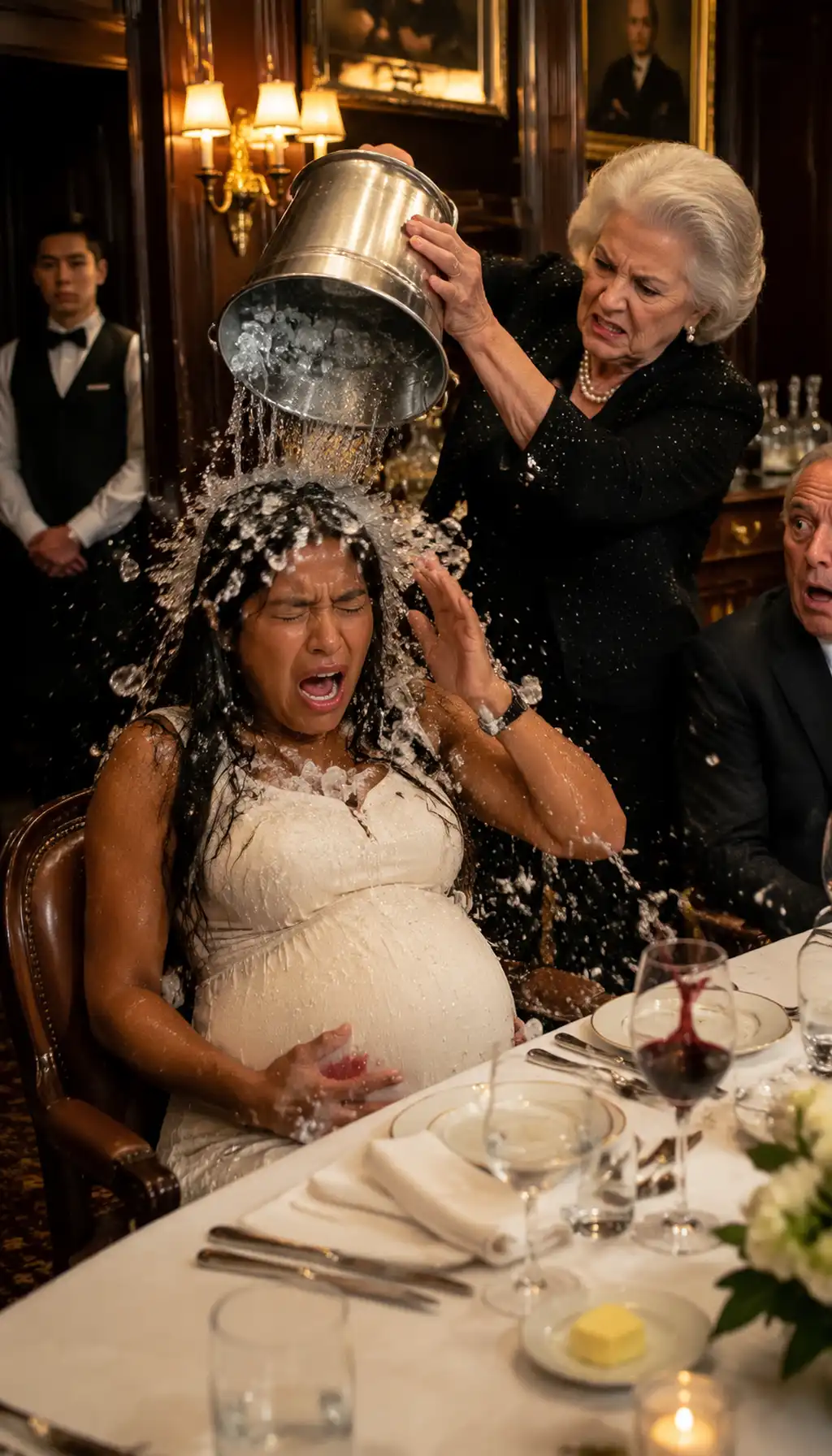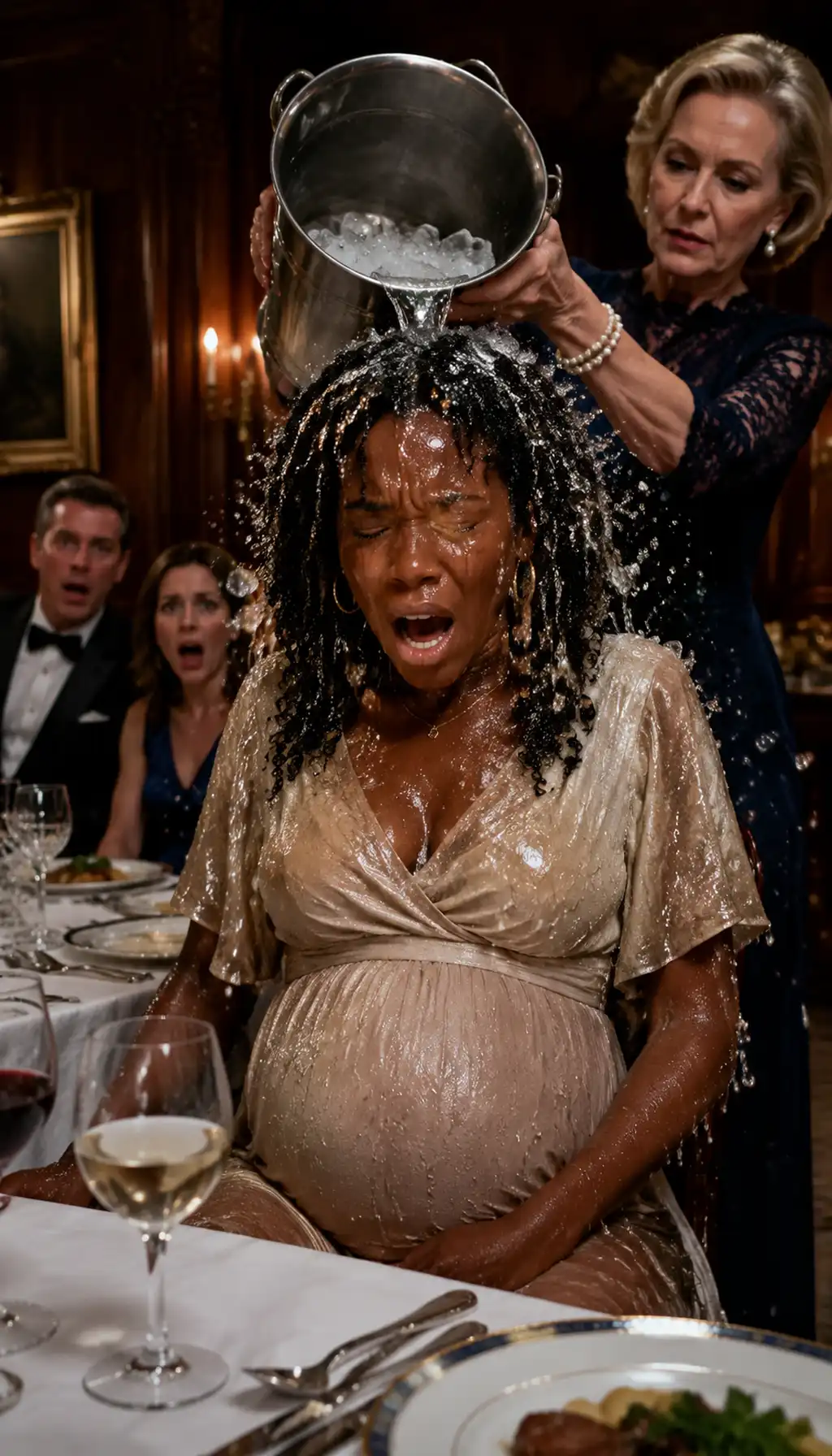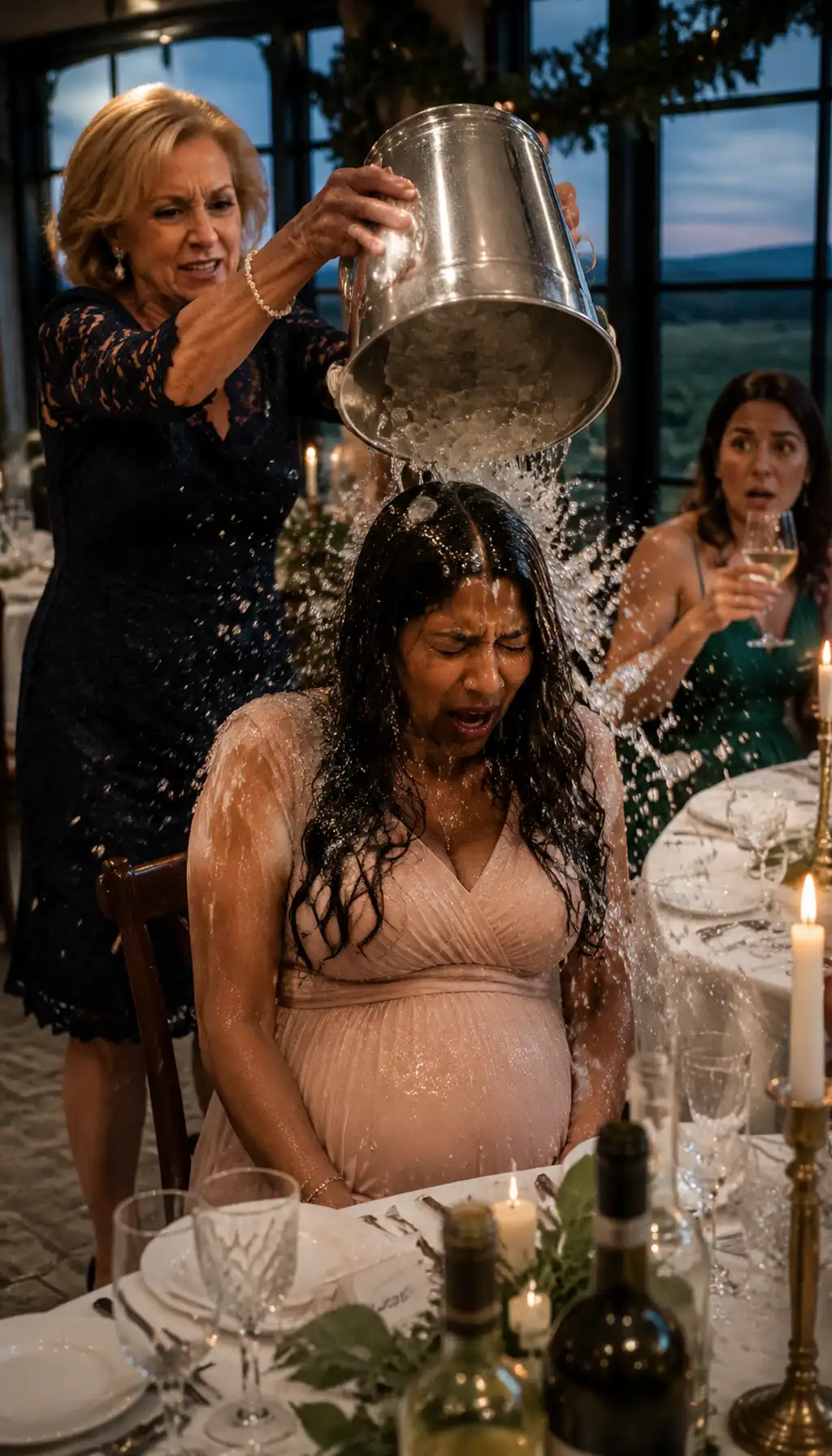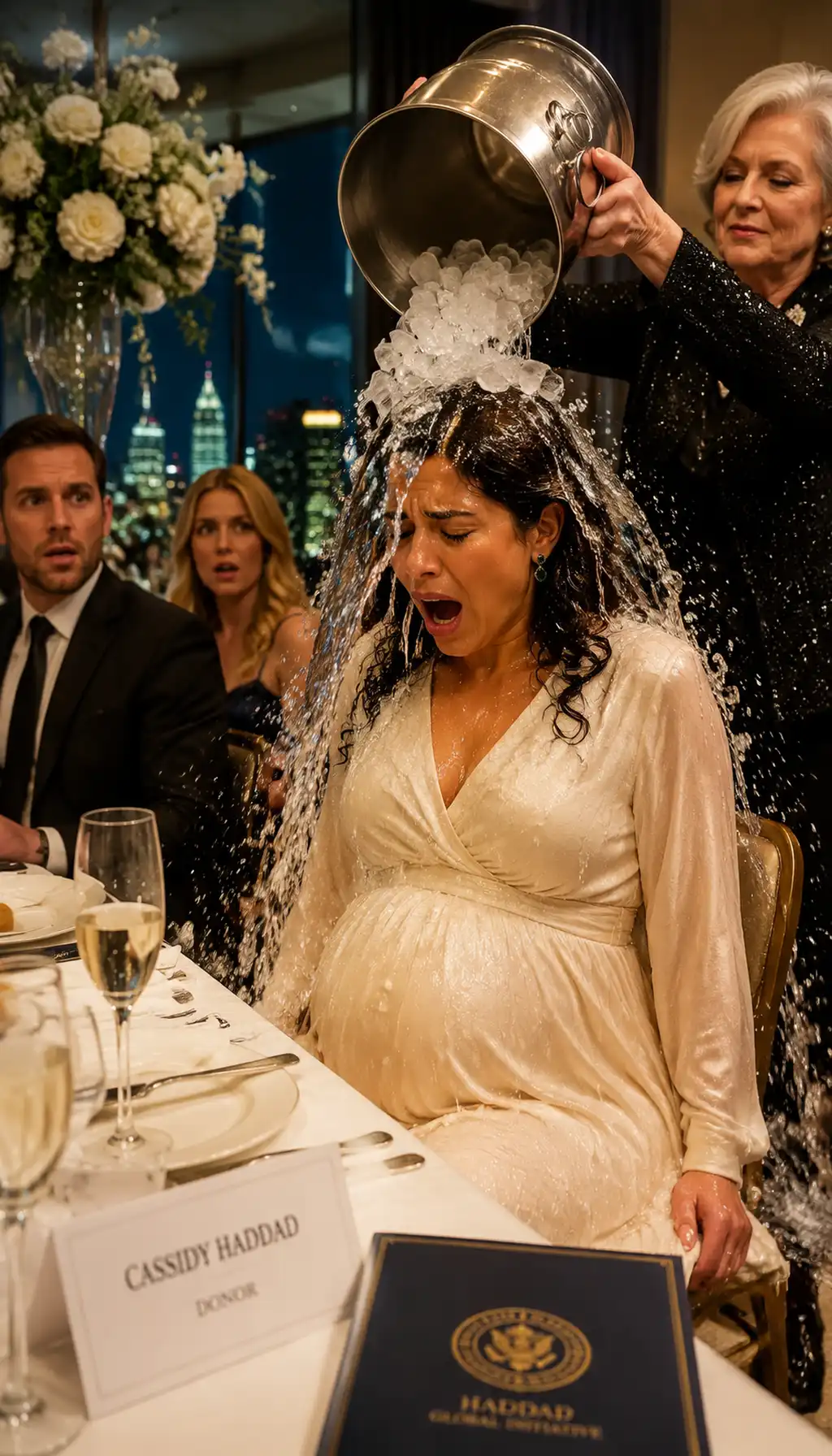
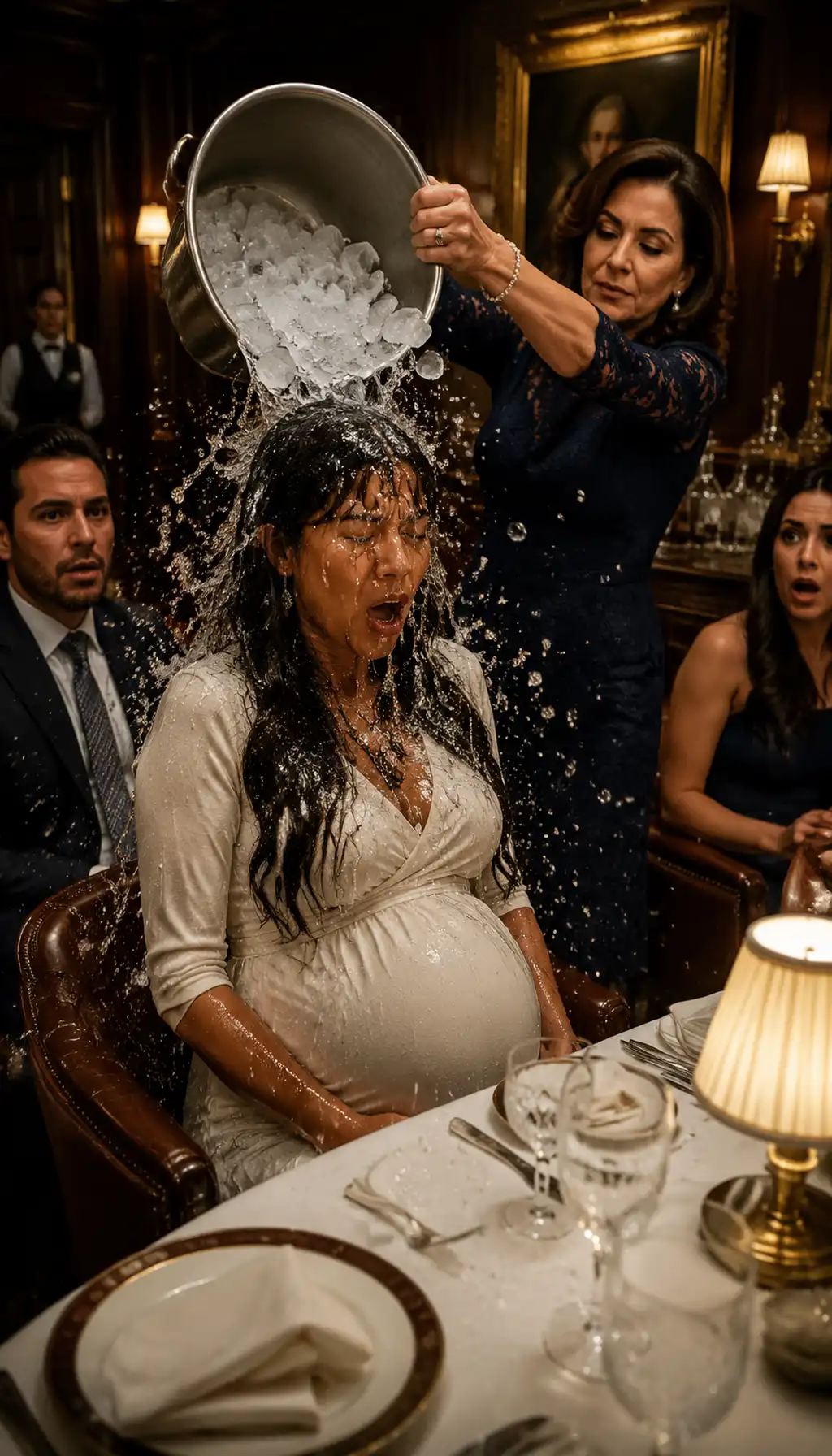
THE NIGHT THEY DRENCHED THE WOMAN WHO OWNED THE ROOM
Nathan stared at his phone like it had betrayed him.
It kept vibrating against the white tablecloth, bright enough for the board chair's name to be visible from where I stood. A second phone buzzed near one of the donor wives. Then another lit up farther down the table. The expensive little room, with its brass sconces and oil portraits and polished old-money confidence, suddenly sounded different. Not louder. Just tighter. As if the air had been cinched around every throat at once.
No one moved to laugh now.
Mara's voice was still on speaker. "Sofia, are you physically safe?"
It mattered that she used my first name in a room where I had been treated all evening like an inconvenience with an invitation. It mattered even more that she did not ask Nathan a thing.
I took the towel from the server with my free hand and pressed it gently to my hairline. "I am standing. My baby moved hard, but I am standing."
"Do you need a medic?"
"I need distance from them first."
The server took one quick glance at Nathan, then at Andrea, then back to me. He had to know he was crossing a line the family believed belonged to them. But that was the point. A lot of people obey power until power changes shape in front of them.
Nathan stood up too fast and knocked the stem of his glass with his cuff. Wine spread across the tablecloth in a red fan. "This is insane. She's making a scene over a joke."
Mara did not raise her voice. She did not have to. "For the record, no one should approach Ms. Redbird."
The silence after that was even sharper than before, because several people at the table heard the last name.
Andrea turned toward me with the first crack in her perfect posture. "Ms. Redbird? Really? Sofia, are you trying to embarrass us with legal theater because you can't behave?"
I looked at her then. Water was still dripping from the ends of my hair onto the rug she had spent twenty minutes earlier bragging about helping select for the private dining renovation. She had said the room needed "a more serious pattern." She had said she had "practically overseen the place herself" because people at the club trusted her taste.
That rug was one of the first things I had approved when Halcyon Venue Holdings bought the building through a layered acquisition three years earlier.
The invoice had crossed my desk with three options attached and a note from project management asking whether the private room should mirror the old club palette or move toward donor-facing luxury. I had written one word in the margin before signing the renovation budget: durable.
I could see the same deep indigo border under my wet heels now.
Andrea followed my eyes and mistook the moment. "Yes, on the rug. Wonderful. Now we all understand what matters to you."
"No," I said quietly. "You still don't."
The young server at the door straightened. "Ma'am, I can get the manager."
Nathan snapped, "No one asked you."
The server's jaw set, but he looked at me. Not Nathan. "Would you like me to get the manager, ma'am?"
That was the first staff flip. Small from the outside. Massive from the inside.
"Yes," I said.
He nodded and moved quickly out the door.
Elizabeth finally found her voice. She had been so eager to laugh when the water fell, but now she looked smaller in her silk dress, one hand gripping the edge of the table. "This is getting blown out of proportion. Andrea barely touched her. It's not like anyone got hurt."
My baby shifted again, a heavy, rolling push that made me suck in a careful breath. I put the towel down and both hands over my stomach for a second until the movement settled.
Mara heard it in my breathing. "Sofia, sit if you need to sit."
"I'd rather stand."
That answer was not about furniture. It was about not letting any of them believe they had folded me in half.
Nathan finally realized speakerphone was not his friend. He reached toward the device on the table near my plate. "Take me off this call."
I stepped back before his hand got close and the movement made him stop. Not because he respected me. Because the room was watching now and because I had said not to touch me again.
Mara spoke before I did. "Mr. Whitaker, your building access and administrative authority are now under review pursuant to Owner Lock. Do not interfere with the call."
Nathan stared at my phone as if it had grown teeth. "My what?"
"Your building access and administrative authority."
Andrea gave a brittle laugh. "This is absurd. Nathan does not need access to this room from some lawyer on speaker. This is a private family dinner."
Mara answered her directly. "No, Mrs. Morrison. It is a leased private-club dining room inside a venue controlled by Halcyon Venue Holdings."
Andrea's face changed by a degree. Then another. Not panic yet. More like offense turning into uncertainty.
Nathan caught the phrase first. "What does that have to do with anything?"
Everything, I thought.
The door opened again before I had to answer.
The manager came in with the server behind him. He was in his fifties, silver at the temples, club tie perfectly centered, calm in the way competent people are calm when a mess starts to bloom in a room they are responsible for. He took in the bucket on the sideboard, the water dripping from my dress, Nathan standing, Andrea rigid behind her chair, and my phone on speaker.
Then he looked at me.
Not at my face first. At my place setting.
At the small silver pin beside my folded napkin.
I had taken it off earlier because it kept catching on the edge of my shawl. It was subtle, not flashy. A tiny shield mark from Halcyon's executive portfolio set. Most people would think it was decorative. People who worked in my buildings knew better.
The manager's expression sharpened. "Ms. Redbird."
Andrea blinked. Nathan actually laughed once, one short disbelieving sound. "You know her?"
The manager ignored him. "Would you prefer the blue room cleared, or security brought here first?"
That was the midpoint when the room finally understood there was a title they had never imagined belonged to the soaked pregnant woman at the table.
Andrea's hand slipped against the chair back. "What did you call her?"
The manager kept his eyes on me. "Ms. Redbird. I am very sorry this occurred in one of your rooms."
One of your rooms.
Not a boast. Not a dramatic reveal. Just staff language from a man who knew the chain of authority.
Nathan looked at me as if he were seeing me for the first time and hating the clarity of it. "You don't own this place."
"No," I said. "Not personally."
Relief flashed across his face too early.
"My holding company does."
That relief died where it started.
Elizabeth whispered, "Oh my God."
Andrea recovered first, because people like her survive on the belief that confidence can bully reality backward. "Even if that were true, this family has hosted donor dinners here for years. We practically keep this club alive."
The manager folded his hands in front of him. "Respectfully, ma'am, donor usage does not confer authority over venue operations."
Nathan turned on him. "You need to think very carefully about who you're speaking to."
The manager did not flinch. "I am."
A second staff member appeared in the doorway, then another. No one rushed in dramatically. They simply took positions that made the room feel supervised. One of them brought bottled water and a clean linen wrap. Another quietly removed the silver bucket from the sideboard as evidence rather than tableware. The smallness of those actions made them stronger. Systems do not need to shout when they start working.
I took the linen wrap and draped it around my shoulders. The fabric was warm from the service cabinet.
Mara asked, "Has the manager arrived?"
"Yes," I said.
"Put him on."
The manager stepped closer, waited for my nod, and bent toward the phone. "Daniel Reeves speaking."
"Mr. Reeves, this is Mara Ellison, general counsel. Owner Lock is active under Ms. Redbird's authorization. Preserve the room, preserve all camera footage to chain of custody, suspend family-directed billing privileges for the event, and restrict the named parties from staff interference until our local counsel arrives."
Daniel did not hesitate. "Understood."
Nathan threw up his hands. "Chain of custody? For water? This is deranged."
"Not for water alone," Mara said. "For assault in a controlled venue, witness handling, and possible contractual breach tied to donor conduct provisions."
That sentence landed on the donor guests harder than anything else had.
One of the men near the end of the table sat up straight. "Contractual breach?"
Here was pressure movement number two. Not security. Donor fear.
The dinner was not just dinner. It was a cultivation event attached to a redevelopment campaign that my firm had structured with the club's preservation board and a charitable foundation. There were behavior clauses in the donor agreements. Not moral perfection clauses. Reputation protection clauses. Public misconduct in club-controlled spaces could trigger review, especially when it involved harassment of a principal stakeholder.
Andrea looked around and realized for the first time that her audience was no longer hers. "Can we stop pretending this is some legal event? It was a family matter."
"It stopped being a family matter," I said, "when you used a business venue, invited donors, and did it in front of staff."
Nathan pointed at me, angry now because confusion was giving way to threat. "You set this up."
I almost laughed then, but not because it was funny. Because accusing a drenched pregnant woman of orchestrating her own humiliation is the last refuge of weak men who lose control in real time.
"You poured the bucket, Nathan?"
"No, but-"
"Then no. I did not set it up."
Andrea's voice sharpened. "I poured water. Cold water. Stop calling it something it was not."
Daniel answered before I could. "The room cameras will clarify what occurred."
Andrea swung toward him. "There are no cameras in private dining."
"There are cameras in the hall, entry, and service approach, and audio at the threshold during staffed events," he said. "And multiple witnesses."
The server in the black vest stood a little straighter at that.
Elizabeth, who had spent the last five minutes trying to become wallpaper, opened her mouth. Closed it. Then said, "Andrea didn't mean... it just happened fast."
I looked at her. "Did my pregnancy happen fast too? Or had you all discussed that before the bucket?"
Her face went white.
No one answered because everyone at that table knew exactly how the night had gone before the water hit. The comments. The little digs. The way Andrea had spoken about "women who use babies as leverage." The way Elizabeth had smiled when Nathan said some people confuse access with importance. The way Nathan had invited me to the dinner under the fiction that it was about settling old tensions for the sake of the child.
He had not known I was coming for another reason too.
I had planned to tell him after dessert that our child would never be brought into his family's staged civility again. I had also planned to meet Daniel quietly after the dinner to review a donor-space compliance issue that had been bothering me for two weeks. A set of charges linked to Nathan's office had been coded against club renovations outside his authority. I was still deciding whether it was sloppiness or entitlement.
Then Andrea poured the bucket and solved my uncertainty for me.
Mara came back in. "Sofia, local counsel is en route. Do you need medical evaluation now, or after separation?"
I touched my belly again. The baby was active but steady. "After separation, unless anything changes."
"Good. Prioritize calm and warmth."
Nathan gave a short, ugly laugh. "You make it sound like she's in danger."
I turned toward him fully then, my wet hair dark against the linen wrap. "A pregnant woman being drenched with ice water in a private dining room after being mocked by her former in-laws is danger enough. The fact that you don't understand that is part of the problem."
For a moment he looked almost ashamed.
Then Andrea rescued him from it by scoffing. "This is why nothing with you could ever stay simple."
Simple.
Like marriage had been simple when his family used my work, my discretion, and my capital while introducing me to people as if I were decorative. Like the acquisition had been simple when I had quietly prevented the building from being sold out from under the club after the old financing collapsed. Like I had not spent four years signing rescue documents through holding entities precisely because people like Andrea respected names on walls more than the women keeping the walls standing.
Daniel turned toward one of the staff members at the door. "Please close the room to additional service. No one leaves until incident acknowledgment is complete."
Andrea bristled. "You cannot keep us here."
He answered with practiced calm. "No one is under arrest, ma'am. But as the venue representative, I am preserving an active incident scene."
The donor at the end of the table, the one who had reacted to contractual breach, pushed his chair back. "I would like to know whether my foundation is implicated by attendance alone."
There it was. Pressure movement number three. The room no longer revolved around family cruelty. It revolved around documented exposure.
Mara answered him through the phone. "Attendance alone, no. Conduct and knowledge, potentially. Witness cooperation matters."
Suddenly every person who had laughed wanted to become a witness instead.
Elizabeth was first. "I didn't know she was going to do it."
Andrea spun toward her. "Elizabeth."
"What?" Elizabeth snapped, a little too shrill. "You said you wanted to shock her, not humiliate her."
The room seemed to lean.
Nathan closed his eyes for one second. He knew what that admission meant before most of the donors did. Premeditation may be a big word for a dinner cruelty, but planning matters in contracts, in liability, in insurance, in board review.
Andrea's voice dropped. "Watch yourself."
"No," I said. "Let her keep talking."
Elizabeth looked at me and then away, ashamed in the way people get ashamed when consequences arrive wearing legal language instead of outrage. "She asked the staff to keep the silver bucket full because she said the room felt stuffy and she wanted a little joke ready if you 'started acting superior.'"
The server in the doorway made a soft sound through his nose, almost like he had already suspected this.
Daniel's face closed another degree. "Thank you. We'll take formal statements separately."
Nathan rounded on Elizabeth. "Why would you say that here?"
"Because my phone is ringing too," she said, and held it up with trembling fingers. "Because whatever this is, it doesn't look like a joke anymore."
I almost felt sorry for her.
Almost.
Daniel asked me quietly, "Would you like to relocate now?"
I thought about that. About dignity. About leaving the room they wanted me broken in. About whether departure would look like retreat to people who still measured women by who exited first.
"Not until the incident log starts."
He nodded, as if that answer told him more about me than any title could.
He took out a slim tablet from the service credenza and opened the venue incident portal. When he entered my surname, the system shifted screens automatically. I saw the recognition in his eyes before he spoke. The portal had pulled owner-priority handling.
He angled the tablet toward me. "Please confirm event classification."
Andrea actually barked a laugh. "She can't classify her own tantrum."
I took the stylus. My hand was cold, but steady.
Under event type, I selected: guest assault during donor function. Under immediate risk, I selected: pregnancy caution. Under authority level, the system autofilled from my profile: principal.
Nathan saw it. "What is principal?"
Daniel answered him because he had earned the right by now. "It means the reporting party outranks your event privileges."
Nathan stared at me. "You let me work in a company connected to you and never said anything."
That was a revealing sentence. Connected to you. He still thought in proximity. He still did not understand control.
"I did say something," I told him. "Just not to you."
Years earlier, when our marriage was already fraying under his vanity and his mother's interference, I had made one decision that saved me. I separated sentiment from structure. The family knew I had capital. They knew I came from disciplined money through a tribal investment arm and later private equity partnerships. They did not know how much of the club rescue, payroll bridge, and donor wing renovation had been routed through entities I chaired. I had kept it that way because business survives better without insecure heirs trying to perform ownership they have not earned.
When our divorce started, Nathan assumed I would fight over houses, accounts, and social circles. I fought over governance language.
My attorneys and I built clauses into the separation, the club lease extensions, and the related holding documents. If a named executive or affiliated family member created reputational exposure, interfered with donor compliance, or compromised a venue principal, emergency authority could move laterally to counsel and the board chair pending review.
That was Owner Lock.
Not a tantrum. A trigger.
Mara explained part of it to the room because by then she understood that silence would only breed more lying. "Owner Lock is an emergency governance protocol tied to principal safety and venue compliance. It temporarily restricts discretionary access, alerts the board chair, and requires preservation of evidence. It exists because too many organizations confuse family status with actual authority."
No one had anything clever to say after that.
The next pressure movement arrived in a form Andrea still believed she could control: staff deference.
She lifted her chin at the older woman who had brought my wrap. "Bring me my bag."
The woman did not move.
Andrea blinked. "Did you hear me?"
The woman answered in a perfectly even voice. "Under incident hold, I can only assist Ms. Redbird or the manager."
Andrea's face flushed crimson.
That tiny refusal was more humiliating to her than any speech could have been. People like Andrea can survive being called cruel if the room still obeys them. They cannot survive being administratively downgraded in front of witnesses.
Nathan saw it too, and desperation made him switch tactics. "Sofia, enough. You're upset. You're pregnant. Let's handle this privately."
There it was. Minimize, then isolate.
"No," I said.
He softened his tone, trying the version of himself that used to work on bankers and women too tired to argue. "You know my mother. She takes things too far. We'll apologize. We can move this to another room."
I should have been shaking from the cold. Instead I felt strangely warm inside, not with comfort but with certainty.
"My baby is not a prop for your private clean-up," I said. "Neither am I."
Daniel received a message through his earpiece, touched it once, and said, "Board liaison has arrived at the front hall."
Nathan cursed under his breath.
Andrea turned toward him so fast her pearls caught the lamp light. "Board liaison? For this?"
"Because you made it this," I said.
A few minutes later, a woman in a charcoal suit entered the room with a slim leather folio and the posture of someone who had spent years telling important men that policy did not care about their feelings. She introduced herself as Tessa Vale, board liaison and governance officer. She greeted me first. Then Daniel. Then Mara on speaker. Only after that did she acknowledge the rest of the room.
"I understand an Owner Lock was initiated by Principal Redbird," she said.
Principal Redbird.
Nathan sat down heavily as if the title had physical weight.
Tessa opened her folio. "Before anyone speaks further, let me clarify process. Statements will be collected individually. Device records relevant to invitation, planning, and post-incident communication may be requested. Event charges are frozen. Venue privilege for the named family is suspended pending review. Any interference with staff or witnesses will be added to the governance report."
Andrea found one last burst of offense. "You cannot suspend my family's privileges over spilled water."
Tessa looked at the silver bucket now sealed in a clear evidence bag on the sideboard. "That object was lifted over a pregnant principal guest during an official donor dinner in a controlled venue after reported verbal humiliation. I would advise against describing it as spilled water."
The donor at the far end exhaled slowly. "I want counsel present for any statement."
"That is your right," Tessa said.
Elizabeth started crying in quiet little bursts, mascara tracking carefully because even now vanity and panic were sharing space inside her.
Nathan looked at me with a fury that was finally naked. "This is revenge because I moved on."
I was tired then. Not weak. Just tired of small men translating every consequence into romance because romance is the only frame in which they can imagine a woman choosing to act.
"This is administration," I said.
Tessa almost smiled.
Daniel asked if I was ready to relocate to the owner's suite for warmth and privacy. The phrase landed on the room like another bell: owner's suite.
Andrea whispered, "This is obscene."
"No," I said, meeting her eyes. "What you did was obscene."
When I turned to leave, my heel paused on the edge of the rug. I bent, slowly because of my belly, and picked up the small silver pin from beside my plate. The Halcyon shield glinted wetly in my palm.
Nathan saw it and recognized the mark at last. His cufflink carried the same company insignia. He looked from his sleeve to the pin in my hand as if the metal itself had been mocking him for years.
"I wore that mark to every quarterly dinner," he said, more to himself than anyone.
"I know," I replied.
"You knew I didn't know."
"Yes."
"Why?"
Because I was not obligated to educate every entitled man standing on the floor I had paid to keep beneath him. Because silence is sometimes a shield until someone mistakes it for weakness. Because I needed to know what kind of people they would be without the correction of my title.
But I gave him the cleaner answer.
"Because authority that only survives announcement isn't authority."
Tessa wrote that down.
I let Daniel guide me to the adjoining owner's suite, a room hidden behind paneled doors at the end of the corridor. Not ostentatious. Comfortable, warm, and impossible for the dinner guests to access without authorization. A doctor affiliated with the club's event medical service met us there within ten minutes. She checked my temperature, pulse, blood pressure, and the baby's heartbeat with a portable monitor she had carried in a black case.
That sound, quick and strong and regular, undid me more than the ice water had.
I did not sob. I just closed my eyes and let tears move for the first time that night.
"Heartbeat is strong," the doctor said softly. "You did the right thing getting warm quickly."
I nodded and kept one hand over my stomach until the baby kicked again, less sharply this time, more like reassurance than protest.
Mara arrived in person shortly after, her dark coat still carrying the night air. She knelt beside my chair before she said anything legal at all.
"How do you feel?"
"Humiliated," I said. "And angry that humiliated comes before angry."
"It won't by morning," she said.
That was one of the reasons I trusted her. She never offered fake comfort. She offered timeline.
She briefed me while Daniel coordinated the next steps outside. The board chair had acknowledged Owner Lock within three minutes. Nathan's discretionary access to venue charge codes, renovation approvals, and donor hospitality accounts was suspended pending immediate review. The family sponsorship privileges at the club were paused. Staff statements had already begun. Hallway footage preserved Andrea carrying the bucket from the service bar after instructing a staff member not to clear it.
"Elizabeth's statement?" I asked.
"Shaky but useful. She confirmed advance intent in language that matters. Not enough to overreach. Enough to defeat the joke defense."
"And the server?"
"Makes a strong witness. He recognized your name when Mara Ellison appeared on speaker and understood there was a hierarchy shift."
I looked up. "He recognized you?"
Mara gave me a dry smile. "People who work in buildings with active disputes tend to know who calls when something serious is happening."
That mattered to me more than she probably knew. The invisible labor in these rooms, the staff who learn where real authority sits while the powerful perform over crystal and linen. They had watched this family for years. They knew who ordered and who paid. They knew the difference.
Daniel came in with a folder and a small sealed envelope. "There's one more issue you should see tonight."
Inside the envelope was a copy of a charge authorization slip tied to the private-room renovation add-ons Nathan had approved six weeks earlier. Decorative wall lighting, upgraded cigar storage, and imported glassware billed against a restricted donor improvement line. The approval code attached to the charges had been rejected in the system and then manually overridden by event administration under family-pressure notation.
I looked at the signature block and saw the note that made my mouth go flat.
Pending owner review - SR deferred.
My initials. Deferred, not waived. I had flagged the charges for later because something felt off and I had not wanted to embarrass the club publicly without proof.
Andrea had mocked me under lights purchased through an override tied to my own caution.
Mara saw my expression. "This supports a misuse pattern."
"Not just Nathan," I said. "Andrea too. She knew enough to push staff by family name."
Daniel nodded. "Several staff mentioned that. She regularly presented preference as authority."
There was one more pressure movement left before the ending, and it came from truth rather than procedure.
Tessa returned with a preliminary summary and one verbal note. "You should know Nathan attempted to claim he believed he had beneficiary standing in the club holding structure because of family legacy. When corrected, he said Andrea told him the venue was effectively theirs."
I let that settle.
Andrea had built an entire private mythology for her son. Not ownership in documents. Ownership in manners. In treatment. In assumptions. She raised him inside rooms he did not pay for until he believed access was inheritance and inheritance was control.
"No wonder he laughed," I said.
Mara sat back. "You sound less surprised than I expected."
"I was surprised by the bucket," I said. "Not by the architecture under it."
After the doctor cleared me for home rest with follow-up monitoring instructions, I made one final decision that night. I asked Daniel not to have Andrea or Nathan escorted out through the service corridor.
He looked at me, waiting for the reason.
"The front hall," I said. "Past the portraits. Past the membership desk. Quietly."
Not as spectacle. As geography. Let them feel the building reclassified around them.
Tessa approved. "Dignified and appropriate."
That word mattered. Dignified. I wanted consequence without theater. The room had already given them enough theater.
Before I left the owner's suite, the young server who had first offered me the towel asked through Daniel if he might speak to me briefly. I said yes.
He stepped in, nervous but composed. Up close he looked very young, though his eyes had the tired steadiness of service workers who have seen rich people act feral in formal clothes.
"I'm sorry this happened to you, ma'am," he said.
"Thank you for helping me."
He hesitated. "I almost didn't step forward. They come here a lot. People like that remember staff."
"So do people like me," I said.
He gave a small startled smile.
Then he said something that stayed with me long after the legal summaries blurred. "When the manager said your name, everything made sense. Not just tonight. The renovation rules, the overtime getting paid on time, the way the owner notes always protected service staff when guests complained. We used to wonder who wrote those."
I looked at him for a moment, really looked.
I had written those. Quietly. Across budgets, policy margins, emergency language, and late-night approvals no donor ever noticed.
"Thank you for telling me," I said.
When I finally walked out, wrapped in a dry club coat over my changed clothes, the front hall was nearly empty. The oil portraits watched in their old frames. The membership desk lamp glowed low. Beyond the vestibule doors, rain had started, soft against the stone steps.
Nathan and Andrea stood near the entrance with Tessa and a security supervisor. Not handcuffed. Not dragged. Just waiting without power.
Andrea looked smaller there. Not because anyone had touched her status. Because status had failed to obey her.
Nathan tried once more. "Sofia."
I stopped, but not close enough for confusion.
He swallowed. "I didn't know."
"That is no defense," I said.
Andrea lifted her chin, a reflex she would probably keep until the grave. "You hid behind paperwork."
"No," I told her. "I protected what I built from people who think cruelty is pedigree."
Neither of them had an answer.
I could have said more. About the building rescue. About the payroll bridge during the winter when donors vanished and staff still needed checks. About the preservation clause I signed so the club would survive long enough for families like theirs to keep pretending they inherited permanence rather than rented it.
But the truth did not need a speech anymore. The room had already spoken in the language they understood best: access denied, privileges suspended, witnesses recorded, authority redirected.
So I put a hand over my belly, felt my child move once under my palm, and chose the line that mattered most.
"You will never be near my baby without supervision again."
Then I walked past them and out into the rain.
By morning, the board had scheduled an emergency review. Nathan's title was stripped pending investigation into misuse of authority and donor-coded expenditures. Andrea's family event privileges were suspended indefinitely. The foundation requested a conduct disclosure before releasing the next funding tranche. Club counsel prepared a formal notice citing venue abuse and interference with staff. Elizabeth's statement, ugly and embarrassed as it was, held. The server's statement held too. So did the hallway footage.
But none of that was the real ending.
The real ending came a week later when I returned to the private club for a quiet meeting with Daniel, Mara, and the preservation committee. I wore a dark wool dress, low heels, and the same silver earrings. My hair was dry, my posture steady, my baby active and calm.
Daniel met me at the front hall and handed me a slim leather binder.
Inside was the revised private-room policy. Clearer language on harassment. Explicit pregnancy protection language. Stronger staff escalation rights. Direct principal reporting access. My notes from years before, no longer hidden in margin logic, now made plain.
At the bottom of the final page, under controlling entity acknowledgment, sat the legal name Andrea had never bothered to learn.
Halcyon Venue Holdings, principal signatory: Sofia Redbird.
Daniel said, "The staff asked whether the service protection note would remain."
"It will," I said.
He smiled. "Good."
As we passed the membership desk, the young server from that night was there assisting with setup for a luncheon. He caught my eye and gave the smallest nod. Professional. Respectful. Certain.
That, more than the board notices or the suspended privileges, felt like justice.
Not because I had won some glamorous war.
Because the people who actually kept the room running now knew exactly who had been protecting it all along.
And because when the ice hit, they had laughed at a soaked pregnant woman in an ivory dress.
What they did not know was that the woman they mocked owned the room, the protocols, the payroll links, and the clause that made the entire performance collapse the second she decided to speak.
The hallway outside the committee room smelled faintly of lemon polish and rain-damp wool when Mara's phone vibrated again.
She glanced at the screen, and whatever she saw flattened the last of the calm in her face.
"What is it?" I asked.
She did not answer immediately. She handed me the phone.
The message was from the doctor who had examined me the night of the dinner. Short. Direct. She had reviewed the follow-up monitoring note from my obstetrician. Stress contractions overnight. No immediate distress now, but she recommended reduced activity, observation, and no unnecessary strain for forty-eight hours.
My first reaction was not fear. It was fury.
Not because I was in active danger. Because Andrea's "joke" had followed me home into my body anyway.
Mara watched me read it. "We can postpone."
"No." My hand went automatically to my belly. The baby rolled once, then settled. "I can do this meeting."
"You can. That doesn't always mean you should."
Before I could answer, Daniel came around the corner, usually composed, now carrying something closer to alarm. "We have a complication."
There is a tone professionals use when a problem has become too documented to deny. He had it.
"What happened?" I asked.
Daniel looked from me to Mara as if weighing whether to protect me from the next blow or respect the fact that the building and the problem were both mine. He chose respect.
"Nathan was here this morning before the luncheon setup. He tried to access the lower archive office through a service hall door. Security stopped him."
Mara's voice went cold. "On suspended privileges?"
"Yes. He claimed he needed personal files from his old event account."
I felt my spine straighten. "What files?"
"We don't know yet." Daniel held up a clear plastic evidence sleeve. Inside was a folded club stationery sheet, damp from being recovered from a waste bin. "A housekeeper found this torn and partially flushed in the executive washroom after he was removed."
Mara took the sleeve and unfolded the paper carefully against the plastic.
It was not stationery. It was a printed routing sheet from club administration. Vendor override approvals. Donor hospitality codes. Renovation add-ons. Several lines highlighted.
My eyes went straight to the margins.
Someone had written in pen beside one charge cluster: move before audit.
The handwriting was blocky and hurried, but I recognized the slash through the t in "audit." Nathan did that on legal pads. On Christmas cards. On divorce draft notes he pretended not to care about.
"He came back to destroy evidence," Mara said.
Daniel nodded once. "That is how it looks."
There it was, the next escalation. The bucket had become exposure. Exposure had become attempted cleanup. And attempted cleanup always told a truer story than the original act.
My baby kicked once, hard enough to make me inhale sharply.
Mara turned immediately. "Sit."
"I'm fine."
"Sofia."
There are moments when even stubbornness has to bow to biology. I sat on the upholstered bench under the portrait wall and waited for the tightness in my abdomen to loosen. Daniel stepped back, giving space without making it dramatic. The old club would have hidden a woman in that moment. The club under my control documented and adapted.
"Get the physician on site," Mara told Daniel. "Not an ambulance unless symptoms escalate."
He was already moving.
I closed my eyes for three seconds, not more, and listened to my own breathing. In. Out. Hand on belly. Calm first, anger second. That was motherhood teaching me a new order before the baby was even born.
When I opened my eyes, Mara was crouched in front of me.
"You do not need to be heroic for me."
"I know."
"Good. Because I need you strategic."
That almost made me smile.
"What do we have?" I asked.
She held up the routing sheet. "We have evidence tampering, or attempted evidence tampering. We have unauthorized access after suspension. We have stronger support for immediate board action."
"And we have a man stupid enough to come back to the building after an Owner Lock."
"Yes," she said. "Which usually means either panic or something bigger than pride."
That landed.
If Nathan had risked reentering just to tear up charge sheets, then the financial misuse was either more extensive than we thought or connected to something he believed would collapse him fast.
The on-site physician, a different one from the dinner night, arrived with a medical kit and calm eyes. She checked my pulse, blood pressure, and asked careful questions while Mara stepped aside to take another call. No bleeding. No regular contraction pattern. Stress response, likely. Rest still advised. Hospital only if symptoms changed.
"Can you continue sitting in a meeting?" she asked.
"Yes."
"Should you?" She gave me the same look Mara had.
"Probably not."
She smiled faintly. "That is a more honest answer."
We relocated from the committee room to a smaller sitting office near the front hall so I could stay comfortable. Daniel brought tea. Mara spread copies of the key documents across a low table: the original incident summary, donor conduct clauses, the override sheets, Nathan's access log attempt, and a draft notice to the board chair.
Then Tessa arrived carrying a problem in human form.
Elizabeth.
Her mascara was more restrained today. Her posture was not. She looked like someone who had spent a week sleeping badly and finally decided that being protected by silence was riskier than being exposed by truth.
"I told her to wait downstairs," Tessa said, "but she says she has information relevant to the financial side."
Elizabeth looked at me, then at my belly, then back at me. "I know this is the worst time."
"Then make this worth it," Mara said.
Elizabeth swallowed. "Andrea used to brag that Nathan had a way around approval delays. I thought she meant social pressure. Last month at dinner she said, 'Why ask Sofia when my son can sign faster than she can read.' I didn't understand what that meant then. I do now."
I said nothing. Silence is useful when guilty people need room to keep talking.
Elizabeth twisted her fingers together. "Two nights before your dinner, Nathan was angry because some charges weren't clearing. He said if the audit queue got to the donor wing entertainment codes, people would ask why cigar storage was billed as historical preservation. Andrea told him to move anything with your deferred mark before quarter close."
Daniel's face sharpened. "Did you see documents?"
"No. I heard them in the car after the theater gala. They thought I was asleep."
Mara leaned back slowly. "Can you give that in a signed statement?"
Elizabeth looked sick. "If I do, Andrea will say I'm lying because she's angry at me."
"Andrea can say many things," Mara replied. "Documents answer better than she does."
Elizabeth nodded, then surprised me.
"I also brought this." She slid her phone onto the table.
On the screen was a photo. Blurry, taken through a vanity mirror from some bathroom or dressing room. Nathan's hand holding a folder open. Not enough to read every page, but enough to make out the Halcyon shield on the header and a cluster of approval lines. And in the corner, Andrea's navy sleeve.
"I took it because I thought it was funny that they acted like royalty over paperwork," Elizabeth said, shame rising in her voice. "I didn't know I'd need it."
A clue, ugly in origin and useful in consequence.
Daniel took a quick evidence capture with Tessa witnessing chain of custody. The room kept turning. Every time the story tried to settle as family cruelty, another layer of institutional misuse surfaced beneath it.
My phone buzzed then with a number I knew from memory but had not expected.
Board chair.
Mara looked at me. "Take it."
I did.
"Mr. Vale."
His voice was older, roughened by age and expensive cigarettes, but precise. "Ms. Redbird, I regret I am late to understanding the extent of this matter."
"Understanding is catching up quickly."
A pause. Then, "It is. I have reviewed enough to place Mr. Whitaker on immediate administrative leave from all affiliated entities pending forensic audit. I am calling because there is another issue. A reporter has contacted the board office."
Daniel looked up sharply. Mara's expression did not change, which was how I knew this was bad.
"What kind of reporter?" I asked.
"Business and society vertical. They have a witness description of a donor dinner incident involving a pregnant guest and suspended board phones. They are asking whether venue misconduct is connected to internal spending review."
Authority pressure had now moved outside the building.
Of course it had.
A private club survives scandal by containing it. A holding company survives scandal by documenting it. A board survives scandal only if it chooses which of those instincts wins first.
Mr. Vale continued, "My instinct is not to comment beyond acknowledging an internal review."
"My instinct," I said, "is that if you sound evasive, they will assume cover-up."
Mara gave me a small approving glance.
"What do you recommend?" he asked.
There it was again, that shift. Powerful men calling not to instruct but to ask.
"State that an incident involving guest safety occurred," I said. "State that venue protocol was activated, evidence preserved, and independent review initiated. Do not minimize. Do not speculate. And do not call it a family dispute."
He exhaled. "Understood."
Before he hung up, he added, "For what it is worth, Ms. Redbird, I did not know your former husband believed this club was his inheritance."
"Neither did I," I said. "Until he proved it."
When the call ended, the room sat in the weight of the next consequence. Public exposure would not just embarrass Nathan and Andrea. It would test the board, the donors, the staff protections, all of it. Policies look noble in binders. They get real when journalists ask who enforced them and when.
Mara gathered the papers into neat stacks. "We move now on two tracks. Medical protection and public containment."
"Not containment," I said. "Accuracy."
She inclined her head. "Fair correction."
The conflict hook arrived right on schedule, not from the press but from security.
Daniel's phone rang. He answered, listened for five seconds, and swore softly.
"Nathan is in the front hall."
Tessa straightened. "He was told not to return."
"He didn't come through the main desk. He waited outside and slipped in behind a delivery crew when the vestibule was busy."
My first thought was not for myself. It was for the staff. Again.
"Where is he now?"
"At the membership desk. Demanding to see you."
Mara stood. "No."
I stood too.
She turned. "Absolutely not."
"If he thinks he can force contact after suspension, then the consequence needs witnesses."
"You are under medical advisement."
"And he is escalating. If I hide now, he turns this into pursuit. If I face him with security and governance present, it becomes record."
Mara studied me for one hard second, then nodded once. "Three minutes. No closer than ten feet. If he advances, security takes him."
The front hall had filled in the way elegant spaces do when trouble leaks into them: members pretending not to stare, staff moving more carefully than usual, conversations breaking and resuming in fragments. Rain still silvered the exterior doors. Nathan stood near the desk without his jacket, tie loosened, looking less like an heir than a man who had finally collided with a locked mechanism and decided to throw his body at it.
When he saw me, something frantic crossed his face. Not remorse. Need.
"Sofia, thank God."
"Wrong opening," Mara muttered beside me.
Security held position at either side of the corridor. Tessa stood with a folio in hand. Daniel remained near the desk. Staff were present. Witnesses everywhere. Good.
Nathan took one step forward. Security shifted. He stopped.
"You need to tell them this has gone far enough," he said. "My accounts are frozen. My office access is gone. The board's acting like I embezzled something."
"If the word frightens you," I said, "consider why."
His jaw tightened. "I moved charges. That's all. Temporary. Everyone does it when approvals lag."
"No," Daniel said evenly from the desk. "Everyone does not."
Nathan ignored him, eyes fixed on me. "I was fixing flow. Entertaining donors. Keeping appearances stable. You know how this world works."
That sentence told on him more cleanly than any audit line. He believed image maintenance justified misuse because he had mistaken the performance of stability for actual stewardship.
"And the bucket?" I asked. "Was that keeping appearances stable too?"
His face changed. For the first time since the dinner, shame actually managed to surface without Andrea there to sponge it away.
"I didn't know she was really going to do it."
"But you laughed."
"I laughed because everyone was looking at me." He said it too fast, then seemed to hear himself and hate what he had revealed.
A murmur moved through the front hall. Tiny. Human. Devastating.
He kept going, as people do once they start telling the truth by accident. "I thought if I made it seem small, it'd stay small."
There are moments when a person finally explains not just what they did, but how they became the kind of person who would do it. Not through apology. Through reflex.
"I know," I said.
He took that as softness and reached for it. "Then help me. Please. My mother is spiraling. The reporters are calling. The board chair won't answer me. Just tell them you don't want charges pursued."
My body went very still.
Not because I was tempted.
Because in one sentence he had made clear that even now, after all of it, my pain mattered to him mainly as a lever that might restore his access.
"You came back here," I said, "while I am under medical observation because your privileges matter more to you than the fact that you frightened a pregnant woman in a building you no longer control."
"That is not what this is."
"It is exactly what this is."
He looked around then, as if seeking an audience sympathetic enough to recast him as tragic. He found staff, members, governance officers, security. No mother. No table. No laughter. The room would not build him a version of himself this time.
His voice broke anyway. "I am going to lose everything."
The emotional reversal hit then, sharp and inconvenient. Not love. Not forgiveness. Just the old muscle memory of knowing the shape of his fear before he spoke it. Once, years earlier, I would have stepped in and translated disaster into process for him. I would have cleaned, negotiated, softened, absorbed.
Pregnancy had changed many things. Ownership had changed more. Humiliation completed the lesson.
"You already lost the important thing," I said. "You lost the chance to be safe for your child."
His eyes flicked to my belly, and he flinched like I'd struck him.
Maybe that was the first true consequence he understood.
Andrea's voice sliced through the hall before anyone else could move.
"Nathan!"
She came in from the side entrance, pearls gone, hair pinned hastily, dignity held together by rage. Two security staff turned at once. She was not supposed to be in the building either, which meant she had either bullied the side porter or slipped in behind him. Her gaze found me and sharpened with pure blame.
"This is enough," she said. "Whatever point you wanted to make has been made."
Mara stepped forward. "Mrs. Morrison, you are trespassing under active suspension."
Andrea ignored her. "You always wanted this. To humiliate us publicly."
"No," I said. "You did that yourselves."
She pointed at my stomach. At my body. Again. "And now you're using that baby as a shield."
The front hall changed temperature.
Some insults are ugly. Some are unforgivable because they reveal an entire moral vacancy in one breath.
Security moved before I spoke, but I had the line before they reached her.
"No," I said, very clearly. "I am protecting my child from you."
Andrea opened her mouth again, maybe to spit out one last cruelty, maybe because people like her can never believe the scene has ended unless they say the final line.
She never got it.
The side doors opened and two uniformed city officers entered with a third person behind them: the detective assigned to take the formal incident referral from venue counsel after the evidence tampering report. Not dramatic. Not sirens. Just timing.
Daniel had done his job.
The detective, a woman in a camel coat over plainclothes, surveyed the hall and asked one crisp question.
"Which of you is Andrea Morrison?"
That was the exposure consequence. Not jail in handcuffs across marble, not spectacle for the sake of spectacle. Just the state's attention arriving after privilege had failed to keep trouble private.
Andrea tried to recover her register. "This is a misunderstanding."
"So I've heard," the detective said. "I still need your statement regarding the donor dinner incident, post-suspension reentry concerns, and possible witness interference."
Andrea looked at Nathan. Nathan looked at the floor.
And there, finally, was rescue in the form that mattered to me most: not a man saving me, not a last-minute apology, but structure holding.
Staff had preserved evidence. Counsel had acted. Governance had documented. Security had enforced. Police had arrived only after the facts were orderly enough to withstand theater.
My knees wobbled then, just once.
Mara caught my elbow immediately. "We're done."
This time I listened.
She and Daniel got me into the quiet office while Tessa managed the hall and the detective separated Andrea and Nathan for statements. The physician returned, checked me again, and this time did not ask whether I should continue. She told me I was leaving for monitored rest now.
As Mara helped me into my coat, voices carried faintly from the corridor. Not words at first. Then one sentence from Nathan, cracked and low through the opening door:
"Mom, stop talking."
I almost laughed, and almost cried, and instead just breathed.
The ride to the maternal observation unit was mercifully short. Mara came with me. The doctor there was careful, practical, and entirely unimpressed by private clubs, donors, or governance protocols. To her, I was a pregnant patient with stress exposure and intermittent contractions. That plainness was its own relief.
They monitored me for several hours. The baby's heartbeat stayed strong. The contractions eased. The nurse brought me crackers I did not want and insisted until I ate them. At some point after midnight, with the room dim and machines blinking softly, Mara set her laptop aside and finally let herself sound tired.
"The reporter story is going live in the morning," she said.
"Do we know the angle?"
"'Venue principal activates emergency protocol after donor dinner incident.' Better than it could have been."
"Principal." I closed my eyes. "They keep using the title like it's the real reveal."
"What is the real reveal?"
I thought about the server's face. Daniel's steadiness. The membership desk. The front hall. Nathan's bafflement. Andrea's fury. My baby's heartbeat after the worst of it passed.
"That the system worked only because I built parts of it before I ever needed it."
Mara was quiet a moment. "That is a good line."
"It isn't for press."
"No," she said. "It's for memory."
By dawn I was cleared to go home with strict rest orders and a direct number for the maternity unit if anything changed. Before we left, my phone buzzed with three updates at once.
The board had voted to expand the audit. The foundation had frozen discretionary donor entertainment reimbursements pending review. And the private club, by emergency consent, had formally adopted the revised pregnancy protection and staff escalation policy effective immediately.
I stared at that last message longest.
Not because policy heals humiliation. It doesn't.
Because consequences that change the floor under other women matter more than consequences that only punish one family.
When I reached home, I slept for four straight hours in a room with the curtains half-drawn and rain still tapping lightly at the windows. When I woke, my first instinct was panic until I felt the baby move, slow and stubborn, under my hand.
Alive. Here. Still with me.
My second instinct was to check the news.
The article was already circulating. Anonymous sources, carefully phrased. No names from staff. Enough board confirmation to make denial impossible. It called the dinner "an internal donor event disrupted by an alleged assault on a pregnant principal stakeholder." Clinical language for a vicious little room. But clinical was fine. Clinical holds up.
There was one part that made me sit up straighter.
The article noted that the venue's emergency protocol had not been triggered by a celebrity owner or a public figure, but by a woman whose name rarely appeared in promotional materials despite her role in preserving the club and stabilizing staff payroll during previous financial strain.
Rarely appeared.
That was true. I had spent years being a signature instead of a spotlight. I preferred it. I still did. But the article also quoted one unnamed employee:
The people who laugh loudest in these rooms are not always the people keeping them standing.
I knew exactly who had said it.
By afternoon, rescue became reality in another way. My obstetrician called personally to confirm that the baby's monitoring remained reassuring and that stress reduction mattered more than pride for the next week. She used the phrase "protective rest." I agreed because for once agreement felt stronger than endurance.
Then came the board memorandum.
Nathan's leave was now termination. Full forensic review. Referral of financial irregularities to external investigators. Andrea barred from private event hosting pending indefinite review. Mandatory conduct protocols for donor-sponsored functions. Independent witness hotline for venue staff.
I read it once, then set it down.
What surprised me was not satisfaction. It was grief.
Not for the marriage. That had died long before the bucket.
Grief for the years spent making myself smaller in rooms where people like Andrea and Nathan would always have demanded another inch. Grief for the fact that exposure had required violence. Grief for the old version of me who thought quiet competence alone would earn safety.
The emotional reversal completed there. I had begun the week humiliated and furious. I moved through vindication, then pressure, then danger, then documentation, and found myself in grief. Real grief. Clean and clarifying.
That evening, my sister called from Santa Fe and said the one thing no board officer or lawyer had.
"You don't have to be impressive right now. You just have to heal."
I cried harder at that than I had at the hospital.
Three days later, when the doctors were satisfied and the contractions had not returned, I agreed to one final meeting at the club under tightly controlled conditions. Not in the blue room. Not in the owner's suite. In the small archive office Nathan had tried to enter.
Daniel unlocked it for me.
Inside were shelves of binders, preservation plans, lease amendments, donor correspondence, renovation drawings, and payroll bridge records. The actual skeleton of the place. The room no one bragged about because it held truth instead of atmosphere.
On the center table sat one sealed banker box labeled for audit review. Mara, Tessa, and an external forensic accountant waited beside it.
The accountant opened the box and withdrew the first stack. "Preliminary review shows misallocated hospitality charges over fourteen months, modest in amount at first, then accelerating. Your deferred marks slowed them down but did not stop the pressure overrides."
"How modest?" I asked.
He named the number.
It was enough to matter. Not enough to be genius. Exactly the kind of theft entitlement produces: not brilliant, just repetitive and protected.
He set out the related documents in rows.
There were Nathan's requests. Andrea's handwritten notes. Event staff cautions. override memos. One email draft never sent by a frightened administrator asking whether "family instruction" could substitute for owner clearance. A whole little architecture of people leaning around policy because the wrong names had learned that enough times, rules bend.
And then the rescue consequence I had not expected arrived in paper form.
At the bottom of one stack was a memo from two years earlier, authored by me, after a winter staffing shortfall. In it I had written a directive requiring no employee wages be delayed to preserve member-facing luxury spend.
The forensic accountant tapped it lightly. "This memo is why the pattern surfaced. The money pressure kept colliding with your wage-protection rules. If those hadn't existed, the misuse would have blended longer."
I read my own signature and felt something inside me settle.
Not pride exactly.
Proof.
The room had been protected because I protected the people who protected the room. That is what ultimately exposed Nathan. Not the bucket alone. Not the cufflink. Not the article. The structure under the glamour, built quietly enough to catch rot when it started spreading.
When the meeting ended, Daniel asked whether I wanted to walk through the front hall before leaving.
"Yes."
The rain had stopped. Late sun struck the brass handles and made the old portraits look almost less severe. Staff moved through setup for an evening lecture. The young server was there again, this time directing another employee toward the service pantry with easy confidence.
He noticed me and came over just enough to speak without abandoning his work.
"We added the new escalation cards to the service stations," he said. "The staff saw them this morning."
The cards were my updated protocol summaries. Clear steps. Names. numbers. no ambiguity.
"Good," I said.
He hesitated. "A lot of us wanted to thank you."
"For what?"
"For making it official," he said. "What we were allowed to do. We knew some things were wrong before. Now we know what to do when they are."
That was the real rescue, after all. Not me being taken from a room. A room being changed so the next woman would not need the same kind of saving.
I rested my hand on my belly and felt a slow answering push from inside.
"Take care of yourselves too," I told him.
He nodded. "We're trying."
As I turned toward the doors, I caught my reflection in the dark glass: wool coat, tired eyes, one protective hand curved low, posture straighter than before. Not unhurt. Not untouched. But legible to myself again.
Behind me, the club continued in its old rhythms of silver, polish, murmured names, and controlled voices. But the floor under those rhythms had shifted. Policies were rewritten. privileges were stripped. audits were moving. staff knew the channel. The board knew the cost of delay. And Nathan, for all his panic, had finally learned that proximity to power is not power.
Neither he nor Andrea called me again.
Their lawyers did. Their counsel asked for settlement language. Their publicist floated "mutual regret." The answers went through Mara and came back clean.
No contact outside formal channels. No access requests. No private visitation discussions. No narrative framing that diluted what happened.
Weeks later, when the first official audit summary was circulated under privilege, one sentence stood out among the financial findings and governance recommendations:
The triggering incident did not create the underlying failure. It revealed it.
That was true of the money. True of the room. True of the marriage. True of the family.
And true of me.
They thought they were drenching an unwanted ex-wife at a dinner table.
What they really did was expose every hidden beam in the building, every false title in the room, every purchased assumption at the table, and every protocol I had written for the day someone mistook my silence for surrender.
Disclaimer: Mention of any brand or trademark is for identification only and does not imply partnership or endorsement