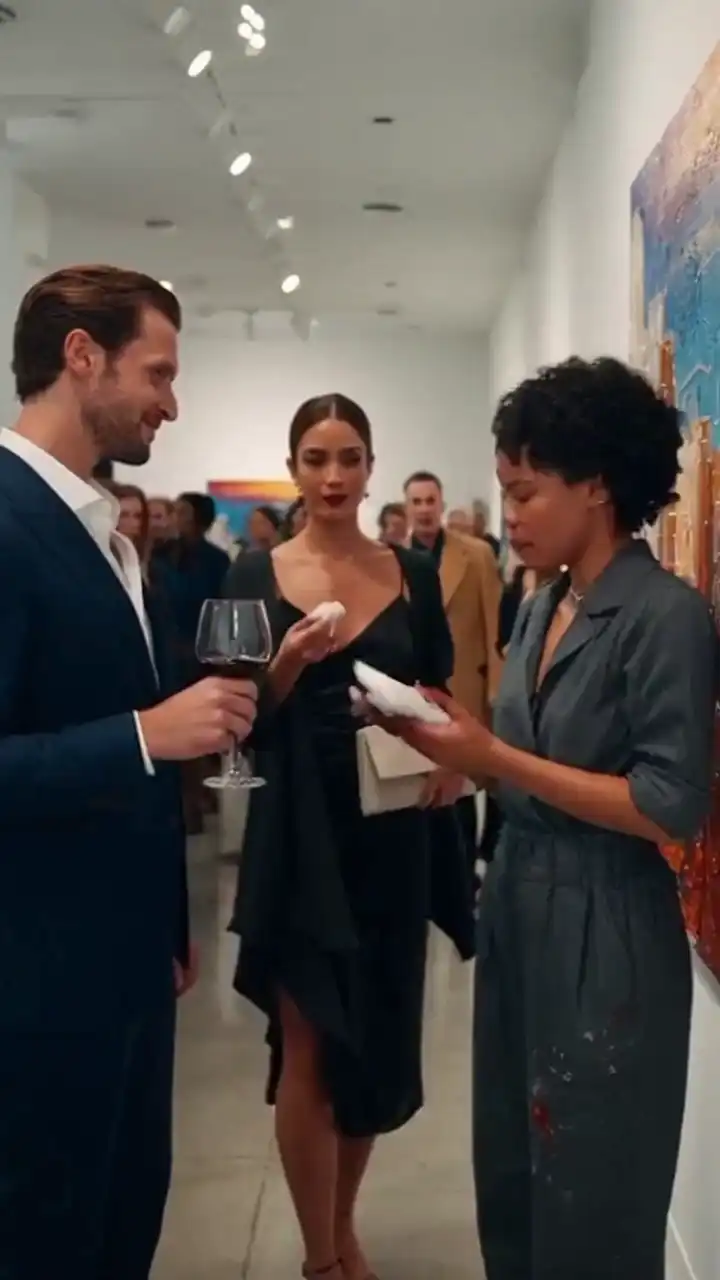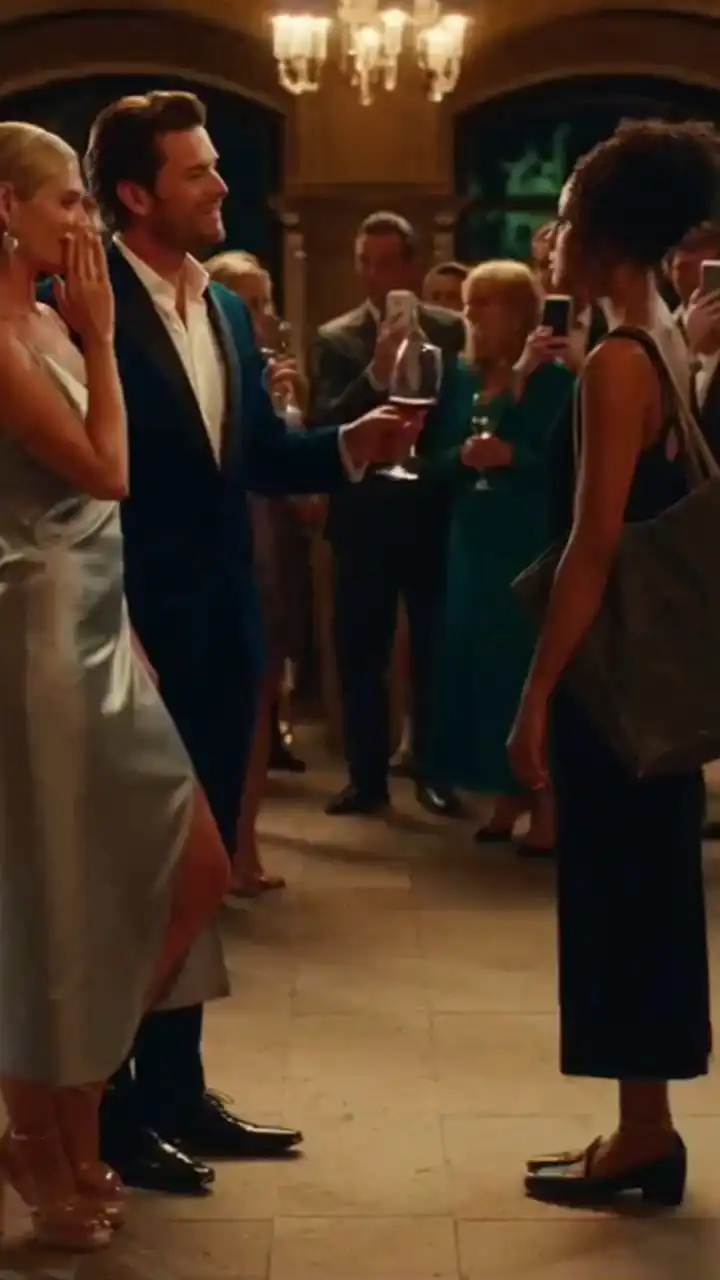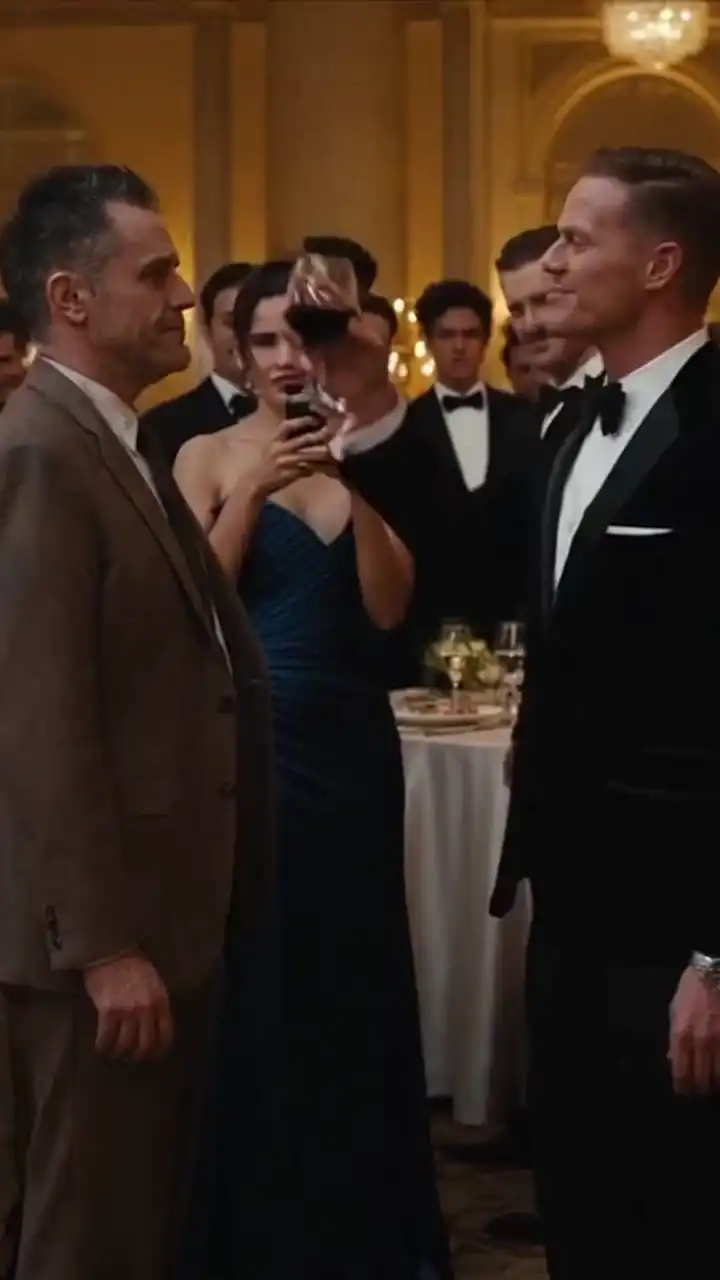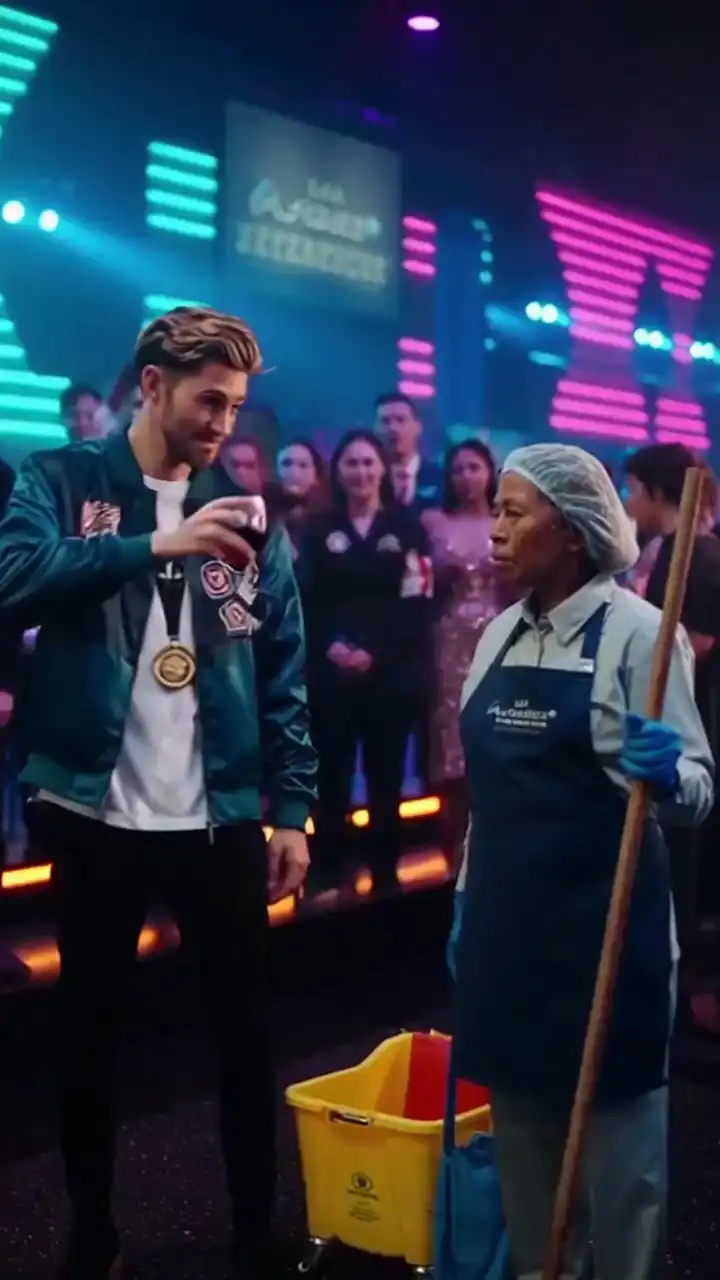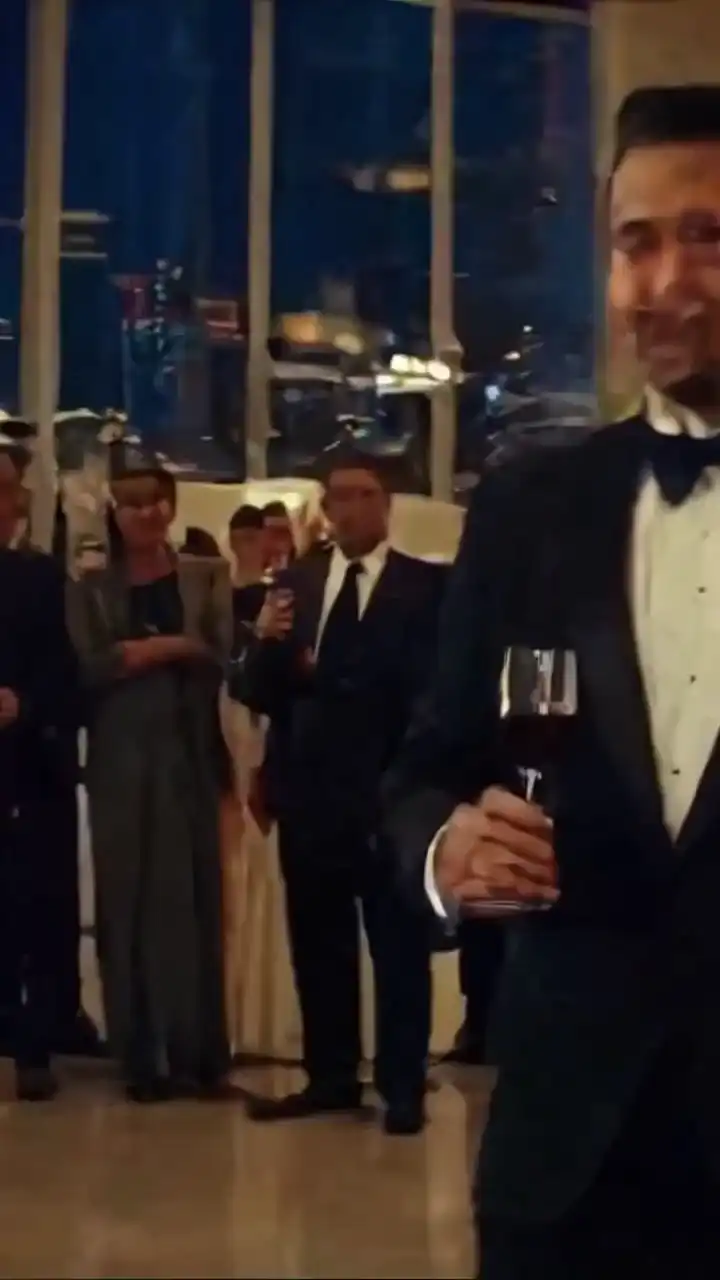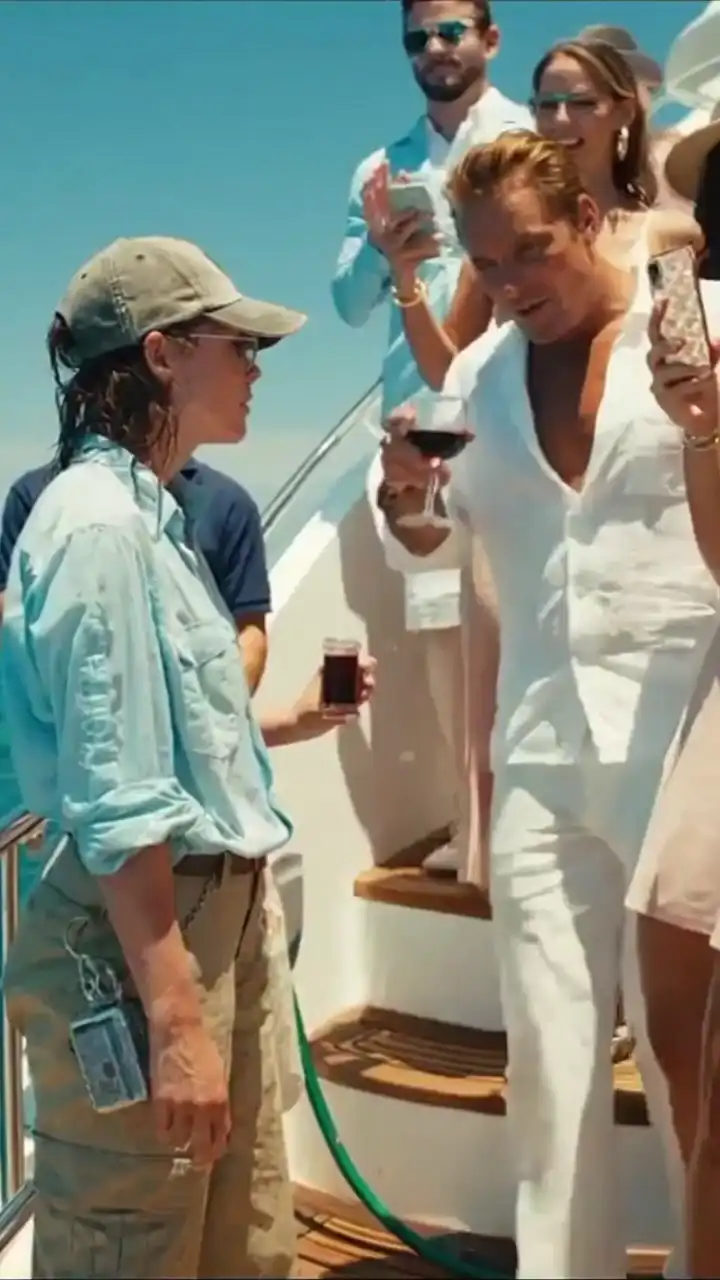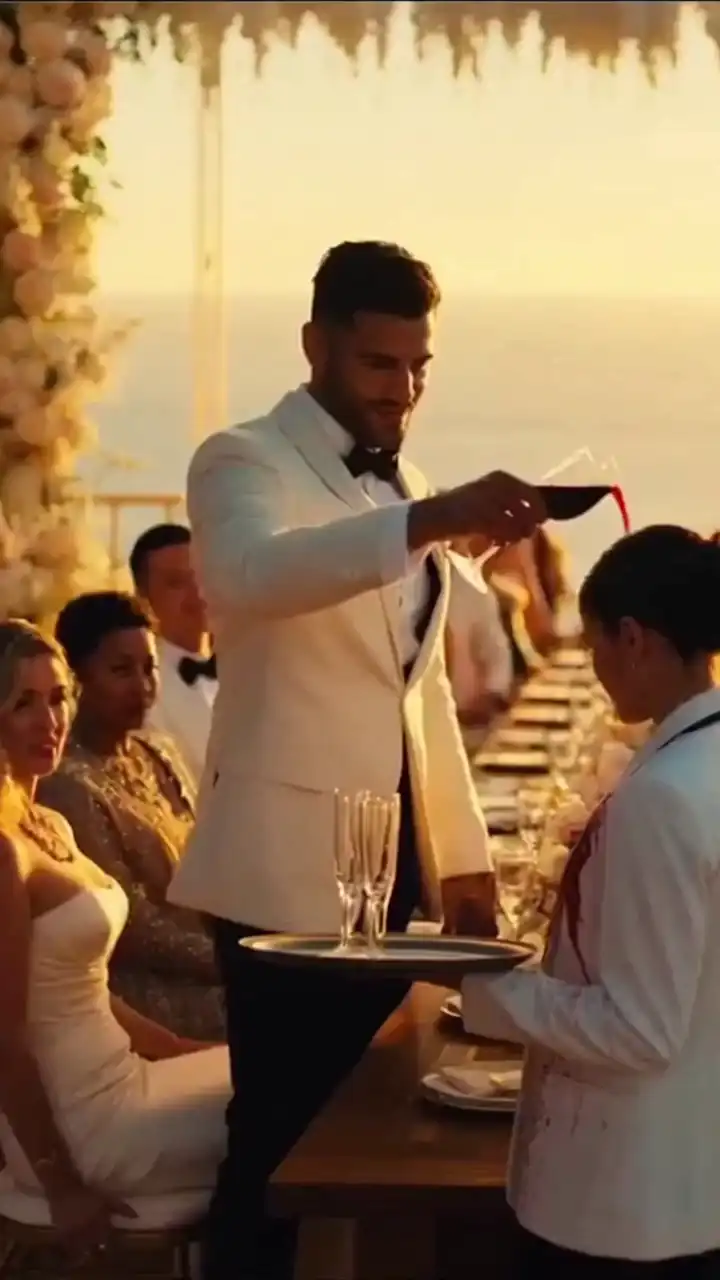
HE POURED WINE ON THE WRONG WOMAN—AND LOST HIS WEDDING, HIS LAND, AND HIS NAME IN ONE MINUTE
The first frame froze his smile twenty feet high above the cake.
Not the polished smile he wore for investors and photographers. The other one. The private one. Sharp. Mean. Familiar.
Then the audio came through the speakers.
“Sophie doesn’t need to know,” his voice said. “She signs whatever I put in front of her when she’s tired.”
The room went dead.
Even the wind off the cliff seemed to stop.
My ex-fiancé jerked around so hard he nearly knocked over the champagne tower. “Turn that off.”
The quiet tech guy by the DJ didn’t move.
On the screen, a date flashed in the corner. Three months before he ended things with me. He was in his downtown office, jacket off, tie loose, laughing with his lawyer. The camera angle came from the security feed he never knew backed up to a cloud server I paid for.
His bride’s smile slipped first.
“What is this?” she demanded, but she was no longer talking to me. She was staring at him.
I reached up at last and wiped one line of wine from my cheek with the back of my hand. “Play the next file.”
The second video opened.
Same office. Different night.
He was kissing the woman who was now wearing white in front of all those guests, while his lawyer spread documents across the conference table. Not romantic documents. Wire instructions. Property transfers. A draft agreement with my name highlighted in yellow.
His mother made a sound like someone had punched the air out of her.
“That’s fake,” he snapped. Too fast. Too loud. “AI can make anything now.”
“Of course,” I said. My voice carried cleanly through the mic. Calm. Almost gentle. “Then we should look at the originals.”
The tech guy tapped once. The giant screen split into four panes.
Time stamps. Metadata. Building security logs. Entry swipes. His ID. Her ID. His lawyer’s ID. Every corner of his lie laid out in white text against black.
A man near table three—Caleb, one of his golf friends, the one who had laughed when the wine hit me—slowly lowered his phone. “Jesus,” he muttered.
The bride took one step back from the groom. “You told me she was unstable.”
He turned to her with that same oily confidence I had once mistaken for strength. “Baby, she is. This is exactly the kind of stunt—”
“Play the audio from May twelfth,” I said.
The speakers obeyed.
His voice again, clearer this time. “Once the Kaanapali parcel closes, I’ll cut Sophie loose. She has no idea the north boundary got corrected. The old family deed is worth millions if we fold it into the resort expansion before she notices.”
A murmur rolled through the guests like a wave hitting rock.
Now the bride was the one who looked confused. “What parcel?”
I looked straight at him. “The land my father let your family lease when yours was drowning in debt. The land you tried to bury in amended paperwork after my stroke rehab, when you thought I was too sedated to read.”
His face changed.
Denial first, exactly as I’d expected. The little dismissive shake. The laugh with no humor in it. “You don’t own anything. Your father signed that over years ago.”
That was when I lifted the document folder from the service station beside me.
Heavy cream paper. Red ribbon. County seal.
“No,” I said. “He didn’t.”
I untied the ribbon slowly enough for the whole room to feel it.
“The lease from 1998,” I said, holding up the first page, “gave your father operating rights to twelve oceanfront acres for twenty-five years. It did not transfer title. This—” I raised the second page “—is the recorded extension request your company filed and my father refused to sign after discovering unreported subleases. This—” another page “—is the county rejection notice. And this—”
I held up the last one.
The original deed.
Not a copy. Not a scan. Thick old stock, embossed seal, the ink browned with age. My family name at the top. My father’s full legal transfer to me, recorded two years earlier, after his diagnosis, before everyone decided my life had become small enough to be ignored.
“The north boundary correction you tried to hide,” I said, “didn’t make the land yours. It proved you knew it wasn’t.”
His mother stumbled into the chair she had grabbed.
The bride’s bouquet slipped from her hand and hit the floor with a soft, ruined thud.
“You said the estate was part of your holdings,” she whispered.
He reached for her elbow. “It will be. This is just a paperwork dispute.”
A man in a tan linen suit stood from the second row. Mr. Ikezawa, counsel for the title company. He had been silent the entire afternoon, exactly as we agreed.
“It is not,” he said.
Every head turned.
He adjusted his glasses and looked at the groom with open disgust. “Our office received a notice of claim this morning, along with the supporting chain of title, survey overlays, and a request for an emergency injunction against any attempted sale, refinance, or development. We verified the recording numbers with Maui County before the ceremony began.”
The groom stared at him. “You knew?”
Mr. Ikezawa did not blink. “I know now that you represented encumbered property as a free asset in at least two financing packages.”
This time the silence wasn’t shock.
It was fear.
Because half the men at the front tables suddenly understood they weren’t watching a lovers’ quarrel.
They were watching fraud walk into daylight.
The bride’s father, who had spent the cocktail hour boasting about merger opportunities, went pale enough to look gray. “Tell me,” he said carefully, “that my daughter did not just marry into criminal exposure.”
No one answered him.
So I did.
“That depends,” I said, “on how much she knew.”
The bride whipped toward me. “I didn’t know about any land.”
“No,” I said. “But you knew about me.”
Her mouth opened.
Closed.
On the screen, the tech guy played the final clip.
It was from a restaurant in Honolulu. The bride sat across from him, laughing over oysters, my engagement ring on a velvet tray between them while my name lit up his phone again and again.
“Don’t answer,” she had said in the video. “If she cries, she’ll get ugly.”
Several women in the crowd flinched as if they had been slapped.
The bride looked at the giant version of herself and then at the 200 guests beneath it. Her face drained so fast I could see the makeup line at her throat.
“That was before—” she began.
“Before what?” I asked. “Before you wore white and mocked the waitress?”
At table one, a woman who had filmed the wine pour lowered her eyes. I recognized her—the bride’s cousin with the pearl headband. She took her phone, walked to me without a word, and held it out.
“I deleted it,” she whispered. “I’m sorry.”
I didn’t take the phone.
“Keep it,” I said. “Remember what you were willing to record.”
Caleb was next. The same man who had chuckled. He cleared his throat and wouldn’t meet my eyes. “Sophie… I didn’t know.”
“Of course you didn’t,” I said. “You just laughed anyway.”
The groom had gone still in that dangerous way liars do when they realize charm has failed and numbers won’t save them. “What do you want?”
There it was.
Not an apology.
A negotiation.
I looked at the wedding arch, the orchids bending in the wind, the linen, the candles, the imported crystal he had paid for with money leveraged against property he did not own. Then I looked back at him.
“What’s mine,” I said.
Two men in dark aloha shirts were already coming up the side path from the valet entrance—private security from the estate. Behind them came a county deputy, hand resting near his belt, badge glinting gold in the late light. The badge caught like fire in the guests’ eyes.
The groom saw it and took half a step back.
“Seriously?” he said, trying one last laugh. “You called the cops to your ex’s wedding?”
“I called the deputy assigned to serve the injunction if you attempted to use this property after notice,” I said. “Your event coordinator received that notice forty minutes ago. She ignored it when your mother told her to keep the champagne flowing.”
His mother made a strangled noise. “You vindictive little—”
The deputy lifted a hand. “Ma’am.”
The estate manager arrived behind him with a tablet and a face like carved stone. “This event is concluded. The current title holder has revoked access to the private bluff and main house effective immediately.”
The bride blinked. “Current title holder?”
The manager turned to me with a small, respectful nod. “Ms. Laurent.”
That was the moment the groom finally understood the whole shape of it.
Not just that he’d been caught cheating.
Not just that the marriage had detonated before the first dance.
But that the cliffside estate, the view, the manicured lawn, the imported champagne, the very ground under his polished shoes had never been his to stand on.
His eyes dropped to the deed in my hand.
Then to the deputy’s badge.
Then to the screen, where his own voice still waited in frozen captions.
Dawning horror settled over his face like a shadow moving across water.
“You planned this,” he said.
I held his stare. “No. I prepared for you.”
The bride took off her ring first.
Her fingers shook so badly she dropped it, and it bounced once against the plate of the wedding cake before disappearing into the grass.
“Don’t touch me,” she said when he reached for her again.
Her father was already on his phone, walking away hard and fast, barking for his legal team. His mother sat collapsed in silk and diamonds, whispering that there had to be some mistake.
There wasn’t.
The deputy stepped forward and handed the groom a packet. “You’ve been served.”
He didn’t take it.
So the papers hit his chest and slid to the wine-stained front of his jacket.
For one strange second, no one moved at all.
Then the room broke.
Chairs scraped. Guests scattered into whispers and frantic calls. The florist cried over trampled arrangements. Someone from the band unplugged their amp. The ocean below kept smashing itself against black rock like none of us had ever mattered.
I unclipped the microphone from beneath my jacket and set it on the abandoned gift table.
The tech guy gave me a small nod from beside the DJ booth. Everything that needed to be said had been said.
As I turned, I saw my father near the terrace rail, one hand pressed to his cane, the other over his heart. He had insisted on coming despite the doctors, insisted on seeing truth arrive with his own eyes. For a second I was afraid the strain had been too much.
Then he straightened.
Slowly, but fully.
And he smiled at me.
Not triumphant.
Proud.
I crossed to him, placed the deed back into its folder, and slipped my arm through his.
Behind us, my ex was still calling my name as if he had any right left to it.
I didn’t answer.
We walked past the fallen bouquet, past the stain drying dark on the stones, past two hundred people learning too late that silence has a price.
At the edge of the bluff path, the wind lifted the last wet strand of hair from my cheek.
I let it.
Disclaimer: Mention of any brand or trademark is for identification only and does not imply partnership or endorsement