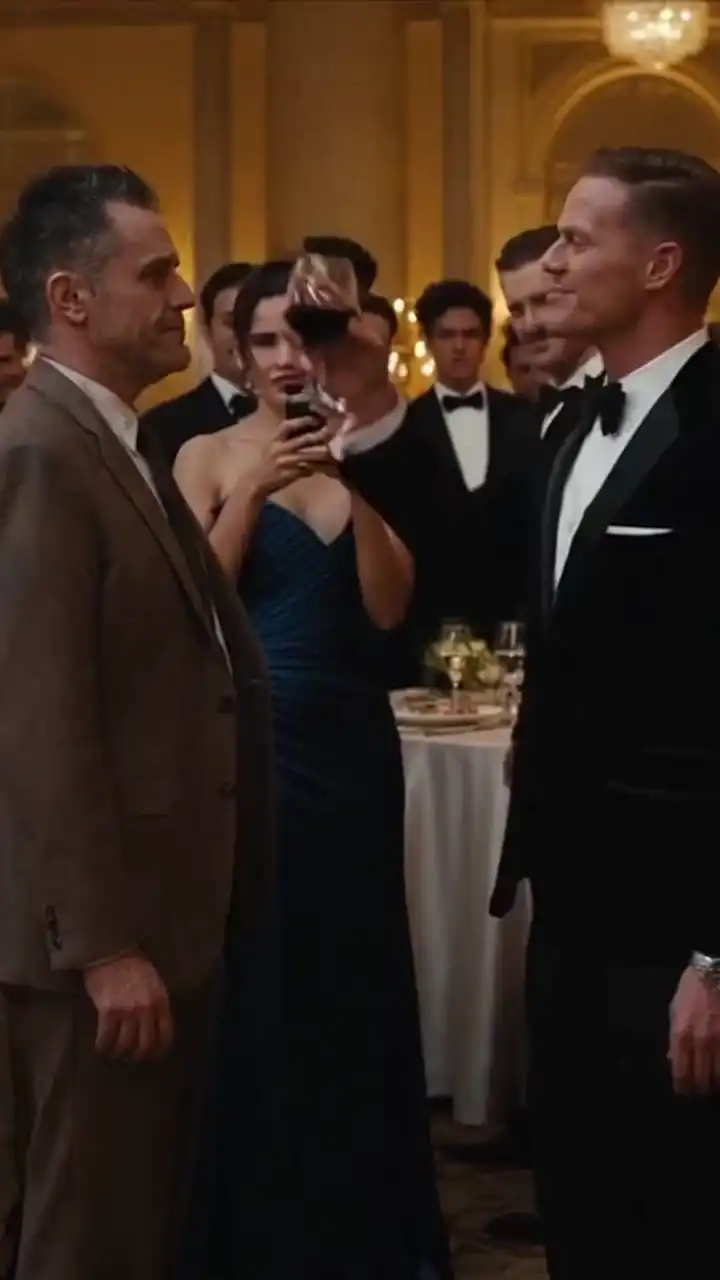

HE POURED WINE ON THE WRONG MAN—AND LOST THE WHOLE TOWER IN ONE MINUTE
The attorney’s voice cracked on the first sentence.
“By order of the Supreme Court of this state, all construction, transfer, financing, occupancy preparation, and ceremonial use of the property identified as Parcel 11-B, 11-C, and 12 of the Old Foundry District is immediately stayed pending enforcement of superior title and preservation of historically protected subsurface structures…”
No one moved.
Then everyone moved at once.
Phones lit up like sparks in dry grass. A banker near the front actually stumbled backward into a cocktail table. One of the investors cursed under his breath and started dialing before the attorney had finished the paragraph. The mayor’s smile vanished so completely it looked peeled off.
Ethan let out one short laugh.
“This is a stunt,” he said. “A piece of paper doesn’t shut down my building.”
Mr. Walter bent, slowly, and picked up one of the wine-soaked newspapers from the marble floor. His fingers were stained red now, but his voice came out steady.
“It does when that paper says your tower was built on land your father never legally acquired.”
A pulse jumped in Ethan’s jaw.
“That land was bought twenty-two years ago.”
“No,” Mr. Walter said. “A bid was made twenty-two years ago. A press conference was held. Demolition permits were pushed through. Fences went up. But the transfer for the south parcels was never completed, because the title challenge from the Whitaker Trust survived every appeal your family buried.”
The room had gone so still I could hear the soft electric hum from the chandelier tracks.
The city attorney swallowed and turned another page. “There’s more.”
“Read it,” Mr. Walter said.
The attorney looked like he wanted to disappear. But he read.
“The court further recognizes the claimant, Walter Whitaker, sole surviving trustee and beneficiary under the amended conveyance of June 14, 1978, recorded in Book 944, Page 118, as the lawful controlling owner of the undeveloped subsurface and easement rights essential to access, utility routing, and occupancy certification for the current structure.”
A woman near the back, one of the lenders who had been laughing into her champagne flute ten minutes earlier, lowered her phone with shaking fingers.
“Occupancy certification?” she whispered.
“Yes,” said Mr. Walter.
He reached into the folder and withdrew a yellowed document in a plastic sleeve. The seal at the bottom was old, embossed, and unmistakable. Even from several feet away, it looked heavy with time.
“My grandfather signed the original rail-access covenant when this district still moved steel and grain,” he said. “My father renewed it when the city converted the yards. And I kept it active after your father assumed no one would notice an old man collecting cardboard.”
Ethan’s face hardened. “You expect anyone to believe you own this project because of some antique tunnel?”
“Not some tunnel,” the attorney muttered, scanning the papers with widening eyes. “The main service corridor.”
That landed.
Not dramatically. Not loudly.
Just a dead, clean impact.
The service corridor. The underground access line that fed emergency power, freight lift compliance, storm drainage tie-ins, and utility maintenance clearance. The invisible spine of the entire tower.
One of the engineers who had been standing near the model display stepped forward. “If those easements are frozen, the temporary certificate is worthless.”
Another man answered from beside him, his voice dry with disbelief. “Without that corridor, the fire occupancy review can’t pass. The lenders can call default.”
The silence after that was worse than shouting.
Ethan looked toward the stage, toward the mayor, the councilman, anybody. “Tell them this is nonsense.”
The mayor did not speak.
He was staring at the court seal like it might explode.
Mr. Walter set the plastic-sleeved document on the microphone stand beside the injunction. “Your father knew. That’s why he spent eleven years filing delays, then shell companies, then redevelopment petitions. He thought I’d die before the case reached the high court.”
Ethan’s expression flickered.
Just once.
Verification had begun.
He snatched the injunction from the stand and thrust it at the city attorney. “Check it.”
“I already did.”
“Check it again.”
The attorney took the document with both hands, as if afraid of tearing it. He inspected the filing stamp, the case number, the judicial signatures. Then he looked at the clerk’s authentication attached behind it. When he spoke, his voice was smaller than before.
“It’s valid.”
Ethan turned to the bank representatives. “This changes nothing. We’ll appeal.”
Mr. Walter shook his head.
“The appeal window closed this morning at four nineteen,” he said. “Your counsel filed late.”
A sound escaped one of the bankers—half groan, half prayer. He pulled at his tie and walked three steps away, already barking into his phone. “Freeze all further disbursements. Now. I don’t care what floor I’m interrupting.”
That was when the first bystander cracked.
Lila Chen, the lifestyle reporter who had laughed when Ethan called Mr. Walter a parasite, slowly lowered the phone she had been using to film. Her makeup was flawless, but all the color had drained from her face. She glanced at the spilled cardboard, then at the old man’s soaked coat.
“I posted it,” she said, almost to herself. “God, I posted that live.”
No one answered her.
Near the entrance, Councilman Reeves—the one who had looked down at his phone when security shoved Mr. Walter—started inching toward the side door. He made it two steps before the mayor snapped, “Don’t you dare leave.”
Reeves stopped cold.
Mr. Walter looked at neither of them.
He was looking at Ethan.
“I came here twice before,” he said. “Once with an offer to settle. Once with proof your survey maps were altered. Both times your office told security to remove me.”
Ethan lifted his chin, but the movement was brittle now. “You look like a scavenger.”
“I am,” Mr. Walter said. “I spent fifteen years collecting what your family threw away.”
Then he opened the folder one last time.
Inside were copies of internal memos, survey overlays, and a letter on Holloway Development letterhead dated eight years earlier. The signature at the bottom belonged to Ethan’s father. A single paragraph had been highlighted.
Proceed with demolition barricades on the south parcels. Whitaker has no political leverage. Delay any title response until after foundation pour. Once vertical construction begins, no court will unwind the project.
The attorney closed his eyes.
Someone in the room whispered, “Jesus.”
Ethan stared at the letter as if it were written in another language.
Denial was leaving him.
Horror was arriving.
“That doesn’t prove anything about me,” he said, but he said it too quickly. “My father handled land assembly.”
“You poured wine on a man your family spent years trying to erase,” Mr. Walter replied. “That part is yours.”
One of the security men who had shoved the cart—thick-necked, shaved head, black earpiece still in place—stepped back from Ethan as though distance might save him. “Sir, we were told he was trespassing.”
Mr. Walter gave him a long look. “And when my property papers were in my hand?”
The guard said nothing.
The second guard bent down, silently, and started gathering the cardboard from the floor. Not for show. Not quickly. Just one flattened box at a time, eyes lowered.
That was the second reckoning.
Then came the call.
Ethan’s phone buzzed. He answered on speaker by mistake, hands no longer steady.
His father’s voice erupted through the room. “Why am I hearing from First Commonwealth before I’m hearing from you?”
“Dad—”
“Did Whitaker serve the order in person?”
No one breathed.
Ethan looked up slowly, the way a man looks up after hearing the trap close.
Mr. Walter didn’t smile.
On the phone, his father kept talking, each word making it worse. “Listen to me carefully. Do not say another thing in that room. If the injunction names the service easement, we are exposed on occupancy, bond covenants, and the heritage review. Do you understand me?”
The entire crowd understood him.
Ethan swallowed. “You told me it was handled.”
His father went silent for one fatal beat.
Then: “I told you not to provoke him.”
The sound that left Ethan then wasn’t anger. It was something emptier.
Lila Chen raised her phone again, but this time she wasn’t smiling. “Can I make a statement?” she asked no one in particular, voice trembling. “For the record?”
“Make all the statements you want,” the mayor muttered. He took off the ceremonial hard hat he had been given for photos and set it on a tray like it had burned him.
Councilman Reeves stepped toward Mr. Walter, hands half-raised. “Sir, if there’s a path to reconciliation—”
Mr. Walter turned his eyes on him, and the man stopped speaking.
“Were you looking for reconciliation,” Mr. Walter asked quietly, “when they threw my papers on the floor last spring outside your office?”
Reeves’ mouth opened. Closed.
“No,” Mr. Walter said. “You were looking away.”
Across the hall, the giant illuminated model of the tower still glowed—silver balconies, rooftop garden, luxury residences, names engraved on a future that had just been canceled by ink and memory.
Mr. Walter walked to his overturned cart.
The second guard had stacked the cardboard neatly beside it. Mr. Walter crouched with a wince, gathered the driest pieces, then lifted the old leather folder and placed it carefully on top. The room watched him like he was carrying dynamite.
Ethan took one step forward. “What do you want?”
At last, Mr. Walter looked directly at him.
Not with triumph.
Not even with anger.
“With men like you,” he said, “that question always comes too late.”
He pulled from his pocket a folded notice and handed it to the city attorney. “Serve the preservation order on the excavation crews. The brick vaults under the south parcels are to be sealed tonight. Historical survey starts at dawn.”
The attorney nodded at once.
No argument. No delay.
Power had changed hands so completely it didn’t need to be announced.
Mr. Walter adjusted the collar of his stained brown coat. Red wine had dried in the seams like old rust. Around him, investors were already scattering, officials whispering, lenders retreating into emergency calls. The party music had stopped somewhere along the way, and nobody had noticed.
As he reached the doors, Lila Chen spoke again.
“Mr. Whitaker,” she said, voice breaking, “I’m sorry.”
He paused, one hand on the cart handle.
“That’s for you,” he said without turning. “Not for me.”
Then he pushed the cart forward.
Its loose wheel clicked softly over the marble, out past the shattered celebration, past the tower that no longer belonged to the people drinking beneath it, and into the night air that smelled like rain and old stone.
Disclaimer: Mention of any brand or trademark is for identification only and does not imply partnership or endorsement