THE THUMBPRINT UNDER THE GLASS DESTROYED HIM WITHOUT A SINGLE SHOUT
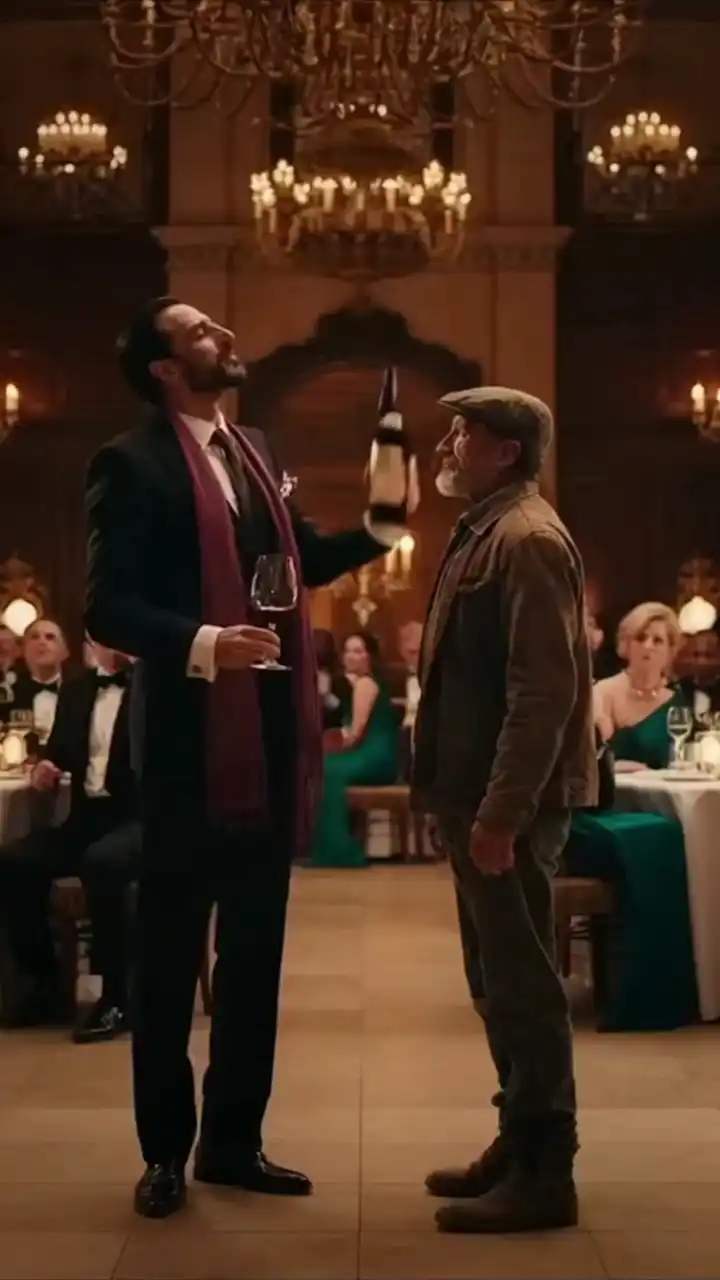
The host’s hand trembled as he took the bottle from Adrian and turned it slowly into the light.
The room leaned with it.
My thumb stayed beside the punt, right under the narrow ring of glass where the deep green darkened to black. “There,” I said.
The flashlight beam cut across the bottom. A tiny crescent, no wider than a fingernail clipping, flashed dull silver under the punt seam. Not paint. Not reflection. A pressure scar in the glass itself, half-moon shaped, with three pinprick dots inside it.
Adrian laughed too quickly. “Every old bottle has imperfections.”
“No,” I said. “Every old bottle has age. That mark is deliberate.”
Someone’s phone stopped recording. I heard the little click in the silence.
The host frowned and leaned closer. “What is it?”
“A mold identifier,” I said. “One used on the emergency recast line in Beaune in 1987 after a furnace crack shut down the primary supplier for six weeks.” I looked at the bottle, not Adrian. “Romanée-Conti never used those recast bottles for release stock. My father rejected every pallet.”
The room went still in a different way then.
Not entertained.
Thinking.
Adrian lifted his chin. “That’s absurd. This bottle came through verified collectors.”
“Then the collectors bought a lie.”
He opened his mouth, but I pointed at the glass. “There should also be a heat bloom on the inner punt from the second sealing. Very faint. Tilt it left.”
The host obeyed before he realized he was obeying me. Under the chandelier light, a cloudy ring appeared inside the bottom, as thin and pale as breath on winter glass.
A woman near the fireplace covered her mouth.
I stepped closer, my wine-soaked shirt cooling against my skin. “The original bottle was opened, emptied through a needle draw at the cork edge, then refilled. When that failed inspection, whoever did it reheated the neck, reset the capsule, and counted on nobody in this room knowing where to look.”
Adrian’s face lost some of its color, but he still smiled. “You expect us to believe a field hand knows all that?”
I met his eyes then. “I expect them to believe the truth.”
The host turned to me fully for the first time that evening. “Who are you?”
I reached into my inside pocket again. This time I brought out the folded document that had been riding there all night, the corners worn soft from years. I opened it carefully, because old paper tears from pride as easily as from clumsy hands.
The deed rustled loud as thunder in the quiet.
It was not elegant. Browned edges. County stamps. A blue ribbon seal crushed flat with age. Across the top, in faded block script, were the words TRANSFER OF AGRICULTURAL PARCELS—CÔTE D’OR. Below that, the date: 14 JUNE 1968.
I handed it to the host.
His eyes moved once, then again, slower. “This can’t be…”
“It can,” I said. “Parcel 7B, lower east slope, and the original workers’ house beside the old sorting shed. Sold for one franc and permanent cultivation rights to my father, Luc Moreau, by Henri Bisset when the frost nearly bankrupted him.” I tapped the page. “Co-signed three years later by his son after inheritance review. That son became your seller’s grandfather.”
A murmur moved through the room like wind in dry vines.
The billionaire who had laughed first took a step back from the table.
Adrian’s smile broke at one corner. “Owning some patch of land doesn’t make you an authority on rare wine.”
“No,” I said. “Forty-two harvests in those rows did that.”
I pointed to the small scar under the bottle. “And so did helping my father reject six hundred and twelve emergency bottles because he said if a man lies about the glass, he’ll lie about what’s inside it.”
The host looked from the deed to me, then back to the bottle. “Six hundred and twelve?”
“In three deliveries,” I said. “Nineteen crates, then seven, then five. We stacked them by the loading wall and marked every base with lampblack so they wouldn’t get mixed into release inventory.” I nodded toward the bottle. “That black was scrubbed off years ago. The pressure scar wasn’t.”
Adrian swallowed.
That was denial giving way.
He snatched the bottle from the host’s hand and flipped it over himself, hunting for a different answer in the glass. His fingers were no longer graceful. “This proves nothing. Anyone could invent a story around a blemish.”
“Check the cork,” I said.
He froze.
The host’s head snapped up. “Open it.”
“It’s a priceless bottle,” Adrian said sharply. “Opening it now would destroy its collector value.”
“It already has no collector value if it’s counterfeit,” the host said.
That landed.
For the first time, fear moved behind Adrian’s eyes. Not social embarrassment. Arithmetic. Insurance. Provenance. Fraud.
A younger guest in a velvet jacket, the one who had been filming me with a grin when the wine hit my shirt, lowered his phone completely. “Wait,” he said. “I posted part of this live.”
Nobody answered him.
The host held out his hand. “Corkscrew.”
Adrian didn’t move.
“Now.”
One of the servers rushed one over. Adrian stood there for a second too long, then surrendered the bottle. The host cut the capsule with clumsy care. When he pulled the cork free, it came with a soft, sick little sound.
I held out my palm. “May I?”
He gave me the cork.
The room watched my hands.
I turned it once, then lifted the flashlight. “Here.”
Even from where they stood, they could see it: a thin dark line circling the lower third of the cork, sharper than natural wine staining, perfectly level all the way around.
“Compressed twice,” I said. “First opening at least five years after bottling. Reinserted with a narrower jaw than the original line used in Vosne at the time.”
The host whispered, “My God.”
Adrian found his voice by grabbing for anger. “This is ridiculous. You’re staging this because you were embarrassed.”
I looked at the red spread across my chest. “You did embarrass yourself.”
A laugh escaped someone near the back, but it died quickly.
The woman who had whispered, Why is he even in here, stared at the floor. “I know that mark,” she said suddenly.
Heads turned.
She swallowed. “My family insured a cellar lot in Geneva two years ago. One bottle failed forensic review because of a recast base exactly like that. The report mentioned emergency post-furnace molds.” She looked at Adrian as if seeing him for the first time. “You certified that lot.”
Now the room shifted away from him.
Not much. Half-steps. A chair edge scraping. But enough.
The man with the phone shoved it into his pocket. “I thought this was a joke,” he muttered, not to me, mostly to himself. “Jesus.”
The billionaire who had chuckled into his napkin cleared his throat and would not meet my eyes. “Mr. Moreau,” he said, the title arriving late and cheap, “if there has been any misunderstanding—”
“It wasn’t misunderstanding,” I said. “You understood perfectly what he was doing. You just thought it was safe to enjoy.”
He went quiet after that.
The host had gone pale. He turned the deed over, then back again, reading the signatures. “Luc Moreau,” he said softly. “Your father.”
“Yes.”
“And you’re Étienne Moreau.”
I nodded.
He closed his eyes for one beat, maybe placing the name. Maybe remembering the old article framed in the château corridor, the one no guests read, about the frost year and the workers who kept the lower vines alive by burning straw through the night.
When he opened them, his voice had changed. “Your family still holds cultivation rights to the eastern rows.”
“And first refusal on any private bottle sale represented as originating from those parcels,” I said. “Clause four. It has been overlooked for years because my father never cared for dining rooms like this.”
The host reread the deed, found the line, and exhaled hard.
Verification.
Then horror.
He looked at Adrian. “You sold me this bottle under personal guarantee.”
Adrian’s lips parted, but nothing came out.
The host kept going, quieter now, which was worse. “You told my guests it was unimpeachable. You tied my name to its authenticity. You brought fraud into my home.”
“It may be a sourcing error,” Adrian said, but the smoothness was gone. His accent thinned. The carefully polished vowels slipped, exposing plain edges underneath. “I can contact the intermediary—”
“There are no more intermediaries,” the host said.
The woman by the fireplace stepped back as if Adrian smelled rotten. The young man with the phone deleted something frantically, thumb jerking across the screen. One of the servers, the same one who had looked away when wine hit my shirt, came to my side with a clean linen towel and held it out with both hands.
“I’m sorry,” she whispered.
I took it. “Thank you.”
That was enough to make her eyes shine.
Adrian saw all of it happening at once—the retreat, the silence, the sudden care shown to the man he had tried to shrink—and that was the moment the truth finally reached him. Not that he might lose the argument.
That he had already lost the room that made him matter.
He took one step toward me. “Mr. Moreau, perhaps we can discuss this privately.”
I folded the towel once and pressed it against my shirt. “You preferred an audience.”
His face collapsed then, not dramatically, just all at once, like wet paper giving way at the center. “Please.”
The host straightened. “Security will handle the rest. And my attorney will handle what follows.”
Nobody protested.
Nobody defended him.
A few minutes earlier they had laughed because red wine on a work shirt felt amusing from a distance. Now they watched as Adrian set down his glass with shaking fingers, careful not to spill a drop, as if precision could still save him.
It couldn’t.
The host tried to hand the deed back with both hands. “Mr. Moreau, I owe you an apology.”
I took the paper and folded it along the old lines. “You owe my father one,” I said. “He’s buried on the hill above row seven.”
The host’s throat worked.
I slipped the deed into my coat, took the bottle by the neck, and passed it to him. “Have it tested. Properly this time.”
He nodded.
When I turned toward the door, the room opened without being asked. The woman who had mocked me moved her chair herself. The young man with the phone stepped aside so fast he nearly struck the wall. No one laughed. No one lifted a glass.
At the threshold, I caught the smell of night air drifting in from the courtyard—cold stone, damp earth, crushed leaves.
Real things.
I walked back toward the vineyard rows with red wine drying on my shirt and dirt still on my boots, and behind me the château stayed bright, loud with money, suddenly very small.
Disclaimer: Mention of any brand or trademark is for identification only and does not imply partnership or endorsement