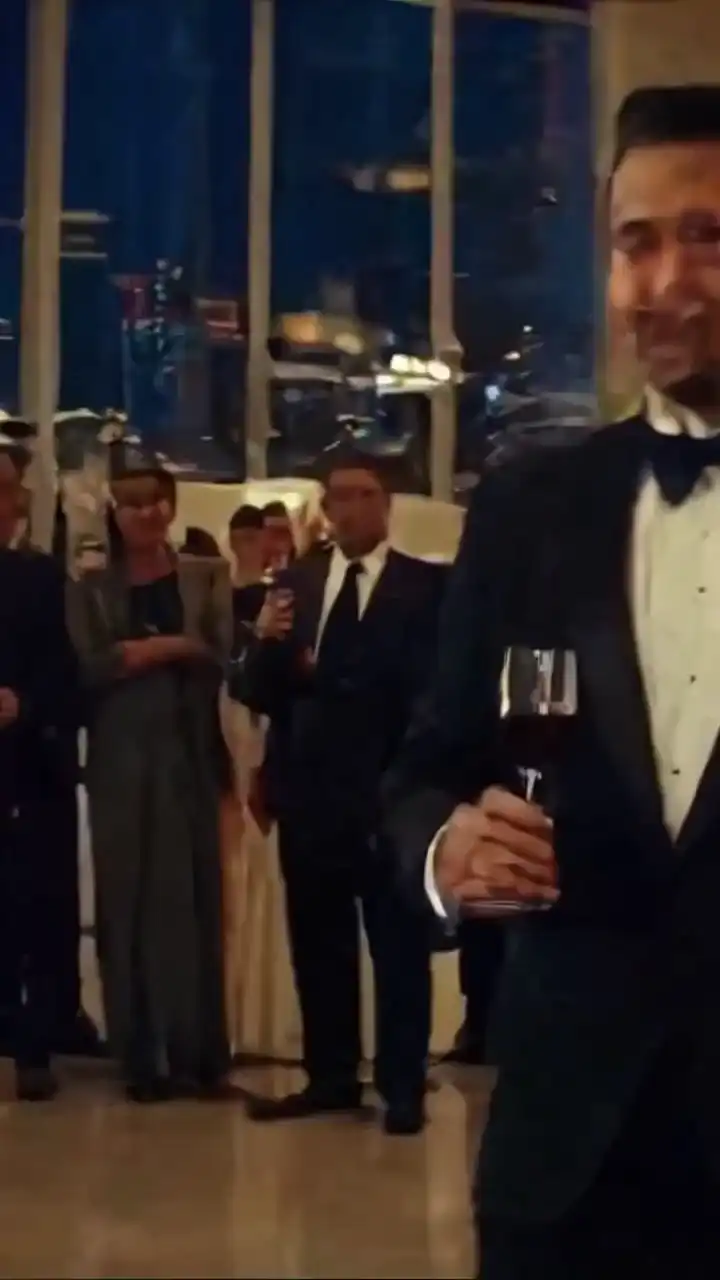
HE POURED WINE ON THE WRONG “OLD MAN” — AND WATCHED HIS NAME VANISH FROM THE MARQUEE
Julian’s smile held for one stubborn second too long, like his face hadn’t caught up with the room.
Then the stage manager took the microphone with both hands and said, voice shaking, “Per Section 8, subsection C of the lead performance agreement, any documented act of public harassment, abuse of staff, or conduct causing material reputational damage to the production constitutes immediate grounds for termination.”
No one moved.
You could hear the wet pages still dripping onto the marble.
Julian gave a short laugh. “Oh, please. You think you can scare me with legal language at a cocktail party?”
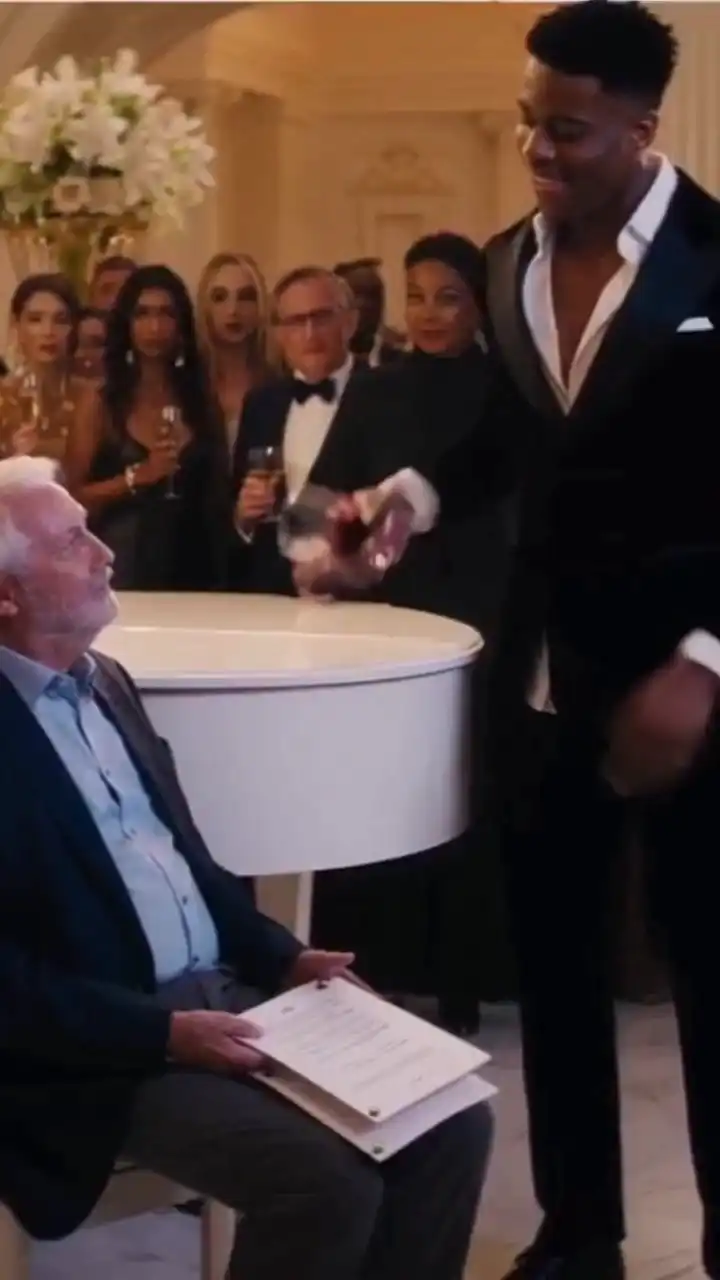
The old man straightened in his chair and set the damp page carefully on top of the folder. “Not scare you. Replace you.”
That landed.
A sharp inhale passed through the room like a draft under a door.
Julian looked at the director first, waiting for backup, for a grin, for somebody to break and say it was all theater. “Martin.”
The director didn’t answer.
“Martin,” Julian repeated, louder.
Martin finally lifted his eyes, and whatever Julian saw there took a shade out of his face. “The clause is real.”
Julian turned to the producer. “Ellen, say something.”
Ellen pressed two fingers to her temple. “I told your agent not to let you sign without reading page twenty-seven.”
A nervous little sound escaped one of the chorus dancers near the bar. She had been one of the ones filming. Now her phone was pointed at the floor.
Julian scoffed and spread his arms. “Over spilled wine? Are you all insane?”
The old man folded his glasses and slipped them into his breast pocket. His voice stayed even. “No. Over a pattern.”
He tapped the cream-colored folder.
“Tonight is simply the first time you were arrogant enough to do it in front of ownership.”
That word hit harder than any shout could have.
Ownership.
Julian blinked. “Ownership?” He looked around, almost offended by the idea. “You’re a consultant. Some retired donor they trot out for opening night photos.”
A few people actually winced.
The old man reached into the folder again and drew out a thicker document this time, heavy paper with a blue ribbon seal at the top corner. He laid it flat on the piano and turned it so the room could see. “Original transfer agreement for Blackbird Street. Dated May 14, 1987. Music, book, lyrics, subsidiary rights, revival rights, adaptation approvals.”
The producer closed her eyes.
“I purchased them,” he said, “from Daniel Vale three weeks before his stroke, because he didn’t trust the investors circling him and he wanted the work protected from men who loved applause more than art.”
Julian’s mouth opened, then shut.
The old man continued, not louder, just more precise. “Every revival of this show has required my signature. Every casting approval for the lead has crossed my desk. Every name printed above the title appears there because I permitted it.”
He touched Julian’s signed contract with one finger.
“And tonight, I am withdrawing that permission.”
The silence that followed was uglier than yelling. It was the sound of people recalculating their loyalties in real time.
Julian’s laugh came back, but now it sounded thin. “This is absurd. You can’t fire me on the spot. I have billing. I have ad campaigns. I have previews sold out for six weeks.”
“You had them,” Ellen said quietly.
He turned on her so fast the wine in his glass sloshed over his knuckles. “Excuse me?”
“The understudy has been at every rehearsal,” she said. “And unlike you, he knows all the rewrites.”
At the back of the room, the understudy froze like someone had shoved him into a spotlight without warning. He was still in his black suit from the event, tie too tight, face completely bloodless.
Julian stared at him, then barked a laugh. “Him?”
The old man looked toward the back. “Nathan.”
The understudy swallowed. “Sir?”
“Step forward.”
Nathan did.
Not confidently. Not like a man taking a victory lap. More like someone walking onto ice, unsure whether it would hold.
The old man studied him for a moment. “When Mrs. Alvarez lost her husband in December, who stayed after rehearsal to run lines with her because she was too embarrassed to ask?”
Nathan blinked. “I did.”
“When the electricians were behind on the rain cue, who spent a lunch break helping them test the timing because no one else would climb the ladder?”
A pause. “I did.”
“When Julian refused to attend the workshop for the school matinee because the audience was ‘not industry,’ who went instead?”
Nathan’s voice was almost a whisper now. “I did.”
The old man nodded once, as if confirming something to himself. “Good. Then you already know how to carry the show.”
Something broke across Julian’s face then—not anger, not yet. It was disbelief stripped raw. “You’re replacing me with an understudy at a party? That’s your grand plan?”
“No,” the old man said. “My plan was to give you every chance your talent had earned.”
He glanced at the wine-dark pages on the floor.
“You mistook that for immunity.”
Julian set the glass down too hard on the piano. It tipped, rolled, and shattered on the marble.
The crack made half the room jump.
“This is blackmail,” he snapped. “Entrapment. You sat there dressed like—” He stopped himself, but too late. Too many people had heard the rest of the sentence in their heads.
The old man’s expression did not change. “Like what?”
Julian didn’t answer.
“Like someone unimportant?” the old man asked. “Someone safe to humiliate?”
Julian looked around desperately now, searching for a friendly face. He found Vanessa, one of the featured dancers who had laughed first when the pages hit the floor. Her mascara looked suddenly too dark against how pale she’d gone. She wouldn’t meet his eyes.
Near the entrance, Theo from the ensemble had stopped recording entirely. Ten minutes ago he’d been smirking behind his phone. Now he stepped forward and cleared his throat. “I have the whole thing on video.”
Julian swung toward him. “Delete it.”
Theo actually flinched.
But he didn’t delete it.
Instead, he looked at the old man. “Sir, if legal needs it, I’ll send it.”
That was the first open shift in the room, and everyone felt it.
Vanessa swallowed hard and moved toward the scattered script pages, kneeling carefully so her gown wouldn’t touch the puddles. She began collecting them one by one, smoothing the warped corners with trembling fingers. “I’m so sorry,” she murmured, not to Julian, not to the room. To the old man.
He accepted the pages from her without ceremony. “Thank you.”
Julian stared at her like betrayal was a language he had never expected to hear spoken by people beneath him.
“This is unbelievable,” he said. “After everything I’ve done for this production?”
Martin, the director, let out one dry, exhausted laugh. “You mean the rehearsals you arrived late to? The rewrites you ignored? The dresser you made cry because a cufflink was wrong?”
Julian’s head snapped toward him.
Martin stepped closer now, years of swallowed humiliation settling into something colder. “I should have stopped you the first time you called a stagehand ‘invisible.’ That’s on me.”
Ellen drew a breath and squared her shoulders. “Your dressing room will be packed by midnight. Security will escort your assistant tomorrow for the rest.”
“Security?” Julian repeated, and now the word seemed to hit him in a place the contract hadn’t. “You’re calling security on me?”
The old man answered before anyone else could. “No. I am protecting my company.”
Company.
Not cast. Not production. Company.
Julian understood that word too.
His eyes dropped to the deed—no, not a deed, not a symbolic page, but the actual transfer agreement with the seal, the signatures, the decades-old date that proved this power did not appear tonight. It had been sitting over all their heads the entire time.
His breathing changed.
That was the verification stage, the awful moment when denial could no longer feed itself. He read the names. Daniel Vale. Harold Mercer. Witnessed and notarized. Then the amendment. Revival authority retained solely by Mercer Holdings Theatrical Trust.
Mercer.
At last the old man was no longer just an old man in a cheap suit with wet paper on his shoes.
He was Harold Mercer.
The Harold Mercer whose notes actors whispered about, whose revivals became Tony winners, whose foundation kept three downtown theaters alive when the pandemic nearly shuttered them for good.
Theo’s face went slack. Vanessa sat back on her heels like the strength had gone out of her legs. Even people who had stayed silent out of fear now looked sick for a different reason.
Julian did too.
“I didn’t know,” he said, but it came out small, almost boyish.
Harold Mercer looked at him for a long moment. “That was never the test.”
Julian’s lips parted. Nothing came out.
Then came the horror.
Not loud. Not cinematic. Worse.
He saw tomorrow’s calls from his agent. The trades. The video. The fact that every producer in the room had just watched him sneer at a seventy-eight-year-old rights holder and assault company property over a joke nobody wanted to laugh at. He saw doors closing in polite emails. He saw auditions that would suddenly be “going another way.” He saw his own name come off the marquee by sunrise.
The arrogance drained out of him so fast it was almost frightening.
He tried one last time anyway. “Harold… Mr. Mercer… if you want an apology—”
Harold lifted a hand.
Julian stopped.
“I have heard your apologies before,” Harold said. “Just never directed at someone you believed mattered.”
That finished him.
He stood there amid broken glass and wet paper, tuxedo perfect from the waist up and completely hollow behind the eyes.
Ellen turned to Nathan. “Can you be at the theater at seven?”
Nathan blinked. “Seven?”
“For costume refit, press photos, and a put-in rehearsal.”
His hand actually shook when he loosened his tie. “Yes. Yes, of course.”
Martin exhaled, and for the first time all night it sounded like oxygen reaching him. “We’ll restage the balcony transition. You always had the stillness for it.”
Nathan looked as though he might cry from sheer shock. “Thank you.”
Harold gathered the ruined pages into a neat stack. Several were stained beyond saving, red bleeding through handwritten notes in the margins. He ran his thumb along one softened edge, then handed the stack to Vanessa. “These are just rehearsal drafts. The real script is memorized where it counts.”
She nodded, eyes glassy.
No one laughed now.
No one filmed.
Even the bartenders had gone still.
Julian looked around one final time, as if he expected somebody—anybody—to rescue the version of himself that had ruled this room an hour ago. No one did. Theo stepped aside to clear a path, not respectfully, just factually. Vanessa kept her gaze lowered. Martin had already started discussing scene changes with Nathan in a low voice, as if the transition had begun before Julian had fully left.
That was the last cruelty of power: the machine moved on.
Harold took his coat from the back of the chair. The wine had darkened one cuff of his sleeve, but his hands were steady as he slipped it on. He did not look at Julian again.
As he passed the piano, Ellen said softly, “I’m sorry this happened.”
Harold adjusted the collar. “No,” he said. “Now it happened where everyone could see.”
Then he walked through the parted crowd, shoes whispering over marble, and left the room carrying none of the noise with him.
Disclaimer: Mention of any brand or trademark is for identification only and does not imply partnership or endorsement