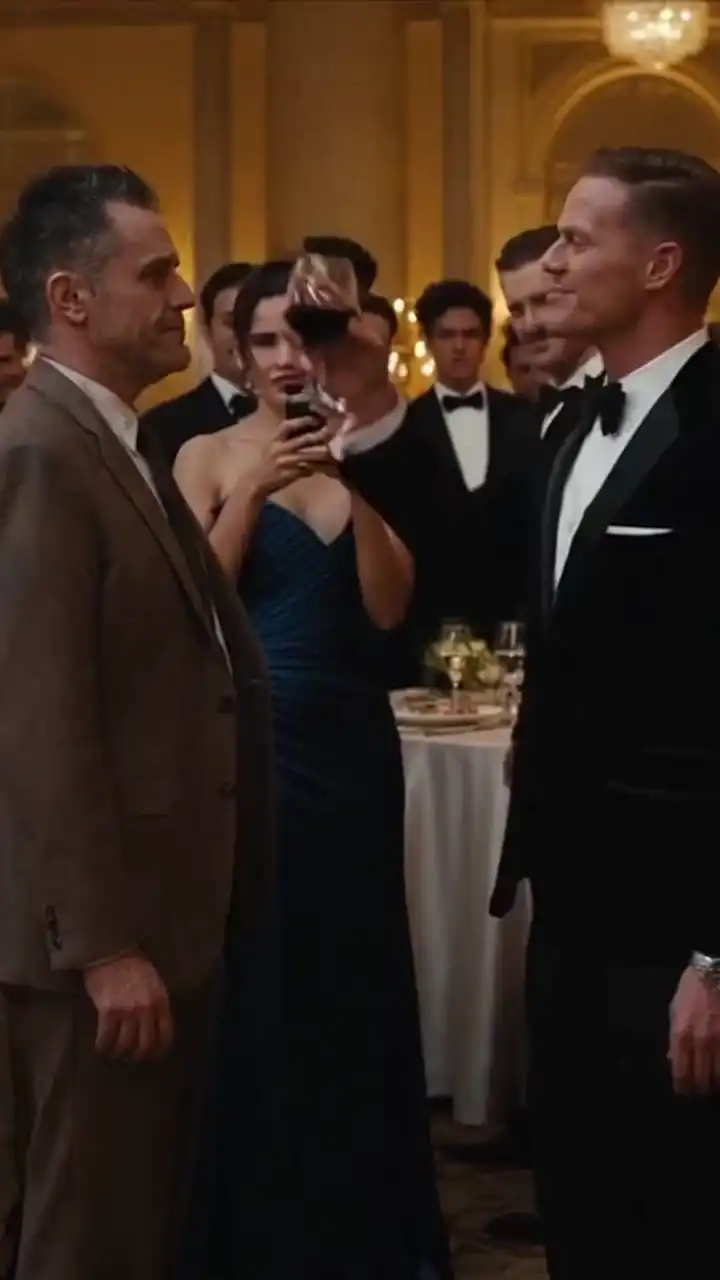

THE CEO POURED WINE ON THE WRONG FARMER—THEN SAW THE DEED THAT COULD ERASE HIS ENTIRE EMPIRE
I held the deed up between two fingers while the tractors rolled to a stop beyond the glass display homes, engines idling low like a warning no one in that courtyard could misunderstand.
Nobody laughed now.
The CEO stared at the paper first, then at me, then past me to the line of green and red machines parked across the access road his company had spent six months paving. Under the floodlights, the drivers sat motionless in their caps and work jackets, hands on their wheels, waiting on me and no one else.
“What the hell is this?” he snapped.
I looked at the city councilman, because his face had gone paler than the white linen on the cocktail tables. “You tell him.”
He swallowed, but nothing came out.
So I unfolded the deed the rest of the way and let the old paper crackle in the silence. “Book 118, page 42, filed June 14, 1978. Transfer from Harold Mercer to Daniel Mercer. Two hundred and twelve acres, including the southern access strip running from County Road 8 to the ridge line.”
The CEO frowned. “That means nothing.”
“It means,” I said, “every truck, bulldozer, concrete pour, utility trench, and sales tour that entered this property from the south crossed land you do not own.”
His assistant stopped smiling.
He took one step toward me, angry enough to forget the cameras still pointed at his face. “That road is part of the development. We bought this parcel two years ago.”
“You bought the parcels around it,” I said. “Not through it.”
A man near the champagne tower—one of the buyers who had been filming when the wine ran down my shirt—lowered his phone slowly. “Wait. Is he saying the entrance road isn’t theirs?”
“It isn’t,” I said.
The councilman finally found his voice. “There was an easement issue, but we were assured—”
“No,” I cut in. “You were warned.”
I reached into my shirt pocket and pulled out a folded copy of the certified letter, the one with the county stamp and the date in blue ink. “Sent to your office, sent to his legal department, and signed for by his operations manager nineteen days before the first excavation crew came through my gate.”
The CEO snatched for it. I pulled it back before his fingers touched the page.
“You don’t get to grab what you ignored.”
His jaw tightened. “This is a delay tactic. A payout play. Name your number.”
That got a murmur out of the crowd, because money was the language they all believed solved everything. It was the first stage of it—denial dressed up as confidence.
I almost felt sorry for him.
“Walter,” I said.
One of the tractor drivers climbed down from the lead machine and walked through the parted crowd with a folder under his arm. Walter had worked my fields with my father thirty years ago. Tonight he wore clean jeans, a pressed denim jacket, and the same expression he wore at harvest when weather turned bad and there was no time left for nonsense.
He handed the folder to me.
Inside were copies of the survey, aerial maps, county filings, and the injunction petition already stamped for emergency review. I turned the survey around so the CEO could see the bright yellow line.
“Your decorative stone wall?” I said. “It starts six feet onto my strip. The lighting trench crosses twelve feet. The fiber line crosses seventeen. And that model home behind you? Its drainage outlet empties onto my creek easement.”
The councilman actually staggered back.
The CEO took the survey from my hand this time because I let him, and I watched his eyes move over the measurements. He looked for the trick, the loophole, the line his lawyers would use to laugh this off tomorrow morning.
There wasn’t one.
“That’s not possible,” he said, quieter now.
“It was possible enough when your surveyors flagged it.” I tapped another page. “And when they were told to keep building.”
His assistant leaned over his shoulder. I remembered her laughing when the wine hit me, hand over her mouth like cruelty could pass for elegance if you did it softly enough. Now all the color drained from her face.
“Evan,” she whispered. “This is the memo.”
He turned on her. “What memo?”
“The one from Land Use,” she said. “The one legal said to hold until after launch.”
The words hit the air like shattered glass.
A woman in a silver dress near the front—one of the loudest laughers ten minutes earlier—slowly set her untouched champagne on a tray and took two steps away from the CEO as if distance alone might erase what she had been part of. Another guest, the young man filming, looked down at his screen, then at me, and finally shoved the phone into his pocket with both hands, ashamed to keep recording but too cowardly to delete what he'd already captured.
The councilman cleared his throat. “Now let’s not overreact. There are processes for resolving land disputes.”
I turned to him. “There are. The first one is not approving permits for a road that depends on land the developer has no legal right to use.”
“That’s a technicality,” the CEO barked, grabbing onto the word like a drowning man grabbing driftwood.
“No,” I said. “A technicality is a typo. This is trespass. Repeated, documented, profitable trespass.”
Behind us, one of the tractors shut off its engine.
Then another.
The sudden quiet made the whole place feel exposed. Without the engine noise and the music from the speakers, all anyone could hear was the click of cameras, the rustle of expensive clothes, and the little nervous sounds rich people make when they realize the room no longer belongs to them.
The CEO thrust the survey back at me. “You think this stops me?”
I looked past him at the glass sales office where framed renderings promised private roads, gated security, and exclusive views. “It already has.”
Walter handed a second envelope to the councilman. “Service copy.”
The councilman stared at it. “What is this?”
“Temporary access revocation,” I said. “Effective tonight. And notice of emergency injunction filed with county court an hour ago. Since your people continued after notice, I also filed for restoration costs, commercial damages, and unlawful use penalties.”
His mouth opened.
Then closed.
The CEO gave a short, disbelieving laugh, but there was no strength in it now. “You can’t shut down a nine-hundred-million-dollar project with one strip of dirt.”
“It isn’t dirt,” I said. “It’s the only legal route heavy equipment can use without crossing protected wetland to the east or the state retention boundary to the west. Your own environmental report says so.”
That was the verification stage. I watched it happen in his face as memory caught up with arrogance. He knew the report. He knew the route. He knew exactly how boxed in he was.
His assistant knew it too.
“Evan,” she said again, barely audible, “if access is blocked, phase two can’t start. If phase two can’t start, the financing trigger—”
“Stop talking,” he hissed.
But everyone had heard enough.
The buyers started murmuring openly now. One man in loafers and a navy blazer stepped away from the reservation table and yanked the little lot selection card from his wife’s hand. “We’re leaving.” A couple near the model kitchen asked for their deposit paperwork back. The local reporter who had been invited for flattering coverage was no longer aiming her camera at the champagne tower. She was focused entirely on the CEO.
The city councilman tried to recover some authority. “Mr. Mercer, perhaps we can arrange a private discussion in my office on Monday.”
I smiled at him for the first time that night, and it made him look down. “You had your private discussion. You chose his office.”
A streak of dried red stained my shirt from collar to belt.
The CEO saw me glance at it, and something in him broke into the next stage—not anger now, but horror. Not at what he had done to me. At what he had done to himself in front of witnesses, investors, and cameras while standing on a road he had no right to use.
He looked around as if he expected someone to fix it. His assistant. The councilman. Security. The guests. Anybody.
No one moved.
“Sir,” one of the security guards said carefully from near the gate, “county vehicles are pulling in.”
Three white SUVs turned off the main road and stopped behind the tractors. County seal on the doors. Code enforcement, planning, and the sheriff’s department.
The councilman’s shoulders slumped like wet cardboard.
The silver-dress woman who had laughed earlier stepped toward me, eyes glossy. “I… I didn’t know.”
“No,” I said. “You didn’t ask.”
The young man with the phone pulled it back out. For a second I thought he was going to keep filming. Instead, he walked over and held it toward me with shaking fingers. “I got the part where he poured it on you. And what he said after. If you need it.”
I looked at him, then nodded once. “Send it to Walter.”
He swallowed hard. “Yes, sir.”
Sir.
Funny how fast that changed.
County officials started crossing the courtyard with clipboards and sealed packets. The lead officer asked for the development representative. The CEO didn’t answer right away. He was still staring at the deed in my hand as if he thought looking at it long enough might make the date change, the line move, the paper disappear.
“Mr. Mercer,” the officer said to me, “are you revoking access as landholder of record?”
“I am.”
“Do you want the equipment cleared tonight?”
I looked at the polished display homes, the branded banners fluttering over a road my grandfather had once ridden with seed sacks in the back of a truck. My father was still on one knee where two guests had finally helped him up, his palm pressed to his chest, more shocked than hurt. When our eyes met, he gave me one small nod.
“Not tonight,” I said. “Tonight they can walk out and look at what they built on borrowed ground.”
The officer tipped his head. “Understood.”
The CEO took a step toward me, all the swagger gone. “Daniel, listen to me. We can settle this.”
I folded the deed carefully, along the same old creases it had carried for years in courthouse drawers and glove compartments and my father’s desk. “You had six months to listen.”
“I can make this right.”
I looked at the red stain on my shirt, then at the row of guests who had laughed because they thought power wore silk and cuff links and never came in work boots.
“You already made it plain,” I said.
Walter touched my elbow and handed me my truck keys.
Behind me, county staff were posting notices on the sales office glass. Buyers were drifting toward the exits. The councilman stood alone, still holding the envelope like it might burn him. The assistant had stepped away from the CEO entirely.
I walked to my truck without hurrying.
No one tried to stop me.
When I pulled the door open, the night air smelled like diesel, wet soil, and crushed grapes, and for the first time all evening, it smelled honest.
Disclaimer: Mention of any brand or trademark is for identification only and does not imply partnership or endorsement