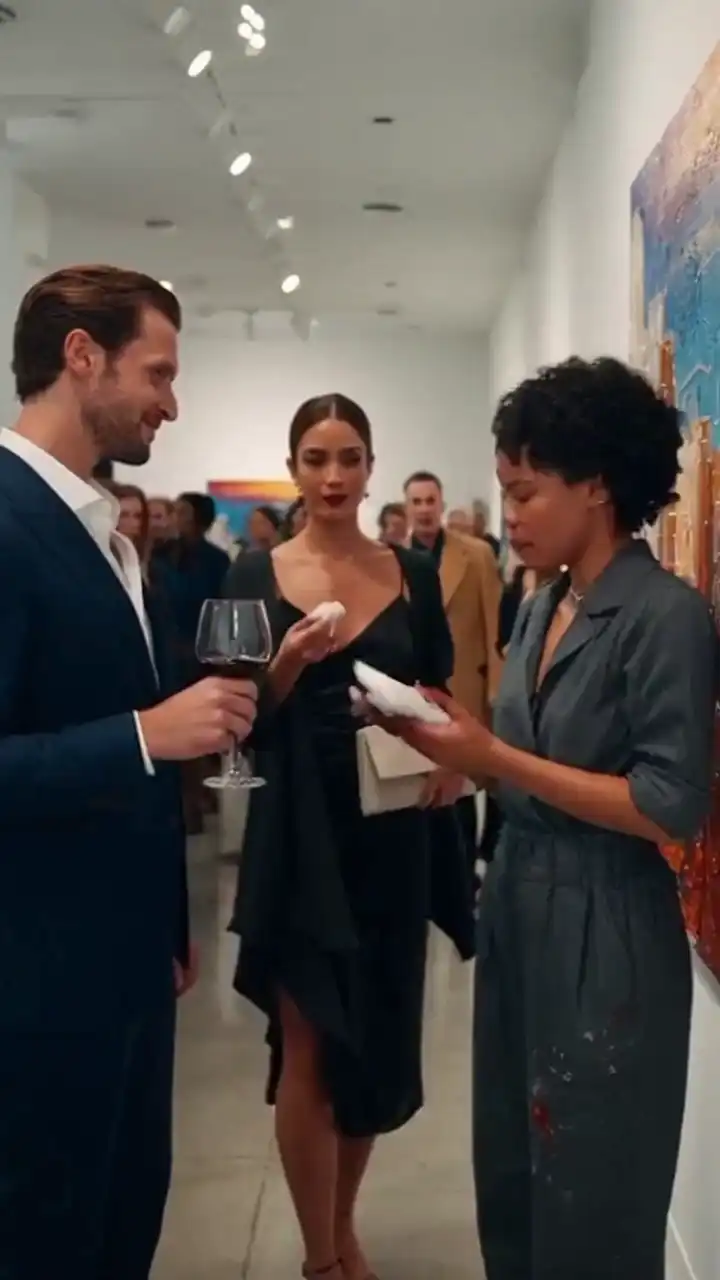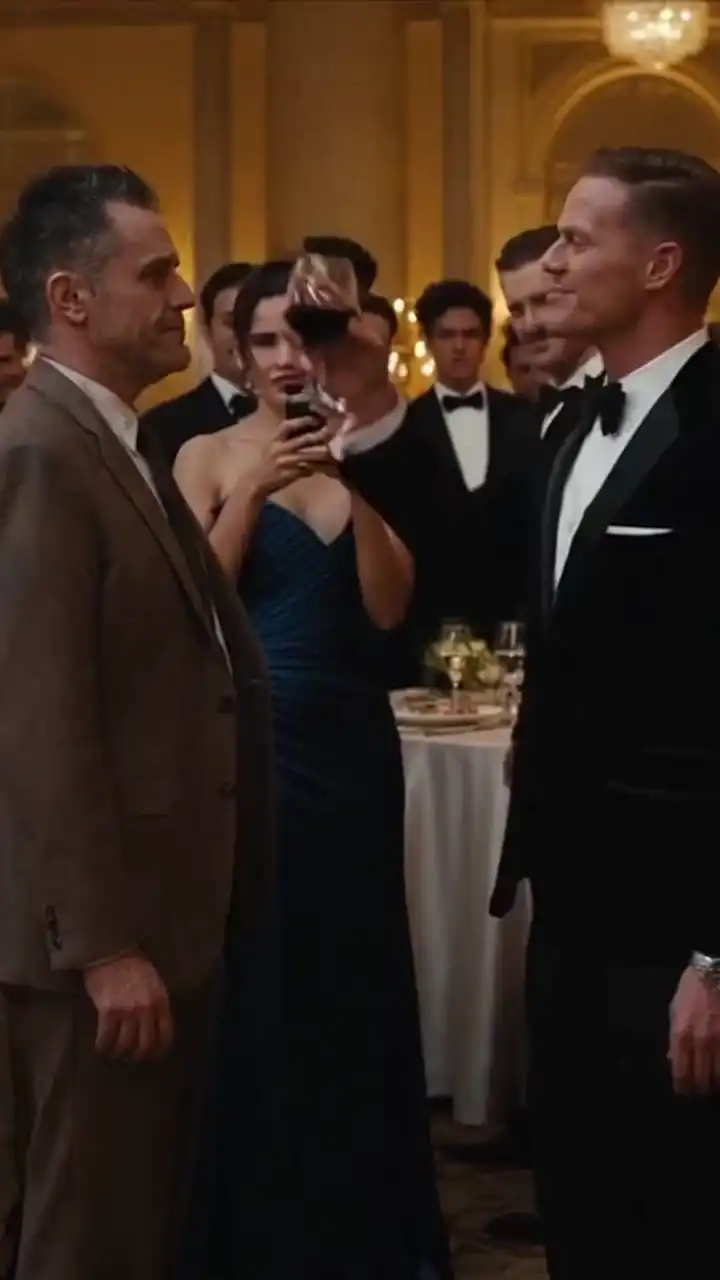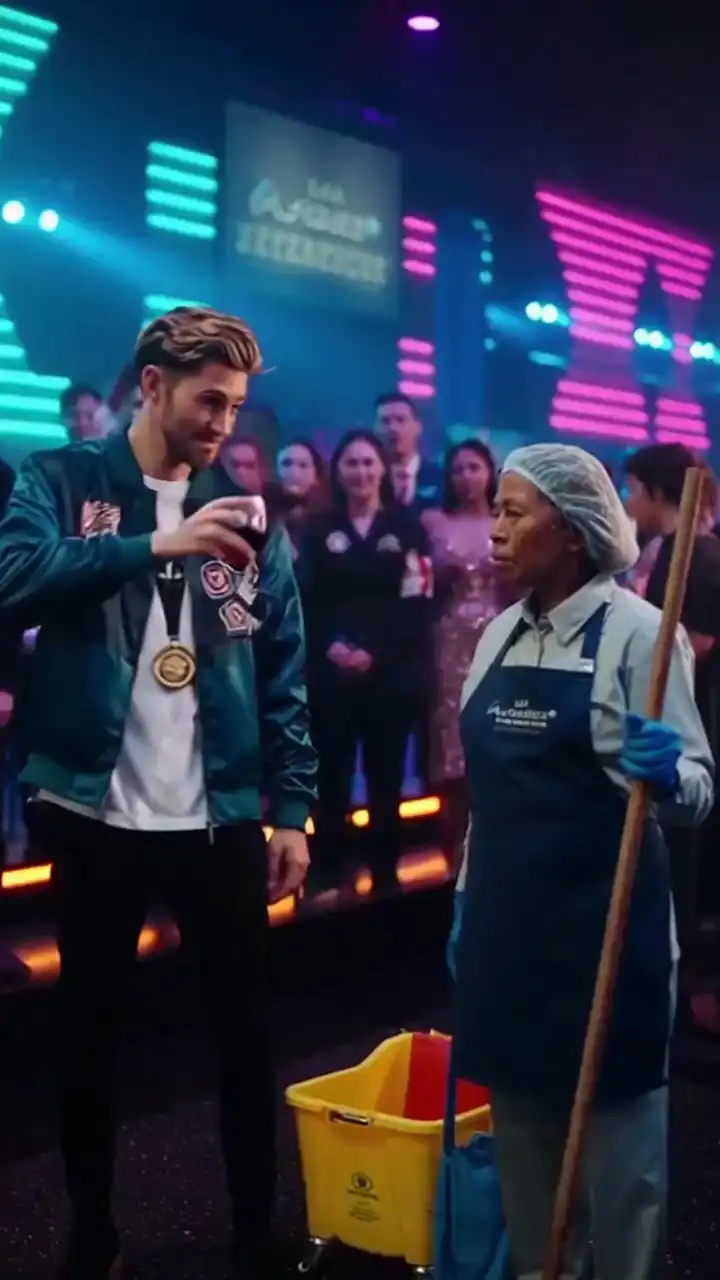
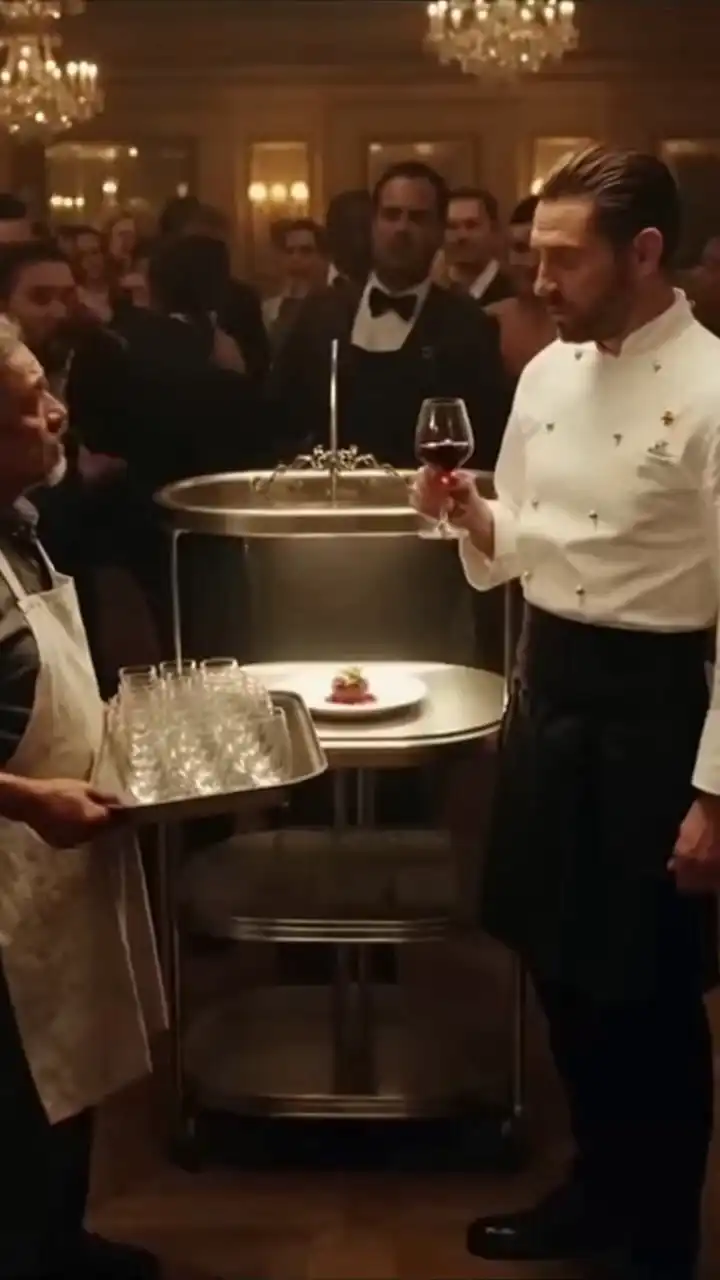
MICHELIN MONSTER FELL TO HIS KNEES WHEN THE “DISHWASHER” OPENED THE FILE
The room went still enough for me to hear the soft tick of the brass clock above the bar.
Adrian stared at the plastic sleeve in my hand, then at the three things I had placed beside his silver cart: a shallot, a thumb of ginger, and a small brown bottle with no label.
For one second, he tried to laugh.
“Is this a joke?” he said, too loudly. “You think you can walk into my dining room dressed like a janitor and perform for my guests?”
I set the tray of glasses down carefully.
“No,” I said. “I think you’ve already done enough performing.”
A few people shifted in their seats. The young cook with the phone lowered it, then raised it again, unsure which instinct would save him.
Adrian’s sous-chef, Marco, stepped forward first. “Chef, say the word and I’ll have security throw him out.”
“You should,” I said, looking at him. “Before they ask why Beaumont House has been serving industrial truffle essence as black truffle reduction for eleven months.”
Marco froze.
Not because of me.
Because he knew the number was right.
A murmur passed through the room like a draft under a door.
Adrian’s face hardened. “You’re insane.”
“Am I?”
I slid the grease-stained page from the plastic and laid it flat on the cart beside his signature dish. Butter had yellowed the edges decades ago. The paper was lined, torn from an old kitchen ledger. At the top, in dark blue ink, were the words:
Beaumont Duck in Black Winter Glaze November 14, 1987
Below it were measurements. Temperatures. Notes in the margins.
And one name written at the bottom in a hand Adrian knew better than his own.
Henri Beaumont.
His father.
Not him.
Adrian didn’t touch the page.
He looked at it the way men look at coffins.
“That proves nothing,” he said.
“It proves your father wrote the original dish when you were nine.” I tapped the lower right corner. “And this notation here? ‘For N., if the boy ever returns.’”
I heard the owner suck in a breath.
Adrian’s expression broke for half a second. “You’re lying.”
“No. But you did. Repeatedly. In interviews. In your book. On camera. You said you created the dish at twenty-three after backpacking through Lyon.”
One of the guests at table twelve—a food columnist with silver hair and a pearl-gray suit—slowly reached for her phone with both hands now, no longer hiding it under the table.
I picked up the shallot.
“Your father’s glaze was balanced with shallot.”
Then the ginger.
“You changed it after he died because your palate was never refined enough for his finish, so you pushed heat where you couldn’t build depth.”
Then the bottle.
“And this is what turned fraud into poison.”
The bottle looked ordinary. Brown glass. Metal cap. Cheap. The kind nobody notices in a storeroom unless they know what they’re looking for.
Adrian’s voice came out rough. “Don’t open that.”
That landed harder than any confession.
I unscrewed the cap anyway. A sharp artificial aroma cut through butter, duck fat, and expensive perfume. Not truffle. Not wine. Solvent. Bitter almond. Chemical sweetness.
Half the room recoiled.
I held the bottle toward the owner. “Taste the air.”
Victor Hale had spent the last ten minutes pretending the floor was fascinating. Now he had no floor left to study. He stepped closer, nostrils flaring once, and color drained from his face.
“What is that?” he whispered.
“Synthetic flavor concentrate cut with an unapproved preservative,” I said. “Imported under a false label. Stored in the dry pantry behind the veal stock.”
Marco’s head snapped toward Adrian. “Chef—”
“Shut up,” Adrian hissed.
There it was.
Denial cracking into verification.
I reached into my apron again and took out a second plastic sleeve. Inside were printed invoices, customs declarations, and three close-up photographs I had taken that morning: the bottle case, the relabeled cartons, the lot number stamped under adhesive tape.
Victor grabbed the papers before Adrian could.
His eyes raced line by line.
“Lot 4C-118…” he read. Then he looked at the bottle in my hand. Same number. Same smudged black stamp near the base.
The silence changed shape after that. It was no longer entertainment.
It was fear.
“You planted this,” Adrian said, but his voice had gone thin. “This old man has been snooping for days. He planted it.”
The young cook filming—Eli, twenty-two, too eager to laugh when the powerful laughed—spoke before he could stop himself. “No, chef.”
Every head turned to him.
He swallowed hard. “I saw the cases come in. You told me not to log them with the regular inventory. You said special suppliers didn’t like paper trails.”
Adrian stared at him like betrayal had no right to come from someone he never respected.
Eli’s hand shook so badly the phone rattled against his rings. “I thought it was tax stuff. I didn’t know—”
“You didn’t ask,” I said quietly.
His eyes dropped.
At the back, the owner’s assistant, Lydia—the one who had looked away when the wine hit me—pressed a hand over her mouth. “There were complaints,” she said. “In February. Two guests got sick after the winter tasting. Adrian told me to send flowers and mark it as shellfish sensitivity.”
Victor turned so fast his chair clipped the tile. “What complaints?”
Lydia flinched. “Three reports total. One urgent care visit. I forwarded them to Adrian. He said legal had handled it.”
“Because they weren’t allergies,” I said. “They were reactions.”
I set the bottle down next to the dish as if it belonged there. In a way, it did.
Adrian was sweating now, though the dining room was cold. “You can’t prove any of this in public with scraps of paper and a pantry bottle.”
“No,” I said. “But the Department of Health can. And so can the lab uptown that already has your sauce sample.”
That did it.
The dawning horror arrived so visibly it seemed to pass over his skin. His jaw slackened. His pupils widened. He looked at the door, the kitchen, the guests, the bottle, the page, like every exit in his mind had suddenly bricked shut.
“You sent it out?” he said.
“This afternoon.”
Marco took one slow step away from him.
Then another.
“Chef,” he said carefully, “you told us that reduction came from Perigord stock.”
Adrian rounded on him. “And you believed me because you wanted this kitchen on your résumé.”
Marco said nothing.
Because yes, he had.
The columnist in gray stood up. “Mr. Hale,” she said, voice crisp as glass, “if this is accurate, your establishment has committed fraud on investors, diners, and the Michelin guide. I’d advise you to stop treating this as a private embarrassment.”
Victor looked like he might be sick.
He turned the invoices over, found the shell company names, then looked back at me. “Who are you?”
It was the first honest question anyone had asked me all night.
I took off the stained apron.
Under it was the dark charcoal suit I had worn into the building before changing downstairs. My cuffs were plain. My tie was plain. Nothing theatrical. Just clean lines and expensive wool the room knew how to respect.
“I’m Nathan Vale,” I said. “Henri Beaumont’s former apprentice.”
Adrian made a strangled sound.
I kept my eyes on Victor. “I was there in 1987. I wrote half the prep notes on that page while your chef’s father tested the glaze for winter service. When Henri got sick, I ran his kitchen for six months. When he died, his journals disappeared.”
I looked at Adrian then.
“You sold his work as your own and called it legacy.”
The owner’s lips parted. “Nathan Vale is dead.”
“That would’ve been more convenient for him,” I said.
A nervous laugh escaped no one.
Victor blinked. “The Vale? Vale of Saint Laurent? The consulting group?”
“Mine.”
The room absorbed that in pieces.
Not just a dishwasher.
Not just a witness.
The man whose quiet acquisitions had reshaped half the fine-dining world without his face ever appearing on magazine covers.
The silver-haired columnist sat down very slowly, like even she understood the center of gravity had moved.
Adrian tried one last reach for arrogance. “So that’s what this is. Revenge. You hide in my scullery for a week, then stage a scene because you’re bitter an old recipe evolved without you?”
I almost pitied him for choosing that hill.
“Evolved?” I said. “You swapped duck stock for concentrate, black truffle for essence, and discipline for branding. Your father built flavor. You built a lie expensive enough to photograph.”
Victor’s phone rang.
He looked at the screen and went ash white.
Then he answered on speaker by accident, fingers slipping. A woman’s voice filled the room.
“Mr. Hale, this is Marianne from Michelin North America. We’ve received urgent documentation regarding ingredient misrepresentation and potential health code violations at Beaumont House. Effective immediately, your stars are under formal review pending inspection.”
No one breathed.
Victor lowered the phone with a hand that no longer seemed attached to him.
Adrian whispered, “No.”
Not angry now.
Not commanding.
Just small.
Lydia began to cry silently. Eli stopped recording and stared at the black screen as if he hated what he had caught too late. Marco removed his white jacket, folded it once, and laid it on the nearest chair. He didn’t look at Adrian when he did it.
Victor found his voice by force. “Adrian Beaumont, you are suspended from this kitchen effective now.”
“You can’t do that.”
“I can.”
“You need me.”
Victor looked down at the page from 1987, at Henri’s handwriting, at the bottle, at the invoices, at the guests already typing messages that would outrun every denial by midnight.
“No,” he said. “I really don’t.”
Adrian turned to the room, desperate now for one ally, one laugh, one familiar nod that could restore the old order.
There was nothing.
Only faces pulling away from him.
Phones no longer raised for entertainment, but evidence.
He looked back at me and finally understood the full cost. The stars. The investors. The interviews. The cookbook sales. The invitations. The carefully polished mythology of Adrian Beaumont, genius chef.
Gone not because I destroyed it.
Because truth touched it.
His knees hit the floor hard enough to echo.
Not dramatic.
Not cinematic.
Just human bone giving out under too much weight.
“Please,” he said, and it was unclear whether he was speaking to Victor, to the room, or to the ghost of his father.
I folded Henri’s page and slipped it back into plastic.
“It belonged to a man who cooked with honor,” I said. “You don’t get to stain it again.”
Nobody laughed when I walked toward the door.
Lydia moved aside first, eyes red, whispering, “I’m sorry.”
Eli stepped back next, phone hanging useless at his side. “Mr. Vale… I should’ve said something.”
“Yes,” I said.
Then I kept going.
At the threshold, I paused long enough to untie the apron strings and leave the wine-streaked cloth on the host stand.
Outside, the city air was cold and clean.
Behind me, Beaumont House was still lit like a palace.
But when the door shut, it sounded like a kitchen finally going dark.
Disclaimer: Mention of any brand or trademark is for identification only and does not imply partnership or endorsement