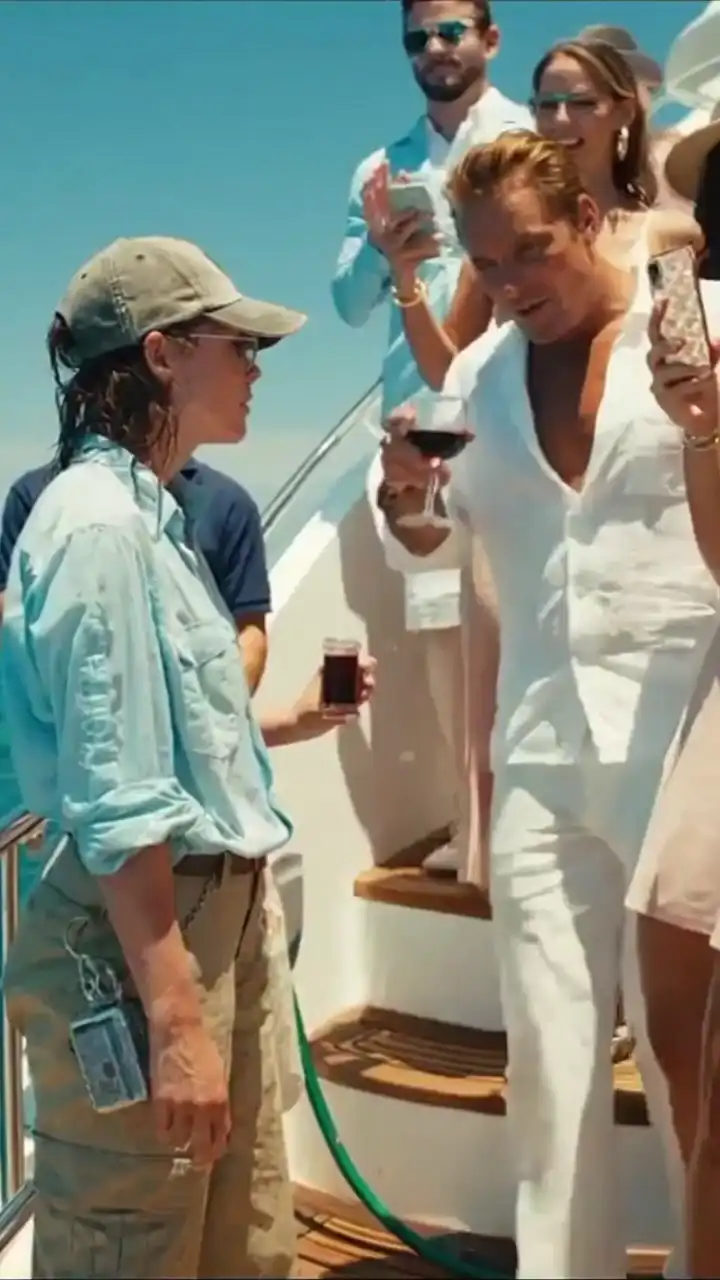

HE POURED WINE ON THE ONE MAN WHO COULD BURY HIS ENTIRE EMPIRE
The two men in dark suits moved with the kind of quiet that made people step aside before they were asked. One went straight to the display table. The other stopped beside me and held up a leather wallet with a silver crest inside.
Metropolitan Police Art and Antiques Unit.
The phones that had been raised for entertainment stayed raised for a very different reason.
Leonard let out a brittle laugh. “This is absurd. Whoever you are, you can’t just interrupt a private sale because a maintenance man found a scratch.”
“It isn’t a scratch,” I said.
My voice carried farther than his.
Maybe because I wasn’t trying to force it.
The beam from my pen still lay across the porcelain vase, catching the hidden line of modern transfer print beneath the glaze. Up close, the letters were impossible to miss now that everyone knew where to look: HARTWELL RESTORATION WAREHOUSE, LOT 47-B. Beneath it, a serial code. Machine-stamped. Straight. Cold. Young.
Not imperial.
Not ancient.
Not priceless.
Just well-aged fraud.
The art expert near Leonard took one step back, then another, as though distance could erase his own words from ten minutes earlier. “There must be some explanation,” he said, but even he didn’t sound like he believed it.
“There is,” I replied. “Forgery, false provenance, insurance inflation, and attempted sale under fraudulent authentication.”
A woman in emerald silk near the front covered her mouth. She had been the first to laugh when Leonard snapped his fingers in my face. Her phone was still recording, but now her hand trembled so hard the screen shook.
Leonard looked around the room for support and found only lenses.
“You’re insane,” he said. “Security!”
No one moved.
The younger waiter who had whispered about the pen lowered his tray and stared at me like he was seeing an entirely different person. He’d looked sorry earlier. Now he looked ashamed.
The officer at the table pulled on gloves and bent over the vase. “Visible under ultraviolet. Modern alphanumeric mark consistent with catalog storage.” He glanced at his partner. “Bag it.”
Leonard’s color drained in a second stage now, not shock but resistance giving way under pressure. “You can’t seize that. It belongs to Halbrecht Auctions.”
“It belongs in evidence,” the officer said.
The room made a small sound then. Not a gasp. Something uglier. The sound money makes when it realizes it has been made foolish.
I took a clean handkerchief from my pocket and wiped wine from my fingers. “Would you like me to continue, Mr. Pierce?”
He stared at me. The wine on my uniform had started to dry, sticky against the fabric. The smell of it—sweet, cheap, aggressive—rose between us.
“Who are you?” he asked.
There it was.
Not outrage. Not mockery.
Fear finally finding the right door.
I reached inside my jacket this time, not the cleaner’s outer coat, but the inner lining beneath it, and removed a flat identification case. I opened it in front of him, then turned it so the nearest guests could see.
Edmund Vale. Senior Field Investigator. International Council for Stolen Art and Cultural Property.
A murmur rolled through the ballroom like distant thunder.
The famous expert actually closed his eyes.
Leonard read the name once. Then again. I watched recognition arrive in pieces. The articles. The court testimony. The recoveries in Florence, Madrid, New York. The private nickname the press had given me years ago after three museum directors and a shipping magnate went to prison.
The Silent Hammer.
His lips parted.
“You’re supposed to be—”
“Deaf?” I said.
No one breathed.
“I let your staff believe what they wished. People reveal themselves quickly when they think a man cannot hear them. Faster still when they think he cannot answer.”
Behind Leonard, Lady Amelia Crowne slowly lowered her champagne flute. In Part 1 she had smiled while filming, amused by the spectacle. Now she turned her screen around, looked at the replay of Leonard emptying wine over my chest, and her face changed. Not compassion. Calculation. She understood scandal when she saw it.
“You said the provenance was flawless,” she said sharply to Leonard.
“It is,” he snapped, grateful for anything that wasn’t me. “Or it was presented to me that way. I was misled.”
The expert’s head jerked up. “Misled? Leonard, I signed what your office gave me after your team—”
“Careful,” I said.
Both men went silent.
I nodded toward the officer, who had moved to the sideboard and lifted a leather folio from beneath a stack of catalogues. “Open that.”
Inside were copies of transfer documents, customs declarations, a restoration invoice, and one sheet Leonard clearly had not expected anyone outside his office to read tonight.
The officer held it by one corner. “Email printout. Internal authorization to alter chain-of-custody records.”
The date was from six weeks earlier.
Leonard lunged forward. “That was confidential—”
The second officer stepped into his path so smoothly Leonard nearly collided with him.
“Read the signature line,” I said.
The officer did.
“Authorized by Leonard Pierce, General Manager.”
No one bothered whispering anymore.
The emerald-silk woman lowered her phone altogether. “Oh my God.”
The younger waiter looked at Leonard with open disgust.
And then came the bystander I had been waiting for. The porter from the entrance, Martin, broad-shouldered, red-faced, the one who had looked away when Leonard mocked me near the coat room. He pushed through two guests and swallowed hard.
“I saw him,” Martin said, voice rough. “Three nights ago. Mr. Pierce. He had the crate brought in after midnight. Told us the registry labels were wrong and made us peel them off.” He looked at the officers, then at me. “I should’ve said something.”
Leonard rounded on him. “You stupid little—”
“Don’t,” I said softly.
He stopped.
That was the moment he understood his authority in the room was gone.
Not reduced.
Gone.
The expert sank into a chair as if his knees had dissolved. “I never examined the base under ultraviolet,” he muttered. “He rushed the authentication. Said the seller wanted urgency.” His eyes lifted to me, wet and horrified. “I knew some of the papers were too clean. I knew it.”
“Yes,” I said. “You did.”
Denial had left him. What remained was the thin, miserable shape of a conscience arriving too late.
One of the billionaire bidders, a steel-haired American named Ross Bennett, strode to the table and jabbed a finger at the catalog listing. “I wired a ten percent pre-bid deposit this afternoon.”
“So did I,” said another.
“And I,” Lady Amelia said, voice now ice.
Leonard turned in a slow circle, trying to find one friendly face. There were none left. Only anger, embarrassment, greed turned inward. He tugged at his collar like it had tightened around his throat.
“This can be fixed,” he said. “A misunderstanding, that’s all. We can correct the paperwork, reimburse any deposits—”
“With what accounts?” I asked.
He froze.
I let that sit there before reaching into the supply cart beside me. Beneath folded rags and polish bottles was a small evidence scanner no cleaner would ever carry. I set it on the table and pressed a key. A sequence of shipping manifests appeared on its screen, then mirrored to the ballroom monitor Leonard had used earlier to boast about the evening’s lots.
Gasps this time.
Real ones.
Row after row of entries. Seven pieces sold in the last eighteen months under altered identities. Two currently listed in private collections. One flagged by Interpol in Antwerp. Another under insurance dispute in Geneva.
Leonard’s voice came out thin. “Where did you get that?”
“From your office,” I said. “While you were teaching your staff how little dignity costs.”
The waiter nearest the dais barked out a shocked laugh before clapping a hand over his mouth.
Lady Amelia took one step away from Leonard, as if fraud were contagious. “You used us,” she said. “You paraded us into a criminal sale.”
“No,” Leonard said quickly. “No, I can explain.”
But verification was over. Horror had arrived.
He saw the officers bagging the vase.
He saw Martin speaking to another detective at the door.
He saw the art expert refusing to meet his eyes.
He saw half the room sending messages to lawyers, bankers, assistants, journalists.
And worst of all, he saw the screens. Dozens of them. Every angle of the wine. Every word. Every second of his own cruelty preserved in perfect high definition.
The officer beside me nodded once. “Leonard Pierce, you are being detained on suspicion of fraud, conspiracy, falsification of provenance records, and trafficking of stolen cultural property. You do not have to say anything—”
Leonard backed up so fast his polished heel slipped on the wine he had poured on me. He grabbed the edge of the display, missed, and hit one knee hard against the marble floor.
A stain spread dark beneath him.
For one strange second, no one moved.
Then the room filled with the tiny mechanical sounds of people lowering cameras to get a better shot.
He looked up at me from the floor, breathing fast, the last scraps of arrogance hanging off him like torn silk. “You set me up.”
I considered him.
“No,” I said. “I gave you an ordinary evening. You chose the rest.”
The officers lifted him by the arms. He didn’t fight then. Men like Leonard never truly believe consequences exist until they feel another hand deciding where they stand.
As they led him toward the doors, he twisted once more toward the crowd. “Turn those off,” he shouted. “All of you, turn those off!”
Not one person did.
The expert covered his face.
Martin stepped aside to let them pass, but before Leonard crossed the threshold, the young waiter quietly took the white towel from my cart and offered it to me with both hands.
“I’m sorry, sir,” he said.
I accepted it with a nod. “Next time, don’t stay silent.”
He swallowed and straightened. “I won’t.”
The ballroom had changed smell by then. Less perfume and candlewax. More sweat, fear, old dust disturbed from hidden places. The auction house no longer felt grand. It felt searched.
One of the officers asked if I wanted a statement room.
“In a moment,” I said.
I removed the stained cleaner’s coat and laid it neatly over the back of a chair. Under it, my charcoal suit was still crisp. The room noticed. Of course it did. But no one said a word.
They only watched.
Not because they cared.
Because now they understood.
I picked up my pen from the table, capped it, and slipped it into my pocket. Then I walked past the shattered little empire Leonard had built out of paper, polish, and other people’s silence.
No one tried to stop me.
By the time the doors closed behind me, the wine on my shirt had begun to dry, but the night air was clean.
Disclaimer: Mention of any brand or trademark is for identification only and does not imply partnership or endorsement