SHE STOLE MY DRESS, SO I LET THE WORLD WATCH HER FALL APART IN SILK
The first letter bloomed through the white silk like blood rising through snow.
A.
The planner frowned and lowered the dryer, but I lifted one finger. “No. Keep going.”
The air hummed hot over the hem. Another letter surfaced, then another, neat crimson thread-dark marks spreading under the outer layer exactly where I had hidden them between silk and organza.
Property of A—
A sound moved through the guests, small at first. A rustle. A swallowed laugh that died halfway out. Phones tilted lower, then higher again as people realized they were no longer filming a perfect wedding. They were filming evidence.
The bride jerked her skirt back with both hands. “Turn that off.”
The planner looked at her, then at me, then at the cameras still pointed from every angle. For the first time all afternoon, no one seemed sure who was in charge.
“Keep it on the hem,” I said.
The planner obeyed.
The full line emerged in a clean arc around the inner border of the gown.
PROPERTY OF ATELIER MARROW — ARCHIVE SAMPLE — NOT FOR RESALE
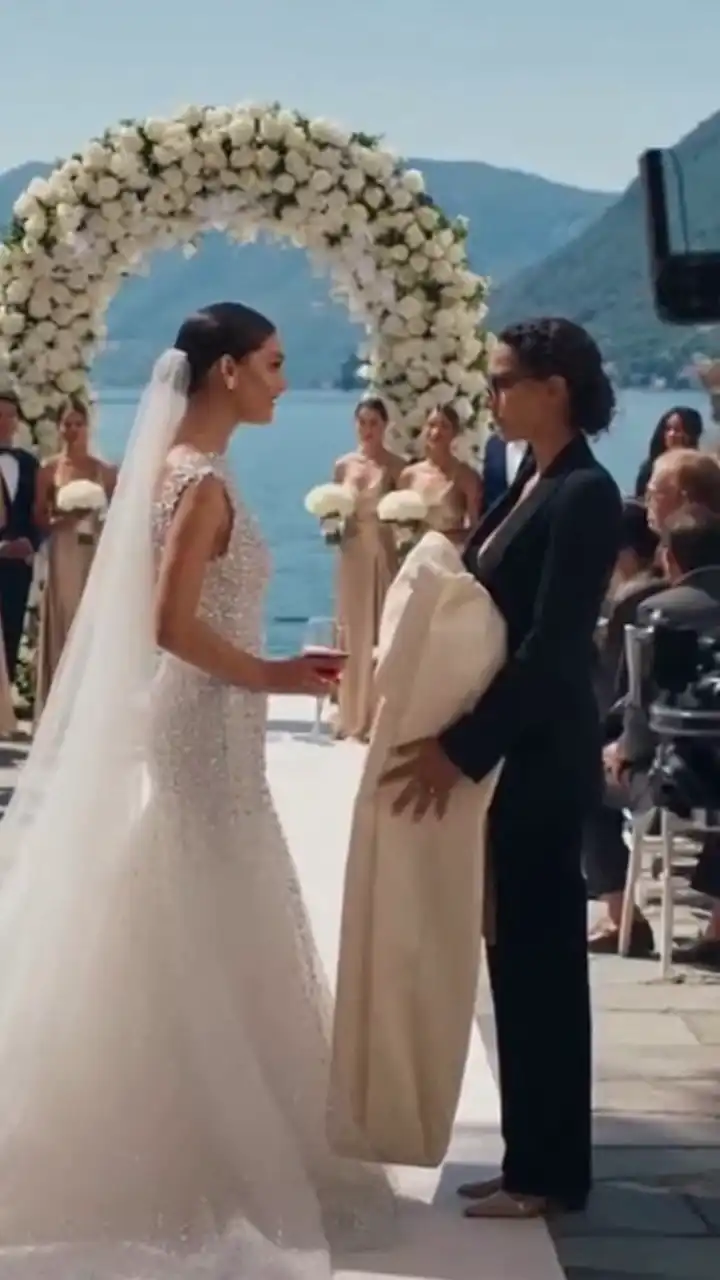
Silence crashed down so hard I could hear the lake water beyond the terrace.
The luxury magazine host, who had been smiling into her mic all day, blinked twice. “Cut—” she whispered, but no one cut anything. Livestream comments were already exploding across the monitor near the floral wall. I saw them flash by in frantic bursts.
She stole it? Archive sample? What is happening?
The bride let out a laugh that was too sharp, too fast. “That means nothing. It’s a sample marking. All couture houses do that.”
“No,” I said. My voice came out calm, almost gentle. “They don’t.”
Her eyes snapped to mine.
I set the garment bag down on an empty chair and reached inside my coat. The badge came out first. Gold edge. Black leather. The kind that made rich people suddenly remember rules existed.
I held it where the planner, the groom, and the nearest cameras could see.
“Amelia Marrow,” I said. “Founder and creative director of Atelier Marrow. Registered design holder for that gown and every pattern draft derived from it.”
The bride’s face emptied.
One of the bridesmaids—the blonde one who had called me a sewing girl—actually scoffed. “That’s insane. If you were the designer, why were you hemming dresses yourself?”
I looked at her. “Because my first fitting is always done by my own hands.”
That shut her up.
The groom finally stepped forward. “There has to be some misunderstanding.”
“There isn’t.” I pulled the folded document from inside the garment bag and opened it carefully. The old deed paper was cream-colored, sealed in plastic, the date stamped in dark ink. “And since your father insisted on calling in the tractors to clear the east field tomorrow morning, we should settle this too.”
His father was already on the ground where he had stumbled earlier, one hand braced against the stone. Two men had helped him upright onto a low chair, but he still looked as if the air had gone thin.
I turned the paper so he could see it.
“Transfer deed. Cascina Bellombra. Signed by Enzo Bellombra in 1987. Controlling acreage, vineyard rights, and lakeside access road included. It transferred to Marrow Holdings after your father defaulted on the final development loan.”
His mouth opened.
Nothing came out.
I continued anyway. “The field with the olive rows? Mine. The service lane your equipment came through? Mine. The terrace you built this temporary extension over?” I let the paper lower an inch. “Also mine.”
The wedding planner’s hand flew to her throat.
The groom’s father stared at the seal as if he could burn through it by force. “That is not possible.”
“It was filed in Como and mirrored in Milan,” I said. “You challenged it once. You lost.”
He looked at his attorney.
Only then did everyone seem to remember the gray-suited man near the back, the one who had been smiling into his champagne all day. He took the deed with shaking fingers, scanned the date, the parcel numbers, the registry stamp.
His expression changed in stages. Professional annoyance. Concentration. Recognition.
Then fear.
He cleared his throat and tried again when no sound came. “It’s authentic.”
The bride spun toward him. “Authentic how?”
“Authentic,” he repeated, quieter now.
She stared at him as if betrayal had just put on a tie and answered in legal language.
“No,” she said. “No, that’s ridiculous. We bought this venue block for the week.”
“You rented usage,” I said. “From a hospitality group that leases event rights. They do not own the land under the east terrace or the field your in-laws ordered torn for helicopter staging.”
The groom looked at his father. “You told me that was approved.”
His father wiped sweat from his upper lip. “It was being handled.”
“It was not,” I said.
The magazine host lowered her mic. “Ms. Marrow… are you saying the bride is wearing a stolen gown and this wedding is taking place over unauthorized land use?”
“I’m saying,” I replied, “that three months ago my archive sample disappeared during a private fitting in New York. We filed the report quietly because I wanted to know where it would surface. Then your magazine announced a visionary bride who designed a silhouette built from a pattern only twelve people in my atelier had ever seen.”
I looked at the bride’s bodice, at the hand-finished boning, at the pearl tack points she had claimed in an interview were inspired by moonlight.
“I knew the dress before she stepped into it.”
The groom turned slowly toward her. “You told me it was your sketch.”
Her lips parted. “It was inspired by—”
“By my work,” I said.
One of the guests, an older woman in emerald silk who had laughed the loudest when the wine hit my face, abruptly set down her glass. “I told you this looked familiar,” she muttered to no one, suddenly desperate to revise history.
And the brunette bridesmaid with the phone—the one who had been filming me from inches away while smiling—lowered it at last. Her mascara had begun to crease. “Should I stop the live?”
The magazine host gave a broken laugh. “A little late for that.”
Comments were now flashing too fast to read. The producer near the camera had gone pale.
The bride gathered her skirt with both fists, trying to hide the lettering, but every movement only showed more of it. The words circled her like a sentence.
“This is harassment,” she said. “You can’t ambush me on my wedding day.”
“You invited me,” I said.
That landed harder than anything else.
I watched the memory strike the room. The printed name on the seating card she had mocked. The vendor badge she’d approved because she wanted one more body to command around. She had wanted me close enough to witness her triumph. She just hadn’t recognized the woman she stole from once the glasses and plain black dress made me useful.
The groom looked sick now. “Did you know who she was?”
The bride didn’t answer.
He took one step back from her.
Then another.
His mother, who had said nothing all day, finally spoke from beside the arch. “Answer him.”
The bride’s voice dropped to a whisper. “I thought she wouldn’t come.”
“I almost didn’t.”
The truth of that sat between us.
I reached into the garment bag one last time and withdrew the invoice copy and police claim receipt. I handed both to the attorney. “The theft report. The atelier valuation. And a preservation notice for every image, recording, and publication using my design without authorization.”
The attorney took them as if they might explode.
The groom’s father made one final attempt at posture. “Whatever sum this is, we can settle it privately.”
“No,” I said.
Not loudly. Not dramatically. Just no.
His shoulders sagged. That was the moment the fight went out of him.
Behind him, the blonde bridesmaid had started crying in the thin, embarrassed way of someone who finally understood that cruelty looked glamorous only before consequences arrived. The brunette with the phone walked over to me, not meeting my eyes, and held out a monogrammed silk napkin.
“For the wine,” she murmured.
I didn’t take it.
Across the terrace, the older woman in emerald silk was already speaking in a hiss to two other guests. “Delete the clip where I laughed,” she said, forgetting microphones still carried farther than pride.
The planner approached me with both hands visible, like I was a bomb technician and she needed permission to breathe. “Ms. Marrow… how would you like to proceed?”
I glanced at the florals, the imported chairs, the arch framing a lake too beautiful to care about any of us.
“Take down the extension over my terrace,” I said. “Cancel the field equipment. And before anyone leaves, I want that dress documented by my team.”
The bride looked at the groom, expecting rescue one last time.
He didn’t move.
He was staring at the red letters around her hem as if they had answered every question he had never thought to ask.
For a second, I almost felt sorry for her. Not because she was exposed, but because she still believed humiliation was the worst thing in the world.
It wasn’t.
Being seen clearly was worse.
I picked up my garment bag from the chair.
As I passed the arch, the bride spoke behind me, her voice cracked raw now. “Please.”
I paused, but I didn’t turn around.
Not because I wanted more from her.
Because there was nothing left to hear.
My driver opened the path through the side gate while camera crews shouted my name and the lake wind lifted the last damp strands of hair from my cheek. Somewhere behind me, the wedding had become an argument, then a negotiation, then a ruin.
I stepped onto the stone path in my black shoes, wine drying on my skin, and left them with the dress they had chosen.
Disclaimer: Mention of any brand or trademark is for identification only and does not imply partnership or endorsement