WHEN THE “POOR NURSE” LIFTED HER BOUQUET, THE BILLIONAIRE AT THE HEAD TABLE ENDED THE WEDDING WITH SIX WORDS
“Take your hands off this land.”
His voice was not loud.
It did not need to be.
The musicians stopped first. Then the servers. Even the lake breeze seemed to go still as every face turned toward the head table. He rose slowly, one palm resting on the polished wood of his cane, the other extended toward me.
My father was already on the gravel path beside the rose hedge, one knee down where security had shoved him when he tried to reach me. His old jacket was dusty at the shoulder. In his hand, raised so tightly his knuckles had gone white, was the deed folder he had brought because I had begged him not to leave it in the car.
And in my other hand, hidden beneath the ruined bouquet ribbons, was the badge.
Not a trinket. Not a sentimental token.
A hospital board credential in brushed steel with a magnetic strip and my full name engraved beneath a second line very few people in that garden had ever seen.
EXECUTIVE DIRECTOR, VALENTI FOUNDATION MEDICAL NETWORK.
My mother-in-law blinked at it once, then twice, like her eyes refused to understand what they were seeing.
“That’s absurd,” she said, but her voice had lost its shape. “What game is this?”
The old man at the head table looked at her the way surgeons look at a monitor when the numbers have already told them the patient is crashing.
“No game, Lucia,” he said. “Only paperwork. The kind your family should have read before humiliating the woman who signed it.”
A murmur ripped through the guests.
My fiancé—still in his tailored tuxedo, still holding the champagne flute he had never put down—finally moved. “Nonno…”
“Don’t,” the old man said without looking at him. “Not one word until you decide whether you are a man or upholstery.”
That landed harder than the wine had.
A few people actually gasped.
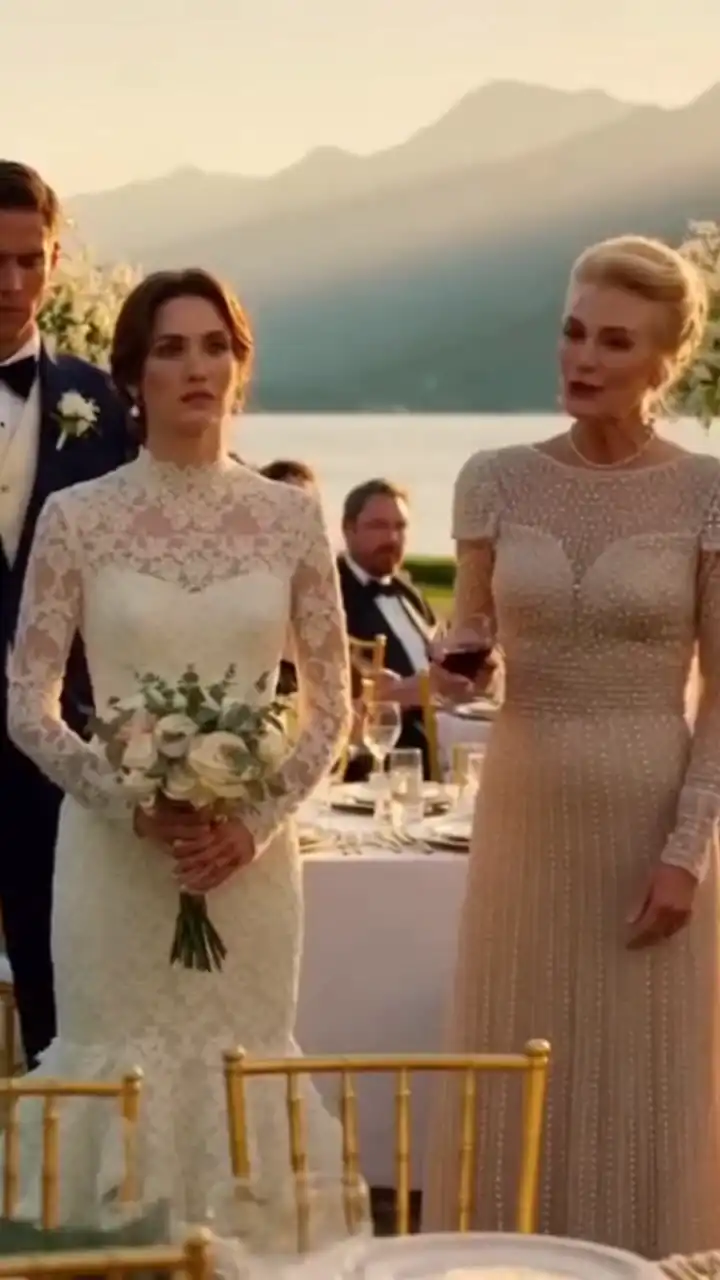
I stepped forward before anyone could touch me again. Wet silk clung cold against my skin. The scent of red wine and gardenias rose off my dress in sour waves. I could feel 180 pairs of eyes waiting for me to either break apart or beg.
I did neither.
I looked at the security guard pinning my father there and said, “Help him up.”
He hesitated.
The old man turned his head an inch. “Now.”
The guard let go so fast he nearly stumbled. My father stood, slower, angrier, brushing dirt from his sleeve with the same stubborn dignity he had worn his whole life. He didn’t speak. He only came to stand beside me and put the deed folder in my hand.
Lucia’s lipstick had gone chalky at the edges. “This is ridiculous. Whatever that pin says, she is a nurse.”
“I am,” I said.
My voice was calm enough to make her flinch.
“I was the charge nurse in Saint Catherine’s emergency wing the night Mr. Valenti coded after your driver brought him in. Fourteen minutes without stable rhythm. A torn aorta. Three surgeons trapped in a storm delay. I kept him alive long enough for them to open his chest.”
No one laughed now.
I lifted the silver pin from my bouquet. Tiny. Tarnished. Ordinary, unless you knew what it meant.
“He gave me this the day he walked again. Then, three years later, when his foundation acquired and rebuilt six failing regional hospitals, he asked me to help run them. Not because I was connected. Because I knew what broke on night shift when rich men slept and poor people still needed saving.”
At the head table, Mr. Valenti gave one brief nod.
The bridesmaid with the pearl clips—the one who had whispered in the dressing room—lowered her phone so quickly she almost dropped it. Her face had gone colorless. Beside her, the blond groomsman who had been filming me with a grin a few minutes earlier quietly tilted his screen down and locked it.
Lucia straightened, reaching for the version of herself that always worked in boardrooms. “Even if that were true, it has nothing to do with this wedding.”
“It has everything to do with this wedding,” Mr. Valenti said. “Because the vineyards, the dock permits, and the east parcel under your family hotel are no longer under your family’s control.”
He pointed with his cane toward the folder in my hands.
My father opened it. The paper inside was thick, cream-colored, stamped and notarized. I knew every crease in it. I had spent two weeks helping him organize the documents after the acquisition closed because he still distrusted anything he couldn’t hold in his own hands.
“This deed,” I said, sliding the top page free, “is recorded under Como Land Registry, parcel 11B through 11F. Date of transfer: three weeks ago. Seller: Belladonna Holdings. Buyer: Lakeview Preservation Trust.”
Lucia frowned. “What does that have to do with us?”
My father answered her this time, rough and steady. “Everything. Because the trust is mine.”
Silence.
Not social silence. Shock silence.
My husband-to-be stared at him as if he had started speaking a different language. “That’s impossible.”
“No,” I said. “It’s documented.”
I held up the second page. Attached was the lease agreement her family’s company had signed eleven years earlier, including the access road, service lane, and event ground where her imported white tractors—brought in that morning for some ridiculous countryside photo display—were now parked in a line near the olive trees.
The old man tapped his cane once.
“Your company defaulted on the redevelopment covenants two years ago,” he said. “The environmental penalties were buried, rolled over, and hidden behind shell entities. Belladonna sold before the enforcement action hit. The trust purchased the land clean. Your event permit became void the moment ownership changed and was challenged this afternoon.”
Lucia’s mouth opened.
Closed.
Then opened again. “No. No, that cannot be right. Our legal department would have seen—”
“They did,” I said. “Three notices were sent. One was signed for by your assistant. One by your hotel manager. The last was refused.”
My fiancé finally found his voice. “You did this?”
I looked at him.
Really looked at him.
At the man who heard me belittled in a dressing room and studied the floor. At the man who watched his mother pour wine over my body and waited to see which way the room would move before choosing a side.
“No,” I said. “You all did.”
His face changed then. First anger, because anger is easy. Then calculation, because calculation had always been easier for him than conscience. Then the first thin fracture of fear.
Mr. Valenti reached into his jacket and removed a folded letter. “And before you imagine this is only about property, let me save you time. As of 4 p.m. today, Valenti Foundation has suspended negotiations to refinance your family’s medical manufacturing arm.”
That hit the businessmen at the back harder than anything else.
I watched three of them exchange looks over half-finished drinks. One of Lucia’s country club friends, the woman in emerald silk who had laughed the loudest at the toast, slowly set down her glass and took a step away from her as if humiliation might spread by contact.
The blond groomsman cleared his throat. “Maybe we should all calm down—”
“You were filming,” I said.
He froze.
I held out my hand. “Give me your phone.”
For one stupid second, he seemed ready to refuse. Then he saw Mr. Valenti watching him and placed it in my palm like an offering. I opened the camera roll, found the clip of wine soaking through my dress while he chuckled behind the lens, and deleted it. Then I deleted the recently removed folder too.
The bridesmaid with the pearl clips swallowed. “I’m sorry,” she whispered.
It was the first true thing anyone in chiffon had said to me all day.
Lucia took a step toward me, all elegance gone now, leaving only panic in expensive fabric. “Listen to me. We can resolve this privately. Whatever misunderstanding—”
“There is no misunderstanding,” I said. “You thought a woman who works with her hands must be small enough to humiliate.”
She turned to my fiancé. “Say something.”
He did.
Not to her.
To me.
“I should have stopped her.”
The words came out thin, late, and useless.
The garden waited.
I remembered every exhausted morning I had defended him to myself. Every compromise dressed up as patience. Every silence I had translated into stress, pressure, family dynamics, anything but the truth.
And the truth was standing in front of me in patent leather shoes, asking for credit because he had finally noticed the building was on fire.
“You should have,” I said.
Nothing more.
Because nothing more was needed.
Across the lawn, staff had begun quietly shutting down the event. One of the tractor drivers was backing a machine away from the flower arch under orders from a municipal officer I hadn’t even seen arrive. The white ribbons tied to the chairs snapped in the wind. A server collected untouched slices of wedding cake as if clearing the remains of somebody else’s mistake.
Lucia looked suddenly older. Not softer. Just older. Her denial had burned off, leaving the bare mechanics of ruin behind her eyes as she understood the order of losses. First the land. Then the permits. Then the refinancing. Then the story that would travel faster than any statement her family could issue.
She looked at the stain on my dress.
Then at the badge.
Then at Mr. Valenti.
And finally at my father, who met her gaze without blinking.
Her shoulders dropped.
That was the moment she believed it.
The emerald-silk friend moved farther away. The blond groomsman would not look up. The bridesmaid with pearl clips took off her matching bracelet and twisted it so hard it snapped, beads scattering across the stones like tiny white teeth.
My father offered me his handkerchief.
I smiled a little and shook my head.
There was no point blotting out what everyone had already seen.
I set the bouquet down on the abandoned sweetheart table. Then I removed the ring from my finger and placed it beside the cake knife, neat and centered, as if finishing a task at the end of a shift.
No announcement followed.
No scene.
I turned to Mr. Valenti. “Thank you for coming.”
“It was an invitation worth honoring,” he said. His eyes dropped to the wine on the lace, and his voice gentled. “Cars are ready whenever you are.”
I nodded.
My father took my arm, not because I needed help walking, but because he knew some exits deserve witnesses. We moved down the garden path between rows of guests who suddenly found the gravel fascinating.
No one tried to stop me.
Behind us, I heard my former fiancé say my name once.
I kept walking until the lake air replaced the smell of spilled wine.
By the time I reached the gate, the dress was still ruined, the flowers were wilting, and my future felt cleaner than it had all morning.
Disclaimer: Mention of any brand or trademark is for identification only and does not imply partnership or endorsement