THE HOUSE WITH THE QUIET LIGHT
Beau Mercer sat alone in his study with the door locked, his forehead pressed into the heel of his hand as if he could push back the ache in his skull and the grief in his chest at the same time. Outside the tall windows, the Atlantic rolled in black and silver beyond the dunes, the beach grass bent low under the wind, and rain streaked across the glass in long slanted lines. The beach house in Seabrook, South Carolina, was big enough to host charity galas, business retreats, and summer parties for people whose last names appeared in financial magazines. Tonight it felt like a museum after closing.
The lamp on his desk cast a pool of amber over contracts, estate reports, and a framed photograph of his wife, Delaney, laughing with her head tipped back, one hand on the stroller where their son had once kicked at the sunlight. Beau had inherited old money and expanded it into something larger, cleaner, colder. Hotels. Shipping. Commercial real estate. People called him disciplined, visionary, impossible to rattle.
At two in the morning, with his tie loosened and his eyes red, he looked like none of those things.
He drew in a shaking breath and failed to steady it.
"I can't do this," he said into the empty room.
The words hit him harder for being spoken aloud.
He had buried Delaney two years ago after routine surgery turned into complications no one had prepared him for. In the same month, he had learned how quickly flowers wilted after a funeral and how useless wealth became when a doctor stopped saying, "We're optimistic," and started saying, "We're doing everything we can."
He stared at another photograph on the desk. This one was more recent. His son, Rowan, three years old, dark brown hair falling over his forehead, enormous brown eyes too solemn for a child, sat in a tiny wheelchair on the sunroom rug with blocks around him. He was beautiful in a way that made strangers soften when they saw him. He was also silent in a way that terrified Beau.
A soft knock came at the study door.
"Mr. Mercer?" the night housekeeper called gently. "Rowan is awake again."
Beau swiped at his face, straightened, and opened the door. "Did he cry?"
"No, sir."
That was somehow worse.
He crossed the long hallway, the polished floors reflecting dim lights from wall sconces. Every room in the house carried Delaney's touch. The blue ceramic bowl she had bought from a roadside artist. The books she had stacked by the window seat. The pale throw blanket she used to tuck around her legs at night. Even now, two years later, Beau could walk from one end of the house to the other and feel ambushed by her absence.
Rowan's bedroom door stood open. The ocean-themed wallpaper glowed faintly under the night-light. The little boy sat awake in his bed, not calling out, not reaching, just watching the rotating shadows from the mobile above him. His wheelchair waited near the dresser. A stuffed whale lay untouched at his side.
"Hey, buddy." Beau forced warmth into his voice. "You're awake late."
Rowan turned his eyes toward him, then away.
Beau came closer and crouched by the bed. "Couldn't sleep?"
No answer.
There had been a time when Rowan babbled more. Delaney used to laugh and say their son had inherited neither of their restraint. But after her death, something in him had gone inward. The specialists said the physical disability was one battle and grief another. His condition had left his legs too weak to support him. He used a wheelchair specially fitted to his small body, bright blue with little silver spokes that Beau had paid extra to customize, as though the right equipment might somehow make it less unfair.
The experts had been careful, clinical, kind in the way people are when they no longer expect miracles.
He reached into the bed and touched Rowan's hair. "Do you want me to read to you?"
The child's fingers tightened once around the blanket but he made no sound.
Beau picked up a picture book from the nightstand and began anyway. He read about a bear in a yellow raincoat who searched for the moon. He gave the bear a silly voice. Delaney had done better voices. Delaney had always known when to pause, when to smile, when to let a child fill in the silence. Beau read to the end and looked up.
Rowan had not moved.
"Can you look at me, Ro?" Beau whispered. "Just look at Daddy."
The boy's eyes drifted toward the spinning mobile again.
Something hot and sharp rose in Beau's throat. He set the book down too quickly. "I'm here," he said, hating how desperate he sounded. "I am here. I know I'm late too much, I know I don't—" He stopped, dragged a hand over his face, and tried again. "I love you. You know that, right? Even if you can't say it back. Even if you never say anything back."
Rowan blinked, solemn and unreachable.
Beau leaned his forearms on the mattress and bowed his head beside his son. He thought of boardrooms where men twice his age had waited for his decision. He thought of private calls with senators, of donations large enough to rename buildings, of lawyers and accountants and physicians who answered on the first ring. None of it had taught him how to cross the distance between his own hand and his own child.
In the morning, Rowan's physical therapist arrived with her cheerful tote bag and carefully neutral expression. Beau stood in the playroom and watched while she encouraged stretches, offered toys, and praised small movements. Rowan tolerated her. That was all.
"He's maintaining upper-body strength," she said afterward, packing up. "That's important."
Beau's voice was flat. "And the rest?"
She hesitated. "Progress is not always linear."
That had become professional language for not enough.
After she left, Beau rolled Rowan into the sunroom himself. The house opened toward the ocean there, with glass walls and white furniture no one really used anymore. Rain tapped the windows. A tray of untouched snacks sat on the low table.
"Want a cookie?" Beau asked.
Rowan stared at the water.
"Want to go outside under the covered terrace?" Beau tried again. "You like the sound of the waves."
Nothing.
At the far end of the room stood a piano Delaney used to play after dinner. Beau had not touched it since she died. Beside it was a framed family photo from the summer before surgery, before hospitals, before wheelchairs became permanent and silence became a second illness. Delaney was kneeling beside Rowan, kissing his cheek. Beau was behind them, one hand on each of them, all three laughing at someone outside the frame.
He looked from the photograph to the little boy in the chair.
First he had lost his wife. Then, in a different way, he had begun losing the child who remained.
By noon, Mrs. Willa Grange, the longtime housekeeper who had run Mercer homes since Beau was a teenager, stepped into his office carrying a list of schedule changes and a look that meant she was choosing her words carefully.
"The agency called," she said. "They've had no luck filling the position."
Beau leaned back in his chair. "How many now?"
She lowered her eyes. "Seven in eight months."
He laughed once, bitterly. "Excellent."
"Mr. Mercer—"
"I know. They don't say it in front of me, but they think he's too much work. Or too sad. Or they think I'm impossible."
Mrs. Grange softened. "They think they are unprepared."
Beau looked out at the gray ocean. "Maybe they are."
There were specialists. Rotating caregivers. Enrichment plans. Adaptive toys. Developmental consultations. Sleep consultants. Grief therapists. A pediatric neurologist in Charleston and another in Atlanta. Every recommendation money could purchase had been purchased. Every promising phrase had dissolved into reports, invoices, and the same silent little boy staring past everyone who wanted to help him.
"So that's it?" Beau asked quietly. "We just keep the routines. We maintain him. We wait."
Mrs. Grange folded her hands. "Your friend Graham called earlier. He asked me to tell you he knows someone. A young woman. She worked for his sister's children in Savannah. He said she is... unusual."
Beau almost said no. He was too tired for unusual.
Then he looked through the open office door and saw Rowan in the hall with the day nurse, his small hands resting motionless in his lap, his wide eyes fixed on nothing Beau could see.
"Tell Graham to send her name," he said.
It was not hope. Not yet.
It was simply the last fragile thing left before surrender.
Her name was Ivy Calder, and if Beau had met her under any other circumstance, he might have assumed she had gotten lost on her way to a music festival instead of a formal employment interview in one of the wealthiest homes on the Carolina coast.
Graham sent her over three days later with a brief text: Trust me. She helped Mia's twins after the divorce. She's different in the best way.
Ivy arrived just after ten in the morning wearing a cream sweater, jeans, and boots damp from the drizzle. She had a canvas tote over one shoulder and a braid that looked as if she'd redone it twice in the car. She was in her early twenties, fresh-faced, with clear green eyes and the kind of easy smile that made formality seem unnecessary. She paused in the front foyer, took in the soaring ceilings and the curved staircase, and said to Mrs. Grange, "This house is beautiful, but wow, it's quiet."
Mrs. Grange looked startled enough that Beau almost smiled.
He met Ivy in the sitting room overlooking the sea. "Miss Calder."
"Ivy's fine," she said, shaking his hand. Her grip was warm and direct. "And Beau?"
He blinked. "Mr. Mercer is fine."
She smiled without offense. "Okay. Mr. Mercer for now."
He motioned for her to sit. "Graham says you worked for his sister."
"I did. Two twin girls. Four years old. One bit me for a month."
Beau stared.
Ivy brightened. "She's lovely now."
He should not have found that funny. He did anyway, faintly.
"I'll be clear," he said. "This position is not simple. My son is three. His name is Rowan. He uses a wheelchair. Doctors say he will likely always need it. Since his mother died, he's withdrawn. He barely speaks. He resists most people. He doesn't tolerate forced routines well, but he also spirals when routines change. Several nannies have left."
Ivy listened without interrupting. Not with the polished, sympathetic face of a trained candidate. With actual attention.
"How long ago did his mom die?" she asked softly.
"Two years."
"What was her name?"
That question caught him off guard. Candidates usually asked about medications, schedule, compensation.
"Delaney."
Ivy nodded once, as if the name mattered in itself. "Does Rowan hear her talked about?"
Beau hesitated. "Not often. I wasn't sure if that would help."
"Maybe," she said. "Maybe not. Kids don't stop loving someone because adults get nervous."
He sat back. "You're very candid."
"You don't need polished right now. You need honest."
Mrs. Grange entered with coffee and a plate of shortbread. Ivy thanked her with such unaffected warmth that even Mrs. Grange seemed unsure whether to disapprove.
Beau folded his hands. "What exactly is your method, Miss Calder?"
"I don't really have a method," she said. "I pay attention. I don't rush kids to perform comfort for adults. And I don't treat disability like the end of a story."
Something tightened in Beau's throat.
He glanced toward the hallway. "You'll meet him, and you may decide this isn't for you."
Ivy rose. "Let's let him decide if I'm for him."
Rowan was in the playroom near the sunroom, positioned by the shelves where expensive adaptive toys sat in neat rows, many barely used. A young aide was sorting foam letters into bins. The child had a wooden train piece in his hand but wasn't playing with it. He was watching light move across the floor.
"There he is," Beau said quietly.
Ivy stopped in the doorway but did not perform delight. She did not say, Oh, what a sweet boy! in the high, strained tone Beau had come to hate. She simply looked at Rowan as if she were meeting a person, not evaluating a problem.
"Hi, Rowan," she said.
No response.
The aide started to stand, but Ivy lifted one hand slightly. "Can I just sit?"
Beau nodded.
She put her tote down, crossed the room, and instead of taking a chair, lowered herself onto the rug a few feet from Rowan's wheelchair. Not too close. Not demanding. She sat cross-legged and looked at the train tracks.
"These are crooked," she said conversationally. "I kind of like crooked better."
The aide glanced at Beau, perplexed.
Rowan did not move.
Ivy reached for a loose piece of track near her knee. "Do you mind if I build on this side?" she asked him. "You can say no by glaring dramatically."
Silence.
She clicked two pieces together anyway, then a third, making a line that looped nowhere. "I'm excellent at making tracks to absolutely nowhere. It's one of my special talents."
Beau leaned against the doorframe, arms folded, telling himself not to expect anything.
After a minute Ivy pulled a small yellow toy car from her tote. "This guy looks lost," she murmured. "I think he was headed for Florida."
She rolled it along the track with a gentle humming sound. Not a babying sound. Just play.
Rowan's fingers tightened around the wooden train piece.
Ivy did not look at him right away. She kept the car moving. "Oh no," she whispered to the car. "Wrong turn. You're in South Carolina now, buddy."
The aide covered a smile.
A full thirty seconds passed. Then Rowan's eyes shifted.
It was small. Barely there. But he was no longer staring at the floor. He was looking at the little yellow car.
Beau straightened.
Ivy must have seen it from the corner of her eye, because her voice stayed easy and low. "Would you look at that," she told the car. "Somebody spotted your terrible driving."
She stopped the car and set it beside a block tunnel. "You can rest there if you want. Or not. No pressure."
Then she sat in silence with him.
The room changed by degrees Beau could not explain. Nothing dramatic happened. Rowan did not smile. He did not speak. But he did not look away either. For the first time with a stranger in months, he seemed curious rather than shut down.
After several minutes, Beau said, "Rowan, this is Ivy."
The boy's eyes flickered toward his father and back to the yellow car.
Ivy finally looked directly at him and smiled, not triumphant, just warm. "Hi again."
When Beau and Ivy stepped into the hall a little later, he said, "That was... unusual."
"You mean because I sat on the floor and talked to a car?"
"Yes."
She tucked a loose strand of hair behind her ear. "He noticed. That's enough for day one."
"Most people try harder."
"That's why they fail."
He studied her. "You sound very sure."
"I sound patient," she corrected. "There's a difference."
Mrs. Grange approached with her disapprovingly perfect posture. "Lunch is served in the breakfast room, Mr. Mercer."
Ivy glanced back toward the playroom. "Can he eat there today? On the rug, maybe? If he wants."
Mrs. Grange nearly dropped the napkins she was carrying. "On the rug?"
Ivy nodded. "Blanket down first. Less formal, more comfortable."
"We do not usually serve lunch on the floor."
Ivy's expression stayed pleasant. "Maybe he doesn't usually feel relaxed."
Beau should have intervened. Instead, he heard himself say, "Put a blanket down."
Mrs. Grange gave him a look full of restrained alarm.
An hour later, after lunch had been served picnic-style on a soft quilt while Ivy named grapes like they were tiny planets and carrots like they were orange submarines, Beau stood just outside the room pretending to check his phone.
Rowan had still said nothing. But when Ivy held out a cracker and asked, "Want another?" the boy had paused, lifted his eyes to her face, and opened his hand.
Tiny. Insignificant to anyone else.
To Ivy, it seemed to mean something.
To Beau, it meant he suddenly had to leave the doorway before anyone saw the dangerous, aching thing that looked too much like hope.
Ivy's first real victory happened at bedtime.
Not in therapy. Not in the playroom with expensive developmental equipment. Not during one of the carefully designed routines Beau's consultants had praised. It happened in the dim blue light of Rowan's room while the ocean thudded softly beyond the windows and the rest of the house settled into its usual polished silence.
"Tell me how bedtime goes," Ivy asked on her third evening.
Beau, loosening his cuff links after coming home late from Charleston, rubbed the back of his neck. "Bath. Pajamas. Story. Lights low. He usually stays awake another hour. Sometimes two."
"Does he like it?"
"Like bedtime?"
"The routine."
Beau frowned. "It's a routine. He needs consistency."
"That wasn't my question."
Mrs. Grange, standing nearby with a folded towel, answered before he could. "The child is properly cared for."
Ivy nodded politely. "I can see that. I was asking whether he feels safe."
The room went quiet.
Beau said, "Try whatever you think helps. Within reason."
Ivy's mouth twitched. "I do enjoy that phrase. It gives me so much room."
She started with ordinary things. Warm bath water, but slower, with no brisk instructions. She put a plastic cup in Rowan's hand and let him pour water against the side of the tub as long as he wanted. She talked to him the whole time in a low, steady voice.
"That one was a waterfall."
Pour.
"That one was a rainstorm."
Pour.
"Oh, dramatic. That one was definitely the ocean showing off."
Rowan's face stayed solemn, but the tension in his shoulders softened.
Then pajamas, but not the stiff matching sets Mrs. Grange preferred. Ivy found the softest cotton ones in his drawer, gray with little moons on them. She let him choose between two blankets by touching one.
At first he didn't.
She waited.
Finally his fingers brushed the blue one.
"Blue wins," she said simply.
No applause. No exaggerated praise. Just respect for a choice.
The story changed too. Instead of reading straight through while Rowan stared at the ceiling, she read one page, then paused to let silence settle. Sometimes she just described the pictures.
"That fox looks sneaky."
Pause.
"I don't trust that goose at all."
Pause.
By the fourth night, Rowan's eyes moved to her face at those pauses, as if he expected her to continue and was quietly surprised when she gave him space.
By the sixth night, he started handing her the book he wanted.
By the eighth, Beau came home in time to hear Ivy inside the room saying, "Would you like the moon book or the truck book?"
A beat passed.
Then a soft tap. One little hand against cardboard.
"Truck book it is," Ivy said.
Beau stood outside the half-open door, one hand on the frame. Rowan sat propped against pillows, his wheelchair nearby, his big brown eyes fixed on Ivy as she sat on the rug. She did not know Beau was there.
"The truck has terrible manners," she informed Rowan. "Honestly. Full scandal."
And there it was.
Not a smile exactly. But the corner of Rowan's mouth trembled upward for one brief second.
Beau's breath caught.
Later, in the kitchen, while the chef wrapped leftovers and rain whispered against the windows, Beau said, "He's calmer with you at night."
Ivy leaned against the counter, drinking tea. "Because nights are when grief gets loud."
He looked down. "You say things like that as if you've lived a hundred years."
"No. Just enough to know adults underestimate children." She paused. "He doesn't need every moment fixed. He needs someone not to be afraid of the hard ones."
Beau's voice came out rougher than he meant it to. "Do you think I'm afraid of him?"
"I think you're terrified of failing him."
He didn't answer.
The next afternoon she committed what Mrs. Grange called a disgrace and what Rowan clearly considered the best thing to happen in months.
It started in the living room when a storm rolled in fast over the ocean and knocked the color out of the day. The wind rattled the terrace doors. Rain lashed the glass.
Ivy dragged two dining chairs into the center of the room.
Mrs. Grange appeared in the doorway at once. "What are you doing?"
"Architecture," Ivy said.
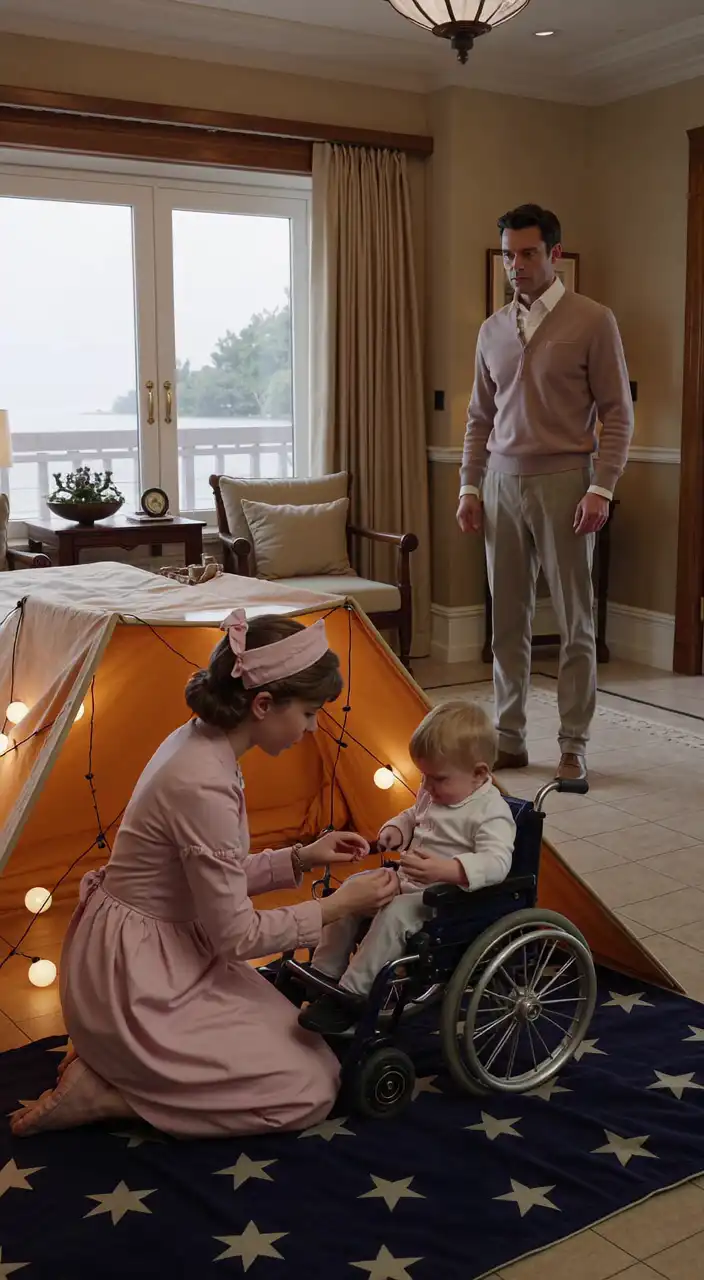
With Rowan watching from his wheelchair, she threw a blanket over the chairs, then another over the side table, making a crooked little fort. "This is obviously a highly exclusive ocean castle," she told him. "Only very serious people allowed."
She crawled inside and peeked out. "Do you think it needs another blanket?"
Rowan's eyes followed her.
"One blink for yes, no blink for no," she suggested.
Mrs. Grange muttered, "This is absurd."
Ivy tossed a pillow inside the fort. "Absurd is where all the good stuff lives."
By the time Beau came in from a call on the terrace, three blankets, four sofa cushions, and a string of battery lights had transformed the formal living room into a nest of softness and shadows. Rowan sat just outside the entrance in his chair while Ivy showed him how the flashlight made stars on the ceiling fabric.
Mrs. Grange was standing rigid with outrage. "Mr. Mercer, I must protest. The living room is not a playground."
Ivy looked up through the blanket opening. "Counterpoint. It is now."
Beau should have sided with the housekeeper. This room contained antique side tables and a rug shipped from Turkey. Delaney used to host holiday dinners here. It had always been maintained perfectly.
Then he saw Rowan leaning forward—forward—his entire attention fixed on the glowing fort.
"Is he upset?" Beau asked quietly.
Mrs. Grange faltered. "Well... no."
"Is anything broken?"
"Not yet."
Ivy grinned. "Confidence. I like that."
Beau exhaled slowly. "Leave it."
Mrs. Grange looked genuinely scandalized. "Sir."
"Leave it," he repeated.
The fort became a daily thing for a week. Sometimes in the living room. Once in the sunroom. Once, outrageously, under the breakfast table. Ivy turned ordinary afternoons into small adventures. She brought books inside the fort, animal crackers, toy boats, and one rainy day, a metal mixing bowl she declared was a drum for storm songs.
But it was still bedtime that mattered most. There, trust deepened in the quiet. She learned that Rowan relaxed when she rubbed two fingers gently across the back of his hand. That he preferred hearing the ocean through a cracked window. That he slept better if she told him what would happen tomorrow in simple order.
"Breakfast, then sweater, then we'll watch the gulls," she would say. "Then maybe fort engineering. Then lunch. Then rest. I've got you."
One evening, as Beau watched from the doorway, Rowan did something he had not done with any caregiver before. Ivy stood to leave after tucking the blanket around him, and his small hand caught the edge of her sleeve.
She turned back immediately. "You want me one more minute?"
He didn't let go.
"Okay," she whispered, sitting again. "One more minute."
Beau went to bed with his chest aching.
The conflict came hard and stupidly, as many real conflicts do.
By the second week, Mrs. Grange's patience had snapped. The blankets. The floor picnics. The living room forts. The flashlight stars. The tray of soup taken to Rowan's room because he was overtired and Ivy said comfort mattered more than table manners. To Mrs. Grange, who had devoted thirty years to maintaining order in Mercer homes, Ivy represented erosion. Disorder. Emotional indulgence.
To Rowan, she represented safety.
To Beau, she represented a fragile possibility he was afraid to protect too openly.
The confrontation began on a wet Thursday morning when Ivy let Rowan sit by the open screened terrace doors to feel the misty air on his face while she wrapped a blanket around his legs.
Mrs. Grange marched in. "That is enough. He will catch cold."
Ivy looked up. "He's not in the rain. He's enjoying the weather."
"He should be in the nursery with proper activities."
"He is having a proper activity. He's breathing."
Mrs. Grange stiffened. "You are not paid to mock this household."
"I'm not mocking it. I'm trying to make it livable for a three-year-old."
Beau walked in just as Mrs. Grange said, "Since your arrival, this house has been in chaos. Meals on the floor, blankets dragged through formal rooms, the child encouraged to ignore structure—"
Ivy rose. "He's not ignoring structure. He's finally trusting one."
Mrs. Grange turned to Beau. "Sir, with respect, this young woman is ruining order. The staff is confused. The child is becoming attached in unhealthy ways. Last night he would not settle until she returned."
The words hit Beau where he was weakest. Attached. Unhealthy. Dependent.
He looked at Ivy. "Is that true?"
Her expression changed, wounded more by the question than the accusation. "He wanted me to finish his bedtime. That's not unhealthy. That's secure."
Mrs. Grange pressed on. "He had a fit when she left the room."
Ivy's jaw tightened. "He cried for forty-five seconds because I said goodnight too quickly."
Beau rubbed his temple. "Enough. Both of you."
Rowan, silent through all of this, began to whimper.
Everyone froze.
Ivy knelt at once beside his chair. "Hey, hey. You're okay."
Mrs. Grange reached to wheel him away. "He needs quiet."
"No," Ivy said sharply. "He needs calm."
Beau's own pulse was pounding now. "Ivy."
She looked up at him, rain-gray light on her face. "If you're going to let people make him feel like a disruption every time he has a feeling, then yes, this will all get worse."
The room fell still.
Beau heard the truth in it and hated that it came wrapped in challenge.
Mrs. Grange said, "Mr. Mercer, this is insubordinate."
Ivy stood. "Maybe I should go home for today."
Rowan's whimper broke into a distressed cry.
Beau looked from his son to Mrs. Grange to Ivy. Every instinct he had built in business said restore order, assert control, remove the disruptive variable. But another part of him, the exhausted father who had been crying in his locked study not long ago, saw something else.
Still, he chose badly.
"Maybe that's best," he said.
Ivy stared at him for one stunned second, then nodded once. "Okay."
She picked up her tote, bent to Rowan's level, and said softly, "I'll see you soon."
When she left, the house felt instantly colder.
And Rowan, who almost never cried hard anymore, cried until he shook.
The mistake revealed itself within hours.
By afternoon Rowan would not nap. He pushed away toys. He refused applesauce, yogurt, and even the butter crackers he usually accepted. Every time the bedroom door opened, his eyes lifted with sudden sharp hope and then dulled again when it wasn't Ivy.
Beau tried to tell himself the setback was temporary. Children had bad days. Attachment shifts happened. He had heard enough experts discuss regulation and stress responses to build a wall of terms around his own guilt.
The wall collapsed by evening.
He found Rowan in the nursery with the day aide, red-eyed and exhausted, his little hands balled in his lap. The aide stood helplessly beside a tray untouched except for a smashed banana.
"He won't let me read," she said apologetically. "He just keeps looking at the door."
Beau dismissed her gently and closed the room behind him.
He knelt in front of Rowan's wheelchair. "Hey."
Rowan's gaze slid past him.
"I know you had a hard day."
Nothing.
Beau swallowed. "I had a hard day too."
He almost laughed at the selfishness of that sentence.
He reached out and touched the edge of Rowan's blanket. "Do you want your truck book?"
No response.
"Do you want the moon one?"
Silence.
The ocean boomed beyond the windows. Rain drummed on the roof. The house around them remained perfectly ordered, every cushion restored, every blanket fort erased as if joy itself had been tidied away.
"I sent her home," Beau said quietly. "I know."
Rowan's mouth trembled.
It wasn't a tantrum. It wasn't even dramatic. It was worse. It was the grief of a child too small to explain that the person who had begun to feel safe had vanished because adults had argued over him.
Beau sat back on the rug, suddenly unable to bear his own ignorance.
At dinner he barely touched his food. Mrs. Grange supervised the table in silence until finally Beau set down his fork and said, "You were wrong."
She looked up, startled. "Sir?"
"About Ivy."
Mrs. Grange's mouth tightened. "I was trying to protect the household."
"And she was trying to protect my son."
The older woman's eyes softened, but pride still held. "I have served this family loyally for many years."
"I know. But order is not the same thing as peace."
She said nothing to that.
When bedtime came, Beau tried to do it himself. He gave the bath carefully. He used the soft gray pajamas. He let Rowan choose the blue blanket. He cracked the window for the sound of the sea. He read the truck book and even paused where Ivy paused.
Halfway through, Rowan turned his face away.
Beau closed the book. "I know. I'm not doing it right."
His son did not look at him.
Something in Beau gave way then, not in a storm of emotion but in a plain, humiliating clarity. He had spent two years outsourcing tenderness because he was afraid of doing it badly. He had treated grief like a management problem. He had hidden behind excellence everywhere else because in this room, with this child, love came with no guarantee and no script.
He tucked the blanket under Rowan's chin and whispered, "I'm sorry."
Then he stood, walked into the hall, and called Ivy.
She answered on the fourth ring. "Hello?"
For a second, hearing her voice almost made him forget how to speak. "Ivy, it's Beau."
A pause. Rain and traffic hummed faintly on her end. "Is Rowan okay?"
The fact that she asked that first scraped him raw. "No. I mean—he's safe. But no. He hasn't settled all day."
She was quiet.
"I should not have sent you away," he said. The words were difficult and necessary. "You were right. I let the wrong thing matter. If you're willing, I'd like you to come back. Tonight."
Another pause, softer now. "Are you asking because it's convenient, or because you understand what happened?"
He closed his eyes. "Because my son trusted someone, and instead of protecting that trust, I protected furniture and hierarchy and my own discomfort. I understand enough to know I got it wrong."
When she spoke again, her voice had gentled. "I'll be there in twenty minutes."
The storm deepened before she arrived. Wind hurled sheets of rain across the terrace, and the house lights flickered once. Beau met her at the front door. Her hair was damp, and she had a yellow rain jacket over her sweater.
"I'm sorry," he said again before she even stepped inside.
"I know," she answered.
That was all. No lecture. No triumph. Just a second chance.
Mrs. Grange stood in the hall, stiff as polished wood. Ivy paused in front of her.
"I wasn't trying to disrespect your work," Ivy said. "I know you love this family."
Mrs. Grange looked at the rainwater beading on Ivy's jacket, then at Beau, then finally at Rowan's closed bedroom door. "And I was not trying to hurt the child," she said, each word deliberate.
"I know."
The older woman exhaled slowly. "The blankets may remain, if they are folded afterward."
Ivy's eyes widened in mock solemnity. "A historic compromise."
Mrs. Grange almost smiled despite herself. "Do not test me."
The apology, the second chance, the tiny reconciliation in the hall became the hinge on which everything turned.
When Ivy entered Rowan's room, Beau followed at a distance and stopped by the doorway.
The little boy was lying awake, cheeks still blotchy from earlier tears. The second he saw her, his whole body changed. Not magically. Not all at once. But his eyes sharpened with recognition, and one hand lifted from the blanket.
"Hi, bug," Ivy whispered, kneeling beside the bed. "I came back."
Rowan's fingers caught in her sleeve.
"I know," she said softly. "That was a hard day."
Beau's throat tightened.
Ivy glanced over her shoulder. "Will you help me tonight?"
He almost looked behind him to see if she meant someone else. "Me?"
"Yes. But slow, okay? Follow him, not your panic."
He nodded.
She turned back to Rowan. "I brought a plan. Very serious plan." She opened her tote and pulled out a string of tiny battery lights and a folded navy blanket patterned with stars. "Emergency storm fort."
For the first time all day, Rowan made a small sound. Not a word. More like breath catching around want.
Ivy looked at Beau. "Can you move those two chairs?"
Within minutes they had built a low blanket fort beside the bed, close enough for Rowan to be transferred comfortably onto a pile of cushions and quilts. Beau lifted him under Ivy's guidance, careful and awkward and wholly focused.
"Tell him what you're doing," Ivy murmured.
Beau adjusted his grip. "I'm picking you up now, buddy. I've got you. We're going to the fort."
Rowan's head rested briefly against Beau's shoulder.
The contact lasted only seconds, but Beau felt it like a prayer answered late.
Inside the fort, the string lights glowed like little stars. Rain battered the windows. Ivy handed Beau a flashlight. "Point it at the blanket roof."
He did.
The light made a wavering moon.
"Better," Ivy whispered to Rowan. "Storms sound less bossy when you make your own sky."
She lay on her stomach at the fort entrance. Beau sat awkwardly cross-legged beside Rowan, half inside, half out.
Ivy looked at him. "Tell him a story. Not from a book."
Beau stared. "I don't know one."
"Yes, you do. Tell him something true."
He looked down at his son. Rowan was watching the flashlight moon.
So Beau began.
"When I was nine," he said slowly, "I built a fort in my grandfather's library and got in trouble because I used his wool coats for walls."
Ivy smiled but stayed silent.
"I thought forts were supposed to be impressive," Beau continued. "Tall. Perfect. But the best part was that once I got inside, I could hear rain on the windows and nobody expected anything from me."
Rowan blinked.
Beau swallowed. "Your mom found me there. She laughed at how terrible it looked. Then she crawled in anyway."
At the mention of Delaney, his voice nearly broke. Ivy's eyes met his briefly, steadying him.
"She brought cookies," Beau said, softer now. "And she said every good fort needs bad architecture and someone kind inside it."
Ivy looked down quickly, pretending to inspect the blanket edge.
Outside, thunder rolled low over the ocean.
Rowan startled at the sound, and before Beau could retreat into helplessness, Ivy said quietly, "Put your hand on his chest. Just light."
He did.
"Now breathe slower," she said.
"I am."
"Slower than that, billionaire."
Despite everything, a small laugh escaped him. He obeyed.
Rowan's breathing, ragged from the day, slowly followed.
Minutes passed. Rain. Lights. Breath. The strange intimacy of all three of them inside a lopsided fort while the mansion stood around them like a shell learning softness.
Ivy took a small container from her tote. "I also brought contraband."
Beau frowned. "What is it?"
"Mini marshmallows."
He stared at her. "At bedtime?"
"One each. Healing is wild."
She placed one on Rowan's palm. He looked at it, then at her.
"Your dad gets one too," she said. "Fairness matters."
Beau accepted his with mock gravity. "Thank you for this scandalous generosity."
Ivy popped hers into her mouth. "You're welcome."
Rowan studied them both. Then, very carefully, he ate his marshmallow.
Ivy held up the container. "Want..." She paused, not finishing the sentence for him as so many adults had. "Do you want another?"
The fort seemed to hold its breath.
Rowan looked at the container. At Ivy. At Beau.
His lips parted.
At first Beau thought the sound was the rain.
Then came a whisper, small and rough from disuse, but unmistakable.
"More."
Everything stopped.
Beau's body went rigid. He turned so sharply he bumped the chair leg and made the blanket roof sway.
Ivy did not gasp. Did not flood the moment with adult astonishment. Her eyes filled anyway.
"You want more?" she asked very gently.
Rowan's lashes lowered, then lifted once.
"Okay," she whispered. "More."
She put another marshmallow in his hand.
Beau stared at his son as if language itself had just entered the room. "Did he—"
Ivy raised one hand without looking away from Rowan. "Wait."
Tears burned behind Beau's eyes.
Rowan put the second marshmallow in his mouth. He swallowed. Then his gaze flicked toward the moon on the blanket ceiling and back to the little plastic container in Ivy's lap.
"More," he said again, barely louder than breath.
This time Beau made a sound like he had been hit.
He pressed a hand over his mouth.
Ivy let out one shaky exhale and smiled through tears. "Yeah, bug. You can have more."
He wasn't just asking for candy. Beau knew that with a force that split him open. He was asking for continuation. For comfort. For the game, the presence, the safety, the people who had come back.
For more life.
Beau bowed his head and cried without dignity in the half-dark of the fort while rain hammered the windows and his son, his silent beautiful son, whispered his first clear word in months.
The first person Ivy made tell the story correctly was Beau.
Not the staff. Not the pediatric therapist. Not Graham, who texted three question marks after Beau called him in tears. Beau.
The next morning Rowan sat in his wheelchair by the sunroom windows, wrapped in a navy sweater, while the storm had washed the world clean. Gulls wheeled over pale surf. The house seemed to be waiting.
Mrs. Grange stood with folded hands near the doorway. Her expression had none of yesterday's certainty left in it.
Beau crouched in front of Rowan. His eyes were swollen from lack of sleep and crying, and he did not care.
"Can I ask you something, buddy?" he said softly.
Rowan looked at him.
Ivy stayed back by the console table, deliberately not taking over.
"Do you want to build the fort again later?"
A pause.
Then Rowan's fingers lifted, tiny and determined, and tapped the armrest twice.
Ivy smiled. "That counts."
Mrs. Grange put one hand to her chest.
Beau looked back at Ivy, dazed all over again. "I still don't know if I imagined last night."
"You didn't imagine it," Ivy said. "But don't chase it like a performance. If every adult in this house starts hunting for proof, he'll retreat."
Mrs. Grange, voice hushed, asked, "He spoke?"
Beau stood. The disbelief hit him again even as he heard himself say the words. "He asked for more."
The housekeeper blinked rapidly. "Oh."
That one quiet syllable held apology, wonder, and grief.
Later that day Rowan's physical therapist, Cora Bell, arrived for the scheduled session. Beau had nearly canceled, wanting to protect the fragile newness of the morning, but Ivy encouraged him to keep the routine.
"Progress has to live in real life," she said.
During the session, Cora placed stacking rings on the mat and spoke to Rowan in her usual encouraging tone. He remained reserved, but not shut down. He watched her. He looked toward Ivy when she spoke from across the room. He tolerated stretches with less visible tension.
Halfway through, Cora said, "He's more engaged today."
Beau, who had spent months learning not to let himself sound foolishly hopeful in front of professionals, replied carefully, "Something happened last night."
Cora glanced up. "What kind of something?"
He opened his mouth, then stopped. The old instinct was to qualify it, diminish it, protect himself from being told he had misunderstood. Ivy caught his eye from the window and gave the slightest nod.
Beau said it plainly. "He spoke."
Cora froze. "What did he say?"
"'More.'"
The therapist's face changed from professional interest to stunned delight. "To request? In context?"
"Yes."
Cora looked at Rowan, then back at Beau. "That matters."
Beau almost laughed through the ache in his chest. "I know it matters."
For the first time, someone in a clinical setting wasn't softening the edges. Wasn't saying maybe or possibly or let's not read into it. Just that simple, solid truth. It matters.
After the session, Cora asked Ivy to walk with her to the hall.
"I'll admit," Cora said, low enough for privacy, "I wasn't sure about the blanket forts."
Ivy grinned. "They're a highly technical intervention."
Cora smiled despite herself. "Whatever you're doing, keep doing it. He feels safe with you."
Ivy's answer was quiet. "I think he's starting to feel safe with his father too."
That part Beau overheard by accident, and it undid him more than the rest.
That evening, he found Ivy on the back terrace under the covered section, watching the sea turn gold under a clearing sky. Rowan had finally napped. The house was calm in a new way, not because every object sat in perfect order, but because the tension had gone out of the walls.
"I didn't believe it at first," Beau admitted.
Ivy leaned against the railing. "I noticed."
He gave a raw half-smile. "I heard him and still thought maybe I was desperate enough to invent it."
"That's what grief does. It makes joy feel suspicious."
He looked out at the water. "When Delaney died, everyone kept bringing solutions. Attorneys. doctors. assistants. Schedules. I got very good at action. Very bad at presence."
Ivy was silent.
"I thought if I couldn't fix Rowan's body, at least I could control everything around him. The house. The care. The rules. But he didn't need control." Beau's voice thickened. "He needed to know people would stay."
Ivy turned to face him. "Then stay."
The simplicity of that nearly broke him.
"I don't mean physically in the same building while your phone rings," she said. "I mean really stay. At bedtime. In the pauses. In the frustration. In the boring middle where trust grows."
He nodded slowly. "Teach me."
Her expression softened. "I can help. But it has to be yours too."
At dinner, Beau did something that made the entire staff pause.
He had Rowan's high-backed adaptive seat moved from the small side table where meals were often served separately and placed beside his own chair in the breakfast room.
Mrs. Grange supervised the change without comment.
When Rowan was wheeled in, he looked uncertain.
Beau touched the edge of the tablecloth. "You sit with me now."
Ivy sat across from them, warm and unobtrusive, ready if needed but not leading. The chef served simple food. Soup. Soft rolls. Roasted vegetables. The kind of meal Delaney used to insist felt more like family than spectacle.
Halfway through, Beau held up a piece of bread. "Do you want more?"
It was a risk and he knew it. Too direct. Too hopeful.
Rowan did not speak.
But he looked at his father. Really looked. Then he lifted his hand and opened his fingers.
Beau smiled, small and shaken, and put another piece on his tray.
Mrs. Grange turned away under the pretense of adjusting silverware. When she came back, her eyes were suspiciously bright.
That night, Beau joined bedtime from the beginning. Not as an observer. As a father willing to be taught.
Ivy handed him the moon book. "Pause here," she whispered.
He did.
"Now let him look."
He did.
"Now ask, 'One more page?'"
He did.
Rowan tapped the page.
Beau turned it, his chest so full it hurt.
The family dynamic changed not in one miracle but in a sequence of humbled choices. Mrs. Grange stopped correcting every unconventional detail and started quietly setting aside the soft blue blanket before evening. The staff lowered their voices around Rowan not out of pity but respect. The giant beach house no longer felt like a gallery of grief. It felt, tentatively, like a place where a child lived.
And Beau, overwhelmed at last by what he had almost ruined and what he had been given back, stopped pretending that love should look effortless before it counted.
Three weeks later, the fort still appeared in different rooms.
Sometimes it was elaborate, with lights and books and pillows stacked like castle walls. Sometimes it was nothing more than one blanket over two chairs and Rowan laughing soundlessly with his whole face while Ivy declared them under attack by imaginary seagulls.
He was still three years old. He still used his wheelchair. He still had difficult days when words disappeared and frustration came fast. Nothing about his physical condition had magically changed. The doctors had not been overturned. The future remained uncertain, full of therapy appointments and adaptations and long work still ahead.
But he was no longer healing inside silence.
Beau changed too. He moved meetings off the evening schedule. He stopped taking calls during bedtime. Once a week, he worked from the home office with the study door open. He learned how to transfer Rowan correctly, how to wait through pauses without filling them, how to narrate what came next in a voice that steadied rather than directed.
One afternoon on the covered terrace, while the ocean shone blue and wild beyond the dunes, Beau sat on the outdoor rug beside Rowan's chair and held up two books.
"Truck or moon?" he asked.
Rowan touched the truck book, then looked toward the house where Ivy was carrying out lemonade.
"She'll be right here," Beau said.
The boy relaxed.
That was the new order in the Mercer home: not perfection, not cure, not a fairy tale ending where grief vanished. Just people who had learned how to come back to one another.
Ivy remained, not with grand promises or dramatic declarations, but because staying had become part of the healing itself. Mrs. Grange still believed in folded blankets and proper meals, but now she also kept cookies in a tin labeled FORT SUPPLIES in tidy handwriting that she insisted was for emergencies only. Cora revised Rowan's goals with a new tone in her voice. Even the rooms seemed brighter, as if the light had found where to land.
And on nights when the wind rose off the Atlantic and the house filled with the old sound of storms, Rowan no longer faced them alone. There was always a hand nearby, a story waiting, and the soft glow of a crooked little fort somewhere under the quiet light.
The future was still unwritten. There would be setbacks, hard anniversaries, and questions no one could answer yet. But now, when Rowan wanted comfort, when he wanted another page, another minute, another turn beneath the blanket stars, he knew how to ask for it.
And the people who loved him had finally learned how to hear.
Disclaimer: Mention of any brand or trademark is for identification only and does not imply partnership or endorsement