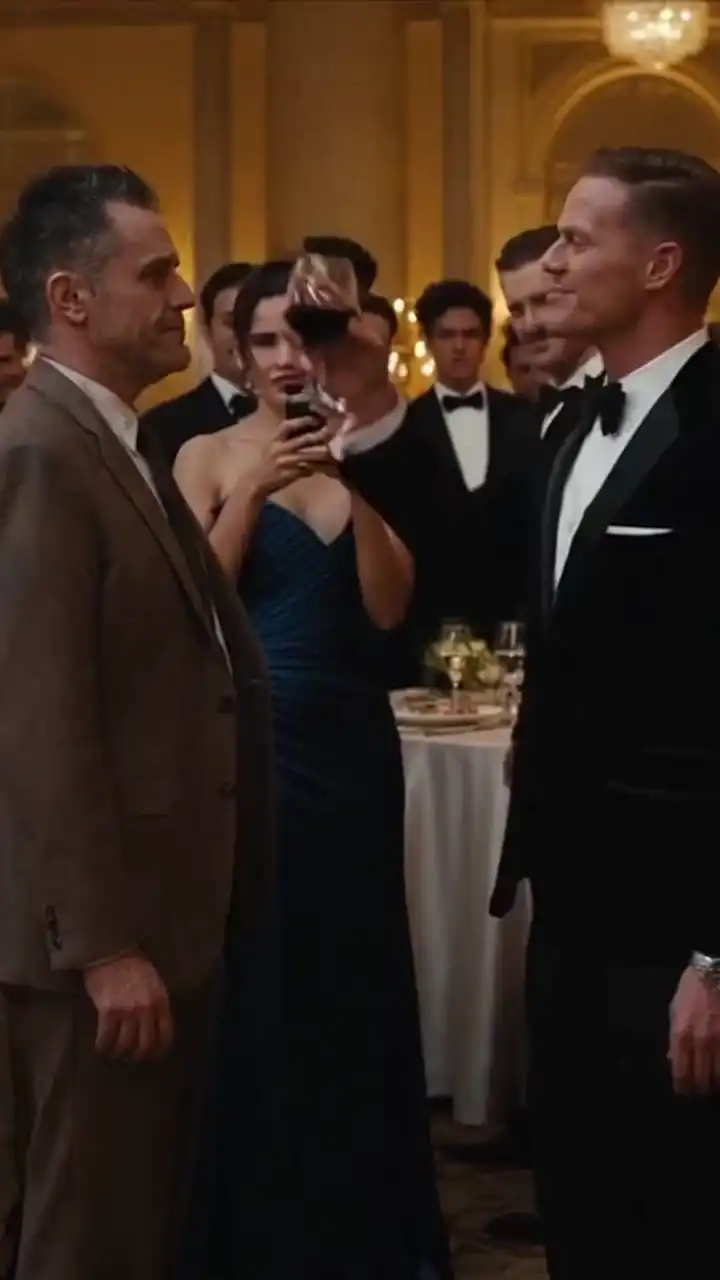

HE POURED WINE ON THE WAITRESS BEFORE I COULD SAY WHO PAID FOR THE ROOM
The sound of that glass breaking was small, but in that room it cut cleaner than a scream.
Every head turned toward the woman who dropped it. She was older, silver hair, sharp posture, one of the board members who had been smiling through the whole dinner like none of this was her problem.
Now her face had gone blank.
Mr. Halston still had the envelope in his hand.
He recovered first, or tried to. “This is exactly why staff should not be fed gossip. Lila Mercer is a rumored prospect. Nothing more.”
“No,” I said. “She checked in under another name at six twelve.”
Silence.
His jaw tightened. “And now the waitress is pretending she has access to guest security?”
“I had access to your coat request, your last-minute table changes, your special bottle service, and the note your assistant sent down demanding the west entrance stay clear at eight forty because you ‘didn’t want surprises.’”
His date looked at him. “What surprises?”
He didn’t answer her.
The silver-haired woman by the stage spoke for the first time. “How would she know about Lila Mercer?”
I looked at her. “Because I was the one asked to carry the sealed packet for Ms. Mercer after the foundation director got delayed upstairs. Because her office called down to confirm the alias. Because the packet has her revised pledge letter inside.”
Mr. Halston laughed again, but now it sounded dry. “This is ridiculous. She heard a name and built a little fantasy around it.”
Then the room itself started working against him.
Not because I had some dramatic speech ready. Not because a giant screen lit up. Because rich people are obsessed with access, and the second they sensed one person in the room knew something they didn’t, they stopped protecting him and started listening.
The man who had half-stood earlier stepped away from his chair and said, “Martin, why would a server know a donor alias tied to a revised pledge?”
Another guest turned toward him. “Revised from what?”
A woman at table three said, “You told us Ms. Mercer had declined to attend.”
Mr. Halston snapped, “Because that is what we were told.”
I kept my voice even. “Then why did you tell your assistant to move her place card off table one and put your date there?”
Now the date looked like she wanted her chair to swallow her whole.
“Martin?” she said. “You told me someone canceled.”
He pointed at me like I was the problem. “This is what happens when employees overstep. They piece together scraps and think they understand strategy.”
“Then open the envelope,” the silver-haired board member said.
That landed hard.
He looked at her. “Margaret, don’t be absurd.”
“I said open it.”
He didn’t move.
The same junior committee woman who had told someone to get me out of the room stared at the envelope in his hand like it had become dangerous. “If it’s nothing, just open it.”
He smiled at her with all the warmth of a knife. “Committee members do not dictate process to me.”
That was when the foundation director finally came in from the side hall, breathless, phone still in hand. Denise Carter. Mid-fifties. Efficient. Not glamorous. The kind of woman people ignored until they needed a miracle.
She stopped dead when she saw my shirt.
“What happened?” she said.
Nobody answered right away, which told her enough.
I stepped toward her. “He intercepted the Mercer packet.”
Denise’s eyes went straight to the envelope. “Mr. Halston, that packet was not for you.”
He held it tighter. “Your staff member interrupted a private donor event and started throwing names around.”
“She was following my instruction,” Denise said.
A murmur moved around the room.
Mr. Halston changed tactics fast. “Then your instruction was reckless. If sensitive information has been leaked to banquet staff, the board should be extremely concerned.”
Denise didn’t blink. “The board should be concerned, yes.”
He looked relieved too soon.
She walked straight up to him. “Concerned about why you were trying to access Ms. Mercer’s pledge amendment before it was presented.”
That hit him harder than my wine-soaked shirt ever could.
“I was not trying to access anything,” he said. “I took it from a confused employee before she embarrassed the foundation.”
“You embarrassed the foundation,” Margaret said from the stage area.
More heads nodded now. Small movements, but visible.
Mr. Halston saw it. “Let’s not overreact because of an unfortunate misunderstanding.”
Denise held out her hand. “Give me the envelope.”
He didn’t.
That was his mistake.
Not the wine. Not the sneering speech. Not even saying Lila’s name.
Refusing a simple request in a room where he had built his whole identity around being the most trusted man there—that was the moment people started doing their own math.
The man near the stage said, “Martin, hand it over.”
Another donor added, “Why are you resisting?”
His date pushed her chair back. “You said this event was about children’s oncology.”
“It is,” Denise said, still looking at him. “And Ms. Mercer’s revised pledge concerns the wing naming restrictions she required after reviewing internal influence concerns.”
Now the room came alive.
“Influence concerns?”
“What restrictions?”
“Internal with who?”
Denise didn’t answer them. She didn’t have to. The room was doing her work for her.
Mr. Halston finally slapped the envelope into her hand. “Fine. Open it. Let’s end this circus.”
Denise opened it carefully, pulled out the letter, and scanned it once.
Then she looked up. “As of tonight, Ms. Mercer’s pledge will be released only if no member of the donor steering committee, including the chair, receives naming consideration, vendor control, or appointment leverage related to the new wing.”
A few people actually gasped.
Because Mr. Halston was the donor steering chair.
Because for six months he had been telling everyone that if the Mercer gift closed, he would obviously be the natural choice to lead expansion partnerships.
Because he had already been acting like the wing was half his.
His face went dark. “This is outrageous.”
Denise kept reading. “She further requests an independent review of recent table placements, donor access restrictions, and pre-event communications after being informed that certain guests were discouraged from attending if they were not considered ‘aligned with the chair’s vision.’”
Margaret closed her eyes.
The junior committee woman whispered, “Oh my God.”
I knew exactly what that line meant, because I had seen a piece of it in motion all week.
Guests quietly shifted around. Invitations delayed. Calls redirected. A widow from an old-money family suddenly moved from stage seating to the back. A pediatric surgeon’s husband dropped from the speaking list because he “wasn’t a cultural fit.” And apparently, Lila Mercer herself had been marked for management before she ever walked in.
Mr. Halston had built a private kingdom inside a charity event.
And he had gotten reckless enough to think nobody below him could see it.
He pointed at me. “She is the one who breached confidentiality.”
“No,” Denise said. “She is the one you tried to silence before the packet reached me.”
He turned to the room, switching from force to injured dignity. “After everything I have raised for this foundation, you are all going to take the word of a banquet server over mine?”
Margaret answered before anyone else could. “No. We are taking your behavior in front of eighty witnesses over your own story.”
That landed.
A man at the back said, “You poured wine on her.”
Another voice: “For carrying an envelope.”
Another: “You announced a confidential donor name first.”
Mr. Halston whipped around. “I did not announce anything confidential. The name was already in circulation.”
I said, “Then tell them why you moved her seat.”
He looked at me with pure hate now. Not because I had shouted him down. Because I was still standing there.
Denise turned to me. “Elena, say exactly what you were told downstairs.”
So I did.
No grand speech. Just the facts.
At five forty, a call from the foundation office. At six twelve, confirmation that Lila Mercer had checked in under the alias Laura Mays. At seven ten, a note from Mr. Halston’s assistant requesting a place card revision at table one. At seven twenty-three, another note saying one guest was to be redirected from the west entrance to “avoid confusion.” At eight thirty-one, Denise asking me to hold the sealed packet because she got pulled into an urgent call. At eight forty-nine, me walking toward the podium. At eight fifty, Mr. Halston cutting me off with a toast, stepping into my path, and pouring wine on me before I could speak.
I even reached into my apron and pulled out the service copy slips. Banquet staff keep everything. Table changes. bottle requests. runner instructions. We are the glue people never notice until something tears.
My slips had times. Initials. Handwriting.
I handed them to Denise.
She gave them to Margaret.
Margaret compared them to something on her phone, then looked up so slowly it made half the room stop breathing.
“Martin,” she said, “your assistant texted me this afternoon that Ms. Mercer was ‘indecisive’ and might not come. You were already moving her seat before check-in.”
He said nothing.
The date stood up. “You used me as a placeholder?”
“Sit down,” he snapped.
She didn’t. She took her purse and stepped away from the table.
That was another little collapse. Not important in the legal sense. Very important in the room.
He saw people watching and tried to soften his tone. “Claire, not now.”
She gave a short laugh. “You poured wine on a waitress to cover your own mess. I think now is perfect.”
Then she walked out.
A couple at table five exchanged one look and followed.
Not out of loyalty to me. Out of disgust, and maybe self-protection. Rich people leave early when they smell a scandal that might stain their jacket.
Mr. Halston turned back to Denise. “This can all be handled privately.”
Denise folded the letter. “You handled it publicly.”
Margaret stepped toward the front of the room. “As vice chair of the board, I am requesting Mr. Halston step away from donor leadership pending immediate review.”
He barked out a laugh. “You can request whatever you want.”
“I can do more than request,” she said. “And after tonight, I doubt you have the votes.”
That made three board members at separate tables stand almost at once.
I watched their faces. Not brave, exactly. Calculating. But useful.
One said, “I support suspension.”
Another: “So do I.”
The junior committee woman who had wanted me removed was suddenly very interested in moral clarity. “This was completely unacceptable.”
I almost laughed.
Mr. Halston heard her and snapped, “You were thanking me ten minutes ago.”
She looked down at her plate.
That’s how these rooms work. They borrow courage only after the bill arrives.
Denise turned to one of the captains by the wall. “Please get Ms. Rivera a clean jacket and have security remain at the doors.”
Mr. Halston spun around. “Security? For me?”
“For the records,” Denise said.
He looked around the room one last time, searching for automatic loyalty. For somebody to joke it away. For somebody to say he didn’t mean it, he’d had too much to drink, she was confused, let’s continue dinner.
Nobody moved.
Even the pianist kept his hands in his lap.
“Fine,” Mr. Halston said. “If this foundation wants to humiliate a major donor based on gossip and theatrics, perhaps my support should be reconsidered.”
Margaret didn’t miss a beat. “Ms. Mercer’s pledge is three times yours.”
That one split the room wide open.
Not because of the number itself. Because it answered the real question no one had asked out loud yet: who actually had power tonight?
Not him.
He’d been acting like king of the room while trying to block the person who was carrying news that made him smaller.
He stared at Margaret like he couldn’t believe she’d say it in public.
She did.
And once one person in that kind of room says the unsayable, the rest rush to catch up.
A surgeon’s wife said, “I had wondered why Dr. Feld was moved from the remarks.”
A museum trustee added, “My office was told there was no room for my niece, then I see three influencer guests at table two.”
The man near the stage, the one who first stood up, said, “My pledge call with Martin included a suggestion about preferred contractors. I thought it was odd at the time.”
Denise looked at him sharply. “Contractors?”
He nodded. “I assumed it was informal. Maybe I shouldn’t have.”
Mr. Halston’s mouth opened, then closed.
And there it was. The room was no longer his shield. It had become a witness box.
People started emptying their pockets in public because once they knew he was falling, they wanted distance from his weight.
A woman I didn’t know said, “He told me which families were worth keeping close.” Another said, “He tried to cut my daughter from the youth speech panel.” Someone else: “His office called my assistant twice to ask whether the Mercer people had spoken to us.”
Each little comment made the next one easier.
Nothing dramatic. Just social gravity reversing.
Denise handed the slips and letter to a board counsel who had arrived during the mess and was already taking notes. “We’ll need statements from staff and attendees.”
Mr. Halston saw the lawyer and finally understood this was no longer about rescuing his image before dessert.
He took a step toward me. “You think this ends well for you? Hotels protect donors, not servers.”
I met his eyes. “Maybe that used to work on people who needed your approval.”
Denise answered for me. “Not tonight.”
Then the hotel general manager came in.
I hadn’t even seen him arrive, but apparently someone from the kitchen had called him the second the wine hit me.
He took in the stained shirt, the broken glass, the faces, and said, “Mr. Halston, I’m informed you assaulted a member of staff.”
Mr. Halston scoffed. “Don’t be ridiculous.”
The manager stayed calm. “You are no longer welcome on this property tonight.”
That was the concrete loss he felt immediately.
Not six months from now. Not after committee review. Right then.
He was being removed from the room he thought he owned.
He looked around again, waiting for someone to object.
Nobody did.
Security wasn’t rough. They didn’t need to be. Shame did the heavy lifting. He grabbed his jacket himself and walked toward the exit with his back too straight, like posture could still negotiate reality.
Halfway there, he turned to Margaret. “This foundation will regret this.”
Margaret said, “The foundation already did.”
And he left.
The doors shut behind him.
For a second nobody spoke. No one knew whether to resume being elegant or admit they had all just watched a man try to destroy a waitress for carrying the wrong envelope at the wrong moment.
Denise looked at me gently. “Are you hurt?”
That simple question almost undid me more than the wine had.
“My shirt is ruined,” I said, and a few people let out strained little laughs because they needed somewhere to put their nerves.
She touched my elbow. “Come with me. We’ll get you cleaned up.”
Before I moved, Margaret stepped in front of me.
I won’t lie. I expected some polished apology that was really about protecting the board.
Instead she said, “Ms. Rivera, I am sorry I sat there as long as I did.”
I nodded. “You weren’t the only one.”
“No,” she said quietly. “I wasn’t.”
That mattered more than a dramatic grovel would have.
In the staff hall, one of the housekeepers handed me a navy blazer from lost and found inventory still in dry-cleaning plastic. I put it on over my stained shirt and finally looked in the mirror.
Red streaks. Blotched skin. Hair coming loose.
I looked exactly like what I was: somebody who had a bad night and didn’t disappear.
Denise joined me a minute later.
“The board counsel wants your statement,” she said. “And the hotel wants one too. You do not have to decide anything tonight beyond facts.”
“Am I fired?” I asked.
She looked offended. “No. You followed instructions. Honestly, you handled yourself better than half the room.”
I let out a breath I hadn’t realized I’d been holding.
Then she said, “Also, Ms. Mercer would like to meet you.”
I stared at her. “She was here?”
“Upstairs first. Then watching the room feed after the commotion started. She chose not to enter once she understood what was happening.”
That made sense. A woman donating that kind of money did not need to step into a circus to know who had created it.
Denise led me to a smaller conference lounge off the main corridor.
Lila Mercer was sitting at the table with no entourage, no dramatic diamonds, no icy attitude. Just a woman in a plain black suit with reading glasses and a tired face.
She stood when I came in.
“You’re Elena?”
“Yes.”
“I’m sorry you got caught in that.”
“Thank you.”
She nodded to the chair across from her. “Denise tells me you kept the packet moving when other people started performing.”
I sat, still damp under the blazer. “I was just doing my job.”
“That’s usually who sees the truth first,” she said.
Then she asked me to walk her through exactly how the floor had been managed all week. The table changes. The runner notes. Which guests got whispered updates and which ones were left wandering. She listened like every detail mattered.
Because to her, it did.
By the end of the conversation, Denise had three pages of notes and a list of staff who might need to be interviewed.
Lila closed the folder and said, “I don’t fund vanity courts. If tonight hadn’t happened in public, I might never have seen how far he’d gone.”
I thought about the wine, the laughter, the clap from that one man, my shirt sticking to my skin.
“I almost walked away,” I admitted.
“I know,” she said. “Most people do.”
Before I left, she said one more thing.
“The foundation has an opening in operations after this review is over. Denise says you’ve been doing half the floor coordinator’s job without the title. If you want to apply, apply.”
I actually laughed then, because it was so far from what I’d expected my night to become. “I’m still in a stained uniform.”
She smiled a little. “That seems to be how truth usually arrives.”
The aftermath took weeks.
Mr. Halston was suspended that night and formally removed within days once statements started stacking up. Two committee members resigned before they could be asked hard questions. His assistant quit. A vendor review opened. The seating manipulation, donor gatekeeping, and contractor steering all crawled into daylight where they looked as ugly as they were.
The hotel banned him pending the outcome of the staff assault complaint. Last I heard, two other nonprofits quietly cut him loose before their galas could become the next story.
As for me, I gave my statement, worked the rest of my scheduled shifts in a borrowed blazer, and ignored the flood of fake sympathy from people who had stared at me while he poured wine on my chest.
Some apologized because they meant it.
Some apologized because the room had chosen a side.
You can tell the difference.
Three months later, I took the operations job at the foundation.
Not because it felt like a movie ending. Because I was already doing the work in smaller, less credited ways, and for once somebody said it out loud.
The first event I helped run under the new system had no secret guest purges, no seat trading for girlfriends, no donor king at the center pretending the charity was his private club.
And yes, we served red wine.
Near the end of the night, one of the newer servers froze when a guest snapped at her for reaching across his plate.
I walked over, took the tray from her shaking hands, and said, “You’re fine. Go breathe.”
The guest started to puff himself up.
I looked him dead in the eye and said, “At our events, staff are not your target.”
He sat back.
Sometimes that’s all it takes once a room learns different rules.
I still have the white shirt, by the way.
The stain never came out completely. A shadow of red stayed near the buttons no matter what I used.
I kept it anyway.
Not because I enjoy remembering what he did.
Because that shirt reminds me of the moment a man with money, a room full of witnesses, and every advantage he could buy still failed to make me disappear.
Disclaimer: Mention of any brand or trademark is for identification only and does not imply partnership or endorsement