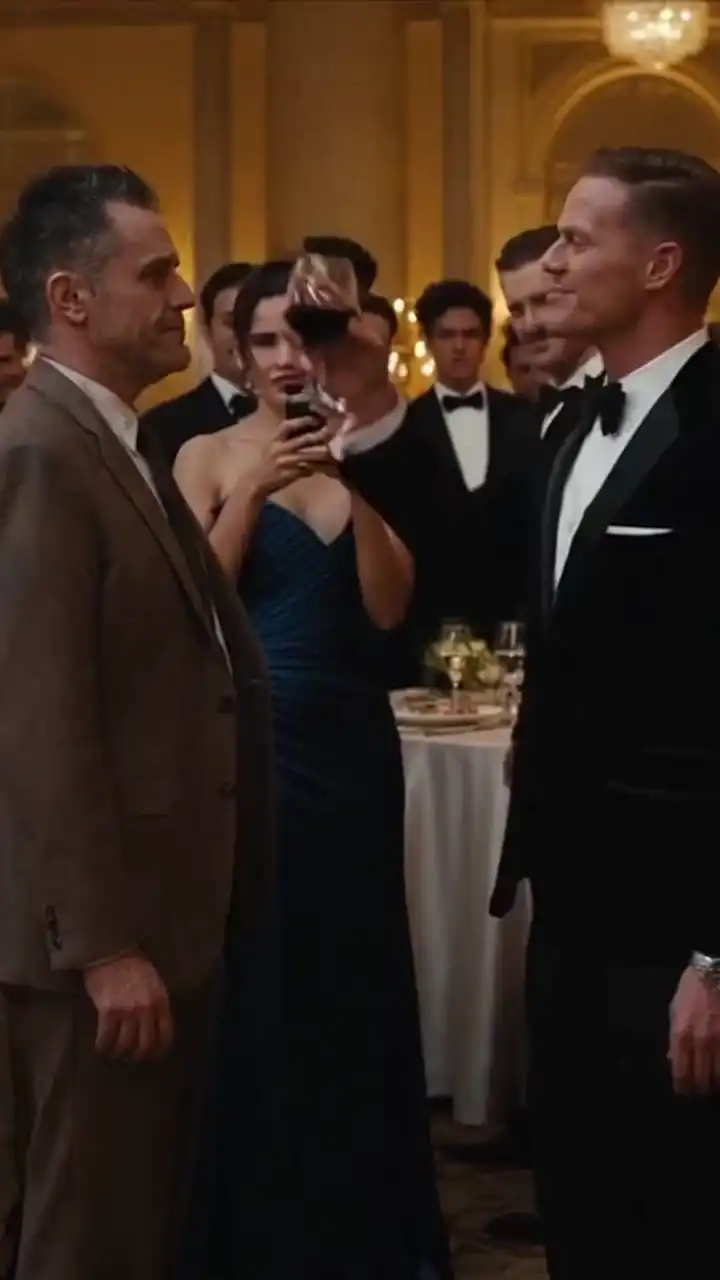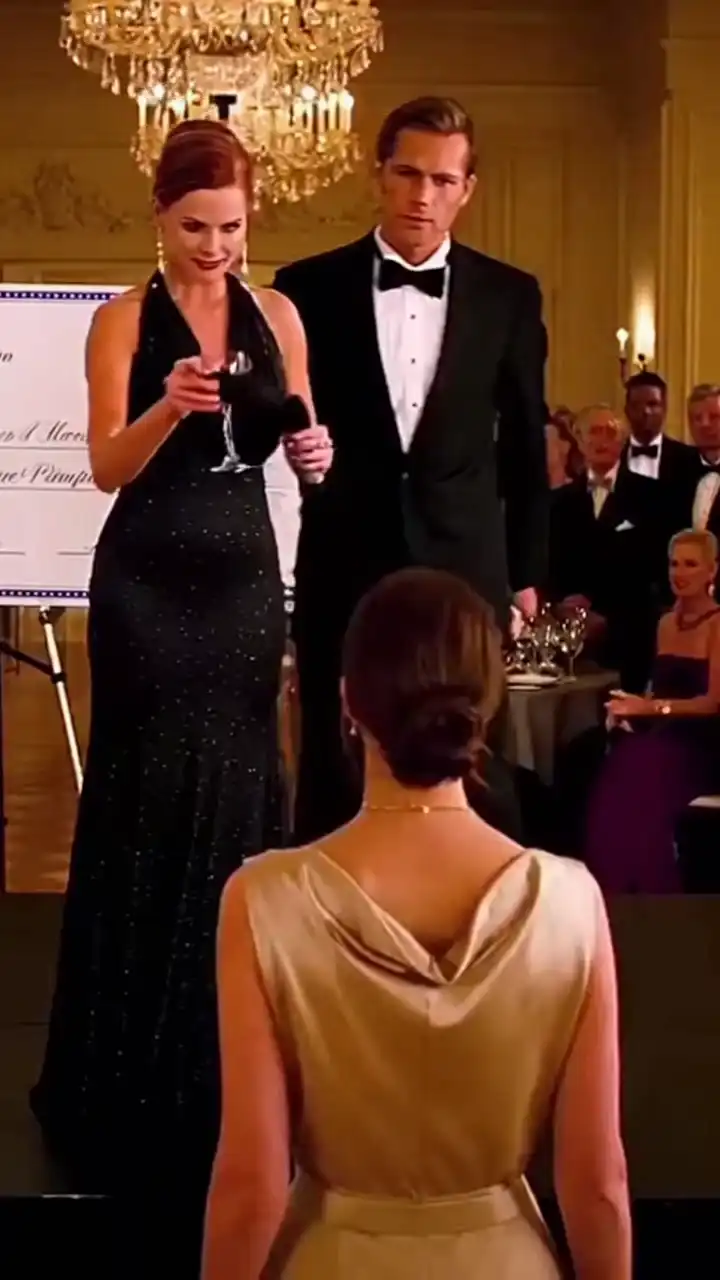
SHE POURED RED WINE DOWN MY DRESS THE SECOND I SAID, “Your husband didn’t make that donation alone.”
I kept staring at that check long enough for Dahlia to notice.
Her smile tightened for half a second.
That was all I needed.
She followed my eyes to the signature line, then moved too quickly. She stepped in front of the easel like she could block paper with her body.
“Security,” she said into the mic, voice bright again. “Please help this woman out before she turns a beautiful night into another one of her episodes.”
Episodes.
There it was. The word they’d been feeding people for months.
Not fraud. Not dispute. Not marriage. Just me, supposedly dramatic and difficult and impossible to trust.
A man in a black suit near the side door started toward me. Not real security. One of the event contractors. He looked more embarrassed than aggressive.
I held up one hand. “Don’t touch me.”
Then I looked at the stage manager, a young guy with a headset who had been frozen beside the podium since the wine hit me.
“Can you bring that check down?” I asked.
Dahlia laughed. “No, he can’t.”
I didn’t raise my voice. “He can. Because if that signature is forged, this hospital just displayed fraud in front of donors, reporters, and the attorney general’s deputy chief of staff.”
That landed.
Not like a bomb. More like a tray slipping in a silent room.
Heads turned.
The stage manager looked at someone off to the side. A woman in a navy suit near the hospital board table stood up slowly. I recognized her from older fundraisers. Judith Klein. General counsel for the hospital network.
Dahlia was still smiling, but now it looked expensive and painful.
“Lena,” she said, as if trying kindness for the first time all night, “you’re clearly upset. Let’s not make reckless accusations.”
I looked at Judith, not Dahlia. “The check says Vernon Mercer approved this gift three days after the stroke put him into a coma. Did hospital counsel verify that before putting his name onstage?”
Every eye that mattered shifted to the signature line.
Grant went pale in a way I had never seen before. Not embarrassed. Not trapped. Terrified.
That answered something too.
Judith walked to the foot of the stage. “Mr. Mercer,” she said, sharp and calm, “is that your father’s signature?”
Grant opened his mouth.
Dahlia answered for him. “This is absurd. It’s ceremonial. Everyone knows these are symbolic.”
“Symbolic checks still represent actual gifts,” Judith said. “And symbolic signatures are still a problem if they imply authorization that did not exist.”
One of the reporters near the back had already lifted her phone.
Dahlia saw that and changed tactics fast. “Fine. Grant was handling the estate. If there was a clerical issue, that has nothing to do with this woman crashing an event to make a scene.”
This woman.
Not wife. Not co-trustee. Not donor family. Not the person whose name had quietly vanished from three foundation boards over the last year after Dahlia got close enough to whisper into the right ears.
I took the napkins away from my dress. No point pretending the stain could be fixed.
“I didn’t crash anything,” I said. “I was invited because I am still co-trustee of the Mercer Family Trust. Or I was, until someone started filing amendments I never signed.”
A ripple went through the tables.
Dahlia turned to Grant at last. “Say something.”
He looked at me. Then at Judith. Then at the floor.
That weak silence that used to make me step in and save him did nothing for me anymore.
Judith spoke first. “Amendments?”
“Yes,” I said. “And since we’re doing this in public, let’s do it properly. Seven months ago, I requested trust account records after distributions started moving without my written approval. My access was revoked two days later. Then I was told I had voluntarily resigned from two associated charitable entities. I had not.”
Murmurs now. Real ones.
At the front table, one donor whispered, “Voluntarily resigned?”
Another said, “Can they even do that?”
Dahlia lifted the mic again. “This is a domestic dispute. It has nothing to do with the hospital.”
“It has everything to do with the hospital if a donation was pledged from restricted family funds using forged authorization,” Judith said.
Grant finally found his voice. “Judith, this is not the place.”
“No,” I said. “It was never supposed to be this place. It was supposed to be a quiet transfer. Quiet removal. Quiet replacement. But then she poured wine on me because I asked one true question.”
The room didn’t need me to explain more than that.
They had seen her do it.
They had heard why.
Dahlia stepped down from the stage and came close enough that only the nearest tables should have heard her. But her mic was still live.
“You vindictive little—”
The speakers carried every word.
A gasp ran across the room.
She froze.
The sound tech slapped at his board too late.
For the first time that night, Dahlia looked naked in front of people. Not physically. Socially. The polished charity queen mask just split right down the center.
Judith folded her arms. “I think we need all event recording preserved.”
That’s when an older voice from the left side of the ballroom said, “You absolutely do.”
Everyone turned.
It was Robert Hale, Vernon Mercer’s longtime estate attorney, walking in through the side entrance with a winter coat still on his arm. I had called him from the ladies’ room twenty minutes before the program started, after seeing my printed name on the seating chart and realizing Dahlia planned to use my absence as public confirmation that I was gone for good.
I hadn’t expected him to come in person.
Apparently neither had Grant.
“Robert,” Grant said, and it came out like a warning.
Robert ignored him. “I was told there was a problem with a trust-funded hospital gift.”
Dahlia recovered just enough to point at me. “Yes. Her.”
Robert looked at her like she was an interruption in a legal deposition. “And you are?”
A few people actually made a sound then. A tiny ugly little inhale from the room’s social lungs.
Because that was the first real public demotion Dahlia had received all night.
She straightened. “I’m chairing this event.”
“For the next few minutes, perhaps,” Robert said.
He walked up to the stage and held out his hand to Judith. She passed him the ceremonial check. He read the signature line, then took off his glasses and looked directly at Grant.
“Why is your father’s name on this?”
Grant’s jaw worked. “It was for presentation.”
Robert’s face stayed flat. “Your father lost capacity before that date. You know that. I know that. And Lena was never removed as co-trustee because the only resignation document ever submitted on her behalf is already under review.”
That one sentence did more damage than any yelling could have.
Under review.
Not gossip. Not revenge. Already moving.
Dahlia stared at Grant. “What does that mean?”
He didn’t answer.
I did. “It means the document used to strip my access is being examined because I never signed it.”
A woman at table three, someone who had spent the last year hosting Dahlia at brunches and smiling past me at board lunches, put down her glass and said out loud, “Oh my God.”
Robert continued, calm as rain. “For the sake of clarity, Ms. Voss—”
Dahlia blinked. “Voss?”
“I assume that is still your legal name,” he said. “You have no authority over the Mercer Trust, the Mercer Foundation, or Mr. Vernon Mercer’s estate.”
That got the reporters moving.
Phones came up everywhere now.
Dahlia turned to Grant hard enough that her bracelet snapped against his sleeve. “You told me everything was finalized.”
Grant finally cracked. “Can we not do this here?”
She almost laughed. “You dragged me into this. You told me she was out. You told me she signed. You told me your father approved the transfer before he got sick.”
There it was.
Not one betrayal. A stack of them.
Judith’s expression changed. “Mr. Mercer, I’m going to ask directly. Did this hospital receive a pledge supported by documents you knew were unauthorized?”
Grant rubbed both hands over his face. “The money exists. The donation is real.”
“That was not the question,” Judith said.
He looked around at the room, at the cameras, at me in the stained dress, at Dahlia standing beside him like a grenade realizing it had been thrown by another hand.
Then he said the stupidest thing possible.
“I was going to fix it before closing.”
A reporter near the back whispered, “Jesus,” loud enough for three tables to hear.
Robert handed the check back to Judith. “You need to pull this from display immediately.”
She nodded to the stage manager, who finally moved. He lifted the giant check off the easel and carried it away while everyone watched.
That mattered more than people think.
In rooms like that, symbols are power. And seeing that big smiling fake artifact removed in silence, while the donors sat there with their salad forks and shocked faces, did more to collapse the evening than any speech ever could.
Dahlia grabbed Grant’s arm. “Tell them I had nothing to do with paperwork.”
“I don’t know what you filed,” I said.
She whipped toward me. “Filed?”
“You knew enough to remove my name from committees before any legal change existed. You knew enough to tell people I had ‘episodes.’ You knew enough to stand under my family trust donation and call yourself the future of this family.”
Her voice dropped. “Your family?”
“Yes,” I said. “Mine. The seed money in that trust came from my grandmother’s estate. Vernon managed it. I built half the children’s programs your brochures love to mention. You just wore the dress and learned the donor names.”
That hit a different part of the room.
Not scandal. Memory.
People started connecting me back into the institution they had let Dahlia edit me out of.
One of the pediatric department chairs stood up from a side table. “Lena chaired the family housing campaign,” she said to no one and everyone. “She spent nights here with parents when the west wing opened.”
Another board member said quietly, “I thought you had stepped away.”
“I was stepped away,” I said.
That line traveled.
You could feel it. The little nods. The shame. The self-protection. People mentally rewriting the past in real time.
Dahlia saw she was losing witnesses and went for cruelty again because it had worked for her before.
“She’s still a woman whose husband left her,” she said. “That doesn’t become noble because she’s making legal threats.”
Grant shut his eyes.
I almost thanked her for saying it, because it gave the room one last clean look at who she was when charm stopped working.
I answered her with the truth she hated most.
“He didn’t leave me,” I said. “He used me until he thought the signatures, boards, and family grief were in order. Then he let you perform the public part.”
No one laughed.
Judith turned to the hospital CEO, who had stayed wisely silent until now. “We need to suspend announcement of the Mercer gift pending document review.”
He nodded once. “Agreed.”
Grant took a step forward. “That will create unnecessary speculation.”
Robert gave him a long look. “You created unnecessary speculation when you used a dead man’s authority before the estate was settled.”
“Dad wasn’t dead then,” Grant snapped.
The second it left his mouth, he knew he’d made it worse.
Robert didn’t blink. “Comatose, then. Thank you for the correction.”
One of the reporters actually walked out then, probably to call it in before anyone tried to lock down the story.
Dahlia’s face had gone from red to white. She was beginning to understand the concrete part now. Not embarrassment. Exposure.
Public charity fraud questions.
Estate review.
Trust inquiry.
Live witnesses.
Recorded audio of her humiliating the woman she had spent a year calling unstable.
And she had done it while standing in front of the very check that could bring investigators to the door.
She tried one last pivot. “Lena, if this is about your marriage, take it up privately.”
“No,” I said. “The marriage was private. You made the theft public.”
That sat in the room like a gavel.
Judith asked me, “Do you have copies of your correspondence and the disputed documents?”
“Yes.”
Robert added, “And my office has already advised Mr. Mercer’s counsel to preserve all trust communications.”
Dahlia snapped toward Grant again. “Counsel?”
He didn’t answer because there was nothing left to say.
She let go of his arm like it had burned her.
That was the first visible thing she lost.
Not the title. Not the room. Him.
Because whatever lie he had sold her—that Lena was gone, the estate was settled, the trust was clean, the wife was unstable, the path was open—had just blown apart in front of everyone whose opinion she used as oxygen.
She took a step back from him. “You said she was finished.”
I laughed once. Couldn’t help it. It wasn’t pretty, but it was honest.
Grant looked at me then with the same pleading expression he used to wear when he wanted me to manage the consequences of his cowardice.
“Lena,” he said, low and desperate, “please don’t do this here.”
I met his eyes. “You mean the way you did it?”
He had no answer.
The hospital CEO returned to the microphone. His voice shook only a little.
“Ladies and gentlemen, we are pausing tonight’s program due to an issue requiring immediate review. We appreciate your understanding.”
No applause. No confusion. Everybody understood enough.
Chairs scraped.
People stood in clusters.
Some came toward me, suddenly full of concern. I had no use for most of it.
A woman who had ignored three of my emails last spring said, “Lena, I had no idea.”
“I know,” I said.
The volunteer who had first offered napkins came back with club soda and a clean shawl. Her hands were shaking. “I’m sorry,” she whispered.
“For the stain or the room?” I asked.
Her eyes filled. “Both.”
I took the shawl. “Thank you.”
Across the ballroom, Dahlia was arguing with someone from the event board. Hard, sharp movements. No smile left. A photographer tried to angle around a floral arrangement to get a cleaner shot of her face. She turned away too late.
Grant went after Robert, then stopped when Robert’s associate intercepted him with a business card and a sentence I couldn’t hear. Grant looked like a man watching the floor open under an expensive house.
Judith came to me directly. “Ms. Mercer,” she said.
That name, in that room, after the way the night started, almost made me dizzy.
“We will need your records first thing tomorrow morning.”
“You’ll have them tonight,” I said.
She glanced at my dress. “Would you like a private room?”
I looked around the ballroom one more time.
At the donors pretending not to stare.
At the giant space where the check had stood.
At Dahlia realizing she wasn’t the hostess anymore, just a witness with a microphone problem.
At Grant, alone in the middle of a crowd he used to control.
“No,” I said. “I’m leaving.”
And I did.
Not rushed. Not dramatic. I walked straight through the center aisle in the stained dress she wanted me to be ashamed of.
People moved out of my way.
That was the second thing Dahlia lost. The room’s permission.
By midnight, three things had happened.
The hospital issued a statement saying the Mercer donation announcement had been suspended pending verification of trust authority.
Robert’s office filed an emergency petition to freeze disputed distributions from the family trust until the signature review was completed.
And the gala clip was everywhere.
Not the whole night. Just the part where Dahlia poured wine on me, called me someone who didn’t belong, and then got caught standing beside a check she had no right to unveil.
The internet did what the internet does.
By morning, people had found old photos of me at hospital fundraisers, ribbon cuttings, planning meetings, family housing drives. They found board newsletters with my name. They found campaign archives Dahlia had never bothered to scrub because she assumed no one looked backward once she controlled the current picture.
They looked now.
Within forty-eight hours, Dahlia resigned from the gala committee “to focus on personal matters.”
Within a week, two board members who had helped push through my supposed “voluntary departure” stepped down pending internal review.
And Grant?
Grant lost more than a girlfriend and a speech.
He lost temporary control over the trust.
He lost the clean image of being the grieving son generously carrying on his father’s legacy.
He lost the legal advantage he thought public perception had already won him in our divorce.
Because once forensic review began, the story stopped being sad marriage gossip and became what it always was: unauthorized transfers, false filings, and a very expensive attempt to erase the wrong woman too early.
His lawyers called mine five days later asking whether I would consider keeping the matter “discreet.”
I said no.
Not because I wanted spectacle.
Because discretion was the weapon they had used on me from the start.
Quiet edits.
Quiet lies.
Quiet signatures.
Quiet introductions where I became “not well,” “taking time,” “no longer involved.”
No more quiet.
The funniest part, if there was one, came two weeks later when one of the society pages ran a correction under a photo from the gala.
Not “Dahlia Mercer.”
Just “Dahlia Voss, guest.”
Guest.
That single word probably hurt her more than the resignation.
As for me, the dress never came clean. Red wine has a way of staying where it lands.
I kept it anyway.
It hangs in the back of my closet now in a clear garment bag, stain still dark across the front.
Not because I enjoy remembering that night.
Because it reminds me of something useful.
They were so sure I would do what embarrassed people are trained to do.
Leave quietly.
Instead, I stayed long enough for the wrong signature to be seen.
Disclaimer: Mention of any brand or trademark is for identification only and does not imply partnership or endorsement