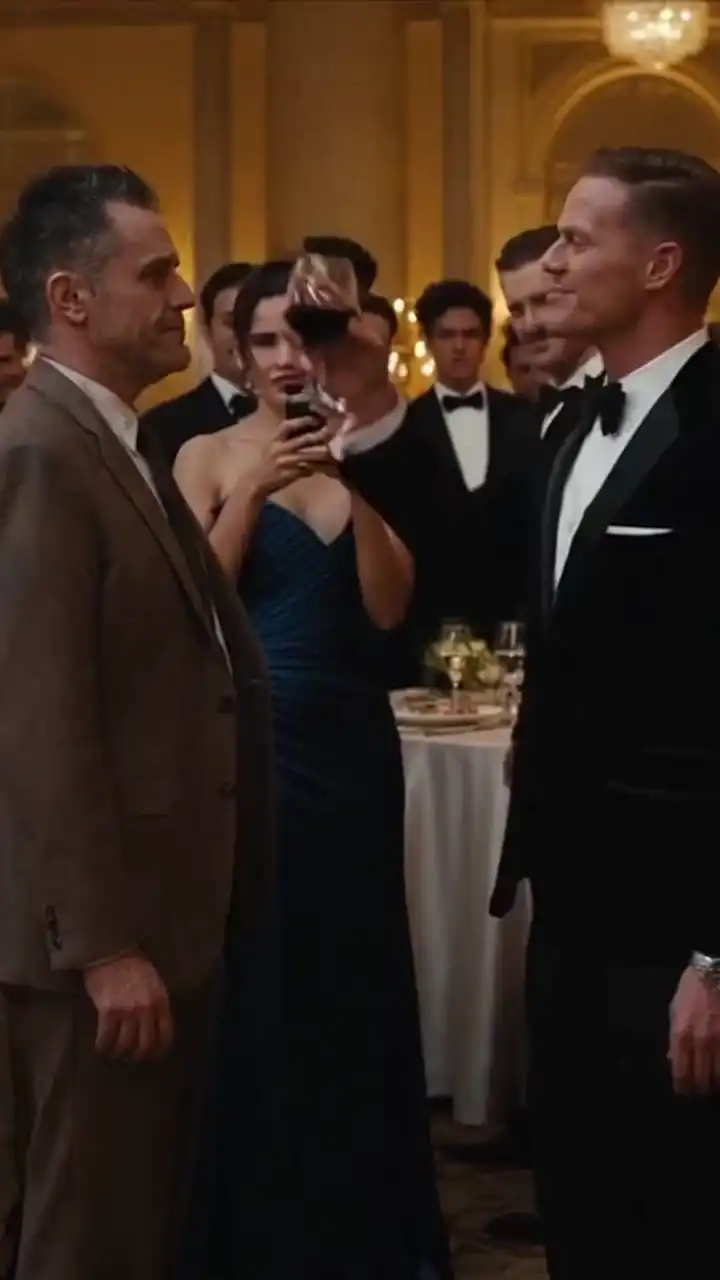

SHE POURED RED WINE ON MY SHIRT AND CALLED ME “THE DRIVER WHO FORGOT HIS PLACE”
Elliot didn’t answer her question.
He stepped closer to me instead.
Not to protect me. Not yet. More like a man walking toward a sound he prayed he was hearing wrong.
He looked at my wrist again. The watch was old, scratched near the clasp, plain enough that nobody in that room would have looked twice unless they knew it. Gold face. Brown leather band. Tiny crack across the number six.
Marissa’s fingers tightened around his sleeve. “It’s a watch,” she said, too fast. “Can we not do this in the middle of my event?”
My event.
That landed differently now.
Elliot asked me, very quietly, “Where did you get that?”
The room had gone thin and strange. Not silent. Glasses still touched. Music still murmured from the speakers. But people were no longer pretending not to watch.
I looked at Marissa first.
She gave me a warning look I’d seen a hundred times in rearview mirrors. The look she used when she wanted a call ended, a name forgotten, a pickup never mentioned.
I said, “Your wife gave it to me.”
That snapped the room fully awake.
Marissa let go of Elliot’s sleeve.
Talia barked out a laugh like she could still save it. “Okay, wow. So now the driver is making up dead women?”
I didn’t look at her. “Her name was Helena. She said if I ever came here and saw my son wearing her initials like they meant he earned them, I should keep the watch on until someone finally asked.”
That time, the silence was real.
Elliot’s face changed first. Not dramatic. Just emptied out.
Because the back of that watch had three engraved letters: H.C.
Helena Crane.
I had never shown it to anybody in that room.
Marissa moved before anybody else could. “He’s lying.”
Sharp. Immediate.
She turned to the crowd, not Elliot. That told me everything.
“He used to drive for us. He overheard private conversations. He’s bitter because he was let go. This is exactly why I didn’t want him here.”
“Let go?” I said.
I almost laughed, but it came out flat.
“You told payroll I quit after asking too many questions.”
A woman near the dessert table lowered her phone. She had been recording the party for fun. Now she was recording for a different reason.
Marissa heard it too. You could see her trying to decide which fire to stamp on first.
So she chose me.
“This man is unstable,” she said. “He became fixated on my family. On me. On my mother’s illness. We tried to help him. Clearly that was a mistake.”
That got her a few nods. Old instincts. Rich people trusting the richest voice.
But Elliot still hadn’t looked at her. He was looking at me like he was trying to pull twenty years of memory through one object.
“Say that again,” he said.
I touched the watch with my thumb. “Helena gave it to me in the hospital parking garage. She said, ‘He won’t hear this from me, and she’ll bury it if I die first.’ Then she told me Marissa wasn’t your miracle. She was your cover.”
A woman at the bar whispered, “Oh my God.”
Marissa’s mouth opened. “Stop.”
I didn’t.
“For years, you’ve stood beside money you didn’t build and grief you didn’t carry, and you called it your strength. But Helena said you weren’t the daughter who saved this family. You were the daughter they had to keep paying to keep quiet.”
“Security,” Talia said instantly, voice cracking with effort.
Nobody moved.
That was the first thing Marissa couldn’t survive.
Not the accusation. The pause.
Because all night, the room had obeyed her before she finished speaking. Now even the guards near the elevator were waiting to see what Elliot would do.
Marissa saw it too. She switched tactics so fast it would have been impressive if I hadn’t seen her do it to waiters, assistants, and one city councilman.
Her eyes filled.
“I can’t believe this,” she whispered, turning toward Elliot. “After everything I’ve done for your family, after the humiliation I accepted to protect your reputation, this is what happens? He comes in here and repeats the fantasies Helena fed anyone who would listen when she was medicated?”
That got a murmur. Better. Softer. More useful.
I knew this version of her. Hurt voice. Shaking hand. Carefully chosen break in tone.
She took one step toward Elliot. “You know what those final months were like. You know how paranoid she became.”
And there it was.
The second thing she shouldn’t have said.
Not because Helena hadn’t been sick. She had.
But because only a few people knew Elliot wasn’t there for most of those final months. He was overseas and then in rehab after a stroke scare nobody publicized. Marissa had handled access. Visitors. medication updates. papers. deliveries. all of it.
I watched Elliot catch it.
“You just said ‘those final months’ like you were with her every day,” he said.
Marissa blinked. “I was.”
“No,” said a voice from behind the champagne tower. “You weren’t.”
Every head turned.
The woman who stepped out was small, maybe late fifties, in a plain black dress with a valet ticket still looped around one wrist like she’d rushed upstairs instead of checking herself in properly. I knew her. Of course I did.
Nina.
Helena Crane’s overnight nurse for eleven months.
Marissa went white.
Talia looked around like she wanted a manager to appear and fix reality.
Nina kept walking until she was beside Elliot, not Marissa.
“You told me not to come,” she said to him, and there was something like apology in it. “I should have anyway.”
Marissa found her voice. “She was paid staff. She signed confidentiality—”
Nina cut across her. “And you broke it first when you used a dead woman’s illness as a prop.”
The room shifted harder than before because Nina wasn’t grand. She wasn’t polished. She didn’t sound rehearsed. She sounded tired. People trust tired when it has nothing to gain.
Elliot finally looked at Marissa. “What is she talking about?”
Nina answered before Marissa could.
“She’s talking about the foundation your stepdaughter launched tonight in Helena’s name. The speeches about caregiving. The interviews about sacrifice. The magazine profile saying Marissa stepped back from her own life to sit beside Helena every evening and learn compassion.”
Marissa said, “I did care for her.”
Nina nodded once. “For photographers. Sometimes for twenty minutes before a fundraiser.”
A man near the windows actually sucked in a breath.
Marissa straightened. “This is disgusting.”
“No,” Nina said. “Disgusting was the night Helena asked for her husband and you told her he was too ashamed to see her confused. He wasn’t ashamed. He was calling from Zurich. You declined it.”
Elliot stared at Marissa.
She took a full step back.
I remembered that night. Marissa had left the apartment in a silver gown and had me circle the block twice while she finished a call. When she got in, she rolled her eyes and said, “If dying people want peace, they should stop making it about themselves.”
I remembered every word because I almost quit that night.
But I had a son in community college. Rent. Blood pressure meds. A sister recovering from surgery. Men like me don’t always get to quit when we should.
Marissa looked around the room and saw the first real problem: nobody was rescuing her anymore.
So she went after Nina.
“You were fired,” she snapped. “For stealing medication.”
Nina almost smiled. “Say the full sentence.”
Marissa didn’t.
Nina did it for her. “I was dismissed after I refused to sign a statement saying Helena was too cognitively impaired to review changes to the family trust.”
That blew through the room like a window had cracked.
Talia whispered, “Marissa…”
“Shut up,” Marissa hissed, then realized too late she’d said it into open air.
Elliot’s expression went from hurt to calculation. That was worse for her. Hurt can be managed. Calculation means a rich man has begun counting consequences.
He asked Nina, “What changes?”
Nina reached into her bag with the slow, careful motion of someone who’d been waiting months to do one honest thing in public.
Marissa lunged a half-step. “Don’t.”
Again, nobody moved for her.
Nina pulled out a folded copy of a notarized visitor log and a set of handwritten notes.
“Helena asked me to document every time Marissa blocked a call, every time papers were brought in after sedation, every time she claimed Elliot had approved something without speaking to Helena directly. I kept copies because Helena told me, and I quote, ‘If I leave this in my own house, my daughter will redecorate it into fiction.’”
A couple of people actually looked down, like they shouldn’t be hearing this and couldn’t stop.
Nina handed the papers to Elliot.
His hands shook once. Just once.
Marissa saw it and tried one last switch.
She softened her voice so much I almost didn’t recognize it. “Elliot, please. Your wife was angry with me. You know she was. She never accepted me. She always treated me like I was after the family name.”
Nina said, “Because you were.”
Marissa rounded on her. “You have no idea what this family put me through.”
“No,” Nina said. “I have exact timestamps.”
That nearly broke the room.
Not because it was witty. Because it was true.
Elliot was scanning the pages now. Visitor times. declined calls. medication windows. two witness signatures on one late-night trust discussion Helena later wrote she did not understand. My name appeared three times as driver on pickup and drop-off logs. I knew because Helena had once asked me to sign when I brought in a lawyer Marissa said was “just a family friend.”
He looked up at me. “You knew.”
“I knew enough to know something was wrong,” I said. “Not enough to prove it alone.”
Marissa pointed at me like that would put me back in my place. “He stayed employed. He took the money. Don’t act noble now.”
It stung because it was half true. I had stayed.
I answered anyway. “Yes. I stayed. Because poor people don’t get clean exits from dirty houses. We get front-row seats.”
No one laughed.
Elliot asked, “Why tonight?”
I looked at the giant screen still glowing with Marissa’s foundation logo: HELENA HOUSE. A CARE LEGACY CONTINUED.
“Because tonight you were letting her turn your wife into branding,” I said. “And because Helena told me if Marissa ever stood in public claiming she built her life through devotion, someone had to say what devotion actually looked like.”
Nina’s voice came in low. Steady.
“Devotion looked like Helena crying because Marissa used her room for donor photos after moving the oxygen equipment out of frame.”
One woman covered her mouth.
Nina kept going, and this was the one truth Marissa could not survive hearing out loud.
“Helena didn’t leave that watch to him as a keepsake,” she said, nodding at me. “She left it because she trusted her driver more than her daughter. She said, ‘If there is one man in this house who has seen enough to know when she is lying, it’s the one she thinks doesn’t count.’”
Marissa made a sound then. Not words. Just impact.
Because that line stripped everything from her in one shot.
The party image. The grieving daughter image. The self-made image. Even the class game she’d built the night around.
She had poured wine on the exact witness her mother chose.
Talia took a slow step away from her.
Then another.
It sounds small, but if you’ve ever watched a social climber lose oxygen, you know that friends stepping back in public can hit harder than a lawsuit.
Marissa turned to Elliot in open panic now. “She manipulated everyone at the end. You know how she was. She wanted to punish me.”
Elliot looked at her for a long time.
Then he asked the only question that mattered.
“Did you block my calls?”
Marissa didn’t answer.
“Did you bring trust papers into her room after sedation?”
Still nothing.
“Did you tell this room tonight that this foundation was built from your caregiving while the woman actually caring for my wife was thrown out?”
Marissa swallowed. “It’s more complicated than that.”
That was enough.
Elliot handed the papers to his attorney, who I hadn’t even noticed near the back until that moment. Maybe he’d arrived with him. Maybe rich men always had one nearby.
“Freeze the foundation accounts,” Elliot said.
The attorney nodded at once.
Marissa stared. “You can’t do that. There are donors. Press. Boards.”
Elliot didn’t raise his voice. He didn’t need to.
“My wife’s name is not a laundering tool for your reputation.”
A few guests physically turned away from Marissa at that. Not because they suddenly grew morals. Because they smelled collapse.
Talia made it worse in the way weak people always do when survival kicks in.
She said, “Marissa, you told us Helena wanted this. You said Elliot signed off months ago.”
Marissa whipped toward her. “Don’t you dare.”
But Talia was already backing up. “You said the nurse was unstable. You said the driver was blackmailing you. You said—”
Marissa shouted, “Stop talking!”
Too late.
Once one person starts trying to save themselves, the rest follow.
A donor mentioned forged urgency emails. Another guest remembered a canceled hospice fundraiser that had somehow become Marissa’s private gala. A stylist said Marissa borrowed Helena’s brooch for the magazine cover and called it “symbolic inheritance.”
That phrase got passed around the room with actual disgust.
Marissa stood in the middle of it, red stain on my shirt, empty glass in her hand, realizing she had chosen the worst possible audience for cruelty. Not because they were kind. Because they were opportunists. And opportunists abandon whoever drops fastest.
She looked at me then with naked hate.
“This is what you wanted?”
“No,” I said. “I wanted you to let me walk out when I asked.”
That hit her harder than anything clever could have.
Because it was true.
I had come upstairs to give Elliot the watch and leave. That was it. No speech. No scene. No revenge fantasy. Just an old woman’s last insurance policy changing hands.
Marissa had needed spectacle. So she created the stage that buried her.
Security finally moved, but not toward me.
One of them approached Marissa carefully and said, “Ma’am, Mr. Crane has asked that you step away from the donor line and surrender event credentials.”
She laughed like he’d told a joke.
Then she saw nobody else laughing.
“Elliot?”
He didn’t answer right away. He was still holding Helena’s notes.
When he did, his voice was tired in a way that made him sound older than he had an hour before.
“You will not use my wife’s name again until counsel finishes reviewing every filing, every transfer, every statement made in connection with this foundation and the trust.”
Marissa’s chin trembled. “You’re doing this because of them?”
“No,” he said. “I’m doing this because of you.”
That landed.
She looked around for one friendly face and found none.
Even the photographers had lowered their cameras. Not out of respect. More because the story had changed genres and they knew it.
Marissa set the glass down with a shaking hand and tried to walk toward the private hallway. Security blocked her.
Not roughly. Just enough.
For a second, all the polish dropped and she looked exactly like what Helena had called her in the car once, under her breath, while Marissa took a donor call in the front seat and pretended not to hear.
A woman who thought being near power was the same thing as earning it.
Elliot turned to me.
“I owe you an apology,” he said.
“You owe Helena one,” I said.
He closed his eyes once. “Yes.”
Nina touched my arm after that, the first gentle thing anybody had done to me since I walked in.
“Come on,” she said. “Let’s get you cleaned up.”
As we headed toward the service corridor, I heard the room behind us break into low, vicious little clusters. Names traded. Alliances updated. Statements drafted in real time. That world is fast when blood is in the water.
In the kitchen, one of the catering girls handed me club soda and paper towels without asking questions. I thanked her and started blotting my shirt.
The stain spread before it faded.
Figures.
Nina leaned against the counter and let out a breath. “She always did think humiliation was cheaper than truth.”
I laughed then. Tired, ugly, real.
“You kept the notes all this time?”
“She kept copies in three places,” Nina said. “I kept one because I knew someday Marissa would get greedy in public.”
“She did.”
“She always does.”
A few minutes later, Elliot came into the kitchen without an audience.
No donors. No cameras. No Marissa.
Just a man holding a dead wife’s watch box, the original one, velvet worn down at the corners.
He set it on the counter between us.
“I found this after Helena died,” he said. “Empty. I thought it was misplaced.” He looked at me. “She planned farther ahead than I did.”
I didn’t say anything.
He pushed the box toward me. “Keep the watch for tonight. My attorney will need your statement. After that… if you’re willing… I’d like to know everything you saw.”
There it was. Not redemption. Work.
Real, messy work.
“I’ll tell the truth,” I said. “All of it.”
He nodded. “That’s more than this family has had in a long time.”
When he left, I looked down at the red marks still ghosting across my shirt. A little of the wine had dried near the buttons, dark as rust.
Upstairs, I could still hear muffled voices and the hard, clipped steps of people pretending they weren’t fleeing.
I thought about Helena in the back seat on rainy Tuesdays, asking me to drive the long way because she wanted twenty extra minutes before going home to a daughter who turned affection into leverage.
I thought about my son, who used to joke that rich people only notice drivers when they’re late or silent.
Tonight they noticed.
By midnight, Marissa’s launch photos were already being pulled offline. By morning, two board members resigned. By noon, the local paper changed its headline from philanthropist debut to foundation under review. A week later, Elliot filed for emergency injunctions over trust amendments and public misuse of Helena’s name. Talia gave a statement so fast you’d think she’d been waiting her whole life to betray a friend before being betrayed first.
As for me, I gave my statement, turned over copies of old route logs, and finally told payroll exactly why I hadn’t “quit.”
I didn’t go back to driving for the Cranes.
I got something better.
A clean exit.
And one last image stayed with me longer than the lawyers, the headlines, or the money ever would.
Marissa standing in a room she thought belonged to her, hand empty, voice useless, while the one person she called “just the driver” walked out carrying the truth her mother trusted him to keep.
Disclaimer: Mention of any brand or trademark is for identification only and does not imply partnership or endorsement