THE LITTLE YELLOW SWEATER
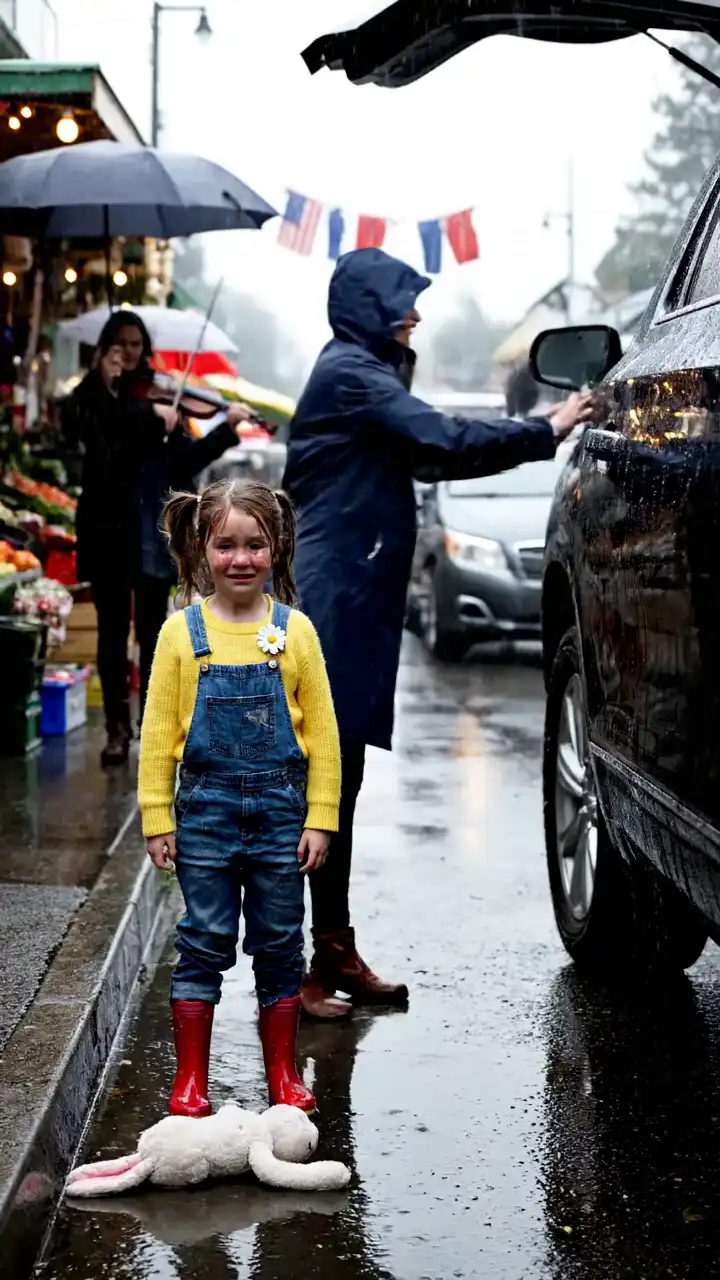
The rain had started just before noon, the kind of thin spring rain that silvered the sidewalks without chasing people indoors. In downtown Tacoma, Washington, the Saturday farmer’s market still buzzed beneath striped tents and dripping awnings. Vendors called out prices for peaches and fresh bread. A street violinist played near the fountain. Strollers bumped over wet pavement, and the smell of coffee and damp flowers drifted through the air.
Marissa Cole held her daughter’s hand as they stepped around a puddle near a stand stacked with honey jars. It was one of those ordinary moments people never think to memorize, which is why life so often steals them.
Five-year-old Delaney looked like something painted from tenderness itself. She had soft brown hair tied into two uneven pigtails, warm brown eyes that always seemed full of questions, and a tiny sprinkle of freckles over her nose. Her round cheeks were pink from the cold. She wore a bright yellow sweater with a daisy sewn near the collar, denim overalls, and red rain boots that made small squeaking sounds when she walked. In one hand she held a plush rabbit with one bent ear. In the other, she clung to her mother.
“Mommy, can we get the big cookie?” Delaney asked, tilting her face up.
Marissa smiled despite the weight already sitting in her chest. “After we buy the apples. You promised.”
“I pwomised,” Delaney said carefully, proud of getting the word right.
Marissa laughed softly. “Yes, you did.”
Her sister-in-law, Kendra, walked beside them beneath a navy umbrella, talking too quickly about traffic, parking, and how Marissa needed to “start getting out more.” Kendra had offered to help that day, insisting that after months of Marissa working double shifts and raising Delaney alone, she deserved support.
Marissa had been tired enough to say yes.
At the corner of the produce row, Delaney tugged her mother’s fingers. “Mommy, look! Balloons.”
A vendor across the lane had tied animal-shaped balloons to a crate. They bobbed in the rainy wind, bright against the gray sky.
“We can look in a minute,” Marissa said. “Stay with me.”
“I stay with you,” Delaney repeated.
Those would be the last easy words Marissa would hear from her child for eight years.
The trouble began with something small, as terrible things often do. Marissa’s phone rang in her coat pocket just as she was paying for apples. It was the memory care center where her father had been admitted two weeks earlier. The nurse’s voice came fast, urgent, telling her he had fallen and was asking for her. Marissa’s heart lurched.
“I need to take this,” she said, pressing the phone harder to her ear.
Kendra immediately reached for Delaney’s hand. “I’ve got her. Go ahead.”
Marissa nodded distractedly. “Don’t move. I’ll be right here.”
She turned half away from the stall, trying to hear over the rain and crowd. “What happened? Is he bleeding? Did he hit his head?”
Behind her, Delaney looked up at Kendra. “Can I have cookie now?”
“In a second,” Kendra said.
Kendra had always been polished, controlled, with a smile that looked supportive from a distance and sharp up close. She was her ex-husband Nolan’s older sister, and she had opinions about everything: Marissa’s apartment, Marissa’s job at the dental office, Marissa’s “chaotic” life after the divorce. For months she had hinted that Delaney needed more structure, more stability, more family influence.
Marissa had ignored most of it.
Now Kendra bent to Delaney’s level. “Sweetheart, your mom’s busy. Why don’t we go get the cookie and surprise her?”
Delaney looked uncertain and tightened her little fingers around the rabbit. “Mommy said stay.”
“We’re staying close,” Kendra said smoothly. “Come on.”
Just then, a cart wheel struck a pothole, spraying water onto Marissa’s jeans. She stepped aside and raised her voice into the phone. “Can someone stay with him until I get there?”
When she turned back, Kendra and Delaney were a few feet away, moving toward the bakery tent.
Marissa called, “Kendra, not far.”
Kendra lifted a hand without looking back. “Just the next stall.”
That should have been harmless. It should have been nothing.
But at the bakery tent, Kendra’s boyfriend, Troy Maddox, was waiting beside a dark SUV parked illegally near the loading curb. Marissa didn’t know he was there. She didn’t know Kendra had arranged any of it. She didn’t know that weeks of whispered conversations and poisonous certainty had led to that exact moment.
Kendra crouched beside Delaney. “Sweetie, your mommy has to help Grandpa. We’re going for a ride first, okay?”
Delaney frowned. “No. I go with Mommy.”
“It’ll be fun,” Kendra said. “Just for a little while.”
Delaney shook her head and backed away. “No. I want Mommy.”
Troy stepped closer. “Put her in.”
At first Delaney only looked confused, because five-year-olds still believe adults explain things. She held up her rabbit and searched Kendra’s face. “Where Mommy?”
“In the truck,” Kendra lied. “Come on.”
“It’s not a truck,” Delaney whispered, seeing the SUV.
Kendra’s smile disappeared. She grabbed Delaney’s wrist.
The little girl gasped. Her small hand slipped free from Kendra for half a second, reaching back toward the market. “Mommy!”
Marissa heard it then, faint but sharp enough to cut through rain and noise. She spun around.
All she saw at first was a flash of yellow sweater disappearing beyond a cluster of umbrellas.
“Delaney?”
Her basket dropped. Apples rolled across the sidewalk.
At the curb, Delaney twisted wildly, crying now. “Mommy! Mommy, no!”
Marissa ran.
Kendra yanked the rear door open. Troy swore under his breath. “Hurry up!”
Delaney tried to plant her red boots on the wet pavement, but she was tiny, frightened, and no match for adult hands. Her rabbit fell into a puddle.
“Mommy!” she screamed, reaching out with both arms as Marissa sprinted toward her. Their eyes met for one terrible, impossible second.
Marissa would remember that look forever: confusion, fear, trust breaking in real time.
“Let her go!” Marissa shouted.
She lunged forward just as Troy shoved Delaney into the SUV. Marissa caught only the sleeve of the yellow sweater. It stretched in her hand, then slipped free. The door slammed.
Delaney’s palm hit the rain-streaked window. “Mommy!”
Marissa pounded on the glass. “Delaney! Baby, I’m here!”
The engine roared. Troy shoved Marissa so hard she stumbled backward, striking the curb with one knee. The SUV lurched away, tires spraying dirty water across her coat and face.
Marissa screamed and ran after it anyway.
“Stop! Stop! My daughter!”
People turned. Someone yelled, “Call 911!”
The SUV cut through the intersection, brake lights flashing red in the rain, then vanished into midday traffic.
For a second the whole world seemed to go soundless. No violin. No vendors. No rain. Just emptiness opening in the center of Marissa’s chest.
Then everything came back at once.
She staggered into the street, waving frantically. “Did you see the plate? Did anyone see the plate?” Her voice cracked into something unrecognizable. “My little girl! They took my little girl!”
A woman with a stroller grabbed her arm. “The police are coming.”
“Kendra,” Marissa whispered, then louder: “Kendra took her. Kendra took my daughter.”
By the time officers arrived, Marissa was soaked, shaking, and half-mad with panic. She pointed with trembling hands, trying to describe the SUV, Troy’s face, Delaney’s sweater, the stuffed rabbit left behind in the puddle. An officer wrapped the toy in a plastic evidence bag while another asked questions that felt obscene in their calmness.
“What is your daughter’s full name?”
“Delaney Rose Cole.”
“Date of birth?”
“June seventeenth. She’s five. She’s five.” Marissa grabbed the officer’s sleeve. “Please don’t write slowly. Please.”
“We’re doing everything we can, ma’am.”
“She was crying for me,” Marissa said, tears mixing with rain. “She was reaching for me.”
“Who is Kendra?”
“My ex-husband’s sister.” The words barely came out. “She said she was helping.”
Another officer spoke into his radio. “Possible custodial interference escalating to kidnapping. Suspect names Kendra Hale and Troy Maddox.”
Marissa looked toward the road again and again, as if willing the SUV to reappear. “Nolan knows,” she said suddenly. “Or he’ll help them. I don’t know. I don’t know.” Guilt crashed over her in violent waves. “I let her take her hand. I let go for one minute.”
“No,” the first officer said, not unkindly. “This is not your fault.”
But blame had already rooted itself deep inside her.
The search began immediately. Patrol cars fanned out. Calls were made. An Amber Alert was discussed, then issued. Witnesses described a dark SUV heading north. One man thought he got part of a license plate. A bakery cashier remembered seeing the child crying. Every detail mattered, and none of it brought Delaney back before sunset.
Marissa went to the police station still in wet clothes. She gave statements until her throat burned. She called Nolan, who swore he knew nothing and then vanished for two days. Officers searched Kendra’s townhouse and found it nearly empty. Closets stripped. Bathroom bare. Mail gone.
It had been planned.
That truth landed heavier than anything else. This wasn’t a moment of panic. It wasn’t confusion in a crowd. Someone Delaney knew had used trust like a weapon.
Near midnight, a detective set a paper cup of coffee in front of Marissa. She didn’t touch it.
“We’ll keep searching through the night,” he said.
Marissa stared at the security stills from a nearby storefront camera: a blurred frame of Kendra’s umbrella, Troy’s shoulder, the bright yellow of Delaney’s sweater. The image was grainy, but Marissa could still see her daughter’s arm reaching outward.
That was the moment realization finally hardened into something cold and unbearable.
Delaney was gone.
Not missing for a minute. Not lost two aisles over. Gone into highways, motels, false names, and distance.
Marissa pressed both hands over her mouth to smother the sound that rose from inside her, but it escaped anyway—a broken, animal sound that turned heads across the station.
“I’m sorry,” she whispered to the empty chair beside her, as if her little girl might still somehow be sitting there. “I’m so sorry, baby. I’m coming. Mommy’s coming.”
The first three days passed without shape. Morning and night lost meaning. Marissa sat in the same clothes too long, then changed only because a female officer gently suggested it. She slept in fragments on a couch at her friend’s apartment because she couldn’t bear to be in Delaney’s bedroom and couldn’t bear not to be.
Detective Aaron Pike became the face of the investigation: a broad-shouldered man with careful eyes and a quiet voice that somehow made room for panic without feeding it. He met Marissa in interview rooms, in hospital-bright hallways, at her apartment table covered in photographs.
“We found toll camera footage,” he told her on the second night. “The SUV was headed into Oregon.”
“Then go there,” Marissa said instantly.
“We are.”
“Not are. Go. Now.”
He nodded once. “Teams are coordinating.”
Every hour she asked the same questions in different forms.
“Did they stop for gas?”
“Did anyone see her?”
“Was she crying?”
“Could she have my phone number memorized?”
Aaron answered what he could and never pretended when he could not.
On the third morning Marissa finally went back to her apartment. Delaney’s little raincoat still hung by the door. Her cup with cartoon strawberries was beside the sink. One pink sock was under the couch. Marissa sank to the floor holding that sock against her mouth.
Her neighbor, Elaine, came in quietly with groceries and found her there.
“You need to eat something,” Elaine said.
“I should have held on tighter.”
“Marissa—”
“I heard her,” Marissa whispered. “I heard her call me, and I still wasn’t fast enough.”
Elaine knelt beside her. “This is on them. Not you.”
But grief is stubborn, and guilt gives it a sharper edge.
The days became weeks. Flyers went up in Tacoma, Seattle, Portland, Spokane. Delaney’s kindergarten picture stared from grocery store windows, post office boards, gas stations, church entrances. MISSING in bold black letters above a smiling five-year-old girl in a yellow barrette.
The media covered the case for a while. Local news vans parked outside the apartment complex. Marissa stood before cameras because maybe someone would recognize the face of her child.
“If you see Delaney Rose Cole,” she said with cracking voice, “please call the number on the screen. She’s five years old. She likes rabbits and chocolate milk and she still sleeps with a night-light. She will be scared. Please—please help bring my baby home.”
For a few days tips poured in. Most were nothing. A girl at a rest stop in Idaho. A child in a diner in Eugene. A family with a nervous little girl in northern California. Every lead lit hope and crushed it.
Nolan finally resurfaced with an attorney and a hollow expression. He claimed Kendra had lied to him, saying she only wanted to “keep Delaney somewhere stable” until Marissa “got herself together.” Marissa almost laughed at the cruelty of that phrase.
“You knew she thought she could do better than me,” Marissa said across the interview room.
Nolan rubbed his forehead. “I didn’t think she’d do this.”
“You didn’t stop her either.”
He had no answer.
Work became impossible. Marissa made mistakes scheduling patients, forgot names, stared through conversations. Her supervisor tried to be kind, but after a month there was only so much kindness a business could afford. Marissa took unpaid leave, then lost the job entirely.
Her father died six weeks after Delaney was taken. In the hospital chapel after the service, Marissa sat alone on a wooden bench and thought how cruel it was that a body could still keep breathing through that much loss.
Winter came. Then spring again.
The police found the SUV abandoned outside Medford, Oregon, wiped clean. No Delaney. No Kendra. No Troy. False IDs had been used at motels. Cash only. The trail thinned, then frayed, then nearly disappeared.
Still, Detective Pike kept calling.
“We got a lead in Reno.”
“We’re checking school registrations under known aliases.”
“There’s a woman in Arizona who may have seen Kendra.”
Marissa clung to each update. “Did she have Delaney?”
“We don’t know yet.”
But most often, they didn’t know anything.
Friends stopped asking daily because they feared the answer. Some family members spoke Delaney’s name in hushed tones, as if she had become something fragile and sacred. Others avoided it entirely, which Marissa hated more.
On Delaney’s sixth birthday, Marissa baked a small cake with rainbow sprinkles and set it on the kitchen table beneath the girl’s framed photograph. She lit one candle and whispered, “Make a wish, baby.” Then she cried so hard she nearly choked on the air.
Year one taught her a terrible skill: how to continue living while one part of her remained frozen in a rain-soaked market, hand outstretched.
She found routines because the body insists on movement even when the heart refuses. She took a new job answering phones at a law office in downtown Tacoma. She paid rent. She folded laundry. She bought groceries. She smiled when required. But every missing child poster on a mailbox made her pulse leap. Every little girl with brown pigtails could stop her where she stood.
She marked the anniversary of the abduction alone at the fountain in the market. The city had repainted the curb. Different vendors stood beneath fresh awnings. Children laughed nearby. Marissa held Delaney’s bent-eared rabbit, recovered from police evidence months earlier and dried carefully, though one paw was still stained darker from the puddle.
Detective Pike stood beside her that afternoon in silence until she finally asked, “Do you think she remembers me?”
He took a long time before answering. “I think children remember love even when memory gets blurry.”
Marissa looked at the crowded sidewalks. “What if they’ve told her I abandoned her?”
“Then we find her,” he said, “and tell her the truth.”
Marissa closed her eyes. Hope no longer burned bright. It was smaller now, protected, like a pilot light hidden from wind. But it was there.
She went home, opened a new notebook, and wrote on the first page:
For Delaney. I am still looking. I will always be looking.
The years did not heal Marissa. They shaped themselves around the wound.
By the third year, she had learned to function well enough to fool strangers. She got certified as a paralegal through night classes, moved into a smaller apartment she could better afford, and organized her life into manageable compartments: work, bills, errands, sleep. But Delaney lived in the hidden center of all of it.
A wall in her bedroom held photographs arranged by age five and under. Delaney on a swing. Delaney licking frosting from a spoon. Delaney asleep with one chubby hand under her cheek. Every June seventeenth, Marissa added a blank frame labeled with the age her daughter should be now. Six. Seven. Eight. Nine. Ten. It hurt, but it also kept time honest.
She kept Delaney’s yellow sweater in a sealed box lined with tissue paper after police returned it. Sometimes, on the loneliest nights, she unfolded it and pressed her face into the fabric, though the scent of her child had long since vanished.
“Talk to me,” Elaine would say over coffee on bad mornings.
“There’s nothing new to say.”
“Then say the old thing.”
Marissa would stare into her mug. “I miss her.”
“I know.”
“I’m afraid she thinks I didn’t come.”
Elaine reached across the table. “If she has your heart, she knows you came.”
Detective Pike remained in touch even after the official urgency faded from the department. He was promoted, transferred units, carried other cases—but he never closed Delaney’s in spirit.
“We found records of Kendra under another name in Nevada,” he said one fall.
“Was Delaney with her?”
“No confirmation.”
“Keep going.”
“I will.”
Marissa dated once, briefly, because people said she deserved a life. The man, a patient accountant named Curtis, was kind enough to notice that she was always halfway elsewhere. After two months he said gently, “You don’t have room for anything uncertain.”
He was right. She didn’t.
While Marissa lived with endless memory, Delaney lived inside a story built for her by other people.
Kendra and Troy changed states twice before settling under new names in Billings, Montana. To neighbors they were respectable enough: a private couple with a quiet little girl they introduced as Lanie Maddox. Kendra said the child had come from a troubled family situation and that too many questions could “trigger old trauma.” People, eager to feel wise and compassionate, mostly accepted that.
At five, Delaney cried every night for her mother. At six, she asked every day when she was going home. At seven, the questions became less frequent, not because they mattered less but because the answers never changed.
“Your mother left you,” Kendra would say while buttoning her coat too tightly. “We’re the ones who stayed.”
“That’s not true,” Delaney whispered once.
Kendra’s face went cold. “Do not be ungrateful.”
Troy was less interested in lies than in order. “Stop fussing,” he would say. “You have a roof, food, school. That’s what matters.”
But children build secret sanctuaries out of fragments. Delaney kept a memory box under her bed: a grocery store receipt she had once convinced herself smelled like rain, a drawing of a fountain she barely remembered, and one important treasure she had hidden from Kendra for years—a tiny thread pulled from the cuff of her yellow sweater the day she was taken. She didn’t know why she had saved it at five. She only knew it belonged to Before.
By age eight, she was a beautiful child with soft brown hair usually braided by her own hands because Kendra tugged too hard. Her brown eyes were observant and older than they should have been. Teachers described her as polite, quiet, unusually self-contained. She read above grade level. She flinched at yelling. She had a gentle smile she offered cautiously, like someone lending out something precious.
Sometimes at night, half-asleep, she heard a voice in memory saying, “Stay with me.” Sometimes she dreamed of red rain boots splashing through silver puddles and woke with tears on her face.
At school, when other children made family trees, Delaney stared at the paper too long.
“Can I put more than one mom?” she asked her third-grade teacher, Mrs. Janney.
Mrs. Janney knelt beside her desk. “Of course you can, honey.”
Delaney lowered her voice. “What if one of them is missing?”
Mrs. Janney looked startled. “Do you mean passed away?”
“I don’t know,” Delaney said.
That was the problem. She didn’t know.
Parallel to Delaney’s carefully narrowed world, Marissa kept searching in ways small and large. She entered Delaney’s age-progressed image into every database she could. She joined online groups for missing families. She learned terms she had never wanted to know: family abduction, alias trail, noncustodial concealment, record scrub. She spoke at child safety events. She answered new parents who asked how to protect their kids. She always went home shaking afterward.
There were near-misses that would haunt both their lives later.
When Delaney was seven, Kendra took her through Spokane on the way back from visiting Troy’s cousin. At a gas station off the interstate, Marissa was inside paying for coffee after a late legal filing run. Delaney stood outside by the ice machine, hugging her sweater closed against the wind. Marissa exited through the opposite door at the exact moment Kendra pulled Delaney toward the SUV. Neither saw the other.
When Delaney was eight, Mrs. Janney reported concerns to a school counselor after the family tree conversation. The counselor called home. Kendra arrived tearful and persuasive, saying Delaney had “attachment fantasy issues” because of early neglect. The report went nowhere.
When Marissa was invited to share Delaney’s case in a regional missing-children newsletter, one copy landed in a dentist’s waiting room in Billings. Delaney, now reading chapter books in the corner while Kendra filled out insurance forms, never saw it because Troy used the page to wipe coffee from his shoe and threw it away.
Yet loss has a way of surviving suppression. Delaney began keeping a notebook at eight, hidden behind old board games in the closet. She wrote down things she remembered and things she wondered.
A fountain. Rain. A rabbit. Mommy? Yellow.
One night, she finally asked Troy directly, “What was my name before Lanie?”
He looked at her over the television remote. “That is your name.”
“You paused.”
Troy’s jaw tightened. “Go to bed.”
“Did my mom leave me?”
Kendra answered from the kitchen doorway. “Yes.”
“Then why do I remember her running?”
Silence filled the room like smoke.
Kendra recovered first. “You imagined that.”
But Delaney saw fear flash across her face, and that fear became a seed.
By then Marissa had spent eight birthdays without her child. The guilt inside her had changed form. It was no longer only I let go. It had become I must not stop. If she ever surrendered hope, then the lie would win completely.
On Delaney’s thirteenth birthday approaching in theory—but in reality, she was only ten now, because eight years had not yet passed? No, only five years under the required time gap. So on Delaney’s tenth birthday, Marissa drove to the coast alone and stood facing the cold Pacific wind. She imagined her daughter somewhere under the same sky, maybe blowing out candles, maybe pretending not to care who had remembered.
“Happy birthday, baby girl,” she said into the wind. “You’re ten now. I hope somebody is kind to you today.”
That same evening in Billings, Delaney sat at a kitchen table under fluorescent light while Kendra set down a grocery store cupcake with pink icing.
“Happy birthday, Lanie,” Kendra said.
Delaney looked at the single candle. “Was I always ten on June seventeenth?”
Kendra froze.
It was a tiny thing, but Delaney noticed. She noticed everything now.
“Yes,” Kendra said.
Delaney held her gaze and made no wish before blowing out the candle.
The truth began moving not because the adults chose honesty, but because a child who had become old enough to doubt refused to stop listening to her own memory.
Delaney was ten when her class was assigned a heritage project. Most students groaned. Delaney felt something stranger—an electric unease. They were supposed to interview family, collect dates, and bring in a baby photo.
At dinner she asked, “Do we have any pictures of me when I was little?”
Kendra didn’t look up from her plate. “Boxes in the garage.”
“I checked. There’s only school pictures from kindergarten.”
“You were a difficult child before that,” Troy muttered. “A lot got lost.”
Delaney took a breath. “What hospital was I born in?”
Kendra set down her fork. “Why all the questions?”
“Because everybody else knows.”
“You know what matters.”
“That’s not an answer.”
The room chilled.
Later that night, Delaney heard Troy and Kendra arguing in low, urgent voices through the vent.
“She’s pushing too much,” Troy said.
“She’s a kid.”
“She’s not dumb.”
“Then we hold the line.”
Delaney lay still in bed, heart hammering. Hold the line. Against what? Against whom?
The next week she went to the public library after school instead of straight home, telling Kendra she had art club. At a computer terminal she typed the few facts she had: June seventeenth, Tacoma fountain, missing mother maybe, not sure. Nothing at first. Then she tried broader terms: Washington kidnapped girl yellow sweater.
Search results spilled down the screen.
One old news article from five years earlier stopped her cold. The photograph was small and grainy, but the child smiling beside the headline had her face.
Five-year-old Delaney Rose Cole abducted from Tacoma market.
Her breathing went shallow. She clicked with trembling fingers.
There was the yellow sweater. There was the rabbit. There was the name Delaney.
There was her mother, standing before microphones, eyes red and desperate, saying, “She will be scared. Please help bring my baby home.”
“No,” Delaney whispered. Then louder: “No.”
The librarian, a silver-haired woman named Joanne Mercer, looked up from the desk. “Honey, are you okay?”
Delaney turned the monitor slightly, tears already spilling. “I think that’s me.”
Joanne crossed the room slowly, the way people approach injured animals. She read the article, then looked back at Delaney with sudden, terrible understanding.
“What’s your name?” Joanne asked softly.
Delaney swallowed hard. “I think it’s Delaney.”
“Who do you live with?”
Delaney’s voice shook. “People who said my mom left me.”
Joanne did not waste a second. “Stay right here with me.”
She guided Delaney into a staff office and locked the door. “You are safe,” she said. “Do you understand? Safe.”
Delaney nodded, though she didn’t feel safe yet. She felt split open.
Joanne called 911, then called the National Center for Missing & Exploited Children. Delaney sat clutching a paper cup of water she couldn’t drink. On the wall hung a faded poster about reading adventures. The ordinary cheerfulness of it made everything feel unreal.
“Will they make me go back with them?” Delaney asked.
“No,” Joanne said firmly.
“Was she looking for me?”
Joanne’s eyes softened. “Yes. For a very long time.”
In Tacoma, Marissa was in the law office break room when Detective Pike called from a number she knew by heart.
“Marissa,” he said, and his voice was different.
Her whole body went cold. “What happened?”
“I need you to sit down.”
“Aaron.”
“We may have found her.”
The ceramic mug slipped from her hand and shattered across the tile.
For one suspended instant Marissa couldn’t move, couldn’t even breathe around the words. “What did you say?”
“A girl in Billings came forward after seeing an old article. Name matches. Age matches. We need formal confirmation, but—Marissa, it could be Delaney.”
Hope hit so hard it felt like pain. “I’m coming.”
“We’re arranging coordination with Montana authorities. Don’t travel until I call you back.”
“I am not waiting here while my daughter is in another state.”
“Marissa, listen to me. We have to do this right.”
She braced one hand on the counter. “Is she okay?”
“She’s alive,” he said. “She’s scared. But she’s alive.”
Marissa slid down the cabinet to the floor amid broken ceramic and coffee spreading like dark rainwater. Alive. Her daughter was alive.
Within hours Kendra and Troy were in custody, stunned not by guilt but by exposure. Delaney gave her statement in the presence of a child advocate and Joanne, who had refused to leave until officials arrived.
“I remembered my mom running,” Delaney said. “They told me I imagined it.”
She described the rabbit, the market, the rain, the name Delaney. She described years of lies in a voice too calm for a child.
Marissa spent that night on a flight to Billings after all, with Detective Pike seated across the aisle because he knew she should not make that journey alone. Her hands never stopped shaking.
“What if she doesn’t want me?” Marissa whispered into the dim airplane cabin.
Aaron leaned forward. “She searched for you.”
“What if she hates me for not finding her sooner?”
“She’s ten, Marissa.”
“She missed five years because I trusted the wrong person.”
Aaron’s expression held both sorrow and steadiness. “And tomorrow she gets the truth.”
Marissa pressed Delaney’s old rabbit to her chest the entire flight.
The reunion took place in a family services center in Billings, Montana, in a room designed by people who understood that pain sometimes needed soft furniture and pastel walls. There was a shelf of puzzles, a faded rug with stars, and a wide window letting in gentle morning light. Outside, the sky was clear and blue in a way that felt almost offensive after so many storm years.
Marissa stood in the hallway unable to feel her legs.
A social worker named Bethany explained the plan in a calm voice. “Delaney knows you’re here. She asked to meet you. We’ll go slowly. If either of you needs a break, we stop.”
Marissa nodded too quickly. “Okay.”
“Try to let her set the pace.”
“I’ve been waiting five years,” Marissa said, then swallowed. “I can go slow.”
Detective Pike stood a few feet away, hands in his coat pockets. “You ready?”
“No,” Marissa whispered. “But yes.”
Bethany opened the door.
At first Marissa only saw the back of a small girl standing by the window in jeans and a pale green sweater. Her brown hair, longer now, fell in a braid between her shoulder blades. She looked taller than the child Marissa carried in memory, but heartbreak recognized her instantly anyway.
“Delaney,” Marissa said.
The girl turned.
Same brown eyes. Same soft shape of face. Same tiny freckle near the left side of her nose. Older, thinner, more guarded—but undeniably hers.
For a moment neither of them moved.
Delaney stared with parted lips, breathing fast. Marissa’s hand flew to her mouth. Years collapsed and stretched at once. She saw the five-year-old in the ten-year-old. She saw the lost child and the person she had become without her.
“Oh my God,” Marissa whispered.
Delaney’s eyes filled first. “You came.”
The words shattered whatever thin control Marissa had left. “I never stopped coming.”
Delaney took one uncertain step forward. “You’re real.”
“Yes, baby. Yes.” Marissa’s voice trembled so hard she could barely speak. “I’m real.”
The girl looked at her face as if matching it to a memory she had polished in secret for years. “I remember your voice,” she said. “Sometimes in dreams.”
Marissa let out a sob she had held in her body for half a decade. “I remember everything.”
Bethany and Aaron remained near the door, giving them space while still present.
Delaney’s hands twisted together. “They said you left me.”
Marissa shook her head immediately. “No. Never. They took you from me at the market. I ran after you. I was there. I was there, Delaney.”
Delaney made a small broken sound, halfway between a cry and a breath. “I knew it.”
Marissa took one careful step closer. “Can I come nearer?”
Delaney nodded.
When Marissa reached her, she stopped just short, afraid even then to assume touch was hers to claim. She looked down and saw Delaney’s fingers trembling.
“I brought something,” Marissa said softly. From her bag she took out the bent-eared rabbit, washed and repaired but still imperfect. “He’s been waiting too.”
Delaney stared at it and then at Marissa. “Bunny.”
“You called him Bunny because naming him rabbit felt too obvious,” Marissa said with a watery smile.
Delaney let out a sob-laugh. “I did.”
“You chewed one ear when you were sick with the flu and then cried because you thought he was ruined.”
Delaney pressed both hands over her mouth.
Marissa’s own eyes flooded. “And when you were four, you told me yellow rain boots made you faster because they looked like sunshine.”
Delaney dropped her hands. “Mine were red.”
Marissa nodded through tears. “Yes. Red. You corrected me every time I mixed them up.”
That did it. The final wall gave way.
“Mom,” Delaney whispered, as if testing the word against truth.
Marissa reached out slowly and touched her cheek.
First touch after five years.
Delaney leaned into it instantly.
Warm skin. Real child. Real life returned.
Marissa’s knees nearly buckled. “Is it really you?” she whispered.
Delaney gave a shaky nod. “I have the mark.”
“What mark?”
Delaney turned her wrist over. Near the base of her thumb was the pale crescent scar from when she had tried to “help” peel potatoes at age three and nicked herself on the peeler blade. Marissa had kissed it for days.
Marissa covered the little scar with her fingertips and cried openly. “You were trying to cook dinner.”
“You said I was your tiny chef,” Delaney answered.
Recognition flashed complete between them—not just in the eyes, not just in features, but in shared history no lie could counterfeit.
From the doorway Bethany quietly turned away to give them privacy, wiping at her own face.
Marissa sank to her knees so they were eye level. “I am so sorry,” she said. “I am sorry for every birthday, every night, every minute I couldn’t get to you.”
Delaney’s brow pinched. “Did you look for me?”
“Every day.”
“Really?”
“Every day,” Marissa said. “There wasn’t one day I stopped.”
Delaney’s tears spilled harder now. “I wrote down things I remembered so I wouldn’t lose you.”
Marissa let out another trembling breath. “I kept your room in my heart the same way.”
Then Delaney stepped forward all at once.
Marissa opened her arms.
The embrace was not graceful. It was fierce. Delaney collided with her, wrapping both arms around her neck so tightly Marissa could hardly breathe, and Marissa held her with the desperation of someone pulling a child from deep water at last.
“Oh, my baby,” Marissa wept into her hair. “My baby girl.”
“Mom,” Delaney cried. “Mom, Mom, Mom.”
Years of grief poured out through touch, through trembling shoulders, through the way neither of them could seem to loosen their hold. Marissa rocked her instinctively as if Delaney were still five, though her daughter was longer now, heavier, older in sorrow.
“I thought maybe you forgot me,” Delaney whispered against her neck.
“Never.”
“I tried to remember your face.”
“I’m here now.”
“I’m here too,” Delaney said, crying harder.
Those first words held each other up like a bridge built in a single breath.
The first hours after reunion were a blur of practical steps wrapped around impossible tenderness. There were official statements, legal documents, emergency custody orders, and careful explanations Delaney only half listened to because she kept looking at Marissa as if afraid she might disappear if not watched.
In a private room later, they sat side by side on a couch with a blanket over Delaney’s legs though the room wasn’t cold.
“Do you like pancakes still?” Marissa asked, smiling through fatigue.
Delaney considered. “Yes. But not blueberries anymore.”
Marissa laughed softly. “Good to know.”
“You still laugh the same,” Delaney said.
“You still tilt your head when you’re deciding whether to trust someone.”
Delaney looked down. “I’m trying.”
“You don’t have to rush.”
After a pause, Delaney asked, “Did Grandma Elaine keep the turtle mug?”
Marissa blinked, stunned. “You remember the turtle mug?”
“It had a chip on the handle.”
Marissa smiled wider. “Elaine still has it.”
Delaney let out a small breath, almost a smile. “Then maybe I remember a lot.”
They talked in pieces, not in neat order. Delaney told her about school in Billings, about hiding questions in notebooks, about pretending not to care when other kids talked about baby photos. Marissa told her about the apartment they no longer lived in, about Detective Pike never giving up, about birthdays marked with candles and blank frames.
“Blank frames?” Delaney asked.
“One for every year I missed seeing your face as it changed.”
Delaney’s eyes filled again. “That’s sad.”
“It is,” Marissa said honestly. “But it also means I was saving space for you.”
Healing did not mean pretending the lost years were small. There was grief in every conversation. Grief that Marissa had not seen first-grade drawings taped to a refrigerator. Grief that Delaney had spent nights believing abandonment instead of love. Grief for school plays, scraped knees, loose teeth, fever nights, bedtime stories, all of it stolen.
One evening two days later, in a temporary family apartment arranged by services, Delaney sat curled beside Marissa on the couch and asked, “Can I be mad?”
Marissa turned to her. “Yes.”
“At them?”
“Yes.”
“At you a little?”
Marissa’s throat tightened. “Yes, baby. Even at me.”
Delaney picked at the blanket. “Because you weren’t there.”
Marissa nodded, tears rising but not hiding. “I know.”
“But you tried.”
“I tried.”
Delaney leaned against her shoulder. “Then I think I’m mad at the right people.”
Marissa kissed the top of her head. “That’s fair.”
Detective Pike visited before they flew home to Washington. He stood awkwardly in the doorway while Delaney studied him.
“So you’re the detective,” she said.
Aaron smiled. “I guess I am.”
“Mom says you kept looking.”
“I did my job.”
Delaney shook her head with the seriousness only children can summon. “No. You did more.”
His eyes reddened unexpectedly. “Thank you, kiddo.”
Back in Tacoma, the return was tender and strange. Elaine cried openly at the airport. The apartment felt both new and full of ghosts. Marissa had redecorated over the years, but she had kept Delaney’s baby quilt, a stack of picture books, and one framed photo beside her bed.
Delaney walked through each room slowly. At the window she turned and asked, “Do I live here now?”
Marissa answered just as carefully. “If that feels right to you, yes. We can make the space together.”
Delaney nodded. “Can I paint my room blue?”
Marissa laughed through tears. “You can paint it any color you want.”
The days ahead would not be simple. There would be therapy, court hearings, nightmares, trust built in inches, and stories too painful to finish in one sitting. There would be moments when Delaney needed space and moments when she needed to sleep with the hall light on. There would be questions about identity, memory, and all that had been stolen.
But there would also be Saturday pancakes. New school supplies. Long walks by the water. Hair braiding learned gently this time. Birthday cakes not eaten alone. A mother and daughter discovering not only who they had been to each other, but who they could still become.
One night a week after coming home, Delaney stood by Marissa’s bedroom door in pajamas, holding Bunny under one arm.
“Mom?”
Marissa looked up from her book. “Yeah?”
Delaney hesitated. “I know I’m big, but... can I sleep in here tonight?”
Marissa set the book aside at once. “Always.”
Delaney climbed into bed, small again in that old familiar way, though also not small at all. Marissa tucked the blanket around her.
After a quiet moment, Delaney whispered, “You found me.”
Marissa smoothed her brown hair. “You found me too.”
Outside, rain tapped lightly against the window, gentle and clean. Not a storm this time. Just weather passing.
And for the first time in five years, neither of them was facing it alone.
They say time heals all wounds. But some wounds don't need healing—they need to be found again.
After 5 years, Marissa finally held Delaney again. The years apart would never be forgotten, but the years ahead would be filled with the love that never died.
Like this story? Follow for more tales of families finding their way back to each other.
Disclaimer: Mention of any brand or trademark is for identification only and does not imply partnership or endorsement