A SCIENCE STUDENT HAD HER ONLY MEAL STOMPED AT A BUS STOP — BUT THE STAR QUARTERBACK HAD NO IDEA WHOSE FAMILY SHE’D JUST HURT.
The black car stopped so close to Grant Holloway that the heat from its engine touched the wet sleeve of his jacket.
He stepped back, still holding the torn meal card between two fingers.
For one second, nobody moved.
The car had no plate.
It had no dealership tag, no state inspection sticker, and no chrome badge anyone at the bus stop recognized.
Its body was low and smooth, almost too clean for the dirty curb, with a thin silver line running over the hood.
The line ended in a small raised mark that looked like a hand holding a flame.
Grant stared at it.
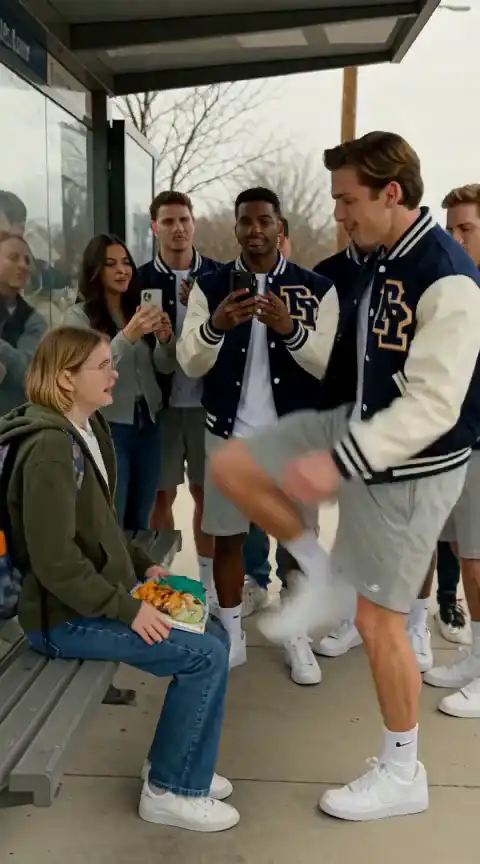
Then he looked at the teammates filming him.
“Is this some kind of commercial?” he asked.
No one answered.
Lillian stood beside the bench with milk dripping from her hair and the remains of her notebook stuck to her shirt.
She had stopped crying before the car arrived.
That was the part Grant did not understand.
He thought silence meant surrender, and he had spent the last ten minutes treating her silence like permission.
The driver’s door opened.
A man stepped out.
He was tall, fair-skinned like Lillian, and wore a dark coat with no logo on it.
He did not look at Grant first.
He looked at the crushed lunch bag beneath Grant’s shoe.
Then he looked at Lillian.
Her mouth tightened.
“Dad,” she said.
The word moved through the crowd faster than the traffic noise.
Grant’s smile slipped, but only for a moment.
“Wait,” he said. “You know this guy?”
The man shut the car door.
His eyes stayed on Lillian’s face.
“Are you hurt?”
Lillian shook her head.
“Just my notebook.”
He glanced at the ruined pages.
“Your hand?”
She looked down.
A thin cut ran across one knuckle where the carton had split.
“It’s fine.”
Her father took one step toward her, but stopped before touching her.
He had warned her never to let anyone connect her to the company before graduation.
He had wanted her to ride the bus, enter the science fair, and be judged on her work instead of his name.
For almost a year, she had carried that warning like another schoolbook.
Grant raised the torn meal card.
“Your daughter started something,” he said.
The man finally turned toward him.
He did not raise his voice.
“Put that card down.”
Grant laughed, and the sound came out too high.
“Man, this is school drama.”
“Put it down.”
Grant looked toward the football parents near the curb.
His mother stood beside a white luxury SUV, one hand wrapped around a paper cup.
His father was on the phone near the bus shelter.
Both of them had been watching.
Neither came closer.
Grant dropped the card.
The damp paper landed in the milk on the sidewalk.
His father ended the call.
“Grant,” he said. “Walk away.”
That was the first time the crowd heard fear in an adult voice.
Grant’s teammates lowered their phones.
Lillian bent to pick up the crushed lunch bag.
Her father reached it first.
He lifted it carefully, as if the torn canvas still mattered.
The black car gave a soft chime.
Grant turned toward it.
A narrow panel on the dashboard lit through the windshield.
A white symbol appeared, followed by a line of text nobody outside the car could read.
Grant took another step backward.
His own vehicle sat behind him, a silver Aurelian R8 with black wheels and a custom plate bearing his jersey number.
He had spent all morning bragging about it.
He had told three teammates that the car could recognize him before he touched the door.
He had said the company built machines for people who mattered.
Now its headlights flashed twice.
The locks clicked.
Then the engine started by itself.
Grant’s father turned sharply.
“What did you do?”
“I didn’t do anything,” Grant said.
His mother hurried from the SUV.
“Grant, get in my car.”
He reached for the driver’s door of the Aurelian.
The handle stayed flat.
He tried again.
The panel on the door lit red.
ACCESS RESTRICTED appeared beneath his name.
One of the football players whispered, “Dude, it says your name.”
Grant slapped the handle.
“It’s glitching.”
His father moved toward the car.
“Call the dealer.”
Grant’s mother pulled out her phone.
The screen showed no signal.
Then her phone buzzed.
She read the message and went still.
Grant saw her face.
“What?”
She turned the screen away.
His father took the phone from her hand.
The message was short.
REMOTE PRIVILEGES REVOKED.
VEHICLE STATUS UNDER REVIEW.
He looked at the black concept car.
The small silver emblem on its hood caught the afternoon light.
His lips parted.
“Everett,” he said.
Lillian’s father did not answer.
Grant’s father took one step closer.
“You’re Everett Mercer.”
The bus driver came down again.
This time he stayed on the pavement.
A woman near the grocery cart raised her phone openly.
No one told her to stop.
Everett Mercer looked at Grant’s father.
“Yes.”
A murmur passed through the stop.
Somebody said the name again.
The football players looked at one another.
One of them opened a search page and stared at the picture that loaded.
Everett Mercer stood beside a black car with the same silver emblem.
The caption beneath the photograph called him the founder of Mercer Automotive Systems.
The company had built the Aurelian line.
Not just the body.
The engine controls, the identity system, the security network, and the software that decided whether a vehicle belonged to the person holding the key.
Grant had spent months bragging about owning one.
He had never asked who built it.
His father had.
He had also spent years asking Everett Mercer for better dealership terms.
Everett looked down at the milk on Lillian’s shirt.
Then he looked at the Aurelian refusing to open for Grant.
Grant’s father swallowed.
“Mr. Mercer, this is a misunderstanding.”
“No,” Everett said. “It isn’t.”
Grant’s mother stepped between them.
“Your daughter is a student at Eastbridge Prep, right?”
“Yes.”
“And Grant is a student there too.”
“I know.”
“We can handle discipline through the school.”
Everett looked past her at the torn meal card.
“Your son didn’t ask the school to handle hunger.”
Grant’s face flushed.
“It was a joke.”
Everett turned to him.
“Was the food a joke?”
Grant said nothing.
“Was the card a joke?”
Grant’s fingers curled.
“Was telling her to go hungry a joke?”
The bus driver lowered his head.
The woman with the grocery cart stopped recording for a second, then turned the phone back toward Grant.
Grant looked at the phones.
His teammates had not put them away.
They were filming him now.
His father grabbed his arm.
“Get in the SUV.”
Grant pulled away.
“I’m not leaving my car.”
“You can’t get in your car.”
“It’s mine.”
Everett reached into his coat and took out a slim black key card.
He did not wave it.
He simply held it at his side.
The black concept car chimed again.
Its front doors unlocked.
The bus stop went quiet.
Grant stared at Everett’s hand.
The key card had the same silver emblem as the car.
Grant’s father stepped closer.
“Please,” he said under his breath.
Everett did not look at him.
“Your son crossed a line in public.”
“He’s a kid.”
“So is my daughter.”
The sentence landed harder than a shout.
Lillian stood behind her father, holding the ruined bag against her stomach.
Grant looked at her.
For the first time, he seemed to see the cut on her hand.
He seemed to see the wet pages, the old hoodie, and the food spread across the pavement.
But shame did not come first.
Panic did.
He turned toward the Aurelian again.
The car’s front display lit up.
OWNER ACCESS REMOVED.
Grant kicked the tire.
The alarm sounded once.
A red line appeared across the windshield.
His father grabbed his wrist.
“Stop.”
Grant jerked free.
“You said this car was mine.”
“I said I paid for it.”
“You said I owned it.”
His father looked at Everett.
“I made a purchase through Mercer Automotive.”
Everett nodded once.
“Under a restricted family privilege agreement.”
Grant’s mother stared at him.
“You knew about that?”
“Everyone who receives a private allocation knows about it.”
Grant’s father’s face tightened.
“Not this.”
“Page twelve,” Everett said.
The man went silent.
Everett’s voice stayed flat.
“The system can suspend access when the owner uses the vehicle or its network to threaten, stalk, harm, or publicly degrade another person.”
Grant scoffed.
“I didn’t use the car.”
“You used the access it gave your family.”
Grant pointed at the black concept car.
“How does that prove anything?”
Everett lifted the key card.
The car’s door opened wider.
A small compartment beside the steering wheel lit up.
Inside it sat a black record module.
Everett tapped the card against the compartment.
The display showed a list of recent events.
At the top was Grant’s name.
Below it were the words: PUBLIC INCIDENT DETECTED.
Grant’s mother took a step back.
The crowd leaned closer.
Everett pressed the screen.
The car played audio through its exterior speakers.
Grant’s own voice came out over the bus stop.
“Look at that. The scholarship special.”
A few people turned toward him.
The recording continued.
“Maybe stop pretending you belong with us.”
Then came the sound of the meal card tearing.
Then Grant’s voice again.
“Go hungry somewhere else.”
Lillian closed her eyes.
She had heard the words once already.
Hearing them come back from the car made the whole crowd hear what they had helped create.
Grant lunged toward the dashboard.
His father caught him around the chest.
“Don’t touch that.”
“You recorded me?”
“The car recorded the event,” Everett said.
“You put cameras on me?”
“The system belongs to my company.”
Grant pointed at Lillian.
“She was there.”
“So were you.”
The recording stopped.
Nobody laughed.
The football player who had filmed the milk lowered his phone.
Grant turned on him.
“Delete it.”
The player shook his head.
“You told us to record.”
“You delete it.”
“No.”
That small refusal changed the group more than anyone expected.
Another teammate put his phone in his pocket.
A third stepped away from Grant.
Grant’s mother grabbed his shoulder.
“You’re coming with me.”
He pulled away again.
“Everybody is acting like I did something serious.”
Lillian finally spoke.
“You destroyed my only food.”
Grant looked at her.
She kept her voice low.
“And you knew it was my only food.”
He opened his mouth.
Nothing came out.
Everett took off his coat and placed it around Lillian’s shoulders.
She tried to hand it back.
“I’m getting milk on it.”
“It’s a coat.”
“It looks expensive.”
“It isn’t more important than you.”
Her fingers tightened around the collar.
Grant heard the exchange.
He looked at the coat, then at the black car, then at his parents.
The picture he had built around himself was breaking in pieces, and every piece was visible.
A school security vehicle pulled up beside the curb.
The assistant principal, Dana Whitcomb, stepped out with a clipboard.
She had been called by the bus driver.
Grant straightened when he saw her.
“Ms. Whitcomb, tell them this is being handled by the school.”
Dana looked at Lillian first.
“Are you hurt?”
“My hand is cut.”
Dana looked at the cut.
Then she looked at the phones.
“Who saw what happened?”
Hands rose slowly.
The woman with the grocery cart raised hers.
The bus driver raised his.
The football players looked at Grant.
Then one by one, they raised their hands too.
Grant stared at them.
“You were with me.”
One teammate nodded.
“We were.”
“And you laughed.”
The boy looked down.
“Yeah.”
Dana wrote his name.
Grant’s father stepped forward.
“Ms. Whitcomb, I would like to speak with the headmaster before this becomes a school matter.”
Dana did not lower her clipboard.
“It already is a school matter.”
“I’m asking for privacy.”
“You asked for privacy after your son made a public spectacle of another student.”
The father’s jaw tightened.
“I can assure you that we will address this.”
Dana glanced at the black car’s display.
“Is that recording admissible?”
Everett answered.
“It is an authenticated system record.”
Grant’s father looked at him.
“Do not say another word.”
Everett slipped the key card back into his coat.
“That is the first useful thing you’ve said today.”
Dana asked Lillian to sit in the security vehicle.
Lillian took one step toward it, then stopped.
“My bag.”
Everett picked it up.
The canvas was ripped open, and the corner of a small plastic case stuck out.
Lillian reached for it.
Inside was a circuit board she had spent three weeks building for the regional science fair.
The sour milk had soaked through the case.
She opened it with trembling hands.
A wire hung loose.
The tiny motor no longer turned.
She stared at it.
That hurt more than the milk.
Grant watched her face change.
For a second, the bus stop offered him a way back.
He could have apologized.
He could have admitted the food was wrong, the card was wrong, and the recording was his voice.
Instead, he pointed at the broken circuit.
“She can build another one.”
Lillian looked up.
Grant’s mother slapped his arm.
“Enough.”
He shrugged her off.
“It’s just a school project.”
Everett’s expression changed then.
Not loudly.
Just enough for Grant’s father to notice.
Everett turned toward the black car.
“Open the service panel.”
The car responded with a click.
A hidden panel beneath the rear door slid open.
Inside sat a compact diagnostic tablet.
Everett removed it and handed it to Dana.
“Call the school board chair.”
Grant’s father went pale.
“Everett.”
“Your company access ends tonight.”
“What does that mean?” Grant asked.
Everett looked directly at him.
“It means the Aurelian is no longer available to your family.”
Grant laughed once, but there was no confidence left in it.
“You can’t take my car.”
“It was never yours.”
His mother grabbed his hand.
“Grant, stop.”
He pulled against her.
“My dad bought it.”
“Your dad signed the agreement.”
Everett turned the tablet toward the crowd.
The screen showed a family allocation contract with the signature line visible.
Grant’s father had signed it.
The condition beneath the signature stated that access could be removed when a family member used the system in a documented act of intimidation or abuse.
The bus driver read the line aloud.
“Documented act of intimidation or abuse.”
Grant’s father closed his eyes.
The phone in his pocket rang.
He looked at it.
Then he looked at Everett.
“Your board is calling me.”
“That’s because your dealership is under review.”
Grant’s mother stepped closer.
“You’re doing this over a school fight?”
Everett shook his head.
“I’m doing it because your family used a safety system as a private privilege while treating a child like she was disposable.”
Grant flinched at the word child.
He was six feet tall, surrounded by teammates, and wearing a jacket people recognized from every Friday night game.
But beside the disabled car, he looked suddenly young.
Not innocent.
Just exposed.
Dana asked Grant to hand over his phone.
He refused.
“I didn’t record anything.”
One of the teammates spoke.
“You told me to.”
Dana held out her hand.
“Give me the phone.”
Grant looked at his father.
His father did not help him.
He looked at his mother.
She was crying now, angry tears that did not soften her face.
Grant handed over the phone.
Dana opened the video.
The first frame showed Lillian standing beside the bench with the carton hitting the pavement.
Grant’s laugh filled the small screen.
Then his voice said the line about the scholarship special.
The bus stop crowd watched it in silence.
The recording ended with Lillian saying the food was all she had.
Grant looked away.
Dana put the phone in an evidence envelope.
The football player who had filmed the milk stepped forward.
“I have another video.”
Grant turned.
“Don’t.”
The player held out his phone to Dana.
“I filmed the card.”
Another teammate raised his hand.
“I have the part before that.”
Grant shook his head.
“You guys were supposed to be my friends.”
The first player looked at the ruined lunch on the pavement.
“We were scared of you.”
Grant’s face twisted.
“Scared?”
“Yeah.”
That answer moved through the crowd in a different way.
Grant’s teammates had laughed because he made them laugh.
They had filmed because he told them to.
They had watched because the cost of walking away seemed higher than the cost of hurting Lillian.
Now the cost had arrived for everyone.
Dana took their names.
The woman with the grocery cart gave her a statement.
The bus driver gave his.
The parents near the curb stood in a line, each trying to explain why they had not intervened sooner.
One mother said she thought the students were joking.
Another said she did not want to get involved.
The bus driver looked at both of them.
“I almost got off the bus,” he said.
The woman with the grocery cart shook her head.
“So did I.”
Lillian heard them.
She did not answer.
Everett crouched beside the broken circuit case.
“Can it be fixed?”
Lillian wiped her face with the sleeve of his coat.
“Maybe.”
“Do you want to try?”
She looked at the disabled Aurelian.
Then she looked at the black concept car.
“I want to go home.”
“Okay.”
He stood.
Grant’s father stepped into the road as a second car arrived.
It was a dark Mercer service vehicle with two technicians inside.
They opened the trunk and removed a locked equipment case.
Grant moved toward them.
“What are they doing?”
Everett answered without turning.
“Collecting company property.”
Grant stared at the Aurelian.
The technicians connected a cable beneath the front grille.
The car’s display changed.
The custom jersey-number plate went dark.
Then the private cabin lights shut off.
Grant’s mother covered her mouth.
The vehicle looked ordinary now.
Expensive, but ordinary.
The thing he had used to announce himself had become a silent object on the curb.
One of the technicians removed the access module.
Grant’s father stepped forward.
“You’re humiliating my son.”
Everett turned to him.
“No.”
He pointed to the torn bag on the bench.
“That happened before I arrived.”
The sentence left Grant’s father with nowhere to stand.
The assistant principal asked Lillian whether she wanted to ride home with Everett or go to urgent care first.
“Urgent care,” Everett said.
Lillian looked at him.
“It’s just a cut.”
“It still needs cleaning.”
She nodded.
Before she entered the security vehicle, Grant stepped toward her.
His mother caught his sleeve.
He pulled free.
“Lillian.”
She stopped.
The crowd went quiet again.
Grant looked at her glasses, the milk on her shirt, and the broken notebook in her hand.
“I didn’t know.”
Lillian waited.
He swallowed.
“I didn’t know you were his daughter.”
Everett’s face went hard.
Lillian’s face went still.
Grant saw the mistake, but he could not take the words back.
He had not said he was sorry for the food.
He had not said he was sorry for the card.
He was sorry that the wrong family had heard him.
Lillian looked at him for a long moment.
“Then you still don’t understand.”
She got into the vehicle.
Everett closed the door behind her.
The black concept car followed them from the curb.
No license plate.
No dealership tag.
No announcement except the low sound of its engine.
At Eastbridge Prep, the story reached the headmaster before Lillian did.
The school secretary placed the phone videos on the conference room screen.
Headmaster Paul Rusk stood beside the table with Grant’s coach, the athletic director, and two board members.
Grant’s father sat at the end of the table.
His phone kept ringing.
The headmaster pressed play.
Grant’s voice filled the room.
“Go hungry somewhere else.”
The coach looked down.
The athletic director rubbed both hands over his face.
Grant’s father stood.
“We can resolve this privately.”
Board member Ellen Price turned toward him.
“Privately for whom?”
He sat back down.
The headmaster played the second video.
It showed the sour drink pouring over Lillian’s hair.
The crowd’s laughter came through the speakers.
Nobody in the room spoke until the clip ended.
Then the door opened.
Everett walked in with Lillian beside him.
She had a bandage over her knuckle and wore a clean shirt from the urgent care clinic.
Her old hoodie was folded over one arm.
The broken circuit case rested in her other hand.
Grant sat across the room.
He no longer wore his team jacket.
The coach had taken it from him at the door.
His mother sat beside him with both hands clasped tightly.
His father looked at Everett.
“Your daughter is here.”
Everett pulled out a chair for Lillian.
“She should hear what happens next.”
Grant shifted in his seat.
The headmaster read the school decision.
Grant was suspended from classes and all athletic activities pending a disciplinary hearing.
The teammates who filmed and laughed received separate suspensions.
The coach was required to attend the hearing as a witness.
The school would also pay for Lillian’s damaged project and replace the meal card.
Lillian looked at the table.
“I don’t want the school to buy me a new one.”
The headmaster blinked.
“Why not?”
“Because I built it.”
Everett set the circuit case on the table.
“Then let’s repair it.”
Grant’s father leaned forward.
“You’re making this a public punishment.”
Ellen Price answered him.
“Your son made it public.”
The door opened again.
A Mercer technician entered carrying the diagnostic tablet.
He placed it beside the ruined project.
Everett turned the screen toward the room.
The car’s event record displayed the exact time, location, voices, and identity profiles of everyone who had stood within range.
Grant’s father stared at the screen.
“You tracked every person there?”
“The system detected a safety event.”
“Those cars are supposed to protect people.”
“They do.”
Everett tapped the screen.
“Sometimes protection means showing the truth when people think nobody is watching.”
Grant looked at Lillian.
She did not look back.
The headmaster asked whether Everett wanted to press charges.
Everett did not answer right away.
Lillian touched the edge of the broken circuit case.
“What happens if you do?”
“Then the district and the police handle the assault and the recording.”
“Will Grant go to jail?”
“Maybe.”
She looked at Grant.
He was staring at the floor.
“Did he hurt me because he thought he could?”
Everett said nothing.
Grant answered.
“Yes.”
The room turned toward him.
He kept his eyes down.
“I thought nobody would do anything.”
Lillian’s fingers pressed against the cracked plastic.
“That’s worse than not knowing.”
Grant nodded once.
His father closed his eyes.
The headmaster asked Lillian what she wanted.
She looked at the broken project.
“Fix this.”
Then she looked at Grant.
“And make him say what he did without using my dad’s name.”
Grant’s face tightened.
The headmaster understood.
“You want an admission?”
“I want the truth.”
The next morning, Grant stood in the school auditorium without his jersey.
The team sat behind him on the first row.
Lillian sat near the aisle with her repaired circuit project in her lap.
The school had invited the students who witnessed the bus stop incident.
The board members sat on the stage.
Grant held a printed statement, but he did not read from it at first.
He looked at the crowd.
“I destroyed Lillian Mercer’s lunch because I thought her clothes and food made her worth less than mine.”
A few students shifted.
He kept going.
“I called her a scholarship special.”
His voice cracked.
“I tore up her meal card.”
He looked at Lillian.
“I told her to go hungry somewhere else.”
Nobody clapped.
Grant lowered the paper.
“I laughed when the drink was poured on her, and I told other people to film it.”
The coach stared at the floor.
“I did it because I thought people would protect me.”
He stopped.
Lillian waited.
Grant swallowed.
“I was wrong.”
The words did not repair the food.
They did not repair the notebook or erase the video.
But they belonged to him now.
The school board voted that afternoon to remove his captaincy and suspend his team privileges for the season.
The athletic director handed the team keys back to the equipment manager.
Grant watched his locker being emptied in front of the coach.
His nameplate came off the door with a small scrape.
The teammates who had filmed lost their starting positions for the next three games.
The boy who first refused to delete the video was the only one allowed to keep his place after he gave the recording to the school.
He found Lillian outside the science lab.
“I should have stopped it,” he said.
Lillian held the repaired circuit board under the fluorescent light.
“Yeah.”
“I was scared.”
“Yeah.”
He looked at the project.
“Does it work?”
Lillian connected the battery.
The tiny motor began to turn.
The light on the board blinked green.
“Now it does.”
He nodded.
Then he walked away.
At the Holloway house, the silver Aurelian sat behind a locked gate with its wheels removed.
A Mercer technician placed the access module in a case while Grant’s father watched from the driveway.
His dealership sign had already been covered by a white sheet.
The family’s private allocation had ended in one afternoon.
The cars were gone by Friday.
The parents who had stood by the curb received calls from the school and from their own children that night.
Some defended themselves.
Some said they had been confused.
The woman with the grocery cart did not make excuses when Dana asked her to speak at the board meeting.
“I saw a child asking for help,” she said.
“I waited to see whether someone more important would help first.”
The bus driver stood beside her.
“I started the bus again because I didn’t want trouble.”
Lillian sat in the back row and listened.
She did not forgive them that day.
Nobody asked her to.
The school changed the bus stop policy, added an adult monitor, and opened a morning meal station for students who arrived without food.
The new meal station stood beside the science lab.
Lillian helped set up the first shelf.
She labeled the bins herself.
Granola bars.
Fruit cups.
Milk.
Crackers.
No questions asked.
A week later, Everett picked her up after school in the black concept car.
Students stopped on the sidewalk as it rolled to the curb.
This time, Lillian did not hide behind her backpack.
She stood beside the car while Everett opened the passenger door.
The silver emblem on the hood caught the late sun.
A freshman asked whether it was real.
Lillian nodded.
“It’s the only one.”
“Who made it?”
She looked at her father.
He gave her the choice.
Lillian looked back at the school, at the science lab windows, and at the bus stop beyond the fence.
“My family did.”
The freshman stared at the car.
Then he looked at Lillian’s old hoodie folded over her arm.
“Are you rich?”
Lillian thought about the crushed lunch bag.
She thought about Grant’s face when the car refused him.
She thought about the repaired circuit turning in her hands.
“My dad is,” she said.
“That doesn’t mean everybody else is worth less.”
Everett opened the door wider.
Lillian got in.
On the seat beside her was a new lunch bag, plain blue canvas, with a repaired notebook tucked inside.
Her father had found the same kind of paper she used for science notes.
He had also placed a small plastic case beside it.
Inside was a fresh circuit board.
Lillian picked it up.
“You made this?”
“I helped.”
She smiled despite herself.
“You connected the motor backward.”
“I knew you’d notice.”
She leaned against the seat.
The car started without a sound.
Behind them, the school doors opened, and students came out into the afternoon.
The bus pulled away from the curb.
Lillian watched it pass.
She still remembered standing there with milk in her hair and nothing to eat.
But that was no longer the only thing the place held.
Now there was a meal station inside the school, a working project in her lap, and a clear line between being overlooked and being invisible.
Everett kept his hands on the wheel.
“You okay?”
Lillian looked at the repaired board.
“Not all the way.”
“That’s honest.”
She set the board beside the lunch bag.
“But I’m getting there.”
The black car carried them down the road while the school grew smaller behind them.
The next morning, Lillian arrived early and placed a full lunch in the new station for whoever needed it.
She did not put her name on it.
She simply set it on the shelf and walked into science class.
The tiny motor on her project turned when she switched it on.
This time, nobody laughed.
And when the room went quiet, Lillian did not mistake that silence for weakness.